
You've just bought a box truck, or your delivery business has picked up enough work to add another one. The dealer wants proof of insurance, a shipper has sent over its requirements, and you're trying to work out what the policy needs to cover before the truck goes to work.
Don't treat this as a one-policy decision. Commercial box truck insurance is a set of decisions about the vehicle, the cargo, the drivers, and the way the business operates. Get those facts wrong, and you can end up paying for protection you don't need while missing coverage you do.
The right starting point isn't the shape of the truck. It's the job the truck does.
Table of Contents
- Why Box Truck Owners Need a Real Insurance Strategy
- What Commercial Box Truck Insurance Actually Is
- The Core Coverage Parts and What Each One Pays For
- Federal and State Requirements Across AL, FL, GA, NC, SC, TN, and VA
- What Actually Drives a Box Truck Premium
- How to Get the Right Quote and Lower Your Premium
- What Happens When You File a Claim
- Fleet-Level Decisions and a Practical Next Step
Why Box Truck Owners Need a Real Insurance Strategy
A truck used for local deliveries, a contractor's enclosed service vehicle, and an interstate freight truck may look alike from the outside. An insurer won't necessarily treat them alike. The underwriting question is what you carry, where you go, who drives, and whose authority the truck operates under.
Start by writing down the operation, not just the vehicle. Note the truck's gross vehicle weight rating (GVWR), whether it's owned or leased, the states and routes it serves, what it carries, and whether drivers are employees or contractors. Add any shipper, lender, or broker insurance requirements. Those details tell an agent which coverage parts to quote and what limits to test.
Then check what the policy is expected to do. A truck can cause injury or property damage, suffer damage itself, carry goods that are damaged in transit, or be driven by someone whose insurance is inadequate. Those are different losses. One coverage doesn't automatically solve all of them.
Practical rule: Don't ask for “box truck insurance” and assume the name of the policy settles the details. Describe the work your truck actually performs.
A useful insurance review follows the operation from purchase through a claim: identify the exposures, confirm legal and contract requirements, choose limits and deductibles, and agree on what drivers should do after a loss. That's how you avoid building a policy around a body style instead of the business.
What Commercial Box Truck Insurance Actually Is
A commercial auto policy is the roof over several distinct protections. It can cover liability for harm your truck causes, damage to your own vehicle, certain losses to cargo, and injuries to occupants or protection when another driver has too little insurance. The declarations and endorsements spell out the limits, exclusions, and conditions that decide which part responds.
Commercial auto liability is the part that addresses bodily injury and property damage to others when an insured driver is legally responsible. Physical damage coverage protects the truck itself, subject to its deductible and policy terms. Cargo protection concerns the goods being carried, while medical-payments or uninsured-motorist coverage may address injuries or losses involving occupants and other drivers, depending on the policy and state requirements.
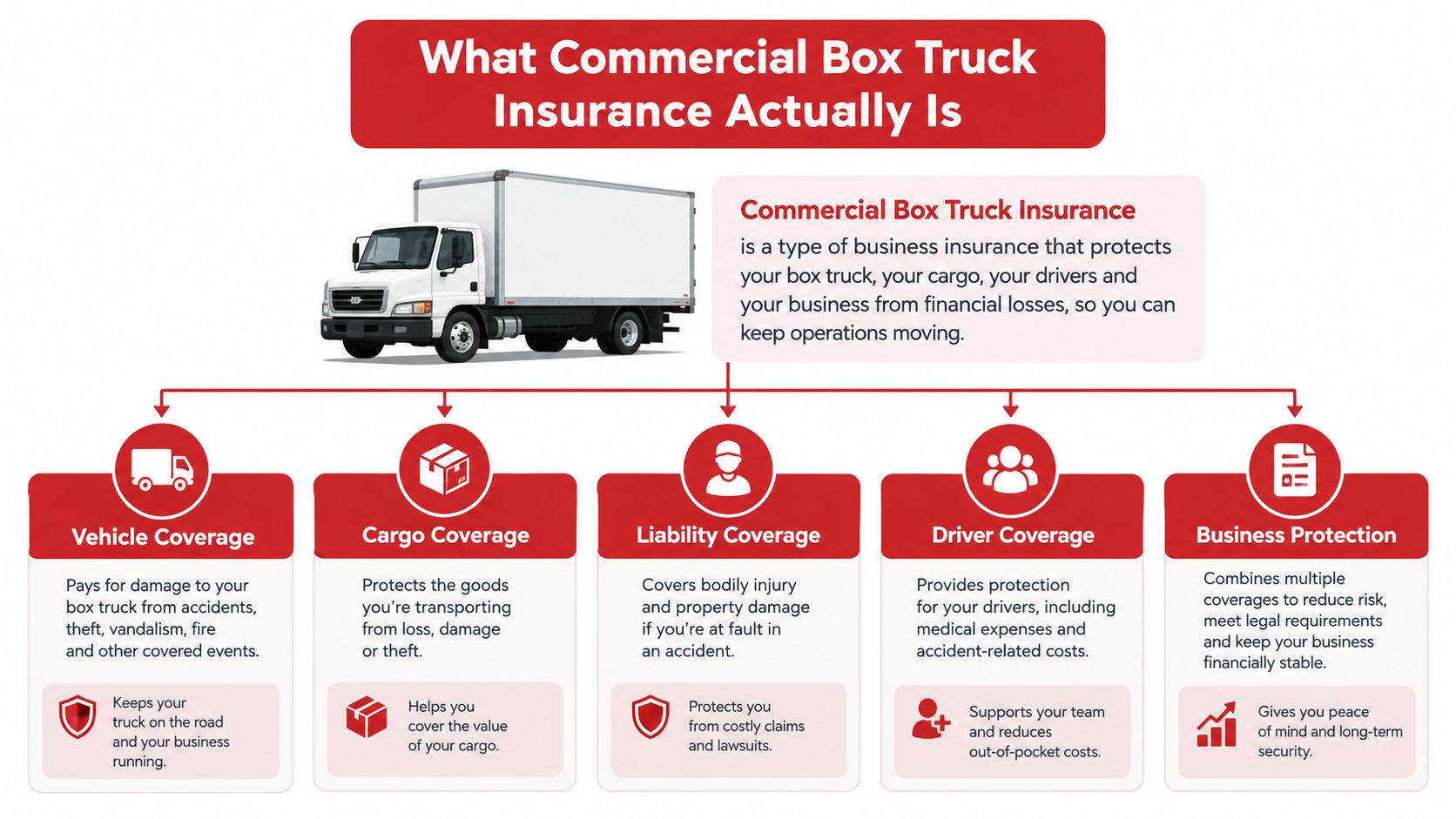
The policy contract matters as much as the coverage labels. A limit may apply per occurrence, a deductible can leave the business paying the first portion of a covered loss, and exclusions can limit coverage for particular drivers, uses, cargo, or circumstances. Ask the agent to explain what each listed coverage does in your operation, rather than relying on a certificate or a policy title.
Personal auto insurance is a common source of trouble. A personal policy generally isn't designed to cover a vehicle used for business, so a truck making deliveries or hauling goods shouldn't be insured on the assumption that a personal policy will follow it. Tell the agent exactly how the truck will be used, including any occasional personal use, before binding coverage.
The Core Coverage Parts and What Each One Pays For
Think about coverage through the loss it's meant to handle. If your driver causes a crash that injures someone or damages another vehicle, commercial auto liability is the primary response, up to the policy limit and subject to its terms. If the truck hits a loading dock, collision coverage may pay for damage to your vehicle. Theft, fire, hail, vandalism, or an animal strike are examples of losses that may fall under comprehensive coverage.
Cargo creates a separate question. A truck's physical-damage coverage protects the vehicle, not automatically the goods inside it. If a load is damaged in transit, motor truck cargo coverage may respond according to its terms, covered commodities, exclusions, and limits. Review cargo insurance for truckers alongside the bill of lading and any shipper contract, not as an afterthought.
If another driver causes a crash but carries inadequate or no insurance, uninsured or underinsured motorist coverage may help with covered losses, depending on the policy and state rules. For a plain-language explanation of what is UM/UIM coverage, consider how those protections address a gap left by the at-fault driver. Don't assume the other party's lack of coverage means your own policy will pay automatically. The wording and applicable law matter.
Other endorsements depend on the way the truck works. Non-trucking liability may be relevant when a truck is being used outside a motor carrier's business authority, such as for a personal errand, but the exact trigger depends on the policy. Leased-driver coverage can address an arrangement where a driver or truck operates under another carrier's authority. Trailer interchange coverage may protect a borrowed trailer when it's held under a written interchange agreement.
| Coverage | What It Pays For | Common Trigger |
|---|---|---|
| Commercial auto liability | Covered injury or property damage caused to others | Your driver is responsible for a crash |
| Collision | Covered damage to your truck from a collision | The truck strikes another vehicle or object |
| Comprehensive | Covered non-collision loss to your truck | Theft, fire, hail, vandalism, or an animal strike |
| Motor truck cargo | Covered loss or damage to goods being transported | Cargo is damaged or lost during a covered operation |
| Uninsured or underinsured motorist | Covered losses involving an inadequately insured at-fault driver | Another driver causes a crash without sufficient coverage |
| Non-trucking liability | Covered liability outside the motor carrier's business use | A qualifying personal-use event occurs |
| Trailer interchange | Covered damage to an exchanged trailer | The business has the required written interchange agreement |
The right combination follows the work, not the truck's appearance. Identify who owns the cargo and equipment, whose authority applies, and when the vehicle is being used for business or personal purposes.
Federal and State Requirements Across AL, FL, GA, NC, SC, TN, and VA
For a for-hire interstate general-freight carrier, the federal liability minimum is generally $750,000 per occurrence. The minimum framework originated in the Motor Carrier Act of 1980, and the property-carrier minimum took effect on January 1, 1985. Higher minimums apply to certain hazardous-material operations: $1 million for specified oil and hazardous materials and $5 million for other specified hazardous materials. The federal framework also requires qualifying property carriers to maintain cargo liability protection of at least $5,000 for property carried on one motor vehicle and $10,000 for loss at one time and place. These federal requirements are described in the FMCSA financial-responsibility study.
Those figures aren't a universal checklist for every box truck. Operating authority, commodity, interstate or intrastate activity, and equipment arrangements can change what rules apply. A truck's body style alone doesn't establish its legal requirement. Before binding coverage, tell your agent where the truck operates and whether it hauls for hire, transports hazardous materials, or runs under another carrier's authority.
State rules require an operation-specific check
In Alabama, Florida, Georgia, North Carolina, South Carolina, Tennessee, and Virginia, intrastate requirements can differ. The applicable rules may depend on vehicle type, weight, business activity, and how the truck is registered or used. Don't assume a limit that satisfies one state or one operation automatically satisfies another.
North Carolina and Virginia have their own fee and liability structures, and state-specific filing or registration obligations may also matter. A Georgia operator can use truck insurance guidance for Georgia as a starting point, but should still confirm requirements against the actual routes, authority, and cargo involved.
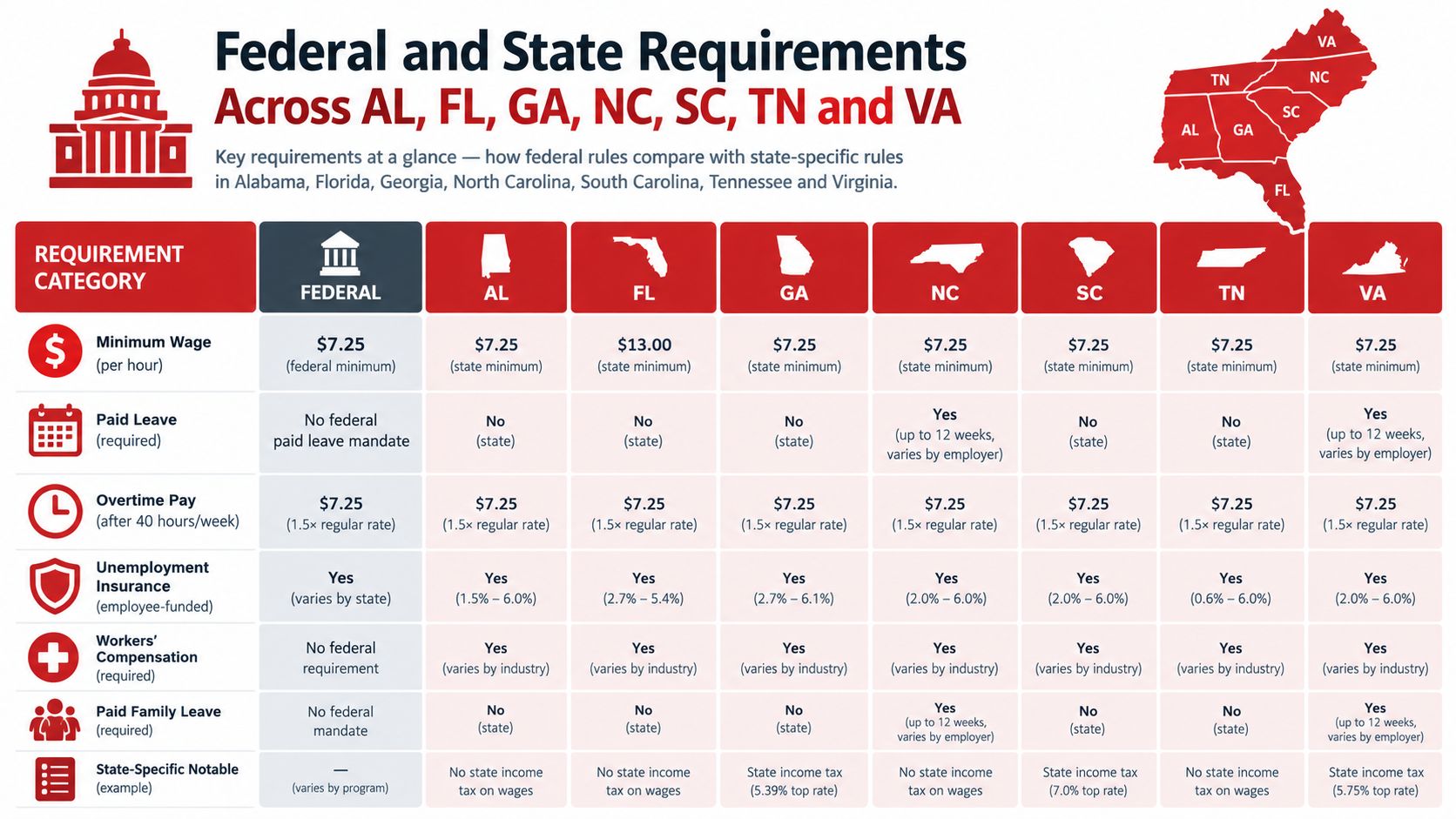
State law is only one layer. A lender may require physical-damage coverage on a financed truck. A shipper or broker may demand liability or cargo limits above the legal floor. A lease agreement or umbrella insurer may set additional conditions. Legal minimums are a starting line, not a complete insurance plan. Put every contract requirement in front of the agent before comparing quotes.
What Actually Drives a Box Truck Premium
An insurer prices the operation through several connected sets of information. Driver history matters because the carrier evaluates the people who will drive, their experience, and their motor-vehicle records. A clean record can make the risk easier to place; serious violations or preventable losses can narrow options or push the price up.
The truck also matters. The carrier will want its VIN, value, GVWR, age, and ownership or financing status. A more valuable vehicle can mean more exposure under physical-damage coverage, while a higher GVWR can affect the risk classification and compliance questions. For underwriting, a box truck should be evaluated by its GVWR, operating radius, cargo, and use, not by its body style alone.
The route and load shape the risk
Underwriters look at annual mileage, operating radius, overnight parking, and the type of goods carried. Frequent urban stops bring different driving and loading conditions from regional highway work. High-value, fragile, or hazardous cargo can also change the exposure, as can who loads and unloads it.
A box truck's crash record deserves attention as a risk-management issue, not just a pricing detail. FMCSA recorded 1,943 fatal crashes, 25,842 injury crashes, and 51,035 towaway crashes involving van or enclosed-box trucks in 2019. Those figures represented 38.8% of fatal crashes, 42.5% of injury crashes, and 46.3% of towaway crashes across the cargo-body categories in the table (FMCSA cargo-body crash data). Backing procedures, cameras, preventive maintenance, and driver coaching are practical controls to discuss with your agent.
Loss history and coverage choices complete the picture
Carriers review prior claims, coverage gaps, and cancellations, then consider the limits and deductibles requested. Telematics or camera use may help document driving and incidents, but it isn't a substitute for sound limits or good driver practices. For more context on average truck insurance cost, focus on how pricing inputs vary instead of expecting a single figure to fit every operation.
Two operators with similar trucks can receive very different quotes because they don't have the same drivers, routes, cargo, loss history, or coverage needs. Choose a deductible your business can pay, and don't buy the thinnest policy just because it has the lowest quote.
How to Get the Right Quote and Lower Your Premium
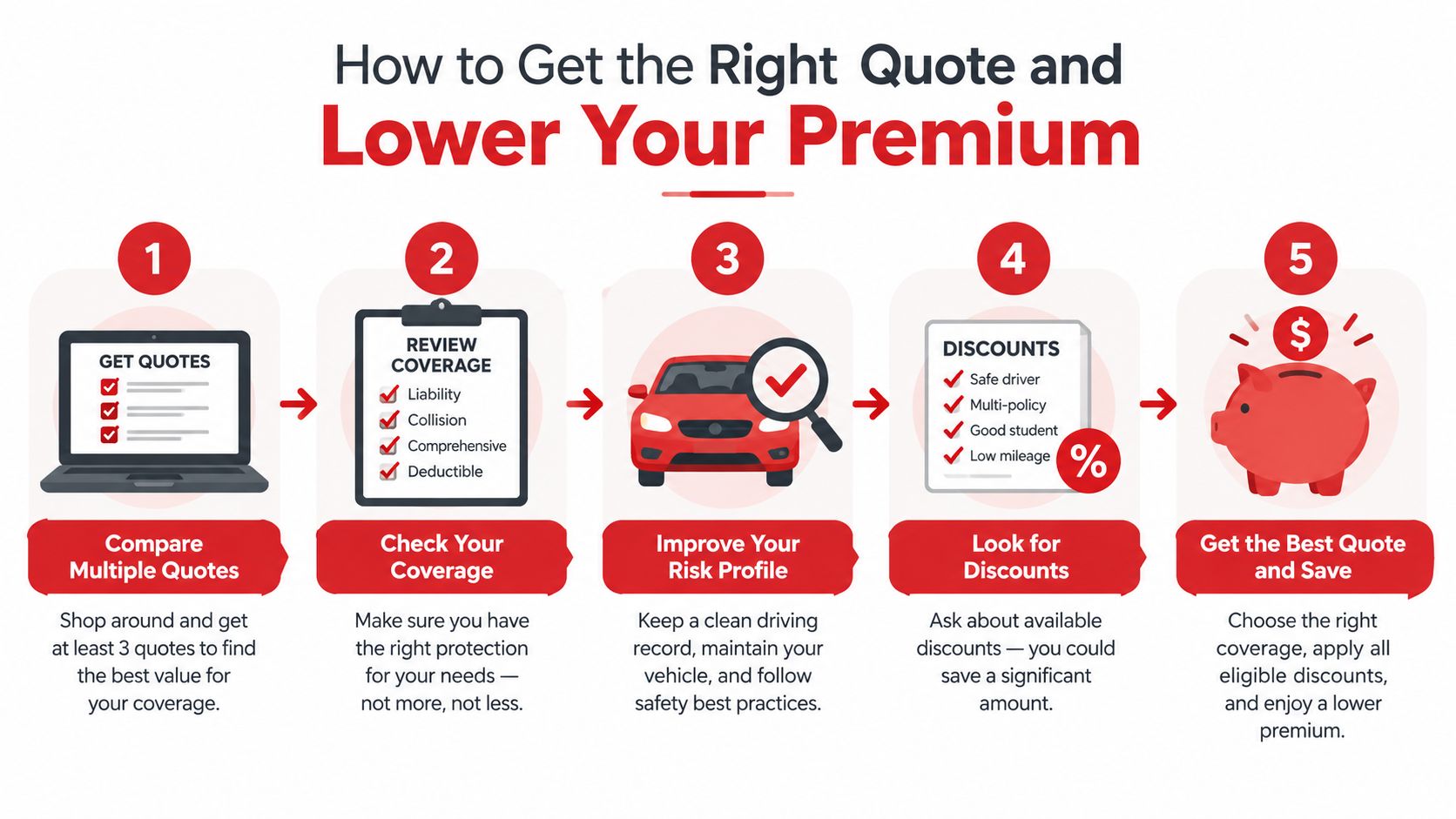
A clean submission saves time and gives carriers a fair chance to price the operation. Before asking for quotes, build an inventory of the fleet and the work each truck performs.
- Map the operation. List every truck, driver, state served, cargo type, route, ownership arrangement, and contract requirement. Note whether drivers are employees, contractors, or leased operators.
- Gather the records. Have VINs and vehicle values, driver motor-vehicle records, loss runs, and any motor carrier or DOT information available. Include certificates or written insurance requirements from brokers and shippers.
- Set the coverage target. Decide what must be insured for legal compliance, contracts, lender terms, cargo exposure, and business continuity. Ask the agent to show how deductibles and limits change the protection, not just the price.
- Compare markets. An independent agency can submit the same operation to multiple carriers whose underwriting appetites differ. Select Insurance Group, Inc. is one option for owners who want an agency to compare coverage across its carrier markets; the useful comparison is the combination of terms, exclusions, service, and price, not the premium alone.
- Improve the risk information. Use documented driver policies, coaching, telematics or cameras where appropriate, and regular maintenance records. Consider a higher physical-damage deductible only if cash reserves can absorb it, and discuss bundling commercial auto with general liability or workers' compensation when the coverage fits the business.
Don't hide a driver, route, or cargo type to make the submission look cleaner. If the policy is written around an incomplete description, the mismatch can create trouble when a claim arrives. Tell the agent what the business does now and what it expects to add, then ask what needs to change before the operation expands.
What Happens When You File a Claim
A first claim often starts with a call from a driver who has just had a collision. The driver should follow the company's reporting procedure, get to a safe location, contact emergency services when needed, and notify the agent or insurer promptly. Photos, the other party's details, witness information, and the police report number can help the adjuster begin the investigation.
The insurer assigns an adjuster to evaluate the loss. The truck may need an inspection or towing, and the business should ask how repairs, rental arrangements, and loss of use are handled under its policy. If another party may be responsible, the insurer can investigate recovery from that party, a process commonly called subrogation.
Cargo claims need careful documentation of the load and the contract. Keep the bill of lading, delivery records, loading notes, and photographs, then report the loss under the policy's required process. If a truck crash involves injury, the legal and insurance steps can be complicated; a resource on Texas truck crash claim filing offers general context about that process, though the governing rules depend on the circumstances and jurisdiction.
Evidence gathered before the crash matters
For a liability claim, the insurer may review driver statements, camera or telematics records, maintenance documents, and inspection records. Don't wait until a loss to decide where those files are stored or who can retrieve them. A consistent recordkeeping routine makes it easier to answer questions while the events are still fresh.
The most useful preparation is simple: give drivers a written reporting procedure, make sure they know who to call, and keep current driver files, maintenance logs, and pre-trip inspection records. Clear instructions and clean records help move a claim forward and give the insurer better evidence to evaluate what happened.
Fleet-Level Decisions and a Practical Next Step
Once you have more than one truck, insurance management becomes a company-wide responsibility. Keep a qualification file for each driver, review motor-vehicle records as part of hiring and ongoing supervision, and document training, vehicle assignments, and any changes in the work. A driver who moves between trucks or operating areas can change the exposure, so update the agent when the fleet changes.
Don't overlook vehicles your employees use for company errands. Hired and non-owned auto coverage may be relevant when the business rents vehicles or employees use personal vehicles for business tasks. It doesn't replace insurance on the box truck itself, and the policy wording determines what situations are covered.
Build the insurance around the fleet's actual footprint
If the business crosses state lines, hauls under motor carrier authority, or works under shipper contracts, keep the required filings and certificates organized. Recheck them when routes, cargo, authority, or contracts change. The seven-state footprint of Alabama, Florida, Georgia, North Carolina, South Carolina, Tennessee, and Virginia calls for a state-by-state review, not an assumption that one rule fits every truck.
An umbrella policy may be worth considering when the business has meaningful liability exposure or contracts require higher limits. The decision should follow the potential severity of a loss and the company's ability to absorb risk, not a rule of thumb based on fleet size alone. Discuss how the umbrella sits over the underlying policies and whether its terms match the contracts you sign.
Keep evidence practices consistent across the fleet. Store driver records, maintenance logs, inspection documents, cargo procedures, and available camera or telematics files in an orderly system. Make sure drivers know how to preserve relevant evidence after an incident, and train managers to report operational changes before a certificate or policy becomes outdated.
The practical next step is to assemble the operation details and ask for a review that tests coverage against actual routes, cargo, drivers, and contracts. Select Insurance Group serves businesses across the Southeast with commercial and trucking coverage, bilingual specialists, secure document-upload tools, and multi-carrier quoting. Bring the details of the fleet, not just a truck description, so the quote can address the risk you're taking on.
Request a free, no-obligation commercial box truck insurance quote from Select Insurance Group, Inc. and have your routes, drivers, cargo, and contract requirements reviewed together. Its bilingual specialists can compare quotes across 20 to 40 carriers and help you find coverage suited to a single truck or a growing Southeast fleet.