
Most Memphis businesses aren't legally required by Tennessee to carry general liability insurance, but contractor licensing rules can require $100,000, $500,000, or $1 million in coverage, depending on the contractor's monetary limit. In practice, landlords, clients, vendors, and project contracts routinely make a policy necessary before you can operate, lease space, or start work.
A Memphis owner usually discovers this at an inconvenient moment. The landlord requests a certificate of insurance before handing over the keys. A commercial client adds an insurance requirement to the contract. A contractor learns that a license application needs proof of liability coverage. Or a customer slips near the entrance, and the business must respond to an injury claim whether the owner believes the company was at fault or not.
That's why Memphis general liability should be treated as an operating requirement, not merely an optional expense. The policy can protect against third-party injury, property damage, and certain personal or advertising injury allegations, while also helping satisfy the contractual requirements that keep local businesses open and eligible for work. Owners comparing coverage can also review Memphis commercial insurance resources for broader policy considerations.
Table of Contents
- Why Memphis Businesses Pay Attention to General Liability
- What General Liability Insurance Actually Covers
- Coverage Types and Common Memphis Limits
- Tennessee Rules and Memphis Triggers That Require Coverage
- Standalone Policy vs Business Owners Policy vs Umbrella
- Getting Quotes and Choosing the Right Limits in Memphis
- Practical Ways to Lower Your Memphis Premium
- How Select Insurance Group Helps Memphis Business Owners
Why Memphis Businesses Pay Attention to General Liability
A Midtown restaurant faces a customer injury allegation after a raised floor section catches a guest's shoe. Before the owner can sort out what happened, the landlord requests an updated certificate of insurance for the lease renewal. One incident now affects both claim handling and the right to keep operating from that location.
The restaurant may ultimately defeat the allegation, but the response still requires incident records, an investigation, defense counsel, and communication with the claimant. General liability is built for these third-party exposures, subject to the policy's exclusions, deductibles, limits, and other terms.
A Bartlett contractor can face the same pressure from property damage. If a crew cracks flooring while moving equipment through a finished room, the customer may demand repair costs and payment for delays. The contractor must then determine whether the policy addresses the damage, whether completed-operations coverage applies, and whether an exclusion changes the result.
State law is only part of the decision
Tennessee does not generally require most businesses to carry general liability insurance. Memphis owners still encounter coverage requirements through the parties controlling access to work and property. Landlords, clients, vendors, licensing boards, and project owners frequently require proof of coverage before approving a lease, job-site entry, bid, or contract.
Contractors face a more specific compliance trigger. Tennessee requires home improvement contractors and applicants with monetary limits up to $500,000 to show at least $100,000 of general liability coverage. Applicants between $500,001 and $1.5 million must carry at least $500,000, while applicants above $1.5 million must carry at least $1 million, as detailed in Tennessee general liability requirements for businesses.
These requirements make the requested limit more than a routine quoting decision. A contractor should match the policy to the licensing threshold, then check whether a lease, client contract, or certificate request requires a higher limit or additional insured wording. Owners reviewing the wider relationship between liability insurance and Memphis operations can also consult Memphis commercial insurance resources.
Local rule of thumb: If another party controls your lease, permit, contract, or license, that party may determine whether general liability coverage is required and how much proof it wants.
A certificate alone does not create coverage. It only confirms that a policy exists. The policy language, endorsements, additional insured provisions, and limits must match the agreement that prompted the request.
What General Liability Insurance Actually Covers
General liability is the policy for claims made by people or organizations outside your business. Its central lanes are third-party bodily injury, third-party property damage, and personal or advertising injury. It may also include limited medical payments coverage for certain minor injuries, regardless of fault, when the policy conditions allow it.
Consider a storefront in Cooper-Young. A visitor slips on water near the entrance and alleges that the business failed to maintain a safe walkway. General liability may respond to the claim, investigate what happened, pay covered defense costs, and resolve a settlement or judgment up to the applicable limit.
Now consider a contractor repairing a kitchen. The contractor accidentally cracks a customer's tile while completing the work. The policy may address resulting property damage, but the exact response depends on the wording, the cause of damage, the contractor's responsibility, and whether an exclusion applies.
What the policy pays
A covered claim can involve more than the final settlement. The insurer may assign an adjuster, appoint defense counsel, review incident records, negotiate with the injured party, and pay a covered judgment or settlement within the policy limit. Defense-cost treatment matters because some policies reduce the available limit by defense expenses, while others handle defense costs outside the limit.
The policy also distinguishes between an occurrence trigger and the timing of the claim. An occurrence policy generally focuses on when the injury or damage happened, not when the claimant submitted paperwork. That distinction can matter when a property-damage allegation appears months after a project ends.
For cleaning companies, the same framework applies to risks such as damage to a customer's premises or an injury caused during service. A practical overview of business liability coverage for cleaners can help owners identify exposures that a generic policy discussion may overlook.
What general liability doesn't cover
General liability has a defined job. It usually isn't the policy for:
- Employee injuries: Workers compensation addresses workplace injuries when required and applicable.
- Professional mistakes: Professional liability is designed for allegations involving advice, designs, consulting, or other specialized services.
- Business vehicles: Commercial auto coverage handles liability arising from covered vehicle use.
- Your own damaged property: Commercial property coverage addresses many first-party property losses.
- Intentional acts and excluded risks: Policy exclusions can remove coverage even when an incident looks similar to a covered claim.
The right question isn't, “Do I have insurance?” Ask, “Which policy responds to this specific loss, and what limit applies?”
Coverage Types and Common Memphis Limits
A Memphis retailer may need proof of insurance before a landlord hands over the keys. A contractor may need specific limits and additional insured wording before starting work. Those practical demands make the policy structure as important as the premium.
Many businesses begin with $1 million per occurrence and $2 million aggregate. The per-occurrence limit applies to one covered event. The aggregate is the policy's general maximum for covered claims during the policy period, subject to the policy terms. Treat this configuration as a starting point, not an automatic answer.
| Coverage Part | What It Pays For | Memphis Example | Typical Limit |
|---|---|---|---|
| Bodily injury and property damage | Covered third-party injury or damage allegations | A visitor falls at a retail shop or a contractor damages a client's wall | $1 million per occurrence |
| Personal and advertising injury | Certain offenses such as specified libel, slander, or advertising-related allegations | A local business faces a covered claim over advertising content | Included within policy limits |
| Medical payments | Certain minor third-party medical expenses under the policy conditions | A customer requests payment after a minor incident at a market booth | Sub-limit stated by policy |
| Products and completed operations | Covered injury or damage arising from products or finished work | A completed remodel later causes covered property damage | Included within policy limits |
| Damage to premises rented to you | Certain covered damage to leased premises | A tenant accidentally damages part of a rented commercial unit | Sub-limit stated by policy |
The $2 million aggregate can be exhausted by several claims during one policy period. A contractor with multiple active projects, a retailer with steady customer traffic, or a food business serving the public may need an umbrella or excess policy above the underlying limits. Venues and larger clients may also require higher limits in their contracts.
Limits should follow exposure
Start with the lease, contract, license requirement, or certificate request. If a landlord requires $1 million per occurrence and $2 million aggregate, meet those limits and confirm the requested additional insured endorsement and certificate wording. A certificate alone does not change the policy.
Higher-risk trades often use the $1 million/$2 million base policy with an umbrella. Larger operations and venues may request $2 million/$4 million limits or further excess protection. Raise limits when the business has substantial foot traffic, sells products, works on valuable property, hosts events, or accepts contractual responsibility for another party's liability.
Review completed operations carefully. A finished project can produce a later property-damage allegation, and the policy must match the work your business performs.
Tennessee Rules and Memphis Triggers That Require Coverage
Tennessee's general rule is straightforward. Most businesses aren't required by state law to carry general liability insurance. The practical rule is different, because a license, lease, contract, permit, or bid can make coverage a condition of doing business.
Contractors face the clearest state-level trigger. Tennessee's milestone requirements apply to certain home improvement contractors and applicants based on monetary limits. The required minimums are $100,000 for limits up to $500,000, $500,000 for limits between $500,001 and $1.5 million, and $1 million above $1.5 million. Contractors should verify the requirement that applies to their license and keep the policy active through renewal and project completion.
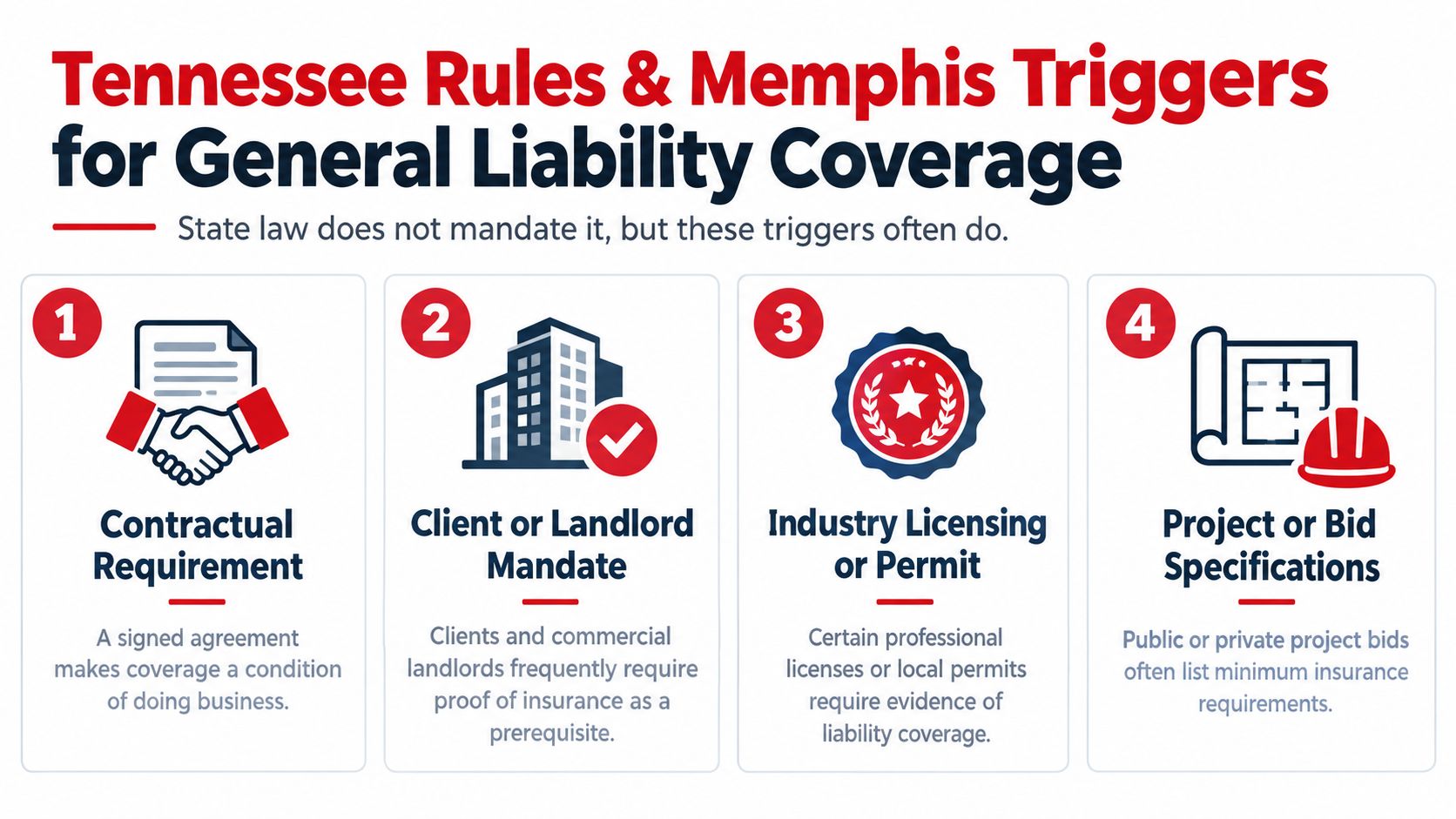
Four triggers deserve immediate attention
- Contract terms: A signed agreement can require insurance, additional insured status, and specific limits before work begins.
- Landlord demands: Retail, office, and warehouse leases often require a certificate and may prescribe additional insured wording.
- Licenses and permits: Contractor licensing and certain local operating approvals can require evidence of liability coverage.
- Project specifications: Public and private bids may establish insurance minimums that exceed a business's existing policy.
A landlord may request $1 million per occurrence and $2 million aggregate, name the landlord as an additional insured, and require notice of cancellation. The certificate must accurately reflect the policy. It can't substitute for the endorsement that grants additional insured status.
Roofing firms should also prepare for classification and payroll questions during policy reviews. Guidance on Tennessee roofing insurance audits can help contractors understand why accurate records matter when the insurer audits the account.
Memphis event organizers, commercial buyers, and local institutions may impose their own requirements. Before signing a contract, ask for the insurance section early. The cheapest policy is useless if it doesn't satisfy the wording that controls site access or payment.
For a broader overview of Tennessee general liability coverage, review both the state requirement and the contractual requirement. They're separate issues, and Memphis owners often face both.
Standalone Policy vs Business Owners Policy vs Umbrella
The structure should match what the business owns, how it operates, and what contracts demand. A standalone general liability policy is not automatically better than a business owners policy. It is narrower and often appropriate when property coverage belongs elsewhere.
| Structure | What It Covers | Best Fit For Memphis |
|---|---|---|
| Standalone general liability | Third-party bodily injury, property damage, personal and advertising injury, and products or completed operations | Contractors, consultants with leased space, and firms carrying separate commercial property coverage |
| Business owners policy | General liability bundled with commercial property and often business income coverage | Storefronts, restaurants, salons, and small warehouses needing liability and property protection |
| Umbrella or excess | Additional liability limits above scheduled underlying policies | Businesses with foot traffic, products, vehicles, valuable projects, or demanding contracts |
Choose standalone coverage when liability is the main concern
A contractor who works at customer locations and owns little business property may need standalone liability, along with commercial auto, tools coverage, workers compensation, or professional liability as appropriate. A consultant leasing an office may also prefer separate policies if a BOP doesn't fit the operation or eligibility rules.
Choose a BOP when the business owns property
A BOP can bundle general liability, commercial property, and business interruption coverage. That makes it a sensible starting point for a Memphis storefront, restaurant, salon, or small warehouse that needs protection for both third-party claims and its own building contents or income exposure.
A BOP typically excludes workers compensation, commercial auto, professional liability, and flood or earthquake damage. Those gaps matter. A business that buys a BOP still needs to evaluate separate policies for employees, vehicles, specialized advice, and location-specific property risks.
Add an umbrella when the underlying policy isn't enough
An umbrella sits above scheduled underlying coverage and may respond after an underlying liability limit is exhausted, subject to its own terms. It won't repair weaknesses in the base policy, and insurers commonly require the underlying limits to remain in place.
Vehicle exposure deserves separate attention. Businesses moving equipment, making deliveries, or sending employees across Shelby County should evaluate Memphis business auto coverage alongside general liability. Don't expect a general liability policy to replace commercial auto insurance.
Getting Quotes and Choosing the Right Limits in Memphis
Good quoting starts with complete information. Carriers price the account based on what the business does, where it operates, how much it sells, who it employs, and what losses it has experienced. An incomplete application produces a weak comparison and can create problems during an audit or claim.
Prepare the submission
Gather these items before contacting an agent:
- Business identity: Legal entity name, FEIN, ownership details, and operating address.
- Classification: SIC or NAICS code, description of operations, subcontractor use, and territory.
- Financial exposure: Payroll, projected sales, property values, and revenue by activity.
- Loss information: Three to five years of loss runs when available.
- Contract requirements: Lease provisions, bid specifications, additional insured requests, and certificate instructions.
Request at least three quotes from carriers that actively write the business's class in Memphis. Compare identical occurrence limits, aggregates, deductibles, endorsements, exclusions, and forms. A lower premium can reflect narrower coverage rather than better value.
Match the policy to the contract and the risk
The Memphis baseline is often $1 million per occurrence and $2 million aggregate, but the contract may require more. A venue, landlord, or large buyer can request higher limits, specific endorsements, or excess insurance. Contractors should verify project requirements before submitting a bid rather than discovering them after winning the work.
Ask the agent directly:
- Is the policy written on an occurrence or claims-made basis?
- Are defense costs inside or outside the liability limit?
- Which exclusions affect the actual work?
- Does the policy cover products and completed operations?
- Can the agent issue the requested certificate and endorsements promptly?
Choose a deductible the business can fund without disrupting payroll or operations. A deductible of $1,000 to $2,500 is a common planning range in the requested quoting process, but the right amount depends on cash reserves and claim frequency. Don't choose a deductible that looks efficient on paper but becomes a crisis after a loss.
Practical Ways to Lower Your Memphis Premium
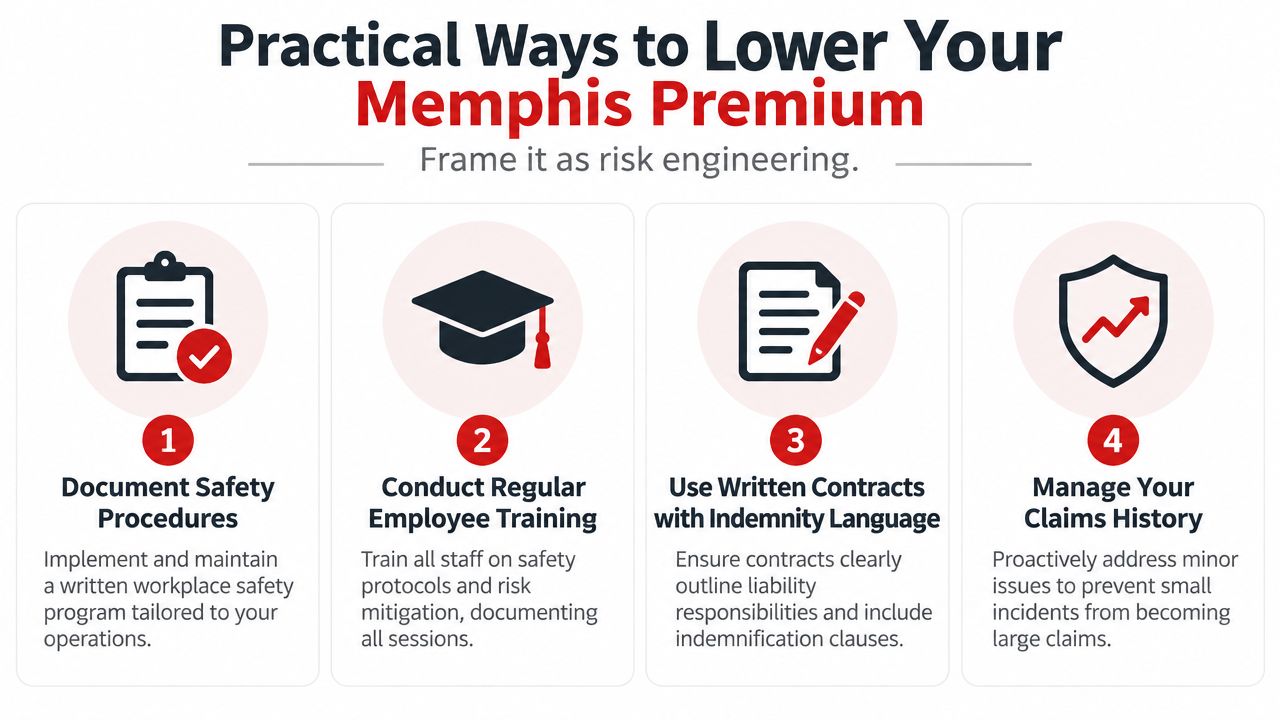
Premium reduction should come from better risk management, not from stripping out protection. Underinsuring to save a small amount can leave the business exposed to a claim that costs far more than the premium difference.
Start with the operational basics:
- Document safety procedures: Keep written inspection, cleaning, maintenance, and incident-reporting procedures that fit the actual premises.
- Train employees consistently: Document training on customer interactions, equipment use, hazard reporting, and emergency response.
- Use clear contracts: Assign responsibility for damage, require subcontractors to maintain coverage, and use indemnity language reviewed for the transaction.
- Manage small incidents early: Record what happened, preserve photographs and witness information, and notify the insurer when the policy requires notice.
- Review classifications: Make sure the application accurately describes the work, sales mix, locations, and subcontracting.
- Bundle when appropriate: A BOP or coordinated commercial package can combine liability and property coverage, and a broader account may qualify for available multi-policy pricing.
- Choose a workable payment plan: Ask how annual payment compares with monthly billing and whether financing charges apply.
Make the account easier to underwrite
Carriers respond better to organized records than to vague assurances. Maintain certificates for subcontractors, document equipment inspections, close known hazards, and keep prior claim information ready. Business experience credits, safety association programs, and efficient certificate tracking may affect eligibility or pricing, but an agent must confirm what applies to the specific carrier and class.
Raising the deductible to $1,000 to $2,500 can change the premium, but only choose that approach when the business can comfortably absorb the expense. The deductible is your retained risk. It's not a discount if the company can't pay it after an incident.
Practical advice: Reduce hazards first, improve documentation second, and reduce coverage last.
How Select Insurance Group Helps Memphis Business Owners
The process should begin with a short discovery conversation, not a generic quote form. An advisor needs to understand the business type, location, payroll, sales, property, vehicles, subcontractors, and existing contracts. Those details determine whether standalone general liability, a BOP, an umbrella, or a coordinated commercial program makes sense.
Select Insurance Group, Inc. compares commercial accounts across 20 to 40 carriers, according to the publisher's stated agency model. That comparison can help an owner evaluate different carrier appetites, policy forms, deductibles, and endorsement options instead of accepting the first available proposal.
Translate contract language into usable coverage
A Tennessee-licensed advisor should review the actual lease, bid, or client agreement. The important question isn't whether the certificate shows liability insurance. It's whether the policy provides the requested limits, additional insured status, waiver wording, primary and noncontributory treatment, and completed-operations protection when required.
Memphis businesses may also need coordinated support for contractor licensing, property protection, workers compensation, commercial auto, or claims involving multiple policies. A single point of contact can identify gaps before a certificate request becomes a last-minute obstacle.
Keep service available after placement
Policy placement is only the beginning. Businesses change locations, add employees, purchase vehicles, take larger contracts, and revise operations. The agency workflow should account for mid-term changes, certificate requests, audit support, renewal reviews, and claims advocacy.
Select Insurance Group states that it serves Tennessee and provides commercial insurance solutions including general liability, commercial property, workers compensation, commercial auto, and trucking coverage. For a Memphis owner, the practical benefit is having an advisor connect the policy structure to the lease, license, contract, and actual work rather than treating each requirement as a separate transaction.
If your Memphis business needs a compliant liability policy, Select Insurance Group, Inc. can review your operations, contracts, existing coverage, and required certificate wording, then compare available commercial options. Visit Select Insurance Group, Inc. to request a no-obligation quote and get help choosing limits that fit both your risk and your Memphis business requirements.