
You've signed a lease, hired your first few people, or finally turned that side gig into a real company. Then the insurance questions start all at once. The landlord wants proof of coverage. A client asks for a certificate. Your lender mentions property insurance. Someone tells you workers' comp is required, and someone else says you may not need it yet.
That's where many Knoxville business owners get stuck. Commercial insurance sounds like one product, but it isn't. It's more like a toolbox. A restaurant, a contractor, a retail shop, and a small manufacturer may all need insurance, but they won't need the same setup because they don't face the same kind of loss.
Knoxville makes that even more important. Local agencies report working with a broad mix of business classes, including apartments and condos, restaurants and bars, and light manufacturing and mercantile risks, which points to a real local market for specialized business coverage rather than a simple personal-lines environment. That local breadth is described by a Knoxville-area agency at Sullivan Group and Associates.
A simple example helps. If a customer slips in your store, that's one kind of problem. If a kitchen fire shuts down your restaurant, that's another. If an employee gets hurt lifting materials, that's different again. One policy usually won't handle all three.
Table of Contents
- Introduction to Knoxville Commercial Insurance for Local Businesses
- What Knoxville Commercial Insurance Covers and How It Works
- Tennessee Requirements and Knoxville Industry Needs
- How Much Knoxville Commercial Insurance Costs and What Drives Price
- How to Get Quotes and Compare Knoxville Commercial Insurance the Right Way
- Why Working With a Local Independent Agency in Knoxville Helps
- Your Knoxville Commercial Insurance Checklist and Next Steps
Introduction to Knoxville Commercial Insurance for Local Businesses
Your lease is signed. A client wants a certificate before work starts. You are hiring help, buying equipment, or putting inventory on the shelf, and suddenly one question sits underneath all the others. If something goes wrong, how much of the bill lands on the business?
That is what Knoxville commercial insurance is for. It shifts part of the financial hit from your business to an insurance policy, based on the coverage, limits, and exclusions you choose.
For a first-time owner, it helps to picture insurance like the guardrails on a mountain road. The road still has curves. The guardrails help keep one mistake, one storm, or one bad turn from becoming a disaster that knocks the whole business off course.
Why Knoxville businesses need a locally fitted approach
Knoxville businesses do not all face the same risks, and Tennessee rules do not always match what owners hear from friends in other states. Tennessee's five-employee workers' compensation threshold changes when coverage becomes required for many employers. Recent shifts in workers' comp loss costs and property claim patterns also change what Knoxville owners should pay closest attention to when they buy.
That local context matters more than many generic business insurance guides admit.
A condo association worries about building damage and liability around common areas. A restaurant worries about kitchen equipment, customer injuries, and income loss after a shutdown. A contractor often has a different mix entirely, with tools, jobsite exposures, and vehicles moving all over Knox County.
The point is simple. Commercial insurance is not one product. It works more like a set of buckets, with each bucket meant to catch a different kind of financial leak.
Practical rule: Ask, “What could stop my business from earning money for 30 days, and what proof of insurance will a landlord, lender, customer, or state rule expect me to carry before that happens?”
What first-time owners usually misunderstand
A low quote can look safe until you see what is missing. One policy may include only basic liability. Another may leave out business income, limit protection for equipment, or exclude a type of work you do every week.
Owners also mix personal and business insurance more often than you might expect. If you are sorting out household coverage at the same time, keep that conversation separate and handle personal policies through a local resource for Knoxville auto insurance, while setting up business coverage around how the company operates.
The biggest early mistake is buying based on price before you understand the rulebook. In Knoxville, that means paying attention to Tennessee thresholds, contract requirements, payroll size, building exposure, and whether property claims are more likely to come from theft, water, wind, fire, or a shutdown that cuts off income. Once those pieces are clear, the coverage choices start to make sense.
What Knoxville Commercial Insurance Covers and How It Works
A Knoxville business owner opens the shop after a hard rain and finds water on the floor, a customer walks in an hour later and slips near the entrance, and one employee leaves for a delivery in the company van. That is three different insurance problems before lunch. One policy will not handle all three.
Commercial insurance works more like a set of separate buckets. Each bucket is built for a certain kind of loss. The goal is simple: match the loss to the right bucket before a claim ever happens.
The main coverages and the job each one does
General liability covers claims from other people who say your business caused bodily injury, property damage, or certain advertising injuries. If a customer falls in your store, or your crew damages part of a client's building while doing work, this is often the first policy involved.
Commercial property covers the business property you own or are responsible for. That can include your building, tenant improvements, equipment, furniture, and inventory, depending on how the policy is set up. For Knoxville owners, this matters because property claims do not all look the same. One business worries more about wind and water. Another worries more about theft, fire, or a burst pipe that shuts down operations for days.
Workers' compensation covers employee job injuries and work-related illness. It stands on its own because employee injury claims follow a different set of rules than claims from customers or the public. It also affects buying decisions in Tennessee in a way many first-time owners miss. Loss costs have changed over time, so this coverage may not be the budget driver owners expect. Property and income-loss exposure can deserve just as much attention, and sometimes more.
Commercial auto covers vehicles used in the business. If a truck, van, or car is used for company errands, deliveries, service calls, or hauling tools, a personal auto policy may leave a gap right where you need coverage most.
The coverage pieces owners often miss
Some Knoxville businesses also need professional liability. This applies when the bigger risk is advice, design, recommendations, planning, or an error in the service itself. A slip-and-fall claim and a bad-advice claim are different problems. They usually belong in different policies.
Business income coverage helps when a covered property loss forces you to slow down or close temporarily. This is one of the easiest coverages to overlook because the damage you can see gets attention first. The harder hit may be the income you stop earning while rent, payroll, and loan payments keep coming due.
A Business Owners Policy, or BOP, combines common coverages for many small businesses, often general liability and commercial property. It can be a good starting frame, but it is still only a starting frame. It does not mean every gap is filled.
How the pieces work together
Owners get into trouble when they expect one policy to spill over into another policy's job. Insurance rarely works that way.
General liability usually does not pay for employee injuries. Property insurance does not always include lost income unless that part is added. Commercial auto may cover the vehicle after a crash but not every tool or piece of equipment inside it. A BOP may bundle key protection, but it will not replace workers' comp or commercial auto if your business needs those policies.
A simple way to test your setup is to walk through a normal week and name the policy that would answer each problem:
- A customer gets hurt at your location.
- A fire, storm, or water loss damages your equipment or inventory.
- An employee gets hurt while working.
- A company vehicle causes an accident.
- A client says your advice or service caused financial harm.
- A covered property loss shuts you down and cuts off revenue.
If you cannot match each event to a policy, that is the gap to fix.
That is why Knoxville commercial insurance works best when you buy it in the order risk hits your business, not just in the order a quote form lists the options. For many Tennessee owners, that means looking beyond the cheapest liability quote and paying closer attention to property limits, income-loss protection, vehicle use, and the state rules that apply once payroll and headcount start to grow.
Tennessee Requirements and Knoxville Industry Needs
A Knoxville owner can buy a policy on Monday and still find out on Tuesday that one state rule was missed. That usually happens with workers' compensation. Owners count only full-time staff, or they assume family members and officers do not count. Tennessee does not treat it that way.
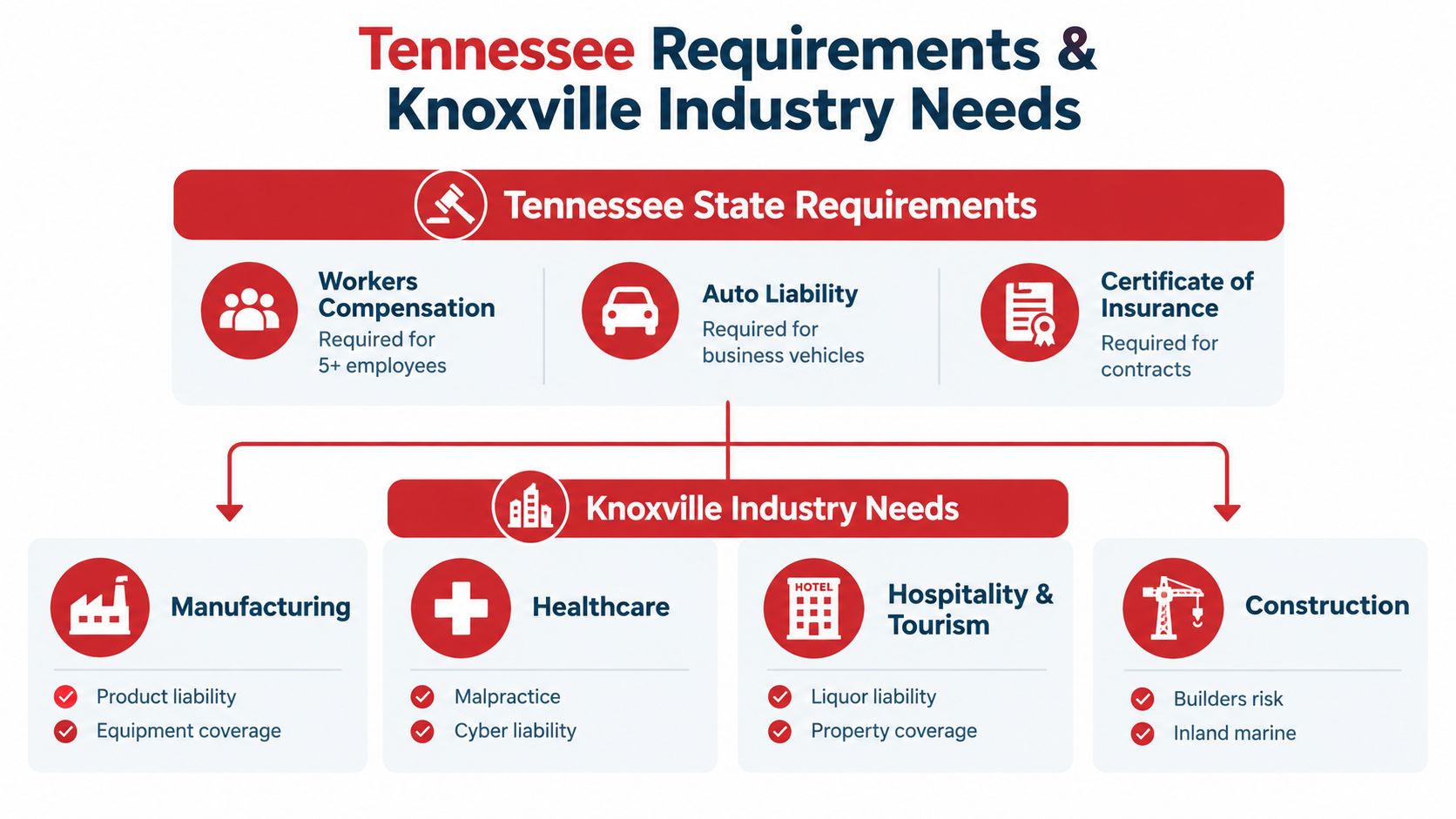
In Tennessee, workers' compensation is required for businesses with five or more employees, including part-time employees, family members, and corporate officers. Construction is stricter. A construction business needs workers' comp with just one employee.
That threshold matters because it changes your insurance priorities the moment your payroll and headcount grow. It also ties directly to cost. Tennessee has seen declining workers' comp loss costs in recent years, which can help some owners on pricing, but lower cost does not make the requirement optional. It means workers' comp may deserve a closer look before you assume it will be the budget problem.
How Knoxville business type changes what matters
State rules are only one part of the decision. Your industry changes where losses are most likely to happen.
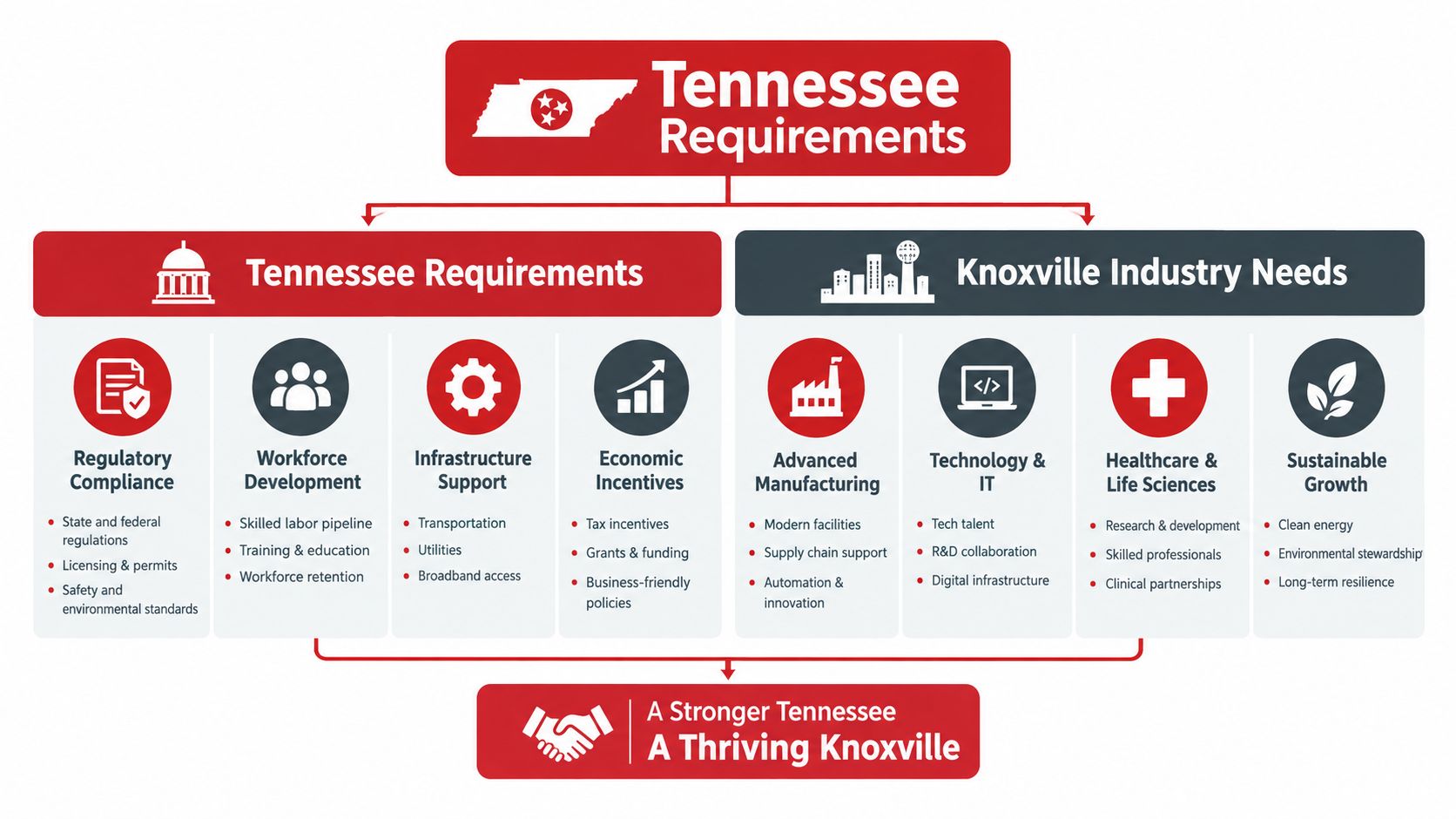
A simple way to look at it is this. Tennessee law sets the floor. Your Knoxville operations decide what belongs above that floor.
- Apartments, condos, and other habitational risks: Shared spaces, roofs, walkways, and resident traffic can create frequent property and liability concerns.
- Restaurants, bars, and taverns: Customer injuries are only part of the picture. Equipment breakdown, kitchen-related property damage, and lost income after a shutdown can hit just as hard.
- Light manufacturing and retail operations: Equipment, stock, and product-related claims can matter more than a new owner expects, especially if one property loss interrupts normal sales.
That local mix matters more now because property claims have been shifting. For many Knoxville businesses, the bigger blind spot is not a missing liability policy. It is weak building limits, missing business income coverage, or no plan for cleanup and reopening after a property loss.
For a broader look at Tennessee commercial insurance options for different business types, it helps to compare the state rules with the way your business operates day to day.
Required by law, required by contract, and simply smart
Owners often hear that a policy is “required” without hearing who requires it. That creates confusion.
Use this three-part test:
| Coverage status | What it usually means |
|---|---|
| Required by law | Coverage tied to Tennessee rules, such as workers' comp once you cross the employee threshold |
| Required by contract | Coverage a landlord, lender, franchise, or client wants before you can lease space, borrow money, or start work |
| Strongly recommended | Coverage that protects your property, income, and equipment even if no law or contract forces the purchase |
That distinction keeps Knoxville owners from solving the wrong problem. Meeting a lease requirement may help you get the keys. It does not automatically protect your income after a fire, storm, or water loss.
How Much Knoxville Commercial Insurance Costs and What Drives Price
A Knoxville owner signs a lease, hires a few employees, and expects one simple insurance number. The quotes come back all over the map. That happens because commercial insurance pricing works more like a utility bill than a flat subscription. Your type of work, payroll, building details, equipment, and loss history all change the total.
Tennessee pricing benchmarks to use as a baseline
Statewide benchmarks can help you set a rough budget before you shop. For many small businesses in Tennessee, commercial property coverage often falls somewhere around $750 to $3,500 per year, general liability often falls around $400 to $1,500 per year, restaurants may land around $3,000 to $8,000 annually, and some contractors may see costs around $800 to $2,500 annually.
| Coverage Type | Typical Monthly Range | Typical Annual Range |
|---|---|---|
| Commercial property | $59 to $235 | Roughly $750 to $3,500 |
| General liability | $32 to $94 | About $400 to $1,500 |
| Restaurant insurance in Knoxville | Not provided monthly | Roughly $3,000 to $8,000 |
| Contractor coverage in Knoxville | Not provided monthly | About $800 to $2,500 |
Use those figures as a ballpark, not a quote. A coffee shop in Sequoyah Hills, an electrical contractor serving job sites across Knox County, and a small office near downtown may all pay very different amounts even if their annual revenue looks similar.
What moves the quote up or down
Underwriters usually focus on a short list of practical cost drivers:
- Business type: A restaurant with fryers and late hours is priced differently from a bookkeeping firm or a retail shop.
- Payroll and employee roles: This directly affects workers' comp and can also change how the account is classified.
- Building and contents: The replacement cost of the space, tenant improvements, inventory, tools, and equipment all matter.
- Loss history: Prior water, fire, liability, or theft claims can raise pricing or limit carrier options.
- Limits and deductibles: Higher limits usually raise cost. Higher deductibles can lower premium, but they also mean more out of pocket after a claim.
- How the business operates: Delivery, installation work, customer foot traffic, cooking, storage, and off-site work all change exposure.
A simple way to view it is this: insurance pricing follows the risk your business creates, not just the label on your storefront.
The Tennessee cost trend many owners miss
Workers' comp deserves a closer look because Tennessee has a state-specific pricing story that many generic guides leave out. The Tennessee Department of Commerce and Insurance announced a 2.0% overall workers' comp loss cost decrease for new and renewal policies effective March 1, 2026, along with a 1.1% decrease in assigned-risk rates, marking the 13th straight annual decline according to the Tennessee Department of Commerce and Insurance.
That matters, but it can also confuse first-time owners.
Loss costs are a base ingredient, not the final bill. Your class code, payroll, claims, experience mod, and whether a standard carrier will write the account still shape the premium. So while Tennessee's trend has been favorable, a Knoxville roofer with claims will not price like a small office with clean history and low-hazard duties.
Why property pricing deserves more attention
Property coverage is where many Knoxville owners underbuy because they focus on the premium first and the interruption risk second. Verisk reported that U.S. commercial property claims declined from 0.91 million to 0.71 million in recent years, according to Verisk. Fewer claims across the market do not mean your own shutdown risk is small.
A broken pipe, kitchen fire, wind loss, or electrical issue can leave a business closed for weeks. The building damage is only one part of the loss. Lost income, payroll pressure, spoiled stock, debris removal, and code upgrades often create the bigger financial strain.
That is why Knoxville owners should price property coverage by asking two questions at the same time. First, what would it cost to repair or replace the space and contents? Second, how much money would the business lose if operations slowed or stopped during repairs? Those answers often matter more than shaving a little off the premium.
How to Get Quotes and Compare Knoxville Commercial Insurance the Right Way
A Knoxville business owner gets three quotes for what looks like the same coverage. One is much cheaper, one is middle of the road, and one is noticeably higher. The natural reaction is to focus on the lowest number first. The problem is that insurance quotes often differ for the same reason two building estimates differ. One may include the full job, and one may leave out costly parts you only notice later.
That is why the quote process matters as much as the quote itself.
Start with one clean set of business facts
Insurance pricing works best when every carrier is looking at the same picture of your business. If one application says you only work from an office, and another mentions jobsite work, you are not comparing prices. You are comparing different versions of your risk.
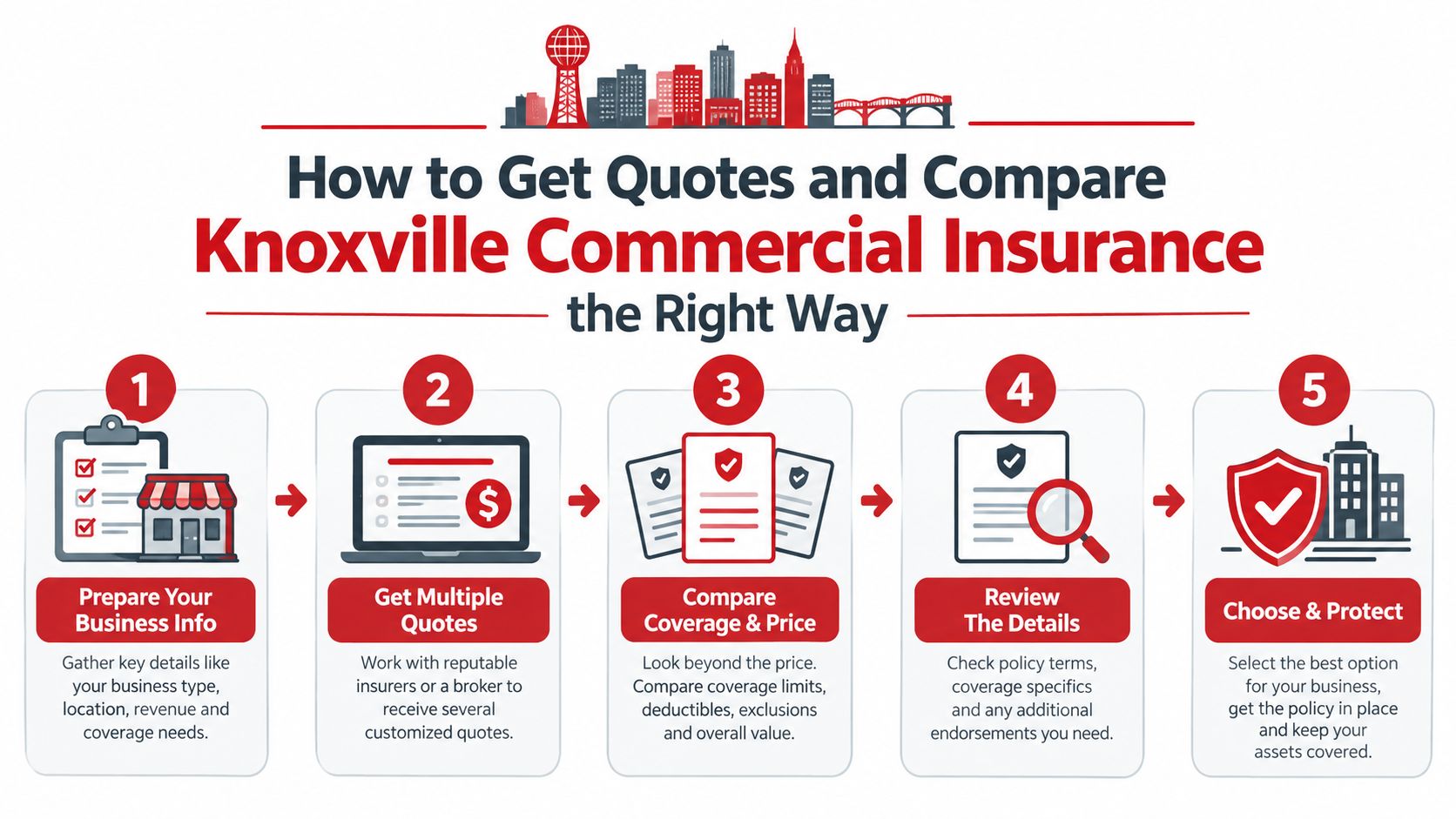
Before you request quotes, gather:
- Business operations: What you do, what you sell, where the work happens, and whether customers come to you or you go to them.
- Headcount and job duties: Employees, owners, family members, part-time help, and what each person does day to day.
- Payroll by role: This matters especially in Tennessee because workers' comp pricing depends heavily on job classification and payroll assigned to each type of work.
- Property details: Address, square footage, improvements, equipment, stock, and any features that affect replacement cost or downtime after a loss.
- Vehicle use: Any car, truck, or van used for deliveries, errands, service calls, or hauling tools.
- Contracts and lease terms: Landlord requirements, client insurance language, and certificate requests.
A simple rule helps here. If you tell the story of your business three different ways, you will likely get three different prices.
Match the quote request before you compare the price
Many first-time owners get tripped up. They compare premiums before they compare coverage terms.
A fair comparison means each quote should line up on the big items first:
| Item to compare | Why it matters |
|---|---|
| Coverage limits | Lower limits can make a quote look cheaper without giving you the same protection |
| Deductibles | A lower premium may mean you keep more of the loss yourself |
| Workers' comp classifications | In Tennessee, the class code and payroll split can change pricing more than owners expect |
| Property valuation method | Replacement cost and actual cash value can produce very different claim payments |
| Business income coverage | A property policy can repair the building but still leave a gap in lost revenue |
| Key endorsements and exclusions | Small wording changes can remove coverage for common claim situations |
| Certificate and additional insured handling | Important if Knoxville jobs, leases, or vendor agreements move quickly |
The goal is not to make every quote identical. That is rarely possible. The goal is to make them close enough that the price difference means something.
Pay close attention to Tennessee pressure points
Generic insurance guides often treat every state the same. Knoxville owners do better when they compare quotes through a Tennessee lens.
For workers' comp, favorable loss cost trends do not guarantee a low quote for your business. The carrier still looks at payroll, class code, claims history, and how the work is described. A contractor with mixed duties, for example, needs payroll broken out carefully. If everything gets lumped into a higher-hazard class, the quote can come back inflated. If duties are described too loosely, the quote can come back artificially low and create problems later.
For property, claim trends in the broader market do not change one basic question. Could your business keep paying bills if a fire, burst pipe, wind loss, or electrical issue shut you down? When you compare quotes, make sure the property number is not the only number getting attention. Downtime protection often decides whether a claim feels manageable or overwhelming.
Watch for quiet gaps that make a cheap quote expensive later
Some problems hide in plain sight.
A lease minimum is one example. Landlords often set the floor, not the right amount for your operation. Another is business income coverage. Owners commonly insure furniture, shelves, tools, or inventory and forget the lost revenue that follows a shutdown.
Misclassification is another big one in Tennessee. If your application makes your work sound simpler or safer than it really is, the quote may look good at first and fit badly when a claim or audit happens.
Also ask about vehicles that are used "once in a while" for business. That phrase causes a lot of confusion. If a personal vehicle is used to pick up supplies, visit clients, or make deliveries, it deserves a direct conversation.
If a quote comes in surprisingly low, ask a plain question: what assumptions were used to price this?
Use a simple decision path
You do not need a complicated spreadsheet. You need an orderly process.
- Write down your real exposures in plain English, including people, property, vehicles, contracts, and shutdown risk.
- Build one fact sheet and use the same information for every quote request.
- Check Tennessee-sensitive items such as workers' comp class codes, payroll splits, and any requirement that applies once you have the required number of employees.
- Compare coverage terms first and premium second.
- Read the exclusions and business income terms before you choose the cheapest option.
- Confirm service details such as certificates, additional insured requests, and how changes are handled during the policy term.
That process adds a few extra minutes up front. It can save months of frustration later.
A good quote comparison should leave you with a clear answer to three questions. What am I covered for? What would I pay out of pocket? What would happen if my business had to stop operating for a while? If a quote does not answer those clearly, it is not ready to judge by price alone.
Why Working With a Local Independent Agency in Knoxville Helps
A Knoxville owner signs a lease, hires a few employees, and buys better equipment. On paper, those are good business moves. For insurance, each one changes the job the policy needs to do.
That is why a local independent agency often helps more than a quick direct purchase. Commercial insurance is less like buying printer paper and more like wiring a small building. If one connection is wrong, the lights still turn on until the day they do not.
Direct purchase versus independent guidance
Buying direct can work for a very simple setup. It gets harder once your policy has to match Tennessee rules, contract wording, payroll classifications, vehicles, property values, and downtime risk at the same time.
An independent agent shops your account with more than one carrier and helps line up the details so you are comparing real options, not just different prices. The publisher of this guide, Select Insurance Group, Inc., says it compares quotes from multiple carriers and places commercial coverage across Tennessee. If you want a plain-English explanation of that model, read this page on how an independent insurance agency works.
Why local context matters in Knoxville
Local context matters because Knoxville risks are not priced in a vacuum. Tennessee workers' comp costs have shifted over time, and property claims have changed too. A local independent agent can explain what that means in practice. If workers' comp pricing is easing for your type of business, that does not automatically mean your whole insurance budget should shrink. It may mean you have room to pay closer attention to property limits, business income coverage, or deductible choices if storm, water, or equipment-related claims are becoming the bigger pressure point.
That is the part many generic guides skip. They talk about "business insurance" as if every coverage line should get equal attention every year. In real life, priorities change.
A Knoxville agent also sees the local patterns behind the paperwork. A contractor may need certificates turned around quickly to keep a job moving. A retailer in leased space may need to sort out what the landlord insures versus what the tenant insures. A business that just crossed a Tennessee employee threshold may need a direct conversation about workers' comp requirements before renewal catches them by surprise.
The practical value shows up before a claim
Good agency help is often quiet. It is the question that prevents a mistake.
An agent may notice that your property limit still reflects last year's buildout costs. They may ask whether employees use their own cars for errands. They may catch that your lease requires wording your basic quote does not include. Those are small details until they are not.
Local independent guidance also helps at renewal. Businesses change fast. One new van, one new service, or one new location can turn an acceptable policy into a poor fit if nobody updates the facts.
The goal is simple. Buy coverage that matches how your Knoxville business operates today, not how it looked when you first opened.
Your Knoxville Commercial Insurance Checklist and Next Steps
A lot of Knoxville owners reach this point with one question: “What do I do now?”
Start with a short review of how your business works today, not how it looked when you first opened. Insurance is a little like setting the locks and smoke alarms in a building. The right setup depends on who comes in, what you keep inside, and what would hurt most if something went wrong.
A practical Knoxville checklist
Use this list before you ask for quotes or renew coverage:
- Check Tennessee trigger points: Confirm whether your current employee count or type of work makes workers' comp required. This matters most for businesses that have grown recently or work in construction-related trades.
- List the risks that could stop cash flow: Note where money could leak out through an injury claim, property damage, a vehicle accident, stolen tools, or a temporary shutdown.
- Pull your contracts first: Gather your lease, loan documents, and client agreements so you can see any insurance requirements before a quote is built.
- Match quote details line by line: Compare the same limits, deductibles, and coverage types. A cheaper quote can mean less protection.
- Ask about downtime, not just damage: A broken pipe or storm loss is not only a repair bill. It can also mean lost income while you cannot operate.
- Adjust priorities each year: Tennessee workers' comp pricing has eased in recent years, while many owners are feeling more pressure from property-related claims. That can change what deserves the closest attention at renewal.
- Review after any business change: New hires, a new vehicle, a move, a renovation, or a new service line should all trigger an update.
What to bring to the insurance conversation
Bring the basics. That usually means your business name, address, a short description of operations, estimated payroll, employee count, vehicle information, property details, and any contract insurance requirements.
If you already have coverage, bring your current policy and recent loss history too. That gives the agent a clearer starting point and helps catch gaps faster.
The goal is simple. Your policy should meet Tennessee requirements, satisfy lease or client demands, and protect the parts of your business that keep revenue coming in. When those pieces line up, commercial insurance feels less like paperwork and more like a working part of the business.
Select Insurance Group, Inc. helps Tennessee business owners compare commercial coverage options for risks like liability, property, workers' compensation, business auto, and BOP needs. If you want help sorting through Knoxville-specific requirements and building quotes that match your operations, visit Select Insurance Group, Inc..