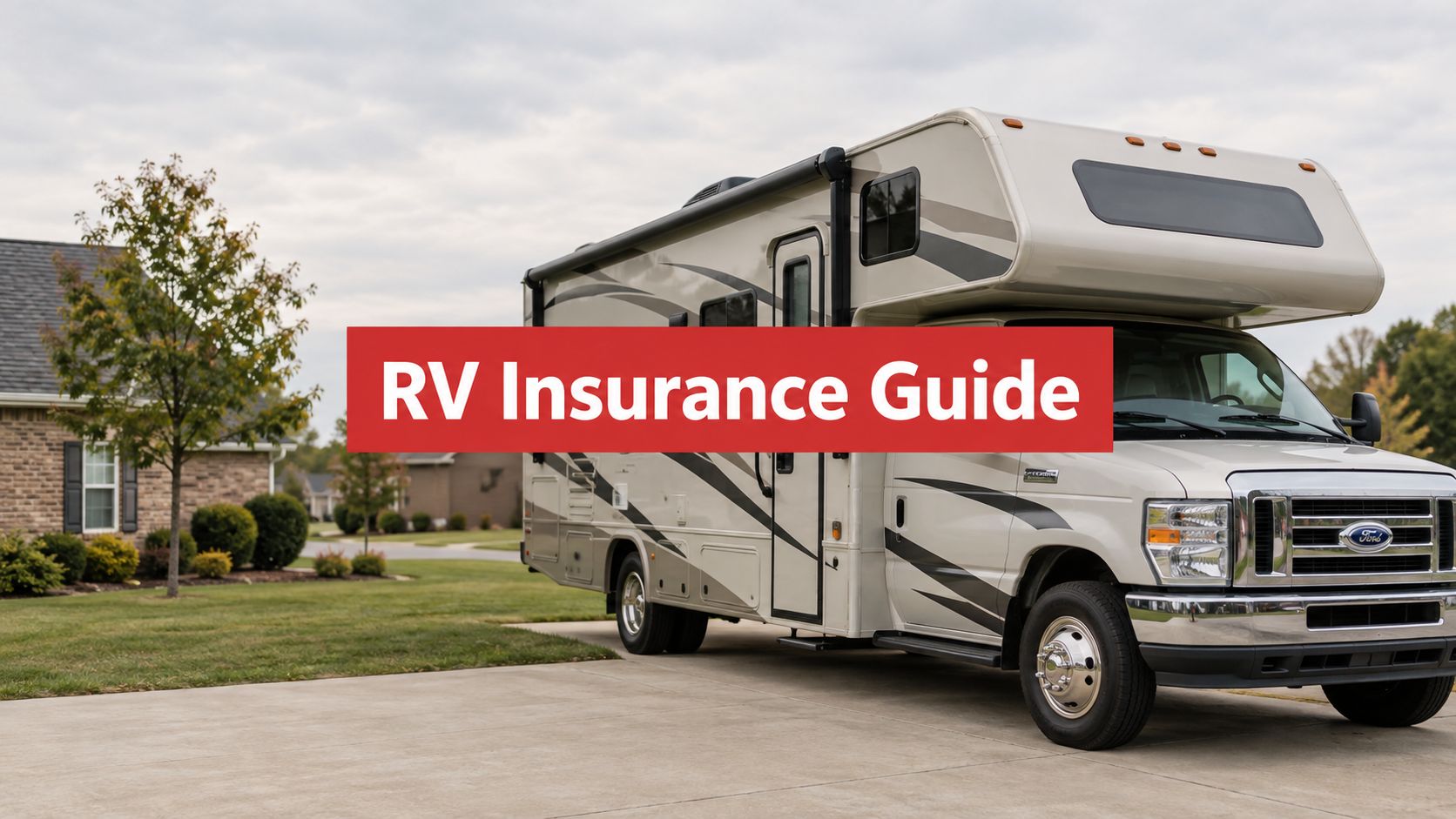

A hail core can cross Montgomery County faster than you can move a truck camper off the street. I have seen owners do everything right on the road, then take their biggest loss while the RV sat at home under a tornado warning.
Clarksville exposure is specific. FEMA National Risk Index data summarized in local risk reporting puts Montgomery County in the 84th national percentile for flood exposure, with severe storms such as hail, straight-line winds, and tornadoes listed among significant hazards; one Clarksville ZIP-code assessment scores flood at 84 and tornado risk at 92 on a 0–100 scale (local Clarksville risk assessment).
That profile changes the insurance conversation. Collision coverage pays for a crash. It does nothing for water rising under a stored fifth wheel, hail bruising a roof membrane, wind turning debris into a projectile, or theft from a driveway. Ask the narrower question before storm season: what does my policy pay when the RV never leaves Clarksville, and what does it exclude?
For Clarksville Recreational Vehicle Insurance, Select Insurance Group's local guidance is plain: verify your non-collision limit, storm deductible, flood exclusions, personal property caps, and storage terms before you need them.
Table of Contents
- A Stormy Weekend in Clarksville and Why RV Insurance Starts Here
- Tennessee Rules Every Clarksville RV Owner Should Know
- What RV Insurance Actually Covers and Where It Stops
- Motorized vs Towable RVs and the Coverage Gap Between Them
- What Actually Drives RV Insurance Costs in Clarksville
- Flood, Storage, and the Risks Most RV Owners Underestimate
- How to Get an Accurate RV Quote and Compare Carriers
- Working With a Local Agent and What to Do Next
A Stormy Weekend in Clarksville and Why RV Insurance Starts Here
A storm warning interrupts a quiet weekend. Your RV is parked in the driveway, plugged in and stocked for the next trip. You pull in the slide toppers, move the loose chairs, and then the question lands: if hail dents the roof or a limb comes down tonight, does the policy pay?
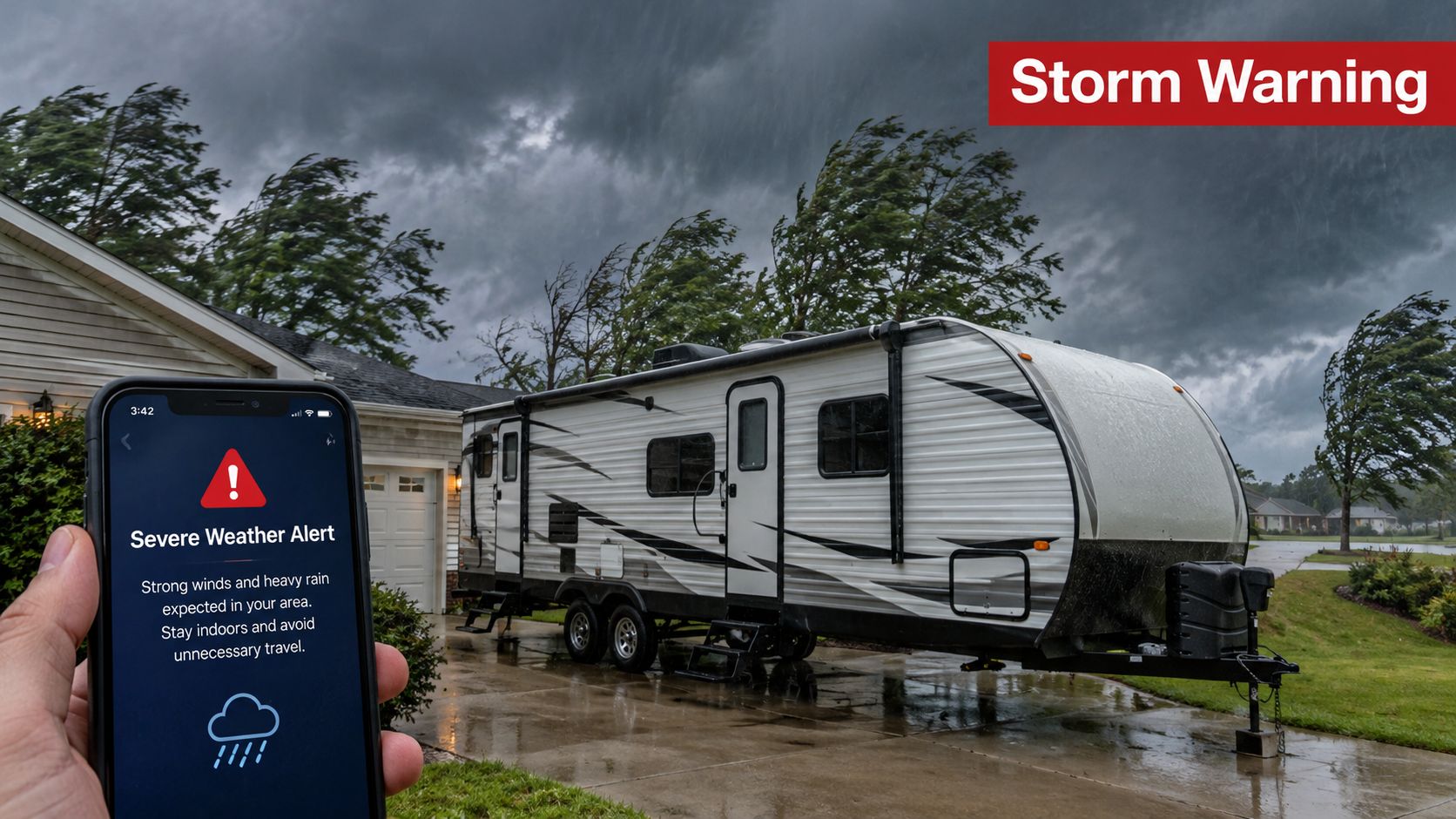
Ask it before the sirens. As noted earlier, Montgomery County's flood and storm profile means a serious loss can find your RV without it moving an inch, and that is where the coverage gap hides. Owners shop for RV insurance thinking about the drive, not the driveway.
Collision coverage pays when the RV hits something or gets hit in traffic. Damage while parked falls under what insurers label coverage that applies without a crash, and it carries its own limits, deductibles, and exclusions. A standard auto policy written for daily driving can treat a parked unit's storm damage differently than a dedicated RV policy does.
Where the RV sits matters as much as how it moves. A unit stored at your house, left at a campground, or parked for months between trips carries steady exposure and zero road risk. Homeowners policies generally exclude motor vehicles even when they sit on your property, so coverage does not transfer just because the RV is in your yard.
Practical rule: Check your policy for both jobs, the trip and the place it sits between trips. In Clarksville, parked losses are the ones that surprise owners at claim time.
Tennessee Rules Every Clarksville RV Owner Should Know
Tennessee sets a minimum liability requirement for motorized RVs driven on state roads. The required limits are $25,000 for bodily injury to one person, $50,000 for bodily injury per accident, and $25,000 for property damage per accident, often written as 25/50/25 (Tennessee RV laws and insurance basics). That is the legal floor. I tell Clarksville clients to read it as a permission slip to drive, not a plan for what a serious accident costs.
Know what you own before you buy anything. A motorhome is self-propelled, so it needs its own motor-vehicle liability policy. A towable travel trailer or fifth wheel rides on the towing vehicle's liability while hitched, but the trailer's value and everything inside it sit unprotected unless you add physical damage coverage. Given the hail and straight-line winds Montgomery County sees, that distinction matters more here than in most places.
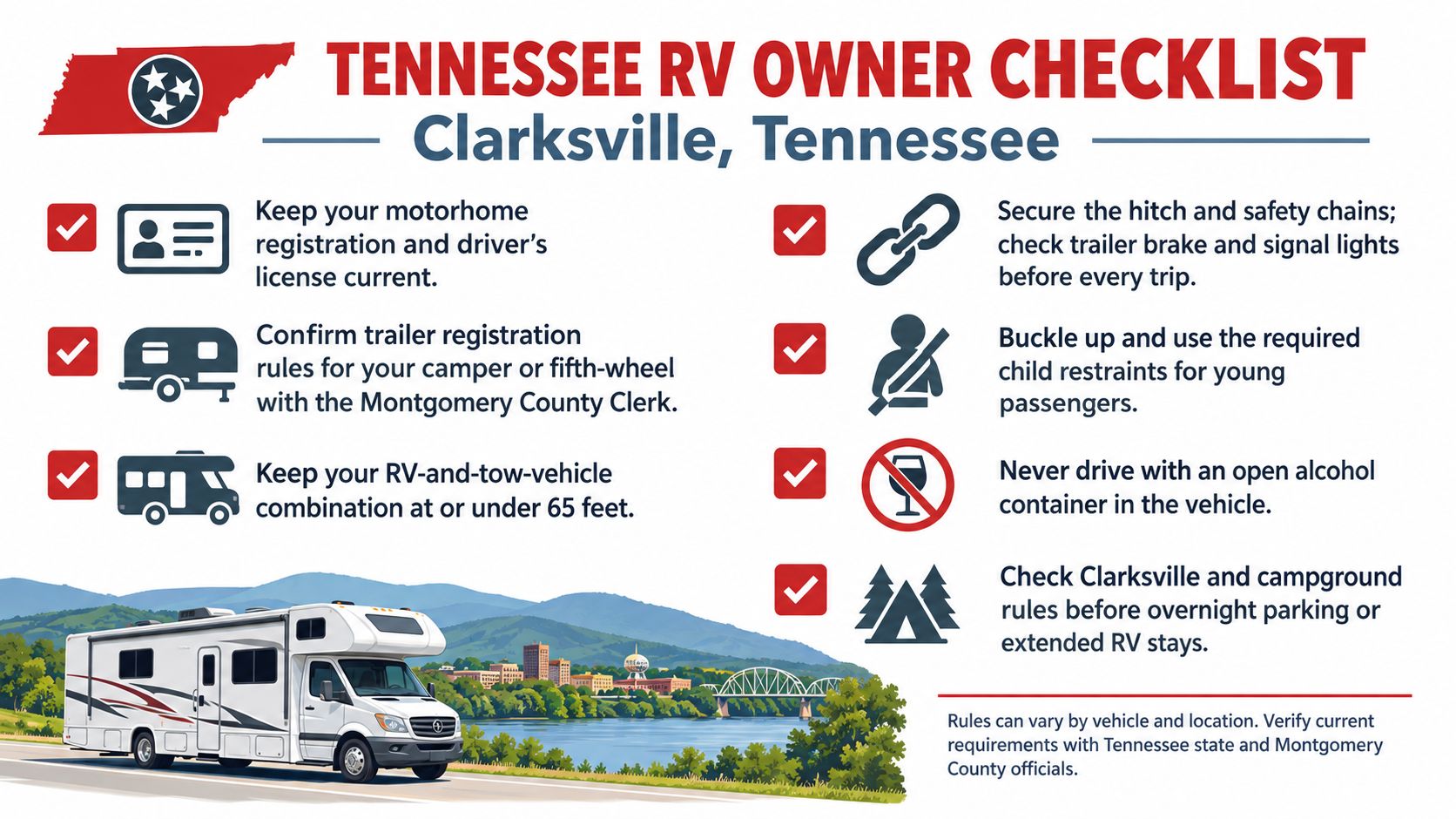
Check registration and licensing
Tennessee motorized RVs must be titled and registered through the county process. Licensing depends partly on weight, and the same state-law summary cited above identifies a Class D license for vehicles under 26,001 pounds GVWR. GVWR, or gross vehicle weight rating, is the manufacturer's specified maximum loaded weight, not what the RV weighs on your scale at home. Confirm the license your unit requires instead of guessing off its size or floor plan.
Your tow vehicle policy and your RV policy should be coordinated, and reviewing Clarksville auto insurance options is a reasonable place to check what your truck or SUV already covers. Ask the insurer directly how liability applies while a trailer is hitched and what happens to coverage after you unhook at the campground.
Treat minimum limits as a starting point
A large motorhome carrying passengers can produce injury claims well past 25/50/25 in a single wreck on I-24. Higher liability limits cost less than most owners expect, and uninsured or underinsured motorist coverage deserves a hard look given how many drivers on Tennessee roads carry the minimum themselves. Set your limits around your assets and what a bad claim would do to your household, not around what the state lets you get away with.
What RV Insurance Actually Covers and Where It Stops
An RV policy isn't one promise to pay for everything. It's a set of coverages, each meant to respond to a particular kind of loss. Read the declarations page, which summarizes your coverages and limits, then check the policy wording for exclusions and conditions.
Match the loss to the coverage
Liability coverage pays for covered injury or property damage you cause to others in an accident. Collision coverage addresses damage to your insured RV from a collision, while other-than-collision coverage generally applies to specified non-collision losses such as theft, fire, hail, wind, or falling objects. Those protections are subject to your deductible, which is the amount you pay before the insurer pays its share of a covered claim.
Personal-effects coverage may help replace belongings inside the RV after a covered loss. Don't assume it covers everything you packed, or that it automatically includes permanently installed equipment, upgraded fixtures, or specialized accessories. List valuable items and upgrades, then ask which policy limit applies to each.
Roadside assistance can help with certain breakdown-related needs, while emergency-expense coverage may help with temporary costs after a covered loss makes the RV unusable. Campsite or vacation-liability coverage may address certain injuries or property damage connected to the RV while it's being used as a temporary residence. Exact terms vary, so ask what events qualify and whether limits apply per person, per incident, or in total.
Know where the promises stop
A coverage name doesn't guarantee a particular claim will be paid. A policy may have a flood exclusion, a limit on personal belongings, or conditions tied to how and where you use the RV. Full-time living, seasonal use, commercial activity, and long-term campground stays can affect eligibility or coverage terms. Tell the insurer how you use the unit; don't describe it as occasional-use if you live in it.
Ask before you buy: “If this happens while my RV is parked, which coverage responds, what deductible applies, and what exclusion could prevent payment?” A specific answer is more useful than a general promise of “full coverage.”
Motorized vs Towable RVs and the Coverage Gap Between Them
A motorhome and a travel trailer may both be RVs, but their insurance needs aren't interchangeable. The motorhome drives itself and creates road-use liability. A towable relies on a separate vehicle for movement, and that difference shapes where liability sits.
| Coverage Need | Motorized RV (Class A/B/C) | Towable Travel Trailer or Fifth Wheel |
|---|---|---|
| Road-use liability | Usually insured under its own motor-vehicle liability policy. | The tow vehicle's liability commonly applies while the trailer is hitched, but confirm this with the insurer. |
| Collision and upset | Consider collision and other-than-collision protection for the motorhome itself. | Evaluate a separate trailer policy or endorsement for damage to the trailer. |
| Theft, hail, wind, and fire | Check other-than-collision terms, limits, and deductibles. | Verify whether a separate trailer policy or endorsement is needed for theft, hail, wind, and fire damage to the trailer itself. |
| Contents and upgrades | Confirm how personal belongings and installed equipment are covered. | Confirm separate limits for contents, accessories, and improvements. |
| Campsite use and storage | Ask whether protection continues while parked or occupied. | Verify coverage while detached, stored, or used at a campsite. |
The costly assumption is that the tow vehicle's policy follows the trailer everywhere. The towing policy may provide primary road liability while the trailer is hitched, but that says nothing about the trailer's physical value against collision, theft, hail, wind, fire, vandalism, or loss of contents.
Here in Montgomery County, that gap bites hardest when the trailer is standing still. A fifth wheel sitting in a driveway through tornado warnings and hail season faces the kind of exposure a house has, with no homeowners policy behind it. Tennessee's RV coverage guidance also highlights the need to evaluate separate physical-damage protection for a towable unit (motorhome and trailer coverage considerations).
Financing raises the stakes. Lenders commonly require collision and other-than-collision coverage until the loan is paid. If you own the trailer outright, the question is simpler but just as real: could you write a check to replace it tomorrow?
Make a simple inventory. Identify the unit, list upgrades and permanently installed accessories, and record its purchase value. Then verify how coverage applies when towing, parked, stored, or occupied. Ask about roadside assistance and campsite liability separately. Neither should be assumed.
What Actually Drives RV Insurance Costs in Clarksville
There isn't one reliable price for RV insurance. A quote reflects the vehicle, the driver, how the RV is used, where it's stored, and the protection selected. Two Clarksville owners with similar-looking units can receive different quotes because their coverage needs and risk details differ.
The details that shape a quote
The RV's class and value matter because they affect the potential cost of a covered repair or replacement. A motorhome's size, features, and installed equipment can also affect its insured value. Give the insurer accurate details about modifications; if you leave an upgrade off the application, you can't assume it'll be covered as part of the original unit.
Your driving record and annual mileage help describe how you use a motorized RV. So does whether the unit is for occasional recreation, seasonal use, or full-time living. Be direct about the pattern. A policy designed for occasional trips may not match a household that lives in the RV or keeps it occupied for long stretches.
Storage deserves the same attention as driving. Tell the agent whether the RV is kept at home, in a storage facility, or at a campground, and ask what security details matter. In Clarksville, storm and flood exposure make location relevant to the coverage discussion, not just the quote form.
Compare more than the premium
A cheaper quote can leave you with higher deductibles, lower contents limits, or exclusions that matter to your setup. Compare the same liability limits, deductibles, physical-damage protection, and add-ons across quotes. Then check whether the policy protects upgrades and belongings at values you can accept.
Some insurers may offer discounts tied to bundling, a safety course, payment choices, or storage arrangements. Ask which discounts apply, what requirements come with them, and whether choosing one changes other policy terms. Don't count on every discount stacking, and don't select a coverage arrangement just to save on the bill if it leaves an important loss uncovered.
A useful quote is one that matches your actual vehicle and use. If an agent asks about storage, mileage, or occupancy, answer specifically. Those details help produce a comparison you can act on rather than a low initial price that changes once the insurer learns how you use the RV.
Flood, Storage, and the Risks Most RV Owners Underestimate
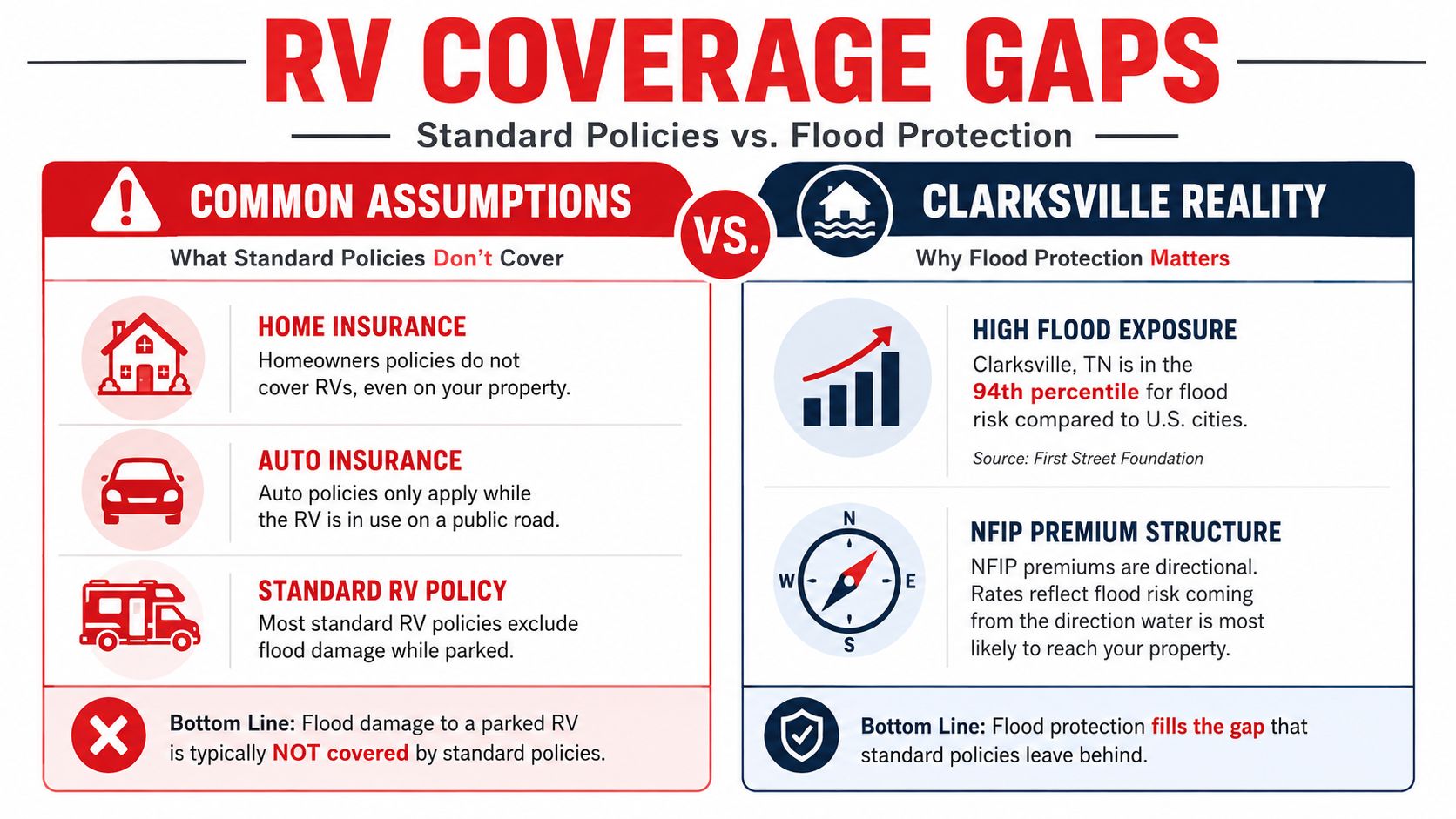
The biggest RV losses I've handled around Clarksville didn't happen on the interstate. They happened in driveways, storage lots, and campground pads when water rose or a storm cell parked itself over Montgomery County for a weekend. A homeowners policy won't touch that loss, and an auto policy won't either. Even a dedicated RV policy treats flood, personal belongings, and permanently installed equipment as separate questions, and the wording controls the answer.
As covered earlier, this county carries higher flood and tornado risk scores. That profile matters most when the RV isn't moving, because parked is exactly where severe weather finds it.
Separate the property from the RV
The City of Clarksville says all property owners are eligible to purchase flood insurance, while lender-required flood coverage generally applies to properties within identified floodplains (Clarksville flooding information). That protection attaches to the home or parcel. An RV sitting in the same driveway is a separate vehicle under a separate policy, and flood damage to it is a separate question entirely. Ask how the unit, its contents, and anything bolted down or wired in are treated under your specific policy.
For a general introduction to evaluating property exposure, see this resource on a flood zone check for property buyers. Use it as background, not as confirmation that a particular RV policy covers flood damage.
Review the place where the RV waits
The ZIP-code risk assessment cited earlier puts a directional annual NFIP flood premium near $2,091 in Clarksville and an estimated historical average flood claim around $71,448 in Montgomery County. The same assessment places Clarksville in the 28th national percentile for wildfire exposure. Treat those as estimates, not a price quote or a prediction about your rig.
What they tell me is that a storage address in this county is never a neutral detail. Photograph the RV's interior and contents each season, and keep records of anything you've added since purchase. Then get a written answer on whether your policy pays a flood or storm loss the same way while parked as it does in motion. Owners who skip that step are the ones calling after a tornado warning, asking why a gap they never saw exists.
How to Get an Accurate RV Quote and Compare Carriers
A useful quote starts with accurate information, not a quick guess about the RV's value. Gather the vehicle identification number, model year, RV class, purchase or current value, annual mileage, storage address, and a clear description of how you use the unit. If you live in it or leave it parked for extended periods, say so.
Next, make a separate list of upgrades, permanently installed equipment, and personal belongings you want covered. Keep receipts or other records where available. The insurer needs enough detail to tell you whether those items are included, subject to a limit, or require a separate option.
Ask for matching coverage
Before you compare prices, decide whether you want coverage based on agreed value or actual cash value. Actual cash value generally accounts for depreciation, meaning the RV's age and condition can affect a claim payment. Ask how the insurer would determine the value after a total loss, what deductible applies, and whether a replacement or agreed-value option is available.
Then ask pointed questions:
- Flood and storms: Does coverage apply to flood, hail, wind, and falling objects while the RV is parked?
- Belongings and upgrades: What limits apply to contents, installed equipment, and aftermarket accessories?
- Use and storage: Are full-time living, seasonal use, campground stays, and long-term storage covered as described?
- Roadside and emergencies: What services or expenses qualify, and what limits apply?
- Campsite liability: What protection applies when the RV is occupied or set up at a campsite?
Compare matching limits and deductibles across carriers. A quote with a lower premium isn't an apples-to-apples alternative if it excludes protection you asked for.
Working with an independent agency can make it easier to compare options from multiple insurers rather than relying on one company's offer. Select Insurance Group, Inc. offers RV coverage options for Tennessee residents and can provide bilingual guidance and free, no-obligation quotes. Its overview of RV insurance company comparisons can help you prepare questions before speaking with an agent.
Working With a Local Agent and What to Do Next
When the next storm warning reaches your phone, you don't want to be searching your policy for the first time to find out whether your RV is protected. Start with the coverage you have, then confirm that it matches the unit, its storage location, and the way you use it.
An independent insurance agency can compare coverage from multiple carriers. To understand how that process works, read about independent insurance agencies. Select Insurance Group serves customers in Tennessee, offers bilingual support, and compares options across 20–40 carriers, according to its company information.
Take these three steps this week
- Read the policy: Find the sections on flood, full coverage, belongings, storage, and exclusions. Write down any questions instead of assuming a general coverage label answers them.
- Confirm your RV type: Decide whether you have a motorized RV or a towable unit. Ask the insurer to explain where road liability comes from and how the RV's physical damage is insured.
- Request comparable quotes: Gather the RV's details and ask for the same limits, deductibles, and key protections from each option. Compare what each policy covers, not just its price.
The key decision isn't whether you have insurance. It's whether the policy protects your RV where it spends time, including during a Clarksville storm, as well as on the road.
If you want help checking storm, flood, storage, and physical-damage gaps, Select Insurance Group, Inc. offers RV insurance options and free, no-obligation quotes for Tennessee customers. Gather your RV details and ask for a side-by-side comparison that reflects how and where you use it.