
If you're shopping for Virginia car insurance right now, you're probably dealing with one of three problems. Your renewal jumped, you're buying a car and need proof of insurance fast, or you just heard Virginia changed the rules and you want to know what matters. Most drivers start by asking, “What's the cheapest policy that keeps me legal?” The better question is, “What keeps me legal without leaving me exposed after one bad crash?”
That difference matters a lot more in Virginia now. The law changed, the minimums went up, and one rule in particular catches people off guard: your uninsured and underinsured motorist protection is tied to the liability limits you choose. That means a bargain policy can solve today's DMV problem and still create tomorrow's financial problem.
As an agent, I see this confusion all the time, especially with drivers who think “full coverage” means “fully protected.” It doesn't. Good Virginia car insurance is about matching your budget to real risk, not just picking the lowest number on a quote screen.
Table of Contents
- Virginia's New Car Insurance Laws Explained
- Decoding Your Virginia Auto Insurance Policy
- What Drives Your Virginia Insurance Premiums
- Average Cost of Car Insurance in Virginia
- How to Find Real Savings and Discounts
- Your Step-by-Step Guide to Getting Quotes in Virginia
- Conclusion Your Partner for Virginia Car Insurance
Virginia's New Car Insurance Laws Explained
Virginia used to have a loophole that confused a lot of people. A driver could pay an uninsured motor vehicle fee and legally drive without carrying standard liability insurance. That option is gone.
What changed in Virginia
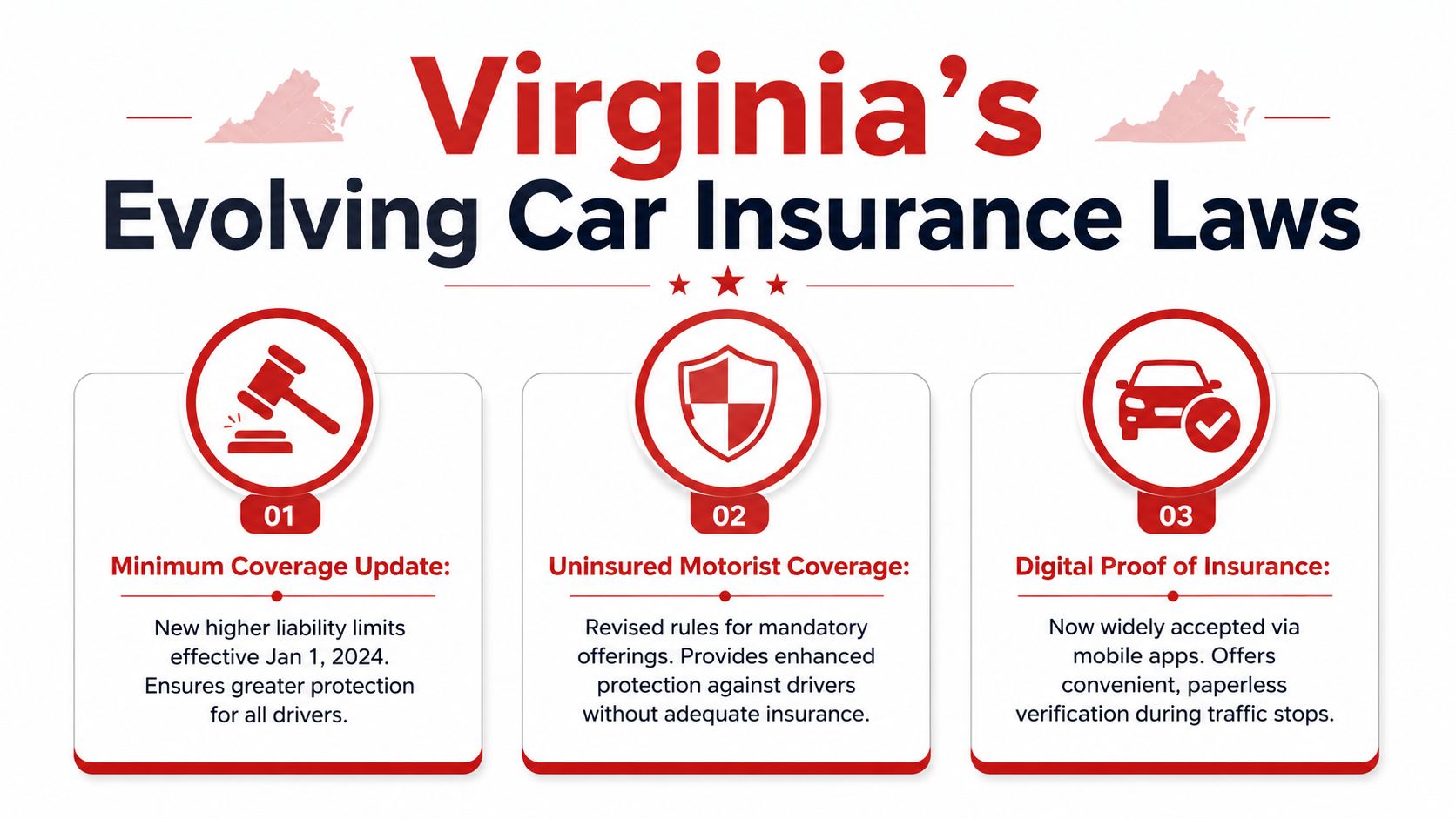
Effective July 1, 2024, Virginia ended the option to pay a $500 uninsured motor vehicle fee instead of buying insurance, and effective January 1, 2025, the state raised mandatory minimum liability limits from 30/60/20 to 50/100/25. That means drivers must carry $50,000 for bodily injury per person, $100,000 for bodily injury per accident, and $25,000 for property damage, according to Virginia insurance requirement updates.
For everyday drivers, the practical takeaway is simple. Insurance is no longer an optional cost you can swap out with a DMV fee. If your car is registered, you need active coverage from a licensed carrier.
That matters even if you rarely drive. It matters if the vehicle is financed. It matters if you're between policies and think you'll “fix it next week.” A lapse now creates a legal problem much faster.
Practical rule: In Virginia, “registered” and “insured” now need to go together at all times.
What 50 100 25 means in plain English
Those three numbers describe the most your liability policy pays when you cause damage to someone else.
| Coverage | What it pays for | New Virginia minimum |
|---|---|---|
| Bodily injury per person | Injuries to one person in an accident you cause | $50,000 |
| Bodily injury per accident | Total injuries to multiple people in one accident you cause | $100,000 |
| Property damage | Damage to cars, fences, buildings, and other property | $25,000 |
If you hit one car and injure one person, your policy pays up to the per-person bodily injury limit and up to the property damage limit. If several people are hurt, the per-accident cap becomes important fast.
Many drivers still think “minimum coverage” means “safe enough.” It only means legal compliance. That's a very different standard.
If you want a deeper look at how insurance issues can affect legal consequences during a stop or after a crash, Understanding no insurance charges gives useful context. If you're comparing policy options in-state, the Virginia auto insurance page is one place to review available coverage types and quote options.
Decoding Your Virginia Auto Insurance Policy
A Virginia auto policy isn't one big bucket of protection. It's a set of separate coverages, each doing a different job. Once you understand what each one does, it's much easier to spot where a cheap policy is cutting corners.
The five coverages that matter most
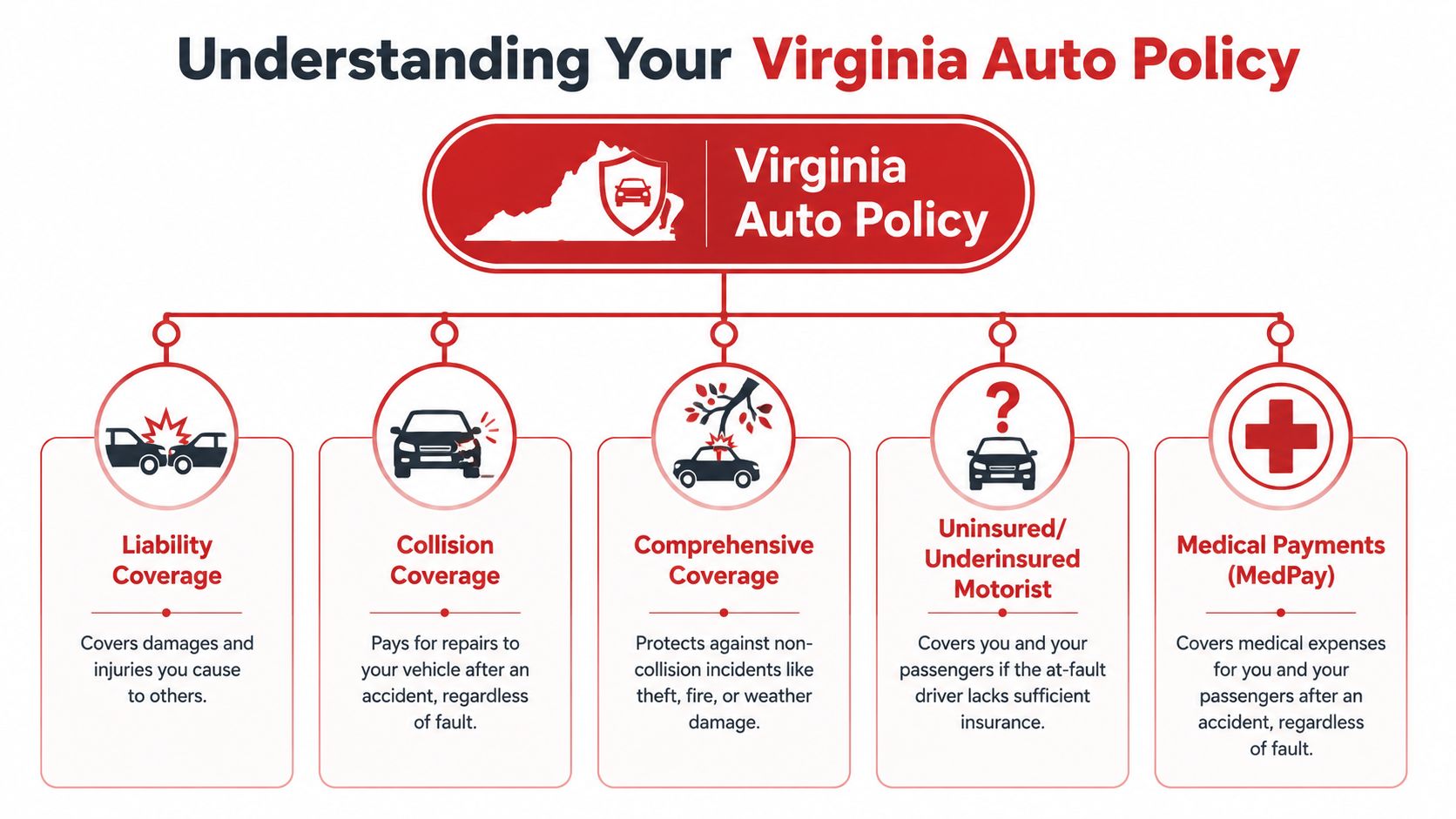
Liability coverage pays for injuries and property damage you cause to others. This is the part Virginia requires. It protects your assets from claims made against you after an at-fault accident.
Uninsured and underinsured motorist coverage, often called UM/UIM, protects you when the other driver has no insurance or not enough insurance. In real life, this is one of the most important parts of a Virginia policy because the person who hits you may not carry enough to cover a serious loss.
Medical Payments coverage, usually called MedPay, helps with medical bills for you and your passengers after a covered accident, regardless of fault. It can be useful for deductibles, copays, and immediate out-of-pocket costs.
Collision coverage pays to repair your vehicle after an accident, whether you hit another car, a pole, or a guardrail. If your lender requires “full coverage,” this is one of the pieces they usually mean.
Other-than-collision coverage handles non-collision losses like theft, vandalism, fire, falling objects, or weather damage. It protects the car from things that happen off the road as much as on it.
For drivers trying to sort out whether they need broad physical damage coverage or just the legal minimum, this guide on full coverage vs liability is a helpful side-by-side starting point.
Why minimum liability can leave you underinsured
Here's the Virginia nuance most guides skip. Virginia's UM/UIM coverage must exactly match liability limits, which creates a floor that can be too low for a serious accident. Legal guidance on this issue warns that carrying at least $100,000 in liability is the practical minimum for stronger personal protection because your own UM/UIM protection rises with it, as explained in Virginia UM/UIM matching rules.
That has a real-world effect. If you buy only the state minimum to save money, you aren't just limiting what your policy pays when you hurt someone else. You're also limiting what your policy can do for you if an underinsured driver hurts you.
Buy liability limits with your own future claim in mind, not just the claim you might cause.
This is why I often tell drivers to stop thinking of liability as “coverage for the other guy only.” In Virginia, your liability choice also shapes your backup protection.
A few policy habits also create trouble fast:
- Misstating garaging address: Rates and underwriting depend on where the vehicle is kept.
- Leaving out household drivers: If someone regularly has access to the car, hiding that fact can create claim issues.
- Changing facts to lower premium: That crosses into serious territory. If you want to understand where misrepresentation can lead legally, read understanding auto insurance fraud charges.
What Drives Your Virginia Insurance Premiums
A Virginia driver can do everything right this year and still get a quote that feels high. Another driver can carry the legal minimum, save a little each month, and still be one bad crash away from a major out-of-pocket loss. Premium pricing sits in that gap between what is cheap today and what protects you tomorrow.
Insurers set rates by looking at a mix of things you can change and things you cannot. According to State Farm's guidance on premium factors, companies commonly price for driving history, age, gender, location, vehicle type, prior insurance, and coverage selections, and that same guidance notes a measurable gender difference in 2026 marketplace data, with men averaging $2,253 annually and women averaging $2,203 annually for full coverage in Virginia, along with a discount rule for drivers age 55 and older who complete an approved accident prevention course. See what affects car insurance premiums.
The factors you can control
Your driving record usually moves the price faster than anything else. Tickets, at-fault accidents, claims, and coverage lapses tell an insurer you may cost more to insure. If you recently picked up a violation, check how long traffic tickets typically stay relevant to your rate before you shop around by reading how long traffic tickets affect insurance.
Coverage choices matter too. Higher liability limits, collision, non-collision coverage, rental reimbursement, and lower deductibles all add cost. They also change what happens after a loss, which is the part drivers tend to underestimate.
That matters more in Virginia than many drivers realize.
Because Virginia requires UM/UIM limits to match your liability limits, choosing a low-liability policy does two things at once. It lowers your premium, but it also keeps your own backup protection low if the other driver does not have enough coverage. So the rate is not just reacting to paperwork. It is reflecting how much financial risk you are keeping for yourself.
Credit can also affect what you pay with many insurers. A driver with a clean record and weak credit often pays more than expected, while a driver with strong credit may see better pricing even with similar coverage.
The factors you mostly cannot control
Age, gender, and ZIP code still influence rates even if your record is clean. Carriers look at local claim frequency, repair costs, traffic density, theft patterns, and lawsuit trends. Two drivers with similar vehicles can see very different prices because one garages the car in a higher-cost part of Virginia.
Your vehicle also has a big effect. Repair cost, parts availability, safety features, theft risk, and how likely the car is to cause severe damage all feed into the premium. A vehicle that is cheap to buy is not always cheap to insure if it is expensive to repair after even a moderate crash.
I tell drivers to watch for the wrong trade-off here. Saving a small amount by dropping limits or raising deductibles too far can backfire if you cannot comfortably absorb the loss later.
In Virginia, a lower premium often means you accepted more personal risk, not that you found a smarter policy.
The goal is not to chase the lowest number on the page. The better move is to find the lowest price for limits and deductibles that would still make sense after a serious accident.
Average Cost of Car Insurance in Virginia
A driver in Richmond can carry the legal minimum, pay a lower premium, and still be one bad crash away from a debt problem. That is the part average-cost articles usually miss. Price matters, but in Virginia, the bigger question is what that price is buying, especially now that uninsured and underinsured motorist coverage has to match your liability limits unless you make a different election where allowed.
What the statewide average actually means
According to Experian's March 2026 data, summarized by SaveMax Auto's Virginia auto insurance cost page, Virginia drivers pay an average of $2,271 per year for full coverage, or about $189 per month. That same summary also shows a wide spread by credit profile.
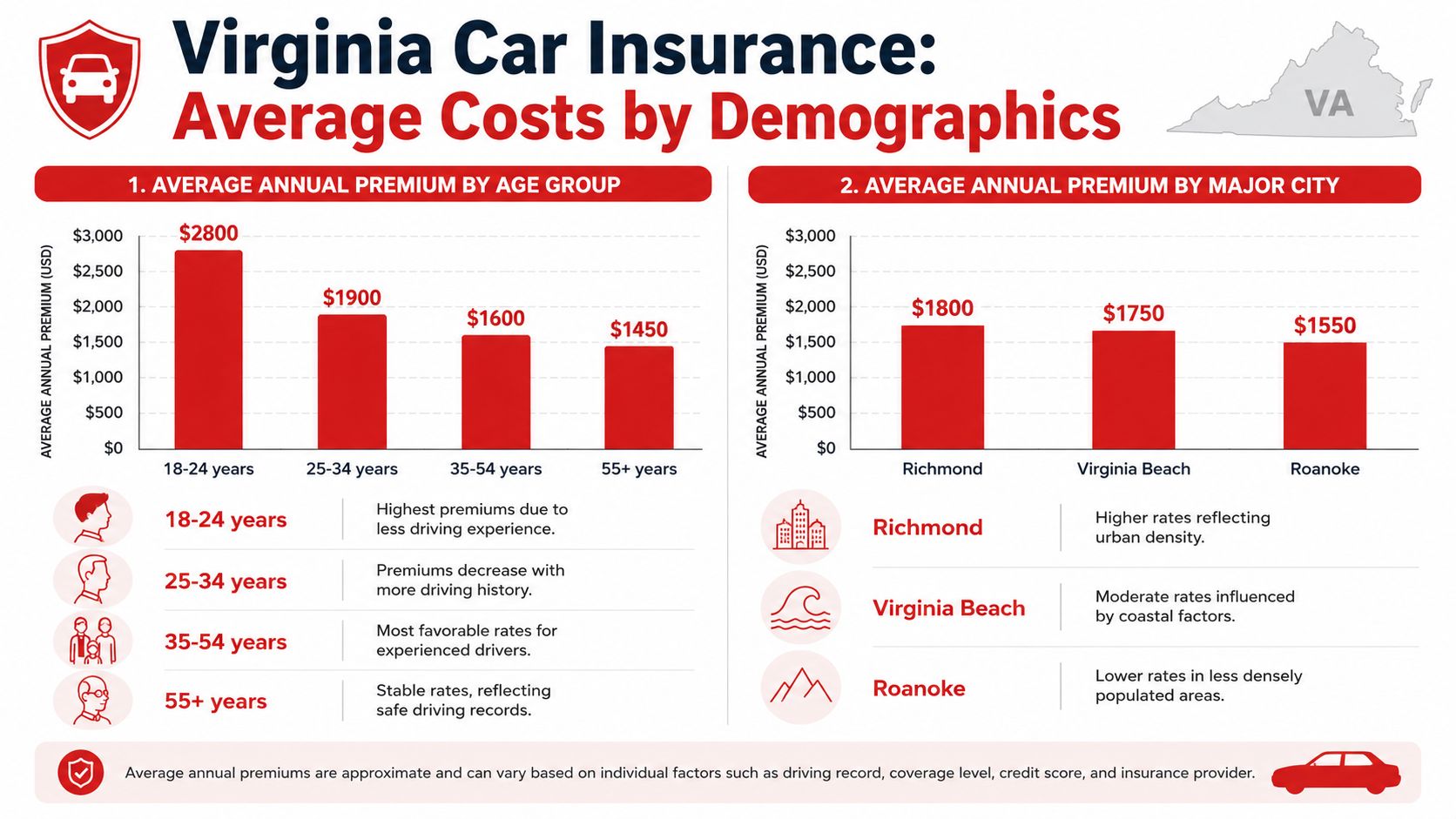
Use that average as a reference point, not a target price.
I tell Virginia drivers to treat the statewide number like a rough range check. If your quote is far above it, there is usually a reason. It might be your driving history, credit-based rating, vehicle type, ZIP code, lapse in coverage, or the limits and deductibles you selected. If your quote is far below it, look closely at the coverage line by line before you assume you found a bargain.
Why averages can mislead Virginia drivers
Averages blend together clean drivers, high-risk drivers, new cars, older cars, city traffic, rural roads, low deductibles, and bare-bones policies. They also hide one of the biggest real-world trade-offs in this state. A policy can look cheap because it leaves you with less protection than you would want after a serious injury claim.
That matters more under Virginia's current rules. If you raise liability limits, your UM/UIM protection usually rises to match. That often increases premium, but it also closes a dangerous gap. If the other driver has low limits, or no meaningful coverage at all, your own policy may be the layer that protects your savings, wages, and future income from a loss that costs far more than the minimum required by law.
Why one driver pays much more than another
The same statewide data summary shows a sharp difference between drivers with good credit and drivers with poor credit. In plain terms, two drivers can have similar cars and similar records and still see very different premiums.
Here is the practical takeaway:
- A lower quote may reflect lower limits: That can leave you exposed if medical bills or lost-income claims exceed the other driver's coverage.
- A higher quote is not always overpriced: It may include stronger liability, matched UM/UIM protection, lower deductibles, or physical damage coverage that would matter after a major loss.
- The best value is usually in the middle: High enough limits to protect your finances, with deductibles you could pay without putting the repair on a credit card.
For many Virginia households, the right question is not, "What is average?" It is, "If I hit a serious claim tomorrow, would this policy protect me?" That is how you judge whether your premium is expensive, reasonable, or cheap for the wrong reasons.
How to Find Real Savings and Discounts
Most savings advice sounds good and helps very little. “Shop around” is true, but incomplete. The right approach is to look for savings in layers, starting with easy discounts, then fixing the rating issues that cost the most.
Savings that usually help
Start with the items insurers commonly reward:
- Keep your record clean: Fewer violations and fewer claims usually improve pricing options over time.
- Ask about household bundling: If more than one policy can be placed together, the overall package may price better.
- Review your deductible carefully: A higher deductible can lower premium, but only choose an amount you could realistically pay after a loss.
- Check for senior eligibility: Drivers who qualify for the Virginia accident prevention course discount should use it.
- Match coverage to the vehicle: An older paid-off car may not need the same physical damage setup as a newer financed one.
Then look at timing. If your renewal is coming up, don't wait until the last day. Better shopping happens when there's time to review driver details, prior coverage, vehicle use, and discount eligibility without rushing.
What doesn't work for most drivers
The biggest misconception I hear is that Virginia has a state-backed low-income auto insurance option. It doesn't. Virginia has no state-sponsored low-income car insurance program. The fallback is the Virginia Automobile Insurance Plan (VAIP), which places high-risk drivers with carriers at rates often 30 to 50 percent higher than the voluntary market, according to Virginia low-income insurance guidance.
That makes VAIP a last resort, not a savings strategy.
What usually doesn't work:
- Waiting for a government discount program: There isn't one for standard low-income drivers in Virginia.
- Buying the minimum without checking the exposure: Lower premium today can mean weak UM/UIM protection later.
- Assuming one quote reflects the whole market: It doesn't.
- Hiding facts on the application: That can create a short-term premium drop and a long-term claim problem.
For budget-conscious drivers, the most effective move is usually disciplined quote comparison in the voluntary market, paired with realistic coverage choices. Cheap and usable is better than cheap and fragile.
Your Step-by-Step Guide to Getting Quotes in Virginia
A driver in Richmond buys the cheapest quote online, then finds out after a crash that the low price came with low liability limits and matching low UM/UIM protection. That is a common Virginia problem. The quote looked good. The protection was thin.
A better quote process starts with one question. What loss could you realistically pay out of pocket if the other driver has little insurance or none at all? In Virginia, that matters more than many drivers realize because your UM/UIM limits generally follow the liability limits you choose. If you set the floor low to save money, you also set your own backup protection low.
Start by pulling together the information that changes a quote and the coverage choices that change your risk.
- Driver details. License information, date of birth, address, and current insurance history.
- Vehicle details. VIN, year, make, model, ownership status, and primary use.
- Household information. Who lives with you, who has access to the car, and whether there are teen or occasional drivers.
- Coverage preferences. Liability limits, deductible range, and whether you want collision, non-collision coverage, or MedPay.

If you already have a policy, keep the declarations page next to you. It lets you compare limits, deductibles, listed drivers, and optional coverages line by line. That is how you catch a quote that is cheaper only because it stripped something out.
Then review each quote in a practical order.
| Priority | What to check | Why it matters |
|---|---|---|
| 1 | Liability limits | In Virginia, these also affect the UM/UIM protection backing you up after a serious crash |
| 2 | Deductibles | A lower premium loses its value if you would struggle to pay the deductible after a claim |
| 3 | Included coverages | MedPay, rental reimbursement, roadside, collision, and comprehensive often differ from quote to quote |
| 4 | Driver listing and exclusions | A cheap policy can become a bad policy if a household driver is missing or excluded |
Many quote shoppers often make the wrong comparison. They look at monthly price first. A better method is to match liability limits first, then match UM/UIM, then check deductibles and extras. Only after that should you compare premium.
Captive agents quote one carrier's options. Independent agents can check several carriers. Either can work for a clean driving record and a simple vehicle setup. If you have a lapse, a ticket, a teen driver, a financed car, or you want help in English or Spanish, access to multiple carriers usually gives you more room to balance cost with protection.
One option in that category is Select Insurance Group, Inc., an independent agency that offers bilingual service and can help drivers review quote differences before they buy.
One last practical tip. Ask every agent or online platform the same direct question: "If I am hit by a driver with low limits, what would my policy pay?" The answer tells you more than the headline price ever will.
Conclusion Your Partner for Virginia Car Insurance
Virginia car insurance got simpler legally and more important financially. The simple part is this: if your vehicle is registered, you need active coverage. The part many drivers still miss is that legal minimums aren't the same as real protection.
Three takeaways matter most. First, insurance is mandatory in Virginia. Second, the minimum policy can leave you exposed, especially because your UM/UIM protection tracks the liability limits you choose. Third, the best way to control cost without stripping out protection is to compare quotes carefully and read the coverage details, not just the monthly premium.
A smart policy should do two jobs at once. It should satisfy Virginia law, and it should give you enough protection to recover from a bad accident without turning the rest of your finances upside down.
If you want help comparing Virginia car insurance quotes without the usual confusion, Select Insurance Group, Inc. can help you review coverage options, compare multiple carriers, and find a policy that fits your budget and your actual risk. Free, no-obligation quotes are available, and bilingual support can make the process easier if you prefer service in English or Spanish.