
You open your renewal notice, scan the premium, and think you must be missing something. Same car. Same address. No accident. No ticket. Yet the number jumped anyway.
That's a familiar moment for Tennessee drivers and homeowners right now. Quotes have gotten harder to make sense of, and the cheapest option on the screen often isn't the smartest one once you look at deductibles, uninsured motorist protection, or flood exclusions. Good coverage in Tennessee isn't just about finding a lower price. It's about knowing which local risks matter and which line items deserve a second look.
If you're sorting through Tennessee insurance quotes, this guide is meant to make the process feel less like guesswork. It pulls apart what a quote really shows, why prices vary so much across the state, and how to compare options without getting fooled by a low headline number. If you want a broader look at coverage options across the state, Tennessee coverage resources from Select Insurance Group in Tennessee are a useful starting point.
Table of Contents
- Your Guide to Navigating Tennessee Insurance Quotes
- Decoding What a Tennessee Insurance Quote Really Is
- Understanding Tennessee's Minimum Insurance Laws
- The Biggest Drivers of Your Insurance Rates in Tennessee
- Your Step by Step Guide to Getting Quotes
- How to Compare Quotes for Real Savings
- Insurance Solutions for Every Tennessean
- Your Partner for Tennessee Insurance
Your Guide to Navigating Tennessee Insurance Quotes
Often, shopping begins after something annoying happens. A renewal jumps. A lender asks for proof of coverage. A teenager gets licensed. A storm damage claim exposes a gap nobody noticed before. The shopping process begins in a hurry, and that's usually when people make the wrong comparison.
A quote is only helpful if it reflects the way you live. A driver in Memphis has a different risk profile than a driver in Johnson City. A homeowner near a creek has a different concern than someone focused mainly on wind or liability. A contractor with two work trucks needs a very different conversation than a family insuring one SUV.
That's why broad advice like “raise your deductible” or “buy the cheapest full coverage” only gets you so far. Sometimes that move helps. Sometimes it saves a little now and costs a lot later when a claim hits.
Practical rule: The best quote is the one that still makes sense on claim day.
Shopping well in Tennessee means checking three things at the same time:
- The price you see first: Premium matters, but it's only one piece.
- The protection underneath it: Limits, deductibles, and endorsements change the actual value.
- The local fit: Uninsured drivers, city traffic, storm patterns, and flood exposure all shape what “good coverage” looks like here.
People can still find strong value in this market. They just need to read quotes the way an agent reads them, line by line, not just top to bottom by price.
Decoding What a Tennessee Insurance Quote Really Is
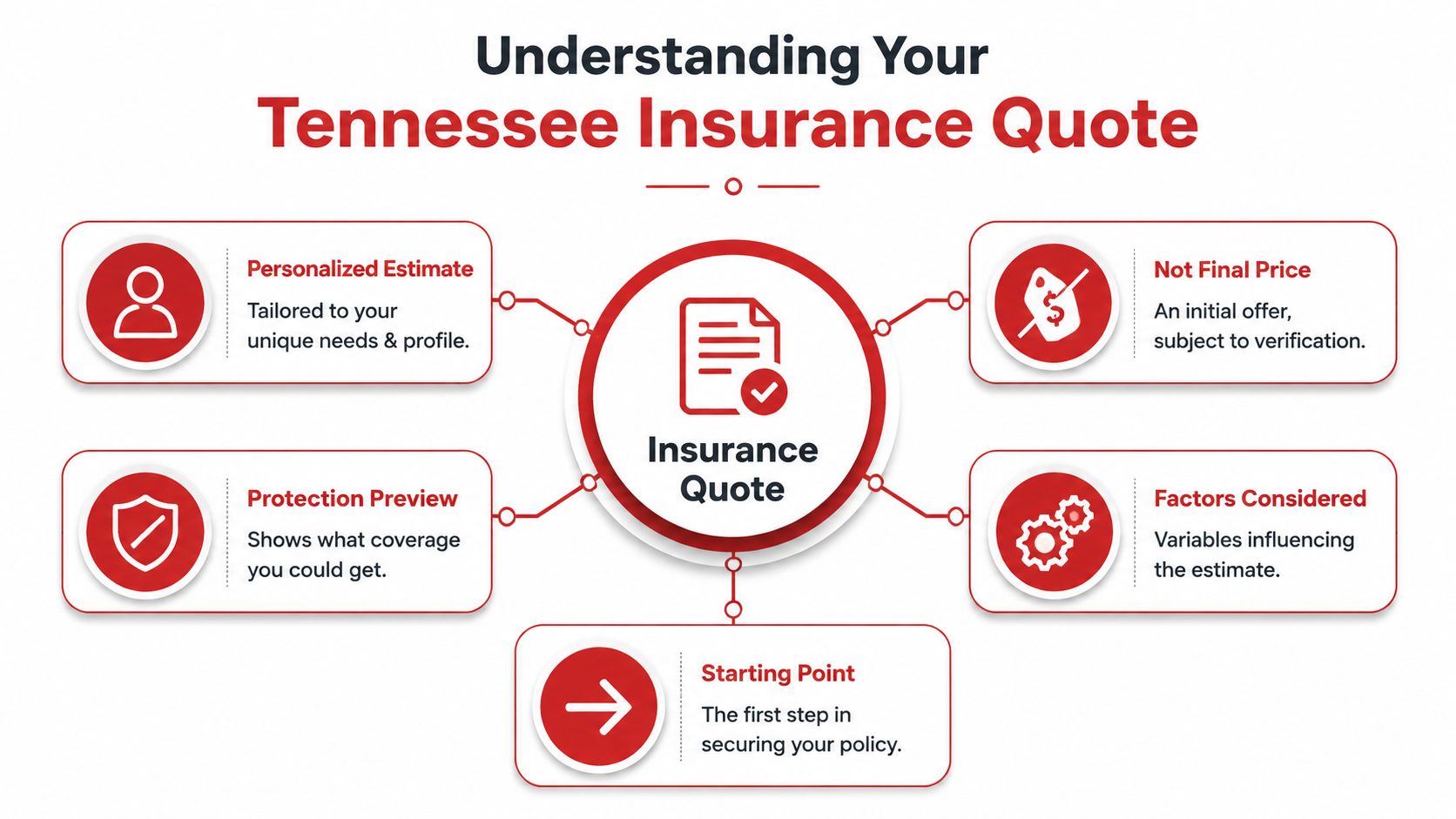
A Tennessee insurance quote is best understood as a personalized estimate for protection. It's the insurer's first pass at pricing your risk based on the details you provide. It serves as a price tag on your financial safety net. It gives you a useful number, but it isn't the final word until the company verifies the information.
A quote is a starting number, not a promise
That distinction matters. If you guessed at annual mileage, forgot an old address, or left out a household driver, the quote can change. The same thing happens when a homeowner's quote starts as a basic policy and later adds the options the property needs.
This visual sums up the moving parts:
A lot of confusion comes from vocabulary. People know the bill matters, but they don't always know which term changes what. If insurance language tends to blur together, this plain-English guide that helps clarify health insurance vocabulary is useful because the same habit applies here. Learn the words first, then compare the options.
The terms that matter most
Here are the quote terms that deserve your attention every time:
- Premium: This is what you pay for the policy, monthly, semiannually, or annually.
- Deductible: This is your share before certain coverages begin to pay. A simple way to think about it is a co-pay, but for property damage claims.
- Coverage limits: This is the maximum the policy will pay for a covered loss.
- Endorsements: These are add-ons or changes that broaden or narrow what the policy includes.
For auto insurance, one line creates a lot of confusion: liability-only versus full coverage.
Liability-only protects other people when you cause damage or injuries. Full coverage usually means liability plus coverage for damage to your own vehicle from collisions and other covered events. It's a common shortcut phrase, but it isn't one fixed product. Two “full coverage” quotes can be very different once you compare deductibles and optional protections. A closer look at full coverage versus liability helps if you're deciding between the two.
A quote should answer two questions at once: what will this cost me each month, and what will it actually do for me when something goes wrong?
That second question is the one people skip. It's also the one that separates a cheap quote from a solid one.
Understanding Tennessee's Minimum Insurance Laws
Tennessee law sets a floor, not a recommendation. Drivers must carry 25/50/15 liability limits, meaning $25,000 per person, $50,000 per accident for bodily injury, and $15,000 for property damage, according to Tennessee auto insurance requirements and average minimum coverage cost. That same source says the average cost for this minimum coverage is $564 per year, or $47 per month.
What Tennessee requires
On paper, minimum coverage can look appealing. It's legal. It's familiar. It's often the lowest number on the page.
But low legal limits can create a false sense of security. They satisfy the state. They may not come close to protecting your savings, wages, or future earnings after a serious accident.
Here's a simple comparison that reflects how many agents frame the decision:
| Coverage Type | State Minimum | Recommended Amount | Why It Matters |
|---|---|---|---|
| Bodily Injury Liability per person | $25,000 | Higher than the minimum | One emergency room visit can run past the minimum quickly |
| Bodily Injury Liability per accident | $50,000 | Higher than the minimum | Multiple injured people can exhaust the limit fast |
| Property Damage Liability | $15,000 | Higher than the minimum | Many vehicles on the road cost far more than this to repair or replace |
Minimum legal does not mean financially safe
Take a common Tennessee scenario. Traffic stacks up on I-40, you glance down for a second, and you hit the car ahead of you hard enough to push it into another vehicle. Nobody planned for a major claim that morning. Now there are injuries, two damaged vehicles, towing, and lost income issues in the background.
That $15,000 property damage limit can disappear fast if one of the vehicles is newer or multiple cars are involved. The $50,000 per-accident bodily injury cap can also run out quickly once treatment starts. After that, the problem doesn't vanish. It can land on you.
Buying the minimum often saves money only until the day you need it.
That same mindset shows up in home coverage too. If you're also trying to understand flood obligations in another property context, this Marion County flood insurance guide is a practical example of how local water risk can change what “enough coverage” really means.
The smartest way to use state minimums is as a baseline to move up from, not a target to stay at.
The Biggest Drivers of Your Insurance Rates in Tennessee
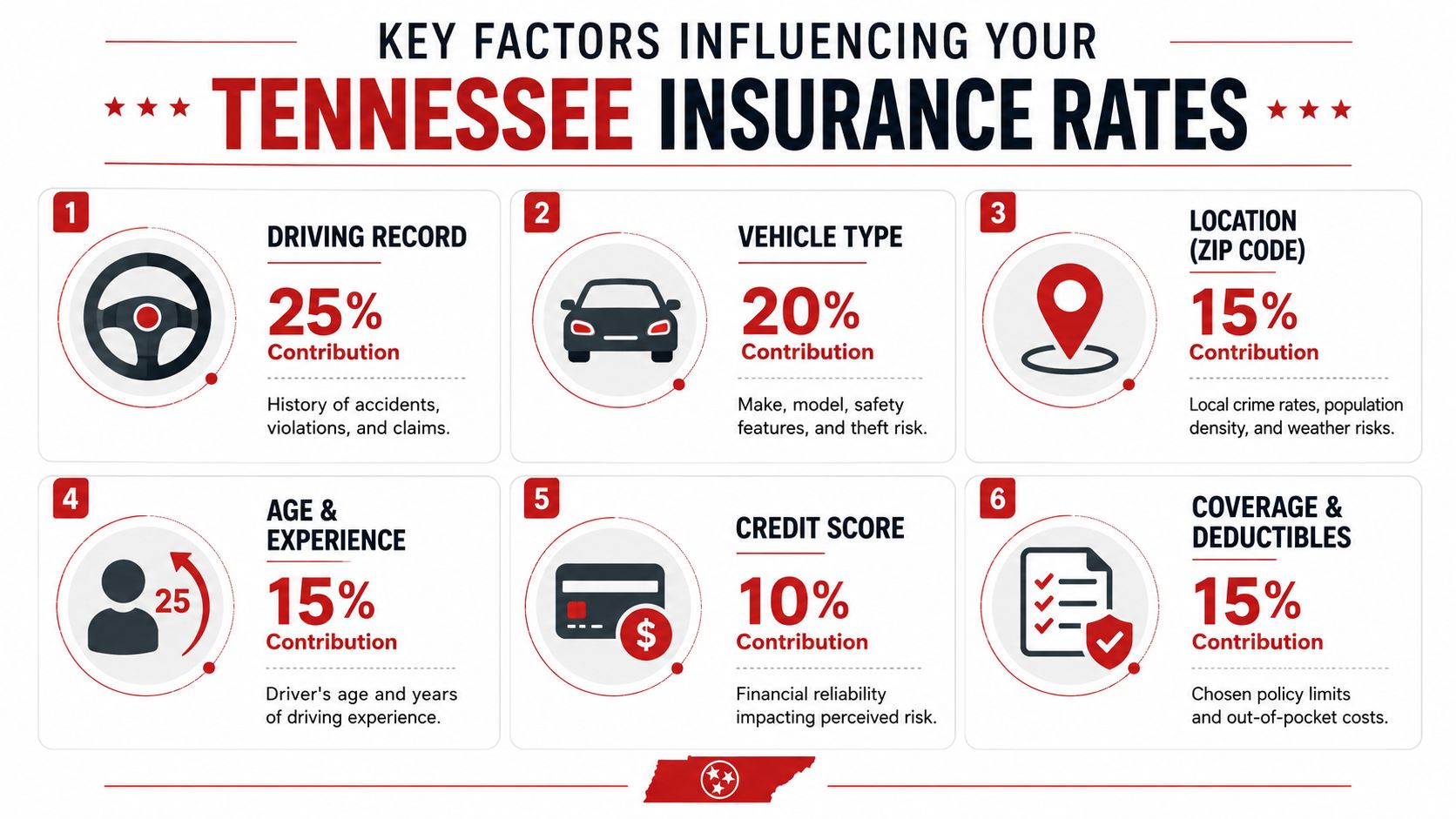
A driver in Jackson can have a clean record, no recent claims, and still watch the renewal jump. Then a friend in Murfreesboro with a similar car gets a very different number. I see that every day. In Tennessee, rates are built from your own profile, your ZIP code, and broader claim trends across the state.
Your personal details still matter plenty. Younger drivers usually draw the highest quotes because carriers see less driving experience and more severe claim risk. Credit matters too in Tennessee, often more than people expect. Earlier rate data shows a wide gap between drivers with strong credit and drivers with poor credit, which is one reason two households with similar vehicles can get very different prices. Vehicle type, annual mileage, prior coverage history, and the deductible you choose also affect the final number.
For families, the biggest shock usually comes with a teen driver. For business owners, it is often the opposite problem. A pickup that looks ordinary to you may be rated differently if it hauls tools, travels between job sites, or is titled to the business. Usage changes price.
Location is another major factor, with Tennessee's local conditions often having a greater impact than many national articles admit. Memphis pricing often runs hotter than many other parts of the state because insurers are looking at area claim frequency, theft, repair costs, congestion, and uninsured driver exposure. Rural counties can be cheaper in some cases, but they bring their own issues, especially longer emergency response times, deer claims, and storm damage.
Flash flooding affects quotes more than people realize. It may not show up as a line item on every auto quote, but carriers price for weather loss patterns by territory. The same goes for homes, commercial buildings, and vehicles parked in low-lying areas near creeks, rivers, or poor drainage. In Middle and East Tennessee, I tell clients to pay attention to water risk even when the property has never flooded before. One bad summer storm can change the claims history in a ZIP code fast.
This infographic highlights the common rating inputs carriers use when shaping premiums:
There is also the broader market problem. Repair bills are up. Medical costs are up. Lawsuit severity is up. Tennessee also has a high share of uninsured and underinsured drivers compared with what many buyers expect, and that pushes more people to rely on their own coverage after a crash. If your uninsured motorist limits are low, a cheap quote can get expensive on the day you need it.
That is why quote shopping in Tennessee is not just about finding the lowest premium. It is about finding the best value for the risks you face in your part of the state. A good quote reflects your driving record and your address, but it should also account for local realities like flood-prone roads, storm losses, and the chance that the other driver may not have enough insurance.
Your Step by Step Guide to Getting Quotes
A driver in Nashville can pull three auto quotes in 20 minutes and still miss the one detail that matters after a wreck. A contractor in Jackson can get a cheap commercial policy fast, then find out the water backup or hired-and-non-owned auto piece was left out. Getting quotes is easy. Getting the right quote takes a little order.
There are three common ways to shop for Tennessee insurance quotes. Each one serves a purpose. The right path depends on how much guidance you need, how complicated your risks are, and whether you are shopping for a personal policy or a business policy.
Going straight to one carrier
This is the quickest route. You answer the questions once and get one price.
It works best if you already know the coverage setup you want and you are checking a company you have used before. I usually see this work for a straightforward renewal, especially for a household with one or two vehicles and no recent changes.
The weakness is simple. One quote cannot tell you whether the premium is fair for your ZIP code, your claim history, or the Tennessee risks that matter to you. If you recently moved, added a young driver, bought a truck, started a small business, or changed how you use a vehicle, one carrier view is a narrow view.
Good fit for:
- Quick renewal checks: You want to confirm whether a current option still makes sense.
- Simple personal insurance needs: Few drivers, standard vehicles, no unusual exposure.
Less useful for:
- Recent life or business changes: New location, new vehicle, claims, teen driver, added employees.
- Properties or vehicles with local risk factors: Flood-prone parking areas, rural roads, delivery use, or frequent highway driving.
Using a quote marketplace
A marketplace can give you a fast read on price ranges. That can help early in the process, especially if you have no idea whether your current premium is in line with the market.
The trade-off is detail. Headline premiums often hide changes in deductibles, liability limits, rental reimbursement, roadside coverage, or business-use classifications. For Tennessee buyers, that can be a problem. A quote that looks good on the first screen may leave out coverage you would want if the other driver has too little insurance or no insurance at all.
This method works better for buyers who already know how to read a declarations page and spot the gaps.
Working with an independent agent
This is usually the best route if you want both comparison and judgment. An independent agent can shop several carriers, explain why the prices differ, and point out where a lower premium comes from a real savings versus a coverage cut.
That matters in Tennessee because local conditions are not the same across the state. A Memphis driver, a homeowner near a creek in East Tennessee, and a small contractor in Murfreesboro are not bringing the same risk to the table. Quote shopping should reflect that.
If you are replacing an existing policy, it also helps to review the timing and paperwork before you cancel anything. This guide on how to switch auto insurance companies without creating a coverage gap is a smart place to start.
Here is the practical difference between the three paths:
| Method | Main Benefit | Main Limitation | Best Use Case |
|---|---|---|---|
| Single carrier | Fast and simple | No broader market check | Renewal review on a known policy |
| Marketplace | Several prices in one place | Coverage details can get flattened | Early price shopping |
| Independent agent | Multiple quotes with advice | Takes more conversation upfront | Personal and commercial buyers who want the policy to fit |
The best quote process is the one that leaves you clear on two things. What you are paying for, and what would happen if you had a claim tomorrow.
How to Compare Quotes for Real Savings
A Nashville driver gets two auto quotes on the same afternoon. One is cheaper by a noticeable margin. A week later, we line them up side by side and find the lower price came with a higher deductible, lower uninsured motorist limits, and fewer extras for rental or roadside help. The cheaper quote was not a better buy. It was a thinner policy.
That is the mistake I see most often in Tennessee. People compare price first, then find out after a wreck, a theft, or a water claim that the lower premium came from shifting more risk back onto them.
Compare the policy before the premium
Start by making the quotes match as closely as possible. If the limits, deductibles, and add-ons are different, you are not comparing competing prices. You are comparing different products.
Here is the checklist I use with Tennessee clients:
- Match liability limits: Higher limits usually cost more, but they also protect more of your income and assets after a serious accident.
- Match deductibles: Lower premium often means you are agreeing to pay more out of pocket at claim time.
- Match physical damage coverage: Collision and other-than-collision coverage should be set up the same way on each auto quote.
- Check endorsements and extras: Rental reimbursement, roadside assistance, equipment coverage, and water backup can change the value of a policy fast.
- Review payment options: Monthly installments, fees, and paid-in-full discounts can change the actual annual cost.
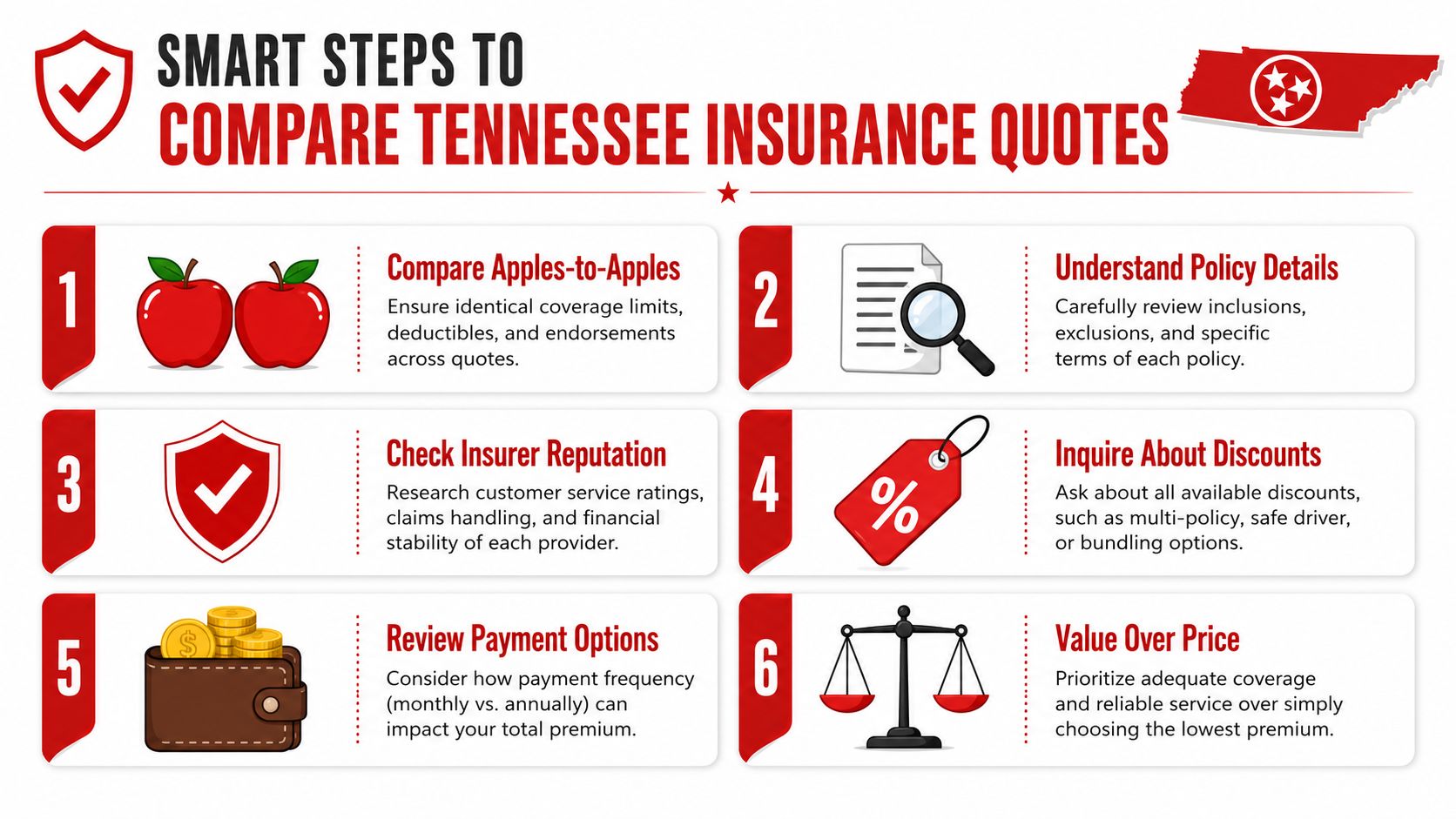
A simple rule helps here. If you cannot explain why one quote costs less, do not buy it yet.
Pay close attention to Tennessee risks
Tennessee quote shopping has a local wrinkle that national advice often misses. A low-priced policy can look fine on paper and still fit this state poorly.
Uninsured drivers are part of that problem. If someone with little or no coverage hits you, your liability limits do nothing for your own injuries or vehicle. That is why I tell Tennessee drivers to study uninsured and underinsured motorist coverage closely, especially in higher-traffic areas and for families with teen drivers on the policy.
Flood exposure matters too, even outside the obvious trouble spots. I have seen homeowners near creeks, low-lying roads, and fast-growing subdivisions assume a standard home quote covered water damage from rising water. It does not. For personal buyers and business owners, real quote comparison means asking what is covered, what is excluded, and which losses require a separate policy.
Questions that help you spot real value
Use these questions before you choose a quote:
- What coverage was reduced to get this lower price?
- Are uninsured and underinsured motorist limits high enough for my household?
- Would this deductible feel manageable if I had a claim next month?
- Does this quote leave out a Tennessee risk I face, such as flash flooding, storm damage, or a vehicle used for work?
- What is the total yearly cost after fees, payment charges, and discounts?
That last question trips up a lot of shoppers.
A discount is helpful. A weak policy with a discount is still a weak policy.
If you are replacing your current auto policy, review the timing before canceling anything. This guide on how to switch auto insurance companies without creating a coverage gap walks through the handoff.
The same careful comparison applies beyond auto. RV owners should review storage, travel radius, liability, and physical damage terms instead of looking at premium alone. This breakdown of the average RV insurance per month gives a useful cost starting point, but the quote still needs to fit how the RV is used.
Real savings come from keeping the right protection, trimming what you do not need, and avoiding expensive surprises later. That is the difference between a low quote and a good one.
Insurance Solutions for Every Tennessean
The process often begins with auto insurance due to its urgency. Then the broader picture shows up. The house needs review. The rental needs contents protection. The business owner realizes personal auto won't solve a commercial vehicle problem. Good insurance planning usually expands once the first quote is on the table.
Personal coverage beyond the car
Homeowners in Tennessee need to pay special attention to flood exposure. A major blind spot in this state is that 40% of flood claims happen outside high-risk zones, according to Bankrate's Tennessee homeowners insurance and flood risk overview. That's why standard online homeowners quotes can feel complete while still leaving a serious gap.
Flood coverage often requires a separate conversation. If nobody asks where water moves around your property, whether the lot drains poorly, or whether nearby development changed runoff patterns, the quote may overlook key factors.
That same principle applies to other personal policies:
- Renters insurance: It protects belongings and liability, but not every water-related loss is treated the same way.
- Motorcycle and RV coverage: Seasonal use, storage, and trip habits affect what makes sense. For RV owners trying to understand cost expectations, this breakdown of the average RV insurance per month is a helpful reference point.
- Bilingual support: For many Tennessee families, being able to review options clearly in English or Spanish makes the quote process more accurate, not just more comfortable.
Good personal insurance advice starts with one question: what loss would hurt this household the most?
Commercial insurance for Tennessee businesses
Business owners need a different lens. Price matters, but classification, payroll estimates, vehicle use, contracts, and certificates matter just as much.
Common building blocks include:
- General liability: For third-party injury or property damage claims.
- Commercial auto: For vehicles used in the business, even when the fleet is small.
- Workers' compensation: Important when the business has employees and injury exposure.
- Commercial property and inland equipment options: Useful when tools, stock, or office contents would be costly to replace.
A contractor, retailer, and delivery-focused company can all ask for “a quote” and need very different policy structures. That's why practical commercial quoting starts with operations first and premium second.
Your Partner for Tennessee Insurance
Good insurance shopping in Tennessee comes down to clarity. You want to know why the quote costs what it costs, what it protects, and where the weak spots are before a claim forces the answer.
The lowest number on the page isn't automatically the wrong choice. It just isn't enough information by itself. In Tennessee, local factors like uninsured drivers, city-level pricing differences, and flood exposure can change what a smart quote looks like for a family or a business.
Experienced guidance is particularly valuable, not because insurance needs more jargon, but because someone has to slow the process down enough to compare the right details and spot the gaps generic quote forms miss.
If you want better Tennessee insurance quotes, focus on value, not just price. Strong coverage starts with the right questions.
If you want help comparing options without the usual confusion, Select Insurance Group, Inc. offers free, no-obligation quotes for personal and commercial coverage. Their team compares multiple carriers, helps you spot coverage gaps, and makes the process easier in English or Spanish so you can choose protection that fits your life, not just your budget.