
You're probably looking at a renewal quote, a newly purchased wrecker, or a customer vehicle sitting in your lot while you wonder whether your current policy responds. The truck may be insured, but that doesn't answer the harder questions. What happens when a disabled vehicle is damaged while hooked, a customer's property disappears from an impounded car, or a private-property tow produces a complaint because the paperwork wasn't right?
Tow truck insurance in Georgia isn't just commercial auto with a different vehicle schedule. You're managing road liability, customer vehicles in your care, storage exposure, permits, proof-of-insurance filings, and sometimes federal requirements. A policy that looks acceptable on the declarations page can still leave a serious gap when the claim involves custody of property or an unauthorized removal.
Table of Contents
- Why Tow Truck Insurance in Georgia Is Its Own Animal
- The Mandatory Georgia Coverage Stack
- Intrastate vs Interstate Thresholds Georgia Operators Cross
- Endorsements Georgia Tow Operations Almost Always Add
- What Drives Your Georgia Tow Insurance Premium
- Nonconsensual Towing Permits Paperwork and the Compliance Workflow
- Documents to Gather Before You Request a Quote
- Putting It Together for Georgia Operators
Why Tow Truck Insurance in Georgia Is Its Own Animal
A roadside call can turn into a coverage dispute before the tow reaches the lot. Your driver hooks up a disabled vehicle, another motorist strikes the scene, and the customer's car shifts on the equipment. The resulting questions involve bodily injury, damage to the customer's vehicle, and responsibility for each part of the operation.
A generic commercial auto policy may respond to damage caused by your truck on the road. It does not automatically protect a vehicle you are towing, impounding, or storing. That distinction leaves many operators insured around the truck while the business carries the larger exposure.
Private-property work creates another failure point. A property manager requests removal from a restricted space, but the authorization is incomplete, the request came from someone without proper authority, or the permit and certificate of insurance are outdated. After the tow, the owner challenges the removal. The dispute can involve penalties, a contested invoice, storage charges, and whether the job met the conditions attached to the coverage.
Three exposures can meet in one claim
Road liability applies when your tow truck causes bodily injury or property damage during operation.
Custody liability concerns the customer's vehicle while it is hooked, transported, impounded, or stored. Georgia's permitted operators must address vehicles and their contents held at a storage facility, not just the tow truck. Verify the framework in Georgia's towing and storage rule.
Regulatory compliance determines whether the tow was authorized and whether required proof of insurance remained current. Insurance does not replace a permit, a property-owner agreement, or a properly documented request. Treat Georgia's nonconsensual-towing paperwork as part of your risk control, not as an administrative afterthought.
Required markings and company identification must remain legible. Decorative graphics, such as a Georgia Tech sticker for truck windows, should never cover those markings or reduce visibility.
Practical rule: If your agent can explain only the truck's liability limit, the account still has unanswered coverage questions. Ask specifically how the policy handles customer vehicles, stored contents, authorization disputes, and Georgia proof-of-insurance requirements.
The Mandatory Georgia Coverage Stack
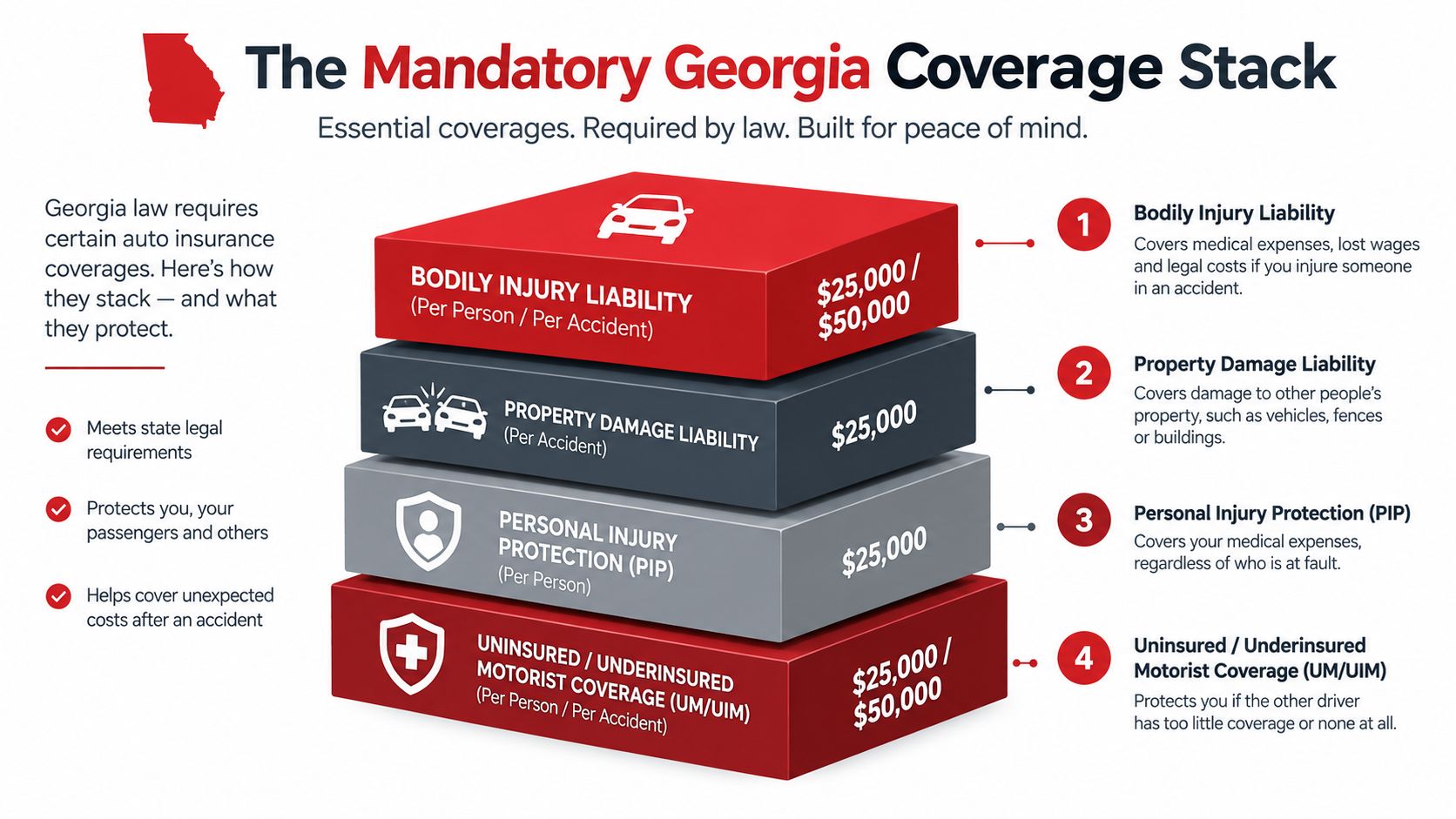
A Georgia tow operator can have a valid commercial auto policy and still miss a state requirement. Start with the required foundation, then build the policy around the trucks, storage site, and services you provide. For permitted intrastate operations, commercial liability coverage applies to each vehicle used in commerce when both the origin and destination are in Georgia.
The baseline limits are:
- Bodily injury or death of one person: $100,000
- Bodily injury or death of all persons in one accident: $300,000
- Damage to other people's property in one accident: $50,000
These limits apply to the commercial liability portion of the operation. A roadside incident can involve the tow truck, a disabled vehicle, passing traffic, and several injured parties at once. Confirm the exact requirements in Georgia's official towing insurance requirements.
Separate the truck from the customer's vehicle
Commercial auto liability responds to covered injury or property damage caused by operating your truck. It does not automatically cover damage to a customer's vehicle while that vehicle is in your custody.
Georgia also requires garage-keepers' legal-liability coverage for vehicles and contents held at an impound or storage facility. The policy must protect the actual value of stored vehicles, subject to a stated minimum of $50,000. That exposure is separate from damage your truck causes to someone else's property.
Cancellation paperwork matters too. The department must receive 30 days' advance notice before cancellation takes effect. A lapse can therefore create an administrative problem as well as an insurance problem, especially when a permitted operation must keep proof of coverage current.
Build the policy around the operation
The required stack works in layers:
- Commercial auto liability covers covered third-party injury and property damage caused by the truck.
- Garage-keepers' legal liability addresses covered damage to vehicles and contents held at your facility.
- Physical damage coverage protects your tow equipment against covered loss, subject to the selected terms and deductibles.
- Additional endorsements address vehicles while on hook, cargo, employees, hired vehicles, and premises liability.
A commercial truck policy can provide the starting structure, but the application must identify towing, impound, and storage work accurately. Operators reviewing commercial truck insurance in Georgia should make sure every service and custody exposure appears in the submission. Missing one activity is how an apparently complete policy turns into a claim dispute.
Intrastate vs Interstate Thresholds Georgia Operators Cross
A tow truck can leave Georgia for one recovery and trigger a different insurance classification. Classify each unit and service before requesting terms.
A truck that stays inside Georgia and performs intrastate work follows the Georgia framework described earlier. A truck crossing state lines can fall under federal requirements, even when most calls begin near home. The route, service type, and vehicle weight all matter.
For-hire tow trucks with a GVWR or GCWR of at least 10,000 pounds performing emergency moves in interstate or foreign commerce must maintain at least $750,000 in financial responsibility. The threshold appears in the Georgia DPS FMCSA factsheet on tow-away operations. Secondary interstate moves, including transporting a disabled or replacement vehicle after the initial tow, can carry financial-responsibility requirements tied to the commodity being transported.
| Operating Class | Bodily Injury Limit | Property Damage Limit | Notes |
|---|---|---|---|
| Georgia intrastate commercial towing | $100,000 per person, $300,000 per accident | $50,000 per accident | Applies to the Georgia baseline for permitted intrastate operations. |
| Interstate emergency towing at or above 10,000 pounds GVWR or GCWR | At least $750,000 financial responsibility | Included within the federal financial-responsibility requirement | Applies to qualifying for-hire emergency moves in interstate or foreign commerce. |
| Secondary interstate moves | Commodity-based federal threshold | Commodity-based federal threshold | The requirement depends on what is being transported after the initial tow. |
Classify each truck before requesting terms
Create a file for every unit showing its GVWR or GCWR, service type, route, and customer-vehicle exposure. Do not classify the fleet only by the company's Georgia address. One truck may handle local roadside calls while another crosses a state line to move a replacement vehicle.
Keep the classification tied to actual work. If dispatchers can accept interstate recoveries, the policy submission should say so. If a truck transports a vehicle after the initial emergency tow, identify that secondary move instead of treating every trip as the same exposure.
Georgia also requires vehicle owners and lessees to maintain continuous automobile-liability coverage while a vehicle has an active Georgia registration. Insurers must transmit coverage information to the state's electronic compliance database within 30 days after coverage begins, as described in the Georgia Department of Transportation permit materials.
A truck's route can change its insurance classification even when the truck itself hasn't changed.
Expanding into neighboring states requires federal filings and higher limits to be addressed before the first cross-border job. Operators comparing multi-state requirements can also review tow truck insurance requirements in Florida as part of that review.
Your website and customer communications should match the territory you serve. A practical guide on how to build a trucking site can help present service areas and operating capabilities clearly, without promising work your permits or insurance do not support.
Endorsements Georgia Tow Operations Almost Always Add
The required baseline is only the floor. A tow operator should ask for coverage by exposure, not by a generic package name.
Start with the customer vehicle
On-hook towing coverage is central to the operation. It addresses the disabled vehicle while it's attached to your equipment and being transported, subject to the policy terms, exclusions, and selected limit. If your policy protects only your wrecker, you're insuring the wrong asset for a large part of the job.
Garage-keepers' legal liability applies to vehicles at your impound or storage location. Georgia requires this coverage for permitted storage facilities, and the required amount must be sufficient for the actual value of stored vehicles, with a stated minimum of $50,000 under the state rule. Don't choose the limit by habit. Review your highest expected storage concentration and discuss whether the limit reflects it.
Add coverage for the people and premises around the truck
Cargo coverage may matter when you transport goods, equipment, or a replacement vehicle under an arrangement that creates cargo responsibility. Don't assume the words “tow” and “cargo” mean the same thing to an underwriter. Describe what is being moved and who owns it.
Workers' compensation is a serious consideration as soon as employees are lifting, winching, directing traffic, or working around stored vehicles. A driver injured while handling equipment presents an employment exposure that commercial auto liability doesn't solve.
Commercial general liability addresses premises and operations claims outside the covered use of the truck. A customer slipping at the lot, a property owner alleging damage to a gate, or an employee causing accidental damage while working away from the vehicle can fall into this category.
Hired and non-owned auto liability matters when the business uses vehicles it doesn't own for company business. That might include an employee's vehicle used to inspect a property or run an administrative errand. Review the distinction carefully in this guide to hired and non-owned automobile coverage.
Ask your agent to show each coverage beside the claim it is designed to handle. If nobody can explain the claim path, the endorsement may not be properly matched to your operation.
What Drives Your Georgia Tow Insurance Premium
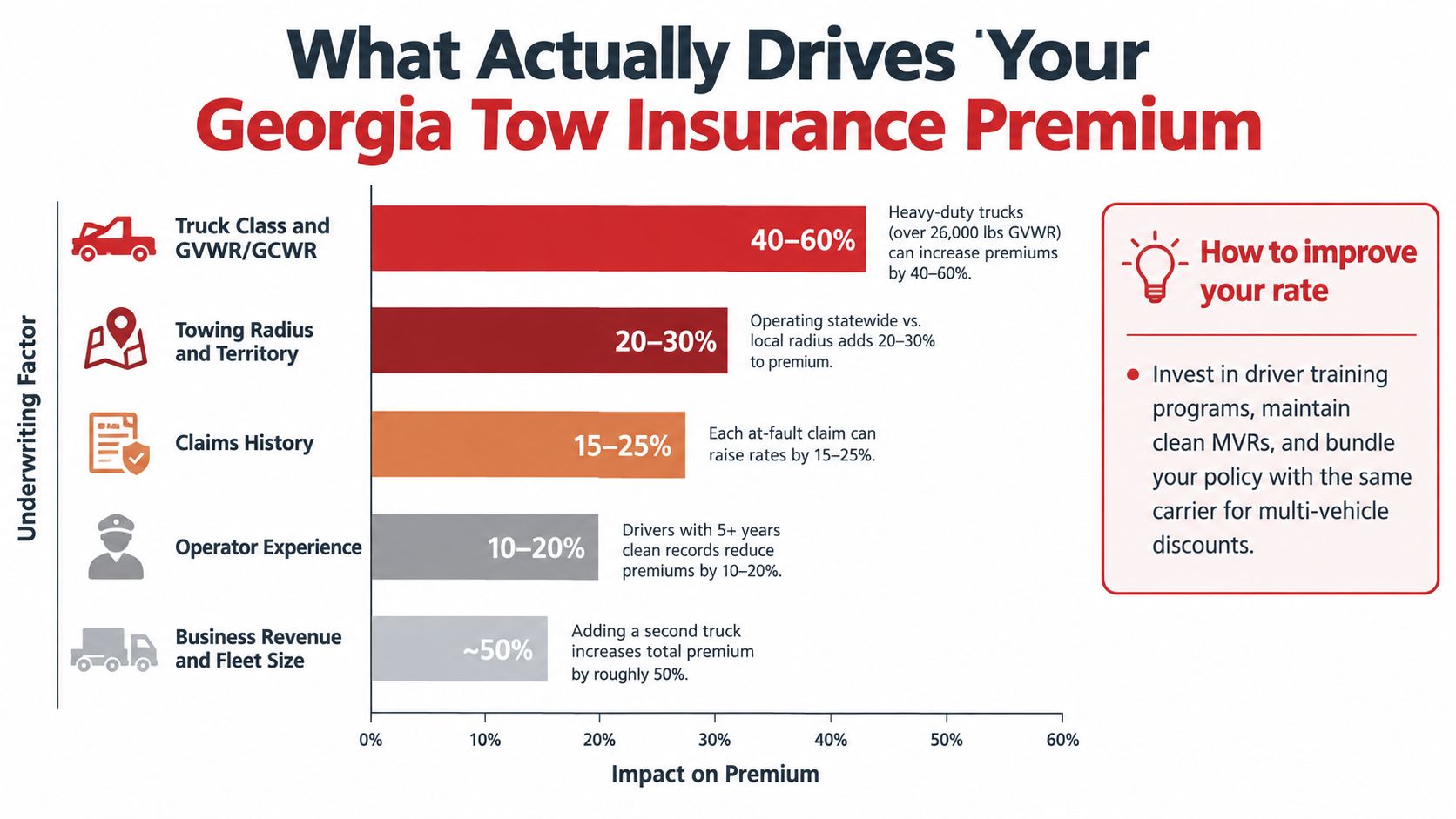
A light-duty truck handling local calls and a heavy recovery unit working interstate incidents do not belong in the same risk category. Underwriters price the operation, not just the truck's purchase price. They examine the risk created by the truck, the route, the service mix, the drivers, and the customer property in your care.
Classification is the first pressure point. GVWR and GCWR shape the operating profile, and the 10,000-pound threshold can change the federal analysis for qualifying interstate emergency work. Describe each unit and its work accurately. A vague application invites the carrier to make conservative assumptions.
The factors that move the quote
Truck class and weight establish the starting point. Give the carrier accurate GVWR and GCWR information for every unit, including equipment that changes how the truck is used.
Radius and territory affect traffic exposure, response conditions, and interstate activity. If your trucks cover Georgia broadly, do not present the business as a local-radius operation to chase a lower quote.
Service mix changes the claim profile. Roadside assistance, private-property towing, storage, recovery, and secondary interstate transport create different exposures. Tell the underwriter what the company does in practice, not only what appears on the business license.
Driver records and experience show how the operation is controlled. Provide current driver information, disclose fleet changes, and keep job assignments consistent with each driver's experience.
Loss history gives the carrier evidence about loading, securing, backing, roadside positioning, and supervision. Missing loss runs delay underwriting and can produce conservative pricing.
Storage concentration drives garage-keepers' exposure. Holding more customer vehicles at one location makes the selected limit, security controls, fire protection, and inventory process more important.
Nonconsensual towing adds both loss exposure and paperwork risk. Underwriters will want to know whether your company maintains permits, property agreements, authorization records, signage, photographs, and dispatch documentation for private-property removals.
If the quote comes in high, correct the information before cutting limits. Verify vehicle classifications, provide complete documentation, separate service types accurately, and match the garage-keepers' limit to the vehicles held. Lower limits without addressing the exposure only turns a pricing problem into a claim problem.
Nonconsensual Towing Permits Paperwork and the Compliance Workflow
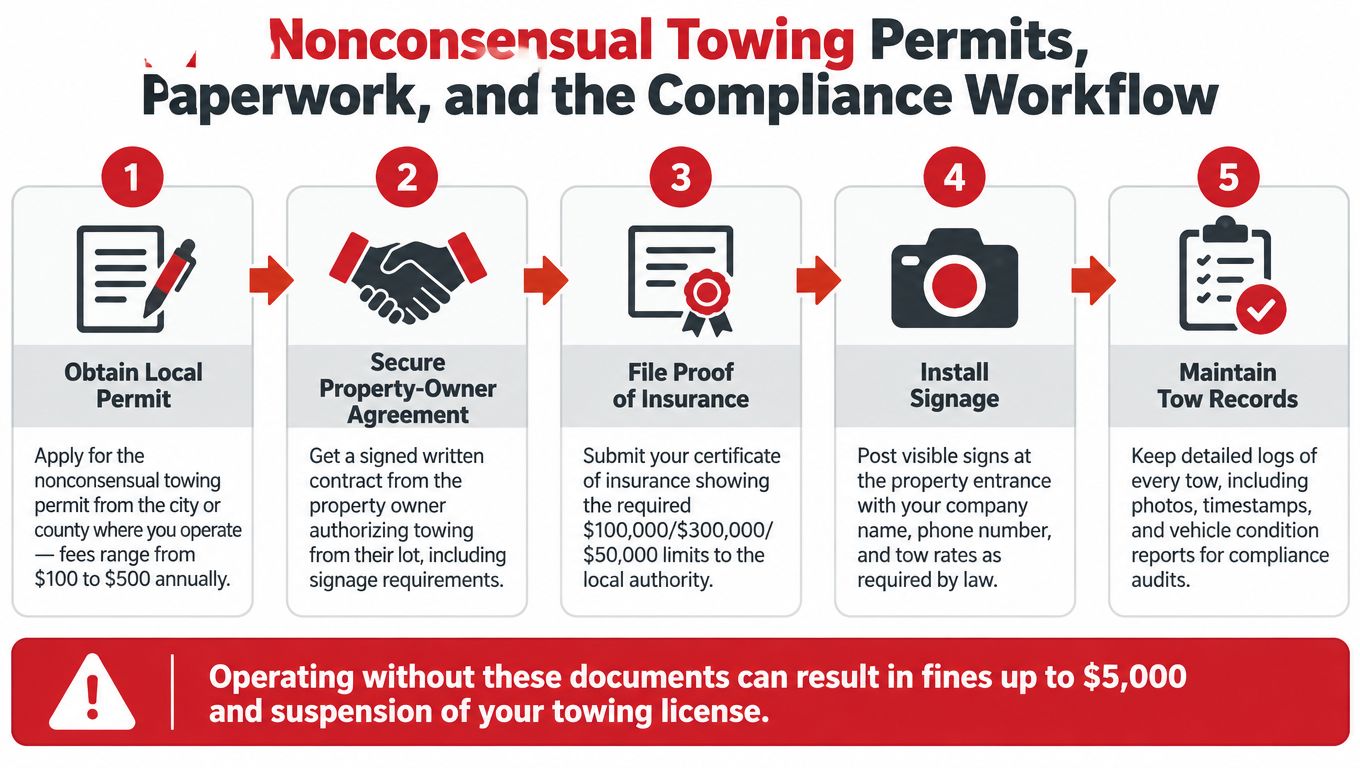
Private-property towing requires more than a phone call from someone who says they manage the lot. Georgia requires a permit for nonconsensual towing from private property, an agreement with the property owner, and insurance information on file with the Department of Public Safety. The Georgia Consumer Protection Division's towing guidance is a useful reference for the public-facing rules.
The critical operational detail is that each nonconsensual tow must be specifically and individually requested on the day of removal by the property owner or a contractually designated agent. A standing relationship with a property owner doesn't eliminate the need to document the individual request.
Run every dispatch through the same control points
- Verify the permit. Keep the current permit information accessible to dispatch and drivers. Don't send a truck based on an assumption that last year's authorization is still active.
- Confirm the property agreement. Maintain the agreement identifying the property owner or designated contracting party and the authority to request removals.
- Identify the requester. Record the name and role of the person requesting the tow on that date.
- Capture the request. Preserve the call record, written instruction, dispatch entry, or other business record showing the specific request.
- Document the vehicle. Photograph the vehicle, its position, surrounding signs, visible damage, and the condition before loading.
- Confirm storage capacity. Know where the vehicle is going and whether your garage-keepers' limit and facility controls are appropriate for the added exposure.
- File the insurance proof. Keep annual certificates current with the Department of Public Safety and monitor policy dates closely.
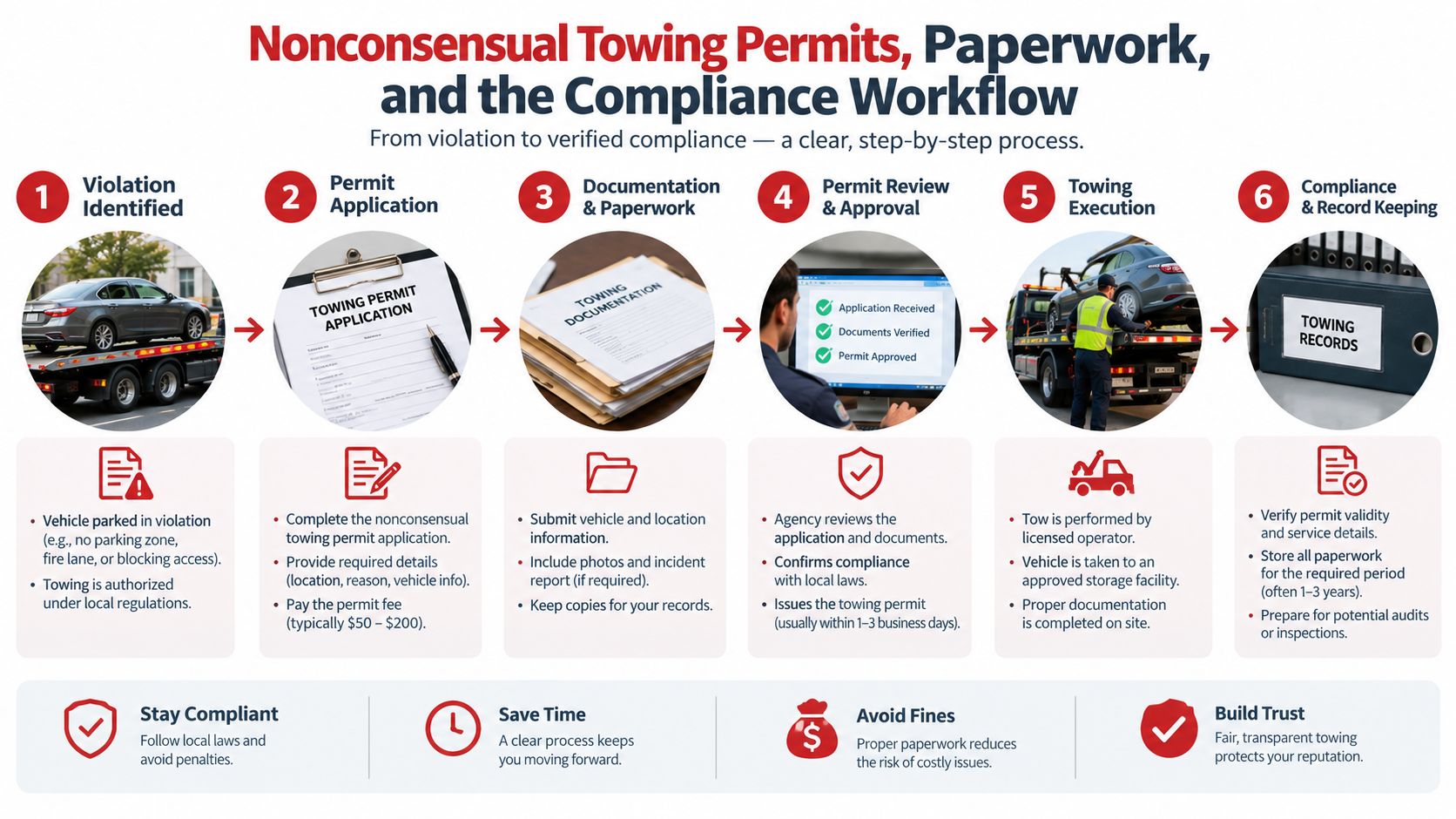
Georgia's rules require annual insurance certificates and prohibit a lapse in coverage. That means the renewal calendar belongs in the compliance system, not only in the agent's inbox. A cancellation, expiration, or missing filing can create trouble even when no accident occurs.
A completed tow ticket is not the same thing as proof that the tow was authorized.
Have dispatch use a checklist with mandatory fields. If a requester can't be identified, the date-specific instruction isn't recorded, or the vehicle condition isn't photographed, pause the job until the documentation is corrected. Fast towing is valuable. Uncontrolled towing is expensive.
Documents to Gather Before You Request a Quote
A complete submission gives an underwriter something concrete to evaluate. An incomplete submission produces follow-up questions, delayed terms, and assumptions that may not favor you.
Gather these items before you ask for a tow truck insurance quote in Georgia:
- Vehicle schedule with VINs, GVWR, and GCWR. The carrier needs to classify every unit correctly and determine whether any truck may fall into an interstate or permit-driven category.
- Driver list and MVRs. Include every regular driver and identify CDL status where applicable. A carrier needs to understand who operates the equipment, not just how many trucks you own.
- Loss runs. Request your available claims history for the prior underwriting period. The carrier uses it to evaluate frequency, severity, vehicle handling, and operational controls.
- Radius and territory description. State whether you work locally, statewide, across state lines, or under a mixture of routes. Explain how often interstate work occurs.
- Service-mix summary. Separate roadside assistance, accident recovery, private-property towing, impound storage, secondary vehicle transport, and any specialized work.
- Garage-keepers' limit and storage details. Identify how many vehicles you typically hold, the facility location, and the protection controls in place.
- Permits and property-owner agreements. Include nonconsensual-towing permits, contracts, and any local documentation that authorizes private-property work.
- Contract requirements. Provide insurance specifications from municipalities, property owners, motor clubs, repair facilities, or other contracting parties.
- Current policy and certificates. The declarations, endorsements, and certificates show what is already insured and where the gaps may be.
Tell the agent about changes before the policy is issued. A new service line, larger truck, expanded territory, or storage arrangement can change the underwriting answer. An independent agency such as Select Insurance Group, Inc. can compare commercial options across multiple carriers, but the comparison is only as good as the information in the submission.
Putting It Together for Georgia Operators
Take three actions this week.
First, classify every truck by GVWR or GCWR, route, and service type. That tells you whether the Georgia intrastate baseline is the right starting point or whether interstate obligations need to be addressed.
Second, decide whether private-property and nonconsensual towing are part of your business. If they are, put the permit, property agreement, date-specific authorization, photographs, certificates, and storage controls into one operating workflow.
Third, gather the loss runs, driver records, vehicle schedule, and garage-keepers' limit before requesting terms. Your policy should survive both the first serious claim and the first compliance review.
Use this guide as a working reference, not a substitute for reviewing your actual policy forms. The right question isn't whether you have insurance. It's whether the policy matches the truck, the customer vehicle, the storage lot, the route, and the paperwork your business uses every day.
Select Insurance Group, Inc. helps Georgia tow operators compare commercial auto, physical-damage, hired and non-owned auto, cargo, and tools-and-equipment coverage across multiple carriers. Visit Select Insurance Group, Inc. to request a no-obligation quote and organize coverage around your actual towing, storage, and compliance exposures.