
The most popular advice about tow truck insurance in Florida is also the most misleading: “Buy the Florida minimum.” Florida doesn't have one flat minimum that fits every tow truck. The applicable limit can change with the vehicle's registered weight, federal jurisdiction, towing method, consent status, storage operations, and county licensing rules.
A light-duty truck handling local consent tows isn't carrying the same exposure as a heavy recovery unit responding to police calls or a truck operating across state lines. The legal minimum may keep a vehicle compliant, but it may not protect the business after a serious collision, damage to a customer's vehicle, or a loss at a storage yard. The right policy starts with the work you perform, not a generic quote form.
Table of Contents
- The Myth of a Single Florida Minimum
- Weight-Based Liability Limits and Federal Rules
- Essential Coverage Types for Tow Operators
- How County Rules and Towing Types Change Limits
- Preparing Your Fleet Data for Accurate Quotes
- Risk Management Strategies to Lower Premiums
- Frequently Asked Questions About Florida Tow Insurance
The Myth of a Single Florida Minimum
Florida does not set one liability limit for every tow truck. The applicable state tier depends on the vehicle's gross weight. Florida Statutes section 627.7415 establishes those weight-based categories, while federal financial-responsibility rules can apply when the operation falls under federal Department of Transportation requirements.
Consider a Tampa operator running two units: a 26,000-pound rollback for local customer-requested calls and a 50,000-pound heavy wrecker for recovery work. They operate from the same business and city, yet their liability requirements may differ because the trucks fall into different weight categories. If the heavy wrecker crosses state lines or performs work subject to federal rules, another standard may apply as well.
Practical rule: Ask, “What limit applies to each truck, each type of tow, and each jurisdiction where we operate?” Do not treat “the Florida minimum” as a single answer.
The statutory limit is only a financial-responsibility floor. A serious crash can produce bodily-injury claims, damage to several vehicles, cleanup expenses, lost operating time, and disputes involving the customer vehicle in transit. Once the policy limit is exhausted, the remaining loss can reach the business owner.
Why the towing model changes the answer
A customer-requested roadside tow has a different regulatory and contractual profile from police rotation, trespass towing, or private-property impounds. Non-consent work and storage can bring added documentation, customer-property, and county licensing requirements.
Separate the operation into three exposures:
- Roadway liability, for injury or damage caused by the tow truck.
- Customer-vehicle exposure, while a vehicle is attached, loaded, or transported.
- Custody exposure, while a vehicle is held at a yard or another covered location.
A generic “tow truck” classification can miss those distinctions. The policy should match each truck's weight, route, towing method, and custody responsibilities before the insurer sets limits or endorsements. A quote built on the wrong unit or service type may look compliant while leaving a material gap.
Weight-Based Liability Limits and Federal Rules
Florida does not set one liability limit for every tow truck. For many commercial towing operations, the starting point is a weight-based schedule using combined bodily-injury and property-damage liability per occurrence. The required amount rises with the vehicle's weight.
| Gross Vehicle Weight | Minimum Liability Limit | Typical Tow Truck Class |
|---|---|---|
| 26,000 pounds or more, but less than 35,000 pounds | $50,000 per occurrence | Some lighter commercial wreckers |
| 35,000 pounds or more, but less than 44,000 pounds | $100,000 per occurrence | Heavier wreckers and recovery units |
| 44,000 pounds or more | $300,000 per occurrence | Heavy-duty recovery equipment |
These amounts reflect Florida's statutory schedule under section 627.7415. They are not universal limits for every tow truck, nor are they automatically appropriate for every business. A unit below these tiers may still face different requirements because of its use, local licensing, contract terms, or federal operating status.
Confirm the actual weight classification
Start with the truck's registration and manufacturer documentation. A sales label such as “light duty” or “heavy duty” is not enough. Depending on the vehicle and operation, the relevant rating may be gross vehicle weight or gross combination weight. A rollback, wrecker, and recovery unit can carry different equipment and fall under different classifications, even when operators use “tow truck” for all three.
Florida law also addresses vehicles subject to federal Department of Transportation insurance rules under 49 C.F.R. part 387. Those units must meet the applicable federal financial-responsibility requirements, which can replace the state weight-based amount for the operation involved.
Interstate work changes the compliance picture
The Federal Motor Carrier Safety Administration guidance on tow-truck financial responsibility states that for-hire tow trucks with a GVWR or GCWR of at least 10,000 pounds performing emergency moves in interstate or foreign commerce must maintain $750,000 of financial responsibility. Secondary moves may be subject to coverage levels tied to the commodity transported by the towed vehicle.
Florida-based operators can therefore fall under federal requirements when they cross state lines, accept certain commercial assignments, or change the type of move they perform. The operating territory and service model belong in the underwriting file, not just the company's mailing address.
Before binding coverage, document each unit's registered weight, GVWR or GCWR, operating territory, interstate activity, and type of tow. Then have the agent confirm the state and federal rules for that specific truck. A fleet-wide limit chosen from the smallest unit can leave a heavier or federally regulated vehicle classified incorrectly.
Essential Coverage Types for Tow Operators
Commercial auto liability pays for bodily injury or property damage you cause to others while the insured truck operates on the road. It does not automatically cover every customer vehicle your business loads, transports, or stores. That distinction should shape the policy program from the start.
Match the policy to the moment of loss
On-hook or in-tow coverage applies to damage to a customer's vehicle while it is attached to the tow truck or being transported. A failed hookup, shifting equipment, or collision in transit can create this exposure. Review the wording for loading, unloading, improper hookup, and whether the policy treats the vehicle as being towed or transported as cargo.
Garagekeepers' legal liability addresses customer vehicles in your care, custody, or control at a covered location. Fire, theft, and collision can damage vehicles in the yard. This coverage is separate from on-hook protection because the risk changes once the vehicle leaves the roadway and enters storage.
Garage liability covers non-driving business exposures. A customer might be injured while visiting the lot, or property could be damaged by an operation unrelated to driving the wrecker. Hillsborough County's trespass-towing and immobilization requirements show how commercial auto, garage liability, and garagekeepers' legal liability can be treated as separate requirements.
Protect the truck and its equipment
Physical-damage coverage protects the tow truck against covered collision, theft, fire, and other selected causes of loss. It covers the business's equipment investment, not the customer's vehicle. Confirm how the policy values specialized booms, winches, dollies, and permanently installed equipment.
Tools and removable gear may need cargo or equipment coverage when they travel with the truck. A stolen winch accessory or damaged roadside tool may not be handled like a collision involving the insured vehicle.
Operators financing a replacement unit should coordinate the lender's interest, vehicle value, and insurance requirements before the truck enters service. Capital Express on fleet funding provides context for that connection. The insurance schedule should reflect the actual equipment installed, not only the chassis description.
A policy review should identify the response to each loss:
- The tow truck injures another driver: commercial auto liability.
- A customer's vehicle is damaged while attached: on-hook or in-tow coverage.
- A customer's vehicle is damaged in the yard: garagekeepers' legal liability.
- A visitor is injured at the premises: garage liability, subject to policy terms.
- The insured wrecker is damaged: physical-damage coverage.
- Tools or removable equipment are stolen: cargo or equipment coverage, if included.
Truck liability coverage offers a broader explanation of commercial vehicle liability structure. Auto liability alone leaves the customer vehicle, the yard, and your equipment exposed.
How County Rules and Towing Types Change Limits
Florida does not have one universal insurance limit for every tow truck. County requirements can raise the threshold based on the work performed, especially for police rotation, trespass towing, immobilization, private-property towing, recovery, and storage.
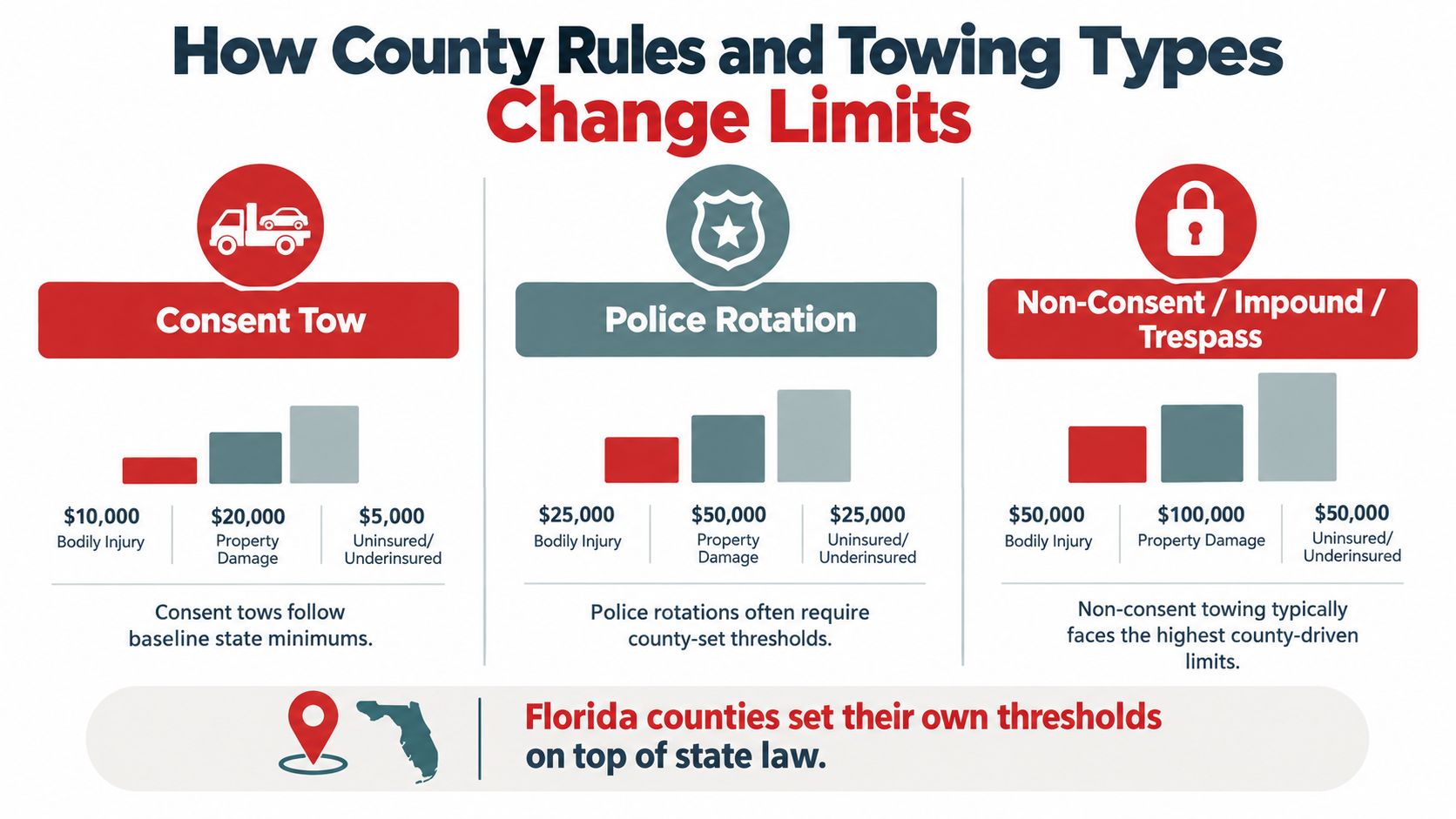
Palm Beach County materials show how operating models affect combined-single-limit requirements. Certain light-duty consent-only trucks are listed at $100,000, light-duty non-consent trucks at $300,000, and other non-consent units at $500,000. The same materials address general or garage liability and vehicle-in-care coverage. These are county-specific examples, not statewide substitutes for Florida's statutory requirements.
Consent and non-consent work are not interchangeable
A customer-requested tow usually has a clearer authorization record. Non-consent work creates added exposure involving property rights, notice, documentation, vehicle condition, and disputes. Police and municipal contracts may also specify insurance wording, certificates, response standards, and liability limits.
Hillsborough County requires each tow truck to carry commercial motor-vehicle liability meeting Florida's statutory requirements. It also requires garage liability of at least $300,000 combined single limit per occurrence and in the aggregate, plus garagekeepers' legal liability. For vehicles in custody, the county specifies at least $50,000 of property-damage coverage per occurrence at each location, including towing, with a deductible of no more than $1,000 per vehicle. Confirm the current county requirement before accepting non-consent work or submitting a certificate.
Florida's wrecker-operator disclosure rules also reference a $300,000 liability level and $50,000 of on-hook cargo insurance in applicable towing arrangements. Verify the obligation under section 627.7415 and the disclosure rules in chapter 627, then match the policy and certificate to the specific license and operation. A limit copied from another county may not satisfy the rule governing your work.
Audit the territory before renewing
List every county where trucks pick up, tow, store, or release vehicles. Mark each service as consent, police rotation, private-property, trespass, recovery, or storage. Expansion into non-consent work can leave a business out of compliance if its policy, certificates, and contract wording remain unchanged.
Coverage follows the job, but county compliance follows the location. Review both before accepting a new contract.
For broader commercial vehicle considerations, review this guide to trucking insurance in Florida. Keep a county-by-county compliance file with applicable limits, certificate wording, covered locations, named trucks, and contract requirements.
Preparing Your Fleet Data for Accurate Quotes
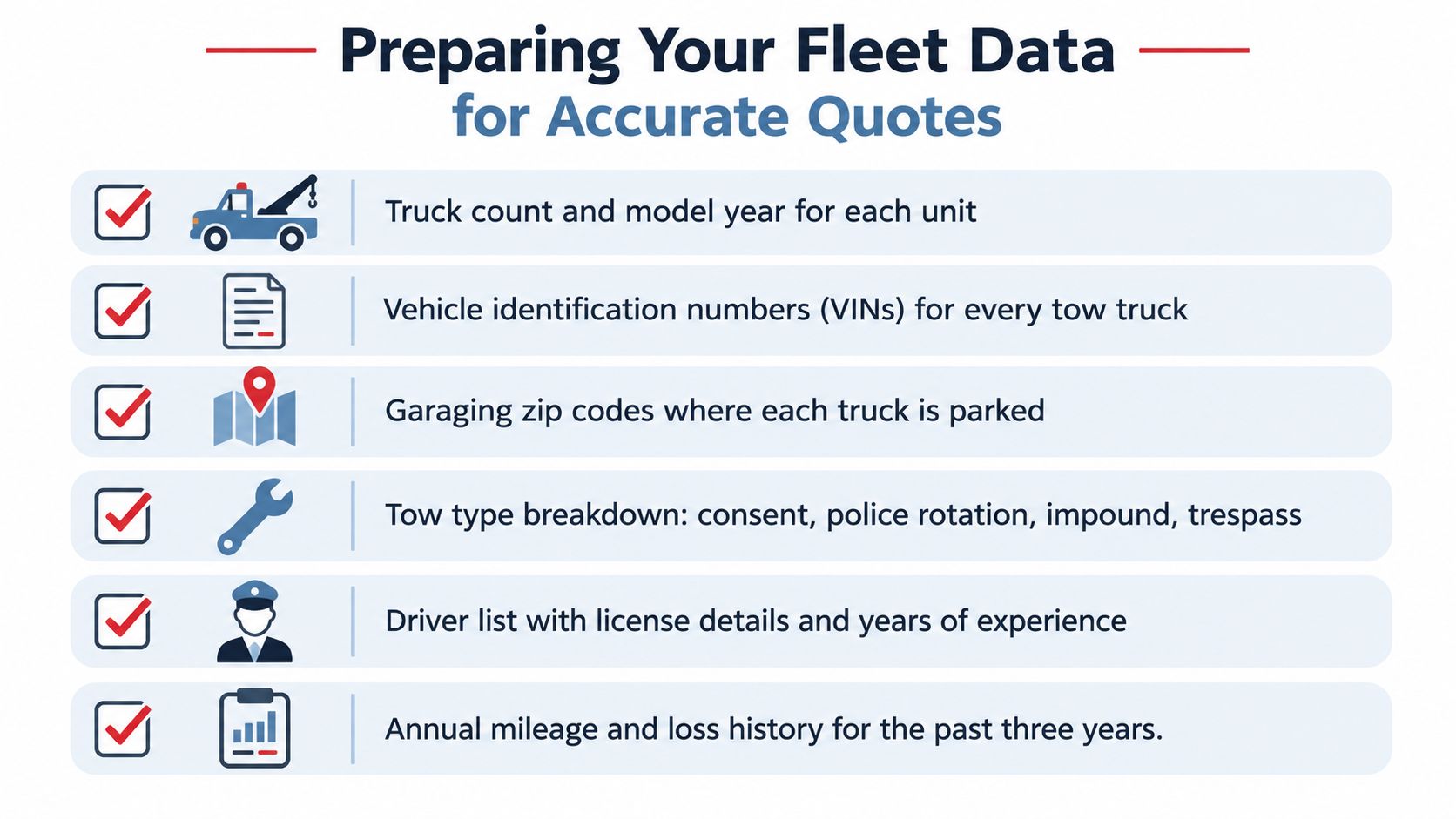
Underwriters can't price a mixed towing fleet accurately from a business name and ZIP code alone. They need each unit, driver, location, and service type identified clearly. Incomplete applications often produce delays, repeated questions, or a quote that changes after the carrier discovers the actual operation.
Build a unit-by-unit schedule
Prepare a fleet schedule showing the year, make, model, VIN, registered weight, stated value, and installed towing equipment for every truck. Florida wrecker-operator disclosures and local licensing rules, including Broward County requirements, may require certificates to identify each truck by year, make, and VIN, as reflected in Florida's statutory material.
Don't group dissimilar trucks under a casual label such as “three wreckers.” The insurer needs to know which unit performs consent towing, which handles police work, and which may cross state lines. The registered weight and operating use can affect both compliance and pricing.
Give the carrier the operating story
A useful submission includes:
- Service mix: Separate consent, police rotation, impound, trespass, recovery, and storage work.
- Territory: Identify local routes, counties served, and any interstate activity.
- Drivers: Provide the driver list, license information, experience, and motor-vehicle history.
- Garaging: Identify every location where trucks are parked, serviced, or stored.
- Customer vehicles: Explain maximum custody exposure, storage practices, and release procedures.
- Loss history: Supply prior claims and explain corrective action after any preventable loss.
The revenue split between consent and non-consent work also matters because it gives the underwriter a more accurate picture than a single annual sales figure. Describe who authorizes the tow, where vehicles go, how long they remain there, and who controls access.
A fleet operator expanding into new territories may also benefit from a practical guide to managing fleets. Good fleet records improve more than insurance submissions. They help identify which units are idle, which drivers operate each truck, and where maintenance or documentation breaks down.
Risk Management Strategies to Lower Premiums
Premium discussions are easier when the operator can show how the business controls risk. Underwriters look beyond the truck's make and model. They want evidence that drivers, equipment, customer vehicles, and storage locations are managed consistently.
Create a documented driver program
Screen every driver before assignment, review driving records on a scheduled basis, and document training for hookups, roadside positioning, winching, backing, and customer interaction. A written procedure matters only when dispatchers and supervisors use it. Keep signed acknowledgments, incident reports, and corrective-action records in a central file.
Dashcams and GPS telematics can support this program by documenting route activity, harsh events, speed patterns, and the circumstances of a disputed loss. They don't replace training, but they can help separate a preventable event from an allegation and give managers facts for coaching.
Control the yard as carefully as the road
A storage operation should have clear intake records, condition photos, key controls, release authorization, and an incident process. Fencing, lighting, controlled access, and continuous camera coverage can reduce opportunities for theft and help demonstrate reasonable care for vehicles in custody.
Vehicle inspections should happen before and after each shift. Record tire condition, lights, winches, straps, chains, hydraulic components, and safety equipment. A tow truck that fails during a roadside recovery can create more than a repair bill. It can damage the customer vehicle, expose workers and motorists, and create a difficult liability dispute.
A lower premium usually follows a better risk story. Build the story with records, not assurances.
Reviewing average truck insurance cost can help an operator understand the factors that influence pricing, but no general estimate replaces a submission based on the actual fleet. The strongest renewal file shows what changed, what the business measured, and what it did after a close call or claim.
Frequently Asked Questions About Florida Tow Insurance
A tow operator usually discovers coverage problems during ordinary operational changes. A new driver joins, a wrecker goes into the shop, a customer asks for a long-distance move, or the business starts holding cars overnight. The safe response is to notify the agent before the change becomes a claim issue.
Can a personal auto policy cover occasional towing?
If the truck earns money towing for customers, responds to paid roadside calls, transports customer vehicles, or performs business work, a personal-use policy is generally the wrong starting point. The insurer needs the commercial use disclosed and the coverage written for the actual operation. “Occasional” doesn't erase the business purpose of the trip.
What happens when a wrecker is leased?
Tell the agent and the leasing company before the truck operates. The contract may require specific liability limits, physical-damage terms, loss-payee wording, or certificates identifying the leased unit. The policy should list the truck accurately, including its VIN and equipment, rather than treating it as a temporary substitute without review.
Can a truck be removed while it's being repaired?
Ask whether the policy permits a temporary suspension, storage status, or change in use. Removing coverage without understanding the consequences can create a gap for theft, fire, equipment damage, or liability arising from movement at the repair location. Keep the agent informed about where the unit is and who controls it.
How should a new driver be added?
Provide the driver's information before dispatching that person. The carrier may review licensing, experience, driving history, and the driver's assigned work. A driver added informally can create underwriting and claim complications, particularly if the person operates a heavier unit or performs a different class of tow.
Does local visibility affect the insurance program?
It doesn't replace coverage, but clear service information can help customers find a properly established operator. Businesses that want practical guidance on boosting local coverage leads should keep their service territory, phone details, and operating categories consistent across public listings. That same discipline helps internally, because the counties and services advertised should match the work disclosed to the insurer.
Select Insurance Group, Inc. helps Florida tow operators compare commercial auto, trucking, liability, physical-damage, cargo, and equipment coverage through licensed agents. Visit Select Insurance Group, Inc. to discuss your truck schedule, towing territory, county requirements, and storage exposure before requesting a quote.