
In ZIP code 37129, the average annual homeowners insurance premium was $1,832 in 2022, but your actual cost can differ sharply based on roof age, flood exposure, and the reconstruction cost created by Murfreesboro's rapid growth. A local policy should be built around your property, not a citywide average.
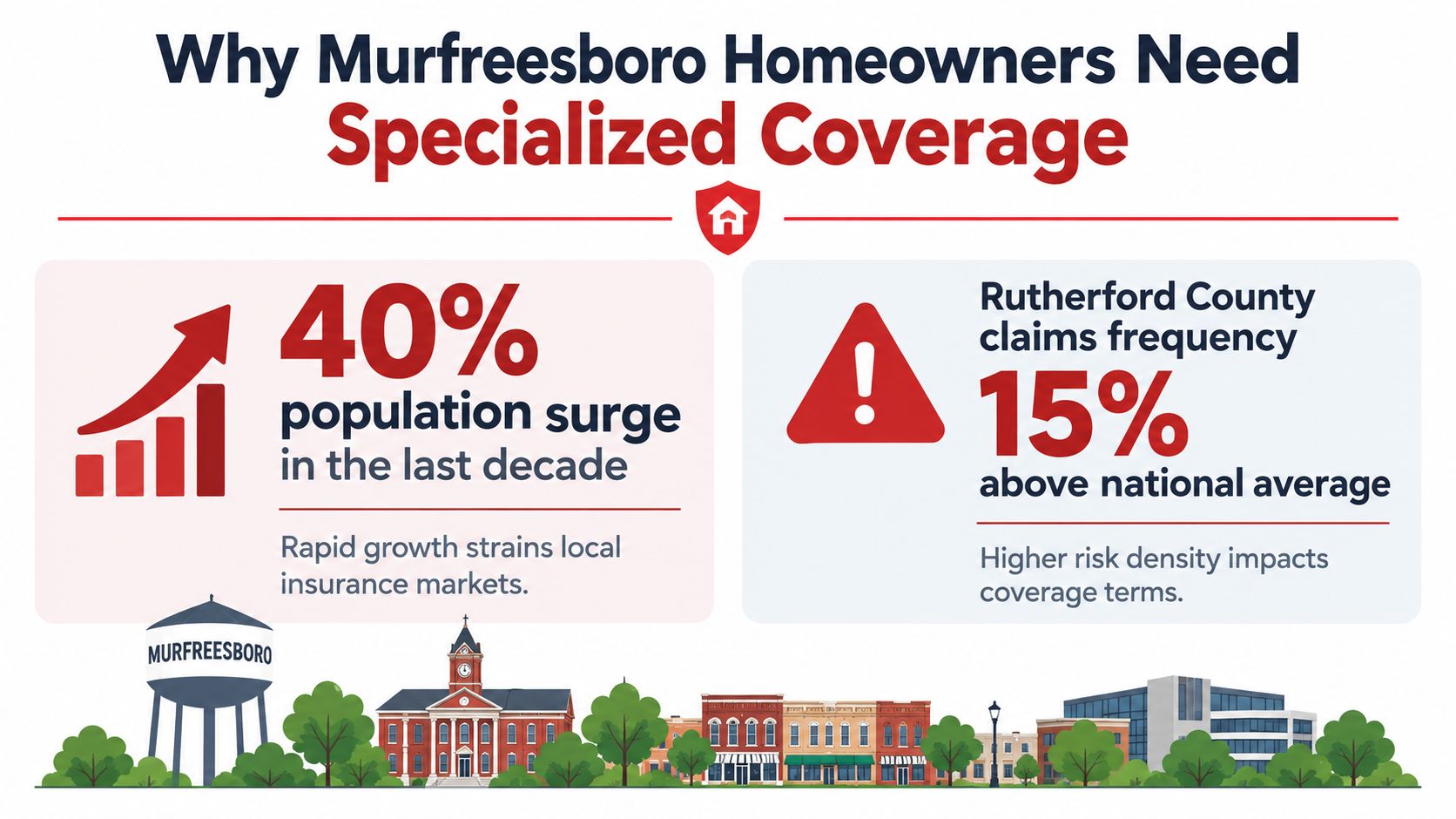
Murfreesboro grew from 108,755 residents in 2010 to 152,769 in 2020, an increase of approximately 40.5%. That growth changes the insurance conversation. New construction, older homes, changing drainage patterns, higher-value properties, and rising rebuilding demands all exist within the same market. A quote that looks competitive may still leave a serious gap if the dwelling limit, roof settlement, flood protection, or deductible is wrong.
Table of Contents
- Why Murfreesboro Homeowners Need Specialized Coverage
- Understanding the Basics of Homeowners Policies
- Local Risks That Drive Premiums Up
- Actual Cash Value vs Replacement Cost
- How to Compare Quotes and Lower Your Costs
- Getting Started with Select Insurance Group
Why Murfreesboro Homeowners Need Specialized Coverage
Murfreesboro's rapid growth has created a rebuilding problem that citywide averages cannot solve. Two homes on neighboring streets may require very different coverage. One might have a newer roof, modern wiring, and no basement. The other could have aging plumbing, lower elevation, a finished basement, or costly renovations that were never added to the policy.
The city also combines newer construction with older housing stock in the same ZIP codes. That mix affects labor, materials, permits, and contractor availability after a major storm. Census figures place the median value of an owner-occupied home at $365,100 during the 2019–2023 period, while 53.3% of occupied housing units were owner-occupied. Those figures describe a broad range of properties, not one standard insurance risk. Tennessee homeowners insurance data
Growth changes the rebuilding equation
A home's purchase price does not establish its insurance replacement cost. Rebuilding may require specialized labor, current material prices, permits, debris removal, and compliance with updated building requirements. Those costs can rise when a regional storm sends many homeowners to the same contractors at once.
Set the dwelling limit from the property itself, not from its real estate value. Review square footage, construction quality, roof type, attached structures, custom finishes, and recent improvements. Report a finished room, upgraded kitchen, new roof, built-ins, or other material change before the policy is issued.
Local rule: A citywide premium average can flag an unusual quote. It cannot confirm that your home has enough coverage to rebuild.
People relocating into Rutherford County should also review neighborhood growth, housing patterns, and moving activity through ReloMaps data for Tennessee movers. Use that information for context, then have an agent assess the specific property, its construction, and its exposure to local drainage and storm risks.
Household finances matter when setting deductibles. Census data reports median monthly owner costs of $1,824 for homes with a mortgage and $543 for homes without one. A deductible that looks manageable on paper may be difficult after a major loss, while a low deductible can increase the premium. Choose both figures together, based on the property and the cash available to handle an uncovered expense.
Understanding the Basics of Homeowners Policies
A typical homeowners policy is easier to evaluate when you separate it into four jobs. It protects the house, your belongings, your legal exposure, and your living arrangements after a covered loss.
The four protections that matter
Dwelling coverage pays to repair or rebuild the insured structure after a covered event, subject to the policy terms and limit. It generally includes the house itself and may extend to attached structures. The limit should reflect estimated reconstruction cost, not the land value or just what you paid.
Personal property coverage protects belongings such as furniture, clothing, appliances, and electronics. Check whether the policy settles damaged property at actual cash value or replacement cost. High-value jewelry, collectibles, firearms, business property, and certain electronics may need special scheduling or separate limits.
Personal liability coverage helps respond when someone claims you caused bodily injury or property damage. It can also help with legal defense, depending on the circumstances and policy language. This protection matters beyond the front door because homeowner liability can involve pets, pools, recreational equipment, and accidents involving visitors.
Additional living expense coverage helps with necessary extra costs if a covered claim makes the home uninhabitable. Keep receipts and ask how the policy defines reasonable expenses, temporary housing, meals, storage, and related costs.
Deductibles and exclusions deserve equal attention
The deductible is the amount you pay before the policy responds. A percentage-based wind or hail deductible must be converted into a dollar amount before you decide whether it fits your budget. A lower premium can become a bad bargain if the deductible is unaffordable after a storm.
Standard homeowners insurance typically doesn't cover every cause of damage. Flood is the major local gap, and sewer or drain backup may require separate coverage or an endorsement. Wear and tear, maintenance failures, and gradual deterioration usually aren't treated like sudden covered losses. For a practical explanation of one common claim question, review does insurance cover plumbing leaks.
For a Tennessee-specific starting point, compare the available Tennessee home insurance coverage and then read the exclusions, endorsements, sublimits, and settlement language before choosing a policy.
Local Risks That Drive Premiums Up
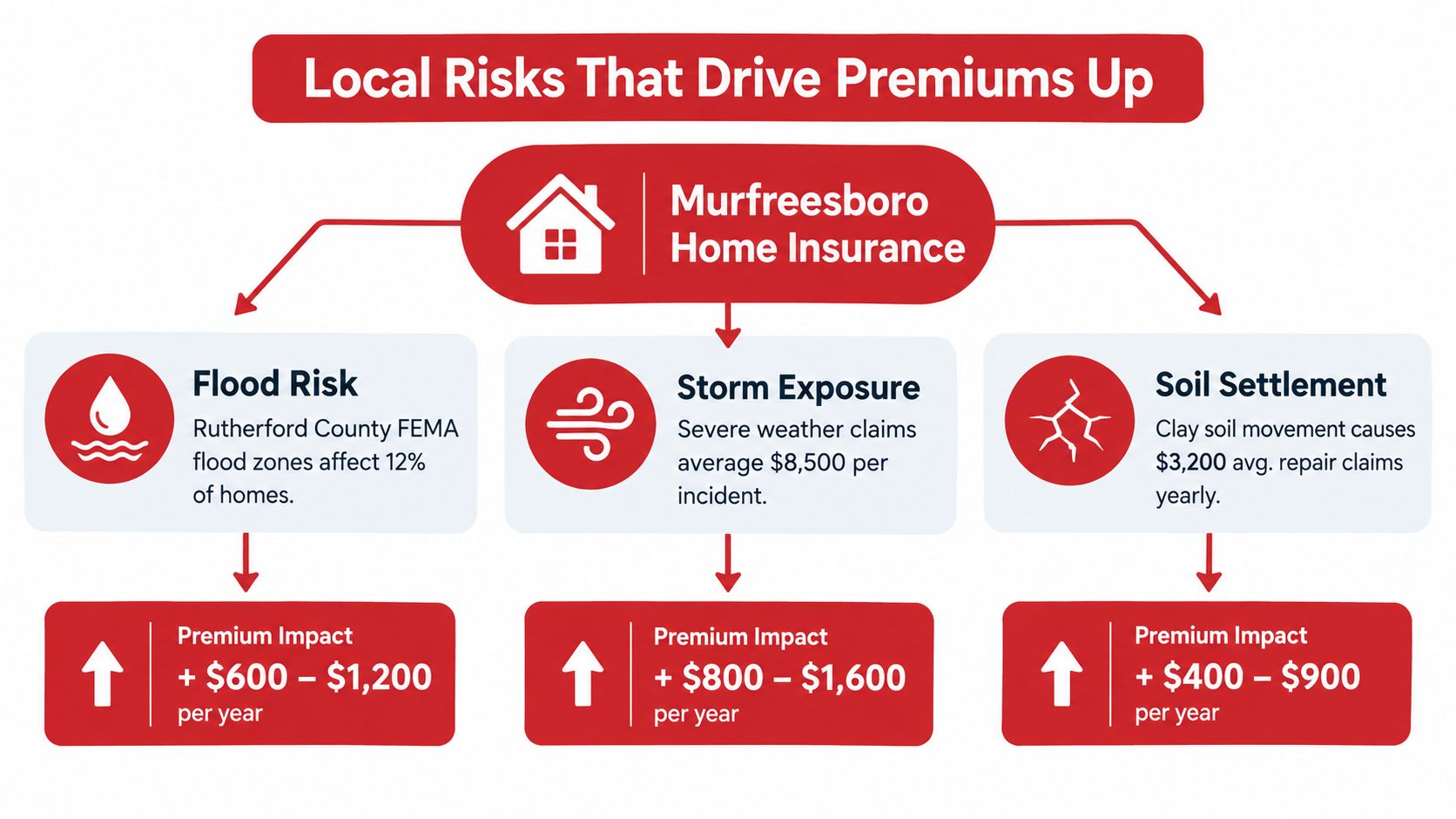
Murfreesboro homeowners face three separate insurance questions: Can water reach the property? Can a storm damage the structure? Can the policy rebuild the home at today's cost? Rapid growth in the area can raise rebuilding costs as labor, materials, and contractor demand change. A standard policy may address some storm losses, but it does not automatically solve flood exposure or inadequate dwelling limits.
Rutherford County has recorded 75 flood or flash-flood events since 1996, including one death. The National Flood Insurance Program has paid approximately $7.1 million across 453 claims since 1978. Those figures cover insured NFIP losses only, not damage suffered without flood insurance or losses below policy thresholds. Review the Rutherford County flood history before assuming a property has little flood exposure.
Flood risk doesn't stop at the mandatory-purchase line
Ordinary homeowners insurance generally does not cover flood damage. A lender can require flood insurance when a mortgaged structure sits in a designated high-risk zone, but no lender requirement does not prove the property is safe.
For a Murfreesboro property, verify the parcel's FEMA map designation and determine whether the structure itself, rather than only the lot, lies in a Special Flood Hazard Area. Compare the lowest floor with the applicable Base Flood Elevation. Ask about foundation type, basement limitations, contents coverage, waiting periods, and exclusions.
Surface water, drainage failures, creek overflow, and intense rainfall can affect homes outside mandatory-purchase areas. Flood damage and sewer or drain backup are separate coverage questions, so get each answer in writing instead of accepting a vague statement that the policy “covers water.”
Storm damage exposes roof weaknesses
Hail and wind losses can make the roof the most important part of the policy review. A Tennessee property-claims analysis reported 6,436 hail claims in 2023, $337 million in insured losses, an average hail claim of $42,814, and average roof-replacement claims of $25,422. These figures are not a quote for a Murfreesboro home, but they show the financial stakes of settlement language. Read the Tennessee property-claims analysis.
Confirm whether the roof settles at replacement cost or actual cash value. Identify cosmetic-damage exclusions, convert the wind or hail deductible into dollars, and document roof condition before a loss. After a storm, hire qualified storm damage repair specialists, then keep inspection records, photographs, invoices, and communications.
For a regional point of comparison, review this Nashville home insurance resource. Murfreesboro quotes still require property-level underwriting.
Actual Cash Value vs Replacement Cost
The difference between actual cash value and replacement cost can determine how much money remains available after a covered loss. That choice matters in Murfreesboro, where population growth, rising construction demand, and specialized labor can affect the cost of restoring a home.
Actual cash value begins with the damaged item's current value, then subtracts depreciation for age and condition. Replacement cost coverage is designed to pay what it costs to replace the item with one of like kind and quality, subject to the policy's limits, deductible, exclusions, conditions, and claim procedures.
A roof makes the difference obvious
Suppose a storm damages an older roof. With an actual cash value settlement, the insurer may account for the roof's age and remaining useful life before calculating payment. The resulting check may fall well below the amount required for a new roof, even when the damage qualifies for coverage.
The Tennessee claims figures cited in the previous section show why settlement language matters when a major loss occurs. Review the policy before a storm, especially if the roof is older or has been repaired more than once.
Read the settlement clause: “Replacement cost” does not mean unlimited payment. The dwelling limit, deductible, exclusions, depreciation rules during the claim process, and any required repair or replacement deadlines still apply.
Contents need the same scrutiny
A damaged television, laptop, sofa, or appliance may have a lower current value than its replacement price. If personal property settles on actual cash value, depreciation can reduce the payment. Replacement cost contents coverage generally provides a stronger path to restoring comparable belongings, but documentation requirements and category limits still apply.
Create a home inventory before you need it. Photograph each room, save receipts for major purchases, record model information, and store the files outside the home. Pay close attention to jewelry, collectibles, musical instruments, tools, and home-office equipment because standard limits may be restrictive.
Replacement cost usually costs more than actual cash value, so compare the premium with the potential funding gap. For a Murfreesboro property, I generally recommend requesting replacement-cost settlement for the dwelling and reviewing contents coverage separately. A premium cut achieved through ACV settlement can cost far more than it saves once an older roof or interior finish is damaged. Ask the agent to explain the roof settlement, contents basis, deductible, and claim deadlines in writing before you choose.
How to Compare Quotes and Lower Your Costs
The cheapest quote isn't automatically the best quote. A meaningful comparison places the same dwelling limit, personal property basis, liability limit, deductible, roof settlement, water endorsements, and additional living expense terms beside one another.
In ZIP code 37129, the reported average annual premium increased from $1,767 in 2018 to $1,832 in 2022, a difference of $65. The 2022 average of $1,832 was approximately 6% above the unweighted Tennessee ZIP-code mean of $1,728. These are historical benchmarks, not promised prices. Tennessee ZIP-level homeowners insurance data
Use this quote comparison process
-
Prepare accurate property details. Gather the address, year built, square footage, roof age, roof material, foundation type, heating system, plumbing updates, electrical updates, detached structures, finished areas, and recent renovations. Guessing creates a weak quote and can create problems during underwriting.
-
Set the dwelling limit from reconstruction needs. Don't use the tax assessment or purchase price as a substitute for replacement-cost analysis. Tell the agent about custom cabinets, upgraded bathrooms, specialty flooring, screened porches, garages, and other features that affect rebuilding.
-
Compare deductibles in dollars. A percentage wind or hail deductible may look simple on a declarations page, but the actual payment obligation depends on the insured dwelling limit. Ask for the exact dollar amount.
-
Review exclusions and endorsements. Ask specifically about flood, drain backup, roof settlement, ordinance or law coverage, equipment breakdown, service lines, identity restoration, and scheduled valuables. A quote comparison is incomplete until these gaps are visible.
-
Ask about discounts without weakening coverage. Bundling home and auto insurance, installing monitored protective devices, maintaining documented roof inspections, and improving risk controls may affect eligibility or price. Credit-based insurance factors may be used where permitted. Never make a safety or maintenance decision solely for a discount without understanding the policy benefit.
-
Re-shop after material changes. A new roof, renovation, added detached structure, paid-off mortgage, major purchase, or change in occupancy should trigger a review. Your policy must keep pace with the property.
An independent agency can request multiple options, but you still need to compare the coverage line by line. A lower premium with ACV roof settlement or a larger storm deductible may provide less protection than a higher premium with stronger terms.
Getting Started with Select Insurance Group
A sound Murfreesboro insurance review starts with facts, not a quick online price. Gather your property information, identify the roof's age and settlement basis, verify flood exposure, and decide what deductible you could pay after a major loss.
Then ask the agent to present alternatives using the same assumptions. The useful questions are straightforward:
- What is the estimated replacement cost, and what features were included?
- Is the roof settled at replacement cost or actual cash value?
- Is the wind or hail deductible a flat amount or a percentage?
- Does the policy address flood, drain backup, and water seepage separately?
- Are improvements, detached structures, and personal valuables adequately insured?
- What happens to additional living expenses if the home can't be occupied?
- Which discounts apply, and what eligibility requirements continue after binding?
Select Insurance Group, Inc. can compare homeowners coverage through its independent agency model and provides quote assistance across Tennessee. Its published service model includes comparisons from multiple carriers, bilingual specialists, online document tools, payment support, policy updates, and claim assistance. Those capabilities are useful when the property has unusual features or when a homeowner wants to compare price and policy language together.
The agency's broader experience across states doesn't remove the need for local underwriting. Murfreesboro's risks still come down to your address, roof, elevation, construction details, occupancy, prior losses, deductible, and coverage choices. Use the same disciplined process for any agency, and insist on written answers to the gaps that matter most.
For homeowners who want to understand how an agency operates in another service area, the Select Insurance Group Orlando resource provides additional company context. The next practical step is to request a review before renewal, before buying a home, or immediately after a renovation or roof replacement.
Select Insurance Group, Inc. offers homeowners insurance comparisons, coverage guidance, and support for Murfreesboro properties, including reviews of dwelling limits, roof settlement, deductibles, flood questions, and liability protection. Visit Select Insurance Group, Inc. to request a free, no-obligation quote review and discuss coverage built around your home rather than an average.