
In Nashville, homeowners insurance averages about $2,023 a year, or $169 a month, for $300,000 in dwelling coverage. That's below Tennessee's statewide average, but it's still above the U.S. average, and pricing can swing roughly 26% by ZIP code inside the city alone.
You can buy what looks like the same policy and still end up with a very different bill after a spring storm, a roof claim, or a flood scare. That's because nashville home insurance is driven by more than house value. It's shaped by wind and hail deductibles, flood exclusions, roof age, and how close your property sits to local loss patterns.
Table of Contents
- Why Nashville Homeowners Need the Right Coverage
- What a Nashville Homeowners Policy Actually Covers
- Nashville Perils From Tornadoes to Flood Water
- How Much Home Insurance Costs in Nashville
- Tennessee Rules and How to Buy a Policy
- Saving Money With Discounts and Loss Prevention
- Comparing Quotes and Working With a Local Agency
Why Nashville Homeowners Need the Right Coverage
A homeowner on a quiet Nashville street gets hit with a strong spring storm, then files a claim and learns the deductible isn't a flat number. It's a percentage wind/hail deductible, which means the out-of-pocket hit is tied to the dwelling limit, not just the repair bill.
That's the kind of surprise that turns an ordinary policy into an expensive mistake. The average Nashville premium is $2,023 per year, or $169 per month, for $300,000 in dwelling coverage. That figure sits about 3% below Tennessee's statewide average of $2,095 and about 15% above the U.S. average of $1,754. Good coverage matters because the average doesn't tell you what your own street, roof, or deductible will cost.
Practical rule: If you only compare monthly premium, you're shopping blind. The deductible structure matters just as much as the price.
By the time you finish shopping, you should know three things cold. First, what your policy covers. Second, where the local gaps are, especially for wind, hail, and flood. Third, what a fair quote looks like for your house, not just the city average.
What a Nashville Homeowners Policy Actually Covers
A standard homeowners policy divides protection into separate coverage parts. Dwelling coverage pays for covered damage to the house itself. Other structures applies to detached property such as a fence or shed. Personal property covers belongings, loss of use helps with temporary living costs when the home cannot be occupied, and liability addresses injury or property-damage claims against you. Each part has its own limit, conditions, and exclusions.
Read the policy like a repair budget
Replacement cost pays to repair or rebuild with similar materials at current prices. Actual cash value subtracts depreciation, so an older roof may produce a much smaller claim payment. For Nashville homeowners, replacement-cost settlement on the dwelling and roof can prevent age-related depreciation from being added to storm damage.
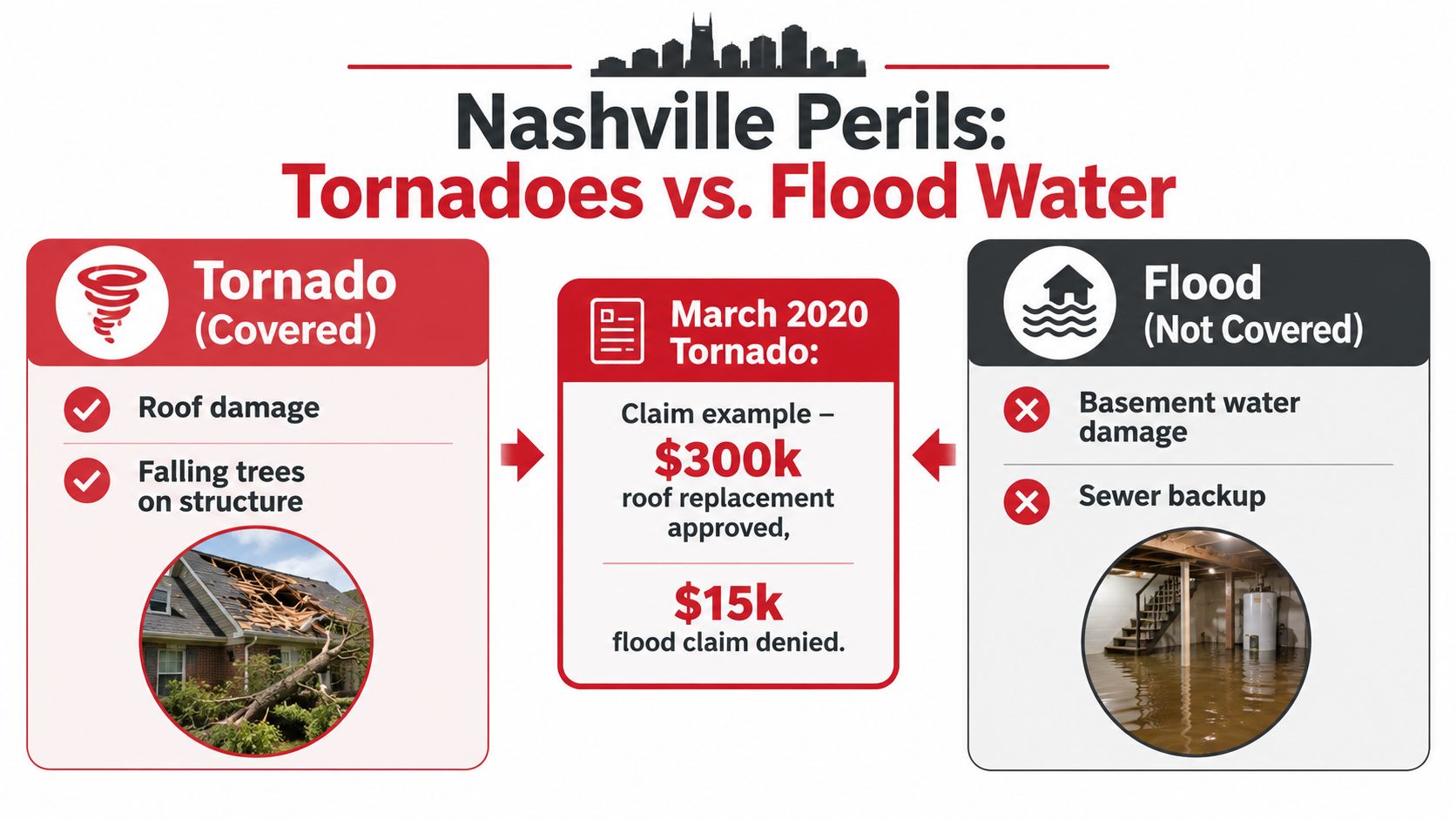
The deductible deserves the same attention as the premium. Nashville policies commonly use a windstorm/hail peril model, rather than a separate tornado policy. Tornado damage generally falls under wind coverage, while many carriers apply a percentage wind/hail deductible. A 2% deductible on a $300,000 dwelling limit means you absorb $6,000 before coverage applies (insurance industry guidance on tornado coverage). Confirm whether the percentage applies to the dwelling limit, then keep that amount available before choosing a lower premium.
Claim payments also depend on documentation. Photograph the roof, siding, major belongings, and mechanical systems before severe weather. Keep receipts for higher-value items, and ask how the policy handles matching materials when only part of a roof or exterior is damaged. For a plain-English discussion of fighting low-ball insurance offers, review the process before signing a settlement.
Know what's excluded before the storm
Flood is the largest coverage gap. A standard homeowners policy excludes flooding, including surface water and river overflow, so flood protection requires a separate policy. Living outside a high-risk flood zone does not remove the need to check this exclusion.
Sewer backup is separate as well. It may require an endorsement or separate pricing, so verify the limit and deductible instead of assuming water damage is covered. Middle Tennessee homes can experience water intrusion through different causes, and the policy responds differently to each one.
Read the declarations page line by line. You should be able to identify the dwelling limit, wind/hail deductible, replacement-cost terms, sewer-backup protection, and flood status immediately. If you cannot, ask the agent to explain each item before binding coverage.
Nashville Perils From Tornadoes to Flood Water
The March 3, 2020 tornado outbreak struck Nashville, caused damages exceeding $1 billion, and became the eighth-costliest tornado in U.S. history. Tennessee also averages about 31 tornadoes per year based on 1995 to 2024 data. Those figures explain why insurers treat tornado exposure as a core underwriting concern, not a minor line item (Wikipedia summary of the event).
Tornado and hail claims usually start with wind coverage
You do not buy a separate tornado policy. Tornado damage generally falls under the wind portion of a standard homeowners policy, so the deductible structure deserves close attention. Roof damage, siding loss, and a tree striking the insured structure can all become wind claims after severe weather.
Check whether your policy applies a flat deductible or a percentage wind/hail deductible. A percentage deductible can create a much larger out-of-pocket bill than homeowners expect, especially after a major roof loss. Ask the agent to show the deductible in dollars for your dwelling limit, not only as a percentage.
Hail is the quieter pressure on Nashville premiums. It produces frequent roof and exterior damage that homeowners may casually call storm loss. Carriers therefore review roof age, roof shape, prior claims, and impact resistance when setting rates and deciding how to underwrite the property. In Nashville, hail can affect pricing more consistently than tornadoes because insurers see repeated roof claims rather than only rare catastrophic events.
Flood is the gap that hurts homeowners most
Standard homeowners insurance excludes flooding, including surface water and river overflow. Protection requires a separate flood policy through the NFIP or a private carrier (Nashville flood guidance). A home may be covered for wind-created openings while remaining uninsured for rising water that enters afterward.
Practical rule: Wind damage and flood damage can occur in the same storm, but they are separate coverage questions. If water enters because the ground flooded, standard home insurance does not cover it.
Do not rely on a flood-zone label alone. Over 25% of flood insurance claims come from properties outside high-risk flood zones, and Nashville flood premiums are often cited around $1,500 annually in higher-risk situations (House Haven Realty flood-zone overview). Ask for a flood quote, confirm the waiting period and limits, and review coverage before storm season. Floodwater does not stay neatly inside map boundaries.
How Much Home Insurance Costs in Nashville
A quote for a $300,000 home is not a Nashville-wide price tag. Premiums change by ZIP code, dwelling limit, roof condition, claims history, and deductible structure. Use the citywide average as a baseline, then price the property itself. For help comparing Tennessee home insurance quotes, provide the same coverage limits and property details to every agency.
Premiums rise with dwelling coverage
| Dwelling Coverage | Average Annual Premium |
|---|---|
| $100,000 | $936 |
| $300,000 | $2,023 |
| $500,000 | $3,277 |
The main cost driver is replacement value. A higher rebuild limit raises the premium before the insurer assesses local storm exposure, roof age, or deductible terms. ZIP-code pricing also varies inside Nashville, from $1,804 in 37215 to $2,281 in 37213, a spread of about 26%. The citywide average and ZIP-code figures come from Policygenius Nashville pricing.
Why similar Nashville homes get different prices
Two homes with similar square footage can receive different premiums. An older roof, prior wind claims, or heavy tree exposure can increase the rate. In a hail-heavy market, insurers focus closely on the chance of repeated roof losses. That underwriting judgment is reflected in the quote.
Deductible design matters as much as the premium. A lower price may come with a percentage wind or hail deductible, which can create a large out-of-pocket bill after a storm. Ask for the dollar amount that deductible would produce on your dwelling limit, not only the monthly payment.
Tennessee's wider rate pressure is also affecting Nashville homeowners. Reporting cited an average of $3,408 per year, rates up 46.8% from 2020 to 2025 and 12.7% in 2024, before growth slowed to 6% in 2025 (FOX17 reporting). The report connected increasing severe convective-storm losses with hail, helping explain why premiums can rise even when tornado damage is not the main claim driver.
Compare quotes by dwelling limit, roof settlement terms, wind or hail deductible, and exclusions first. Then choose the price that matches the coverage.
Tennessee Rules and How to Buy a Policy
Tennessee law does not require homeowners insurance, but a mortgage lender almost certainly will. If you finance the property, coverage is part of the loan requirements. Flood insurance is separate from standard home insurance, and lenders may require it for federally backed mortgages in designated high-risk zones.
Gather the right documents before you quote
Give the agent accurate property details before comparing prices. Prepare:
- Home facts: Square footage, construction type, year built, and roof age.
- Prior claims history: Include wind, hail, water, and other losses.
- Current declarations page: Review existing limits, deductibles, and endorsements.
- Flood zone status: Check the property's status instead of assuming standard coverage protects it.
Flood coverage deserves a separate decision. Standard homeowners policies generally exclude flood water, including losses that can affect properties outside designated high-risk areas. Ask whether a separate flood policy fits the property, and confirm any lender requirement before closing.
Verify the parts that cause claims trouble
Before binding coverage, confirm the wind and hail deductible, roof settlement terms, water backup coverage, and replacement-cost limits. A percentage deductible can create a large bill after a storm, even when the monthly premium looks attractive. Ask the agent to show the deductible in dollars using your dwelling limit.
Read exclusions and endorsements in the quote, not just the summary page. If wording is unclear, get the answer in writing before signing.
A fast quote is not a good quote if the deductible is buried. The policy paperwork determines what you pay after a loss.
Use Select Insurance Group's Tennessee home insurance guidance to review common policy features, then request quotes using identical dwelling limits and deductibles. Compare coverage first, price second.
Saving Money With Discounts and Loss Prevention
The right way to save money is to lower risk first, then ask for the discount. In Nashville, that means focusing on the things carriers punish, roof wear, storm vulnerability, and sloppy maintenance around water entry points.

The savings levers that matter most
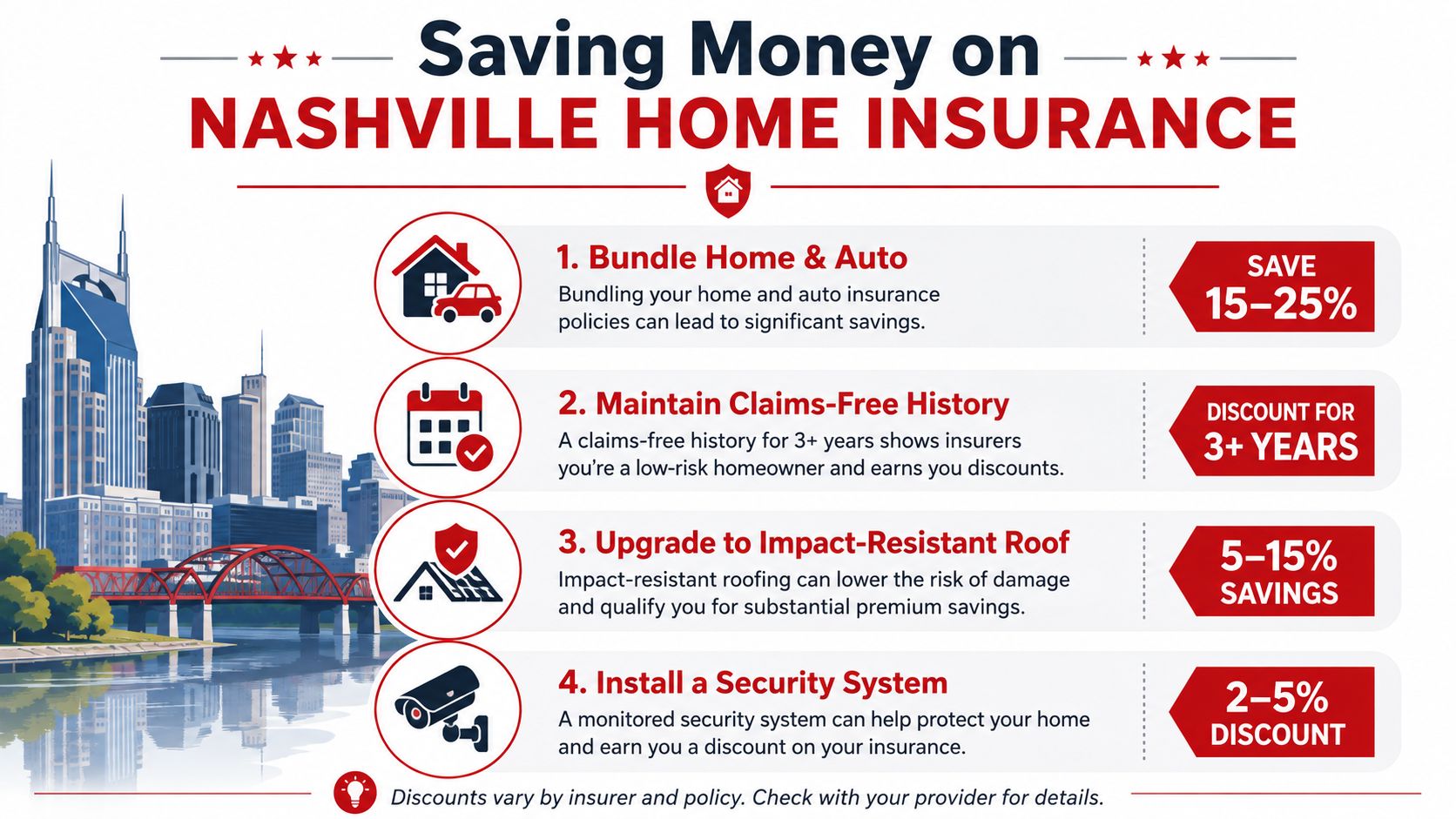
- Bundle home and auto. Carriers often price multiple policies more favorably when they keep more of your business together.
- Stay claims-free. A clean loss history helps at renewal, especially after a stretch of severe weather.
- Upgrade the roof. In a hail-heavy market, impact resistance isn't cosmetic, it directly changes claim severity.
- Install a security system. Theft and liability controls can help at the margin, and they also make the house easier to underwrite.
- Choose your deductible carefully. A higher deductible can lower premium, but not if it leaves you exposed to a wind/hail percentage that's already painful.
- Maintain drainage. Clean gutters, grading, and downspouts reduce water intrusion risk.
- Trim storm exposure. Overhanging limbs and loose debris make storm damage worse.
- Document maintenance. Photos, invoices, and roof records help when the carrier asks for proof.
A few of those savings moves are immediate. Others pay off when you renew or when an underwriter reviews the home after a weather event. The biggest mistake is chasing a small premium drop and ignoring the out-of-pocket exposure that comes with a percentage deductible.
When a higher deductible helps, and when it backfires
A higher deductible makes sense if you can pay it without panic and you're buying it on top of a flat structure that you understand. It backfires when you already face a percentage wind/hail deductible and you don't have enough cash reserves to absorb a storm claim. In that case, you're not saving, you're just shifting pain into the next storm season.
I'd rather see a homeowner invest in roof maintenance and drainage control than squeeze the deductible into a number that feels cheap. Those improvements lower both claim frequency and claim severity, which is what carriers care about when they price the next renewal. If you want an independent quote comparison that checks multiple options, a local agency like Select Insurance Group, Inc.’s independent agency model can help you compare how different carriers treat the same roof, same ZIP code, and same deductible.
Comparing Quotes and Working With a Local Agency
A low premium can hide a large storm bill. Compare Nashville home insurance quotes by the coverage details, not the headline price. Two policies may use the same dwelling limit yet treat wind, hail, water, and deductibles very differently, especially across ZIP codes.
What a smart comparison looks like
Request each quote with the same dwelling limit, personal property limit, liability limit, deductible structure, and endorsements. Check whether the wind/hail deductible is a flat amount or a percentage of the insured home value. That difference can change your out-of-pocket cost sharply after a Middle Tennessee hailstorm.
Flood needs its own decision. A homeowners policy generally excludes flood water, even when the property sits outside a high-risk flood zone. Ask the agent to explain flood options and the limits in writing. Do not assume a flood-zone result settles the question.
A local independent agency can compare multiple carriers using the same home details, roof information, ZIP code, and deductible choices. Select Insurance Group, Inc. provides free, no-obligation quotes and can assist with policy changes, documents, payments, and claim support after purchase. Its independent agency model can also make carrier differences easier to review.
Your buyer checklist
- Match coverage limits before comparing premiums.
- Verify the wind/hail deductible and calculate the likely dollar exposure.
- Ask what flood excludes and whether separate coverage fits the property.
- Check roof age and condition requirements before binding the policy.
- Ask about bundling if you want to reduce the household insurance bill.
Do not accept a generic Nashville quote with a vague deductible explanation. Get the proposal in writing, compare each line, and ask why the premium differs between ZIP codes. Hail-driven underwriting can matter more than a tornado headline when insurers price a specific home.
Select Insurance Group, Inc. can compare Nashville home insurance options against your dwelling limit, deductible, and flood needs. Visit Select Insurance Group, Inc. to request a free quote and policy review.