

Covered private employers in Clarksville must secure Tennessee workers' compensation coverage, generally through a private insurance carrier, with premiums shaped by payroll and employees' actual job duties. The first question isn't just what a policy costs, but whether your business has the right coverage for the people doing the work.
You may be reviewing a renewal while hiring another crew, adding delivery work, or trying to satisfy a customer's insurance requirements. Don't treat that purchase as a certificate request. Treat it as a review of who works for you, what they do, and what happens when someone gets hurt.
Table of Contents
- Why Clarksville Employers Need a Workers Comp Strategy
- How Tennessee Workers Compensation Rules Apply in Clarksville
- What Drives the Cost of Workers Comp Premiums
- How to Get a Workers Comp Quote From Select Insurance Group
- Wage Replacement Benefits and the Hidden Value of Light Duty
- Filing a Workers Comp Claim the Right Way
- Local Resources for Clarksville Employers and Injured Workers
- Checklists for Employers and Injured Employees
Why Clarksville Employers Need a Workers Comp Strategy
A Clarksville restaurant owner adds catering deliveries. A contractor starts using another subcontractor. A clinic hires employees whose duties differ from the existing staff. Each owner should tell the insurance agent about the operational change before accepting a renewal based on last year's information.
Buy coverage around the work, not the business name. A short description such as restaurant, contractor, or healthcare office doesn't give an advisor enough information to assess the account properly.
The same discipline belongs in your broader Clarksville commercial insurance planning. Keep employee injury coverage, business vehicle exposures, and other commercial insurance questions in the same conversation, without assuming any policy substitutes for another.
Put someone in charge before an injury
Assign a person to maintain the insurance file and another to handle the task when that person is unavailable. In a small business, that may be the owner and office manager rather than a human resources department.
Give them a practical assignment:
- Describe operations accurately. Document where employees work, what they handle, and whether their duties change.
- Keep records usable. Organize payroll, job descriptions, subcontractor documents, and claims correspondence.
- Prepare supervisors. Tell managers whom to contact when an employee reports an injury.
- Review changes promptly. Don't save questions about new operations for renewal.
Practical rule: If your agent can't explain what your employees actually do, don't assume the proposed coverage reflects your business accurately.
My recommendation is straightforward: review the account before shopping the price. A competitive proposal built on incomplete information isn't a dependable purchasing decision. Start with the facts, then ask carriers to compete on the same account.
How Tennessee Workers Compensation Rules Apply in Clarksville
Identify the employer before choosing the claims pathway. Clarksville has an important distinction that generic Tennessee insurance advice often misses.
The City of Clarksville's On-the-Job Injury program operates in place of conventional workers' compensation for municipal employees. It provides procedures for reporting, treatment, medical payments, and lost-time compensation for qualifying injuries or occupational illnesses arising from official duties.
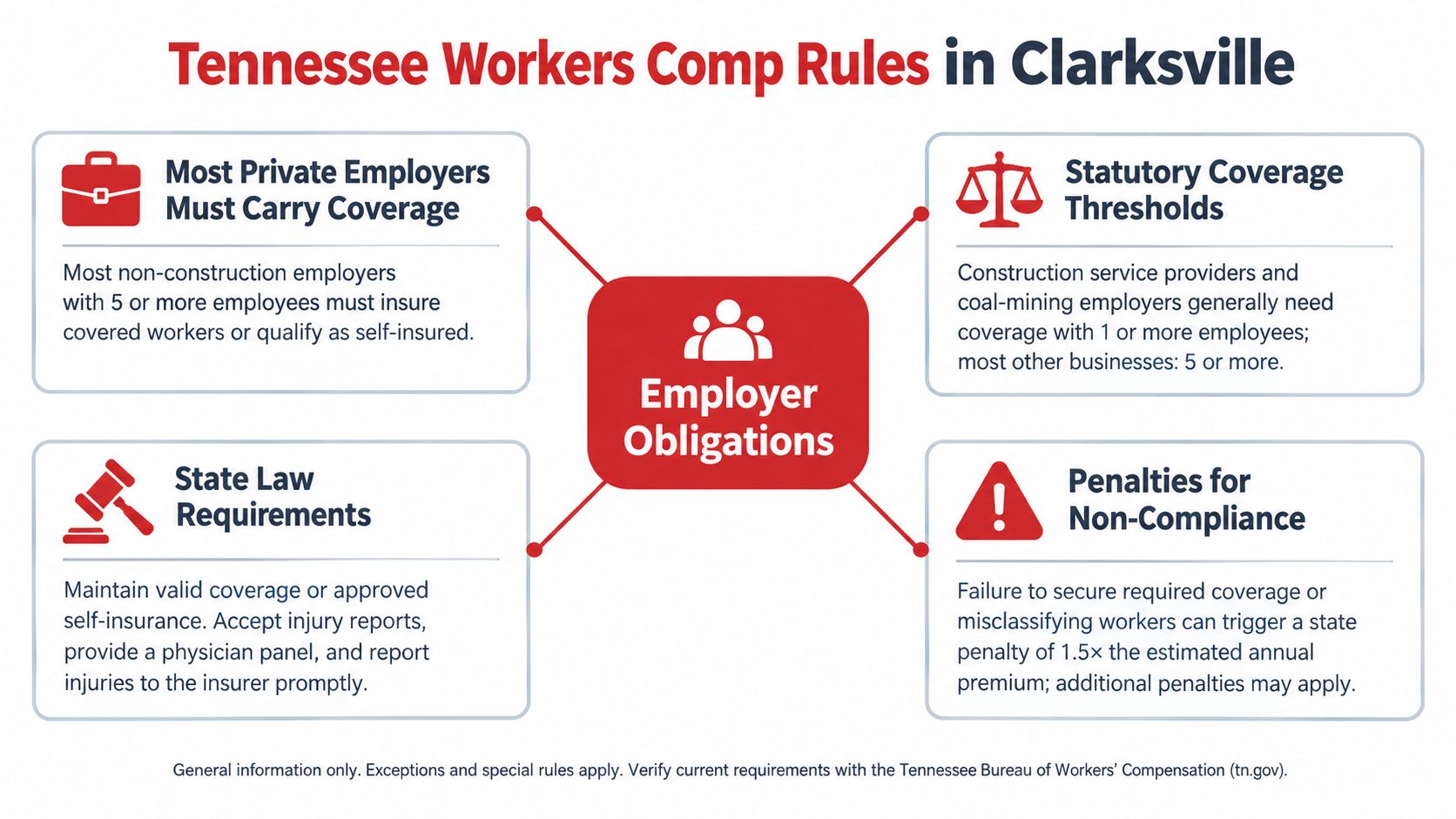
Private employers operate within Tennessee's Bureau of Workers' Compensation framework. Covered employers must secure the required coverage, while eligible construction business owners may apply for an exemption for themselves. That owner exemption doesn't remove the obligation to insure employees.
Separate coverage status from assumptions
Don't decide whether insurance is required from a neighboring owner's experience. Have your advisor verify the applicable statutory requirements against your business type, workforce, and ownership arrangement. This article isn't a substitute for that determination.
Use the following distinctions when gathering information:
| Situation | What to verify |
|---|---|
| Private business | Applicable coverage requirements and the policy responsible for claims |
| Municipal employment | The city's OJI reporting and administrative procedures |
| Construction owner exemption | Whose exemption is documented and whether employees remain properly insured |
| Subcontracted work | The working relationship, insurance documentation, and how the arrangement should be treated |
A subcontractor's invoice alone isn't a sound basis for your insurance decision. Ask the agent what supporting records are needed and retain the answer with the account file.
Get uncertain classifications resolved before work begins. A restaurant manager, clinic owner, or contractor should be able to identify the responsible administrator without searching through old emails after an injury. That's a basic operational requirement, not paperwork to postpone.
What Drives the Cost of Workers Comp Premiums
Payroll and job classification deserve more attention than the headline premium. When you compare proposals, ask the agent to identify the payroll assumptions and describe which duties each classification represents.
Clarksville's regional workforce gives those questions practical importance. The metropolitan area recorded approximately 138,000 employed residents in 2025, compared with 126,850 in 2021, an increase of about 11,150 workers, or 8.8%, according to the metropolitan employment series published through FRED. Those are regional employment figures, not Clarksville workers' compensation claim totals.
Growth doesn't tell you what your policy should cost. Your own staffing plans, payroll, and mix of work are the useful starting points.
Read the assumptions behind the quote
Ask for a proposal that makes the rating inputs understandable rather than presenting only a total.
- Payroll estimates. Use a realistic forecast that reflects hiring, seasonal work, and operational changes.
- Job duties. Explain fieldwork, driving, lifting, equipment use, and office responsibilities accurately.
- Classification treatment. Ask why the proposed categories fit the work and what documentation supports any separation.
- Claims information. Supply complete records and ask the advisor to explain any claims-related pricing adjustments.
- Policy terms. Compare payment arrangements, endorsements, and other quoted charges alongside premium.
Don't describe someone as an office employee merely because they also complete paperwork. Give the agent the full job description and ask how the carrier will treat it.
For construction businesses, insurance planning for contractors should include a clear account of subcontracted work and employee responsibilities. A vague description leaves too much room for misunderstanding.
A cheaper quote isn't a better quote when the carriers priced different payroll estimates or different work.
My preference is to clean up the submission before negotiating. Ask the advisor to explain the pricing basis in plain English, then compare proposals using matching information. That gives you a meaningful premium comparison rather than a contest between inconsistent estimates.
How to Get a Workers Comp Quote From Select Insurance Group
The agency's independent approach allows it to compare coverage options across multiple carriers. That's useful only when each carrier receives an accurate description of your business and the advisor explains the differences between proposals.
Don't send an old policy and ask someone to beat the price. Send an account file that explains what the business does today.
Build a submission carriers can evaluate
Prepare these materials before requesting quotes:
- Payroll by job category. Include current estimates and explain expected staffing changes.
- Job descriptions. Describe actual tasks, work locations, driving responsibilities, and equipment use.
- Claims records. Request available loss runs from your current or previous insurer and explain unresolved items.
- Ownership information. Identify owners' working roles and provide any relevant exemption documents.
- Subcontractor arrangements. Gather contracts and insurance documentation for the advisor's review.
- Certificate requirements. Include customer requests so the agent can assess them before placement.
Keep a short written explanation of anything unusual. A business that recently stopped a particular operation should say so explicitly rather than expecting a carrier to infer it from payroll changes.
Compare the service, not just the invoice
Ask the agency which carriers fit your operations and why. Don't assume every carrier on an agency's broader platform will quote every workers' compensation account.
Use direct questions during proposal review:
| Decision area | Question to ask |
|---|---|
| Claims communication | Who receives an injury report, and how do we reach that person? |
| Financial strength | What current financial-strength information supports the recommendation? |
| Recovery support | Does this proposal include access to return-to-work or clinical coordination resources? |
| Administration | How are payroll changes, documents, payments, and certificates handled? |
| Payment terms | What is due initially, and how does the payment arrangement work? |
The agency also offers bilingual guidance and digital service tools. Tell the advisor whether Spanish-language assistance or secure document submission will help your office manage the account.
My recommendation is to request a written comparison and an explanation of the proposed choice. Carrier access creates options; careful review makes those options useful.
Wage Replacement Benefits and the Hidden Value of Light Duty
Accurate wage records matter to the injured employee and the employer. An incomplete payroll history can distort the benefit calculation before anyone starts discussing recovery or transitional work.
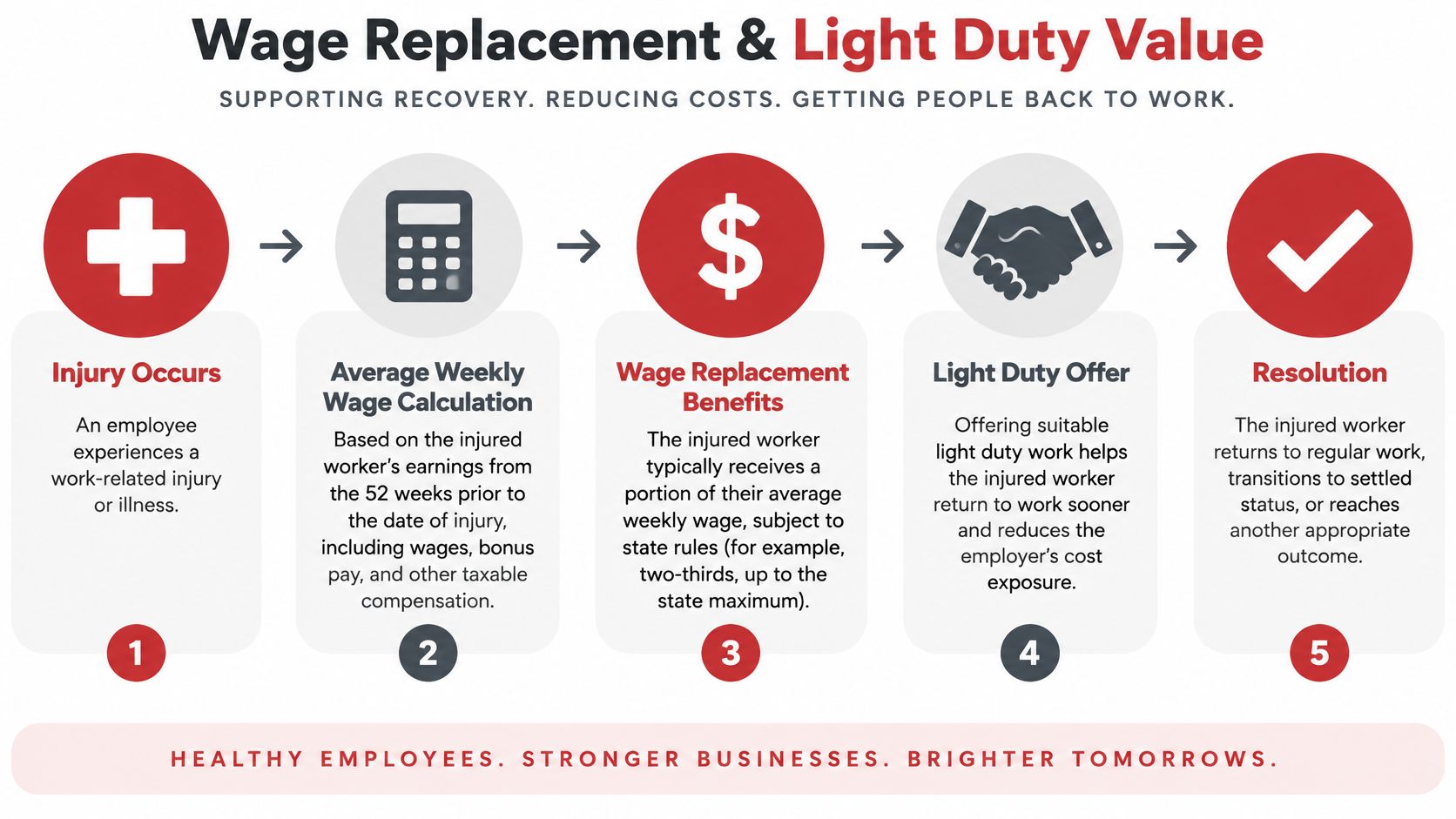
Under Tennessee's workers' compensation benefit guidance, average weekly wage generally uses gross earnings, including overtime and bonuses, from the 52 weeks before injury, divided by 52. Shorter employment may require actual weeks worked or a comparable employee's earnings.
That guidance describes temporary total disability at 66 2/3% of average weekly wage, subject to statutory limits. Temporary partial disability is generally 66 2/3% of the difference between pre-injury average weekly wage and reduced light-duty earnings, also subject to applicable limits.
Apply the formula to the employee's records
For an hourly employee with variable overtime, assemble the full earnings history rather than multiplying the current hourly rate by a typical schedule. For a tipped employee, provide documented earnings and ask the administrator how the applicable wage rules treat them.
For someone with multiple jobs, disclose the employment arrangements and request a written calculation explanation. Don't assume every paycheck belongs in the calculation or that another job is irrelevant.
A numerical illustration isn't necessary to understand the light-duty principle: compare the established pre-injury average with documented reduced earnings, then apply the temporary partial disability formula and limits.
Make transitional work specific
A useful light-duty offer describes tasks, hours, pay, and how the proposed work fits medical restrictions. Update the adjuster when hours or earnings change, and don't let a supervisor expand duties informally.
For a structured conversation about practical barriers to returning, LeaveWizard's workplace absence interview guide can support preparation. Keep the discussion separate from medical determinations.
Returning to work doesn't automatically eliminate a potential permanent partial disability award. Tennessee's workers' compensation annual report and training discussion distinguish benefits involving permanent impairment from temporary wage-loss calculations.
Review what workers' compensation insurance covers with the advisor, but leave individual benefit determinations to the responsible administrator.
Filing a Workers Comp Claim the Right Way
When an employee reports an injury, your first job is to respond, document, and notify the responsible administrator. Don't turn the initial conversation into an argument about whether the claim will be accepted.
The severity stakes are real. Tennessee recorded 155 fatal work injuries in 2024, compared with 164 in 2023, a 5.5% decline; transportation incidents accounted for 53 of the 164 fatalities in 2023, according to the Bureau of Labor Statistics' Tennessee workplace-fatality release. Those statewide fatality figures aren't Clarksville claim counts and don't measure everyday medical-only or lost-time claims.

Move the report to the right person
Build your procedure around clear responsibilities:
- Address immediate medical needs. Don't delay urgent care while collecting insurance information.
- Record the account accurately. Note the reported task, location, timing, witnesses, and symptoms without adding conclusions.
- Notify the administrator promptly. Obtain current reporting instructions and applicable deadlines rather than relying on memory.
- Confirm treatment procedures. Ask how authorized treatment is arranged before directing non-emergency care.
- Preserve relevant records. Keep schedules, incident reports, photographs where appropriate, and correspondence together.
Give the employee a contact name and a clear next action. Telling someone that insurance will call eventually isn't adequate communication.
Manage the file through recovery
Ask the adjuster what information is needed for medical coordination and any wage-replacement review. Keep payroll records available and distinguish confirmed information from questions still awaiting a response.
Claims discipline: Report what happened, preserve the evidence, and let the administrator investigate coverage and benefits.
As treatment progresses, request explanations of changing restrictions, maximum medical improvement, and any proposed resolution. Before signing settlement documents, obtain a clear explanation of what the agreement addresses and consider advice from a Tennessee-licensed workers' compensation attorney.
The employer should manage communication and records, not make medical judgments or promise a particular benefit outcome.
Local Resources for Clarksville Employers and Injured Workers
The right first contact depends on the problem. A business owner shopping coverage needs an insurance advisor; an employee trying to understand an active claim needs the responsible claims contact. Neither should face a chain of unrelated offices.
Keep a contact sheet with names, responsibilities, and verified communication details. Update it when the policy or claims administrator changes.
Match the resource to the question
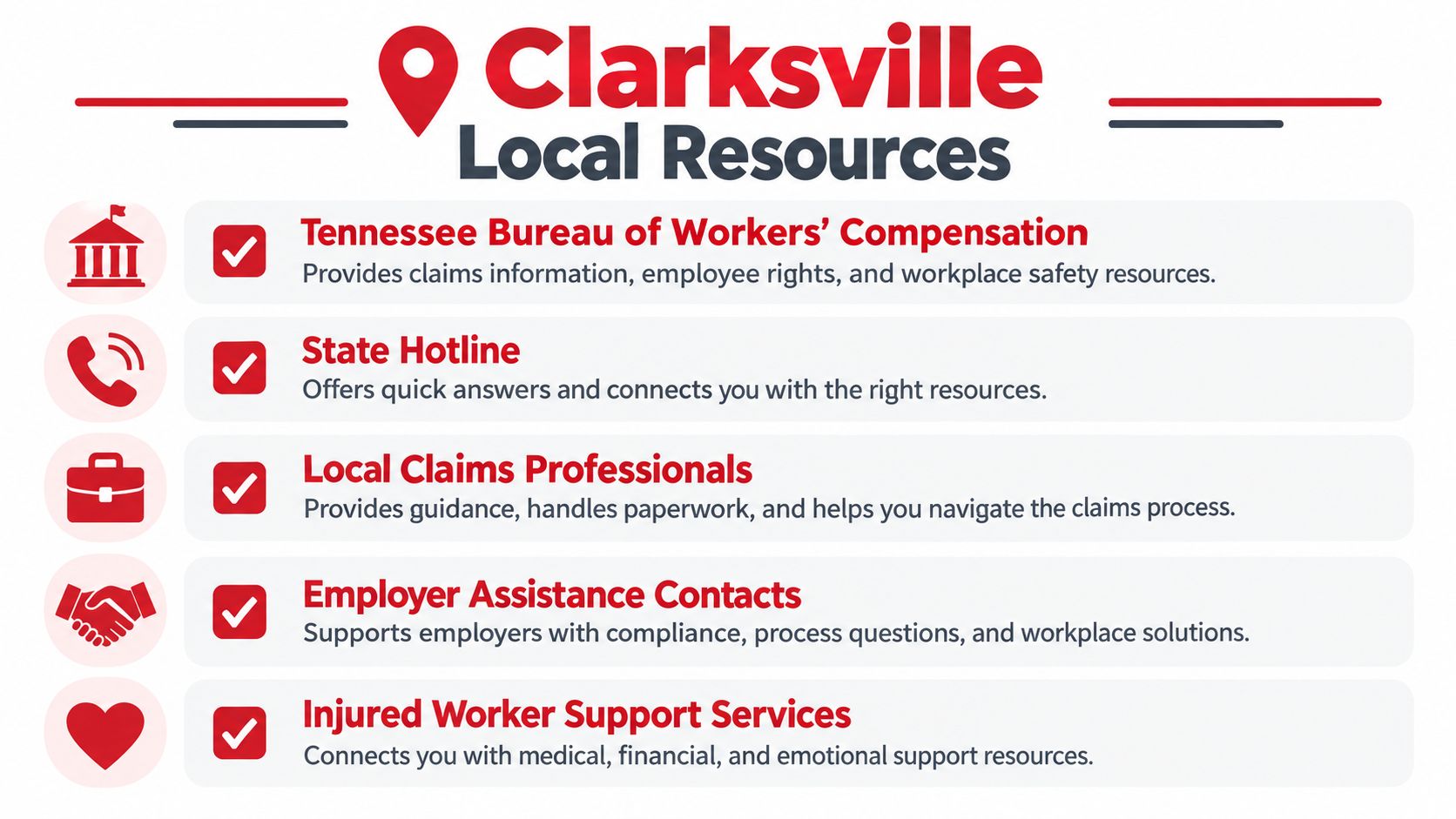
For policy and certificate questions, start with your insurance agent. A small-business owner who has added a service should bring the revised job description, payroll estimate, and customer insurance requirements. Ask for a documented coverage review rather than a verbal assurance.
For an existing claim, contact the assigned adjuster or administrator. An employee awaiting information should have the claim reference, relevant correspondence, and a concise description of the unresolved issue ready.
Other useful contact paths include:
- Tennessee Bureau of Workers' Compensation. Use the state framework's official guidance when you need help identifying the appropriate process or office. Verify current contact details rather than using an old directory.
- City OJI administrator. Municipal employees should follow the city-specific route identified earlier.
- Tennessee-licensed workers' compensation attorney. Seek individual legal advice when you don't understand a disputed position or proposed agreement.
- Agency service team. Request bilingual help when language makes policy administration or communication difficult.
Make the request easy to answer
A useful message identifies the issue, the document involved, and the action requested. For example, ask whether a wage statement was received rather than sending an unexplained attachment.
Don't transmit sensitive employee records through an unverified channel. Ask the recipient how to submit them securely, and retain a copy of what you provided.
Checklists for Employers and Injured Employees
Good workers' compensation administration is repeatable. Owners shouldn't need to reconstruct procedures during a busy shift, and injured employees shouldn't have to guess which documents matter.
Use these checklists as working records. Assign responsibility for each employer task and keep the employee version accessible without requiring someone to search the policy file.
Employer checklist
- Prepare the renewal. Review operations and staffing changes before asking for proposals.
- Confirm the pricing basis. Resolve questions about job descriptions and payroll assumptions in writing.
- Track subcontractor records. Keep current documentation organized and available for review.
- Train supervisors. Make the reporting contact and escalation process easy to find.
- Document transitional offers. Retain the proposed duties, schedule, pay, and relevant restrictions together.
- Maintain continuity. Name a backup person who can access the necessary insurance records.
A procedure that depends entirely on the owner's memory will be difficult to follow when the owner is unavailable. Store instructions where the responsible employees can use them.
Injured employee checklist
- Get appropriate care. Address urgent needs and confirm the process for subsequent treatment.
- Notify the designated contact. Explain what happened and retain your reporting record.
- Keep documents together. Save wage information, medical work-status documents, and claims correspondence.
- Clarify instructions. Ask whom to contact about appointments, restrictions, or payment questions.
- Request language assistance. Tell the agency or administrator when bilingual communication would help.
- Review before signing. Ask for an explanation of documents you don't understand.
The standard is simple: each person should know the next action, who owns it, and where the supporting record is stored. That's more useful than a thick file nobody can read.
Select Insurance Group, Inc. offers independent workers' compensation coverage comparisons, bilingual guidance, and help with policy administration. Bring your payroll information, job descriptions, and current coverage documents to Select Insurance Group, Inc. and request a no-obligation review of your Clarksville business's coverage needs and available quotes.