
Clarksville has nearly 3,000 firms, and more than 85% employ 19 or fewer workers, so most owners need practical protection rather than an oversized insurance package. Start with general liability, commercial property, workers' compensation where required, and commercial auto when vehicles or employee driving are part of the operation, then compare quotes from multiple carriers.
You may be reviewing a certificate of insurance for a new contract, renewing a storefront policy, or wondering whether your personal vehicle is properly covered for deliveries. A Clarksville contractor can face a liability claim after a customer falls at a job site. A small restaurant or retailer can lose inventory and equipment after flood damage. A delivery business can create a serious coverage problem when an employee causes a crash while making a business trip.
The right policy should reflect what your business does, where it operates, who performs the work, what property it owns, and how customers or employees interact with the operation. Cheap coverage that excludes your largest exposure isn't affordable. It's incomplete.
Table of Contents
- Why Clarksville Businesses Need Commercial Insurance
- Core Commercial Insurance Coverage Types
- Tennessee Requirements and Clarksville Business Rules
- Local Risks That Standard Policies Miss
- Understanding Clarksville Commercial Insurance Costs
- How to Get Affordable Commercial Insurance Quotes
- Essential Documents and Information for Your Quote
- Frequently Asked Questions About Clarksville Commercial Insurance
- How much does commercial insurance cost in Clarksville?
- Can I bundle several coverages?
- What happens if someone sues me without general liability?
- Do I need commercial auto if I occasionally use my personal vehicle?
- How can I find gaps in my current policy?
- Does the workers' compensation threshold answer everything?
Why Clarksville Businesses Need Commercial Insurance
A contractor finishes a renovation, leaves the property, and then gets a call: a visitor slipped on a wet wooden floor. The visitor is injured and claims the contractor failed to keep the work area safe. The contractor now needs legal defense, evidence, and money for a potential settlement while meeting payroll and finishing other jobs.

A similar financial hit can follow heavy rain at a restaurant, a fire at a manufacturer, or a collision during a business delivery. Commercial insurance helps protect the property, equipment, inventory, income, and legal position that keep an operation running. Personal homeowners or auto insurance usually does not cover business property, customer claims, employee injuries, or commercial vehicle use.
Clarksville's small firms still face large losses
Clarksville and Montgomery County support nearly 3,000 firms, with about 85% operating as small businesses. That local economy includes construction, manufacturing, retail, transportation, utilities, and service companies, alongside larger employers. The regional economy was valued at approximately $4.92 billion during the study period. The regional economic analysis makes the point clearly: a policy suited to one local business may leave another exposed.
A small staff does not mean a small claim. One customer injury, equipment loss, employee accident, or company-vehicle collision can consume cash that the business needs for wages, suppliers, and rent. Your exposure follows the work, not just the headcount.
Tennessee requirements also matter. Employee injuries, business vehicles, and liability claims must be handled under the rules and policy terms that apply to the operation. Owners should not assume that a personal policy or a basic package addresses those obligations.
Practical rule: Build the policy around your worst realistic loss, not the smallest premium quote.
Review coverage against what your business does, where the work occurs, who performs it, and how customers, employees, vehicles, and equipment move through the operation. Contractors should examine completed work and tools. Manufacturers should focus on machinery and interruption risks. Retailers should address premises, inventory, and customer property. Professional firms should consider claims alleging that advice or services caused financial loss.
The goal is not to buy every available endorsement. Transfer losses you cannot comfortably absorb, and retain only risks the business can handle without threatening its ability to operate.
Core Commercial Insurance Coverage Types
Commercial coverage should follow the way money, people, vehicles, and property move through your business. Start with the liability created by customers and third parties, then examine physical assets, employees, vehicles, and professional services.
General liability comes first
General liability generally addresses third-party bodily injury, third-party property damage, and the legal defense connected to covered claims. A construction firm needs it when work takes place at a customer's property. A retailer needs it when a shopper alleges an injury in the store. A delivery business needs it when its work damages a customer's premises.
Commercial property coverage addresses the business's building, contents, equipment, and inventory, subject to policy terms and exclusions. A restaurant should review kitchen equipment, furnishings, stock, and the cost of continuing operations after a covered loss. If fire or smoke damages a commercial location, a business owner also needs a clear restoration and documentation plan. A resource on expert fire restoration for businesses can help owners understand why prompt documentation and professional cleanup matter after a fire.
Match employee and vehicle risks to the policy
Workers' compensation pays for covered workplace injuries under Tennessee rules and policy terms. It isn't a substitute for general liability, and general liability doesn't replace workers' compensation. Construction companies, installers, warehouses, and businesses with field staff should review job classifications, payroll, subcontractor arrangements, and safety procedures carefully.
Commercial auto belongs on the policy whenever vehicles are owned, hired, or used for business. A personal auto policy typically doesn't cover business use adequately, especially when an employee makes deliveries, transports tools, visits job sites, or carries customer property. Review commercial auto insurance guidance before assuming occasional business driving is harmless.
Transportation businesses may need fleet, trucking, cargo, hired-auto, and non-owned-auto analysis. Service firms should also consider professional liability when a client could claim that advice, design, administration, or another professional service caused financial harm. A business owner's policy, or BOP, can bundle common property and liability protections for eligible small businesses, although it still needs careful review for exclusions and limits.
| Coverage Type | What It Protects | Who Needs It Most |
|---|---|---|
| General liability | Third-party injury, property damage, and legal defense | Contractors, retailers, restaurants, and service businesses |
| Commercial property | Buildings, equipment, furnishings, and inventory | Storefronts, offices, restaurants, warehouses, and manufacturers |
| Workers' compensation | Covered employee workplace injuries | Employers with employees, especially construction firms |
| Commercial auto | Business vehicle liability and related vehicle exposures | Contractors, delivery services, fleets, and field-service firms |
| Professional liability | Claims alleging professional errors or omissions | Consultants, designers, accountants, and other service professionals |
| BOP | Bundled property and liability protection | Eligible small businesses with standard exposures |
Tennessee Requirements and Clarksville Business Rules
Clarksville has nearly 3,000 firms, and 85% are small businesses. That mix spans construction, manufacturing, offices, retail, and field services, so Tennessee insurance rules cannot be applied with a generic checklist. Start with your employee count, job duties, and ownership structure.
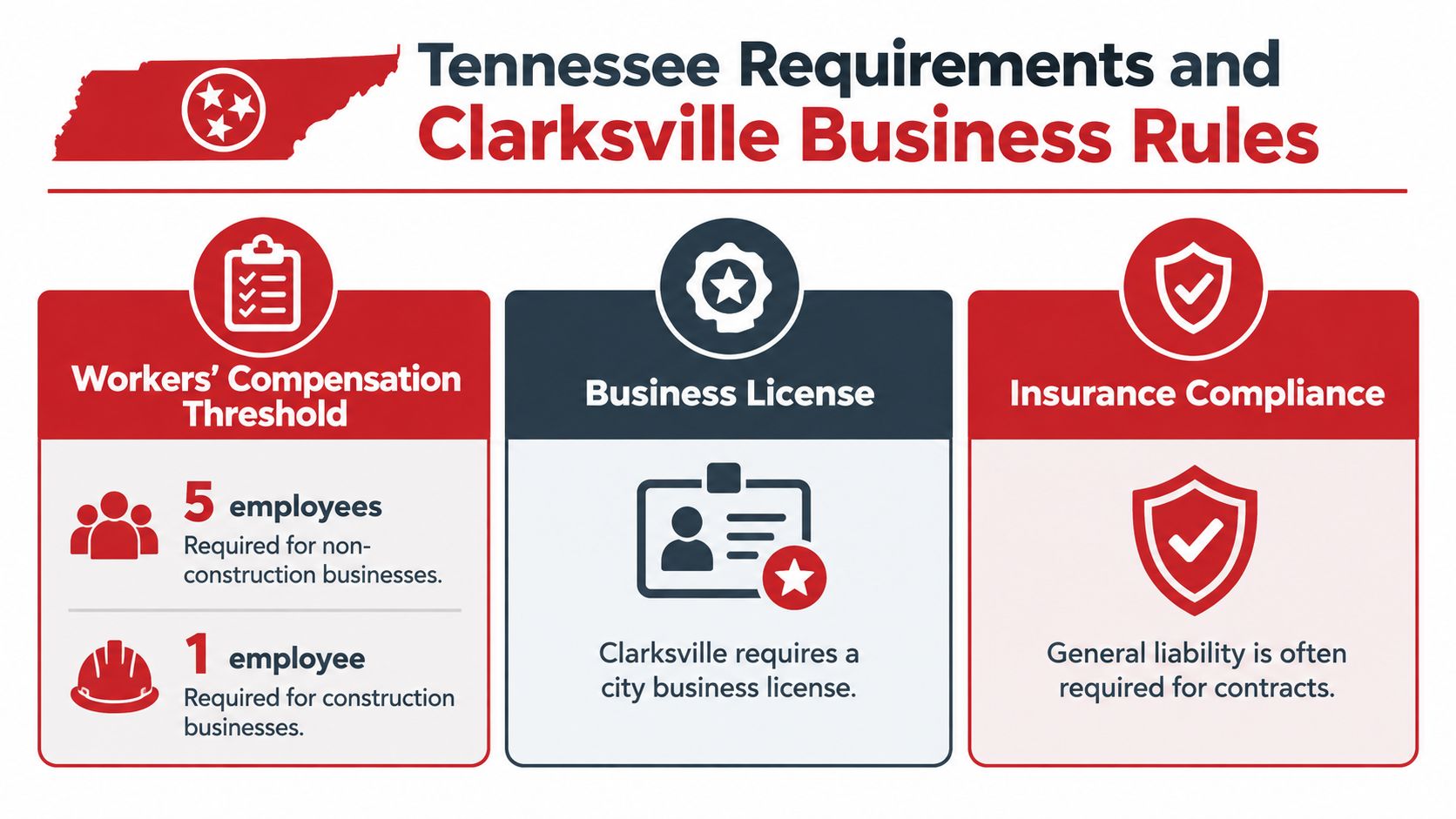
Tennessee's workers' compensation requirement depends on the business. Non-construction employers generally reach the threshold at five employees, while construction and coal-mining employers can face it with one employee. Counting may include part-time workers, family members, and corporate officers. A changing headcount or informal ownership arrangement warrants a direct review.
A four-person office and a contractor with one field employee have different legal positions. The contractor may already have a workers' compensation obligation. The office owner still needs to decide how an injury involving an employee, owner, family member, or uninsured subcontractor would be handled. Tennessee permits some employers without a legal requirement to purchase coverage voluntarily. Legal compliance sets the minimum, not a sound protection plan.
Tennessee's employer guidance covers workers' compensation notices and English-and-Spanish posting requirements for employers subject to the law.
Separate legal compliance from sound risk transfer
Commercial auto requires a separate review as soon as anyone drives for work. List owned, hired, and non-owned vehicles, driver histories, operating radius, vehicle type, cargo, garaging location, and personal vehicles used for business. Review Tennessee commercial insurance guidance and Select Insurance Group's Tennessee commercial insurance information before assuming occasional business driving is harmless. Actual job duties and vehicle use determine the exposure, not just the business name on an application.
Have a licensed agent review Tennessee's uninsured-motorist rules and available policy options for business vehicles. A personal auto policy, an employee's coverage, or a basic commercial policy may not respond as your operation requires.
Keep a current headcount worksheet, written subcontractor agreements, certificates of insurance, driver records, and payroll classifications. Confirm Clarksville city and county licensing obligations separately from insurance requirements. A business license does not replace liability coverage, and a certificate of insurance does not correct an unsuitable policy.
Local Risks That Standard Policies Miss
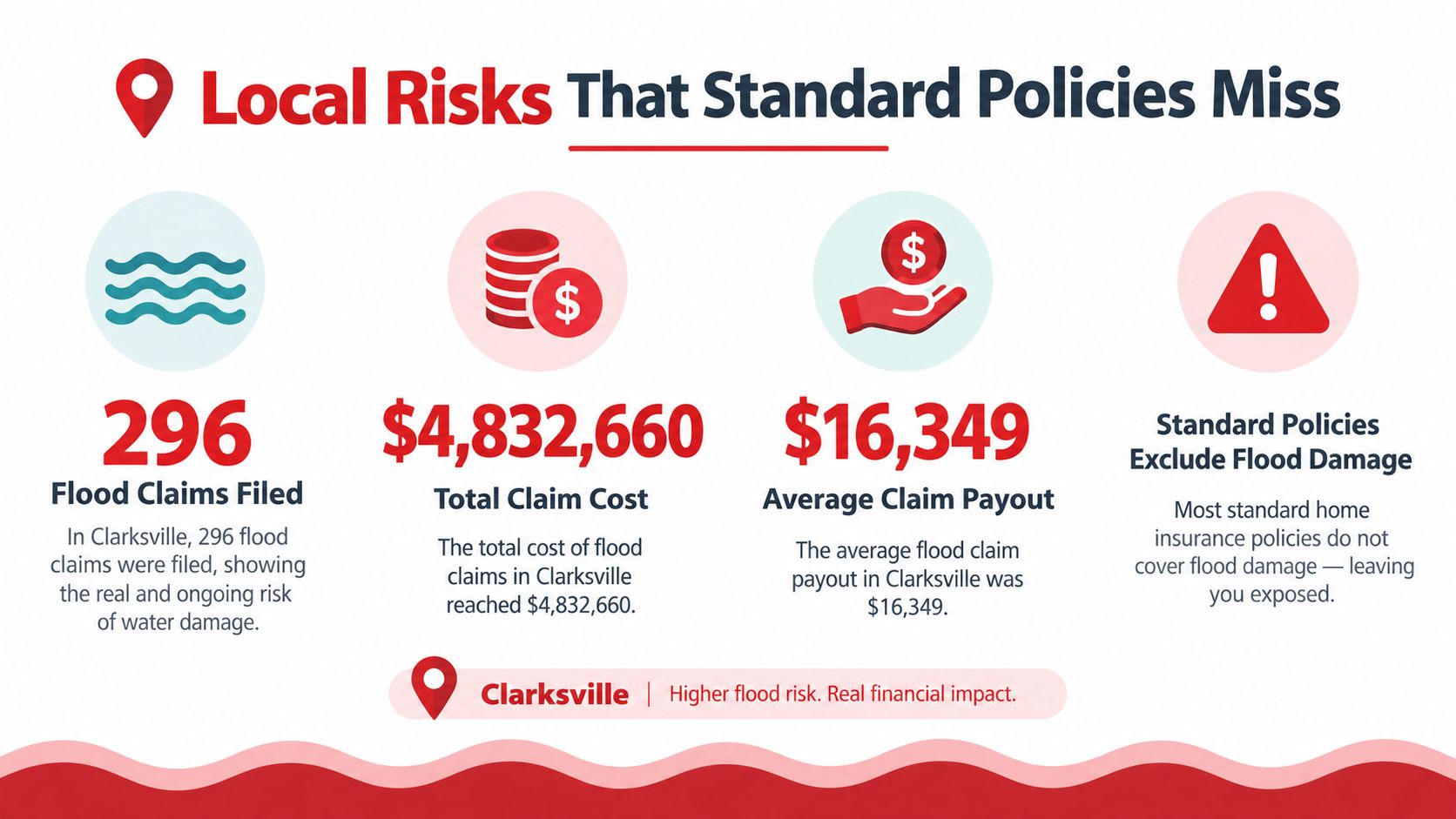
A Clarksville business can have a clean-looking property and still face a serious coverage gap. Flood is the clearest example for commercial property owners. Historical National Flood Insurance Program data identified 296 Clarksville claims, with building, contents, and increased-cost-of-compliance payments totaling approximately $10.7 million. Among claims with payment information, the average reported payment was about $45,000. The Clarksville flood-risk data also identifies 110 claims in ZIP code 37042 and 86 claims in the AE flood zone.
Those figures do not assign the same exposure to every property. They show why owners should not judge flood risk by appearance, neighborhood reputation, or whether a building sits inside a mapped high-risk area.
Review the exact parcel, not just the ZIP code
Standard commercial property insurance generally excludes flood damage. Ask whether separate flood insurance or an endorsement should cover the building, business personal property, inventory, equipment, and business-income exposure. A lender may require coverage in a designated floodplain, but coverage outside that designation can still protect the operation.
Montgomery County reports that the May 2010 flood caused more than $36 million in damage. Local authorities also state that flood insurance is available outside a FEMA-designated high-risk area. Montgomery County flood information supports a parcel-level review rather than a ZIP-code assumption.
Ask an agent to examine:
- Exact location: Review the official FEMA map for the property address.
- Building details: Check elevation, foundation, basement, ground-floor contents, and building use.
- Water movement: Assess drainage, surface-water flow, and proximity to mapped waterways.
- Values at risk: Separate replacement costs for the building, inventory, equipment, and contents.
- Shutdown impact: Estimate the business-income loss from a flood-related closure.
Flood is only one local exposure. Clarksville's small-business base spans construction, manufacturing, retail, services, and other operations. Construction brings job-site injury, completed-work, equipment, and liability concerns. Manufacturing adds machinery damage and equipment-interruption risk. Underwriting must reflect the work performed, not just the address or industry label.
Understanding Clarksville Commercial Insurance Costs
There is no responsible single price for commercial insurance in Clarksville. A contractor, manufacturer, retailer, professional office, and delivery company can occupy similar-sized spaces while presenting completely different liability, property, employee, and auto exposures.
The main pricing drivers
Industry and job duties shape the starting point. Insurers examine whether workers climb, install, manufacture, transport, serve food, handle customer property, or provide professional advice. A contractor with subcontractors and heavy equipment needs a different review from an office-based consultant.
Payroll and staffing influence workers' compensation pricing. The carrier needs accurate employee classifications and payroll information, not a broad job title that hides higher-risk work. If employees split time between office duties and field work, report that accurately.
Vehicles and drivers affect commercial auto pricing through vehicle type, use, operating radius, cargo, driver history, and garaging. A single service van used locally is not the same risk as multiple vehicles carrying tools, materials, or goods across a wider area.
Claims history, limits, and deductibles also matter. A business with repeated losses may need stronger controls before an insurer offers favorable terms. Higher limits can increase premium, while a higher deductible can reduce premium but shifts more loss cost back to the business. Choose a deductible your company can fund after a bad month.
Compare the policy, not just the premium
Two quotes can differ because carriers classify the operation differently, apply different underwriting appetites, or include different limits and exclusions. The lowest quote may omit business income, exclude a vehicle use, apply a restrictive property form, or provide inadequate limits for a contract.
A fair comparison puts the same exposures, limits, deductibles, and endorsements side by side.
Affordable coverage usually comes from accurate applications, documented safety controls, clean maintenance records, sound driver procedures, and disciplined quote shopping. Ask for the reason behind each major price difference. A good agent should explain what changed, not just announce that one carrier is cheaper.
How to Get Affordable Commercial Insurance Quotes
Start before renewal pressure arrives. Write down every business activity, location, vehicle, employee category, customer interaction, contract requirement, and valuable asset. If the application describes only your primary service but omits delivery, installation, storage, or subcontractor work, the quote may be inaccurate.

Use a disciplined quote process
- Prepare the facts. Gather payroll, employee duties, property details, vehicle schedules, driver records, loss history, contracts, and current declarations pages.
- Explain the operation plainly. Tell the agent what employees do, where they travel, what they carry, and how customers interact with the business.
- Request multiple carrier options. An independent agency can compare insurers with different underwriting preferences instead of presenting one automatic renewal.
- Review coverage line by line. Compare limits, deductibles, exclusions, endorsements, valuation methods, business-income periods, and named insureds.
- Correct gaps before choosing. If a quote excludes flood, professional liability, hired auto, cyber risk, or equipment breakdown, decide whether that exposure belongs elsewhere.
- Ask for written recommendations. Keep the proposal, coverage explanation, and certificate requirements with your insurance records.
Getting quotes doesn't commit you to buying. It puts you in a stronger position and exposes differences that a single online price cannot show.
Local guidance matters because a Clarksville agent should understand Tennessee requirements, construction operations, manufacturing exposures, flood questions, and the needs of small employers. Select Insurance Group, Inc. offers commercial insurance options in Tennessee and compares available coverage through licensed agents. The right agency should explain both the price and the protection behind it.
Essential Documents and Information for Your Quote
A complete submission helps an agent obtain a more accurate comparison. Gather these items before the first conversation:
- Business identity: Incorporation or formation documents, EIN, business license information, and the legal names that should appear on the policy.
- Financial picture: Year-to-date financial statements, revenue details, payroll, and a breakdown of subcontractor costs.
- Employee details: Headcount, job duties, payroll by classification, ownership information, and whether any officers seek inclusion or exclusion.
- Vehicle records: Vehicle identification details, ownership, garaging address, use, cargo, driver information, and motor-vehicle records.
- Property facts: Address, construction details, square footage, occupancy, roof information, security features, equipment values, and inventory values.
- Contracts: Leases, lender requirements, customer agreements, certificates, and indemnification language.
- Loss history: Prior claims, open losses, corrective actions, and current policy declarations.
Organize these records in a business insurance binder. Keep digital copies in a secure folder and update them when payroll, vehicles, locations, equipment, or services change. A current file prevents rushed applications and makes renewal conversations more productive.
For a plain-language explanation of employee injury protection, review what workers' compensation insurance covers, then ask an agent how the coverage applies to your classifications and ownership structure. Bilingual documentation assistance may also be available for Spanish-speaking owners and employees who need help understanding administrative requirements.
Frequently Asked Questions About Clarksville Commercial Insurance
How much does commercial insurance cost in Clarksville?
The premium depends on the business type, payroll, property values, vehicles, claims history, requested limits, deductibles, and risk controls. A retail shop and a contractor shouldn't expect the same price. Request comparable proposals and review exclusions before choosing the lowest premium.
Can I bundle several coverages?
Often, eligible small businesses can combine common property and liability protection through a BOP. Bundling can simplify administration and may be competitively priced, but it doesn't automatically include every needed coverage. Flood, professional liability, workers' compensation, commercial auto, umbrella, and specialized equipment protection may require separate policies or endorsements.
What happens if someone sues me without general liability?
You may have to pay legal defense costs, settlement amounts, or judgments from business funds, depending on the claim and applicable law. A lawsuit can also disrupt operations and threaten contracts. General liability won't cover every dispute, but operating without it leaves a major financial exposure with no insurance transfer.
Do I need commercial auto if I occasionally use my personal vehicle?
Usually, you should disclose the business use and have an agent review the policy. Personal auto coverage may not respond adequately to deliveries, job-site travel, transporting tools, or employee use. The correct analysis includes owned, hired, and non-owned vehicles, not just vehicles titled to the company.
How can I find gaps in my current policy?
Compare your actual operation with the declarations page and exclusions. Check whether every location, vehicle, service, employee category, property value, subcontractor arrangement, and contract requirement is represented. Ask specifically about flood, business income, equipment, professional services, cyber incidents, hired auto, and employee use of personal vehicles.
Does the workers' compensation threshold answer everything?
No. Tennessee's threshold depends on the business type, and employee counting can involve part-time workers, family members, and corporate officers. Independent-contractor labels also don't eliminate the need to examine control, contracts, certificates, and injury responsibility. Legal exemption doesn't mean the business has no meaningful injury exposure.
Contact a local independent agency for a free, no-obligation review. Bring your current policy and the operational documents listed above so the agent can compare protection rather than just compare prices.
Select Insurance Group, Inc. helps Clarksville and Tennessee businesses review general liability, commercial property, workers' compensation, commercial auto, business interruption, professional liability, and other commercial coverage needs. Visit Select Insurance Group, Inc. to request a no-obligation quote comparison and discuss the risks specific to your operation.