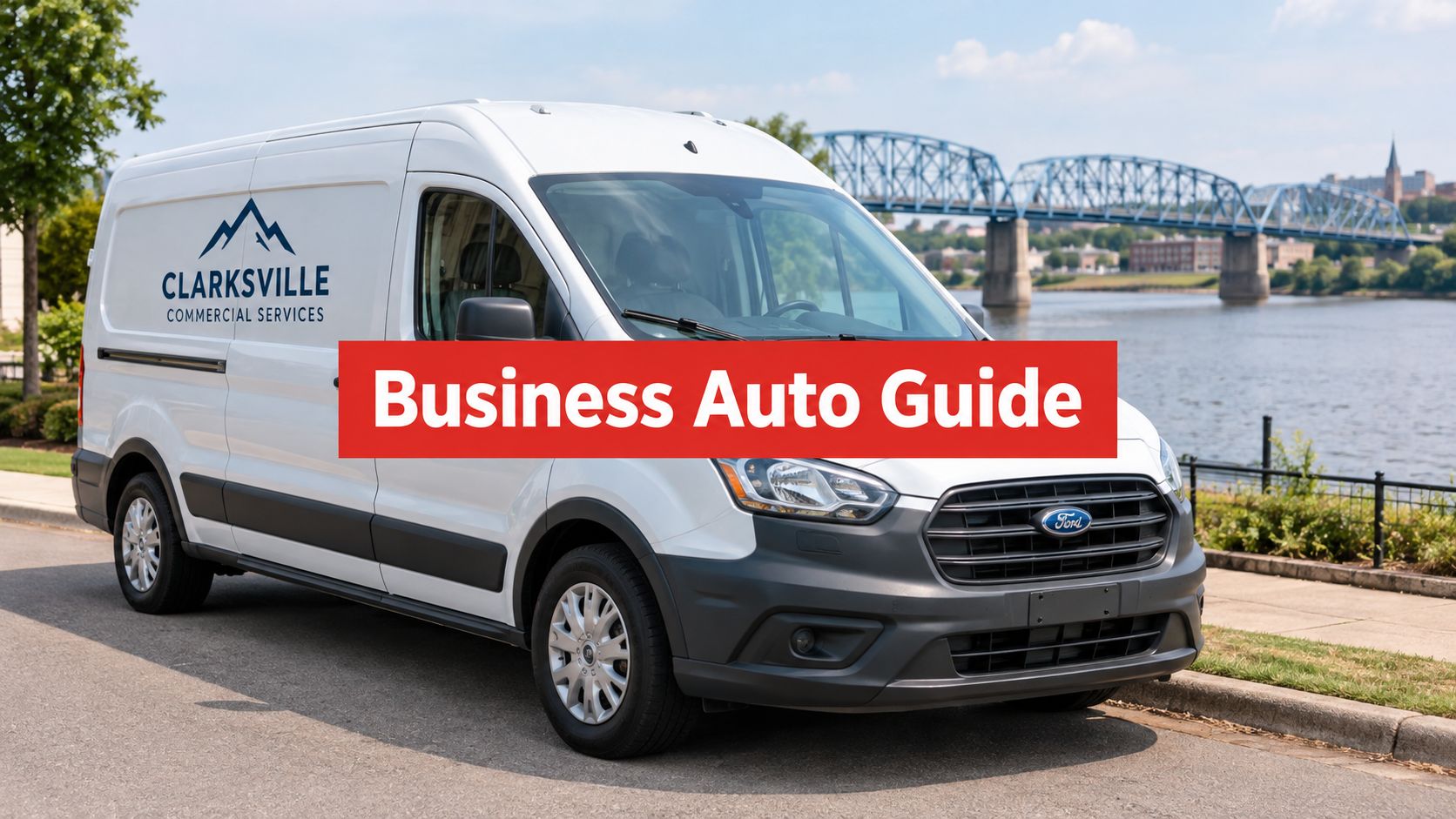

The most popular advice about Clarksville business auto is also some of the most dangerous: buy the Tennessee minimum, put the vehicle on a commercial policy, and assume the problem is solved. That approach satisfies a legal requirement. It doesn't necessarily protect your company, your equipment, or your personal assets after a serious crash.
Clarksville contractors and fleets operate in a freight corridor shaped by Interstate 24, Fort Campbell, manufacturing, local deliveries, and regional travel. Your insurance should reflect what the vehicle does, where it travels, what it carries, and who drives it, not just the number of vehicles on the schedule.
Table of Contents
- Why State Minimums Fail Local Businesses
- Clarksville Commercial Driving Exposures
- Essential Coverages and Endorsements
- Navigating Interstate and Cargo Rules
- Lowering Premiums Through Fleet Safety
- Preparing for Your Insurance Quote
Why State Minimums Fail Local Businesses
Tennessee requires at least $25,000 per injured person, $50,000 per accident, and $25,000 for property damage. Vehicles bearing commercial plates must carry a commercial auto policy, according to the Tennessee Department of Revenue's insurance requirements.
Those figures establish a floor for legal compliance, not a ceiling for responsible protection. A work truck involved in a serious collision can generate medical claims, vehicle damage, lost income claims, legal expenses, and demands from multiple parties. The per-person and per-accident limits can disappear quickly, leaving the business responsible for amounts above the policy limit.
A realistic Clarksville loss scenario
Consider a contractor traveling on I-24 between a job site and the company yard. The truck rear-ends another vehicle in traffic. The other driver suffers a serious injury, the passenger also seeks treatment, and the work truck damages a newer vehicle carrying expensive equipment.
The precise settlement depends on the facts, but the coverage problem is straightforward. The $50,000 per-accident limit applies to all bodily-injury claims from the accident, while the $25,000 property-damage limit may be inadequate for the other vehicle, equipment, and related property. Once the insurer pays the applicable limit, the business may need to fund the remaining costs.
Broker's rule: If one accident could force you to sell equipment, delay payroll, or reach into personal savings, the policy limit is too low for the exposure.
A personal auto policy creates another gap. If a vehicle is titled, registered, or principally used for business, the personal policy may not respond as the owner expects. Commercial plates can trigger a commercial-policy requirement, and business use can conflict with the assumptions built into personal coverage. Review the difference between personal and commercial protection through this Clarksville auto insurance resource, then have an agent classify the vehicle based on its actual use.
The right question isn't, “Am I insured?” Ask instead, “Could this policy protect the business after the worst reasonable accident?” That answer usually requires higher liability limits, physical-damage coverage, and endorsements designed around your operation.
Clarksville Commercial Driving Exposures
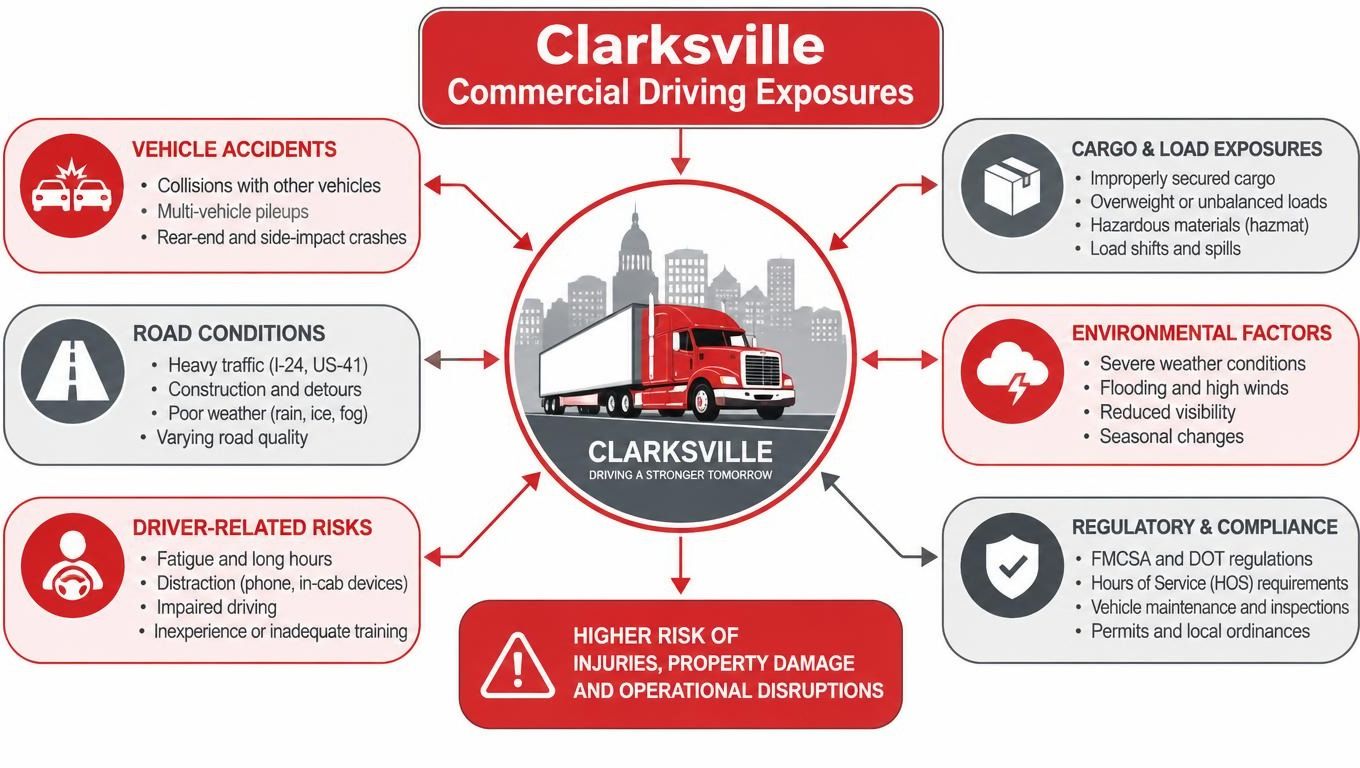
Clarksville's commercial-auto risk comes from how the city functions. It has long been a transportation and trading center, not merely a local retail market. The town was founded in 1785, became a tobacco-inspection point in 1788, saw steamboats reach the Cumberland River in 1820, and shipped more than 18,000 hogsheads of dark-fired tobacco in 1858, generating more than $2.3 million in revenue, according to the Tennessee Encyclopedia's Clarksville history.
That history matters because commercial vehicles still move inventory, equipment, agricultural products, tools, and people across the region. River commerce gave way to rail, highways, and interstate routes, but the underlying exposure remains the same: businesses depend on vehicles reaching customers and job sites without interruption.
Why underwriters look beyond vehicle count
Highway access expanded through U.S. Highways 79 and 41A and State Route 13 during the 1920s. Interstate 24 was completed in 1978, improving the connection between Clarksville and Nashville. Nearby military expansion began in 1942, when Camp Campbell, later Fort Campbell, brought construction activity and a major new source of regional commerce. Clarksville also reports 53 manufacturing facilities, ranging from an established tobacco manufacturer to a data center that came online in 2019, as described in this Clarksville economic and newcomers guide.
A contractor working within a tight local radius has a different exposure from a delivery company traveling daily on I-24. A service business may send employees to multiple addresses, while a manufacturer may move materials, finished goods, or maintenance equipment. A business connected to military-related commerce may face scheduled deliveries, controlled access points, and customer requirements for certificates of insurance.
Your agent and underwriter will care about:
- Operating radius: Local routes and interstate travel create different mileage and regulatory questions.
- Vehicle use: A service van, dump truck, pickup, passenger vehicle, and delivery vehicle don't present the same loss pattern.
- Driver profile: Employee experience, driving records, age, training, and assignment affect risk.
- Cargo and tools: Equipment inside or attached to a vehicle may require protection beyond auto liability.
- Traffic environment: Urban routes, highway speeds, loading zones, and job-site access create different collision and property exposures.
A complete Clarksville commercial insurance overview should start with those operating facts. Don't let an application reduce your business to “three vans and two trucks.” The useful classification is what each vehicle does during a normal workweek.
Essential Coverages and Endorsements
A commercial auto policy should be built around the accident you can't afford, not the cheapest quote that appears on a comparison screen. Liability protects others when your business is responsible for a covered accident. It doesn't automatically repair your vehicle, replace stolen tools, pay for transported property, or cover an employee's personal vehicle used for company business.
Match coverage to the operation
Start with liability limits that reflect the value of your business, the routes your drivers use, contract requirements, and the potential severity of a crash. Then add physical damage coverage for vehicles that would be expensive or disruptive to replace. Collision addresses crash damage, while other-than-collision protection generally addresses non-collision losses such as theft, weather, fire, or vandalism, subject to policy terms.
Use this decision matrix as a starting point:
| Business Type | Primary Risk Exposure | Recommended Endorsement |
|---|---|---|
| Contractor with work trucks | Third-party injury, vehicle damage, tools at job sites | Higher liability limits, physical damage, tools and equipment protection |
| Delivery operator | Frequent stops, loading activity, customer property in transit | Commercial auto liability, physical damage, cargo review |
| Service business | Employees traveling to customers and collecting supplies | Hired and non-owned auto, physical damage, roadside assistance |
| Fleet with multiple drivers | Driver behavior, scheduling, maintenance, and accumulated mileage | Fleet safety program, driver screening, telematics review |
| Business renting or borrowing vehicles | Temporary vehicle use and uncertain ownership | Hired auto coverage and contract review |
Hired and non-owned auto coverage deserves special attention. Hired auto addresses certain rented or leased vehicles used for business. Non-owned auto addresses certain situations in which employees use personal vehicles for company errands, supply pickups, or work-related travel. It generally protects the business's liability exposure, not the employee's personal vehicle itself. Review the details in this guide to hired and non-owned automobile coverage before assuming a standard policy handles the exposure.
Don't ignore deductibles and downtime
A lower deductible can make a claim easier to absorb, but it usually affects premium. A higher deductible may reduce the premium while transferring more repair cost to the business. Choose an amount your company can pay immediately without delaying operations.
Physical-damage coverage also needs realistic vehicle values. An outdated schedule can leave you short after a total loss, while an inaccurate vehicle description can complicate underwriting. List installed equipment, permanently attached units, and ownership or lease details accurately.
Roadside planning belongs in the same conversation. A fleet manager should know who handles a disabled vehicle, how drivers request help, and how towing or recovery affects a delivery schedule. A practical fleet manager's roadside guide can help turn roadside response from an improvised phone call into a written procedure.
Select Insurance Group, Inc. offers commercial auto options that can include liability, physical damage, hired and non-owned auto, cargo, tools and equipment, uninsured motorist, rental reimbursement, and roadside assistance. The correct combination depends on the vehicles, drivers, contracts, and goods involved.
Navigating Interstate and Cargo Rules
The blurry line between local commercial driving and interstate trucking causes expensive mistakes. A company may think of itself as a local contractor while occasionally crossing a state line, hauling customer property, or accepting a transportation assignment that changes its insurance and compliance obligations.
Tennessee's commercial-plate financial-responsibility rule is only one layer. Interstate motor carriers may face federal liability requirements ranging from $750,000 to $5 million, depending on the operation, cargo, passengers, and hazardous-material exposure, as summarized in this Tennessee commercial auto insurance compliance resource. Don't select a limit from a generic trucking chart. First identify what your business does.
Compare the operation, not the vehicle
A landscaper transporting its own equipment to a Tennessee job may present a different regulatory profile from a company paid to haul another party's property across state lines. A courier, furniture mover, HVAC contractor, and freight carrier may all use vans or trucks, but their insurance classifications can differ materially.
Ask these questions before requesting a quote:
- Where does the vehicle travel? Occasional interstate trips matter even if most work is local.
- Whose property is being carried? Your own tools and materials aren't the same as customer goods.
- Are you paid to transport property? Transportation for hire can change the insurance analysis.
- What cargo is involved? Ordinary goods, valuable items, and hazardous materials create different concerns.
- Who owns the vehicle? Leased, rented, borrowed, and employee-owned vehicles require careful review.
Commercial auto liability generally protects against liability arising from an accident. It doesn't automatically insure the goods inside the vehicle. If your business is responsible for customer property while transporting it, ask about motor-truck-cargo coverage and review exclusions, valuation, deductibles, and handling requirements.
Treat certificates as a contract issue
A general contractor may request a certificate showing a particular liability limit, additional insured status, or other condition. A certificate summarizes coverage. It doesn't expand the policy beyond its actual terms.
Don't wait until a bid is accepted to discover that your current policy can't satisfy the request. Provide the contract language to your agent early, especially if the work involves interstate travel, rented vehicles, customer cargo, or subcontractors. For broader background on transportation requirements, use this plain-language resource on DOT standards explained, then confirm your specific obligations with a qualified insurance and compliance professional.
Lowering Premiums Through Fleet Safety
Premium control starts with loss control. Telling drivers to be careful isn't a fleet-safety program. A contractor with several vehicles needs a repeatable process that identifies risky behavior, corrects it, and preserves evidence of the intervention.
Federal Motor Carrier Safety Administration evaluations found that video-based onboard safety monitoring paired with driver feedback and coaching reduced safety-related events by 52.2% per 10,000 miles. A separate telematics intervention using instant feedback, manager coaching, and incentives reduced less-severe events by 55% and more-severe events by 60%, according to the FMCSA guidance on onboard safety monitoring technologies.
Build a program managers can defend
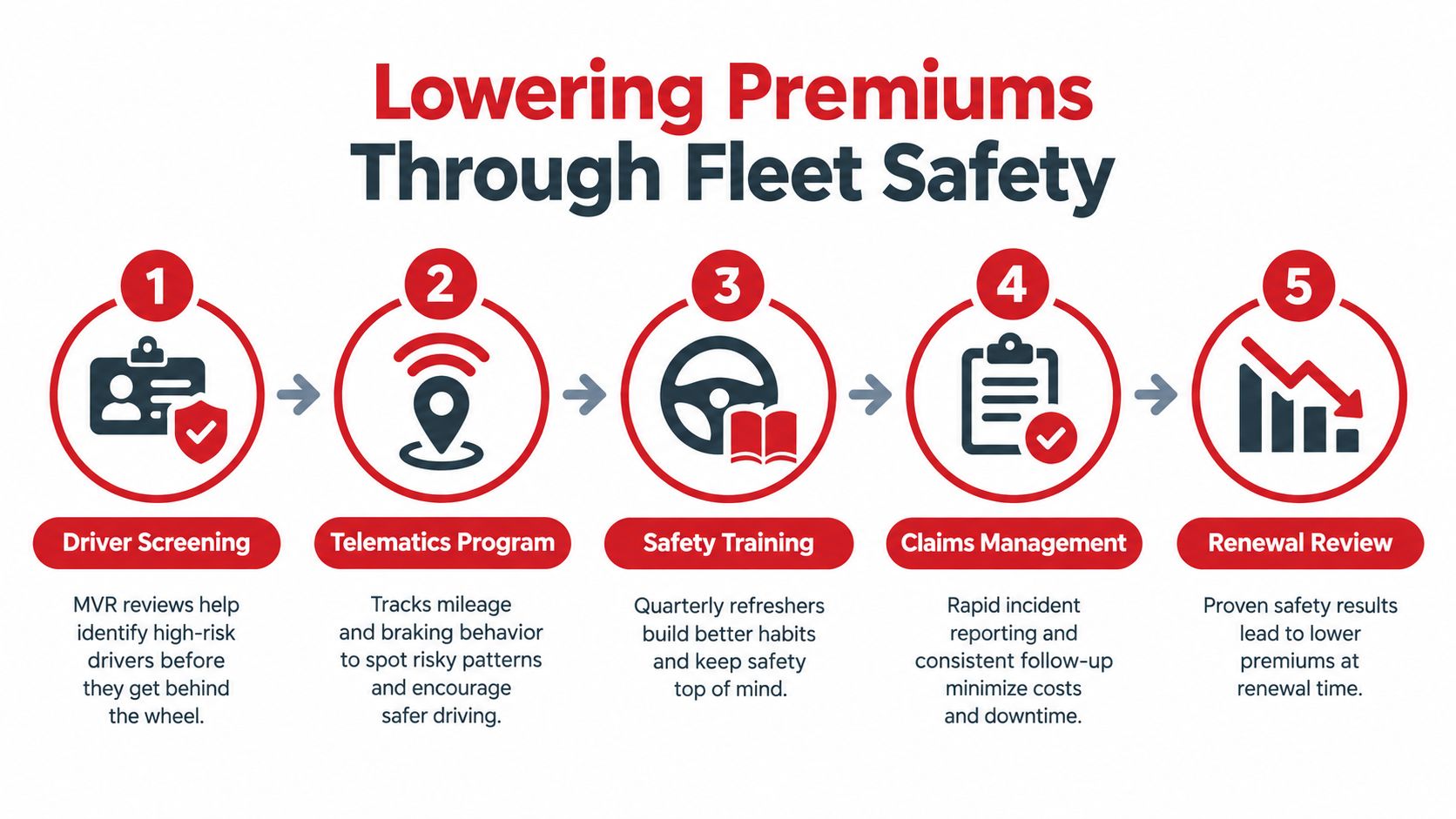
Use technology to coach people, not just to punish them. Establish a baseline for each driver, define thresholds for speeding and harsh braking, review exceptions weekly, and document the conversation and corrective action.
A workable process looks like this:
- Screen drivers before assignment. Review driving records, license status, experience, and the type of vehicle the employee will operate.
- Measure actual behavior. Track mileage, speeding, hard braking, acceleration, and other available risk signals.
- Coach specific events. Discuss the route, conditions, and driver decision instead of sending a generic warning.
- Record follow-up. Keep dates, topics, expectations, and subsequent results in a consistent file.
- Review the pattern at renewal. Give the agent documented evidence of governance, not just a verbal promise that drivers receive training.
Underwriting advantage: A documented safety process won't guarantee a premium credit, but it gives the insurer something concrete to evaluate.
Maintenance supports the same objective. A vehicle with worn tires, weak brakes, defective lights, or unsecured loads creates preventable risk and can undermine an otherwise strong driver program. Keep inspection, repair, and incident records together. For practical commercial-vehicle repair and maintenance information, consult information from Brothers Truck Trailer.
Don't purchase telematics and stop there. Assign an owner, set a review schedule, and decide what happens after repeated violations. The value comes from the management action that follows the alert.
Preparing for Your Insurance Quote
An accurate quote depends on accurate operating information. If you provide only the number of vehicles and a rough estimate of mileage, the agent may need to revise the application later. That creates delays and can produce coverage that doesn't reflect the actual business.
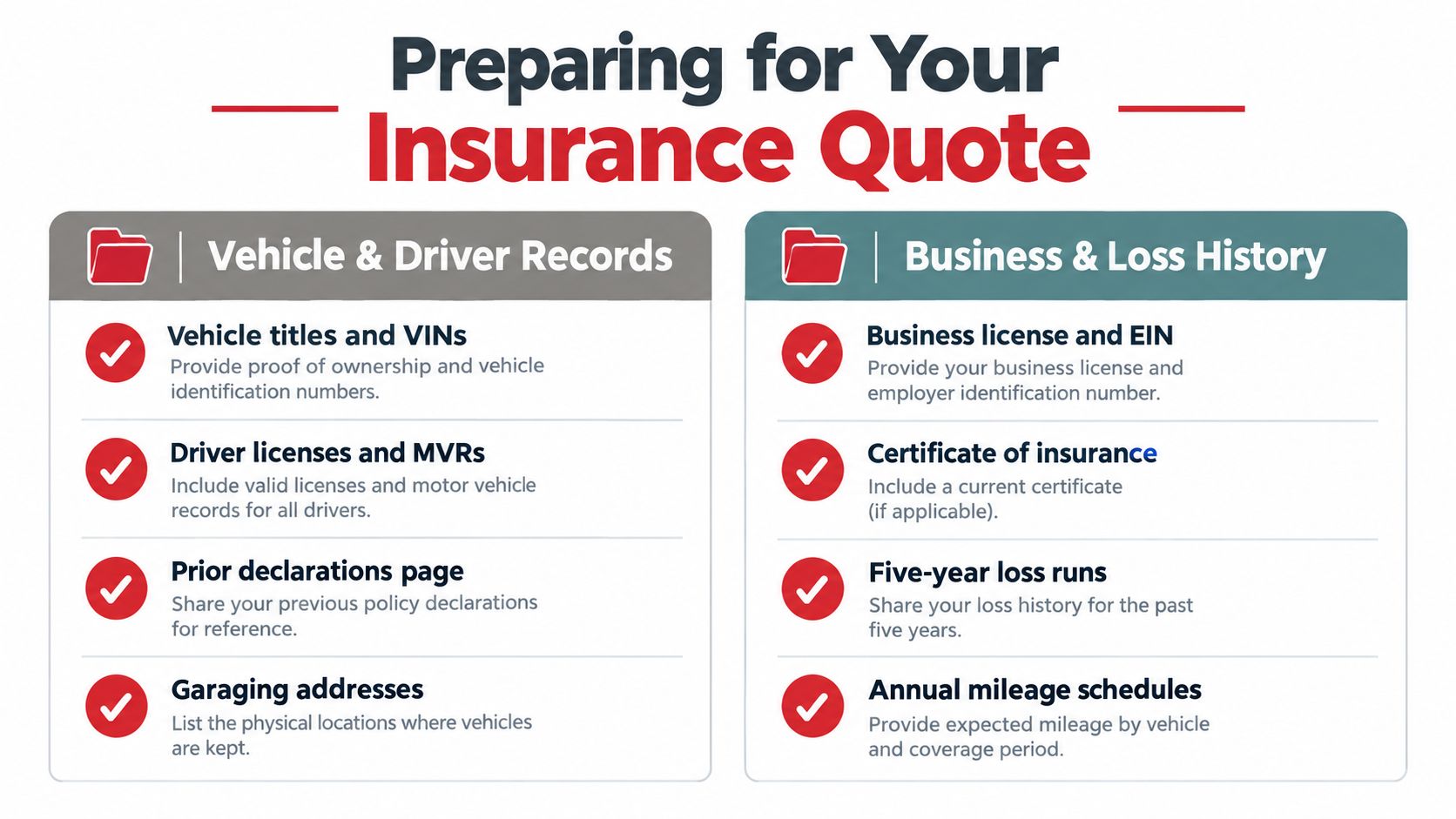
Gather the following before the conversation:
- Vehicle records: Titles, registrations, VINs, vehicle year and model, ownership status, lease information, gross weight classification, and installed safety technology.
- Use details: Garaging addresses, operating radius, routes, annual mileage, delivery frequency, job-site locations, and whether vehicles cross state lines.
- Driver records: Names, license information, assigned vehicles, driving experience, motor-vehicle records, and any required qualification documentation.
- Cargo information: What each vehicle carries, who owns the goods, estimated values, loading methods, and whether customer property is transported.
- Current insurance: Declarations page, policy forms, endorsements, certificates, deductibles, and any contract requirements from customers or general contractors.
- Loss history: Current loss runs and a clear explanation of prior claims, open reserves, repairs, and corrective measures.
- Business documents: Legal business name, business license, employer identification number, entity structure, and contact information for the person responsible for safety.
Ask the questions that prevent rework
Tell the agent whether employees use personal cars, whether the business rents vehicles, whether customers' property is carried, and whether a contract requires a specific certificate format. Explain the difference between vehicles used for transportation, vehicles used as mobile offices, and vehicles that carry tools or equipment.
Ask how each deductible affects a claim, whether physical-damage values are current, whether cargo is excluded, and whether roadside assistance or rental reimbursement would keep the business operating after a loss. These questions expose gaps before a collision exposes them for you.
An independent agency can compare available carriers while keeping the discussion centered on your actual operation. Select Insurance Group accepts commercial auto details through its quote process and can review coverage for company cars, delivery vehicles, service trucks, and fleets. Give the agency complete information from the start so the quote reflects the Clarksville business you run, not a simplified version of it.
Select Insurance Group, Inc. helps Clarksville contractors and fleet owners compare commercial auto options for liability, vehicle damage, hired and non-owned auto, cargo, equipment, and related needs. Visit Select Insurance Group, Inc. to submit your business details and request a no-obligation review focused on closing liability gaps without paying for coverage your operation doesn't need.