
You're closing up a Southside restaurant after a wet Saturday rush when a customer slips near the entrance. Or you're watching a work truck crawl through the Ridge Cut after a driver loses control on I-75. The first call may be to an attorney, an employee, a customer, or a carrier. The financial consequences begin long before anyone knows how the claim will end.
That's why Chattanooga commercial insurance isn't merely an accounts-payable item. It's a balance-sheet decision. The right policy can pay defense costs, covered damages, repairs, and lost business income. The wrong policy can leave your company funding a serious loss from cash reserves, even though you thought you were insured.
Greater Chattanooga Insurance has operated since 1984 and says it serves personal and commercial customers across Tennessee, Georgia, Alabama, and Florida, giving the agency more than 40 years of documented operating history as of 2026 (Greater Chattanooga Insurance). That kind of regional perspective matters because a Chattanooga contractor, restaurant, manufacturer, and interstate fleet don't face the same risks.
Table of Contents
- Why Chattanooga Commercial Insurance Is a Business Decision, Not a Bill
- Core Coverage Lines Every Chattanooga Business Should Understand
- Tennessee Rules That Shape Your Commercial Insurance
- Local Risks Most Chattanooga Property Policies Miss
- Comparing Agents and Carriers in the Chattanooga Market
- How to Evaluate a Chattanooga Commercial Insurance Quote
- Coverage Recommendations for Chattanooga Contractors, Fleets, and Restaurants
- Choosing an Agent and Your Next Steps
Why Chattanooga Commercial Insurance Is a Business Decision, Not a Bill
A slip-and-fall can trigger medical expenses, lost-income allegations, attorney involvement, and demands for records. A truck crash can involve your driver, the vehicle, cargo, a customer's property, and multiple contracts. A worker injury can create both a workers' compensation claim and an operational problem if you lose a key employee.
The policy's job is bigger than writing a check after damage. Liability coverage gives your business a defense, subject to the policy terms, while property and income coverages help preserve the company's ability to reopen and keep paying its bills. That protection supports the balance sheet at the moment your revenue may be under pressure.
Chattanooga buyers also face a crowded marketplace. One directory snapshot identified 860 insurance-related businesses in or near Chattanooga, spanning auto, life, homeowners, and commercial insurance. The same listing showed that 22 rated businesses had 4+ star ratings, while only one business held an A/A+ BBB rating, a reminder that a large market isn't automatically an even or easy one.
Practical rule: Judge a policy by the loss it can absorb, not by the premium printed on the proposal.
A low premium may reflect lower limits, restrictive endorsements, large deductibles, outdated property values, or exclusions that matter specifically to your operation. A higher premium can be sensible if it protects payroll, equipment, contractual obligations, and the revenue stream that keeps your business alive.
The right question isn't, “What does this policy cost?” Ask, “Which losses would force me to borrow money, close temporarily, or sell assets?” That answer should drive your limits and endorsements.
Core Coverage Lines Every Chattanooga Business Should Understand
Commercial insurance works best when each coverage has a defined job. A Northgate storefront needs liability protection for a visitor injury. A Hixson manufacturer needs property coverage that reflects machinery, inventory, and rebuilding costs. A contractor on Cleveland Highway needs workers' compensation structured around actual trade classifications and payroll.
General liability responds to third-party bodily injury, property damage, and certain personal or advertising injury claims, subject to the policy. It's the line behind the customer who falls in a retail entrance or the client who says your work damaged its premises.
Commercial property protects buildings, contents, equipment, and inventory against covered causes of loss. For a manufacturer, the replacement value of a CNC machine or packaging line may matter more than the building itself.
Workers' compensation addresses covered employee injuries and related benefits. A contractor with a back injury may need medical care and wage replacement, while the business needs a compliant claim process and a plan for maintaining operations.
Commercial auto covers business-owned vehicles and related liability exposures. A carpet-cleaning van rear-ended on Highway 27 creates a different risk profile from a personal vehicle used occasionally for errands.
Professional liability responds to claims alleging that professional advice, services, or errors caused financial harm. A downtown marketing agency sued over a missed campaign needs a policy designed for service errors, not just premises liability.
| Coverage Line | What It Pays For | Typical Chattanooga Buyer |
|---|---|---|
| General liability | Third-party injury, property damage, and certain advertising injury claims | Retailers, restaurants, contractors |
| Commercial property | Covered damage to buildings, equipment, contents, and inventory | Manufacturers, warehouses, offices |
| Workers' compensation | Covered employee injuries and related benefits | Employers with staff, especially contractors |
| Commercial auto | Business vehicle liability and selected physical damage | Fleets, service companies, contractors |
| Professional liability | Alleged financial harm from professional errors or omissions | Agencies, consultants, designers |
| Business owners policy | Packaged property and liability protection for eligible small businesses | Main Street shops and smaller offices |
| Umbrella liability | Additional liability limits above underlying policies | Growing employers and fleets |
| Cyber coverage | Selected costs tied to data incidents, system compromise, and notification obligations | Businesses storing payment or customer data |
A business owners policy, often called a BOP, can fit an eligible Main Street shop that wants packaged property and liability coverage. It isn't a universal substitute for specialized lines. Growing employers may need an umbrella, while any business handling payment information should ask how its coverage responds to cyber events.
Tennessee Rules That Shape Your Commercial Insurance
A Chattanooga contractor can hire one employee and trigger workers' compensation requirements. Many other employers reach that requirement at five or more employees. Coal mining also reaches the threshold at one employee (Tennessee commercial insurance requirements). Headcount matters, but industry matters first. A small construction crew working across Chattanooga, North Georgia, and Alabama cannot treat a low payroll as a reason to delay coverage.
Commercial auto limits create a separate exposure. Tennessee's stated minimum liability limits are 25,000/50,000/15,000, covering bodily injury per person, bodily injury per accident, and property damage (Tennessee commercial insurance resource). Those limits satisfy the legal floor, not the practical needs of a company vehicle carrying tools, equipment, or customer property along I-24 and I-75.
| Rule | Threshold | Penalty or Consequence |
|---|---|---|
| Workers' compensation | Five or more employees in many industries | Required coverage, with enforcement consequences for noncompliance |
| Construction workers' compensation | One employee | Coverage requirement arrives immediately |
| Coal mining workers' compensation | One employee | Coverage requirement arrives immediately |
| Tennessee auto liability | State minimum limits of 25,000/50,000/15,000 | Legal minimum may leave serious claim severity largely uninsured |
Address workers' compensation before polishing the rest of the insurance program. Confirm payroll classifications, employee status, and subcontractor documentation. A contractor with one employee can have an obligation that a similar-sized retail business does not.
Set higher auto limits when vehicles serve customers, haul equipment, or cross state lines. Review hired and non-owned auto as well. Contracts may require limits or endorsements that a minimum policy does not provide, especially on construction work spanning Tennessee, Georgia, and Alabama.
State borders also affect certificates, policy territory, employer registration, and claims handling. One Tennessee setup should not be treated as an automatic answer for every job site, driver, or payroll location.
The Tennessee Department of Commerce and Insurance provides a regulatory channel for insurance questions and carrier disputes. Keep declarations pages, correspondence, certificates, and claim records organized. Those documents show what you requested and what the carrier issued.
For a practical review, compare your current documents with this Tennessee commercial insurance resource.
Local Risks Most Chattanooga Property Policies Miss
A cheap property policy can be expensive if it excludes the loss most likely to interrupt your business. Chattanooga businesses near the Tennessee River, Chattanooga Creek, South Chickamauga Creek, and other low-lying areas need to ask direct flood questions. Standard commercial property policies typically exclude flood, so a building can have property insurance and still lack meaningful protection for river overflow, flash flooding, or related business interruption (Chattanooga commercial insurance coverage considerations).
That gap matters to warehouses, restaurants, retail strips, and light industrial sites. Flood isn't only a coastal concern. Inland water and extreme rainfall can damage inventory, electrical systems, tenant improvements, and access routes at the same time.
| Local Risk | Standard Policy Treatment | Gap to Address |
|---|---|---|
| River or creek flooding | Typically excluded from standard property coverage | Evaluate separate flood coverage and business-income consequences |
| Sewer or sump backup | May be excluded or limited | Add appropriate backup protection where available |
| Equipment breakdown | May not be included in ordinary property coverage | Insure mechanical and electrical failure separately when needed |
| Older manufacturing buildings | Valuation may not reflect rebuilding requirements | Confirm replacement cost versus actual cash value |
| Cash-heavy restaurant operations | Theft or employee dishonesty may be limited | Review crime and fidelity protection |
| Extended shutdown | Business income may include waiting periods or limited restoration time | Match limits and restoration period to realistic recovery needs |
Older buildings deserve special attention. Replacement cost and actual cash value aren't interchangeable. If your valuation basis is actual cash value, depreciation can reduce the payment when you need funds to rebuild or replace property.
Also examine wind, roof, sewer, sump, equipment, crime, and business-income wording. A business-income limit that looks adequate may fail if the restoration period ends before customers return, suppliers normalize, and operations reach a sustainable level.
Don't use a generic checklist at renewal. Walk the property with your agent and ask which event would create the largest uninsured loss. You can also review the distinction between property protection and broader household coverage through this Chattanooga insurance resource, while keeping the discussion focused on your commercial premises.
Comparing Agents and Carriers in the Chattanooga Market
Businesses generally buy commercial coverage through one of three channels: a direct carrier, a captive agent, or an independent agency. The differences show up when your business changes, your claims history worsens, or one underwriter no longer wants your class.
A direct carrier can be convenient for a straightforward account. A solo landlord with one building, clean records, and no unusual operations may value a quick quote and simple service. The tradeoff is limited appetite. You're usually working within one carrier's underwriting rules.
A captive agent offers a local relationship tied to one insurance company. That can work well when your business fits the carrier's preferred classes and pricing structure. Flexibility narrows when you add vehicles, cross state lines, take on riskier work, or need specialty endorsements.
An independent agency can compare multiple markets, including specialty placements where appropriate. That matters for older fleets, contractors with loss history, restaurants with prior claims, manufacturers with unusual equipment, and businesses needing coordinated coverage across Tennessee, Georgia, and Alabama.
| Channel | Carrier Access | Best Fit For |
|---|---|---|
| Direct carrier | Usually one carrier's products and appetite | Simple, standard risks seeking convenience |
| Captive agent | One carrier relationship | Businesses that fit a specific preferred market |
| Independent agency | Multiple carriers and possible specialty markets | Growing, mixed-class, interstate, or harder-to-place risks |
Price isn't the only measure. Ask who will explain a coverage dispute, correct a certificate problem, coordinate policy changes, and help after a loss. A cheap quote with no useful advocacy can cost more in confusion and delay.
My recommendation is straightforward. Use a direct channel for simple risks. Use a captive relationship when the fit is excellent. Choose an independent agency when your operation has multiple moving parts or when your business can't afford to start over every time one carrier changes its appetite.
How to Evaluate a Chattanooga Commercial Insurance Quote
A quote comparison should begin before the application. Gather the information an underwriter will use, then insist that every proposal reflects the same operations and exposure details.
Start with:
- Loss runs: Request prior claim records and verify that dates, reserves, and descriptions are accurate.
- Workers' compensation payroll: Separate payroll by class code and identify changes in duties, locations, and subcontractor use.
- Vehicle schedule: List every vehicle, its identification details, use, garaging location, driver information, and financing status.
- Property documentation: Update building, contents, equipment, and inventory values using realistic replacement-cost information.
- Contracts: Collect certificates, lease requirements, indemnity language, and additional-insured requests from general contractors and customers.
- Operations summary: Describe what you do, where you do it, who performs the work, and which states your people and vehicles enter.
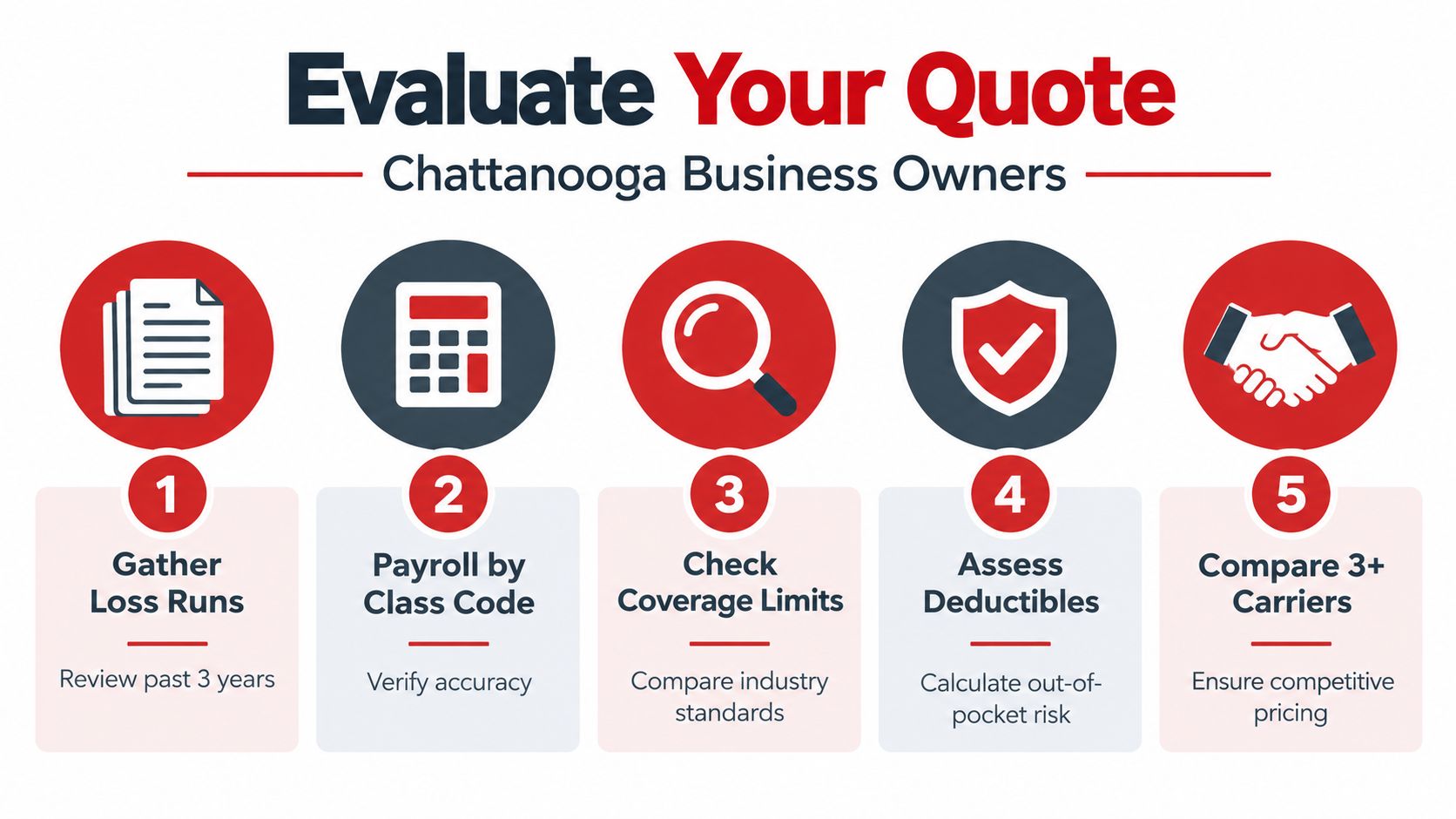
When the quotes arrive, compare limits first, then deductibles, exclusions, endorsements, valuation, territory, and claims conditions. A professional liability policy also requires attention to whether it is occurrence-based or claims-made, along with any retroactive date and reporting requirements.
Use a side-by-side worksheet rather than comparing only the premium:
| Item | Quote A | Quote B | Question |
|---|---|---|---|
| Liability limits | Are the limits sufficient for contracts and severity? | ||
| Property valuation | Is payment based on replacement cost or actual cash value? | ||
| Deductibles | Could the business pay this immediately? | ||
| Flood and backup | Are these excluded, limited, or separately insured? | ||
| Business income | Does the limit and restoration period fit the operation? | ||
| Auto territory | Does it follow vehicles across state lines? | ||
| Additional insured wording | Does it match the contract? | ||
| Claims-made provisions | Are the retroactive date and reporting rules acceptable? |
Walk away from proposals with broad exclusions that undermine the contractor's actual work. Be cautious with auto limits that don't reflect trucking exposure on I-75, I-24, or US-27. A property deductible that looks manageable on paper may consume the cash needed for payroll and rent.
Review the account annually at renewal. Update vehicles, payroll, locations, equipment, contracts, and revenue assumptions before the policy renews, not after a claim reveals the mismatch.
Coverage Recommendations for Chattanooga Contractors, Fleets, and Restaurants
The right insurance program depends on how your business earns revenue. A contractor, a fleet operator, and a restaurant may all need general liability, but the useful endorsements and limits will be different.
Contractors working across state lines
A contractor moving between Tennessee, Georgia, and Alabama needs more than a home-state certificate. Review general liability territory, completed-operations exposure, additional-insured wording, waiver of subrogation, and contractual liability. Workers' compensation should reflect the actual skilled-trade classifications, payroll, and jurisdictional requirements.
Work trucks need commercial auto coverage, while tools and mobile equipment often require inland marine protection. Builders risk can matter for new construction and renovation projects in areas such as Ooltewah and Hixson. Subcontractor certificates should be collected and reviewed, not filed without checking limits and dates.
This contractors insurance resource is a useful starting point, but your agent still needs a complete description of the work and states involved.
Fleets and trucking operations
A fleet traveling through Chattanooga faces concentrated highway exposure, cargo responsibilities, vehicle damage, and contractual demands. Ask about commercial auto liability, physical damage by vehicle, motor truck cargo, hired and non-owned auto, and non-trucking liability for eligible owner-operators.
Some operations also need filings connected to their operating authority and contracts. Don't assume every driver fits workers' compensation. Where drivers fall outside statutory workers' compensation coverage, occupational accident arrangements may need review with qualified counsel and an insurance professional.
Driver controls matter too. Written hiring standards, vehicle inspection practices, maintenance records, and documented safety procedures help underwriters understand how you manage risk. They don't replace insurance, but they can improve the quality of the submission.
Restaurants and retail businesses
Restaurants along Southside, North Shore, and riverfront corridors should review general liability, property, business income, equipment breakdown, crime, cyber, and food-related exposures. A business serving alcohol needs to ask specifically about liquor liability rather than assuming general liability handles every alcohol-related claim.
Retailers and restaurants also depend on payment systems and customer information. Cyber coverage may address selected response, notification, restoration, and liability expenses, depending on the form. Property values should include kitchen equipment, refrigeration, tenant improvements, inventory, signage, and furniture.
| Coverage Line | Contractors | Fleets & Trucking | Restaurants & Retail |
|---|---|---|---|
| General liability | Job-site and completed-operations claims | Premises and operations claims | Customer injury and premises claims |
| Commercial auto | Work trucks and service vehicles | Fleet liability and physical damage | Delivery and business-use vehicles |
| Workers' compensation | Trade classifications and interstate payroll | Employee duties and driver status | Kitchen, service, and retail employees |
| Inland marine or cargo | Tools, equipment, and materials | Goods in transit | Selected mobile equipment or inventory |
| Builders risk | Construction and renovation projects | Usually not central | Renovations and tenant improvements |
| Liquor liability | Only where alcohol is served on site | Usually not central | Bars, restaurants, and event operations |
| Cyber coverage | Customer and project data | Dispatch and customer records | POS systems and payment data |
| Business income | Project or premises interruption | Operational downtime | Reopening, equipment, and supply disruption |
The recommendation is simple: insure the way you operate, not the way a generic application describes you.
Choosing an Agent and Your Next Steps
The carrier logo on your declarations page matters, but the agent relationship often determines whether the program stays useful as your business changes. I'd evaluate an agency on three practical questions.
First, how many commercial markets does it actively quote for your class of business? A long carrier list means little if the agency rarely submits accounts like yours. Ask which markets currently consider contractors, fleets, manufacturers, restaurants, or interstate employers.
Second, does the agency understand the underwriting appetite behind those markets? A good submission explains operations, controls, vehicles, payroll, contracts, and loss history before the underwriter asks. That reduces avoidable back-and-forth and helps the carrier evaluate the account accurately.
Third, who handles the hard call after a loss? If every question routes to a generic number, you may be left translating policy language while trying to keep the business running. A real advocate should help clarify the claim process, documentation, certificates, and policy changes without promising coverage that the contract doesn't provide.
Language access deserves practical attention. Chattanooga construction and service businesses may have Spanish-speaking employees, supervisors, owners, or subcontractors. An agency able to communicate clearly in both English and Spanish can reduce misunderstandings during applications, safety discussions, certificate requests, and claims reporting.
Prepare a clean submission before requesting quotes:
- Collect loss runs for the prior three to five years.
- Gather current declarations pages and endorsements.
- List vehicles and identification details, including use and drivers.
- Separate payroll by class code and state.
- Write a one-page operations summary covering locations, contracts, equipment, and interstate work.
- Provide property values with supporting replacement-cost information.
A serious agency should return a side-by-side comparison and a clear recommendation, not a spreadsheet that leaves you to decode the differences. Ask for an annual review that updates limits, locations, payroll, vehicles, contracts, and revenue before renewal.
Greater Chattanooga Insurance's long operating history illustrates why regional experience can be useful for a business serving multiple southeastern states, while an independent agency can provide another approach when you need broader market comparison. Select Insurance Group, Inc. offers commercial lines including general liability, commercial property, workers' compensation, commercial auto, and business owners policies, with Tennessee service that includes Chattanooga.
The decision doesn't need to be complicated. Identify the losses that could threaten your balance sheet, confirm the state and contract requirements that apply now, close the flood and business-income gaps, and compare coverage on equal terms. Then choose the agency that can explain the recommendation in plain English and stay involved after the policy is issued.
If your Chattanooga business needs a policy review, Select Insurance Group, Inc. can compare commercial coverage options for liability, property, workers' compensation, commercial auto, and related risks. Gather your current declarations pages and loss information, then request a clear, no-obligation review focused on the exposures that could interrupt your operation.