

A forklift operator in a Memphis warehouse catches a wheel on a damaged pallet. The machine jolts, a shoulder twists, and the normal sounds of loading equipment, radios, and truck doors suddenly give way to a supervisor calling for help. The worker may finish the shift, thinking the pain will settle, then discover that lifting the next morning is impossible.
That moment raises practical questions. Who reports the injury? Which doctor can treat it? When do wage benefits begin? What happens if the insurer denies the claim? Memphis employers and employees use Tennessee's statewide workers compensation system, but local administration, medical providers, court procedures, and language needs shape the experience on the ground.
Table of Contents
- When a Memphis Job Goes Wrong
- Who Tennessee Workers Compensation Actually Covers
- Employer Duties and the Four Benefit Types
- How a Memphis Workers Comp Claim Moves from Injury to Resolution
- Mistakes That Derail Memphis Workers Comp Claims
- How Insurers and Independent Agents Help Memphis Employers
- Local Memphis Resources and Your Next Steps
When a Memphis Job Goes Wrong
The first priority is medical safety, not paperwork. A supervisor should secure the area, arrange appropriate care, record what happened, and notify the employer's workers compensation carrier. The employee should describe the injury clearly, identify witnesses, and keep copies of every document received.
Tennessee's system exists because workplace injuries were once handled mainly through fault-based lawsuits. The state's Workmen's Compensation Act, signed on April 15, 1919, shifted the framework toward no-fault benefits for injured workers. That history still matters in Memphis because employers and employees operate under statewide rules for medical care, wage replacement, and disability benefits, rather than negotiating a separate system for each workplace. Tennessee's workers compensation history and system development explains that early medical benefits were capped at $100 and limited to the first 30 days after notice, while modern Tennessee law no longer uses that medical cap.
The worker may need authorized medical treatment, temporary income while unable to work, or help challenging a denial. A business owner may need to know whether the worker is covered, how quickly the injury must be reported, and how a claim affects insurance costs. Those answers depend on the employer's business, the worker's classification, the medical evidence, and the procedural deadlines.
Practical rule: Treat every reported workplace injury as a claim-management issue immediately, even when the injury initially appears minor.
A Memphis claim can remain routine when everyone documents events and follows the approved process. It can become procedural when the injury is reported late, the worker chooses an unauthorized doctor, the employer questions employment status, or the insurer disputes whether the condition arose from work.
Who Tennessee Workers Compensation Actually Covers
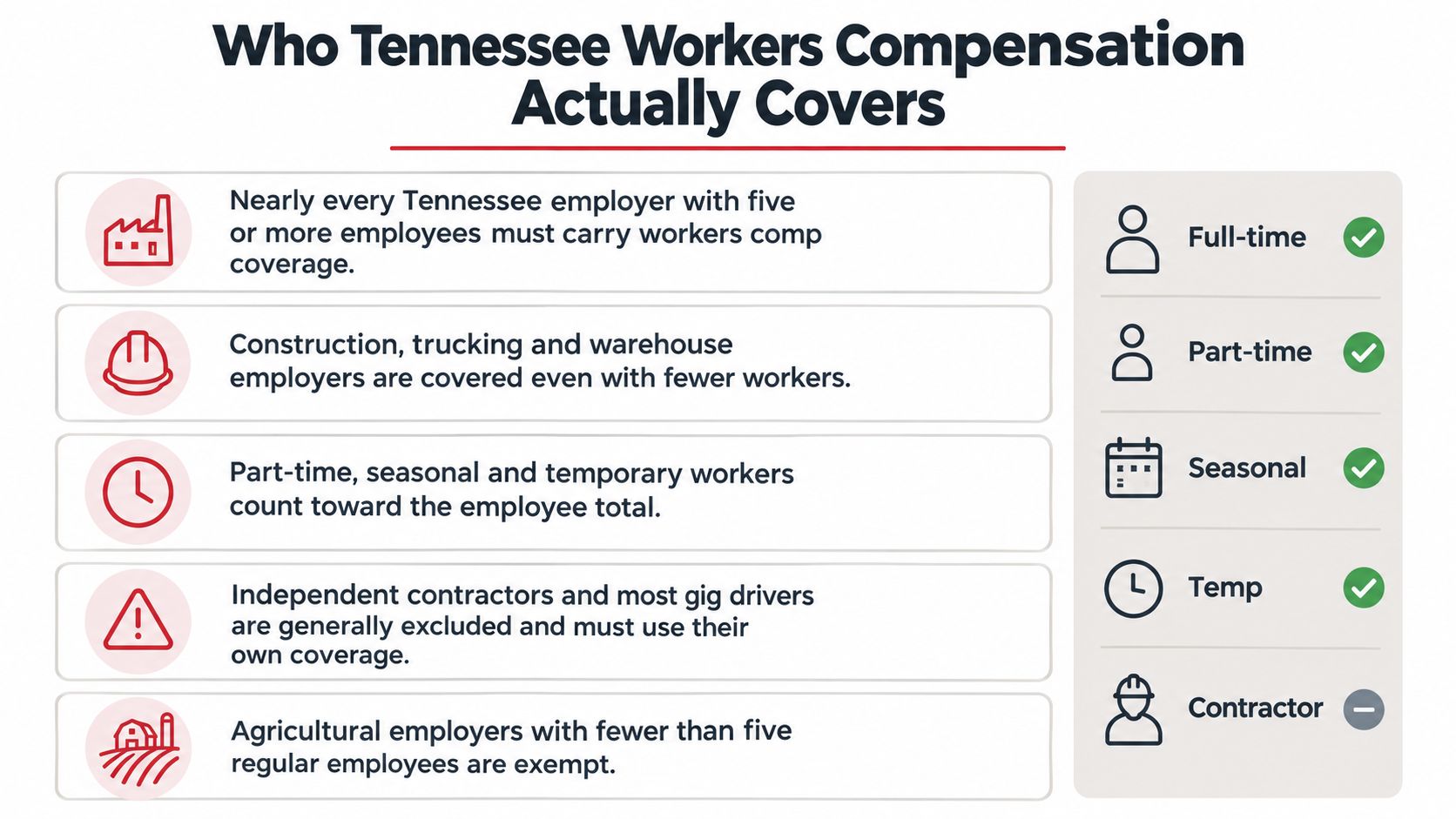
Start with the employer, not the injury. Tennessee generally requires most employers with five or more full-time or part-time employees to carry workers compensation coverage. Construction employers face a stricter rule and generally need coverage from the first worker. Part-time, seasonal, and temporary workers may count, so a small Memphis business shouldn't assume that a rotating schedule removes the obligation.
Construction, transportation, warehousing, hospitality, and manufacturing businesses should review their status carefully. A restaurant with a small kitchen crew, a contractor working on renovation projects, and a distribution operation near Memphis International Airport can face different coverage questions because industry rules and worker classifications matter.
Employee status matters more than the label
Calling someone an “independent contractor” doesn't settle the issue. Tennessee courts look at the actual working relationship under common-law principles, including who controls the work, how the person is paid, whether the work is part of the regular business, and who supplies equipment. Tennessee also applies a detailed analysis based on the familiar IRS-style 20-factor approach when deciding whether a worker is an employee or contractor.
That distinction creates problems for gig delivery drivers, day laborers, and workers supplied through staffing arrangements. A Memphis company may believe a driver is self-employed, while the facts show the company controls routes, schedules, uniforms, equipment, or customer contact. A staffing agency may employ the worker, but the host business still needs to understand who handles reporting and claims coordination.
Common exclusions require care
Sole proprietors, partners, certain corporate officers, domestic workers, farm laborers, and people performing casual labor may fall outside mandatory coverage in particular circumstances. An unpaid nonprofit intern also requires a fact-specific review. Exclusion isn't the same as immunity from risk, especially if the person's daily duties resemble those of regular employees.
A useful screening question is simple: Does the business control how the person performs regular work, and does Tennessee law require coverage for that employer or industry? If the answer is unclear, document the relationship and ask a Tennessee insurance professional or attorney to review it. Employers can also review Tennessee workers compensation coverage guidance before making a classification decision.
Employer Duties and the Four Benefit Types
A Memphis warehouse employee slips near a loading dock, feels pain, and is unsure whether to finish the shift. The employer's response should make the next steps clear. The official Notice to Employees must be posted at each jobsite in English and Spanish. After an injury, the employer should notify the insurer promptly, preserve the incident record, and provide a panel of three physicians so the worker can choose authorized treatment.
The benefits then fall into four categories.
Medical care
Workers compensation generally pays for reasonable, necessary treatment for a covered work injury without an employee deductible. Tennessee's current system has no overall medical-benefit cap. Payment remains controlled by a statewide maximum-allowable-payment schedule, so reimbursement depends on the service code, modifiers, date of service, and applicable rate table.
The schedule uses Medicare-based calculations and changes according to the service date. Under the current Tennessee's 2026 medical fee schedule, services dated April 1, 2026 through March 31, 2027 are listed with category-specific caps of 275% for orthopedic and neurosurgery surgical services, 200% for general surgery, radiology, pathology, and emergency care, and 180% for physical or occupational therapy and chiropractic care. The Tennessee Medical Fee Schedule guidance explains that these figures set maximum payments, not fixed prices. A Memphis provider may therefore receive a different amount depending on the treatment billed and its service date.
For a separate state comparison, Massachusetts workers comp medical care illustrates why medical-benefit rules cannot be carried from one state into another.
Temporary wage replacement
For the benefit year from July 1, 2024 through June 30, 2025, Tennessee set temporary wage-replacement benefits at 66.67% of average weekly wage, with a $185.55 minimum and a $1,360.70 maximum temporary-benefit rate. The calculation uses the worker's average weekly wage. It does not necessarily equal what that worker would have earned in every future week. Tennessee benefit-rate figures for that period also list the state average weekly wage as $1,237.
Permanent disability benefits
Permanent disability benefits require a medical and legal assessment of the lasting injury. Tennessee distinguishes permanent partial disability from permanent total disability. The outcome can depend on impairment evidence, the affected body part, and whether the worker can return to employment.
For that same benefit period, permanent-benefit payments were capped at $1,237. A body-as-a-whole injury was limited to 450 weeks or $556,650. Those figures provide limits for evaluating a claim, not an automatic settlement quote.
Death benefits
A qualifying workplace death may allow dependents to receive weekly benefits. Burial expenses were capped at $10,000 for the stated benefit period. Dependency, the connection between the injury and death, and supporting records can affect the result, so the employer and carrier should handle the file carefully.
| Benefit type | What it pays | 2024–2025 limit |
|---|---|---|
| Medical care | Authorized, necessary treatment for the work injury | Medical benefits remain unlimited |
| Temporary wage replacement | 66.67% of average weekly wage | $185.55 minimum, $1,360.70 maximum |
| Permanent disability | Benefits based on the applicable disability rules | $1,237 permanent-benefit cap; body-as-a-whole limit of 450 weeks or $556,650 |
| Death benefits | Dependent payments and qualifying burial expenses | Burial expenses capped at $10,000 |
How a Memphis Workers Comp Claim Moves from Injury to Resolution
A claim usually starts with a report to the supervisor. The employee should report the injury as soon as possible, even if the pain seems manageable. The employer then opens a written file, contacts the carrier, and directs the employee to the authorized medical panel.
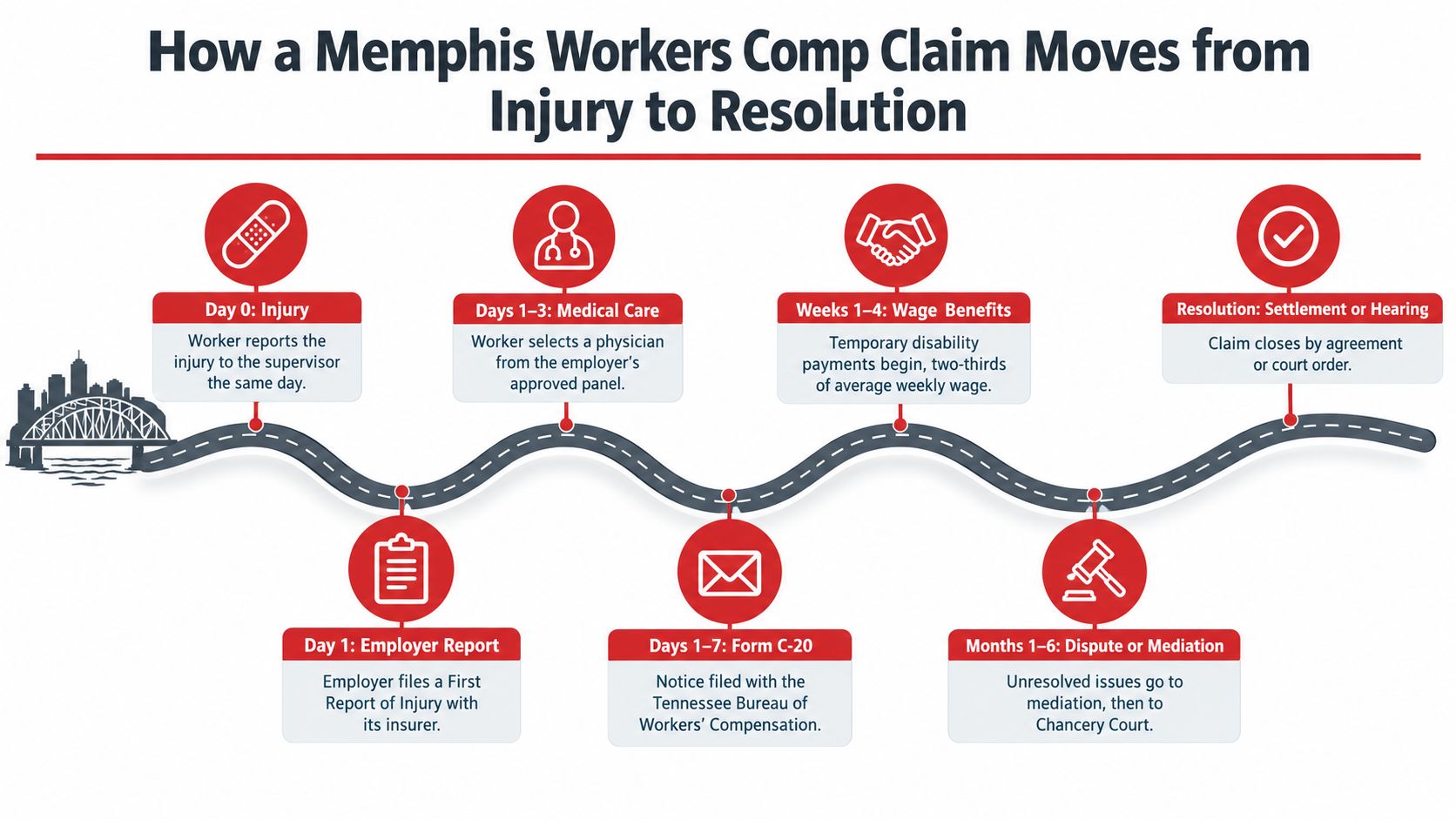
The early claim stages
The employer's file should contain the incident report, witness information, photographs when appropriate, job details, wage records, and medical instructions. The employer also has reporting obligations to the carrier and the Tennessee Bureau of Workers' Compensation. A small business shouldn't wait until the end of a payroll cycle to tell the carrier about an injury.
The authorized physician evaluates the condition, identifies restrictions, and determines whether the employee can work. If the worker can perform modified duties, the employer and doctor may coordinate a light-duty plan. If the worker cannot work during recovery, temporary disability benefits may apply under the state formula and limits for the relevant benefit year.
The insurer reviews compensability, medical documentation, employment records, and wage information. A claim may be accepted, questioned, or denied. A denial doesn't automatically resolve the matter against the worker, but it does change the next step from ordinary claim handling to dispute management.
Local administration and resolution
Unresolved matters can involve mediation, formal filings, and the Tennessee Court of Workers' Compensation Claims. Memphis workers may deal with a local court process even though the governing law is statewide. The state's beginner's guide says a denied claim generally must be challenged through a Petition for Benefit Determination, and in most cases the filing deadline is one year from the injury date or the last date temporary disability or medical benefits were paid, whichever is later. Tennessee's guide to denied workers compensation claims should be checked for current filing instructions.
A denial is a trigger to review deadlines, not a reason to stop communicating.
A claim may close through an agreed settlement or proceed to a hearing. Before accepting a settlement, the worker should understand which medical and disability rights are being resolved. The employer should confirm that payroll, medical, and return-to-work records support the proposed resolution.
Mistakes That Derail Memphis Workers Comp Claims
The most damaging error is treating an injury as an informal conversation. A trucking company along I-40, a distribution business, or a Beale Street restaurant may hope that a worker's soreness disappears. If the condition worsens, the lack of a prompt written report can create a dispute over when, where, and how the injury occurred.
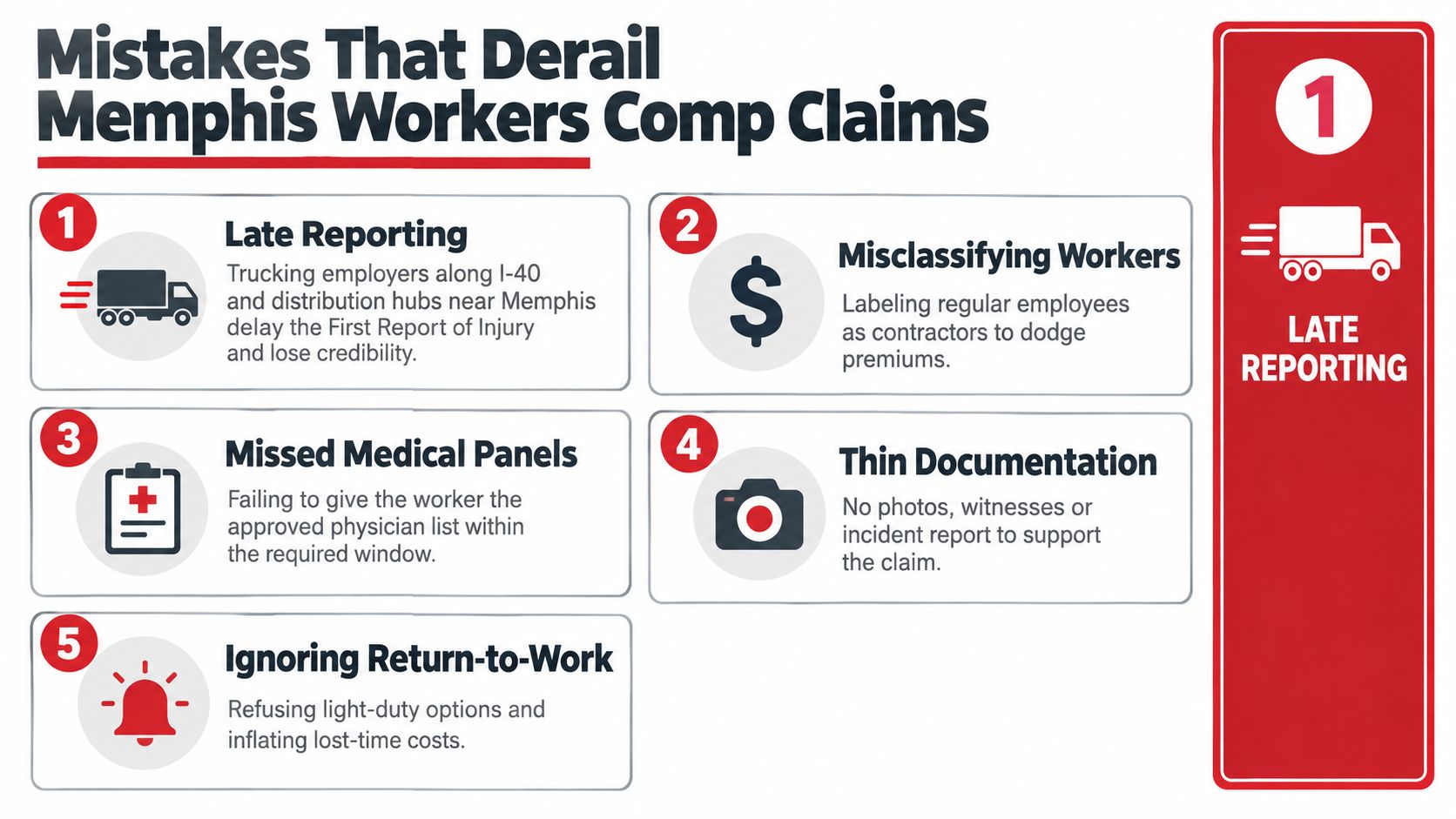
The errors that create avoidable friction
- Late reporting: A worker who finishes a shift can still be injured. The employer should record the report when it is made, not when symptoms become severe.
- Misclassified workers: Labeling a regular employee as a contractor can create coverage, premium, tax, and liability problems. Businesses reviewing classification should also examine broader mistakes in employee classification and leave because the same factual errors often affect multiple employment obligations.
- Unauthorized treatment: The worker should use the authorized physician panel unless the rules allow another arrangement. Treatment outside the approved process can lead to payment disputes.
- Thin documentation: Record names of witnesses, preserve relevant photographs, and write down the worker's description in neutral language. Don't edit the account later to make it sound more convenient.
- Ignored work restrictions: If a doctor permits light duty, the employer should evaluate whether safe work is available. Refusing to discuss reasonable modified duties can increase lost-time costs and make the return-to-work process harder.
Social media can also complicate credibility. A photograph from a Memphis restaurant, a recreational activity, or a family event may be misunderstood when it appears inconsistent with reported restrictions. Workers shouldn't delete ordinary posts to conceal activity, but they should avoid discussing the claim publicly and should answer medical and insurer questions accurately.
Independent-contractor status creates another trap. A business can't solve a classification problem by printing a contractor agreement if daily operations show employee-like control. Both sides should preserve contracts, schedules, payment records, and instructions.
How Insurers and Independent Agents Help Memphis Employers
The carrier and the independent agent serve different roles. The carrier pays covered claims, assigns adjusters, evaluates medical information, and establishes reserves. The agent helps the employer structure coverage, review classifications, compare available options, and maintain policy documentation.
For a Memphis shop with several trucks and Spanish-speaking drivers, the relationship can be practical rather than abstract. An agent can help identify the correct payroll classes, explain what information the carrier needs, and support communication in the client's preferred language. The carrier remains responsible for claim decisions and payments.
Two sides of one process
Agents may review classifications for auto repair, manufacturing, hotel housekeeping, trucking, and warehouse operations before a policy is issued or audited. They can also help contractors provide certificates of insurance to general contractors. Those steps don't decide whether a particular injury is compensable, but accurate information gives the carrier a clearer starting point.
Carriers may use utilization review for medical treatment and assign nurse case managers on serious claims. The employer should cooperate with lawful requests while protecting employee privacy and maintaining a consistent return-to-work process.
| Responsibility | Workers compensation carrier | Independent agent |
|---|---|---|
| Policy placement | Underwrites and issues coverage | Collects business details and presents coverage options |
| Claim handling | Assigns the adjuster, reviews coverage, and pays approved benefits | Helps the employer understand the process and communicate concerns |
| Classification | Reviews payroll and class information during underwriting or audit | Helps identify possible classification errors before submission |
| Medical management | Applies fee schedules, utilization review, and case-management procedures | Explains the policy and helps the employer coordinate with the carrier |
| Certificates | Confirms coverage details | Helps provide certificates required for commercial work |
An independent agency can be useful when a business has changing payroll, multiple job functions, language needs, or contractor certificate requirements. Understanding what an independent insurance agency does can help a business owner decide what support belongs with the agent and what must be handled by the carrier or attorney.
Local Memphis Resources and Your Next Steps
A Memphis injury can leave a worker unsure whether to call a supervisor, a doctor, or the state first. Start with the Tennessee Bureau of Workers' Compensation. Its materials include forms, claim information, and ombudsman assistance. An ombudsman can explain claim status and process steps, but cannot replace legal representation when the parties are contesting the claim.
A dispute may reach the Tennessee Court of Workers' Compensation Claims and involve local court administration. Court contacts, judge assignments, addresses, and filing procedures can change. Confirm the current instructions with the Bureau before sending documents or appearing.
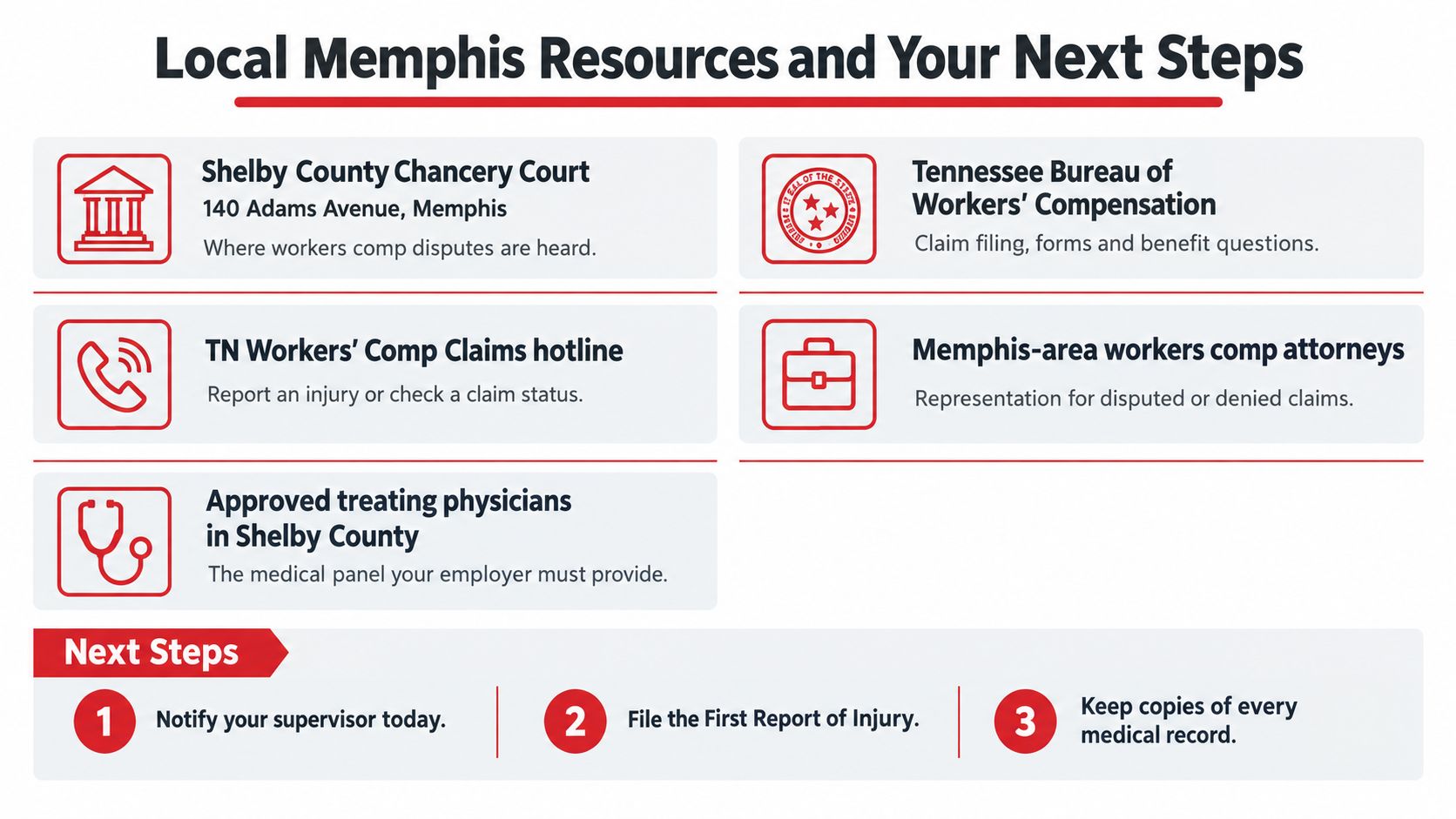
Practical help for injured workers
Ask the employer for the authorized medical panel and follow the permitted treatment process. Memphis-area workers may use occupational health clinics experienced with work-injury documentation. Confirm authorization, appointment availability, and language services before booking care, because a convenient clinic may not be the authorized choice.
Language support can affect whether a worker understands medical restrictions, forms, or a denial. A Spanish-speaking attorney, bilingual insurance professional, or local community organization that offers bilingual support can assist with communication. Employers should provide required workplace notices in English and Spanish. A family member may not accurately translate medical or legal instructions.
Employers reviewing coverage can use Memphis commercial insurance resources and ask an independent agency about workers compensation, payroll classifications, certificates, and claim-reporting procedures.
Seven actions to take now
- Seek appropriate care: Use emergency services when necessary, then follow the authorized treatment process.
- Report the injury: Tell the supervisor promptly and provide a written account.
- Complete required forms: Ask about the First Report of Injury and any Bureau filing, including the C-20 process when applicable.
- Document witnesses: Record names, contact details, photographs, equipment information, and work conditions.
- Keep a wage log: Save pay records, schedules, and information about missed or modified work.
- Protect your statement: Do not give a recorded statement without understanding what is requested. Consider legal advice before agreeing.
- Act on a denial: If benefits remain denied, contact the Bureau, an ombudsman, or a Tennessee-licensed attorney promptly so an applicable deadline is not missed.
Tennessee law sets the framework, while Memphis details affect how a claim is handled. Prompt reporting, authorized care, organized records, and early assistance can reduce avoidable delays.
Select Insurance Group, Inc. helps Tennessee businesses review workers compensation coverage, payroll classifications, and related commercial policies. Bilingual guidance is available for employers and workers who prefer Spanish. Visit Select Insurance Group, Inc. to discuss Memphis coverage needs and request a no-obligation quote.