

Under Tennessee law, most Nashville employers with five or more employees must carry workers compensation coverage, and the Tennessee Bureau of Workers Compensation, headquartered in Nashville at 220 French Landing Drive, administers every claim and policy filing in the state. For injuries from July 1, 2025 through June 30, 2026, the maximum temporary weekly benefit is $1,426.70, rising to $1,488.30 for injuries from July 1, 2026 through June 30, 2027.
A Nashville restaurant owner renewing a policy, a contractor adding crews in the Gulch, and a growing office company hiring its fifth employee all face the same first question: are we properly covered before we worry about price? The answer depends on more than headcount. Job classifications, corporate officers, subcontractors, payroll changes, and prior coverage gaps can all change the compliance picture.
Nashville employers also have a local administrative reality that generic Tennessee guides often miss. The state bureau is headquartered in the city, so policy filings, proof-of-coverage obligations, claim disputes, mediations, and settlements all connect to a statewide system administered from Nashville. That makes accurate records and timely reporting more than back-office housekeeping. They're the operating evidence behind the policy.
Table of Contents
- What Nashville Employers Must Know About Tennessee Workers Compensation
- How Tennessee's No-Fault System Reached Nashville
- How 2026 Benefit Rates and Wage Indexing Raise Your Exposure
- Getting Covered and Staying Compliant in Nashville
- Filing and Managing a Workers Compensation Claim in Tennessee
- Why Premiums Can Rise Even When Rates Drop
- The Offset Trap Nashville Claimants Often Miss
- How an Independent Agency Helps Nashville Businesses Save
What Nashville Employers Must Know About Tennessee Workers Compensation
Start with legal eligibility, not a quote. Most Tennessee employers with five or more employees must carry workers compensation insurance, while construction businesses and certain other industries can face different thresholds or special rules. A small headcount doesn't automatically mean an exemption, especially when the business uses executive officers, subcontractors, temporary workers, or multiple related entities.
Workers compensation generally addresses approved medical care, temporary disability benefits, permanent disability compensation when applicable, and death benefits. It also gives employers protection from many workplace-injury lawsuits by placing covered injuries inside Tennessee's statutory system. That protection only works when the employer has secured coverage correctly and maintained it without a lapse.
Complete the compliance check first
Before binding or renewing a policy, verify:
- Legal entity: Confirm which corporation, limited liability company, or partnership employs the workers.
- Employee count: Include the people who count under the applicable Tennessee rules, not just full-time office staff.
- Job classifications: Separate clerical, sales, field, driving, construction, hospitality, and supervisory work accurately.
- Subcontractor controls: Collect certificates of insurance and verify that coverage remains active before work begins.
- Coverage history: Investigate every cancellation, nonrenewal, payroll change, or possible gap.
The Tennessee Bureau of Workers Compensation requires employers to use an authorized carrier or properly document an approved alternative. Required notices and posting information must also be available to employees. Missing coverage can expose the business to state enforcement, unpaid-claim responsibility, and penalties that overwhelm any premium savings.
For businesses managing multiple claims, deadlines, medical records, and settlement documents, a guide to comp case software can help explain how structured claim tracking works. It won't replace an agent, carrier, or lawyer, but it can clarify why informal spreadsheets fail once a file becomes disputed.
A practical starting point is the Tennessee workers compensation coverage resource. Treat the policy as a legal control, not just another insurance invoice.
How Tennessee's No-Fault System Reached Nashville
Before Tennessee adopted its workers compensation law, an injured worker often had little practical recourse. Employers could rely on defenses such as assumption of risk, contributory negligence, and the fellow-servant rule. The state changed that structure on April 12, 1919, when it adopted the Workmen's Compensation Act and created a no-fault tradeoff. The historical milestone is documented by this account of Tennessee workers compensation's creation.
The bargain was straightforward. Employers accepted defined responsibility for covered workplace injuries without requiring employees to prove employer negligence. Workers gave up many tort claims in exchange for medical care, wage replacement, and other statutory benefits. That trade still shapes how a Nashville claim should be handled today.
A claim is managed through records, not arguments
Consider a warehouse employee who reports a back injury while lifting inventory. The employer doesn't need to decide fault before notifying the carrier. The employer needs to document when the incident occurred, what task the employee performed, who witnessed it, what symptoms were reported, and whether the employee can work with restrictions.
The same logic applies to a construction injury, a repetitive-motion complaint, or a fall in a hospitality workplace. The no-fault structure moves the discussion away from proving negligence, but it doesn't eliminate disputes over whether the injury arose from work, what treatment is reasonable, or how much wage loss is supported.
Tennessee's modern system has also emphasized medical management, dispute procedures, vocational considerations, and return-to-work outcomes. The state's 2024 annual report recorded return to work with the same employer rising from 58.6% before reform to 72% after reform. That comparison appears in the Tennessee Bureau of Workers Compensation annual report.
Practical rule: Report the injury promptly, authorize the appropriate medical pathway, and document every restricted-duty conversation. A clean file protects both the employee and the employer.
How 2026 Benefit Rates and Wage Indexing Raise Your Exposure
Premiums aren't the whole financial risk. Tennessee indexes important benefit limits to the state average weekly wage, so Nashville employers with higher-paid workers can face greater indemnity exposure even when the policy rate itself doesn't move in the same direction.
For injuries from July 1, 2025 through June 30, 2026, Tennessee lists a state average weekly wage of $1,297. The maximum temporary benefit is $1,426.70, or 110% of that wage, while the maximum permanent disability rate is $1,297, or 100%. For injuries from July 1, 2026 through June 30, 2027, the state average weekly wage rises to $1,353, the temporary maximum rises to $1,488.30, and the permanent maximum rises to $1,353. These figures appear in the bureau's Tennessee compensation rate schedule.
Temporary total disability generally uses two-thirds of average weekly wages, subject to the applicable statutory limit. A worker earning below the maximum won't automatically receive the maximum, but a high-wage Nashville employee may approach or reach it. The result is a larger potential obligation over a long recovery, particularly when permanent disability or settlement valuation enters the discussion.
Benefit reference for Nashville employers
| Benefit or Factor | 2026 Tennessee Reference | Employer Implication |
|---|---|---|
| State average weekly wage, July 1, 2025 to June 30, 2026 | $1,297 | Establishes the wage-indexed reference for benefits |
| Temporary weekly maximum, July 1, 2025 to June 30, 2026 | $1,426.70 | Sets the ceiling for temporary benefits during that period |
| Permanent weekly maximum, July 1, 2025 to June 30, 2026 | $1,297 | Sets the permanent disability rate ceiling |
| State average weekly wage, July 1, 2026 to June 30, 2027 | $1,353 | Raises the wage-indexed reference |
| Temporary weekly maximum, July 1, 2026 to June 30, 2027 | $1,488.30 | Increases potential temporary indemnity exposure |
| Permanent weekly maximum, July 1, 2026 to June 30, 2027 | $1,353 | Increases the permanent rate ceiling |
| Minimum weekly benefit, July 1, 2026 to June 30, 2027 | $202.95 | Establishes the lower statutory benefit limit |
| Death benefit cap | 450 weeks and $608,850 maximum total benefit | Creates long-tail exposure in fatal-claim planning |
Review payroll by employee and role before inception and audit. Overtime, bonuses, wage increases, out-of-state work, and inaccurate classifications can all distort the underwriting picture. A higher payroll doesn't increase premium dollar for dollar, but it can raise the benefits attached to a serious claim.
Getting Covered and Staying Compliant in Nashville
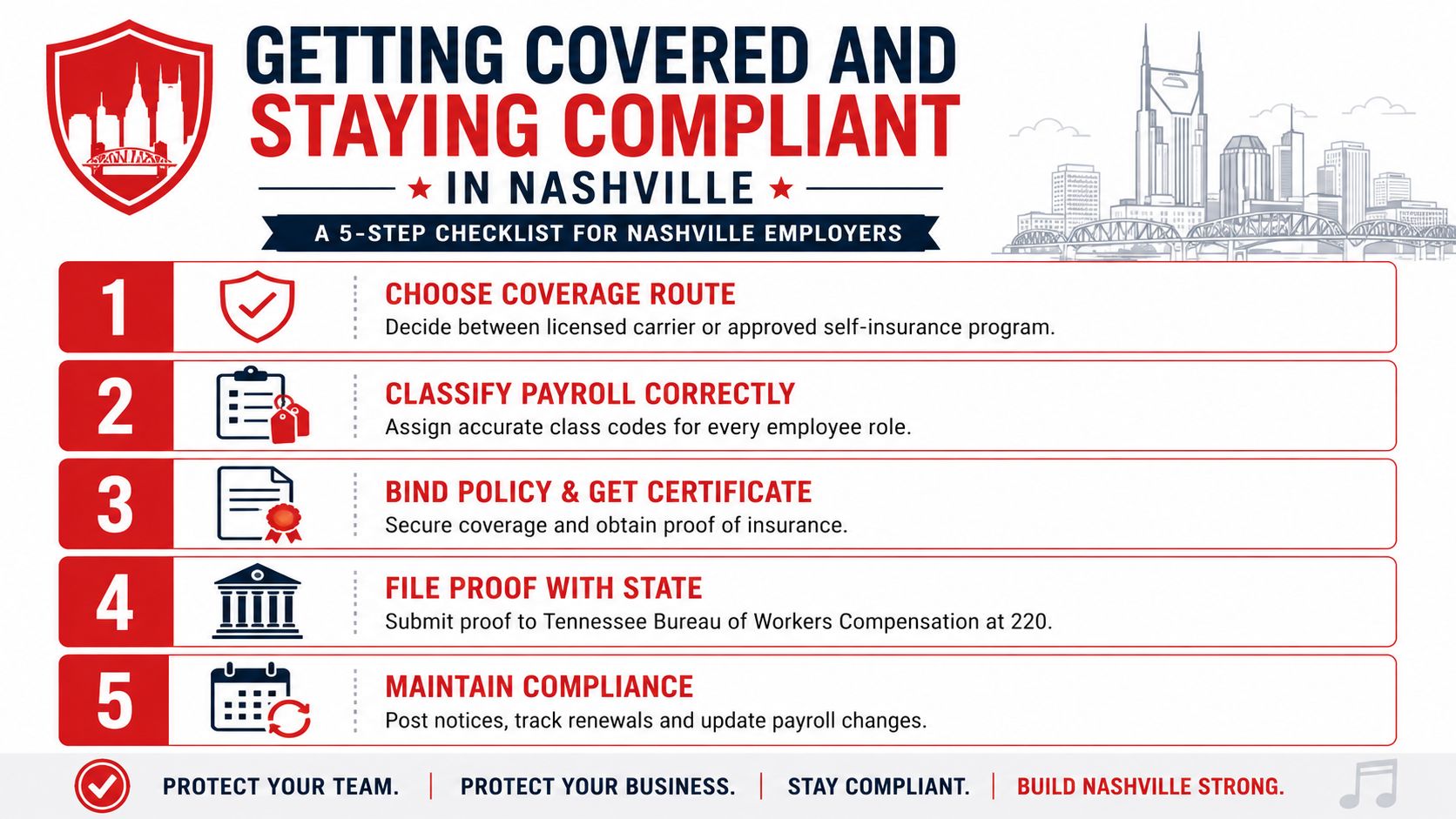
Choose the coverage route first. Most employers use an authorized insurance carrier, while some may qualify for an approved self-insurance arrangement. Once the route is selected, classify every job accurately, bind the policy, obtain the certificate, and confirm that the legal employer name matches the entity operating in Nashville.
The filing calendar matters. Tennessee requires procurement or renewal evidence to be filed electronically within 30 calendar days, while cancellation evidence must be filed within 15 calendar days. The bureau's rules also require a Certificate of Insurance to remain at the employer's place of business and at job sites. Construction-services employers must provide proof of valid coverage at the workplace and when the bureau requests it. These requirements are described in the state's proof-of-coverage rules.
Use a five-step control process
- Choose the coverage route: Select an authorized carrier or confirm an approved self-insurance option.
- Classify payroll correctly: Match each employee's actual duties to the appropriate classification.
- Bind the policy and get certificates: Check the named insured, effective dates, locations, and covered operations.
- File proof with the state: Make sure the required electronic evidence reaches the Tennessee Bureau of Workers Compensation.
- Maintain compliance: Post notices, monitor renewals, update payroll, and replace expired subcontractor certificates.
Construction owners should never accept a certificate at face value and move on. Keep subcontractor certificates in a central file, check the dates before work begins, and request updated evidence when a policy renews or changes. A subcontractor's missing coverage can create serious questions about who employed the worker and who controlled the job.
An annual review should examine classifications, officer elections, subcontractor practices, locations, and payroll changes. Do it before audit time. Correcting drift early is cheaper than defending an inflated audit after the carrier has already issued the bill.
Filing and Managing a Workers Compensation Claim in Tennessee
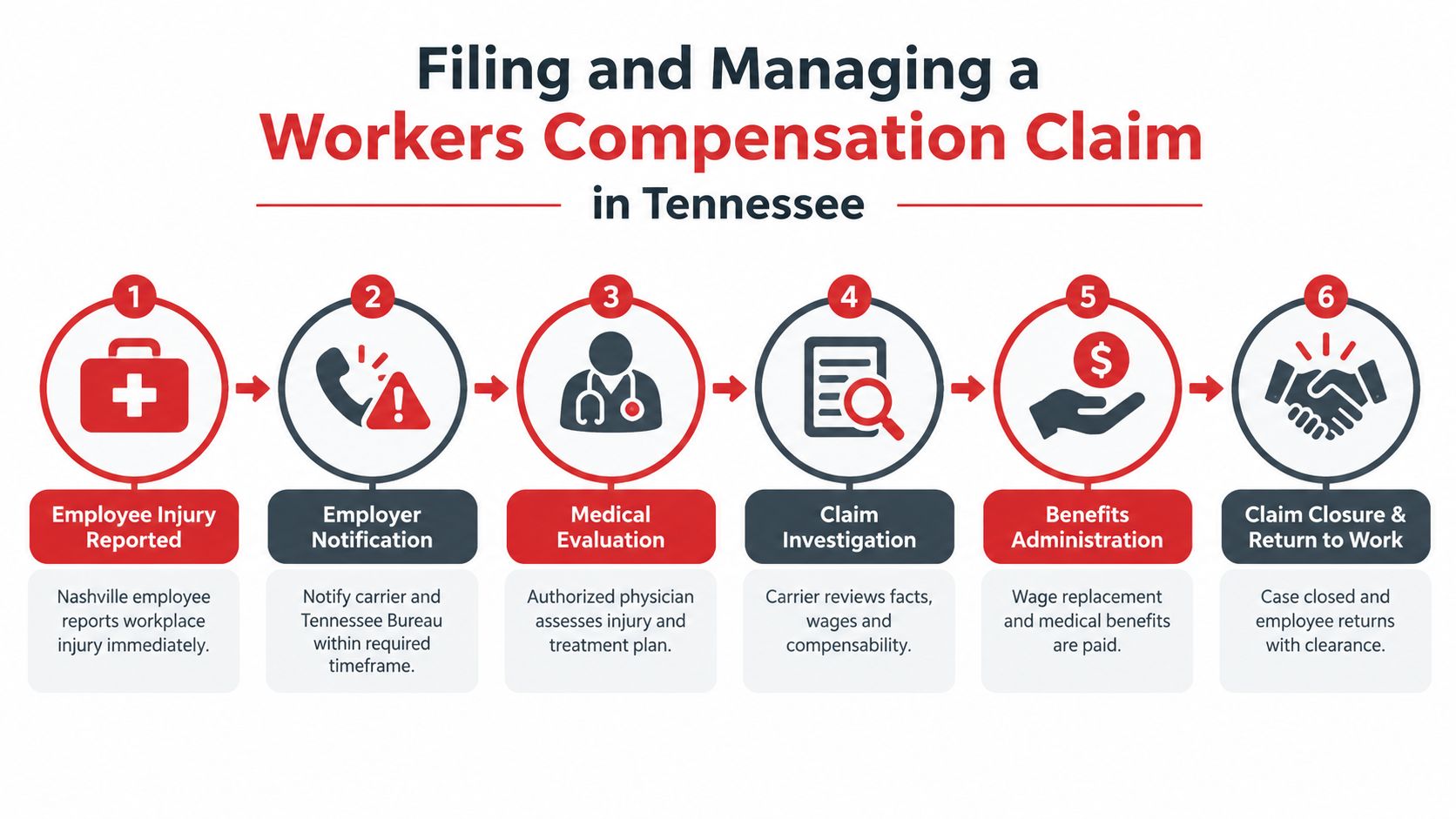
A Nashville claim should follow a repeatable operating procedure. The employee reports the injury, the employer records the facts, the carrier receives notice, and the authorized medical process begins. Don't make the employee prove fault before you report the incident. That delays care and creates an avoidable record problem.
The employer should gather the incident date, location, task, witnesses, body part, reported symptoms, wage information, and any available video or equipment details. Give the employee clear instructions for medical evaluation and preserve work restrictions in writing. If the employee can perform modified duty, provide a specific offer that identifies the role, schedule, duties, and physical limits.
Keep the file moving
- Report immediately: Notify the carrier and follow the bureau's applicable reporting requirements.
- Track disputes: A contested issue may trigger a 15-day filing clock with the bureau, so route disputed notices to the carrier promptly.
- Manage treatment: Confirm the authorized treating physician and record appointments, restrictions, and work status.
- Document return to work: Keep signed offers, acceptance or refusal records, and clearance information.
- Preserve the claim file: Store payroll, medical correspondence, incident records, and settlement documents together.
Tennessee's 2024 annual report recorded 2,455 successful mediations and 8,723 settlements approved by judges. Those figures show how much dispute resolution and settlement activity moves through the state system administered from Nashville. Mediation can resolve contested issues without a full trial, while a settlement petition or compromise release requires the appropriate bureau review and approval process.
Employers handling claims in more than one state should keep jurisdiction-specific timelines separate. A general Florida workers comp timeline can provide comparison context, but it shouldn't be used as a Tennessee procedure guide. For Tennessee coverage basics, review what workers compensation insurance covers, then let the carrier manage the formal claim process.
Why Premiums Can Rise Even When Rates Drop
Nashville business owners are right to question a simple “rates are down” message. Tennessee announced a 2.0% voluntary-market loss cost decrease and a 1.1% assigned-risk decrease effective March 1, 2026, the 13th consecutive year of declines. The same announcement identified a proposed 4.8% increase for October 1, 2026, tied to changes in the medical fee schedule. Those figures come from the state's 2026 Tennessee workers compensation rate announcement.
That isn't a contradiction once you separate loss costs from the final premium. A lower market cost can be offset by payroll growth, a riskier classification mix, claim severity, experience modification changes, carrier expenses, or a medical fee schedule adjustment. The proposed medical change matters because medical treatment is a major component of claim cost, and higher cost per claim can affect underwriting even when claim frequency falls.
What actually moves the invoice
| Cost Driver | Effect on Premium | Employer Lever |
|---|---|---|
| Classification mix | Field, driving, construction, and other higher-risk work can raise the cost basis | Audit duties and class codes |
| Payroll growth | More covered payroll increases the exposure used to calculate premium | Use current payroll estimates |
| Experience modification | Prior loss history can make the account more or less attractive | Reduce repeat incidents and challenge errors |
| Medical cost changes | Fee schedule updates can increase claim severity | Coordinate early treatment and return to work |
| Deductible structure | A higher deductible may reduce premium but increases retained loss responsibility | Model cash flow before choosing |
| Audit accuracy | Misclassified or overstated payroll can inflate the final bill | Prepare records before the audit |
Two neighboring contractors can pay very different amounts because their payroll, loss history, subcontractor controls, and classifications differ. Don't chase a rate while ignoring the account structure. A classification audit, documented safety program, early claim reporting, meaningful light-duty work, and a deductible analysis are more useful than demanding a lower quote with bad data.
The Offset Trap Nashville Claimants Often Miss
An injured worker can receive a workers compensation benefit and still lose part of a federal disability payment. That interaction deserves attention before a claim settles, especially as Tennessee's wage-indexed benefit ceiling increases for the 2026 to 2027 injury period.
The federal offset rule can reduce Social Security Disability Insurance when combined workers compensation and disability income exceed the applicable federal threshold. The reduction can reach 80% of the workers compensation figure under the rule described in the state's 2026 legislative-change information, which also highlights how a higher state workers compensation ceiling can affect federal disability benefits. Review the Tennessee explanation of the 2026 workers compensation changes before assuming a larger weekly check means larger total household income.
Model the whole income picture
A claimant should obtain a Social Security benefit statement, identify the workers compensation rate, and project income through maximum medical improvement and any settlement. The relevant question isn't, “What does the comp check pay?” It's, “What remains after every benefit program applies its rules?”
The table below provides a planning framework, not a personalized calculation. The available verified data identifies Tennessee's weekly compensation limits, but it doesn't provide claimant-specific SSDI amounts, federal thresholds, tax treatment, or settlement facts. Those missing variables must be supplied by the claimant's benefits professionals.
| Tennessee Weekly Comp Rate | Estimated SSDI Reduction | Net Monthly Income Impact |
|---|---|---|
| $1,426.70 | Cannot be calculated without the claimant's SSDI amount and applicable federal offset data | Must be modeled individually |
| $1,488.30 | Cannot be calculated without the claimant's SSDI amount and applicable federal offset data | Must be modeled individually |
| $1,297 | Cannot be calculated without the claimant's SSDI amount and applicable federal offset data | Must be modeled individually |
| $1,353 | Cannot be calculated without the claimant's SSDI amount and applicable federal offset data | Must be modeled individually |
Employers should raise the issue rather than promise an outcome. A settlement that ignores federal offsets can create financial disputes after the release is signed. Claimants should ask qualified workers compensation and Social Security advisors whether a commutation strategy or other settlement structure could reduce offset exposure, then compare long-term income instead of accepting the largest short-term figure.
How an Independent Agency Helps Nashville Businesses Save
The best premium opportunity usually isn't a slogan about market rates. It's a disciplined review of how the policy is built, classified, audited, and serviced.
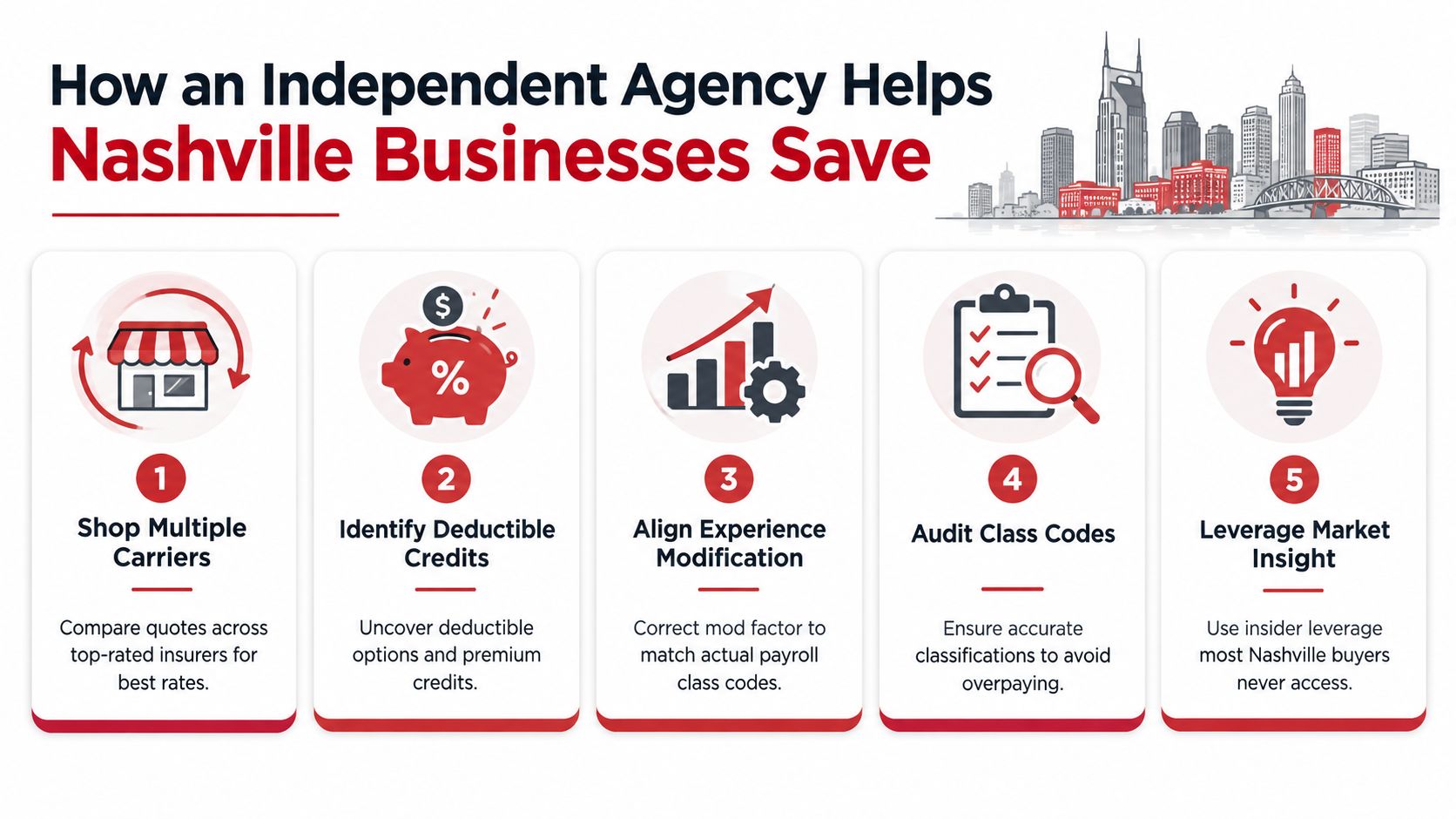
An independent agency can compare multiple carriers, review deductible options, align the experience modification with actual payroll class codes, and prepare the account before underwriting or audit. For a seasonal contractor, a pay-as-you-go structure may better match changing payroll. For a company working across Tennessee and neighboring states, the agent should examine multi-state endorsements and employee travel. For a builder working on several Nashville developments, wrap-up coordination may prevent overlapping or missing coverage.
Use the levers that owners control
- Carrier comparison: Obtain multiple proposals based on identical payroll and classification information.
- Deductible analysis: Compare premium savings against the company's ability to fund retained losses.
- Experience modification review: Check whether prior claims and payroll classifications are accurate.
- Pre-audit preparation: Organize payroll, subcontractor certificates, overtime records, and job descriptions.
- Claims oversight: Ask the carrier to review reserves and investigate medical billing or repricing errors.
- Payroll alignment: Consider payment structures that follow actual payroll movement instead of relying on rough estimates.
Select Insurance Group, Inc. can support Tennessee businesses with workers compensation and broader commercial coverage. Its service model includes carrier comparisons, policy support, document handling, and claim assistance across its Southeast footprint. Employers evaluating what an independent insurance agency does should focus on the practical difference: one carrier offers one solution, while an independent agency can test the account against multiple available structures.
The agency relationship matters most before renewal and before audit, not after a premium surprise. Ask for a classification review, a payroll reconciliation, a claims-status check, and a written comparison of deductible and payment options. That process gives a Nashville employer something concrete to act on instead of another generic rate discussion.
Select Insurance Group, Inc. offers Nashville businesses workers compensation coverage support, commercial policy comparisons, claims assistance, and pre-audit preparation. Visit Select Insurance Group, Inc. to review your current classifications, payroll exposure, and renewal options before the next policy deadline.