
You need to drive in Florida, but you don't own a car. Maybe your license is suspended and the state requires proof of insurance before reinstatement. Maybe you borrow a relative's vehicle, rent cars for work, or need coverage between selling one car and buying another. In each case, buying a standard policy for a vehicle you don't own can create the wrong policy structure.
Non-owner car insurance in Florida is designed for the driver, not a specific vehicle. It can provide liability protection while you drive an eligible borrowed or rented vehicle, and it can support an SR-22 or FR-44 filing when the state requires financial responsibility proof. It also comes with strict limits. The policy generally won't repair the car you're driving, won't automatically cover app-based work, and won't protect every driving situation because you paid the premium.
The important question isn't only whether you can find a cheap quote. It's whether the policy is filed correctly, remains active for the required period, and matches how you drive.
Table of Contents
- What Non Owner Car Insurance Actually Covers
- Florida Minimum Coverage Requirements Explained
- SR-22 and FR-44 Filing Requirements for High-Risk Drivers
- How Much Non Owner Car Insurance Costs in Florida
- Coverage Gaps for Rideshare and Rental Car Use
- How to Get a Non Owner Policy in Florida
- Frequently Asked Questions About Non Owner Insurance
What Non Owner Car Insurance Actually Covers
Your neighbor hands you the keys to a sedan because your car is in the shop. You have permission to drive it, but you don't own it, and your name isn't on the vehicle registration. If you cause an accident, the vehicle owner's policy may respond first, depending on its terms. A non-owner policy can provide liability protection for you when the owner's limits aren't enough or the owner's policy doesn't fully protect your situation.
That distinction matters. A non-owner policy follows the named driver in a limited way. It doesn't insure a particular car, and it isn't a substitute for the owner's vehicle policy. The policy is usually liability-focused, meaning it may address injuries or property damage you cause to other people, subject to the selected limits and policy terms.
What the policy usually does
A properly structured policy may help with:
- Liability claims: It can respond when you're legally responsible for injuries or property damage caused while driving a vehicle you don't own.
- License reinstatement: It can be written to support an SR-22 or FR-44 filing when Florida requires proof of financial responsibility.
- Occasional borrowing: It can provide a personal layer of protection when you drive eligible vehicles belonging to friends or relatives.
- Rental liability: It may provide liability coverage while you're driving a rental, but you must confirm the rental agreement and policy language before declining other protection.
The owner's policy still matters. If you borrow a car regularly, the owner should ask the insurer whether you must be listed as a driver. A non-owner policy isn't a license to ignore household-driver or regular-use rules.
What it doesn't cover
Non-owner insurance generally doesn't pay to repair the borrowed or rented car after a collision. It also doesn't provide protection for theft, weather, vandalism, or other physical damage to that vehicle. If you want protection for the rental car itself, you need to examine the rental contract and any separate collision damage option available to you.
The policy also isn't designed for a car you own, lease, or regularly keep available for your personal use. If you buy a vehicle, tell the insurer immediately. The policy structure may need to change because the state, lender, and insurer will expect coverage connected to that vehicle.
For a plain-English overview of the policy structure, see this simple guide to non-owner car insurance. The practical rule is straightforward:
Practical rule: Buy non-owner coverage to protect your driving exposure, not to protect the physical vehicle.
Florida Minimum Coverage Requirements Explained
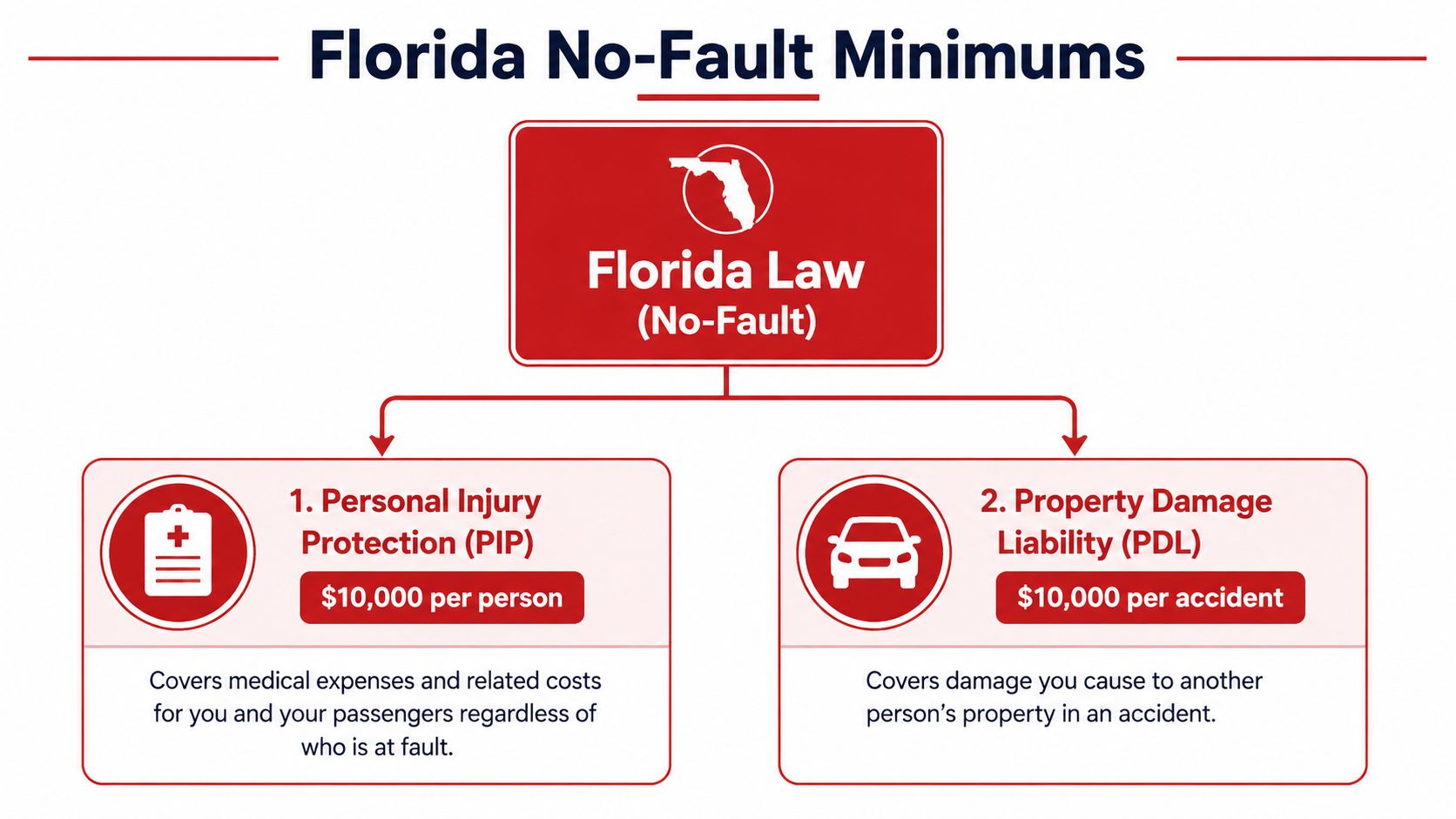
Florida's auto insurance system starts with no-fault rules, which makes the state's baseline different from the liability framework many drivers expect elsewhere. For a vehicle with a current Florida registration, Florida requires at least $10,000 in Personal Injury Protection, or PIP, and $10,000 in Property Damage Liability, or PDL. The requirement applies to registered motor vehicles with four or more wheels, as explained by the Florida Highway Safety and Motor Vehicles insurance requirements.
The two-part Florida baseline
PIP is connected to injury protection for covered people, subject to the policy and Florida law. PDL addresses damage you cause to someone else's property, including another vehicle. A non-owner policy used for Florida compliance is built around this statutory context even though the policy doesn't insure a car registered to you.
Florida generally doesn't require bodily injury liability for ordinary registered passenger vehicles under the standard framework. That doesn't mean bodily injury exposure disappears. It means the legal floor and the financial protection available under a basic policy aren't the same thing.
| Coverage | Florida baseline | What it addresses |
|---|---|---|
| Personal Injury Protection | $10,000 | Injury-related protection under Florida's no-fault structure |
| Property Damage Liability | $10,000 | Damage you cause to another person's property |
The amounts in this table are the Florida registration baseline described by the state guidance. They aren't a recommendation for every driver. If you seriously injure someone or cause substantial property damage, minimum limits can leave you exposed beyond the policy's payment obligation.
Why non-owner policies need careful construction
A non-owner policy isn't a miniature version of a regular vehicle policy. It must identify you as the insured driver while excluding ownership-based coverages tied to a specific car. The insurer must also determine whether the policy can satisfy the filing or reinstatement requirement attached to your driving record.
Florida's no-fault structure doesn't eliminate the need to review liability limits. Drivers comparing insurance requirements across different vehicle uses can also benefit from understanding how personal auto rules differ from minimum coverage for trucking companies, because commercial vehicles involve a different risk and compliance structure.
For a state-specific explanation of the ordinary auto baseline, review this Florida minimum auto insurance guide. Don't treat the legal minimum as a complete financial plan. Treat it as the starting point for a policy designed around your actual exposure.
SR-22 and FR-44 Filing Requirements for High-Risk Drivers
A Florida driver restoring driving privileges after a suspension, judgment, or serious violation needs more than an insurance card. The insurer must submit the correct electronic filing, and the policy must remain active for the required period.
SR-22 limits
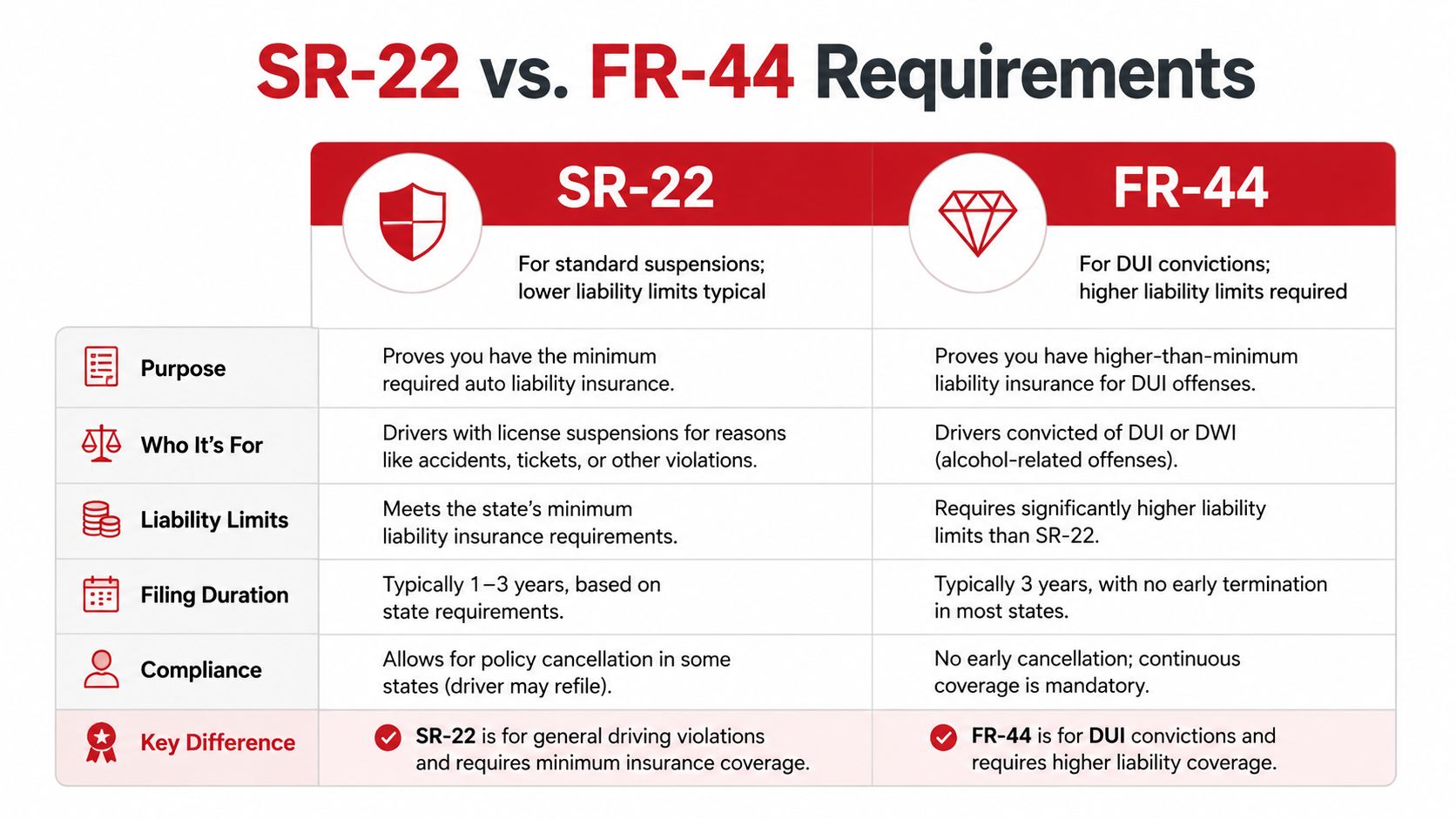
A Florida non-owner SR-22 requires $10,000 in bodily injury liability per person, $20,000 per accident, and $10,000 in property damage liability, according to the Florida filing requirements summarized by the source. The SR-22 is an electronic certificate sent by the insurer to show that the required coverage is active.
The filing does not insure a car you do not own. It connects your active non-owner policy with the state's financial responsibility record. Tell the insurer that you need a non-owner filing before the policy is written. A regular vehicle policy can create ownership questions or prevent the filing from matching your situation.
FR-44 limits after a DUI or DWI
Florida's FR-44 requirement is substantially higher. After a DUI or DWI, an FR-44 requires $100,000 per person, $300,000 per accident, and $50,000 in property damage, as detailed in the Florida non-owner SR-22 and FR-44 requirements.
The FR-44 bodily injury limit per person is ten times the SR-22 requirement. That difference affects the policy limits, the insurers willing to write the risk, and the premium.
| Filing | Bodily injury per person | Bodily injury per accident | Property damage |
|---|---|---|---|
| SR-22 | $10,000 | $20,000 | $10,000 |
| FR-44 | $100,000 | $300,000 | $50,000 |
Continuous maintenance is the part drivers miss
Florida typically requires continuous maintenance for three years. If the insurer cancels the policy or the certificate terminates, the insurer must electronically notify the state. That notice can create immediate compliance problems and delay the restoration process. The Florida non-owner filing guidance explains why a lapse matters.
Keep the policy active even if you are not driving this month. Prevent payment failures, and never assume a replacement policy transfers the old filing automatically. Before cancelling existing coverage, ask the new insurer to confirm the electronic filing, its effective date, and the policy limits required by the state.
The filing is an ongoing compliance obligation, not paperwork completed once. A lapse can put your reinstatement status at risk.
How Much Non Owner Car Insurance Costs in Florida
Non-owner coverage often costs less than a standard policy because it does not insure physical damage to a particular vehicle. It is not automatically cheap. Your driving record, location, age, prior insurance history, and filing requirement all affect the premium. An FR-44 usually produces a tougher underwriting decision than an ordinary non-owner policy because it requires higher liability limits.
Published comparisons show how widely Florida quotes can differ. One comparison listed a Florida non-owner state-minimum policy at $545, compared with $993 for a traditional state-minimum policy. Another listed a Florida non-owner premium of $1,299, compared with $1,734 for a Florida state-minimum policy. The figures are market examples from the Florida non-owner filing and pricing comparison, not guaranteed offers.
Florida non-owner versus standard policy cost comparison
| Policy type | Annual premium | Key difference |
|---|---|---|
| Non-owner state-minimum example | $545 | Driver-focused liability coverage without a specific insured vehicle |
| Traditional state-minimum example | $993 | Vehicle-based policy with coverage connected to an owned car |
| Florida non-owner example | $1,299 | Non-owner policy example with Florida underwriting factors |
| Florida state-minimum example | $1,734 | Standard Florida policy example tied to an owned vehicle |
The comparison changes quickly when a high-risk filing is involved. An FR-44 requires substantially higher liability limits than an SR-22, increasing the insurer's potential exposure. Recent violations, a suspension, missed payments, or a prior coverage gap can also make the application harder to place.
How to control the premium
Request quotes from insurers that specifically write non-owner policies and electronic filings. Many ordinary auto programs do not support this coverage, so a general online quote may leave out the filing requirement or produce an unusable policy.
Give the agent complete information at the start. State whether you need an SR-22 or FR-44, rent vehicles, live with someone who owns a car, or drive for work. Incorrectly describing your use can create a coverage dispute later. Paying for the correct policy now is safer than choosing a cheaper policy that excludes the way you drive.
Compare identical liability limits, filing types, and permitted uses. A lower premium is not a bargain if the insurer will not submit the required filing or the policy limits fail to meet Florida's requirement. Confirm the electronic filing before relying on the policy for license reinstatement.
Coverage Gaps for Rideshare and Rental Car Use
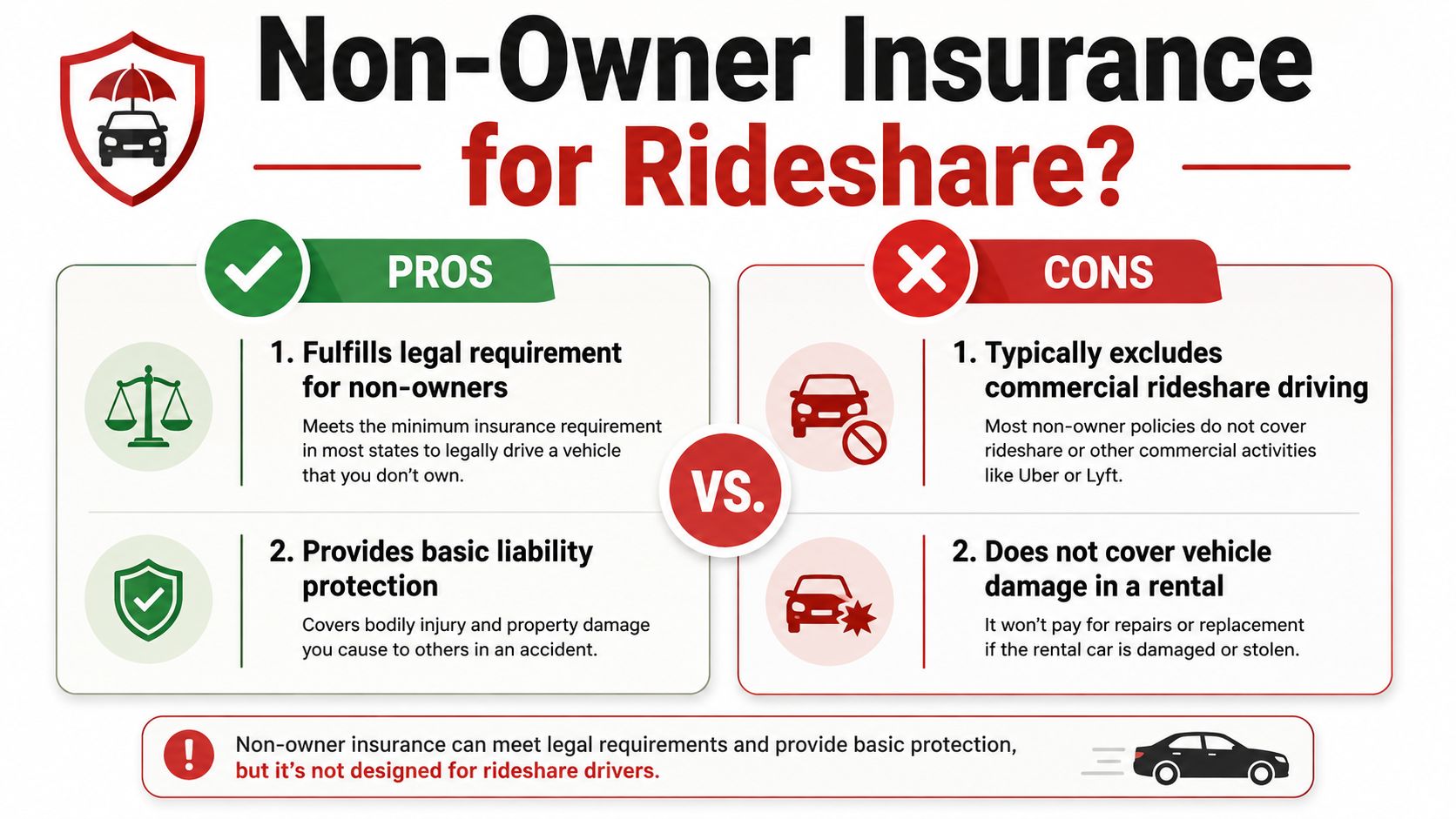
A non-owner policy isn't a universal permission slip for every kind of driving. The most common mistake is buying a policy for personal borrowing, then assuming it automatically covers rideshare, delivery, rental damage, or commercial work.
Why app-based work is different
Rideshare and delivery driving changes the risk. You aren't only driving for personal transportation. You're using a vehicle in connection with income-producing activity, passenger transportation, or delivery. Standard non-owner policies typically exclude commercial use because the insurer priced the policy around personal driving, not repeated business exposure.
Read the policy's permitted-use language before accepting an app-based assignment. If you drive for a transportation or delivery platform, ask specifically whether the policy covers the period when you're logged in, waiting for a request, carrying a passenger, or carrying goods. Don't rely on a general statement that the policy covers borrowed cars.
Rental coverage has two separate questions
Rental drivers often combine two different issues:
- Liability to other people: Your non-owner policy may provide liability protection while driving the rental, subject to its terms and limits.
- Damage to the rental car: A non-owner policy generally doesn't pay for damage to the rental vehicle itself.
Those are separate coverages. If you decline the rental company's damage protection, you may be responsible for the rental vehicle's repair costs, loss of use, or other contract charges. Check the agreement and any separate protection available through your payment method before you take the keys.
Florida's minimum rules focus on PIP and property-damage liability, and uninsured or underinsured motorist coverage isn't required. The Florida consumer automobile insurance toolkit explains this baseline. That leaves a meaningful difference between the minimum policy needed for compliance and the protection many drivers assume they have.
If you're researching a vehicle's registration context before borrowing or purchasing, you can find Florida plate data through a vehicle-information resource. That information doesn't replace an insurance coverage review, but it can help you verify details about the vehicle you're considering.
For a broader discussion of vehicles used by people who don't own them, review this guide to hired and non-owned automobile coverage. The practical recommendation is simple: disclose every use before the policy is issued.
How to Get a Non Owner Policy in Florida
A Florida driver can often obtain a non-owner policy quickly, but only when the application reflects the actual situation. Tell the agent about any required filing, regular access to another vehicle, rental use, car-sharing, and delivery or other work-related driving. Asking only for “cheap insurance” can produce a policy that fails to address the reason you need coverage.
Start with the documents and facts
Prepare the following information before requesting quotes:
- Personal identification: Provide your Florida driver's license information or state identification details.
- Driving history: Report suspensions, convictions, accidents, cancellations, and prior insurance gaps accurately.
- Filing order: Bring the notice or court information identifying whether you need an SR-22 or FR-44.
- Driving pattern: Explain whether you borrow cars, rent vehicles, use car-sharing services, or drive for work.
- Household details: Tell the agent whether you live with someone who owns a vehicle. Regular access can change how the insurer evaluates the risk.
The agent must match the policy to your actual use, not just enter your name into a quote form. A policy that excludes a vehicle you drive regularly may leave the underlying problem unresolved.
Ask for filing confirmation
Many standard auto programs do not support non-owner filings. An independent agency can check available carriers, compare terms, and determine whether the policy can electronically submit the required certificate.
Select Insurance Group, Inc. can assist Florida drivers with non-owner coverage and quote comparisons through its independent agency process. Ask the agent to confirm the effective date, filing type, limits, and expected transmission time for the electronic filing.
For license reinstatement, prompt filing may matter because the restoration process depends on active proof of coverage. An insurance card alone does not prove that the state record has updated. Request confirmation that the filing was submitted, then keep the policy documents and submission details.
Keep the policy active
Florida typically requires continuous maintenance for three years. The insurer must electronically notify the state if the certificate is canceled or terminates, according to the Florida filing maintenance guidance. Use reliable payment, keep your contact information current, and contact the agency before canceling or replacing the policy.
A lapse can create a new compliance problem even when the original filing was accepted. Do not let a payment issue or policy change interrupt the required period.
If you buy a vehicle later, tell the insurer before driving it. A non-owner policy may no longer fit, and the SR-22 or FR-44 filing may need to move to an owner policy or be rebuilt under the new policy structure.
Frequently Asked Questions About Non Owner Insurance
Can I get a non-owner policy if someone in my household owns a car?
Possibly, but don't assume you're eligible without review. If you live with someone who owns a vehicle and you regularly drive it, the insurer may expect you to be listed on that vehicle's policy. A non-owner policy may not be appropriate for regular access to a household vehicle.
Ask both the vehicle owner and the insurer how the household driving arrangement should be documented. The goal is to avoid a policy that appears valid but doesn't address the car you drive.
Will non-owner insurance satisfy Florida reinstatement requirements?
It can, if the policy is written with the required filing and limits. An ordinary non-owner policy without the requested SR-22 or FR-44 may not satisfy a reinstatement order. Give the agent the exact requirement so the insurer can submit the correct electronic filing.
What happens if I buy a car later?
Tell the insurer before using the car. A non-owner policy is designed for a driver who doesn't own the vehicle, so purchasing a car changes the risk and policy structure. The insurer can explain how to move the filing to an owner policy and how to avoid an interruption.
How quickly can coverage begin?
Coverage can often begin once underwriting is complete and the insurer accepts the application, but the filing transmission and state record update are separate operational steps. Ask for the effective date and electronic filing confirmation rather than relying only on a temporary identification card.
Does the policy cover rideshare or rental-car damage?
Don't assume it does. Rideshare and delivery work typically require specific approval or a different policy arrangement, while damage to a rental car generally falls outside a non-owner policy's liability protection. Confirm both questions in writing before driving.
Is the cheapest policy the right choice?
Not if it lacks the filing, limits, or permitted use you need. Compare matching policies, verify the electronic filing, and maintain the coverage without interruption. In Florida, compliance details matter as much as the premium.
Select Insurance Group, Inc. helps Florida drivers compare non-owner policies, arrange SR-22 or FR-44 filings, and clarify rental or rideshare coverage before a gap becomes a claim problem. Visit Select Insurance Group, Inc. to request a free, no-obligation quote and speak with a specialist about your reinstatement or occasional-driving needs.