
You just signed a Charlotte lease, and now the property manager wants proof of renters insurance before move-in. Meanwhile, the weather app is lighting up with hail alerts, your boxes are still packed, and you're trying to figure out whether the cheapest policy is enough for your laptop, furniture, and the ring on your dresser. That's the Charlotte problem, not the generic “do I need renters insurance?” question.
Renters insurance Charlotte NC should be treated as a local buying decision, not a formality. In this city, lease language, storm exposure, floodplain risk, and replacement-cost choices matter more than slick national checklists. If you get those wrong, the policy can look fine on paper and still fail you when you need it.
Table of Contents
- Why Charlotte Renters Need a Local Playbook
- What Renters Insurance Actually Covers
- How North Carolina Lease Rules Shape Your Policy
- Charlotte Premiums and What Really Moves the Price
- The Storm and Flood Gap Most Renters Miss
- How to Compare Charlotte Renters Quotes the Smart Way
- Savings Tactics That Work in the Charlotte Market
- Filing a Claim in Charlotte Without the Headaches
Why Charlotte Renters Need a Local Playbook
A renter in NoDa can run into this fast. The lease says insurance is required, the landlord wants proof, and a storm rolls through the same week with roof damage and water intrusion nearby. That's when the typical “any HO-4 will do” advice falls apart, because Charlotte renters aren't shopping in a vacuum.
Charlotte's rental market turns over quickly in places like South End, University City, and Steele Creek, and a lot of tenants are new to North Carolina lease rules. They're also moving into a city that gets slammed by severe thunderstorms and tropical remnants, with flood exposure that doesn't stay politely at the coast. Insurify notes that Charlotte has an estimated 2,700 residential and commercial properties in a floodplain, which is exactly why a standard renters policy has to be paired with a flood plan if you live near the wrong creek or low spot. See the local Charlotte overview in this Charlotte insurance guide.
Practical rule: If you rent in Charlotte, don't buy coverage as if you were in a dry, inland suburb with no lease requirement and no water risk.
North Carolina's 2025 update to landlord-tenant rules makes that even more important. The state clarified how lease-required renters insurance works, including what landlords can request and how fast you have to prove coverage. That matters because the compliance side is no longer fuzzy, and Charlotte renters are often the ones feeling that pressure first.
A common mistake is copying a national checklist and calling it done. Charlotte needs a policy that matches the lease, the building, and the weather.
What Renters Insurance Actually Covers
A renters policy, usually written as an HO-4, is built around four things: personal property, liability, loss of use, and some optional add-ons. If you understand those four pieces, you can stop buying coverage by guesswork.
Personal property and why valuation matters
Your stuff is the first thing many people underestimate. A laptop, clothes, shoes, cookware, a TV, furniture, and a bike can add up quickly, and the payout method matters just as much as the limit. Under actual cash value, depreciation bites hard. Under replacement cost, you're closer to the money needed to buy new gear again, which is the better fit for most Charlotte renters.
That difference is exactly why a policy can look cheap and still leave you short after a loss. A laptop bought for school or work doesn't hold value the way renters assume it does.
Liability and loss of use
Liability is there for when somebody gets hurt or their property gets damaged and you're the one on the hook. A dog bite at a Charlotte park, or a guest slipping on a floor in your apartment, can turn into a serious claim fast. You don't want to discover that your policy was bare-bones after a lawyer letter shows up.
Loss of use is the part many renters ignore until they need it. If a fire or covered loss forces you out, this coverage helps with temporary living costs while your unit is repaired. That matters in Charlotte, where short-term housing can get tight when the city is busy.
Optional riders and hard exclusions
If you've got jewelry, recording gear, or high-value electronics, ask about scheduled personal property rather than hoping the base policy stretches far enough. And know what's not included. Standard renters policies do not cover flood, earthquake, or business property. Flood belongs in the storm section below, because that's where Charlotte renters get burned most often.
For a useful move-in checklist mindset, the RentReboot renter tips piece is worth skimming if you want a practical way to document belongings before a claim ever happens.
How North Carolina Lease Rules Shape Your Policy
North Carolina changed the landlord-tenant rulebook in 2025, and Charlotte renters should care about the details. If your lease requires renters insurance, the landlord can enforce that requirement, but the tenant can't be forced to use a designated carrier or agent. If you don't provide proof within three business days of the landlord's request, the landlord may buy coverage and charge you the actual cost plus an administrative fee capped at $50 per year under the amended statute (North Carolina Session Law 2025-45).
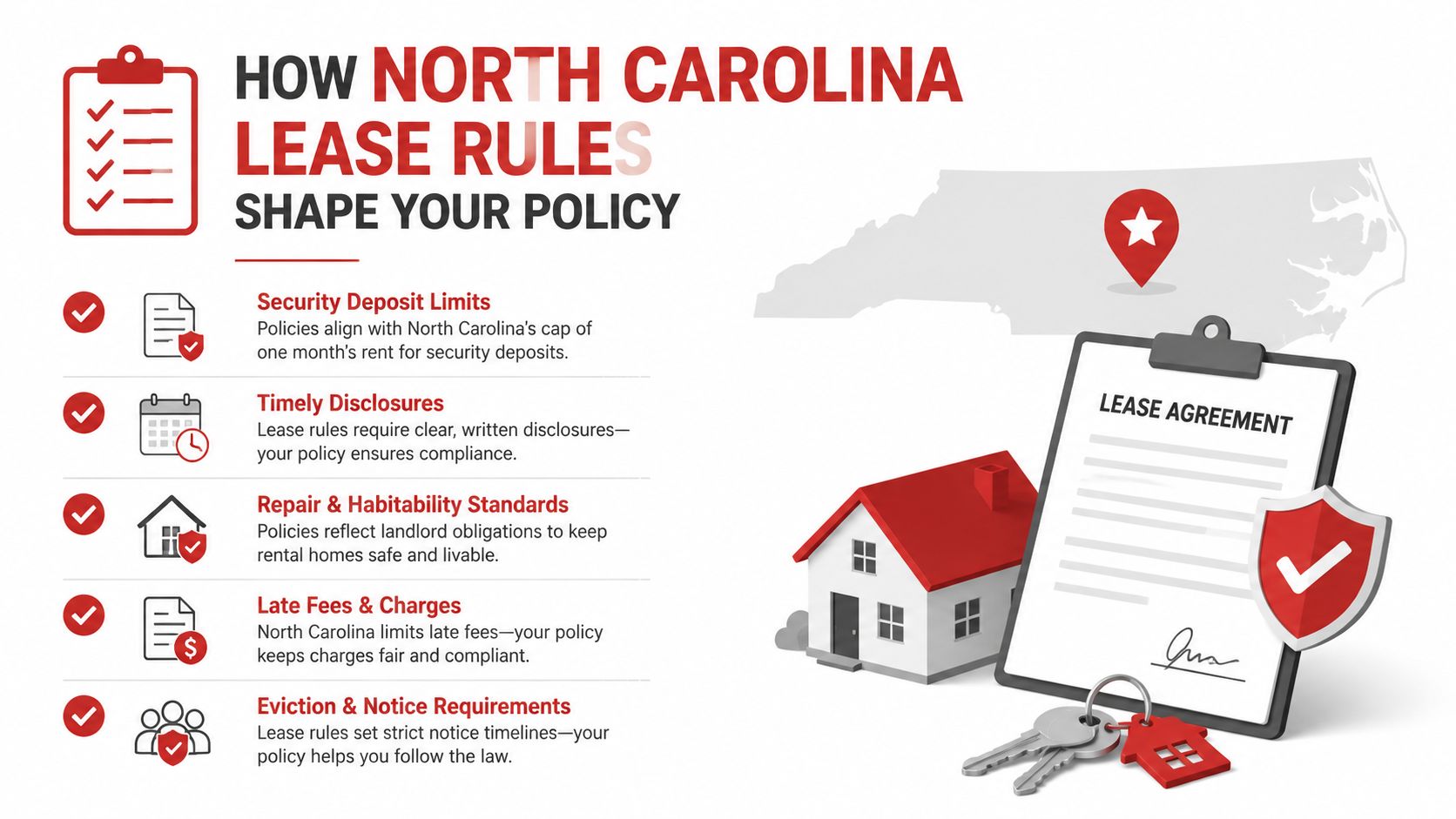
That statute is a big deal because it removes a lot of the old ambiguity. Tenants get carrier choice, landlords get a clear compliance path, and missed paperwork now has a direct cost attached to it. In a city with a lot of corporate leases and fast move-ins, that matters more than most comparison pages admit.
What landlords can and cannot do
A landlord can require proof of coverage if the lease says so. A landlord cannot force you into a specific insurer just because they prefer the paperwork flow. They also can't rewrite the state rule by pretending a lease form lets them ignore the proof timeline.
Some Charlotte buildings still layer on their own administrative habits, like asking for a certificate of insurance or pushing for higher liability than a bare minimum. That's not the same as dictating the carrier. The point is simple, read the lease carefully, then shop the policy to match the lease instead of blindly accepting the first quote.
Use the lease as the starting point, not the finish line. If the building wants proof, get it ready before move-in day so you're not paying an admin charge over a missing PDF.
Comparison shopping gets practical. If the lease wants documentation, the quote has to be bindable quickly, accurate on address and unit details, and clear about liability wording. That's the Charlotte reality after the 2025 update.
Charlotte Premiums and What Really Moves the Price
Charlotte renters often assume better coverage means a huge premium jump. It usually doesn't. The market is still relatively affordable, but the quote changes quickly once you adjust limits, deductible, or valuation method. Insurify reports that the average renters insurance cost in North Carolina is about $10 per month, while the national average is about $19 per month. ValuePenguin separately estimates Charlotte renters insurance at about $17 per month for $30,000 of personal property coverage, and another Charlotte estimate puts the average annual premium at $316, or about $26 per month, for $40,000 in personal property coverage, $300,000 in liability, and a $1,000 deductible. Those differences aren't contradictions, they're proof that the quote depends on the coverage package.
| Coverage Tier | Contents Limit | Liability Limit | Avg. Monthly Premium | Avg. Annual Premium |
|---|---|---|---|---|
| Lower-content setup | $30,000 | Not specified in the source | About $17 | Not specified in the source |
| Standard Charlotte benchmark | $40,000 | $300,000 | About $26 | $316 |
| Broader benchmark policy | $40,000 | $300,000 | About $36 | Not specified in the source |
Those figures make one thing obvious. Charlotte renters can buy solid protection without blowing up their budget, but the price moves with the structure of the policy. A higher deductible can reduce premium, while stepping up personal property coverage is usually the right move if your apartment is full of electronics, furniture, clothing, and school or work gear. For a broader rate view, the monthly renters cost guide is a useful place to compare the mechanics behind the quote.
What actually changes the number
The biggest levers are coverage limit, deductible, and whether the policy pays replacement cost or actual cash value. A high-rise unit in Uptown with modern contents can justify a different limit than a smaller place with fewer belongings, even if the rent is similar.
Don't buy the lowest quote by default. In Charlotte, the cheapest policy often just means you underinsured the contents.
Use your own inventory to set the limit. If you don't know what your stuff is worth, the insurer will guess for you, and that guess won't be generous.
The Storm and Flood Gap Most Renters Miss
Charlotte renters usually get a clean answer on storms and then stop there. The better question is whether renters insurance covers hurricane damage and where the policy draws the line. Standard renters insurance responds to wind-driven loss from a storm, theft, vandalism, and the contents side of a claim, but water that rises from outside the building sits outside the base form. North Carolina Legal Services notes that renters insurance generally covers contents and may address wind, theft, or vandalism, while flood remains outside the standard policy (North Carolina Legal Services).
That split matters in Charlotte. Heavy rain can push water into low-lying areas fast, and a standard HO-4 does nothing for that kind of loss. Wind damage belongs in renters insurance. Rising-water damage does not.
What to add if you live in a risky spot
If your unit sits near a creek, in a basement-style setup, or in a lower part of the city, ask about a separate flood policy or NFIP contents coverage. If your building is leak-prone or your landlord is strict about water damage, ask about a water backup endorsement too. It is a narrow fix, but it closes the gap many renters only notice after a storm.
Flood is not the same as storm damage. If water comes in from outside the home, the standard policy will not help much unless you bought separate protection.
Charlotte renters should treat flood as a real buying issue, not an edge case. The city's storm exposure makes the water question practical, especially for leases that require proof of coverage and for renters whose belongings would be expensive to replace. If you only buy the base policy, you are covered for part of the problem and exposed to the rest.
How to Compare Charlotte Renters Quotes the Smart Way
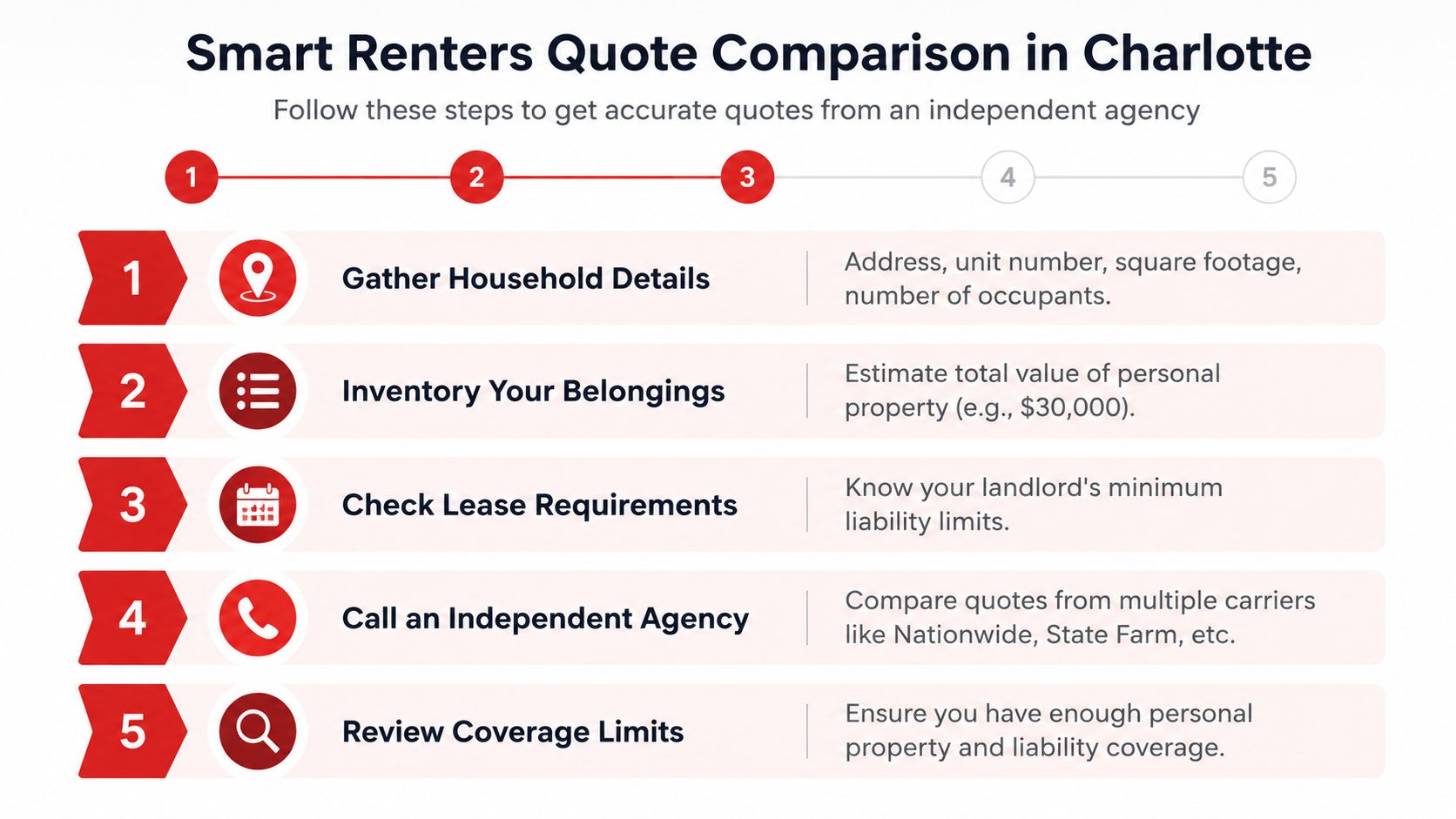
Don't shop by monthly number alone. That's the lazy way to buy insurance, and it produces weak policies. Start with the household facts a carrier needs, then compare the structure of the quote, not just the price.
Gather the right details first
Have your address, unit number, approximate square footage, building type, desired contents limit, prior claims history, and any auto policy you already carry. If your lease has a minimum liability requirement, put that in writing before you start asking for quotes. If you don't, you'll waste time comparing policies that can't satisfy the lease.
The best way to do this is through an independent agency that can gather quotes across multiple carriers in one pass. A Charlotte renter doesn't need five separate logins and five different call centers to figure out basic coverage.
Read the quote sheet like a buyer, not a tourist
Look past the premium and check whether the policy uses replacement cost or actual cash value for contents. Check for water backup, animal liability wording, and whether loss-of-use coverage has any daily caps that could be a problem if displacement lasts longer than expected. If your lease or building asks for proof, confirm the documentation requirements before binding.
Ask direct questions
- Claims process: Ask how storm claims are handled after hours and who answers when the weather turns bad.
- Local handling: Ask whether they use local adjusters in Mecklenburg County.
- Contents payout: Ask how they handle depreciation on electronics and furniture.
- Lease proof: Ask how fast they can issue proof for a landlord request.
- Optional coverage: Ask whether the quote includes water backup and scheduled items for jewelry or gear.
Charlotte renters don't need a lecture. They need a quote that matches the lease, the apartment, and the stuff they own. One option from Select Insurance Group, Inc. is a free renters insurance quote in Charlotte, which fits this kind of comparison-driven shopping without locking you into a single carrier.
Savings Tactics That Work in the Charlotte Market
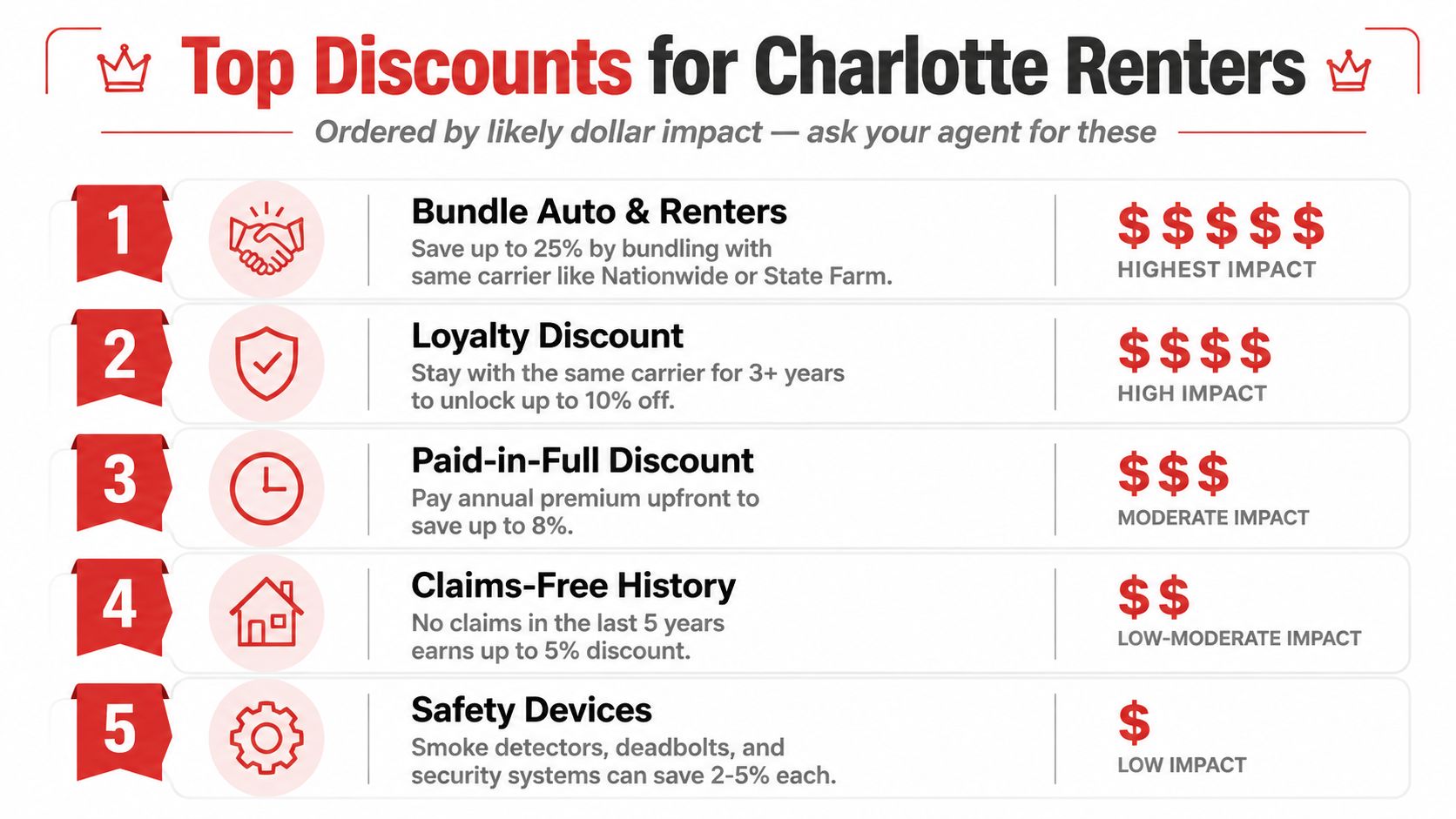
The best savings move is usually bundling auto and renters with the same carrier. Most Charlotte renters drive, so this is the first discount I'd ask for every time. After that, the smarter play is to tune the deductible and keep the coverage limit honest instead of chasing the lowest sticker price.
A $1,000 deductible usually trims the premium more than a timid policyholder expects, but it only makes sense if you can absorb that loss after a claim. A $500 deductible is the safer middle ground for many Charlotte renters, especially if the premium is already in that lower local range discussed earlier. Don't starve the policy to save a few dollars a month.
The discount stack worth asking for
Paperless billing and autopay credits are easy wins. Smoke detectors, deadbolts, and security devices can help too, and some carriers give practical credits for those features because they lower claim risk. If you have a freezer or a small set of high-risk appliances, ask whether a food-loss or freezer-contents rider exists. That's a small detail, but it's the kind of detail people only care about after a spoiled-food claim.
Charlotte's carrier pricing can also move when the broader homeowners market tightens, so it pays to ask an agent what's happening in current filings and appetite. A good independent agent can usually surface multiple offers from one conversation, which is exactly how you find the right mix of price and protection without doing all the legwork yourself.
Ask for the discount before you accept the quote. If the carrier can shave off friction with simple billing choices or safety devices, let them.
The cheapest quote on paper is rarely the smartest quote in practice. In Charlotte, the right savings tactic is to keep the policy strong where it matters, then trim the premium with discounts that don't weaken the claim.
Filing a Claim in Charlotte Without the Headaches
The first hour after a loss matters more than the next week. If you wait too long or clean up too fast, you make the claim harder than it needs to be. Start with proof.
Take photos and video of the damage before you move anything. Save the files with timestamps, and capture close-ups plus wide shots so there's no dispute about scope. If there's theft or vandalism, call the police and get the incident number, because your carrier may want it later.
The sequence that keeps claims cleaner
- Document the scene. Photograph broken items, water lines, damaged packaging, and anything that helps show what happened.
- Tell the landlord in writing. Use the lease timeline, not just a text message.
- Open the claim immediately. Use the carrier app or claims number and give the same story every time.
- Ask about temporary housing. If you might need to leave, ask for an advance on loss-of-use benefits.
- Escalate if the loss is big. For a major contents loss, a public adjuster may make sense, and a local agent can help push back when contents are undervalued.
If your policy promised replacement-cost treatment, hold the carrier to it. Too many renters accept the first low settlement because they don't know what their furniture, clothes, and electronics cost to replace. That's where a local independent agent still earns the fee-free trust, by helping you translate the policy language into a payout.
The best claim is the one you can prove cleanly. Charlotte renters who keep inventories, receipts, and photos don't have to fight nearly as hard when the loss turns real.
If you want a renters policy that fits your Charlotte lease, your storm exposure, and the way your belongings are covered, talk to Select Insurance Group, Inc. They work with renters across North Carolina and can quote coverage that lines up with landlord requirements, flood concerns, and replacement-cost questions. Visit Select Insurance Group, Inc. and get a Charlotte renters quote that's built for the lease you're signing, not a generic online form.