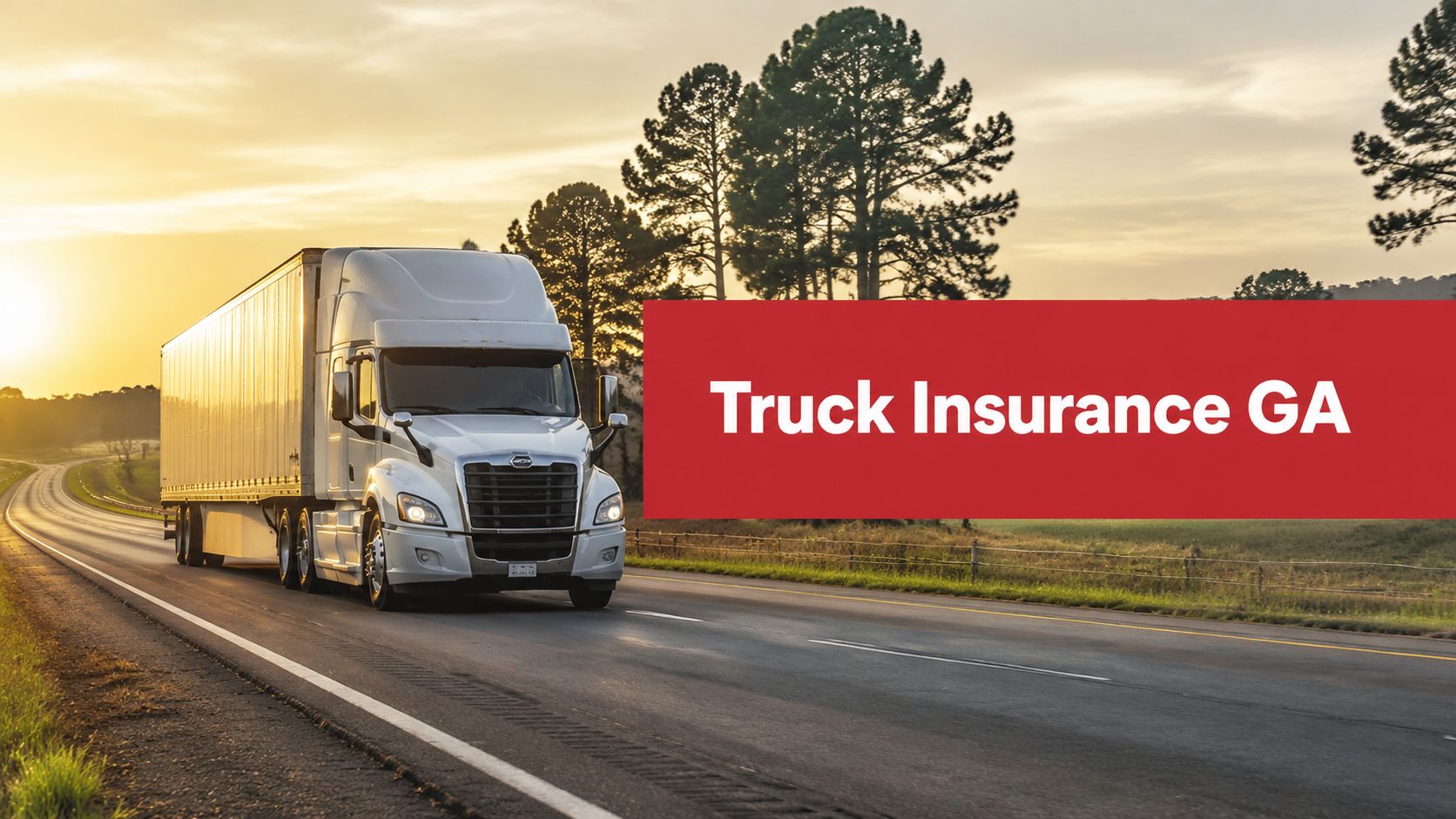

A dispatcher calls while you're halfway through a Georgia load. Your reefer left Vidalia headed toward Atlanta, but the next assignment runs from Atlanta to Jacksonville. The route crosses a state line, the broker wants stronger liability limits, and your current policy was written for Georgia-only hauling. Then you discover another problem: your policy doesn't clearly cover the tractor's personal-use trip home after dispatch ends.
That situation is common because commercial truck insurance in Georgia isn't one simple state minimum. Your requirements change with operating authority, vehicle class, cargo, route, and federal filing obligations. Georgia's freight connections through Atlanta, Savannah, and the Southeast corridor create serious opportunity, but they also create more exposure to liability claims, cargo theft, severe weather, and complex underwriting.
Table of Contents
- Why Georgia Truckers Need a Policy Built for the Southeast Corridor
- The Two-Layer Liability Framework Every Georgia Carrier Must Meet
- Core Coverages That Shape a Georgia Trucking Policy
- Choosing the Right Endorsements for Your Operation
- What Really Drives Your Georgia Commercial Truck Premium
- A Compliance and Documentation Checklist for Georgia Operators
- How to Compare Quotes and Work With an Independent Bilingual Agency
- Key Decisions and Next Steps for Georgia Truckers
Why Georgia Truckers Need a Policy Built for the Southeast Corridor
A Georgia truck rarely operates in a vacuum. A local straight truck may deliver agricultural products around Macon, while a tractor-trailer based near Atlanta may regularly run through Tennessee, Florida, Alabama, or South Carolina. A carrier can start the week intrastate and accept an interstate load before the week is over.
That change matters. Georgia's commercial truck insurance framework depends on both vehicle weight and operating scope, with different rules applying to intrastate and interstate carriers (Georgia commercial truck insurance requirements). A policy written around local deliveries may not satisfy the liability expectations attached to a new interstate haul.
Georgia's freight corridors create mixed exposure
The Atlanta metro area brings dense traffic, frequent lane changes, and heavy commercial activity. I-75, I-85, and I-20 connect Georgia carriers to major regional markets, while the Port of Savannah feeds freight into trucking networks throughout the Southeast. Hartsfield-Jackson cargo activity adds another layer of time-sensitive and high-value transportation exposure.
Georgia's agricultural and poultry industries also produce substantial intrastate trucking work. A carrier may haul food products locally one day, refrigerated freight toward Atlanta the next, and then accept a longer regional load. That mixed-radius pattern affects underwriting, filings, cargo requirements, and premium pricing. Georgia's position as a major freight hub means truckers face greater exposure to loss severity, liability claims, and compliance demands than a local commercial auto customer (Georgia trucking insurance and freight activity).
Practical rule: Tell your agent every state, commodity, and route you expect to use. Insuring only the easy part of your operation creates a coverage problem when the better-paying load arrives.
Your policy must match the way you actually work
An owner-operator needs to answer several questions before choosing a policy:
- Who controls the truck? Your own authority and a leased arrangement can create different insurance responsibilities.
- Where does the truck operate? Local, regional, and interstate radius descriptions affect eligibility and pricing.
- What does it haul? General freight, refrigerated goods, petroleum, and hazardous materials don't receive the same underwriting treatment.
- What happens off dispatch? Bobtail and non-trucking use exposures require clear policy treatment.
The driver in the opening example didn't need a cheaper policy. He needed one that reflected his actual Southeast operation. The right policy starts with the route and cargo profile, then builds limits and endorsements around those facts.
The Two-Layer Liability Framework Every Georgia Carrier Must Meet
Georgia carriers should think about liability in two layers. The first is the Georgia intrastate requirement. The second is the federal requirement for interstate operations. You can't choose the lower limit because the truck is registered in Georgia.
For intrastate commercial motor carriers, commonly cited Georgia minimums include $100,000 per person, $300,000 per accident, and $50,000 for property damage (Georgia liability requirements). Larger commercial vehicles operating under broader trucking rules may face higher minimums based on the freight, including $750,000 for non-hazardous freight, $1,000,000 for oil or petroleum products, and $5,000,000 for hazardous materials (commercial motor vehicle insurance limits).
Compare the operating scopes
| Operating Scope | Minimum Liability | Typical Carrier | Proof Required |
|---|---|---|---|
| Georgia intrastate operation | $100,000 per person, $300,000 per accident, and $50,000 property damage | Georgia-only local or regional carrier | Continuous evidence of insurance tied to active registration |
| Interstate general freight | $750,000 liability | Carrier crossing state lines with non-hazardous property | Federal financial responsibility filing when required |
| Interstate oil or petroleum hauling | $1,000,000 liability | Carrier transporting covered petroleum products | Applicable federal filing and evidence of insurance |
| Certain hazardous-material operations | $5,000,000 liability | Hazmat carrier subject to federal thresholds | Federal filing and policy documentation |
A Georgia-only straight-truck operation may legally qualify for lower state limits than a tractor-trailer running from Atlanta to Jacksonville. Once that tractor crosses state lines, federal rules become part of the insurance conversation. Interstate motor carriers hauling general freight typically need at least $750,000 in liability coverage, while certain hazardous-material shipments require $5,000,000 (federal and Georgia trucking coverage requirements).
Legal minimums aren't always business minimums
Many brokers and shippers require $1,000,000 CSL, even when a carrier's statutory minimum is lower. That requirement can determine whether you're eligible for a load, not merely whether you can legally operate.
The MCS-90 endorsement supports federal financial responsibility for applicable motor carriers. It isn't a substitute for selecting appropriate liability limits, and it isn't a magic shield for every claim. It functions as a federal filing endorsement connected to the carrier's responsibility obligations.
Before requesting a quote, review the difference between statutory requirements and commercial expectations in this guide to trucking liability insurance. Then ask for written confirmation of the limits, filings, and operating authority reflected in the proposal.
Core Coverages That Shape a Georgia Trucking Policy
Liability starts the policy, but it does not protect the truck, the freight, or every person involved in a serious crash. A Georgia operator can meet the legal requirement and still face a large uninsured loss after theft, cargo damage, or an accident caused by a driver with too little insurance.
Liability and vehicle protection
Commercial auto liability pays covered bodily injury and property damage claims arising from truck operations. Your limit should reflect the route, freight, operating authority, and broker requirements. The statutory figures discussed earlier are a starting point. Buying the minimum can leave the business unable to satisfy a shipper or absorb a severe claim.
Physical damage coverage protects the truck itself. Collision covers impact damage. This coverage generally addresses theft, fire, weather, falling objects, and similar losses, subject to the policy terms. A tractor parked near Atlanta, a trailer exposed to coastal weather around Savannah, and a refrigerated unit carrying valuable freight can require different deductibles, valuations, and security controls.
A finance company may require physical damage coverage. Even without a lender, insure the equipment for a realistic value. Setting the value artificially low can reduce the premium while leaving the business short after a total loss.
Cargo and driver-related protection
Motor truck cargo coverage protects goods in your care, custody, or control when a covered loss occurs. General freight is often written around $100,000 to $250,000, while specialty cargo may require more based on the commodity and contract. These are planning ranges, not automatic Georgia requirements. A shipper can demand a specific cargo limit even when state law does not.
Underwriters are examining commodity class, parking and security procedures, loading practices, identity fraud exposure, and theft controls more closely. Ask exactly how unattended parking, refrigeration breakdown, loading errors, and theft-related conditions affect your cargo coverage. Cargo exclusions can matter more than the headline limit.
Medical payments can help with covered medical expenses after an accident, subject to the policy. Discuss uninsured and underinsured motorist coverage as well. It can protect your operation when another driver causes a serious accident but lacks enough insurance for the resulting injuries or damage.
Endorsements and gaps
Bobtail liability and non-trucking use liability apply to different situations. A leased owner-operator may need protection while operating outside the motor carrier's dispatch, but the lease and policy language determine who responds. Personal use, deadheading, and an empty trailer can create different coverage questions. Give the agent an accurate dispatch and trailer-use description before binding coverage.
The MCS-90 endorsement is a filing tied to federal financial responsibility. It does not replace primary liability, physical damage, or cargo insurance. Have the agent confirm that the filing matches your authority and operation, then keep the related documentation current. In 2025 underwriting remains tight, so clean records, accurate vehicle values, and complete cargo details give an independent bilingual agency a better chance to quote your operation across 20 to 40 carriers.
Choosing the Right Endorsements for Your Operation
Most endorsement mistakes come from treating similar terms as interchangeable. They aren't. The endorsement has to match who dispatches the truck, whether a trailer is attached, and whether the freight is in your care.
The common distinctions
Bobtail liability generally addresses a tractor operating without a trailer, often after a load has been delivered. Non-trucking use liability generally addresses personal or non-business use while the driver isn't operating under dispatch. A tractor pulling an empty trailer, a tractor traveling home, and a truck being used for a personal errand can fall into different policy situations.
A leased owner-operator should compare the lease agreement with both policies. A local intrastate hauler may not need the same endorsement structure as a regional LTL operator, but the agent still needs to know what happens between dispatches.
| Endorsement | What It Covers | When You Need It | Typical Limit Range |
|---|---|---|---|
| Bobtail liability | Covered liability exposure while the tractor operates without a trailer | Leased owner-operator deadheading or returning after delivery | Match the underlying liability requirement |
| Non-trucking use liability | Covered personal-use exposure outside dispatch | Owner-operator using the truck away from business activity | Match the lease and primary policy structure |
| Motor truck cargo | Covered loss involving freight in your care | Regional LTL, general freight, refrigerated, or specialty hauling | Often $100,000 to $250,000 for general freight, with higher needs for specialty cargo |
| MCS-90 | Federal financial responsibility filing | Applicable interstate and regulated operations | Not a separate coverage limit |
| Contingent freight or cargo legal liability | Certain negligence-related freight claims, subject to wording | Carriers with contractual freight responsibilities beyond basic cargo protection | Written according to contract and exposure |
Cargo insurance is not automatically included in commercial auto liability. Review the differences before accepting a load with this resource on cargo insurance for truckers.
Match the endorsement to the business model
A hazmat hauler needs more than a generic endorsement package because commodity class can raise required liability to $5,000,000 for certain shipments (commercial vehicle limits by cargo type). A regional LTL carrier needs cargo wording that fits repeated pickups, multiple terminals, and varied freight. An owner-operator leased to a carrier needs a careful split between the carrier's primary responsibility and the driver's off-dispatch exposure.
Don't buy an endorsement because another driver has it. Buy it because your contract, route, or use of the vehicle creates the exposure.
What Really Drives Your Georgia Commercial Truck Premium
A Georgia owner-operator can have a newer tractor and still receive a higher quote than a competitor with older equipment. Underwriters price the full risk profile: operating history, cargo, territory, claims, drivers, and how the business is managed.
Commercial auto pricing continued rising even as crash rates fell. Industry reporting placed truck insurance premiums at 10.6 cents per mile in 2025, an increase of 3.8% (2025 truck insurance pricing pressure). Claims severity, reinsurance costs, and reduced insurance capacity all put pressure on Georgia trucking quotes. Cargo theft concerns add scrutiny for high-value and theft-sensitive freight moving through the Southeast corridor.
The factors underwriters examine first
- Driver records: CDL violations, accidents, MVR history, and DOT out-of-service performance can change eligibility quickly.
- Operating radius: Local Georgia routes create a different exposure from long Southeast lanes or interstate work.
- Commodity: Hazmat, high-value goods, refrigerated freight, and theft-sensitive cargo receive closer review.
- Experience: Time in business and CDL experience help underwriters judge operational maturity.
- Garaging location: The ZIP code where vehicles are kept affects theft, traffic, weather, and claims exposure.
- Equipment: Vehicle type, value, use, and trailer arrangements shape physical damage pricing.
- Loss runs: Recent claims patterns influence both price and which markets will offer terms.
| Factor | Impact Direction | Typical Rate Adjustment | Lever You Control |
|---|---|---|---|
| Clean MVR and CDL history | Usually favorable | Case-specific, not fixed | Screen drivers and review records before adding them |
| Longer operating radius | Often increases exposure | Case-specific, not fixed | Report the actual radius and avoid unnecessary territory |
| Higher-hazard cargo | Often increases underwriting pressure | Case-specific, not fixed | Improve cargo controls and select markets familiar with the class |
| Recent losses | Usually unfavorable | Case-specific, not fixed | Correct causes, document safety changes, and prepare loss runs |
| Higher physical damage deductible | May reduce premium | Case-specific, not fixed | Choose a deductible the business can actually fund |
| Telematics and safety controls | Can strengthen the submission | Case-specific, not fixed | Maintain documented driver and maintenance programs |
Start the renewal process 45 to 60 days early. An independent bilingual agency can review driver changes, radius, deductibles, and loss documentation, then approach 20 to 40 carriers at once. That market comparison helps match the operation with an insurer that understands its cargo and routes instead of forcing a poor fit.
Control the variables you can. Screen drivers before hiring, document maintenance and safety procedures, report the true operating radius, and choose a deductible the business can fund after a loss. No agent can promise a specific savings amount before underwriting.
For further context, review this guide to average truck insurance cost.
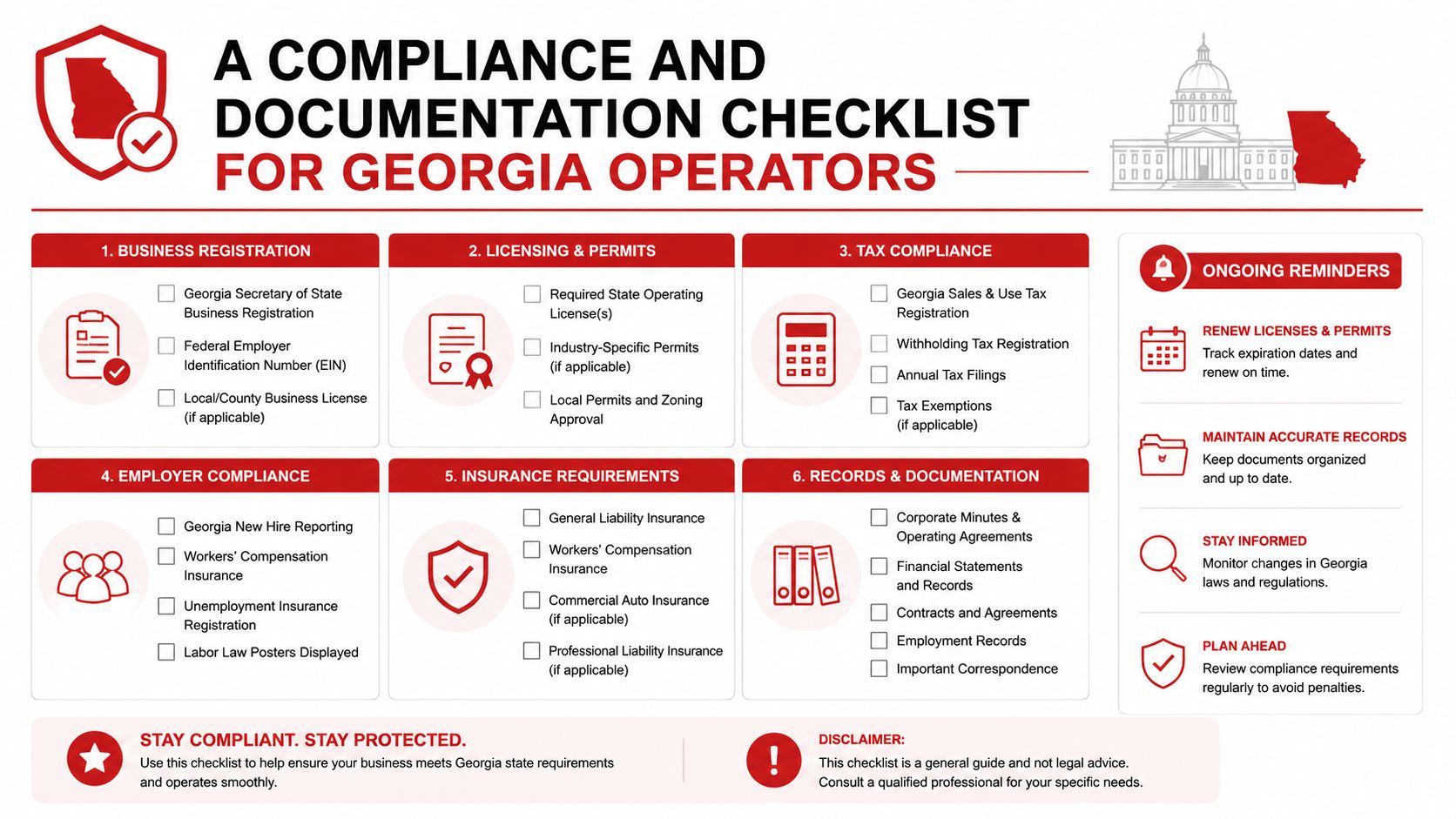
A Compliance and Documentation Checklist for Georgia Operators
Insurance compliance is an operating system, not a folder you open at renewal. Georgia also requires continuous proof of insurance for vehicles with active registration, so a lapse can create a registration and business problem rather than an insurance inconvenience (Georgia continuous insurance requirements).
Keep one current digital file for the business, one accessible copy in each truck, and a renewal calendar that assigns responsibility to a specific person.
Documents to verify before requesting quotes
- Authority records: Confirm the USDOT and operating authority information matches the business applying for coverage.
- Registration: Verify Georgia registration and any applicable interstate registration documents.
- UCR: Confirm the Unified Carrier Registration is paid for the current operating period.
- IRP: Check that apportioned plates and jurisdiction information match the states where the truck runs.
- Federal filings: Ask whether an MCS-90 filing or other evidence is required for the operation.
- COI accuracy: Make sure the certificate identifies the correct named insured, limits, vehicle information, and Georgia garaging details.
- Driver files: Maintain qualification documents, MVRs, and current medical certificates for each CDL driver.
- FMCSA updates: Track required biennial updates and keep operational details current.
The one-page self-audit
Before you call an agency, gather your DOT number, MC number, VINs, driver information, cargo descriptions, operating radius, current declarations page, loss runs, and lease documents. Check every renewal date, filing status, vehicle change, and driver change against the current policy.
Digital document workflows can reduce missing signatures and delayed certificates. If your office still handles paperwork manually, review this resource on electronic signing for insurance firms for background on organizing signature-dependent processes.
A broker asking for a current certificate shouldn't trigger a scramble. If your documents are organized, the agency can issue accurate evidence faster and identify mismatches before they interrupt a load.
How to Compare Quotes and Work With an Independent Bilingual Agency
A direct carrier can offer one company's solution. An independent agency can submit the same operation to multiple markets and compare how each one views the risk. For Georgia trucking, that difference matters when the operation includes newer authority, unusual cargo, interstate routes, or a driver profile that doesn't fit every underwriting appetite.
An experienced independent bilingual agency may quote 20 to 40 carriers at once, giving the owner-operator more than one price and one set of assumptions to evaluate. That breadth doesn't guarantee the lowest premium, but it can expose differences in limits, exclusions, deductibles, payment terms, and eligibility.
Prepare a clean submission
Bring the information an underwriter will ask for:
- DOT and MC numbers
- Vehicle identification numbers and stated values
- Driver names, CDL details, and MVRs
- Operating radius and states traveled
- Commodity descriptions and cargo values
- Current policy and declarations
- Prior loss runs
- Lease or broker requirements
- Safety, maintenance, and telematics documentation
Ask the agency to quote the same structure across markets. Otherwise, one proposal may show lower liability but omit cargo, use a higher deductible, exclude a driver, or describe a narrower radius.
| Factor | Direct Carrier Quote | Independent Agency Quote |
|---|---|---|
| Market access | One carrier's appetite | Multiple carrier markets |
| Coverage comparison | Limited to one policy form | Side-by-side limits and exclusions |
| Specialty operations | Depends on that carrier's eligibility | More opportunity to locate a suitable market |
| Certificates | Carrier-specific process | Agency-managed document workflow |
| Payment options | One carrier's terms | Options vary by selected market |
| Bilingual support | Depends on the carrier office | Available through an agency that provides it |
Read every line before choosing
Compare the liability limit, physical damage deductible, cargo limit, valuation, excluded drivers, radius, trailer coverage, MCS-90 status, and payment schedule. Don't compare premium alone. A low quote that can't satisfy a broker, excludes your cargo class, or leaves personal-use exposure unresolved is not a bargain.
For broader context on how fleet coverage is structured, this fleet insurance guide offers useful background, though your Georgia policy must follow the applicable American state and federal requirements.
Select Insurance Group, Inc. is one agency option that provides commercial trucking quote support, document handling, and bilingual service across its regional footprint. The useful question isn't whether an agency speaks Spanish or English. It's whether the team can explain the policy in the language you prefer and keep the limits aligned with the work you accept.
Key Decisions and Next Steps for Georgia Truckers
Three decisions control the quality of your Georgia trucking program.
First, choose liability limits based on the actual hauling profile, not only the lowest intrastate figure. Crossing state lines, hauling regulated commodities, or accepting brokered freight can move the requirement substantially higher.
Second, select endorsements that match real use. Bobtail, non-trucking, cargo, and MCS-90 provisions solve different problems. Buying the wrong one leaves a gap, while adding endorsements without reviewing your lease and routes wastes money.
Third, use an agency channel with enough market access to compare the operation properly. An independent bilingual agency can submit one organized application to 20 to 40 carriers, then help compare the proposals instead of leaving you to interpret conflicting forms.
Gather your CDL information, MVRs, VINs, cargo description, radius, current policy, and loss runs this week. Request a multi-carrier review 45 to 60 days before renewal, and judge the result by protection, carrier fit, compliance support, and total value, not premium alone.
Select Insurance Group, Inc. helps Georgia owner-operators and small fleets compare commercial truck coverage, liability limits, cargo protection, physical damage, and required filings through multiple carrier markets. Visit Select Insurance Group, Inc. to request a no-obligation quote and speak with a bilingual specialist about coverage built for your actual routes and cargo.