
Georgia's baseline commercial auto liability minimum is 25/50/25, but most businesses running real fleets or hauling freight need limits from $750,000 to $5,000,000 depending on the operation. If you're trying to sort out commercial auto insurance Georgia rules while keeping a truck, van, or pickup protected for the work it does, that gap is the first thing to understand.
A lot of owners only find out there's a problem after a claim or a certificate request gets pushed back. The policy looked fine on paper, the vehicle was insured, and then the carrier, shipper, or adjuster started asking questions about who drove it, what it hauled, and how it was used day to day.
A Marietta landscaping crew finishing a Friday route, a Decatur food truck heading to a private festival, and a Savannah plumbing van pulling a trailer all look different on the surface, but they share the same issue. The business name is on the vehicle, employees are driving, equipment is riding along, and the exposure is tied to work, not errands.
If you've got a cargo van, a box truck, a service pickup, or a small fleet, the question isn't whether the vehicle has a tag. It's whether the way you use it fits personal insurance at all. If you're also trying to launch a route-based operation, start a cargo van business is a useful read for understanding the business side before you lock in the insurance side, and the Georgia business auto page at Select Insurance Group's Georgia business auto resource is worth reviewing if you need a policy built around work vehicles.
Table of Contents
- When a Georgia Business Needs Commercial Auto Coverage
- What Commercial Auto Insurance Actually Covers
- Georgia Minimum Limits and Federal Trucking Rules
- Core Coverages and Endorsements Georgia Fleets Rely On
- How Pricing Works in Georgia
- Getting Accurate Quotes Without the Guesswork
- Claims, Pitfalls, and Habits That Protect Your Business
- Your Next Step and Quick Georgia FAQs
When a Georgia Business Needs Commercial Auto Coverage
A Georgia owner usually doesn't need a lecture about theory. They need to know whether the vehicle they use every day is about to become an uninsured problem. A plumbing van in Cobb County, a food truck driving to a private event, and a service pickup with ladders and signage all look like business vehicles because that's what they are.
The practical test is simple. If the vehicle is titled to a business, used to haul tools or products, or driven by employees for work, personal auto coverage usually isn't built for that exposure. The claim dispute often starts long before the loss, because the policy was written for commuting and errands, not routes, job sites, or paid transport.
Practical rule: if the vehicle makes money for the business, carries work equipment, or moves people or goods as part of the job, it deserves a commercial policy review.
That's why contractors, delivery and courier operations, food trucks, non-emergency medical transport, motor carriers, churches, and nonprofit fleets land in the commercial auto bucket so often. A pickup used for both farm chores and hauling materials may still need commercial treatment if the work use is the dominant use. Carriers and courts care more about the actual pattern of use than the badge on the door or the registration class.
Georgia owners who operate in gray areas should read policies with a skeptical eye. A personal policy may tolerate an occasional business trip, but regular stops, heavier cargo, or employee drivers can push the risk outside that lane. If the vehicle is part of the revenue engine, it's usually safer to assume commercial coverage belongs there.
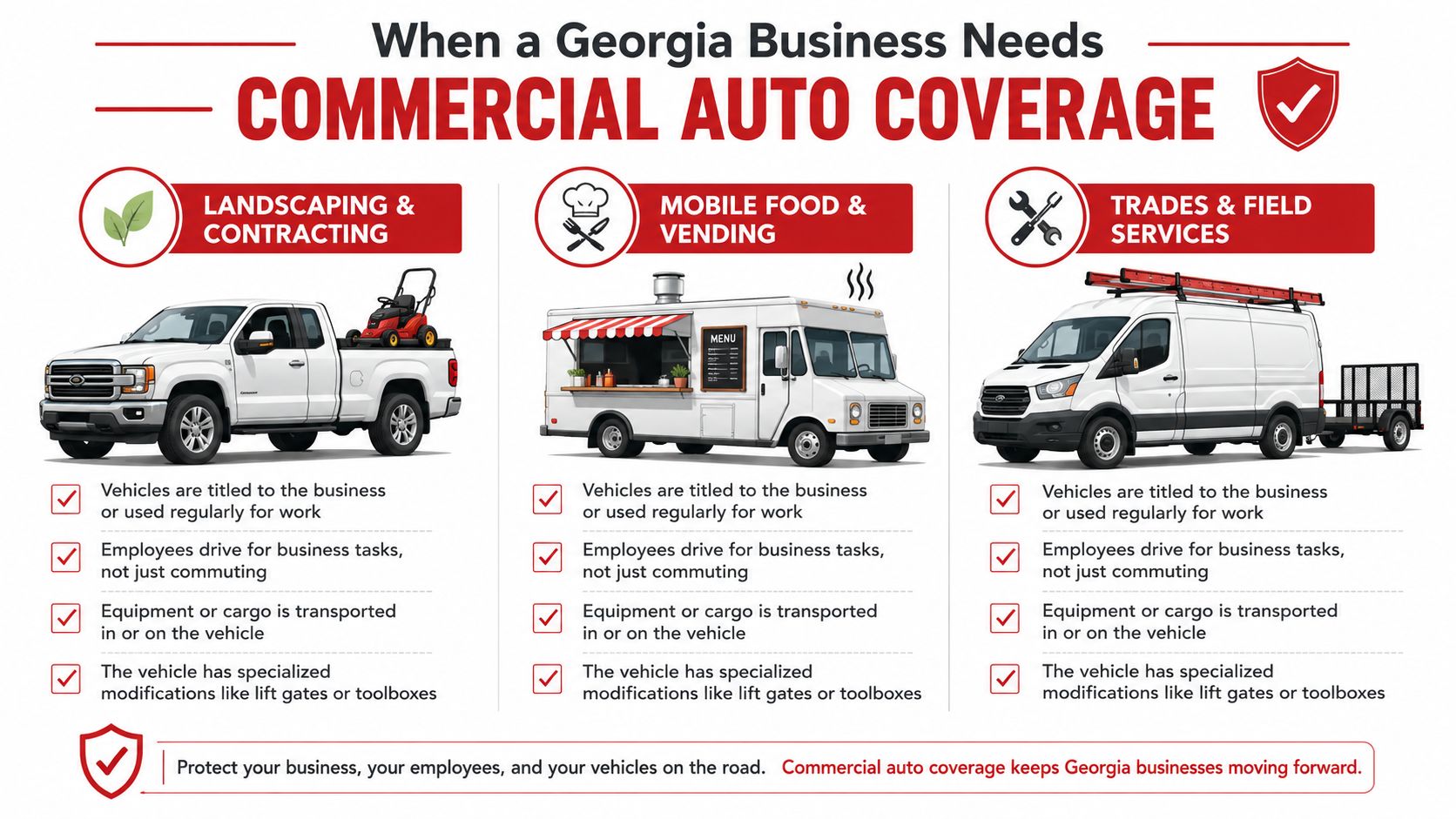
The cleanest way to think about it is this, personal auto is for personal use, and business use has its own risk pattern. That's why a freelancer with an occasional client visit may land differently than a contractor with a bed full of tools or a shuttle operation with passengers on a schedule. If your day includes hauling, deliveries, or employee drivers, commercial coverage is usually the safer starting point.
What Commercial Auto Insurance Actually Covers
A delivery driver backs into a customer's vehicle, an employee causes a crash in a personal car while making a business errand, or a work van is damaged before the next scheduled job. Commercial auto insurance is designed for these business exposures. It names the business as an insured and considers routes, equipment, passengers, and employee drivers, not just the individual behind the wheel. The same accident can receive very different treatment when the policy was written for business use.
The main coverage parts are clear. Liability pays for bodily injury and property damage your business causes to others. Physical damage protects the company vehicle through collision and other applicable coverage. Medical payments or similar medical coverage may help with injuries to occupants, depending on the policy wording and selected limits.
Hired and non-owned auto coverage addresses another common gap. It may respond when an employee uses a personal vehicle for a business errand, or when the company rents or borrows a vehicle for work. For closely held companies, drive-other-car wording can also matter when an owner needs protection beyond one scheduled company vehicle.
A policy can look complete and still leave a major gap if it does not address how employees drive for the business.
Commercial auto does not replace workers' compensation for employee injuries arising from work. It also does not cover general liability for operations away from the vehicle, and cargo in transit may require separate or specifically added protection. For every vehicle, ask four questions: what happens if the loss involves the car, the other party, the employee, or the load?
Personal auto is generally built around commuting and everyday driving. Commercial auto is built around business activity, particularly when a vehicle generates revenue or the company controls who drives it. A contractor's van, catering truck, or delivery fleet can require commercial placement even when the vehicle looks ordinary.
For a plain-language overview of policy structure and options, the commercial auto insurance page provides a starting point before quotes are compared. The essential step is matching coverage to the way the vehicle is used, who drives it, what it carries, and which contracts or customers depend on it.
Georgia Minimum Limits and Federal Trucking Rules
Georgia's minimum commercial auto liability floor is 25/50/25, which means $25,000 bodily injury per person, $50,000 bodily injury per accident, and $25,000 property damage per accident. That satisfies the state minimum, but it doesn't mean the policy is adequate for a serious loss. One severe crash can create medical bills and property damage that blow past the floor very quickly.
The state regulatory backdrop also changed in a meaningful way in 2023, when House Bill 221 gave the Insurance Commissioner prior-review authority over private auto rate filings. The reform was aimed at a loophole that had allowed insurers to raise rates by as much as 25% in a single filing, and it preserved prior-approval authority for mandatory minimum-limit filings while giving the Commissioner 60 days to review other filings. That matters for business owners because the same regulatory structure influences how vehicle liability coverage is filed, reviewed, and priced in Georgia. Georgia Insurance Commissioner rate filing reform
For trucking, the state floor often isn't the benchmark. Federal minimum primary liability for interstate for-hire motor carriers is typically $750,000 for general freight, $1,000,000 for oil, and $5,000,000 for hazardous materials. Multiple industry sources also note that intrastate Georgia-only freight operations may face higher public-liability expectations around $100,000/$300,000/$50,000. Federal and Georgia trucking exposure overview
| Operation Type | Georgia State Minimum | Typical Contract Minimum | Federal FMCSA Minimum |
|---|---|---|---|
| Passenger-style business vehicle | 25/50/25 | Higher limits often requested | Not usually applicable |
| Local contractor or service fleet | 25/50/25 | Often much higher than the state floor | Not usually applicable |
| Interstate for-hire trucking | 25/50/25 | Frequently $1,000,000 CSL or more | $750,000 to $5,000,000 depending on cargo |
| Hazardous materials hauling | 25/50/25 | Usually exceeds the state floor by a wide margin | $5,000,000 |
The trap is contract language. A shipper or broker may ask for higher limits than the policy carries, and a certificate can be rejected even when the vehicle technically meets Georgia law. In practice, the question isn't just whether a policy is legal, it's whether it satisfies the specific job, the lane, and the paperwork attached to the haul. For a deeper policy comparison, Georgia auto insurance guidance is useful when you're sorting state minimums from real-world buying requirements.
Core Coverages and Endorsements Georgia Fleets Rely On
Commercial auto policies in Georgia usually revolve around a few pieces that do different jobs. Liability protects against damage you cause to others. Collision and other coverage protect your own vehicle. Medical payments or similar occupant medical coverage helps with injury-related costs, while uninsured and underinsured motorist coverage can respond when the at-fault driver doesn't carry enough insurance.
The right mix depends on the vehicle and the work. A plumbing van that sits overnight in Cobb County may need strong physical damage protection because downtime hurts revenue. A catering truck in Savannah may care more about liability and collision because it spends its life in traffic, at events, and in crowded parking areas. An owner-operator hauling produce on I-75 is usually watching liability limits, cargo-related requirements, and federal filing obligations much more closely.
| Coverage | What It Pays For | Typical Georgia Buyer |
|---|---|---|
| Liability | Injury or property damage you cause to others | Contractors, delivery fleets, truckers |
| Collision | Damage to your own vehicle after a crash | Service vans, pickups, box trucks |
| Comprehensive | Theft, fire, vandalism, weather, glass | Newer units, parked fleet vehicles |
| Medical payments | Medical costs for occupants | Small fleets, family-run businesses |
| Uninsured motorist | Losses caused by drivers with weak or no coverage | Daily drivers in heavier traffic areas |
| Hired and non-owned auto | Business exposure from borrowed or employee-owned vehicles | Contractors, nonprofits, sales teams |
| Cargo and trucking forms | Freight-related protection and required filings | Motor carriers, owner-operators |
Some endorsements matter more than owners expect. Hired and non-owned auto coverage is the obvious one when employees sometimes use personal cars for errands. Broadened employee language can also help reduce confusion over who counts as an insured while driving for the company. In trucking placements, the MCS-90 filing can become part of the conversation, and pollution-related endorsements may be requested on certain contracts.
Keep this in mind: a policy can meet the vehicle requirement and still fail the contract requirement if the right endorsement is missing.
Operational controls matter too. If a business uses electric gates, access systems, or fleet entry controls, the insurance conversation often gets easier when the owner can show who had access to which vehicle and when. For fleets that want tighter control over who can drive what, programmatic gate control for fleets is one example of the kind of operational tool that can support better vehicle oversight, though it doesn't replace coverage.
How Pricing Works in Georgia
A statewide average does little for a Georgia business owner choosing commercial auto coverage. A light service van, delivery route, and for-hire truck carry different exposures, so the premium follows the work, not the ZIP code alone. A quote advertised as “cheap in Georgia” may be irrelevant if it reflects a different vehicle class or use pattern.
Underwriters examine the industry class, vehicle type, gross vehicle weight, operating radius, annual mileage, driver records, prior losses, liability limits, deductibles, and garaging location. A fleet operating throughout the Atlanta metro area may face different claim pressure from one based in a quieter part of the state. Coastal weather can also affect claims involving newer vehicles.
Recent 2026 pricing shows that commercial auto insurance in Georgia typically runs $1,000 to $3,200+ annually for light business-use vehicles, while towing and for-hire trucking can move much higher, sometimes reaching $10,000 to $30,000+ annually for higher-risk operations. Georgia commercial auto cost ranges These figures are not guarantees. They show why the operation matters more than a single statewide average.
Key rating factors include:
- Industry and vehicle use: The same van may price differently when it carries tools, passengers, or freight.
- Driver records: Clean records help, but every person with access to the keys must present a consistent risk profile.
- Limits and deductibles: Higher limits generally increase the premium, while lower deductibles usually do the same.
- Telematics and route behavior: Some light-duty fleets can qualify for better pricing when they document safer driving patterns.
Georgia also operates within a large, competitive vehicle-insurance market. In 2021, private passenger auto insurers wrote about $10.5 billion in premiums on roughly 4 million vehicles in the state, and the market concentration index was 647, indicating competition among many carriers. The same analysis reported 1,647 highway fatalities from 2007 to 2021 and found that Georgia's collision loss ratio had risen 19.6 points since Q1 2021, reaching 16.5 points above its five-year average of 68.8% by Q3 2021. Georgia risk and loss environment
Pricing reflects exposure. Change the vehicle, driver, route, or hauling pattern, and the quote can change with it.
Owners looking to lower insurance premiums Georgia businesses pay should focus on controllable factors, including driver quality, mileage discipline, consistent vehicle use, and documented safety practices. Those steps do not remove the risk, but they can give underwriters fewer reasons to treat the account like a high-loss fleet.
Getting Accurate Quotes Without the Guesswork
Bad quotes usually start with bad input. If an owner gives one carrier a half-finished description and another carrier a more complete version, the numbers won't mean much when you compare them. The best results come from sending the same facts to each market and letting the underwriters respond to the same risk profile.
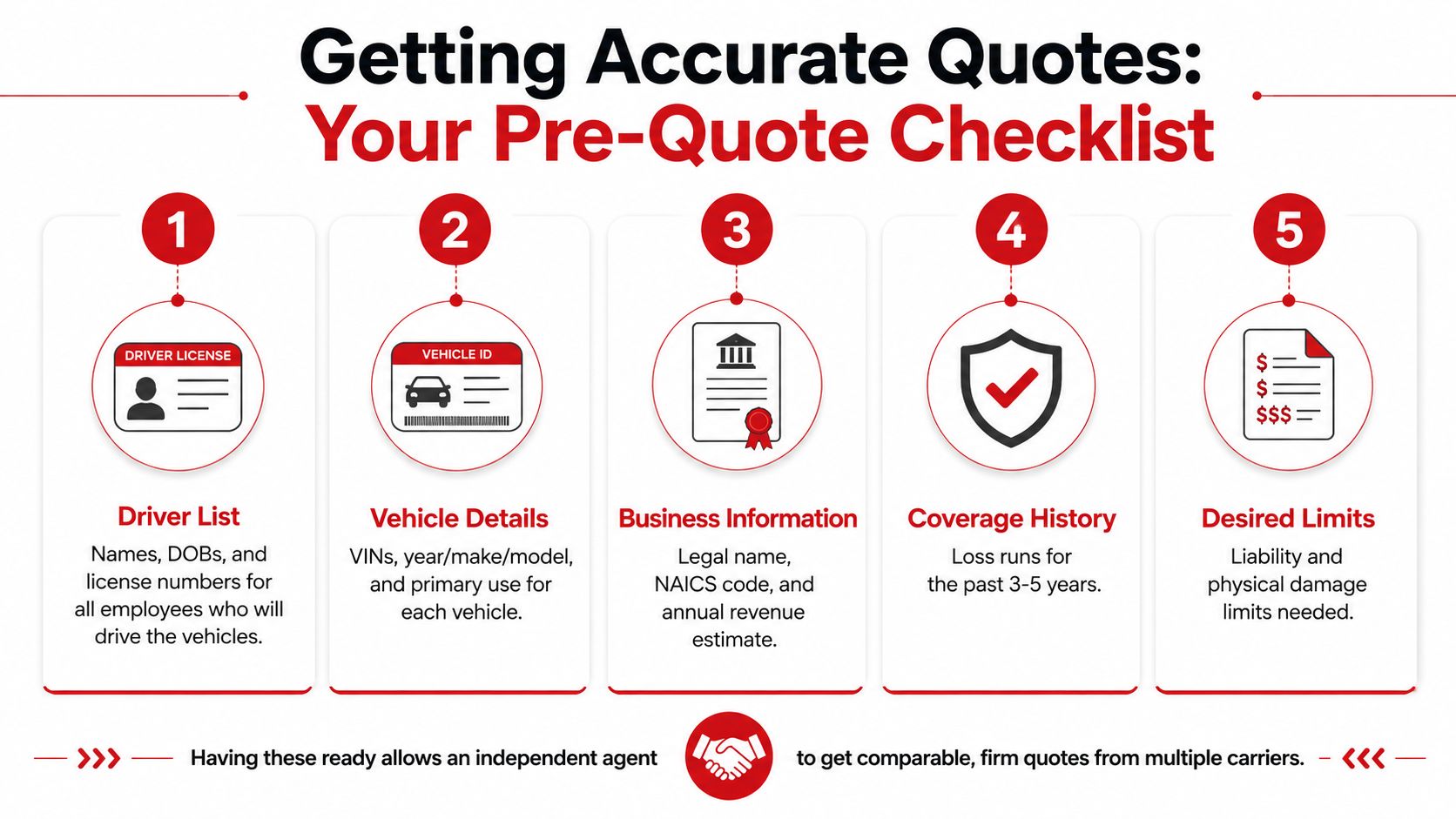
Gather the basics before you ask for pricing. You'll usually need a current driver list with license information and dates of birth, VINs for every unit, garaging addresses, MVRs, prior loss runs for the last few years, and a clear description of the work you do and what you haul. You should also have radius, annual mileage, and any shipper or contract minimums ready to go.
A clean submission usually makes the difference between a usable quote and a vague estimate. It also helps an independent agency place the account with multiple carriers at once, which matters when one market likes your operation and another doesn't. For Georgia fleets that change routes, vehicles, or drivers often, firm data saves time and reduces surprises.
Here's the checklist I want on the desk before quoting:
- Driver file: names, DOBs, and license numbers for everyone who can drive.
- Vehicle details: VIN, year, make, model, and primary use for each unit.
- Business profile: legal name, class of operation, and what the vehicles do.
- Loss history: prior claims so the underwriter can see the pattern.
- Target limits: the liability and physical damage structure you need.
If you're quoting light-duty vehicles, ask whether usage-based pricing or telematics options are available. Those tools won't help every account, but they can be useful when the fleet is small, the drivers are steady, and the routes don't swing wildly from week to week.
Claims, Pitfalls, and Habits That Protect Your Business
A typical Georgia claims problem starts small. A driver backs a service van into a customer's gate, then tells the office after the fact. The manager notices the damage, but the bigger issue is that the policy file, driver list, and actual vehicle use don't line up cleanly enough to make the claim easy.
That's where owners get hurt. If the vehicle was being used outside the way it was described, the carrier starts asking questions about who drove it, whether the trip was business-related, and whether the right coverage form was in place. One sloppy incident can turn into a coverage dispute if the business can't document use, training, and permission.
The fix is usually mundane, which is good news. Keep a written driver list, require prompt accident reporting, and make sure employees know whether personal vehicles used for errands are covered under hired and non-owned language or not. If a truck carries tools, freight, or specialty equipment, the schedule should reflect that reality instead of assuming the auto policy will sort it out later.
A short habit list prevents a lot of pain:
- Document who drives what: don't rely on memory when employees rotate among units.
- Report losses fast: delays make adjusters suspicious and can slow repairs.
- Match the policy to the route: a local service call and an interstate haul are not the same risk.
- Review endorsements before binding: missing contract language is a common failure point.
In practice, the best claims outcome comes from boring operations. The owner knows the drivers, the fleet list is current, and the vehicle use on the policy matches the business model. That makes the loss easier to adjust and cuts down on finger-pointing after the fact.
Your Next Step and Quick Georgia FAQs
Start with the exposure, not the premium. Review how each vehicle is used, who drives it, and whether the policy limits satisfy your contracts, customer requirements, or hauling rules. A pickup used for service calls, a van carrying employees, a box truck delivering goods, and a freight unit can require different coverage decisions.
Do I need commercial auto if I only use the truck for work sometimes? Possibly. A business-titled vehicle or one regularly used to haul tools, products, or people may need commercial coverage even when work use is occasional.
Can I rely on Georgia's 25/50/25 minimum? It meets the state requirement, but it may leave your business responsible for losses above those limits. Contracts and federal trucking rules can also require more.
Why did my certificate get rejected? The contract, customer, shipper, or trucking rule may require higher limits or specific endorsements than the state minimum provides.
For a useful quote comparison, give every carrier the same driver list, vehicle schedule, limits, and description of operations. Otherwise, a lower premium may reflect missing protection rather than better underwriting.
Select Insurance Group, Inc. can help Georgia businesses compare commercial auto, trucking coverage, and other business lines with a no-obligation quote. Request a free coverage review with Select Insurance Group, Inc. and check current limits before the next load, job, or route.
Select Insurance Group, Inc. can help you compare options for vans, pickups, box trucks, and trucking accounts. The goal is coverage that reflects how the business operates, rather than a policy built only around Georgia's basic minimum.