
Hot shot insurance in Florida commonly runs $7,000 to $14,000 per year for an established owner-operator, $18,000 to $30,000 or more for a new authority, and about $5,500 to $8,500 for liability-only coverage. Those ranges reflect commercial trucking risk, not an ordinary personal pickup policy.
You may be pricing your first truck, lining up a gooseneck trailer, or trying to satisfy a broker that wants a certificate before releasing a load. The truck may look like a heavy-duty pickup, but the insurance exposure looks like a commercial freight operation the moment you haul property for other people.
Florida operators need to make three decisions before requesting quotes: choose the correct policy form, meet federal and broker requirements, and close the gaps that personal auto coverage leaves behind. The cheapest quote isn't useful if it can't support your authority, protect the cargo, or keep a broker from rejecting your certificate.
Table of Contents
- What Hot Shot Insurance Means in Florida
- Commercial Auto Versus Motor Carrier Coverage
- Required Coverages and Key Endorsements
- Florida and FMCSA Rules You Must Follow
- Typical Costs and What Drives Your Premium
- Documentation Checklist for Fast Quotes
- Common Mistakes and Smart Coverage Choices
What Hot Shot Insurance Means in Florida
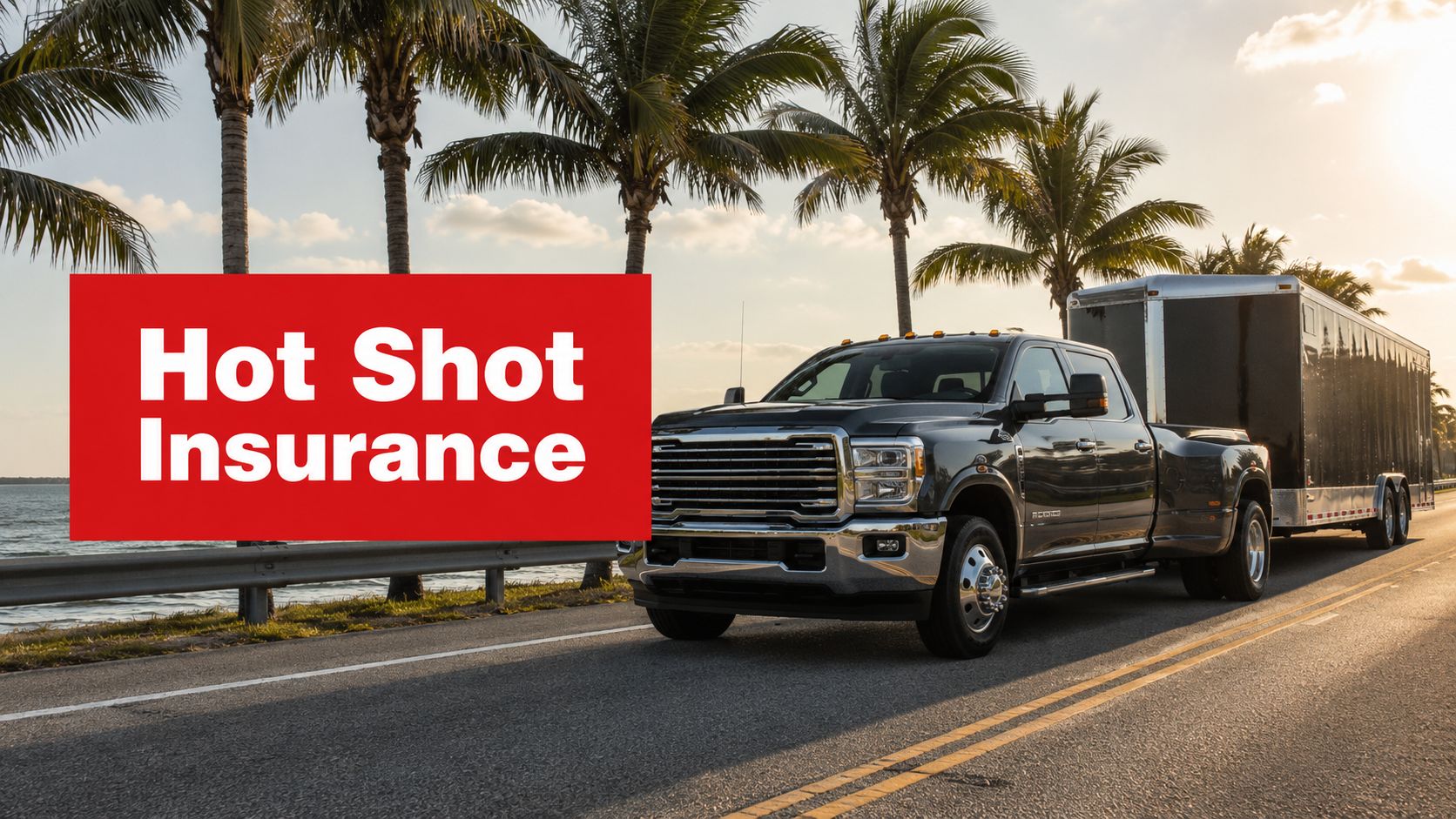
You may have a dually pickup, a gooseneck trailer, and a load waiting at the dock. The insurance question changes as soon as you haul property for customers. Hot shot trucking generally involves time-sensitive or expedited freight moved with a Class 3, 4, or 5 truck, often a dually pickup pulling a gooseneck or flatbed trailer. Operators may run Florida lanes, regional routes, or interstate trips as owner-operators or small fleets.
For an established owner-operator carrying liability and cargo coverage, Florida premiums commonly fall around $7,000 to $14,000 per year. New authorities and higher-risk operations often reach $18,000 to $30,000 or more, while liability-only coverage commonly runs about $5,500 to $8,500. See this Florida hot shot insurance cost guide for the market ranges.
New authorities often pay 25% to 40% more in year one. Insurers have less operating history to review, so they price for uncertainty around experience, safety controls, claims, and dispatch patterns. A clean driving record helps, but it does not erase the new-authority surcharge.
Why Florida changes the underwriting conversation
Florida traffic density, tourist movement, severe weather, theft concerns, and long interstate routes all affect underwriting. Garaging location matters, but underwriters also review your lanes, cargo, equipment value, driving history, and authority experience.
A quote based only on the truck's make and model is incomplete. An operator hauling construction materials within a controlled radius presents a different risk from a new authority crossing state lines with mixed commodities.
Practical rule: Treat hot shot insurance as a commercial freight program, not personal auto insurance with a larger truck.
What to decide before you request quotes
First identify your operating structure. If you run under your own authority, you carry responsibilities that differ from leasing onto an established motor carrier. That choice affects primary liability, required filings, physical damage, cargo, and off-dispatch use.
Next, collect the requirements from every broker and shipper you plan to serve. Brokers commonly request $1,000,000 in liability, even when a lower legal threshold applies. Contracts may also require $100,000 or more in cargo coverage, depending on the freight.
Personal pickup policies cannot satisfy those broker-driven thresholds. Choose coverage that supports your authority, produces an accepted certificate, and protects equipment and freight you cannot afford to replace.
Commercial Auto Versus Motor Carrier Coverage
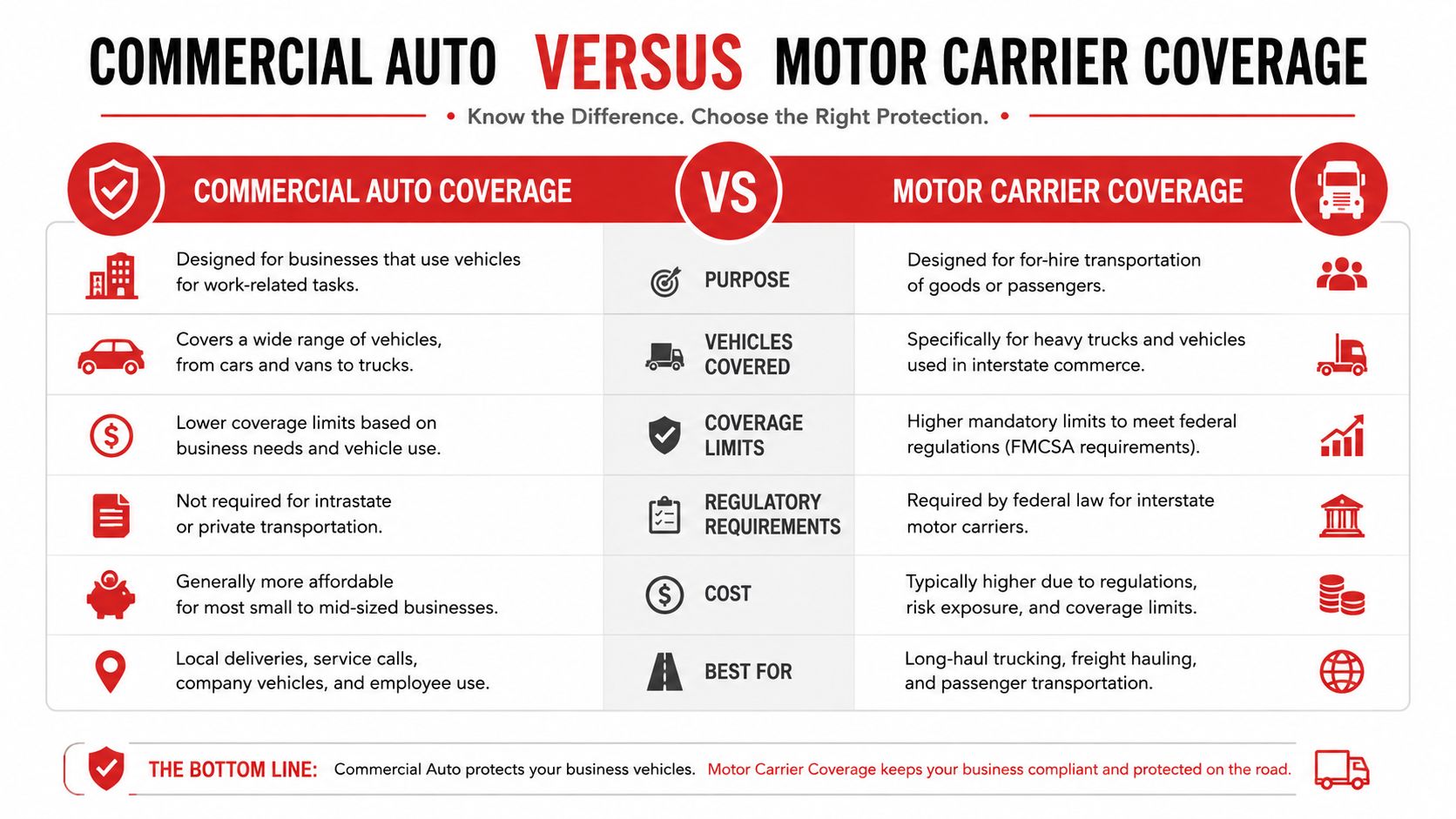
A commercial auto policy is the foundation for the vehicle. It addresses the truck's physical damage and liability for injuries or property damage arising from its use. A motor carrier policy goes further by recognizing that you're operating a freight business and accepting responsibility for property moved for customers.
Think of it this way: commercial auto protects the vehicle in service, while motor carrier coverage protects the business operation around that vehicle. If you buy the first form without checking the second, you can have an insurance card in the cab and still fail a broker's onboarding review.
The weight breakpoint matters
For interstate, for-hire operations, the combined GVWR of the truck and trailer is the key technical test. Once that combination exceeds 10,001 pounds, it generally falls within the FMCSA commercial motor vehicle framework and typically requires USDOT and MC authority, along with a primary liability filing, as explained in this Florida hot shot insurance overview.
That threshold is why a personal pickup policy is structurally mismatched. The truck may be titled personally, but the use is commercial, the freight belongs to someone else, and the operation may be subject to federal filings.
A motor carrier program may also address:
- Cargo claims, when freight is lost, damaged, or stolen in transit.
- Federal filings, including the liability documentation needed to support operating authority.
- Trailer interchange, when you use a trailer that belongs to another party under an interchange agreement.
- Reefer-related exposures, if your operation involves temperature-controlled freight.
Before you accept a quote, ask whether the insurer can issue the filings and certificate language your contracts require. You can also review the distinction between vehicle-focused protection and broader business protection through commercial auto insurance guidance.
A broker may reject a certificate that shows only a standard commercial auto form because it doesn't demonstrate the required motor carrier filings or cargo protection. Get the policy form right before you spend time chasing loads.
Required Coverages and Key Endorsements
A hot shot policy should be built around the work you perform. Don't accept a package because the premium looks manageable. Ask what each coverage pays, where it applies, and which exclusions could affect your most common loads.
The core protection
Primary auto liability pays for third-party bodily injury and property damage when you cause an accident while operating the truck. Interstate non-hazardous freight commonly starts at $750,000, but brokers and shippers frequently require $1,000,000, according to Florida hot shot insurance requirements.
Motor truck cargo protects the freight you're hauling. The appropriate limit depends on commodity value and contract terms, and industry guidance commonly places recommended cargo coverage at $100,000 or more for many operations. Read commodity exclusions carefully. A policy that covers ordinary freight may not cover specialized equipment, high-value materials, or unusual cargo handling.
Physical damage covers your truck and, when insured, the trailer for collision and other losses. In Florida, this type of protection deserves serious attention because it can respond to theft, falling objects, and weather-related damage. If a lender has an interest in the equipment, that lender will typically require physical damage protection.
Bobtail and non-trucking liability addresses liability while you're using the truck without a trailer or outside dispatch, depending on the policy and lease arrangement. Leased-on operators shouldn't assume the motor carrier's primary policy follows them during every personal or off-dispatch use.
Uninsured and underinsured motorist coverage protects you and your occupants when another driver causes a crash but has insufficient insurance. Florida's exposure to uninsured motorists makes this coverage worth discussing rather than treating it as an afterthought.
Useful endorsements
Consider trailer interchange if you operate under an interchange agreement, hired and non-owned auto if the business uses vehicles it doesn't own, and reefer breakdown if temperature-controlled freight is part of the operation. If drivers work as contractors rather than payroll employees, ask about occupational accident coverage, while remembering that it isn't the same as workers' compensation.
Policy endorsements change how coverage applies, so a plain-language reference such as BoloSign's insurance endorsement guide can help you understand why the declarations page alone isn't enough.
| Coverage | What It Pays For | Typical Limit | Required? |
|---|---|---|---|
| Primary liability | Third-party injuries and property damage | $750,000 to $1,000,000 | Usually required for own authority and commonly required by brokers |
| Motor truck cargo | Loss or damage to freight in transit | Often $100,000 or more, based on contract and commodity | Commonly required by brokers and shippers |
| Physical damage | Collision and comprehensive damage to truck and trailer | Based on stated equipment value | Often required by lenders |
| Bobtail or non-trucking liability | Certain off-dispatch or no-trailer liability exposures | Policy-specific | Depends on lease and use |
| Uninsured or underinsured motorist | Injuries caused by inadequately insured drivers | Often coordinated with liability limits | Discuss with your agent |
| Trailer interchange | Damage to a non-owned trailer under agreement | Contract-specific | Only when the agreement requires it |
For a deeper look at freight protection, review cargo insurance for truckers. The important point is simple: liability protects you from what you do to others, while cargo and physical damage protect the freight and equipment tied to your revenue.
Florida and FMCSA Rules You Must Follow
The legal minimum isn't always the practical minimum. Federal rules establish the financial-responsibility floor, but brokers and shippers decide whether your certificate meets their contracts.
For interstate, non-hazardous general freight, the commonly cited federal liability minimum is $750,000. Florida-focused guidance also notes that $1,000,000 is a common broker and shipper requirement. Those figures are discussed in the commercial hot shot insurance guidance.
Authority and filings
If your interstate combination exceeds 10,001 pounds GVWR, you typically need a USDOT number, operating authority, and a primary liability filing. The insurer or agent must submit the required proof of financial responsibility so the authority can operate under the applicable federal framework.
Common filing references include BMC-91 or BMC-91X, with MCS-90 serving as a federal endorsement concept associated with certain financial-responsibility obligations. Buying a policy isn't the final step. Confirm that the correct filings were submitted and accepted.
Your operating arrangement also matters:
- Own authority: You carry the responsibility for authority, filings, broker compliance, and the insurance program.
- Leased-on operation: The motor carrier may provide primary liability while you're under dispatch, but your lease can still require physical damage, non-trucking liability, cargo, or other protection.
- Intrastate operation: Staying within Florida may change which registrations and filings apply, so confirm the classification before binding coverage.
Minimums and working expectations
| Coverage Type | Federal Minimum | Typical Broker Requirement | Florida Requirement |
|---|---|---|---|
| Primary liability for general interstate freight | $750,000 | Commonly $1,000,000 | Confirm based on operation and contract |
| Motor truck cargo | Determined by operation and contract | Commonly $100,000 or more | Confirm commodity and shipper requirements |
| Physical damage | No universal federal minimum | Often required when equipment is financed | Based on lender and business needs |
| Non-trucking liability | Depends on lease and use | May be required for leased operators | Confirm with the motor carrier |
| Federal filing | Required for applicable authority | Brokers verify active compliance | Applies according to operating classification |
Don't rely on a state minimum if your revenue depends on brokered freight. A certificate that misses a contract requirement can lead to disqualification before you ever haul the load, while an incorrect filing can create operational and claims problems.
Typical Costs and What Drives Your Premium
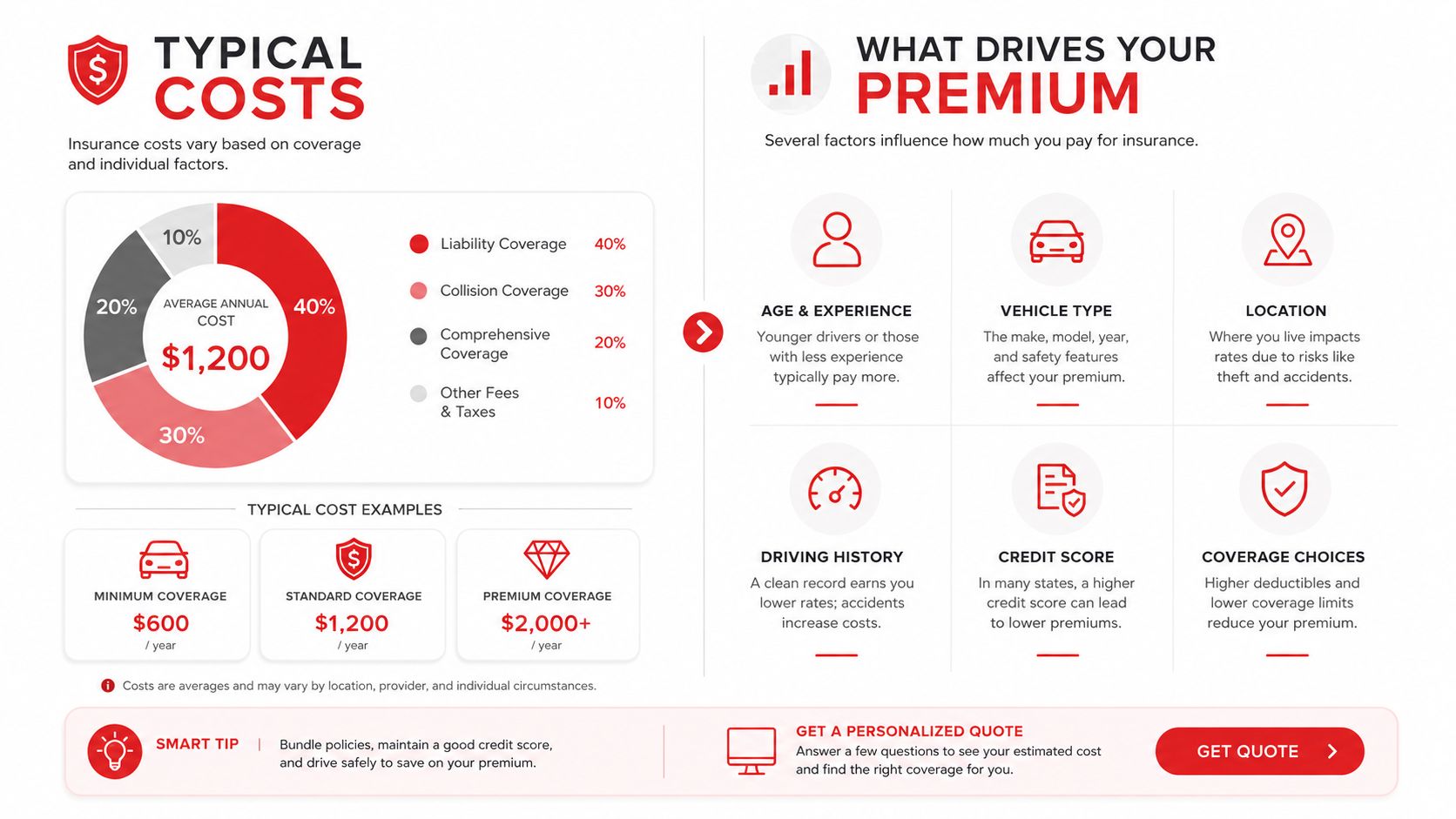
Florida hot shot insurance pricing follows risk bands, not a single statewide rate. Established owner-operators with a stable record commonly fall in the $7,000 to $14,000 annual range for liability and cargo protection, while new authorities and higher-risk operations commonly face $18,000 to $30,000 or more. Liability-only coverage commonly runs $5,500 to $8,500, as documented in this Florida trucking insurance cost guide.
Why new authorities pay more
The most overlooked pricing issue is the first year. Market guidance indicates that many new authorities see a 25% to 40% first-year premium increase, because underwriters have little operating history and limited loss information to evaluate. A clean driving record helps, but it doesn't erase the uncertainty attached to a new authority.
That difference can determine whether the business has enough cash for fuel, maintenance, deductibles, and slow-paying freight. Build the insurance payment into your operating budget before buying equipment, not after the first quote arrives.
The inputs underwriters care about
Your driving record is central. Accidents, violations, lapses, and inexperienced drivers can narrow the available market. Your commodity matters just as much. Refrigerated, hazardous, oversized, or high-value freight can bring stricter underwriting than ordinary general freight.
Your radius also changes the exposure. A consistent Florida-focused operation may present less uncertainty than a carrier that alternates between short regional work and coast-to-coast lanes. Financed equipment adds another issue, because lenders generally expect physical damage protection and may require additional protection tied to the loan.
A broker that can approach multiple insurance markets may give you a more useful comparison than a single-carrier quote. Ask for the reasoning behind each option, not just the premium.
For Florida-specific commercial trucking guidance, review trucking insurance in Florida. The right choice balances contract compliance, protection, and cash flow. Cutting cargo or physical damage without understanding the exposure is not a savings strategy. It's a transfer of risk back to your business.
Documentation Checklist for Fast Quotes
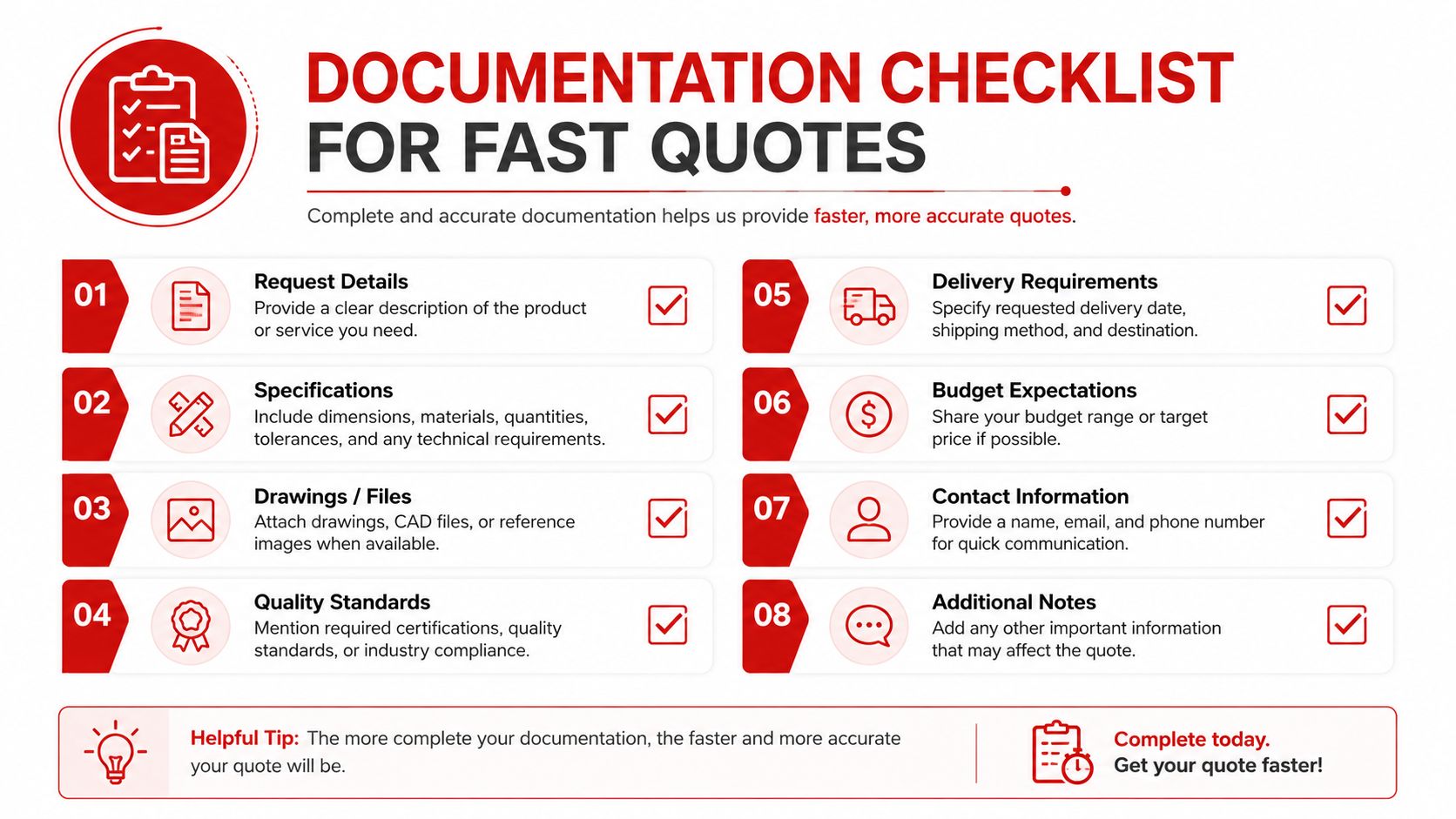
Underwriters can't price what they can't verify. A complete submission gives the agent enough information to present the account accurately, while missing documents can trigger follow-up questions, revised terms, or a quote that can't bind.
Gather the operating file
Prepare these items before you call:
- Authority records: Your USDOT number, MC authority letter, and current operating information.
- Business documents: Articles of incorporation, LLC records, or sole-proprietor documentation.
- Loss history: Three years of loss runs when available, or a clean-letter explanation for a new authority.
- Driver records: CDL information and a current MVR for every listed driver.
- Equipment details: VINs, year, make, model, stated values, and the towed unit's information.
- Lienholder information: Lender name, address, and payoff details for financed equipment.
- Freight profile: Commodity list, expected cargo values, and shipper or broker details when available.
- Operating plan: Estimated gross revenue, radius, states traveled, and whether the work is intrastate or interstate.
The insurer needs more than a truck description. A dually hauling building materials within Florida creates a different underwriting profile from the same truck hauling mixed freight across multiple states.
Inspect before coverage binds
Photograph the truck and trailer before binding coverage. Include the dash odometer, aftermarket equipment, tires, trailer condition, and existing damage. Those images create a useful condition record if a claim later involves disputed pre-existing damage.
Keep your descriptions consistent across the application, authority records, lease, and broker packet. If you say you haul one commodity but routinely accept another, notify the agent before taking the load. Coverage depends on the facts of the operation, not the description that produced the lowest quote.
Florida operators should also ask whether work for a particular industry creates workers' compensation classification concerns. If the operation changes from intrastate to interstate, or from one cargo class to another, request a compliance review rather than assuming the existing policy still fits.
Common Mistakes and Smart Coverage Choices
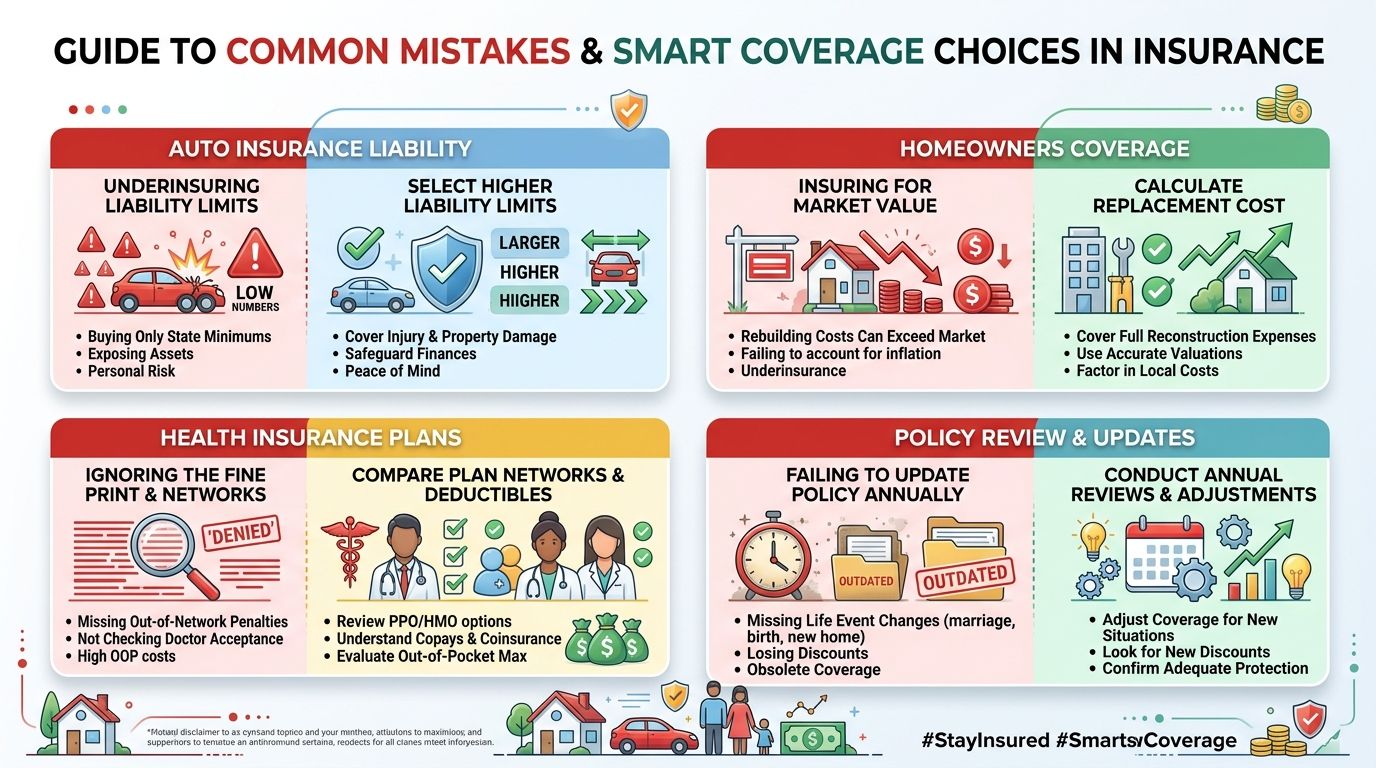
The expensive mistakes usually happen before the accident. An operator chooses a low limit, accepts a personal policy, skips an endorsement, or assumes the broker's requirements are optional. The premium savings look small until a claim exposes the gap.
Errors that create avoidable losses
Underinsuring cargo is a common false economy. If the load value exceeds your cargo limit or falls under a commodity exclusion, you may carry the financial responsibility even though the policy is active.
Skipping bobtail protection can leave a leased operator exposed during off-dispatch use. The motor carrier's policy may not respond to every trip you take without a trailer or outside its dispatch instructions.
Choosing state minimums instead of contract limits can block access to freight. Brokers commonly expect $1,000,000 in liability, so a lower limit may satisfy one legal requirement but fail the business requirement, as described in the Florida hot shot insurance requirements guide.
Putting a commercial pickup on a personal policy creates a fundamental mismatch between the policy's intended use and the actual freight operation. It can also leave the business without the federal filing structure and motor carrier protections it needs.
Missing filings or letting coverage lapse can affect authority status and broker eligibility. Check BMC filings, BOC-3 status, policy dates, and certificate details before accepting loads.
Better choices for a working operator
Match the liability limit to the most demanding broker contract you expect to accept. Buy cargo protection based on your highest realistic freight exposure, not the cheapest load you hauled last month. Add contingent cargo or bailment protection when your contracts place responsibility on you for brokered freight that falls outside the basic cargo wording.
Physical damage deductibles should match your cash reserves. A lower deductible can make a claim easier to absorb, while a higher deductible may reduce premium, but neither choice works if you can't fund it after a loss. Review stated values, lender requirements, trailer coverage, and endorsements at every renewal.
Operator rule: Buy the policy that lets you accept the right freight and survive the wrong day.
Select Insurance Group, Inc. can compare commercial and trucking coverage options for Florida operators, help organize certificates and filings, and review liability, cargo, physical damage, and endorsement needs against the way you run. Visit Select Insurance Group, Inc. to request a quote and discuss your hot shot operation before you commit to a policy.