
A Jacksonville marketing LLC owner recently filed a workers' compensation exemption to keep overhead low. At the time, she worked alone from a small office and assumed the decision was straightforward. Then she hired a part-time editor, and the risk changed immediately. If that editor slips on a wet floor, the exemption protecting the owner doesn't protect the employee, and the business may face enforcement action for operating without required coverage.
That's the decision many Florida LLC owners get wrong. A workers comp exemption Florida LLC filing isn't a substitute for insurance, and it isn't a blanket waiver for the company. It's a personal exclusion for an eligible owner or member. The form matters, but the business decision behind it matters more.
Table of Contents
- The Florida LLC Exemption Decision Most Owners Get Wrong
- Who Actually Qualifies for the Florida LLC Exemption
- Single-Member vs Multi-Member vs Construction LLCs
- How to File the Florida Workers Comp Exemption
- What the Exemption Really Covers and What It Does Not
- When Buying Coverage Beats Filing the Exemption
- A Practical Next Step for Florida LLC Owners
The Florida LLC Exemption Decision Most Owners Get Wrong
Before filing, answer three questions plainly:
- Are there employees right now? Include anyone whose relationship with the business could make them an employee under Florida law, not just people receiving a W-2.
- How soon could the business hire? A solo operation can become an employer after one new contract, a spouse joining the company, or a part-time administrative hire.
- Is the LLC in construction? Construction businesses face a narrower exemption framework and a more immediate coverage concern than many non-construction businesses.
The Florida Division of Workers' Compensation makes clear that an exemption removes the named owner or member from employee coverage. It doesn't remove the LLC's obligation to protect other workers. The Florida Division of Workers' Compensation exemption guidance also requires the LLC to be registered and active with the Division of Corporations, while the applicant must attest to at least 10% ownership interest. In construction, Florida limits the exemption to no more than three officers or members of an LLC or affiliated LLC group, and each application carries a $50 fee.
Practical rule: File the exemption only after you've decided that going without owner coverage fits your actual work, hiring plan, contracts, and personal finances.
The Jacksonville owner's mistake wasn't necessarily filing. Her mistake was treating the filing as the end of the insurance decision. Once an employee appeared, the company needed a fresh review of employee classification, coverage requirements, and enforcement exposure. A Stop Work Order or Working in Violation status can turn a small premium-saving decision into an operational crisis.
The rest of the decision comes down to three checks: whether the owner qualifies, what the filing changes, and whether the financial exposure is acceptable. Eligibility gets you to the application. It doesn't tell you whether filing is smart.
Who Actually Qualifies for the Florida LLC Exemption
Florida's eligibility test is document-driven. Ownership, entity status, and business standing all matter. A title such as “owner” or “managing member” isn't enough by itself.
Start with the entity
The exemption framework applies to eligible LLC members and qualifying business officers under Florida law. First confirm that the business is an active LLC registered with the Florida Department of State, Division of Corporations. An inactive or improperly registered entity shouldn't be treated as eligible just because it has an LLC designation in an internal document.
The state's current guidance identifies the 10% ownership test as a central requirement. The applicant must attest to at least 10% ownership interest in the LLC. That ownership must be real and supportable through the company's operating agreement, ownership records, or other business documentation.
Confirm the individual applicant
The exemption is personal. Each owner or member who wants excluded status must qualify and apply individually. One member's approved exemption doesn't extend to another member, an employee, or a contractor whose classification later changes.
Use this checklist before opening the application:
- Verify active registration. Confirm the LLC is active with the Division of Corporations.
- Document ownership. Make sure the applicant can support at least 10% ownership.
- Review business standing. Check that the company isn't under an active Stop Work Order or Working in Violation status.
- Identify the industry. Construction rules are more restrictive, so don't use a non-construction assumption for a construction operation.
- Separate owner status from employee coverage. Filing for one member doesn't satisfy the company's obligation for other workers.
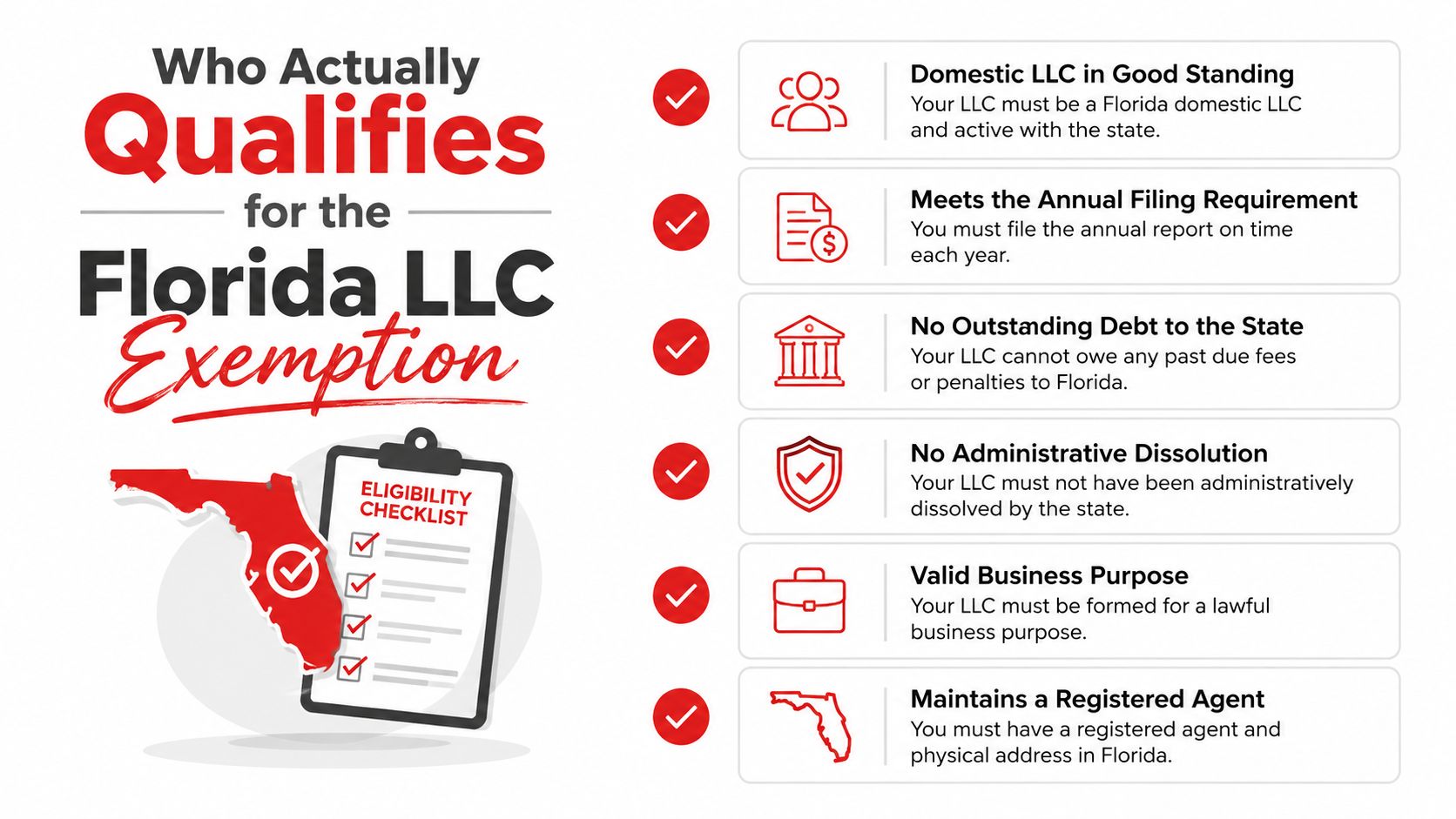
The Florida non-construction exemption instructions reinforce the practical sequence: confirm the LLC is active, verify ownership, review enforcement status, then apply and monitor renewal. That order prevents owners from submitting a form before discovering a status problem.
An applicant can be eligible and still make a poor business decision. The exemption may reduce the company's workers' compensation premium for that owner, but it also removes that owner's access to workers' compensation benefits. Treat the qualification test as a legal gate, not a recommendation.
Single-Member vs Multi-Member vs Construction LLCs
The structure of the LLC changes how owners should think about the exemption. The table below gives a practical comparison, but construction owners need a deeper review because field operations and worker classification can change the outcome quickly.
| LLC Type | Eligible for Exemption? | Key Conditions | Watch Out For |
|---|---|---|---|
| Single-member LLC | Generally, if the member meets the ownership and entity requirements | The member applies personally and the LLC must be active | The exemption doesn't cover future employees |
| Multi-member LLC | Members meeting the ownership requirement may apply individually | Each exempt member must qualify separately | Non-member employees remain a company responsibility |
| Construction LLC | Limited owner exemption may be available | Florida caps construction exemptions at no more than three officers or members | Field labor, payroll relationships, and classification issues can trigger coverage obligations |
A single-member non-construction LLC often has the cleanest decision. The owner can remove themselves from coverage, but that choice won't help once the business hires someone else. The company must reassess coverage before the first employee starts work, not after payroll has accumulated.
A multi-member LLC needs an owner-by-owner review. One member may qualify while another doesn't. Even when several members qualify, their certificates don't protect employees or other people treated as employees during an audit.
Construction is where owners get careless. Florida's framework caps the exemption at three officers or members in construction, and construction operations create more opportunities for worker classification disputes. A worker paid on a 1099 isn't automatically outside the workers' compensation analysis. If the business controls the relationship in a way that makes the worker function like an employee, an audit can treat the arrangement differently.
For broader contractor risk planning, owners can review this guide to insurance for contractors. Those considering subcontractor arrangements should also review this explanation of workers comp for subcontractors in CA, while remembering that Florida classification questions must be evaluated under Florida rules.
A filed owner exemption is not a shield for a construction LLC that misclassifies labor.
The right comparison isn't “exemption versus policy” in the abstract. It's “which people are excluded, which people remain exposed, and what work will the LLC perform next?”
How to File the Florida Workers Comp Exemption
Don't start with the form. Start with eligibility and enforcement status. Florida's process is formal, and an application doesn't fix an LLC that isn't active or is already subject to an enforcement action.
Prepare the business information
Confirm the LLC is active and review whether it has a Stop Work Order or Working in Violation status. Then gather the information the application requires, including:
- Federal EIN
- Florida registration number
- Business legal name and address
- Member or officer names
- Ownership percentages
- Officer titles or member information being submitted for exemption
The Florida Division of Workers' Compensation provides the current exemption application process through its online workers' compensation systems. Owners generally use the electronic DWC-251 Notice of Election to be Exempt process, with a notarized paper alternative available when online filing isn't appropriate.
Submit and preserve the evidence
The application requires the applicable fee. For the Florida framework described by the Division, each construction application carries a $50 fee. Payment options and the electronic submission process are presented through the state portal, which provides an electronic confirmation receipt after successful filing.
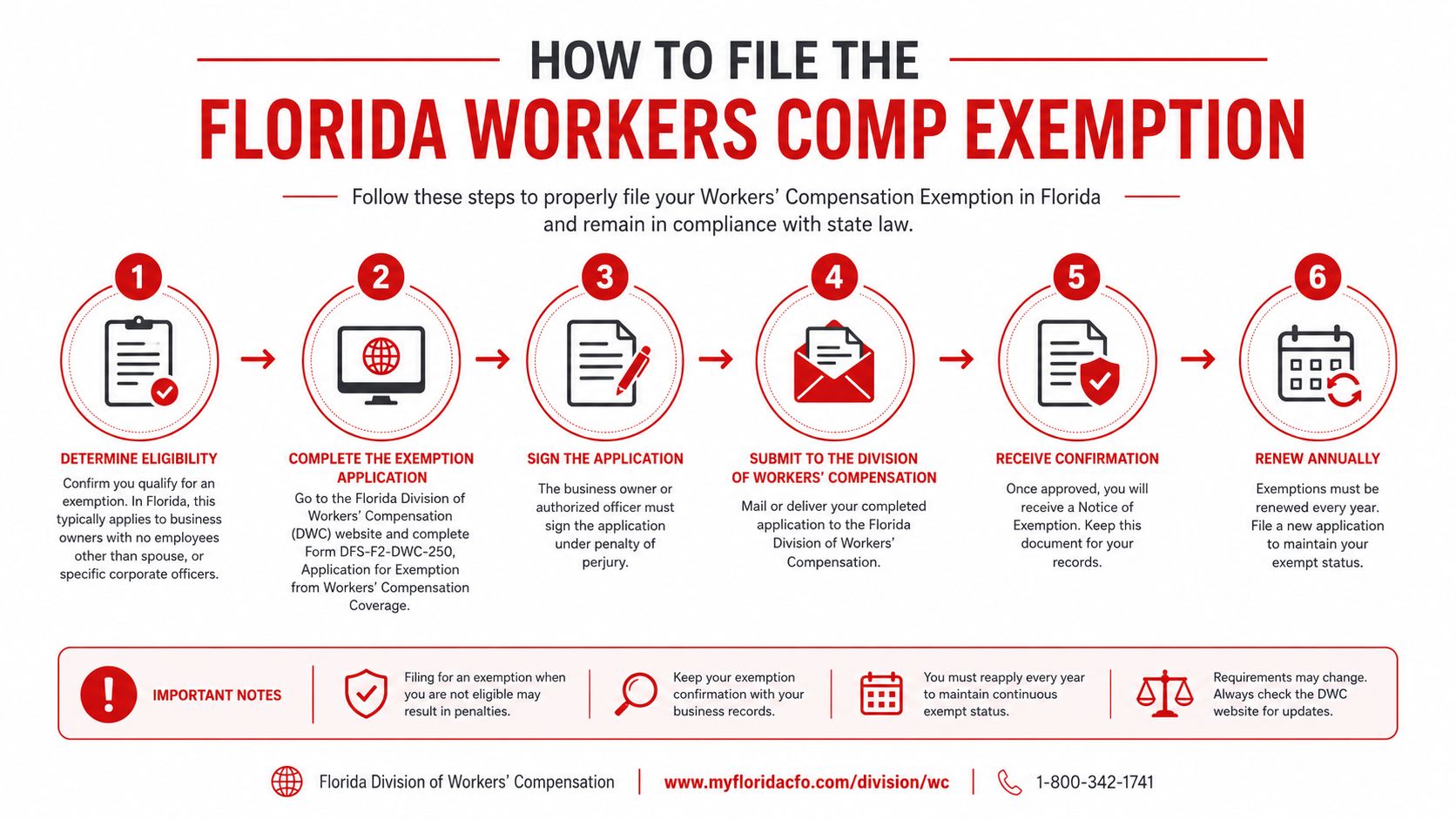
Save the receipt immediately. Keep payment proof, the approved certificate, ownership records, and any member or board resolution authorizing the election in the company's permanent insurance file. Those records help demonstrate what the business intended and who was exempted.
Track the renewal date
The standard certificate period is two years, unless the owner voluntarily revokes the exemption or the Division revokes it. Don't assume the state will manage your renewal calendar for you. Add the expiration date to the company's compliance calendar and review the exemption before the certificate lapses.
Florida's statute history also shows why owners shouldn't treat the current rules as permanent or automatic. The law specifically addresses non-construction LLCs meeting the definition of employment during July 1, 2013, through December 31, 2013, a historical marker tied to the state's post-2013 compliance regime. The current Florida Chapter 440 statutory text should be checked when the business structure, industry, or ownership changes.
A receipt proves that an application was submitted. It doesn't prove that the business has coverage for anyone else.
What the Exemption Really Covers and What It Does Not
The exemption isn't insurance. It doesn't pay the exempted owner's medical bills, replace lost wages, provide disability benefits, or create a death benefit for the owner's family after a work injury. It removes that named person from employee coverage under Chapter 440.
That distinction drives the entire decision. A covered employee may receive benefits through the employer's workers' compensation policy after a compensable work injury. An exempted owner accepts the personal financial consequences of being outside that system. For a general overview of benefits and protections, this workers' compensation coverage explanation from Lein Law Offices can help owners understand what covered workers' compensation is designed to address.
| Issue | Exempted Owner / Member | Covered Employee |
|---|---|---|
| Medical benefits for a work injury | Not provided through the owner exemption | Available under applicable workers' compensation coverage |
| Wage replacement | Not provided through the exemption | May be available under the policy and applicable law |
| Personal premium treatment | The owner is excluded from the covered payroll treatment for that individual | The employee remains part of the coverage calculation |
| Company coverage obligation | Unchanged for other workers | The employer must maintain required coverage |
| Third-party liability | The exemption doesn't block third-party claims | The policy doesn't replace separate liability coverage |
What changes
Once approved, the named owner or member is excluded from the employee coverage requirement. That can remove the owner from the covered payroll calculation and may reduce the premium associated with that individual. It also addresses the specific owner's status for non-coverage enforcement, but only within the scope of the valid exemption.
What remains
The LLC still has to insure workers who aren't validly exempt. The exemption doesn't satisfy commercial general liability requirements, protect the business from third-party claims, or eliminate employer-related exposures that other policies may address.
Owners should also review the broader cost context in this Florida workers' comp cost guide. A premium comparison matters, but it shouldn't hide the value of medical treatment and wage protection the owner gives up.
The honest tradeoff is simple: the LLC may save money on coverage for the exempted owner, while that owner accepts direct exposure for an injury. That's a business risk transfer decision, not a paperwork shortcut.
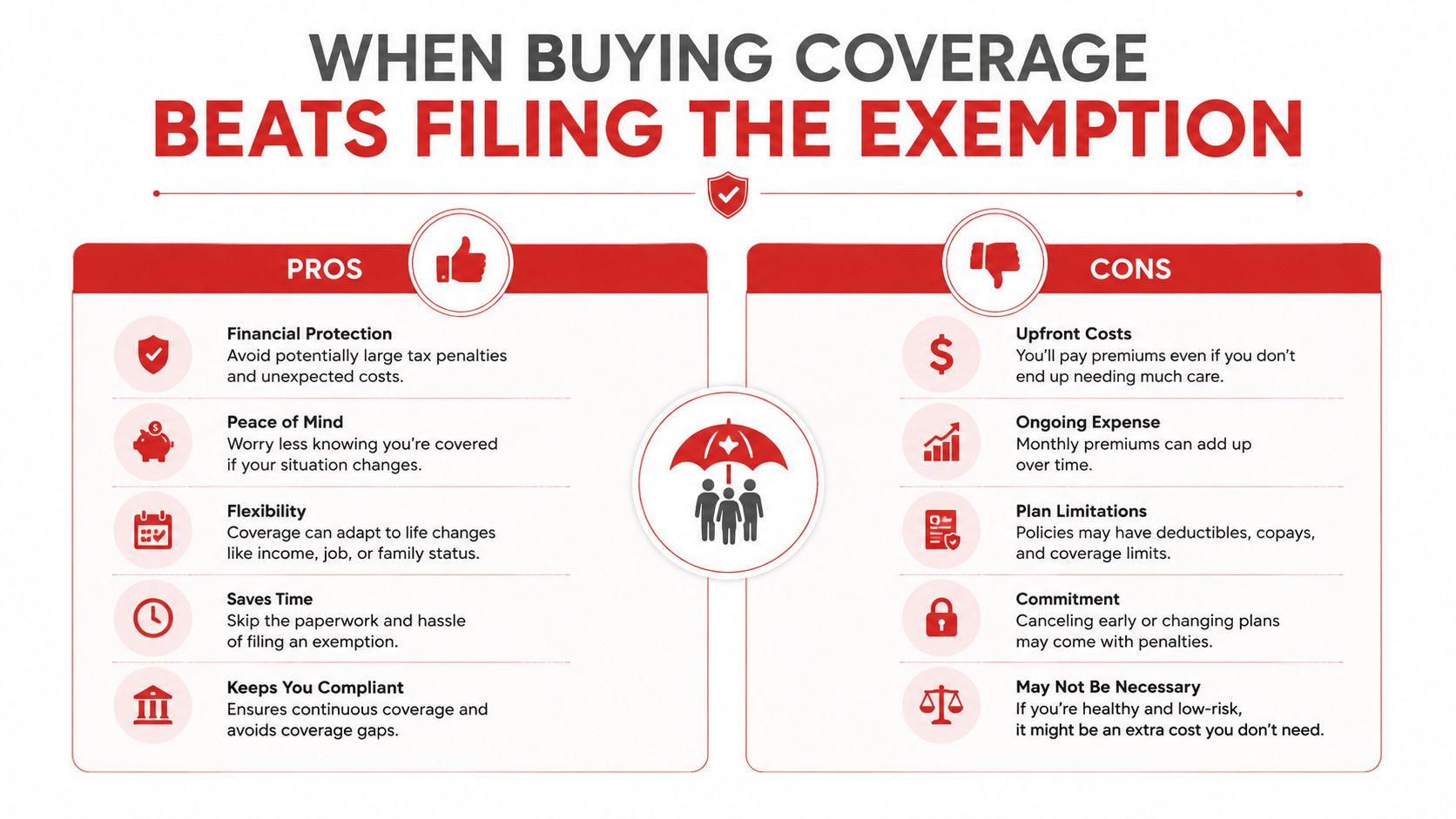
When Buying Coverage Beats Filing the Exemption
A Florida LLC shouldn't file an exemption merely because the owner works alone today. The better question is whether the owner can absorb an injury, satisfy contract requirements, and manage the business after hiring begins.
High-risk work changes the answer
Owners in roofing, electrical, plumbing, specialty trades, and other physically demanding work face a different risk profile from an owner who performs desk-based professional services. A serious fall or other job injury can create medical and income problems that a modest premium saving won't solve.
The owner may be legally eligible to exclude themselves, but eligibility doesn't make self-insuring sensible. If the owner is the only person who can produce revenue, the financial effect of an injury can reach beyond the owner's personal health. It can interrupt contracts, delay projects, and pressure the LLC to borrow money at the worst possible time.
Contracts may require a certificate
Commercial and government customers often ask contractors to provide proof of workers' compensation insurance. An exemption certificate isn't the same thing as a workers' compensation policy certificate. If bidding depends on proof of coverage, filing the exemption can limit the work the LLC can pursue.
Growth plans matter too. An owner expecting to bring on a partner, spouse, editor, laborer, or other W-2 employee should price coverage before the hire. The Florida workers' compensation insurance information page can help frame that conversation, but the final decision should reflect the actual class of work and payroll.
Personal assets deserve attention
Review what the owner has at risk. Personal savings, investment accounts, property interests, and business assets can make an uninsured injury more consequential. The exemption doesn't create a liability barrier around those assets, and it doesn't turn a workers' compensation exposure into a general liability claim.
A policy also gives the business a stable framework for hiring and contracting. Switching from an exemption to coverage after an incident, audit problem, or sudden contract requirement can be more difficult than arranging the policy before the business grows.
Choose the exemption when it fits the risk. Don't choose it simply because the form is easy to file.
A Practical Next Step for Florida LLC Owners
Run this checklist before making the election:
- Confirm the entity. Verify that the LLC is active and that the proposed applicant meets the ownership requirement.
- Map the work. Identify every service the business performs, including field work, installation, delivery, and client-site activity.
- Review the workforce. List employees, part-time help, temporary workers, members, and anyone paid as a contractor.
- Check enforcement exposure. Confirm the business isn't under a Stop Work Order or Working in Violation status.
- Test the growth plan. Note whether the next hire or contract will change the coverage decision.
- Compare the risk. Put the exemption savings beside an actual workers' compensation quote.
Gather the documents that make the comparison useful: ownership records, payroll registers separated by class code, prior loss information, job descriptions, subcontractor agreements, and contract insurance requirements. A Florida commercial advisor can then review whether the payroll classifications match the work, whether an experience modification factor applies, and whether owner or officer endorsements make sense.
Don't make this decision from a guessed premium. Ask for two clear scenarios, one showing the effect of a valid owner exemption and another showing coverage for the owner and any required employees. The comparison should also identify what happens when the business hires, changes trades, adds a partner, or takes on a contract requiring proof of insurance.
Select Insurance Group, Inc. can help Florida business owners compare workers' compensation options with other commercial coverage needs, including general liability and commercial property. Request a side-by-side review from a licensed Florida commercial insurance advisor before filing, renewing, or allowing an exemption to lapse.
Select Insurance Group, Inc. offers Florida LLC owners guidance on workers' compensation quotes, exemption decisions, and related commercial coverage. Visit Select Insurance Group, Inc. to request a no-obligation comparison based on your ownership structure, payroll, class codes, and business plans.