
You're probably staring at the same headache a lot of Florida owners face. The truck is in the yard, the broker wants a certificate, the lender wants proof of coverage, and somebody keeps saying “just get commercial auto” like that answers anything. It doesn't. In Florida, box truck insurance lives in the gap between what the state says you can register and what your shippers, brokers, and federal rules demand, and that gap is where people get burned.
The smart move is simple, but it's not cheap or vague. Match the policy to the gross vehicle weight, the way you haul, and whether you stay intrastate or cross state lines. If you buy the wrong layer, you don't just overpay, you leave yourself exposed when the claim lands.
Table of Contents
- What Florida Box Truck Owners Get Wrong on Day One
- What Box Truck Insurance Actually Covers
- Florida Liability Limits and Federal Overlay
- The Coverage Stack That Actually Protects You
- Why Florida Premiums Vary So Sharply
- Owner-Operator Versus Small Fleet Compared
- How to Quote and Bind Coverage Step by Step
- Recap and FAQs on Box Truck Insurance in Florida
What Florida Box Truck Owners Get Wrong on Day One
A Miami owner-operator picks up a 16-foot box truck, keeps the cheapest policy he can find, and starts hauling furniture for a broker. He backs into a parked Tesla in a tight lot, then finds out his carrier never meant to cover a commercial truck used that way. That's the moment he learns the same hard lesson. Cheap insurance and wrong insurance are not the same thing.
Start with the vehicle's actual class, not its nickname
Florida doesn't care that you call it “just a box truck.” The insurer looks at the GVWR, the use, the cargo, and whether the truck is operating under business authority. Under Florida Statute 627.7415, liability expectations climb with weight, and the jump from $50,000 to $300,000 across the statute's bands shows how fast exposure rises as the truck gets heavier. That statute also sits on top of other requirements, so it's a floor, not a ceiling. Florida Statute 627.7415
Practical rule: if you don't know your truck's GVWR from the VIN and title paperwork, you're quoting blind.
The seven things you need to understand before you bind
You need the weight-based liability tiers, the federal overlay that can kick in for interstate hauling, where cargo coverage sits, why UM/UIM matters in a no-fault state, how radius drives premium, what a new venture surcharge really means, and which discounts move the quote. That's the whole game. Everything else is noise.
Florida's commercial vehicle rules also start from a separate baseline for many business vehicles, including lighter box trucks, with $10,000 personal injury protection and $10,000 property damage liability for many Florida-registered vehicles, according to a Florida commercial auto summary Florida commercial auto requirements. But for a box truck used for hire or in interstate work, the actual number is often much higher. If you don't separate “legal minimum” from “business minimum,” you'll underinsure the truck and overestimate your protection.
What Box Truck Insurance Actually Covers
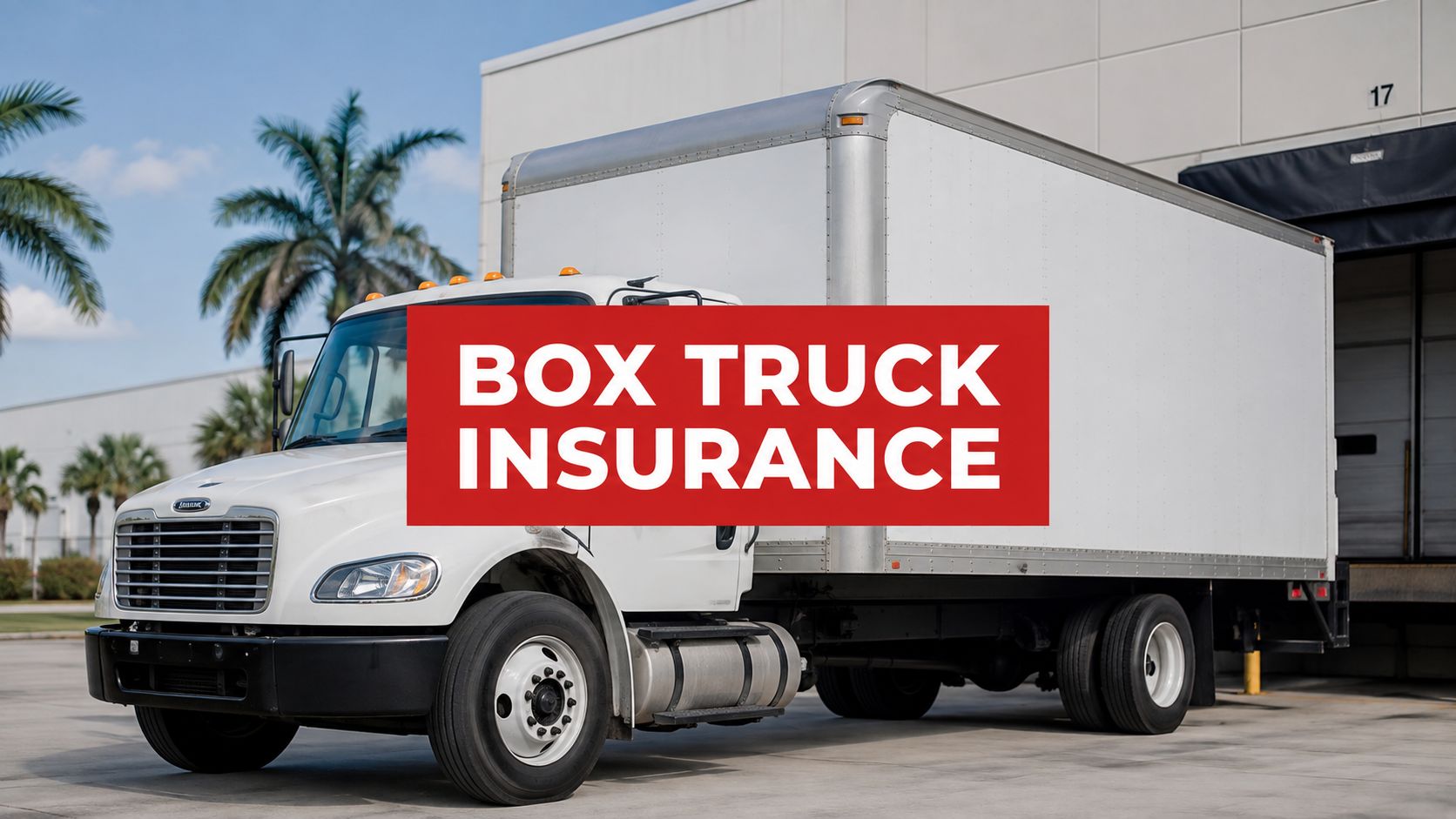
Box truck insurance is commercial auto insurance scaled for straight trucks that do business work. It sits between personal auto and long-haul trucking. If you're moving furniture, appliances, freight, supplies, or equipment in a truck that's clearly being used for business, you need a policy built for that use, not a personal policy with a business-friendly story attached.
Think of the policy in layers
The easiest way to understand it is as a structure. Liability is the foundation, it pays others when your truck causes injury or property damage. Physical damage is the walls, it protects your truck itself from collision, theft, vandalism, and weather-related loss. Cargo is the roof, it's there to protect the freight, not the truck. Endorsements like non-trucking liability, hired and non-owned auto, and UM/UIM are the utilities that keep the operation functioning when the basic policy isn't enough.
That's why personal auto falls apart here. Personal policies rate for private use, not commercial exposure. They don't like business hauling, and they don't price for dock work, loading zones, brokered freight, or the liability that comes with a heavier truck. Box truck coverage is also different from full trucking because many straight-truck operations don't need the same federal structure that a true over-the-road carrier needs, unless the truck crosses the thresholds covered later.
The coverage pieces need to fit the job
If the truck is financed, physical damage usually stops being optional in the world. If the truck is hauling for hire, cargo terms start mattering immediately. If the truck is leased onto another carrier's authority, the policy structure changes again, because your non-business use and dispatch use are not the same risk.
The bottom line is this. Box truck insurance is not one policy, it's a stack of coverages that should match the truck's weight, route, cargo, and contract language. If you're trying to save money by trimming the wrong layer, you'll find out at claim time that the carrier wasn't being picky, it was being precise.
Florida Liability Limits and Federal Overlay
Florida box truck owners get tripped up on the same point every day, they read the truck size wrong and quote the wrong liability limit. A unit that looks ordinary in the yard can fall into a very different bracket once the GVWR changes. Under Florida Statute 627.7415, vehicles operating on Florida roads must carry at least $50,000 per occurrence for gross vehicle weight of 26,000 to under 35,000 pounds, $100,000 for 35,000 to under 44,000 pounds, and $300,000 for 44,000 pounds or more. Florida Statute 627.7415
Find the bracket before you ask for quotes
The truck's GVWR is on the VIN decode, title paperwork, and usually the manufacturer label. Use that number, not a guess. A 26-foot box truck doing local delivery can sit in a different bracket than a heavier straight truck running regional freight, even if the bodies look similar. That is why two trucks in the same business often need different limits.
Florida also has a commercial auto baseline that many registered vehicles start from, with $10,000 PIP and $10,000 property damage liability noted in the Florida commercial auto requirements. That baseline satisfies a paper requirement. It does not satisfy shippers, brokers, lenders, or a serious loss.
Federal rules can override the state floor
If the truck is in interstate for-hire service and sits above 10,001 pounds GVWR, federal motor-carrier financial responsibility rules usually control. In practice, that means the policy is commonly paired with a $750,000 minimum and filings such as MCS-90 and BMC-91/BMC-91X. The same box truck can be a routine commercial auto risk for intrastate delivery, then become a much tighter filing and underwriting problem once it crosses state lines. See the federal overlay for Florida commercial truck insurance requirements for the filing side of that split.
Brokers and shippers often want $1,000,000 CSL anyway, because the contract floor usually beats the legal floor. That is standard freight math, not overkill. If you are hauling under a contract, the best way to price the job is to start with the required limit and then match the policy language to the freight agreement.
| Truck Class | GVWR | Florida Minimum Liability | Federal Minimum | Typical Contractual Floor | PIP Required |
|---|---|---|---|---|---|
| Lighter commercial box truck | Under 26,001 pounds | Often tied to Florida commercial auto baseline | May not trigger federal motor-carrier filings if not in interstate for-hire use | Higher than the legal floor in many contracts | $10,000 for many Florida-registered vehicles |
| Medium straight truck | 26,000 to under 35,000 pounds | $50,000 per occurrence | Federal rules may apply if interstate for-hire and above 10,001 pounds | Often $1,000,000 CSL in freight contracts | $10,000 for many Florida-registered vehicles |
| Heavier straight truck | 35,000 to under 44,000 pounds | $100,000 per occurrence | Federal rules may apply if interstate for-hire and above 10,001 pounds | Often $1,000,000 CSL in freight contracts | $10,000 for many Florida-registered vehicles |
| Heaviest bracket covered by the statute | 44,000 pounds or more | $300,000 per occurrence | Federal rules may apply if interstate for-hire and above 10,001 pounds | Often $1,000,000 CSL in freight contracts | $10,000 for many Florida-registered vehicles |
Truck liability coverage guidance for Florida operations
Do not anchor to the state floor and call it done. Brokers, lenders, and federal filing rules can push the required number much higher.
The Coverage Stack That Actually Protects You
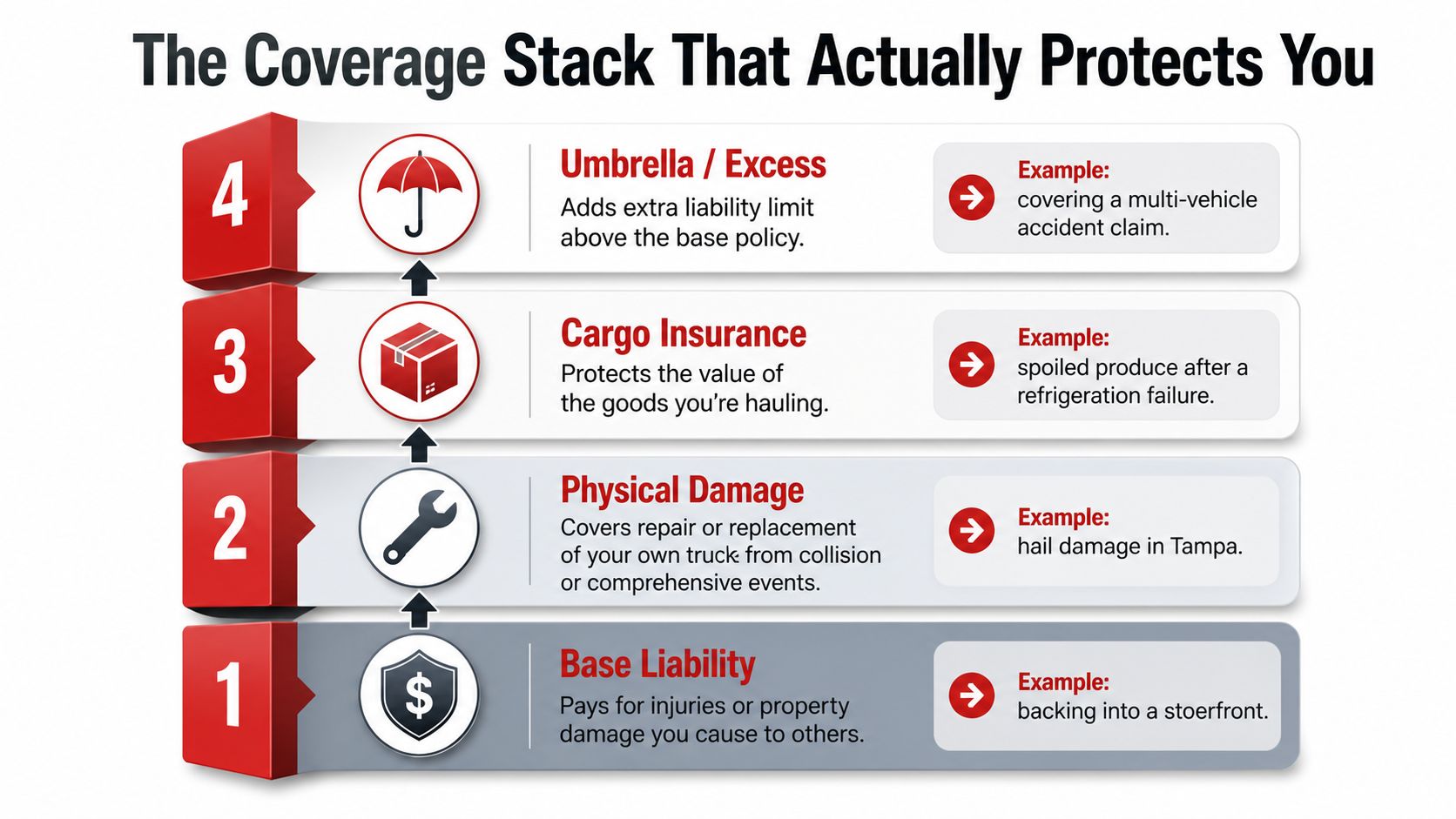
The policy only works if each layer does its job. If you've ever watched a dock claim turn into a fee dispute, a cargo loss turn into a denied payout, or a parking-lot accident turn into a certificate problem, you already know why this matters. The coverage has to match the way the truck is used, not the way somebody wishes it were used.
Liability and cargo need different thinking
Liability pays for injuries or property damage you cause to others. If your driver backs into a storefront or clips a parked car, that's the layer that responds. Cargo insurance is separate, and it covers the freight, not the truck. A customer's load damaged in transit is a cargo problem, not a liability claim.
The trap is assuming a liability policy makes you whole on the freight. It doesn't. That's why cargo terms need to track the actual commodity list, loading method, and exclusions. For Florida truckers who carry freight for brokers or shippers, cargo language matters as much as the limit itself. Cargo insurance for truckers
Physical damage and UM/UIM are not extras you ignore
Collision and full coverage are the two parts of physical damage. Collision handles a dock scrape, rollover, or impact. Full coverage handles non-collision losses like theft, vandalism, hail, or flood-related damage, depending on the policy wording. If the truck is financed, this coverage is usually the part lenders care about most.
UM/UIM matters in Florida because the state's no-fault framework doesn't magically protect a commercial truck owner from an underinsured driver. If your truck and driver are hit by someone with weak coverage, UM/UIM can be the difference between a clean recovery and a painful gap. Medical payments can help with smaller injury claims and is often written at modest limits, but it's still secondary to getting the liability tower right.
Leased trucks and fleets need the right add-ons
If you're leased onto another carrier, non-trucking liability helps when the truck is being used outside dispatch. Hired and non-owned auto fits businesses that may use vehicles they don't own, such as a company arranging occasional delivery support. Trailer interchange comes into play when a fleet handles trailers under an interchange agreement. Those endorsements are not decorative, they're there because the standard policy won't always answer the claim.
| Coverage Layer | What It Really Pays For | What Trips People Up |
|---|---|---|
| Liability | Injuries or property damage to others after an at-fault loss | Too-low limits for freight contracts |
| Cargo | Damage to the goods you haul | Exclusions tied to commodity, theft, or temperature control |
| Physical damage | Repair or replacement of your truck | Deductible and stated-value mistakes |
| UM/UIM | Gaps when the other driver can't fully pay | Assuming a no-fault state removes the need |
| Non-trucking liability / HNO / trailer interchange | Use outside dispatch, non-owned auto exposure, trailer exchange risk | Using the wrong endorsement for the operation |
The gaps that cause the most denials are predictable, refrigeration loss on reefer-style loads, restricted cargo like cigarettes or cannabis, and hired-auto situations where the policy was never built for the exposure. The endorsement has to match the work.
Why Florida Premiums Vary So Sharply
Florida box truck prices commonly land somewhere in the $3,000 to $14,000 per year range, depending on the setup and risk profile. That wide band is the truth nobody likes because it's not a quote, it's a spread. One truck can sit near the bottom while another with the same body style lands near the top, and the underwriter usually has a reason for it. Florida box truck insurance cost drivers
The biggest levers are not mysterious
Operating radius is usually the strongest pricing lever. A truck staying local carries less exposure time and fewer road miles than one running regionally. ZIP code is next, because garaging in a dense metro area changes theft pressure, traffic exposure, and claim patterns. Cargo class matters because some freight is riskier and harder to place.
Driving record still matters the old-fashioned way. MVR violations, prior losses, and claims history all affect how hard the carrier leans on the file. New venture status is another obvious one. If the business has no prior insurance, no stable loss history, or a thin operating record, the underwriter has less to trust.
Declines usually come from red flags, not just price
A carrier may decline when the operation looks unstable, the truck is being used outside the stated radius, or the commodity list includes something the market doesn't want. Missing prior insurance, inconsistent garaging information, or a driver file that doesn't match the application can do the same thing. If the risk story is messy, the quote either gets expensive or disappears.
| Driver | Typical Premium Impact | Carrier Signal |
|---|---|---|
| Operating radius | Highest impact | Short local radius usually reads safer than broad regional use |
| ZIP code | High impact | Metro garage locations usually signal more theft and traffic exposure |
| Cargo class | High impact | Restricted or higher-risk freight makes the file harder to place |
| Driving record | High impact | Violations and losses push pricing up fast |
| New venture status | High impact | No prior insurance or thin history often means stricter underwriting |
Florida trucking insurance and rating factors
Owner-Operator Versus Small Fleet Compared
A one-truck owner-operator and a 3 to 10 unit fleet buy coverage for different headaches. The owner-operator is trying to protect one truck, one driver, and one contract path. The fleet is trying to control driver spread, hired exposure, and consistency across units. Underwriting treats those as separate files.
The policy shape changes with the operation
| Item | Owner-Operator | Small Fleet |
|---|---|---|
| Core policy | Commercial auto for the truck | Commercial auto across multiple VINs |
| Non-business use | Often needs non-trucking liability | Usually handled through fleet structure and use rules |
| Filings | May need federal filings depending on interstate freight and commodity | More likely to manage filings across several units |
| Physical damage | Usually scheduled by VIN | Scheduled by VIN with fleet deductibles and unit tracking |
| Cargo | Often tied to broker or shipper requirements | Often standardized across the fleet |
| Driver controls | Usually one primary driver | Scheduled driver coverage and broader driver files |
| Add-ons | HNO, non-trucking liability, trailer interchange | Hired auto, employer non-ownership, trailer interchange |
| Shop or tow exposure | Garage keeper can matter for service and tow activity | More relevant where a fleet handles vehicles in custody |
| Telematics | Helpful, especially for rate support | Stronger leverage because consistency across units matters |
For the owner-operator, the biggest problem is usually thin history. One clean truck with a clean file can still get hit hard if the driver profile is light or the use pattern is unclear. That is why non-trucking liability and the right cargo setup matter so much.
Small fleets get judged on consistency. One bad driver file, one wrong VIN, or one sloppy class code can drag the whole submission. Carriers want the same story across every unit, every driver, and every use pattern. If the fleet is disciplined, it usually binds cleaner and prices better than a scattered one-truck file with gaps.
How to Quote and Bind Coverage Step by Step
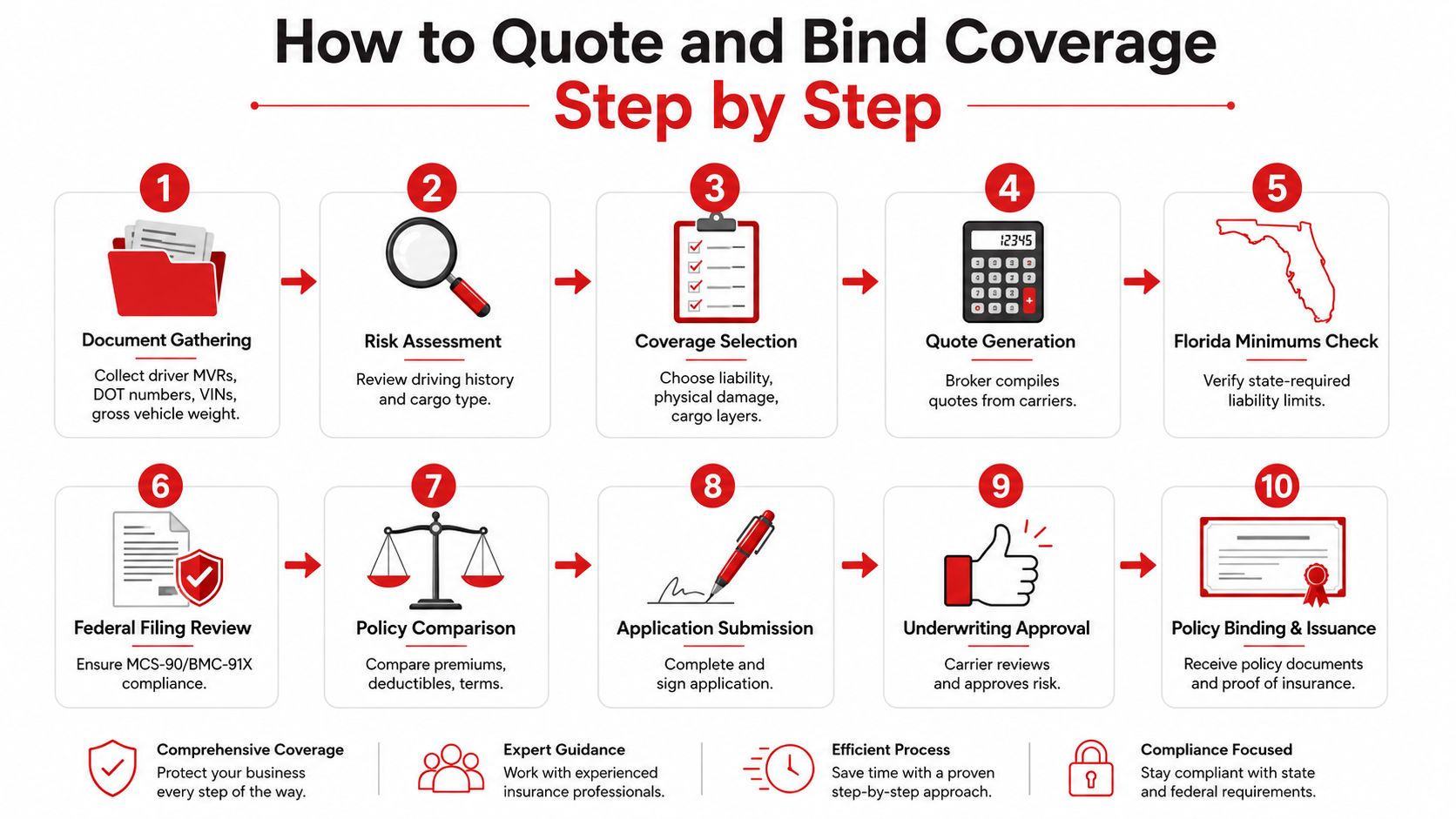
Clean quotes start with clean inputs. If the file is sloppy, the market wastes time, reissues quotes, and hands you weaker terms. A broker can only price the risk you hand over.
Use a strict file before you ask for quotes
- Gather the driver file. Pull MVRs, license details, CDL status, and any recent violations.
- List the equipment. Write down VINs, year, make, model, stated value, and gross vehicle weight.
- Pin down the garaging ZIP. Underwriters rate the truck where it sleeps, not where you wish it did.
- State the operating radius. Be honest about local, regional, or interstate use.
- Describe the cargo. Commodity type matters more than most owners realize.
- Show loss runs. If you've had prior coverage, provide the last 35 months.
- Confirm filing needs. If the truck crosses state lines or runs for hire, say so upfront.
- Ask for the same application to go to multiple carriers. Keep the submission consistent so you're comparing real differences, not mismatched data.
- Check every limit before binding. Liability, cargo, physical damage, deductibles, and endorsements all need to line up.
- Get proof before the truck rolls. Binder, ID cards, filing certificates, and claims contact info should all be in hand.
If the quote looks too easy, somebody skipped a risk question.
Ask about paid-in-full, continuous coverage, driver safety credits, and telematics treatment before you bind. Those are the levers that can help the right account. In some cases, an independent agency such as Select Insurance Group, Inc. can place Florida commercial auto and trucking coverage by comparing markets instead of forcing one carrier's box onto your operation.
Use the same comparison standard every time
You are not buying the lowest sticker price. You are buying the best mix of annual premium, deductible, exclusions, and filing support. A cheap quote with a bad driver schedule or a missing endorsement is an expensive denial waiting to happen.
Recap and FAQs on Box Truck Insurance in Florida
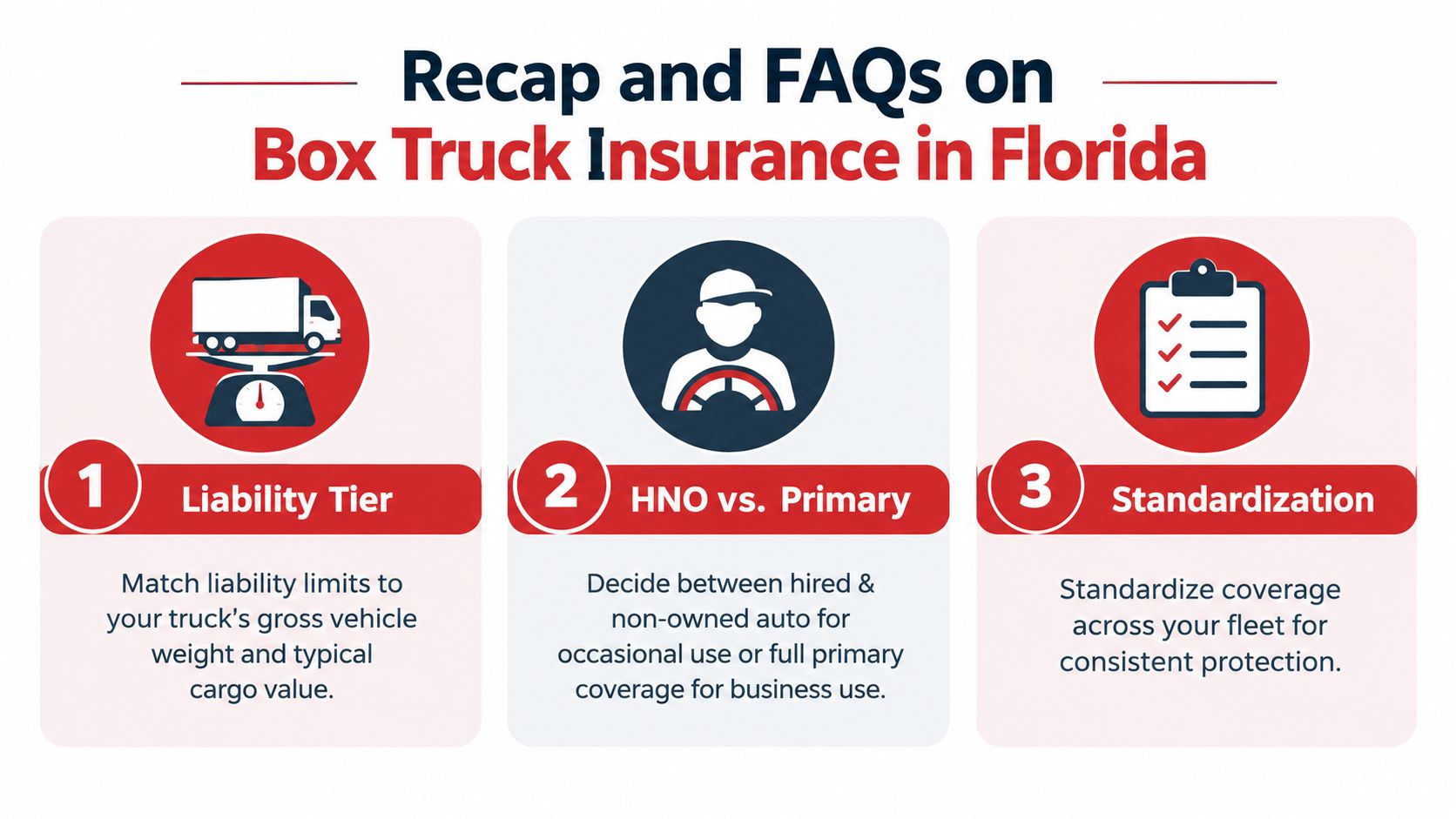
A Florida box truck owner usually gets tripped up in the same three places. Set the liability tier from the truck's weight and the freight contract, not a guess. Choose the right structure for non-business use, whether that means non-trucking liability or a broader primary setup. Then standardize the file with clean driver data, telematics where it fits, and the same quote inputs every time. That is how you control the $3,000 to $14,000 spread instead of landing at the top end.
FAQ 1. Does a 26-foot box truck need MCS-90 filings?
If it runs in interstate for-hire service above 10,001 pounds GVWR, federal responsibility rules can apply, and filings such as MCS-90 and BMC-91/BMC-91X may be part of the setup. If the truck stays intrastate, the federal filing issue usually does not drive the same result. Route and use matter more than box size.
FAQ 2. How does UM/UIM stacking work for fleets?
Florida coverage can allow stacked protection in some cases, but the answer depends on the policy form and how the vehicles are scheduled. Fleets should treat UM/UIM as a real exposure. The other driver's weak coverage does not disappear just because your truck is commercial.
FAQ 3. When is standalone cargo better than relying on the motor carrier's coverage?
Use standalone cargo when the freight value, commodity, or contract language makes the carrier's cargo protection too thin or too restrictive. If the load is brokered, higher value, or sensitive to exclusions, stand-alone cargo can fill gaps the motor carrier form will not cover.
FAQ 4. How long does binding usually take once underwriting approves?
If the file is clean and all required documents are in hand, binding can move fast. The delay usually comes from missing VINs, an unclear cargo description, or waiting on filing confirmation, not from issuing the policy itself.
If you want a straight answer on what your truck should really carry, Select Insurance Group, Inc. can quote Florida commercial auto and trucking coverage with the liability, cargo, and filing structure matched to your operation. Visit Select Insurance Group, Inc. and get the conversation started before a broker or shipper makes the coverage decision for you.