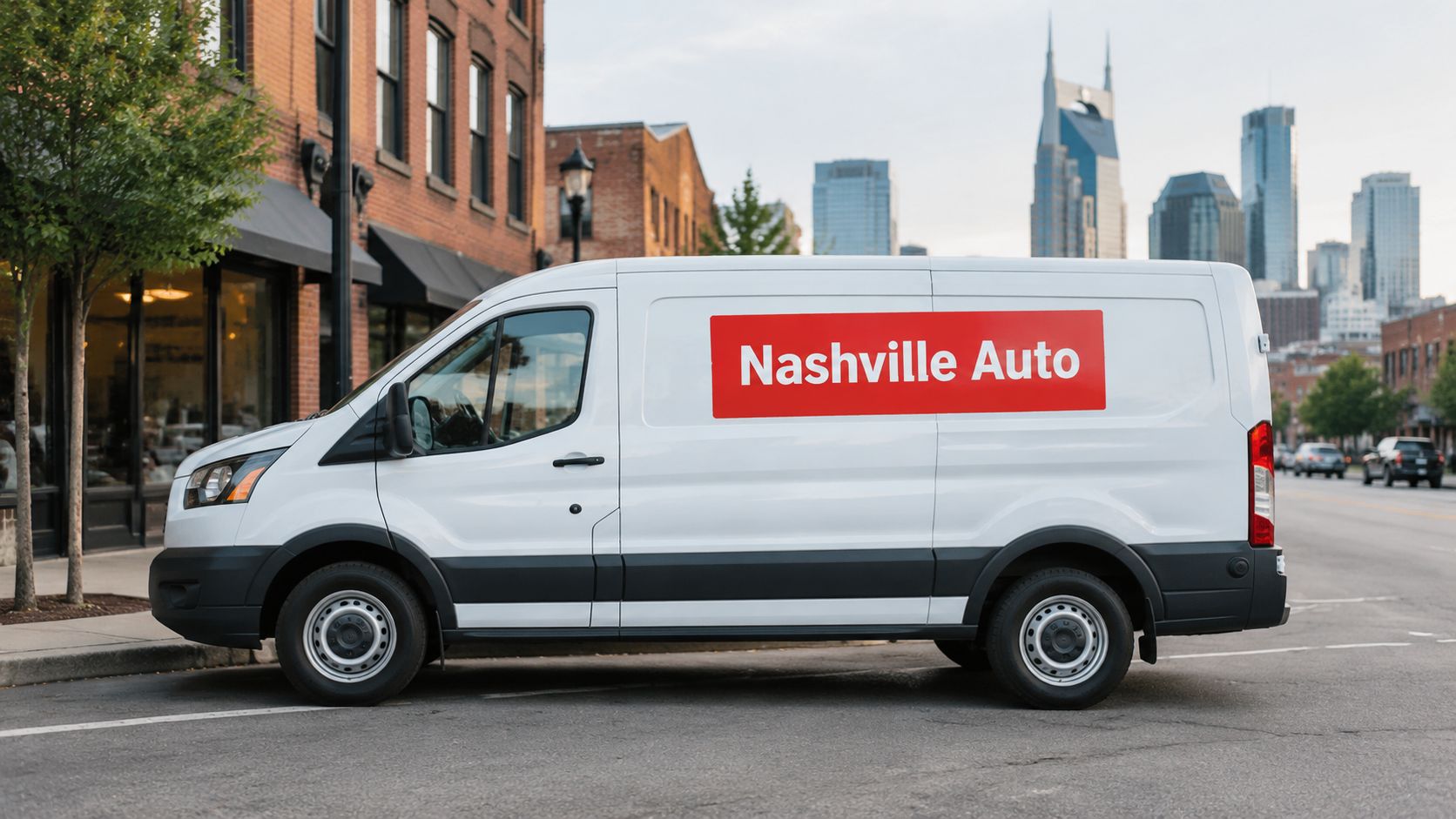

A Nashville contractor finishes a late job in Franklin, loads tools into a company van, and heads back toward town. Traffic tightens near I-24. One distracted driver changes lanes, clips the van, and turns a routine drive into a business liability problem. The owner may be thinking about repairs, missed work, and replacing equipment, while the insurer is asking a more basic question: was the vehicle being used for business under the correct policy?
Nashville business auto insurance needs to match how your company operates. A personal policy may be suitable for commuting or personal errands, but it can leave serious gaps when a vehicle carries tools, transports customers, makes deliveries, or sends employees to job sites. The right policy starts with Tennessee's legal requirements and then accounts for your drivers, vehicles, routes, cargo, and claims exposure.
Table of Contents
- Why Your Personal Car Insurance Is Not Enough in Nashville
- Building Your Nashville Commercial Auto Policy
- Gathering Your Documents for a Faster Quote
- Key Factors That Drive Your Insurance Costs
- How to Compare Quotes and Lower Your Premiums
- Get a Fast Bilingual Nashville Business Auto Quote Today
Why Your Personal Car Insurance Is Not Enough in Nashville
A real estate agent driving to a showing, a caterer delivering food downtown, and a plumber traveling to a home in Bellevue may all be using ordinary-looking vehicles. The insurance risk isn't ordinary, though. Once the vehicle supports the business, carries business property, or is driven as part of paid work, the personal policy may not respond as the owner expects.
A personal auto insurer could question a claim if the vehicle was being used for deliveries, transporting supplies, visiting customers, or allowing an employee to drive on company business. The issue isn't whether the vehicle has a business logo. It's the purpose of the trip and the way the vehicle is owned, operated, and represented to the insurer.
Practical rule: Tell the agent what the vehicle does on a normal workday, not just what it looks like in the driveway.
Nashville creates plenty of situations where a minor collision can become expensive. Construction activity puts more service vehicles and equipment on the road. Tourism increases congestion around downtown, Broadway, Midtown, and major event areas. Regional routes can take drivers through changing traffic conditions between Davidson County, Franklin, Murfreesboro, and surrounding communities.
The loss environment also deserves attention. Verisk reported that commercial auto claim volume fell 5% in 2025, yet remained 14% above 2021 levels. At the same time, claim severity rose 62%, reaching an average of $27.4K in the latest four-quarter period, according to its commercial auto claims trends analysis. Fewer claims don't automatically mean lower risk when the claims that remain are more costly.
Where business owners commonly get caught
A contractor may insure a van personally because the van is also used for family trips. A restaurant owner may assume an employee's personal policy covers a delivery run. A small company may insure one vehicle correctly but overlook a second vehicle used occasionally by an owner or employee.
Those arrangements create uncertainty about liability, physical damage, employee use, and business property. If your company sometimes borrows vehicles or employees use personal cars for work, review hired and non-owned automobile coverage rather than assuming every vehicle exposure fits under the company's owned-auto policy.
Commercial auto coverage is more than just another expense on the books. It protects the business from a vehicle-related claim reaching beyond the car itself and affecting operating cash, equipment, contracts, and future growth. A properly described policy gives the insurer a fair opportunity to price the exposure and gives you a clearer path through a claim.
Building Your Nashville Commercial Auto Policy
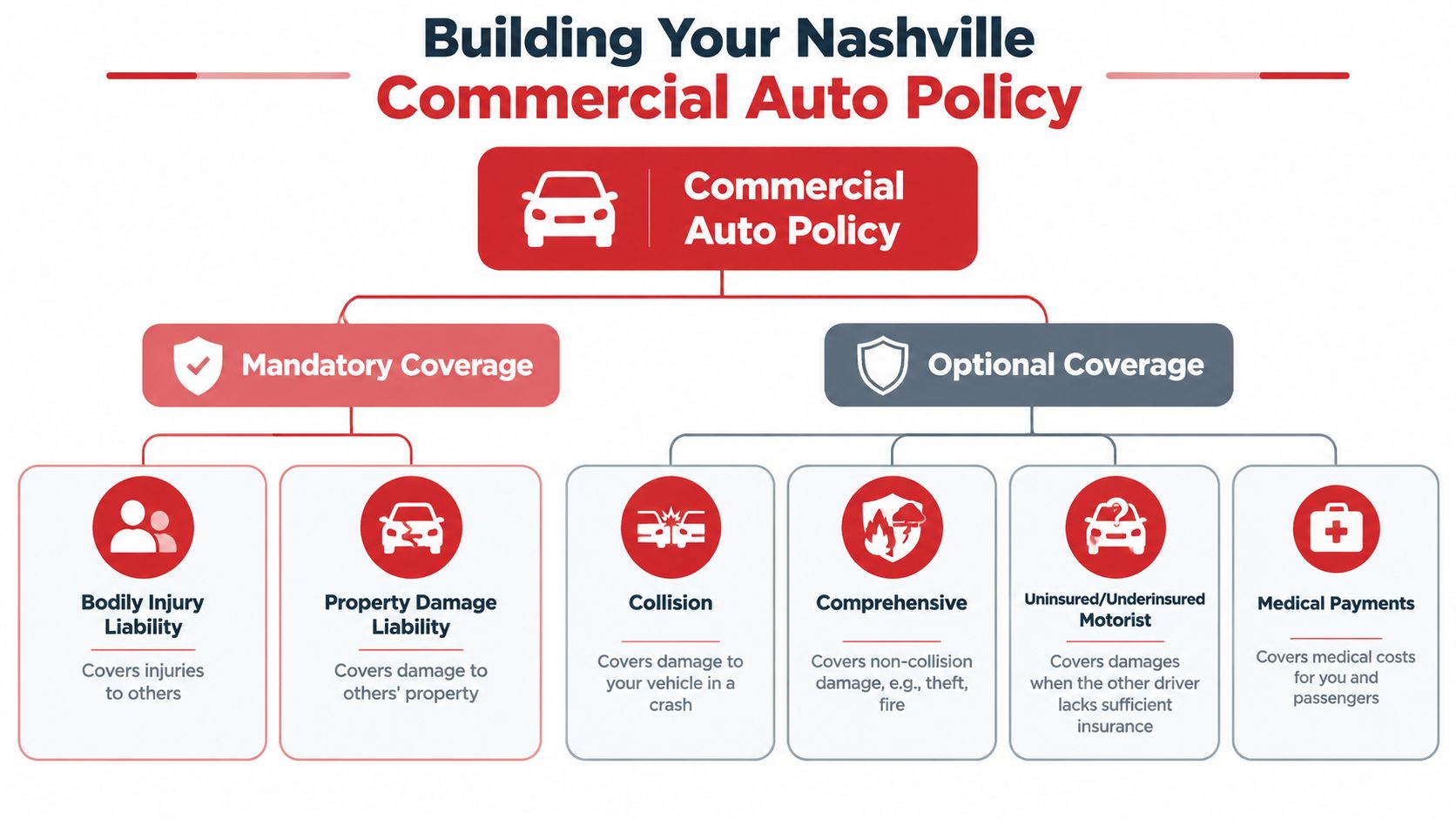
Build the policy around the vehicle, the driver, and the work being performed. Tennessee requires business vehicles operating on public roads to carry minimum commercial auto liability limits of $25,000 per person for bodily injury, $50,000 per accident for bodily injury, and $15,000 per accident for property damage. Those limits meet the legal requirement, but they may not protect the company's cash flow after a serious accident.
A contractor hauling equipment, a delivery company crossing the region, and a consultant driving a sedan face different exposures. Nashville's I-24 traffic, downtown congestion, construction activity, and tourism-related driving can increase the chance of a collision, delay, or property-damage claim. A policy should account for the financial effect of injuries, vehicle repairs, legal expenses, and interrupted operations.
Match each coverage to a loss
Liability coverage responds when the business or an insured driver causes injuries to another person or damages someone else's property. It forms the foundation of the policy and may be required by landlords, general contractors, municipalities, or commercial customers reviewing a certificate of insurance.
Collision coverage addresses damage to a covered vehicle after a crash, subject to the selected deductible. It can help when a work van is damaged on a crowded downtown street or a service truck is struck between job sites.
Protection against non-collision damage applies to losses such as theft, fire, vandalism, falling objects, and severe weather. Tools and other equipment inside the vehicle may need separate coverage because vehicle damage and business-property damage are not always handled under the same protection.
Uninsured and underinsured motorist protection helps address injuries or damage caused by a driver with no insurance or insufficient limits. It deserves attention when employees spend many hours on Nashville-area roads.
Medical payments coverage may help with eligible medical expenses for vehicle occupants, depending on the policy. Hired and non-owned auto coverage applies when the company rents vehicles or employees use personal cars for company errands. Cargo coverage may fit delivery businesses, caterers, and companies transporting customers' property.
| Coverage Type | What It Covers | Example Scenario |
|---|---|---|
| Bodily injury liability | Injuries to other people when the business is legally responsible | An employee causes an accident while traveling to a job |
| Property damage liability | Damage to another person's vehicle or property | A company truck damages a customer's gate |
| Collision | Damage to a covered business vehicle after a crash | A service van is struck in heavy Nashville traffic |
| Protection against non-collision damage | Theft, fire, vandalism, weather, or other listed damage to a covered vehicle | A van is stolen or damaged by a storm |
| Uninsured or underinsured motorist | Losses involving an inadequately insured driver | Another driver causes an accident but has limited insurance |
| Medical payments | Certain medical expenses for drivers or passengers | An occupant needs medical attention after a covered accident |
| Hired and non-owned auto | Certain business use of rented or employee-owned vehicles | An employee uses a personal car for a supply run |
| Cargo | Covered property being transported | A delivery business transports customer goods |
The vehicle title does not tell the whole story. Describe who drives, where vehicles travel, what they carry, and whether employees use personal or rented vehicles. Spanish-speaking owners can review Nashville commercial insurance options with a bilingual insurance professional, then coordinate auto, liability, property, and related coverage so one policy does not leave an avoidable gap in another.
Gathering Your Documents for a Faster Quote
A crew leaves Nashville for a job, then traffic on I-24 turns a short trip into a regional run. If the application only says “local service work,” the quote may not reflect the business's real exposure. That mismatch can slow underwriting and create questions during a claim. Give the agent operating details that match daily work, including construction-site travel, tourism-related deliveries, and routes across Middle Tennessee.
Prepare the business file
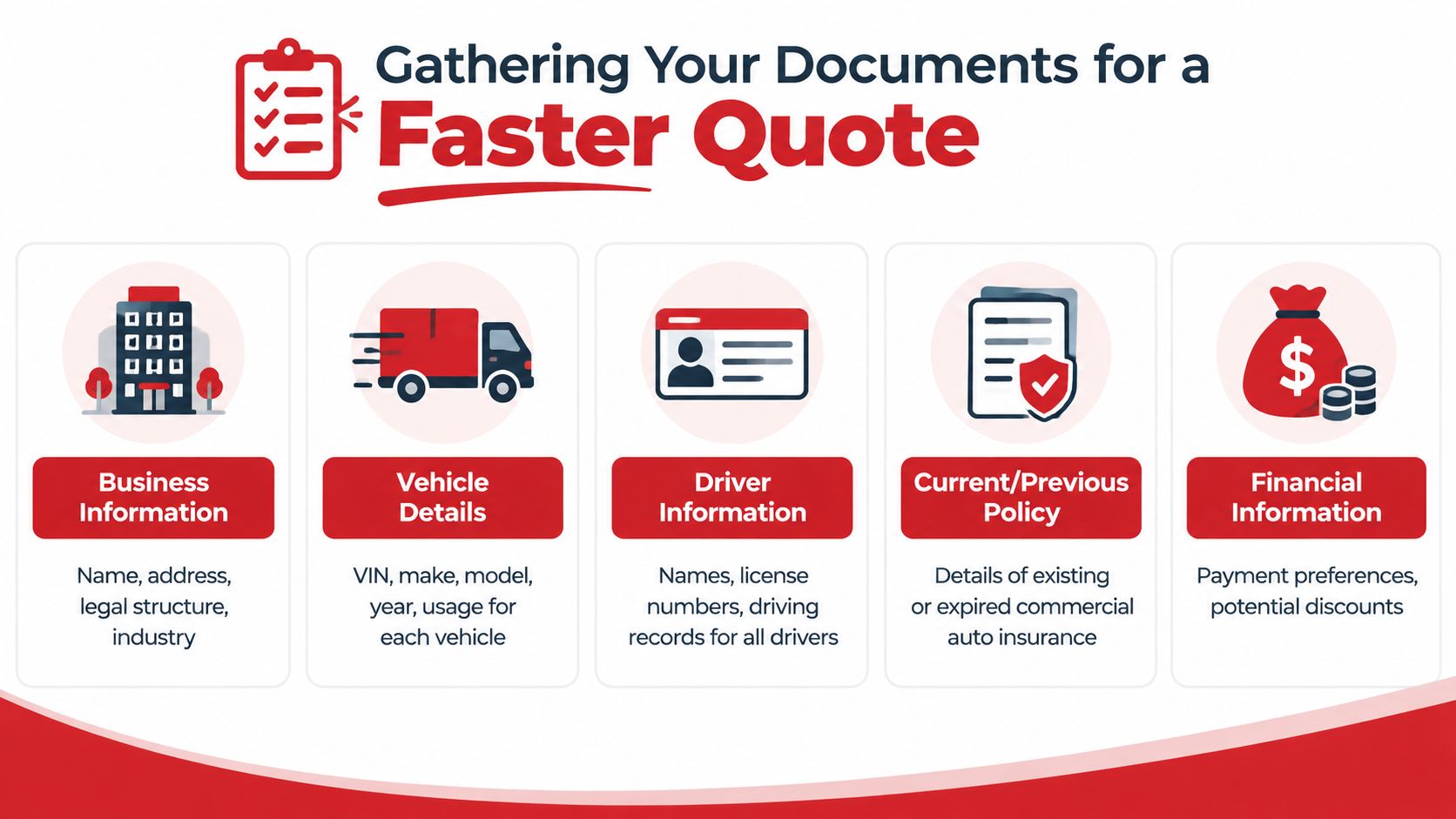
Gather the legal business name, operating and mailing addresses, business structure, and a plain-English description of the work. Include the garaging address, because insurers need to know where vehicles are kept when they are not working.
Truckers and some commercial operations may need a DOT number or other regulatory information. Explain whether the business uses employees, subcontractors, or temporary drivers. Leaving those details out can lead to follow-up questions or an inaccurate quote.
Add the current or prior policy, including declarations pages, renewal information, limits, deductibles, and any cancellation or nonrenewal notices. Loss runs help the agent review prior claims, dates, causes, and paid or reserved amounts.
Assemble vehicle and driver details
For each vehicle, provide the VIN, year, make, model, ownership status, stated use, and approximate operating radius. A van used for appointments has a different exposure from a truck carrying equipment to construction sites or making deliveries near busy Nashville event areas. Correct vehicle information keeps the quote tied to the vehicle and its actual use.
For every driver, provide the full legal name, license number, date of birth when requested, job role, and driving history. The insurer may use this information to evaluate experience and obtain Motor Vehicle Reports when authorized. List anyone who drives regularly, including employees who use a personal vehicle for business errands.
- Business information: Legal name, addresses, entity structure, and operations.
- Vehicle information: VINs, ownership, vehicle specifications, and business use.
- Driver information: Names, license details, assigned vehicles, and driving records.
- Policy history: Current declarations, prior coverage, deductibles, and loss runs.
- Operating details: Routes, radius, cargo, overnight parking, and employee use.
Keep digital copies in one clearly labeled folder. Spanish-speaking owners can organize the submission with a bilingual agent and review the fields on our free insurance quote form before sending documents. For broader administrative workflow ideas, marketing automation for small business may help, but the insurance submission still needs complete vehicle and driver information.
Key Factors That Drive Your Insurance Costs
A contractor sending a crew through I-24 during rush hour faces different insurance exposure from a florist making short local deliveries. Nashville traffic, construction activity, tourism, event congestion, vehicle type, driver experience, and cargo all affect how an insurer evaluates commercial auto risk.
The premium follows the operation, not the owner's preferred budget. A small sedan used for appointments may be easier to underwrite than a heavy service truck carrying equipment to job sites. A business delivering near downtown venues also presents different parking, loading, and collision concerns than one working mainly in suburban neighborhoods.
The pricing levers that matter most
Vehicle type and value affect potential physical damage costs and accident severity. Heavy trucks, specialized equipment, and vehicles carrying substantial tools may need different limits and deductibles than passenger cars. Vehicle age matters, but it is only one part of the rating picture.
Driving radius changes road exposure. Local Nashville trips may be evaluated differently from regional routes that add interstate miles and unfamiliar roads. Describe I-24 travel, major commuter corridors, event traffic, and repeated downtown deliveries accurately. An understated radius can create underwriting problems later.
Driver history and tenure influence how an insurer views the fleet. Motor Vehicle Reports, prior accidents, moving violations, experience with the vehicle class, and driver turnover can all affect pricing. Written hiring standards and recurring record reviews provide stronger risk information than informal assurances.
Business operation and cargo shape claim severity. Fragile goods, expensive equipment, or hazardous materials may require specialized underwriting. Passenger transport, food delivery, construction work, and service calls each create different patterns of loading, parking, backing, and roadside exposure.
Garaging and security also affect the risk. Vehicles stored overnight at a secure business location may have a different theft and vandalism profile from vehicles left on public streets or at employee homes. State where vehicles are kept, who has access, and whether employees take them home.
Review limits as costs rise
Commercial auto claim severity has been increasing about 8% annually, more than twice the 3% rate of general economic inflation, according to industry market intelligence. That pattern supports an annual policy review, especially after buying vehicles, adding drivers, expanding routes, accepting larger contracts, or changing the cargo being transported.
Tennessee commercial auto coverage is often benchmarked in the low hundreds per month. One industry source reports an average of $229 per month, or $2,744 annually, for commercial auto coverage in Tennessee. Actual pricing can differ substantially because underwriting reflects the business's vehicles, drivers, routes, use, and claims history.
Review limits when the operation changes. A growing contractor may need protection that matches larger equipment and longer routes, while a delivery business may need to reassess coverage as downtown activity and mileage increase.
A lower premium has little value if it comes from inaccurate classifications, inadequate limits, or omitted vehicles. The practical goal is to reduce avoidable exposure while keeping coverage aligned with the company's actual work. Spanish-speaking owners can review these operating details with a bilingual agent before accepting a quote.
How to Compare Quotes and Lower Your Premiums
The cheapest quote isn't always the least expensive policy. A low price can reflect a higher deductible, narrower coverage, lower limits, restrictive driver language, or an incorrect description of the business. Compare quotes on matching limits, deductibles, covered vehicles, driver assumptions, and endorsements before deciding.
Start by asking each agent to confirm the application details. If one quote assumes local use and another includes regional work, the prices aren't comparable. The same applies when one proposal includes hired and non-owned auto coverage, physical damage, or cargo protection and the other doesn't.
Reduce avoidable underwriting concerns
Driver controls usually produce better long-term results than chasing a temporary discount. Use written rules for phone use, passenger restrictions, vehicle inspections, backing procedures, and personal use. Verify driving records before hiring and review them periodically.
Telematics or electronic logging devices may help some fleets document mileage, driver behavior, hours, and route activity. They aren't a cure-all. A system that generates data nobody reviews won't improve operations, and a program that employees don't understand can create resistance. Use technology where it supports a clear safety process.
Other practical decisions include:
- Choose deductibles deliberately: A higher deductible can reduce premium, but only if the business can absorb the out-of-pocket cost after a loss.
- Keep vehicles and drivers current: Remove sold vehicles and former drivers promptly, and report replacements before they enter regular use.
- Control vehicle use: Separate personal use, employee errands, delivery work, and customer transport in your written rules.
- Consider payment structure: Ask whether paying the premium in full or using an approved payment plan changes the total cost.
- Coordinate related policies: A broader business insurance review may reveal opportunities to align coverage and reduce duplicated administration.
Look past the quote price
Commercial auto underwriting remains difficult. In 2024, the sector reported a 113 combined ratio, an approximately 86% weighted-average loss ratio, and a 14th consecutive year of underwriting losses, according to commercial auto market benchmarks. Those figures explain why carriers may scrutinize driver controls, vehicle use, limits, and loss history.
Ask how the carrier handles claims, communicates during repairs, and reviews changing fleet conditions. An independent agent can request options from multiple carriers, but the business owner still needs to compare the actual coverage terms and the carrier's approach to underwriting.
Select Insurance Group, Inc. can be one option for businesses seeking commercial auto coverage, including liability, physical damage, hired and non-owned auto, cargo, and tools and equipment protection. The right choice is the proposal that accurately reflects your Nashville operation and remains workable when the business changes.
Get a Fast Bilingual Nashville Business Auto Quote Today
A business can discover an auto coverage gap after a delivery accident, an employee crash on I-24, or a vehicle change during a busy Nashville construction project. You do not have to wait for renewal to address it. Start with a short review of what the business owns, who drives, where vehicles are stored, how far they travel, and what they carry.
Spanish-speaking owners should request bilingual assistance at the start. Clear communication helps document employee use, delivery arrangements, cargo, prior claims, and vehicle ownership. A misunderstood detail can produce an inaccurate quote or a coverage problem when a claim is filed.
A practical quote process
- Describe the operation: Explain the business, service area, vehicle use, cargo, driver structure, and any tourism-related or downtown routes.
- Send the documents: Provide VINs, driver information, current policy details, loss runs, and required regulatory information.
- Review matching options: Compare limits, deductibles, exclusions, endorsements, payment terms, and vehicle schedules.
- Bind only after checking details: Confirm every vehicle and regular driver appears correctly before coverage begins.
- Schedule a review: Revisit the policy after fleet growth, route expansion, a new contract, or a significant operational change.
A Tennessee average is only a planning reference. Your Nashville premium depends on the risk details underwriters receive. An independent agent can compare multiple carriers and help avoid the false economy of buying coverage that does not fit.
Select Insurance Group has more than 30 years of experience and offers bilingual support, free no-obligation quotes, and commercial coverage guidance in its service areas. An online request, a direct conversation, or marketing automation for small business can help organize follow-up, but the quote still depends on complete and accurate documents.
Select Insurance Group, Inc. provides Nashville business auto guidance for company cars, delivery vehicles, service trucks, and fleets. Coverage may include liability, physical damage, hired and non-owned auto, cargo, and tools and equipment protection. Visit Select Insurance Group, Inc. to request a fast, bilingual, no-obligation quote based on how your business operates.