
A restaurant owner in East Nashville watches a customer slip near the entrance during a busy dinner service. Across town, a contractor's employee is injured at a jobsite, while a delivery van clips another vehicle in traffic. None of these events requires a large company or unusual mistake. Each can create medical bills, legal costs, repair expenses, lost income, or a contract dispute that puts pressure on the business's cash flow.
That's why Nashville commercial insurance isn't just paperwork for a landlord or a line item to revisit at renewal. It's a financial safety net built around the way your company operates. The right policy helps separate a serious incident from the survival of the business, while the wrong policy can leave important gaps even when the certificate looks complete.
This guide explains the core coverage types, Tennessee's legal requirements, Nashville-specific risk factors, the reasons premiums change, and the coverage questions that matter most for restaurants, contractors, retailers, fleets, and other local businesses. You'll also find a practical quote-to-bind process and ways to manage premiums without cutting protection too far.
Table of Contents
- Introduction Why Nashville Businesses Cannot Operate Without Coverage
- Understanding Core Commercial Insurance Coverage Types
- Tennessee Requirements and Nashville Specific Risks
- What Drives Cost and What Nashville Owners Actually Pay
- Industry Coverage Checklists for Nashville Businesses
- How to Get Quotes and Bind Coverage in Nashville
- Lowering Premiums and Managing Claims and Renewals
- How a Local Independent Agency Helps You Choose With Confidence
Introduction Why Nashville Businesses Cannot Operate Without Coverage
A business owner often notices insurance only when a certificate is requested, a renewal arrives, or a claim occurs. Day to day, the actual exposure is less dramatic. Customers walk across wet floors, employees drive company vehicles, tools travel between jobsites, inventory sits in storage, and vendors or landlords impose contract requirements.
Suppose a delivery driver causes a collision while making a scheduled drop-off. Tennessee law sets a minimum commercial auto liability baseline, but the resulting damage may involve several vehicles, injuries, legal defense, and business interruption. A policy designed only around the legal minimum may satisfy a narrow requirement while leaving the company financially exposed.
The same principle applies to property. A fire, storm, theft, or equipment loss can affect more than the building. It may damage inventory, tools, furniture, computers, refrigerated goods, or materials waiting for installation. Replacement costs and the time needed to source equipment can matter as much as the original physical damage.
Practical rule: Buy coverage around the largest realistic loss your business could face, not only around the smallest amount the law allows.
Nashville's commercial base makes this decision relevant to companies of many sizes. A recent city profile reported 16,547 business establishments, which helps explain why local demand extends across general liability, property, workers' compensation, commercial auto, and specialty policies. Tennessee business insurance guidance also connects the state's regulatory requirements with the practical needs of local businesses.
The rest of this guide follows a simple path. First, you'll learn what each major policy does. Then you'll see how Tennessee rules differ from contract expectations, what drives premiums, how industry risks vary, and what information helps an agent secure a useful quote. The goal isn't to make you memorize insurance language. It's to help you ask better questions before a claim, renewal, or contract deadline forces a rushed decision.
Understanding Core Commercial Insurance Coverage Types
Start with the business's exposure, then match each exposure to a coverage layer. General liability is the customer-facing shield. It can respond to allegations involving bodily injury, property damage, or certain personal and advertising injuries connected with business operations. A customer falling in a café, for example, is a premises and operations concern, while damage caused at a client's location may involve completed work or contractual details.
Commercial property protects physical business assets, subject to the policy's terms, conditions, limits, and exclusions. Think of it as the roof over your operation and the contents inside it. Buildings, business personal property, inventory, equipment, and improvements may require different limits, and a tenant may need coverage for improvements even when the landlord insures the structure.
The protection layers
- Workers' compensation addresses employee work injuries through a statutory system. It isn't a substitute for general liability, and general liability doesn't replace workers' compensation.
- Commercial auto covers vehicles used for business, with liability and physical-damage options that must reflect ownership, use, drivers, and vehicle schedules.
- Trucking coverage can add complexity involving cargo, hired or non-owned vehicles, terminal exposures, and contractual requirements.
- Professional liability matters when clients rely on advice, designs, recommendations, or specialized services. A mistake that causes financial harm may not fit a standard bodily-injury claim.
- Cyber coverage can address selected technology, privacy, notification, payment, and recovery exposures, depending on the policy wording and business controls.
- Employment practices liability insurance, often called EPLI, can address allegations such as discrimination, harassment, retaliation, or wrongful termination.
A small firm may use a Business Owners Policy, or BOP, to combine eligible property and liability protection. That bundle can simplify administration, but it doesn't automatically include workers' compensation, commercial auto, professional liability, cyber coverage, or every endorsement the company needs.
How the policies fit together
A useful hierarchy looks like this:
- Required foundation: Workers' compensation and commercial auto liability where Tennessee rules apply.
- Everyday protection: General liability and commercial property.
- Operational extensions: Business interruption, equipment breakdown, inland marine, and hired or non-owned auto.
- Specialized layers: Professional liability, cyber, EPLI, cargo, and umbrella or excess liability.
Coverage should follow the actual work. A consultant may need less property insurance than a retailer, but more professional liability. A contractor may have modest office contents but significant tools, vehicles, materials, and jobsite exposures. A policy becomes useful when its limits and definitions reflect those realities.
Tennessee Requirements and Nashville Specific Risks
A Nashville contractor can meet Tennessee's auto-insurance floor and still lose a project because the contract requires higher limits. That gap separates legal compliance from the protection needed to operate. Review Tennessee commercial insurance requirements before setting limits for vehicles, employees, property, and contracts.
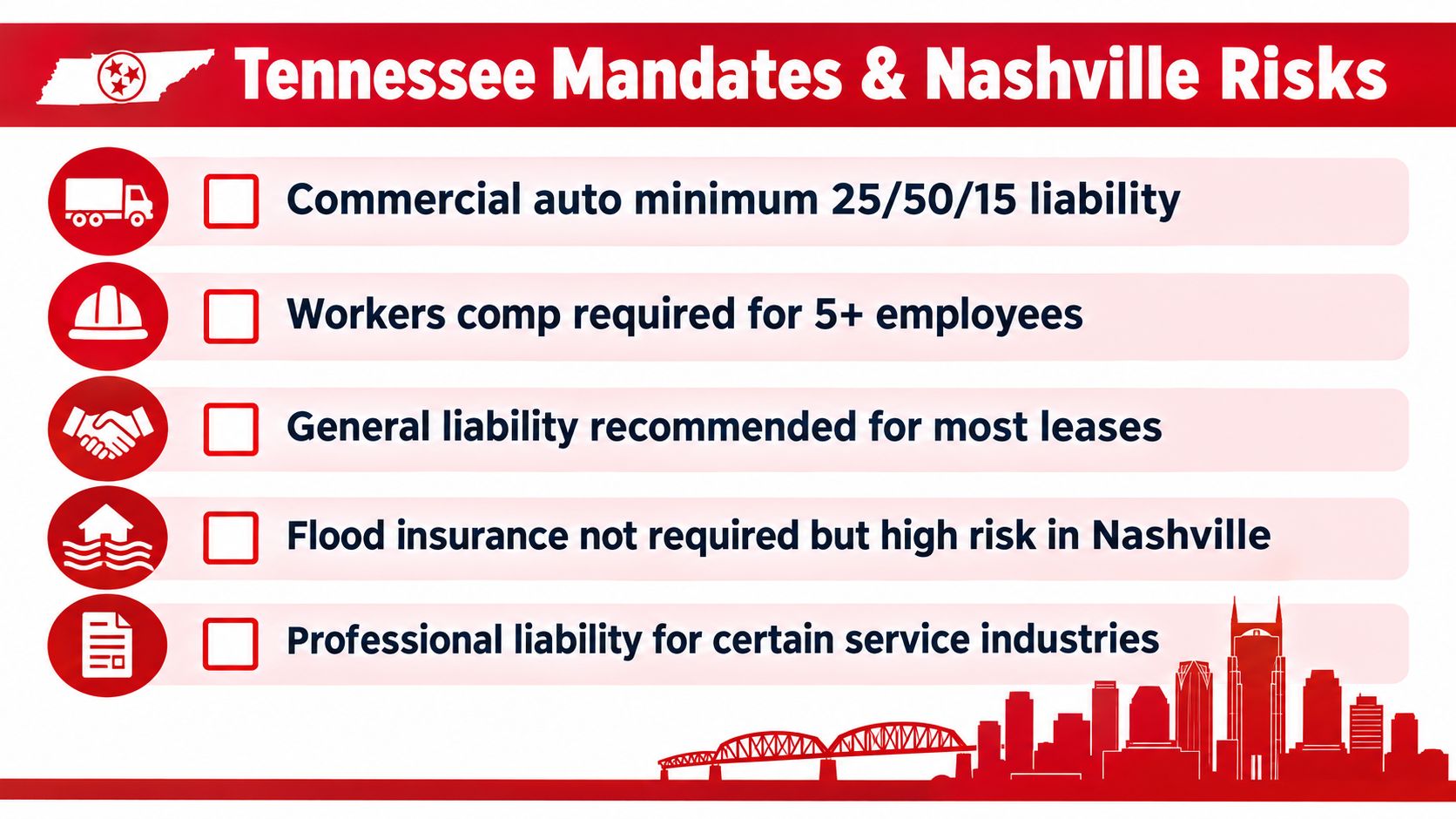
Commercial auto liability must meet $25,000 for bodily injury per person, $50,000 for bodily injury per accident, and $15,000 for property damage per accident, commonly called 25/50/15. Workers' compensation is required for businesses with five or more employees, including part-time workers. Construction has a stricter threshold, beginning with the first employee.
State rules provide the floor. A landlord, general contractor, customer, or lender may set a higher operating requirement. Commercial agreements frequently call for $1,000,000 in auto liability and general liability limits of $1,000,000 per occurrence and $2,000,000 aggregate, according to Nashville commercial insurance contract guidance. A company carrying only 25/50/15 could therefore satisfy the law yet fail a contract review.
Legal minimums versus operating requirements
The distinction is practical:
- Statutory limits meet the legal floor.
- Contract limits allocate risk between businesses.
- Adequate limits account for the size and severity of a realistic loss.
A logistics operator may need scheduled vehicles, cargo protection, and excess liability because one accident or damaged shipment can exceed the underlying policy. A contractor may need limits that satisfy a project owner before work begins. Contract certificates and endorsements matter as much as the headline limit.
Nashville's growth adds pressure to the decision. The city profile cited earlier includes 16,547 business establishments, creating exposure across premises, employees, vehicles, inventory, and customer relationships. Tennessee ranked 13th nationally in total domestic and foreign insurers licensed in the state. Commercial multi-peril premium written in Tennessee reached $1,296,408,082 in 2019, according to The National Association of Insurance Commissioners' Tennessee market profile. The figures show an established commercial-insurance market serving varied business risks.
Nashville also has a long insurance history. National Life & Accident Insurance Company began in Nashville in 1900, and Life & Casualty Insurance Company was founded there in 1903. The NAIC profile documents how those companies helped establish Nashville as a major Southern insurance center during the mid-20th century.
What Drives Cost and What Nashville Owners Actually Pay
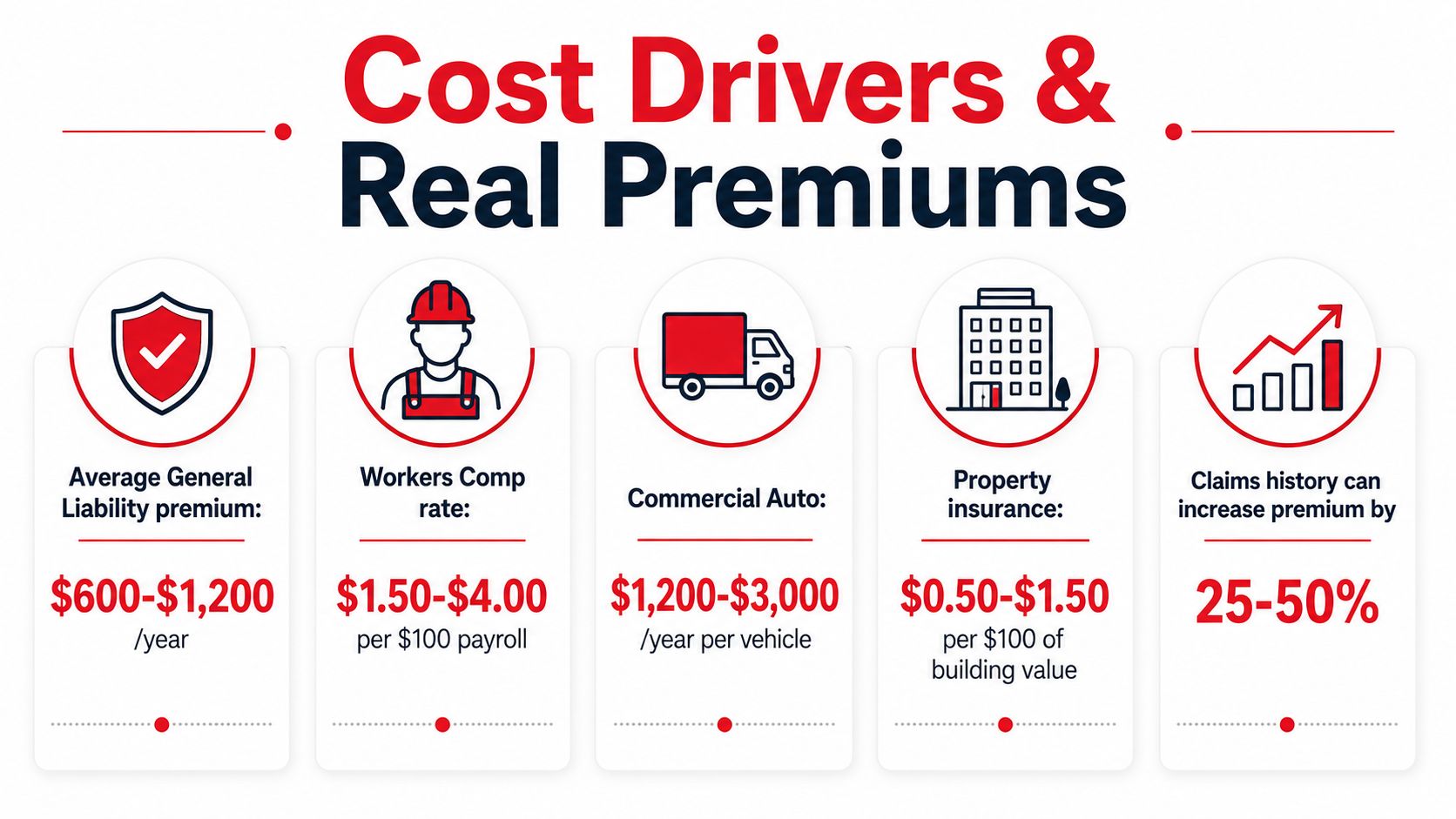
Insurance pricing doesn't follow one simple formula. Underwriters evaluate the business classification, payroll, revenue, vehicles, drivers, property values, building characteristics, claims history, safety controls, and requested limits. Two companies with similar sales can receive very different pricing if one uses company vehicles, performs higher-risk work, or has a more adverse loss history.
A renewal can rise even when your payroll and operations look unchanged. The reason may be broader replacement-cost pressure, theft, supply-chain inflation, older construction, or claims severity across the relevant line of insurance. A business owner may see a higher property premium because rebuilding or replacing equipment costs more, not because the company suddenly became careless.
The market pressures behind a renewal
Tennessee's broader insurance market experienced a 76% rise in direct premium written since 2015, according to Tennessee business insurance market information. The same source describes 2025 commercial property outlooks of roughly 8% to 15% increases, with pressure from theft, supply-chain inflation, and older construction risks. These are market observations, not a prediction of what every Nashville business will pay.
The controllable factors deserve equal attention:
- Classification accuracy: The insurer needs the correct description of work, payroll allocation, and employee duties.
- Property valuation: Limits should reflect realistic replacement needs, not an outdated purchase price.
- Vehicle scheduling: Every owned, leased, hired, and non-owned exposure must be disclosed correctly.
- Loss controls: Written safety procedures, training records, maintenance logs, and incident reviews help demonstrate management discipline.
- Claims history: Frequent or severe claims can affect eligibility, deductibles, terms, and pricing.
Renewal question to ask: “Which part of the account changed, and which part reflects the wider market?”
A broker or agent should be able to separate those explanations. If the increase comes from property valuation, updating the limit may be necessary. If it follows a classification issue, correcting payroll or operations data may improve accuracy. If it reflects claims, the business needs a documented prevention and response plan rather than a quick limit reduction.
The safest savings usually come from better information and stronger controls. Cutting limits without understanding the exposure can create a cheap policy that fails during the loss that matters most.
Industry Coverage Checklists for Nashville Businesses
Nashville businesses don't share the same insurance profile. A restaurant has food, refrigeration, customer traffic, and employees moving through a busy workspace. A contractor moves tools and materials between locations. A retailer protects inventory and welcomes members of the public. A fleet operator manages vehicles, drivers, cargo, and contractual obligations.
| Industry | Essential Coverages | Recommended Add-Ons |
|---|---|---|
| Restaurants | General liability, commercial property, workers' compensation, business interruption | Spoilage, equipment breakdown, cyber, EPLI |
| Contractors | General liability, workers' compensation, commercial auto, tools and equipment protection | Inland marine, contractor's equipment, professional liability, umbrella |
| Retail | General liability, commercial property, inventory protection, workers' compensation | Cyber, EPLI, business interruption, equipment breakdown |
| Fleets and trucking | Commercial auto, physical damage, cargo where applicable, workers' compensation | Umbrella or excess liability, hired and non-owned auto, specialized endorsements |
Restaurants
Check whether property limits include kitchen equipment, furniture, signage, tenant improvements, and stock. Food spoilage protection may matter when refrigeration fails or a covered event interrupts power or access. General liability should reflect customer traffic and the premises, while workers' compensation belongs in the operating plan for employee injuries.
Restaurants should also review business interruption protection. Property damage can stop sales, but the financial effect may continue through payroll, rent, utilities, and reopening costs.
Contractors
Contractors need to distinguish between property kept at the office and property that travels. Tools, equipment, and materials may need inland marine or related protection while they're in transit, at a temporary location, or on a jobsite. Commercial auto must reflect work vehicles, trailers, hired vehicles, and employees using personal vehicles for company tasks.
A certificate alone doesn't prove that the policy covers every contractual demand. Review additional-insured wording, completed-operations concerns, waiver requirements, and requested liability limits before signing the agreement.
Retailers
Retailers should test the inventory limit against the highest realistic stock level, not an average month. Premises liability, theft, glass, signage, equipment, and interruption exposures can all affect the store's ability to reopen. Cyber and EPLI become more relevant as the business handles customer data and employs a larger team.
Fleets and trucking operations
Fleet operators need accurate vehicle schedules and driver information. Cargo, loading activity, hired or non-owned vehicles, and contractual requirements may create gaps if the account is written like a simple business-use auto policy. Umbrella or excess layers deserve attention when a single severe collision could exceed underlying limits.
Checklist habit: Revisit the industry checklist whenever you add a vehicle, sign a new contract, move locations, change services, or take on employees.
How to Get Quotes and Bind Coverage in Nashville
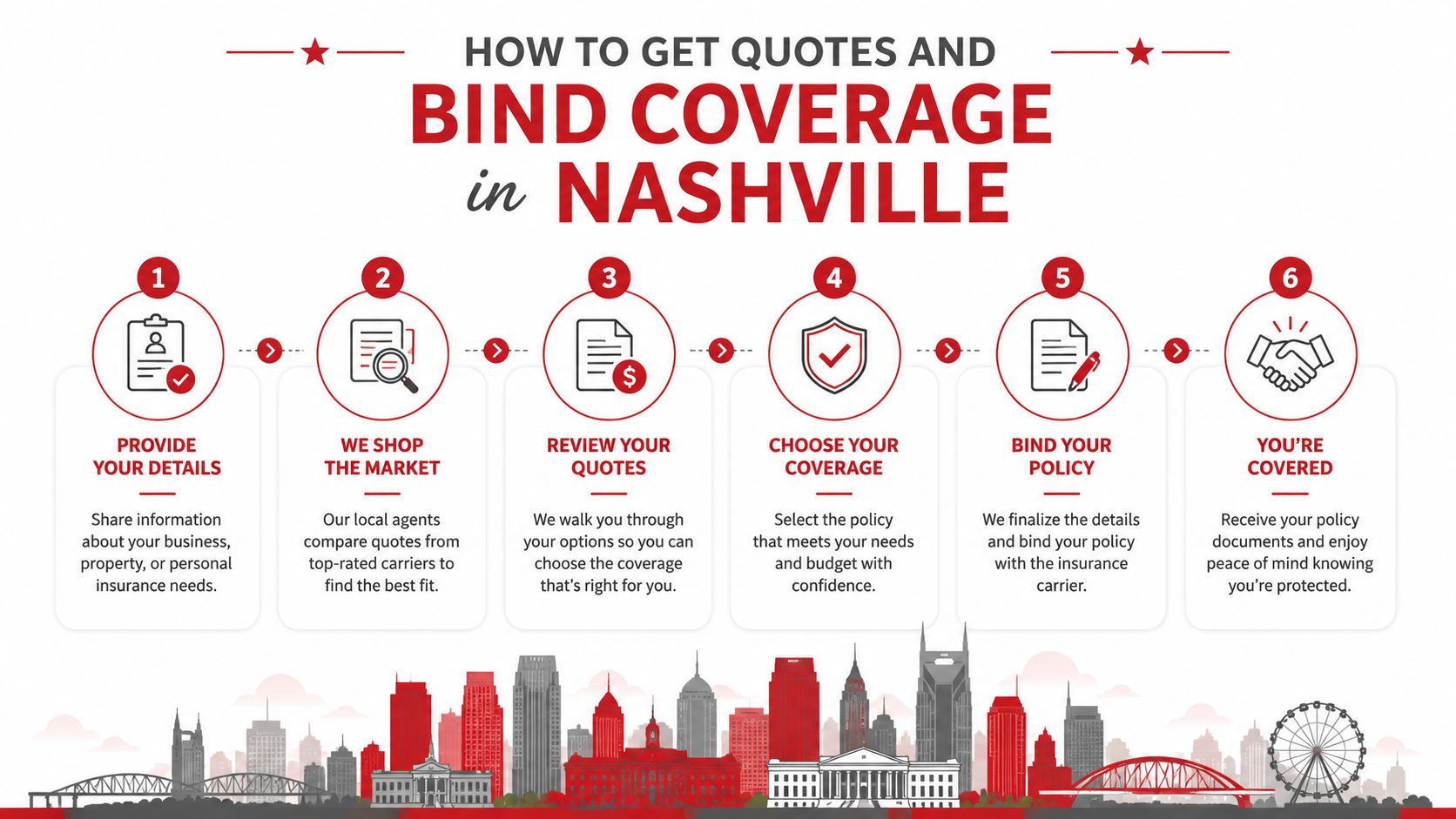
A good quote starts with accurate information, not a rushed request for a low number. Gather the business's legal name, locations, ownership details, operations description, annual revenue, payroll, employee duties, prior policy information, claims history, property details, vehicle schedules, driver information, and contract requirements.
A practical quote workflow
- Describe the work precisely. “Construction” is too broad for underwriting. Identify the trade, job types, percentage of subcontracted work, use of heights or heat, and where employees perform services.
- Separate payroll by duty. Classification errors can distort workers' compensation pricing and create audit problems.
- List every vehicle exposure. Include owned, leased, hired, and non-owned vehicles, along with vehicle use and driver details.
- Document the property. Share construction type, occupancy, protective systems, equipment values, inventory levels, and interruption needs.
- Collect contracts and certificates. Let the agent review the actual insurance wording requested by landlords, general contractors, lenders, or customers.
- Compare terms, not just premiums. Review limits, deductibles, exclusions, endorsements, valuation methods, audit provisions, and cancellation terms before binding.
Businesses often ask an independent agency to compare 20 to 40 carrier quotes, but the useful comparison depends on receiving consistent, accurate underwriting information. More options don't fix a poorly described operation.
Workers' compensation placement
Tennessee guidance describes roughly 400 licensed carriers writing workers' compensation and an assigned-risk backstop administered through NCCI for employers that can't place coverage in the voluntary market. The state's workers' compensation purchasing guide explains that structure.
Standard-market placement should come first. Accurate class codes, organized payroll records, documented safety procedures, and a credible loss-control plan can help an employer present a stronger account. Businesses with difficult loss histories or hard-to-place operations may face stricter administration and higher manual premiums in the residual market.
Binding and certificates
Before binding, confirm that the named insured, locations, vehicles, limits, deductibles, and endorsements are correct. After binding, request certificates only as evidence of existing coverage. A certificate can't expand the policy or replace the underlying contract language. For Tennessee quote support, businesses can also review commercial insurance quote assistance as part of their purchasing process.
Lowering Premiums and Managing Claims and Renewals
Premium control works best as an operating discipline, not a last-minute negotiation. Start by correcting the information insurers use. Keep payroll classifications current, update vehicle schedules promptly, and review property limits when equipment, inventory, or improvements change.
A BOP may simplify coverage for an eligible small business, but bundling only helps when the package matches the exposure. Deductibles can reduce premium, yet the business should choose an amount it can fund after a loss. A lower premium that creates an unaffordable claim response isn't a reliable saving.
Build evidence of safer operations
Written procedures are useful only when employees follow them. Maintain training records, vehicle inspection logs, driver policies, incident reports, equipment maintenance records, and jobsite checklists. For contractors, document subcontractor insurance and work controls. For restaurants and retailers, review floor conditions, fire protection, security, and employee training.
Vehicle telematics may help some fleets monitor driving behavior, but the business should connect any technology to a documented safety program. Insurers respond more meaningfully to consistent controls than to a promise to improve later.
Treat claims as part of underwriting
Report incidents promptly according to the policy instructions. Preserve photographs, invoices, witness information, employee records, contracts, and repair documentation. Don't admit liability or make broad payment promises before receiving appropriate guidance.
Begin renewal preparation well before the expiration date. A review conducted 60 to 90 days before renewal gives the business time to correct classifications, gather loss information, update property values, and approach carriers with documented risk controls. The aim is to protect future insurability while avoiding unnecessary coverage reductions.
How a Local Independent Agency Helps You Choose With Confidence
A local independent agency can compare coverage across multiple carriers and help align limits with Tennessee rules, Nashville contracts, and industry-specific exposures. Select Insurance Group, Inc. offers commercial coverage support, bilingual guidance, and tools for documents, payments, policy updates, and claims. Owners interested in the broader role of independent agencies can also read how an independent insurance agency works. Insurance offices are also using workflow technology to improve responsiveness, and this overview of how Recepta.ai helps insurance offices offers additional context.
Select Insurance Group, Inc. can help Nashville business owners review general liability, property, workers' compensation, commercial auto, trucking, and related coverage through a quote process built around the actual operation. Visit Select Insurance Group, Inc. to request a free, no-obligation quote and discuss the limits, contracts, and risk controls your business needs.