
A free insurance quote in Orlando is not a formality, it's the only sane way to shop a market where a full-coverage quote has been published at $247 per month, or about $2,942 per year, while liability coverage sits around $166 per month. In the same metro, another Orlando dataset put full coverage at $268 per month, or about $3,216 annually, and one ZIP code analysis showed a 39% price spread between Lake Nona and Parramore, with annual premiums ranging from $2,188 to $3,720. If you skip comparison shopping, you're volunteering to overpay.
For Orlando drivers and homeowners, the lesson is blunt. Your ZIP code, coverage level, and carrier choice change the price materially, and the cheapest-looking quote can turn expensive fast if the inputs aren't normalized. Florida's own rate-comparison history exists because the market is segmented, and shoppers need a clean way to see what's happening before they bind anything.
Table of Contents
- Why Orlando Drivers Pay Wildly Different Rates
- Gathering the Right Information Before You Request a Quote
- Channels for Requesting Your Free Quote from Select Insurance Group
- How to Compare Quotes Without Getting Misled
- Proven Ways to Lower Your Orlando Insurance Premium
- Next Steps to Bind Your Policy and Customize Coverage
Why Orlando Drivers Pay Wildly Different Rates
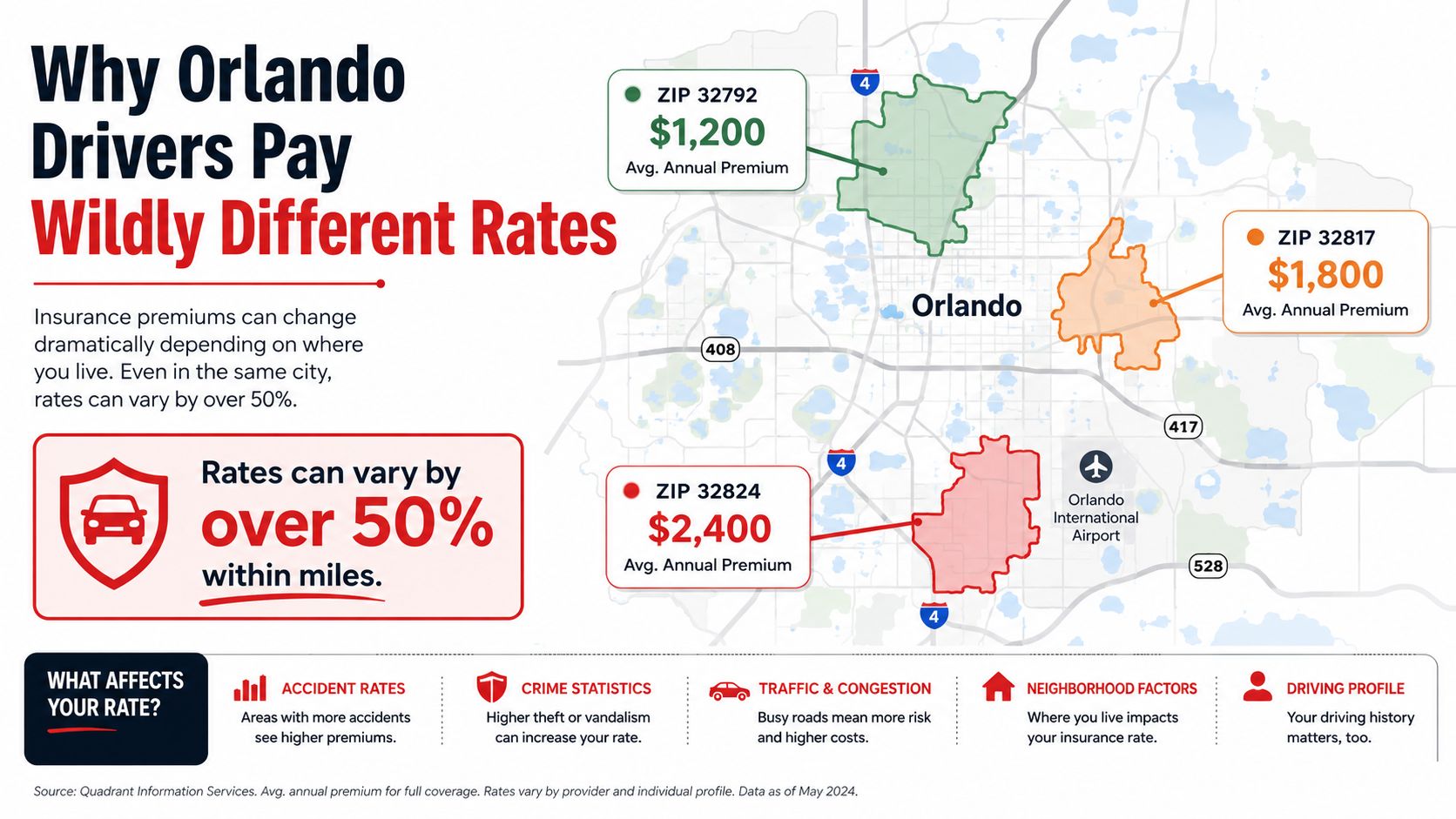
Orlando insurance pricing is uneven by design, because carriers don't price a city, they price risk factors inside a city. That's why a free insurance quote Orlando shoppers request can look completely different from one neighborhood to the next, even before a driver changes cars or coverage. One Orlando analysis found a 39% price spread between ZIP code 32832 in Lake Nona at $2,188 and ZIP code 32805 in Parramore at $3,720. That's not a rounding error. That's a budget problem.
ZIP code is not a minor detail
Your garaging address affects what a carrier thinks it might have to pay out. In Orlando, the gap between neighborhoods shows why “nearby” doesn't mean “priced the same.” If you live, work, or park in a different part of the metro, the quote can move.
Florida's state comparison tool exists for a reason. The Office of Insurance Regulation's CHOICES system lets shoppers compare automobile rates from multiple insurers in one place, using sample averages rather than a single-company pitch. The practical value is simple. It helps you tell whether a quote is wildly out of line before you spend time binding it. Florida's CHOICES rate-comparison tool is the historical marker here, because it reflects the state's push toward transparent shopping rather than one-company pricing.
Practical rule: If two quotes differ a lot, don't assume one agent “missed something.” Check the ZIP code, vehicle details, and coverage limits first.
Coverage level changes the story fast
The state benchmark matters too. In May 2026, Florida averaged $1,702 for minimum coverage and $2,730 for full coverage, while Orlando's full-coverage quote sat higher than the Florida city average of $207 per month reported by Experian. Those numbers tell you the same thing from different angles. Orlando often sits at or above an already expensive Florida baseline. Florida market benchmark from CHOICES and Orlando market snapshot.
That's why a free quote isn't a convenience feature. It's the entry point into a segmented market where one wrong assumption about coverage can distort the whole comparison. If you want a deeper local context, the pricing spread tracked in this Orlando auto insurance cost overview reinforces the same point.
Gathering the Right Information Before You Request a Quote
Bad inputs create bad quotes. That sounds obvious, but Orlando shoppers still fill out forms with missing vehicle data, inconsistent addresses, or half-finished policy details, then wonder why the binding price shifts later. If you want a reliable free insurance quote Orlando carriers can stand behind, prepare your information first.
What to have ready
Bring the basics before you start:
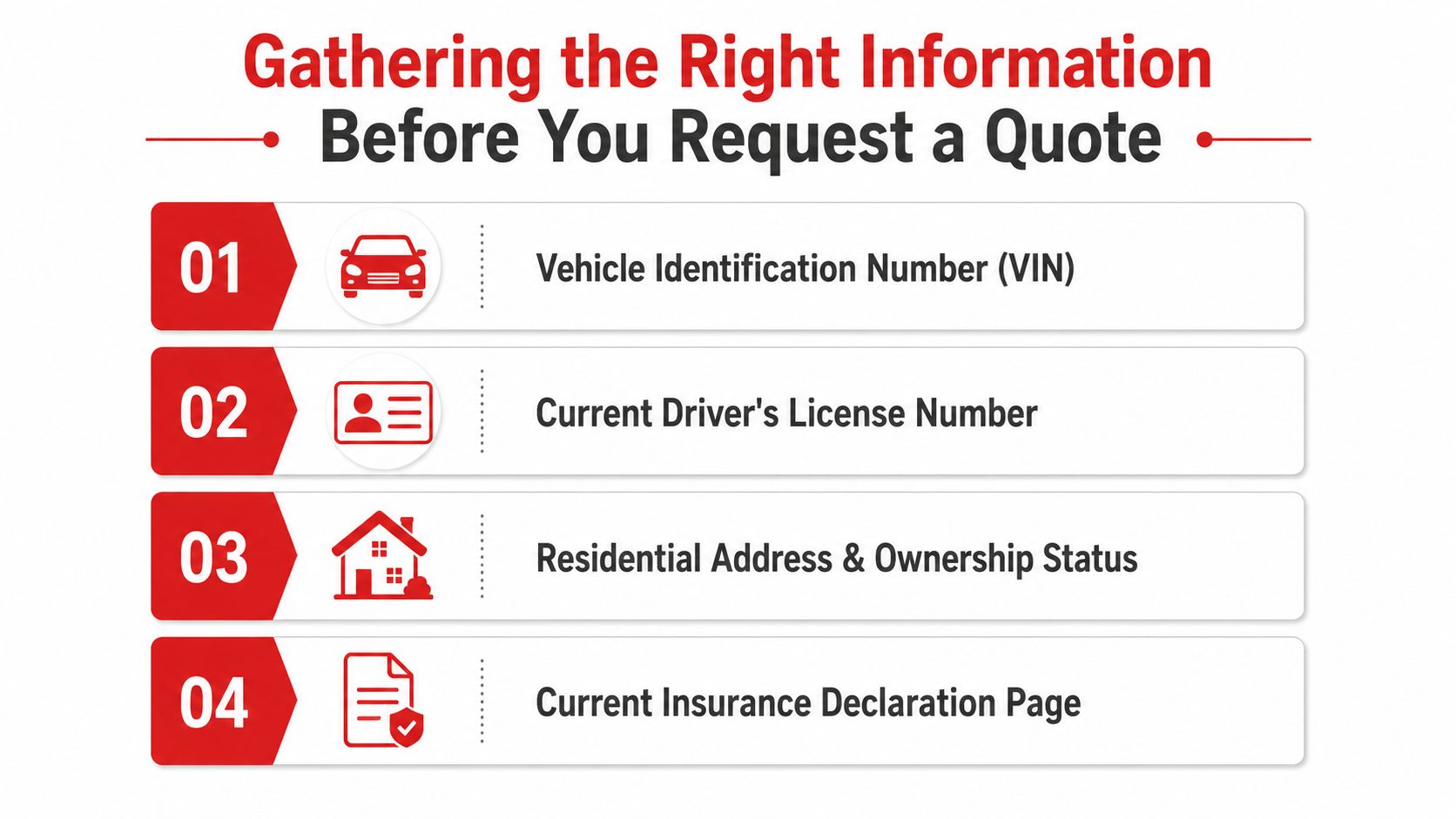
- Vehicle Identification Number, or VIN. This ties the quote to the exact vehicle, not a generic model.
- Current driver's license number. Carriers use it to verify driving history.
- Current declarations page. This shows your present coverage so the new quote can be compared on the same terms.
- Driving history. Accidents, tickets, and other underwriting details matter.
- Residential address and ownership status. Where the car is parked, and whether you own or rent, can affect the quote.
Direct advice: Don't guess. If you're unsure about a policy limit or vehicle detail, pull the document and copy it exactly.
The reason this matters is practical. Quote tools rely on core variables like ZIP code, vehicle details, age range, and contact information, so incomplete or inconsistent inputs can distort the first estimate and then shift later when the policy is bound. That's why document prep saves money. It also saves time.
Keep the data clean and keep your privacy tight
Accuracy matters, but so does data discipline. If you're using an anonymous or minimal-data quote flow, give only what's needed to get a usable estimate. Oversharing personal contact information can lead to extra follow-up calls, while still not improving the quote itself. The goal is simple. Get the estimate, not a pile of noise.
The Florida Office of Insurance Regulation also makes a useful methodological point through its CHOICES rate-comparison tool, which is built on three pre-defined model risk scenarios for sample average auto and homeowners rates by county. That makes it a benchmark, not a bindable quote. CHOICES methodology and benchmarking note
Channels for Requesting Your Free Quote from Select Insurance Group
You've got three practical ways to request a quote, and the right one depends on how complicated your insurance picture is. A single-car auto shopper can move quickly online. A household bundling auto and home usually does better with a human conversation. Orlando and Central Florida customers who want direct help can also work with a local office in person, which is still the fastest way to clear up coverage confusion.
Use the channel that matches your situation
Online works best when you want speed and a clean first look at pricing. Phone or text makes more sense when you need someone to untangle multiple vehicles, a home policy, or a coverage change that affects more than one line. In-person is the right move if you want face-to-face review, document help, or a tighter walkthrough of your options.
A single request can also open the door to multiple carrier options, because Select Insurance Group compares quotes from 20 to 40 leading carriers. That matters because one form doesn't have to turn into one offer. You can use one intake to get a broader read on the market.
What each contact path does well
- Online form: Best for quick shopping and first-pass comparisons.
- Phone or text: Best for questions, edge cases, and multi-policy situations.
- In-person visit: Best for clients who want direct guidance and document review.
If you want the agency overview, the local Orlando page at Select Insurance Group Orlando lays out the service footprint clearly. The point isn't to make the process complicated. It's to avoid forcing every shopper through the same channel when their needs aren't the same.
Operational rule: Don't start with the hardest channel. Start with the one that matches your complexity, then move to a human review if the quote needs cleanup.
The strongest quote process is the one that saves you from rework. If you submit complete information through the right channel the first time, the estimate is more useful and the final policy is less likely to surprise you. That's the advantage of working with a local agency that can move between digital, phone, and in-person support without making you repeat everything.
How to Compare Quotes Without Getting Misled
Getting several quotes is useful only if the inputs match. Otherwise, you're comparing different products and pretending the numbers mean the same thing. That mistake is common in Orlando because small changes in deductibles, liability limits, and coverage tiers can swing the price enough to make a quote look cheaper when it really isn't.
Start with a benchmark, then standardize the quote
Use a county-level benchmark to sanity-check whether a quote is way above or below the market. The Florida CHOICES tool is built for that purpose, since it produces sample averages, not personalized premiums. It's not meant to bind coverage, and it won't capture vehicle-specific or driver-specific factors like garaging address, claim history, or chosen limits. CHOICES rate-comparison search
Once you have that benchmark, make the carriers quote the same thing. Match the deductible. Match the liability limits. Match the coverage type. If one quote has lower limits or a higher deductible, it isn't cheaper in a meaningful sense. It's just thinner.
Orlando Auto Insurance Rate Snapshot
| Coverage Type | Orlando Monthly Average | Florida Statewide Average |
|---|---|---|
| Full coverage | $247 | $2,730 annually statewide |
| Liability coverage | $166 | $1,702 minimum coverage statewide |
The table shows why quote normalization matters. A monthly number by itself can mislead you, and a statewide benchmark can't replace a like-for-like comparison. One market snapshot put Orlando's full coverage at about $247 per month, while the state's full-coverage average in May 2026 was $2,730. Those figures belong in the same conversation, but not in the same pile of assumptions. Orlando market snapshot and Florida statewide benchmark
Watch the hidden comparison traps
A quote that looks cheaper can hide a different deductible, a different liability limit, or a narrower protection package. That's why the cleanest comparison starts with a script, not a sales pitch. Use the same vehicle, the same garaging address, the same drivers, and the same coverage structure on every quote request.
Bottom line: If the inputs aren't identical, the comparison isn't real.
For a broader multi-carrier shopping process, the agency's 40-carrier quote approach is worth understanding because it helps frame the market search around options, not assumptions. The win is not just getting more quotes. It's getting quote lines that mean something next to each other.
Proven Ways to Lower Your Orlando Insurance Premium
If your goal is to cut the final premium, don't start by asking for a miracle. Start by stacking the discounts and coverage choices that carriers reward. Orlando shoppers can lower costs by bundling, raising deductibles, using safe-driving programs, and asking about discounts that fit the household, not just the vehicle.
Use the discount levers that actually move the number
Bundling auto and home is usually the first place to look because it consolidates more than one policy under one roof. Telematics can reward safer driving habits when the carrier offers it. Higher deductibles can reduce the monthly premium, but only if you can comfortably absorb the out-of-pocket hit later. Good-student and defensive-driving discounts can also matter when the household qualifies.
These are not abstract ideas. Another Orlando market analysis reported that telematics plus bundling reduced annual costs by an average of $532. That doesn't mean every shopper gets the same result, but it does show why discount strategy matters in a city where premiums are already high. Orlando pricing analysis
Match the coverage to the life stage
People overpay when they keep old coverage on a situation that has changed. A car sitting in storage doesn't need the same setup as a daily commuter. A deployed driver or someone between major vehicle changes may need a temporary coverage adjustment. A homeowner with a new roof, a new alarm system, or a different occupancy pattern should ask whether the policy still fits the risk.
Ask the carrier what it rewards, not what it advertises.
If you want a practical framework for trimming a premium without wrecking the policy, the strategies for lower premiums resource is a useful way to think about deductible choices, usage changes, and discount hunting. Use it as a checklist, not as a substitute for a proper quote review.
Select Insurance Group, Inc. also fits into this part of the process because it compares quotes from multiple carriers and can surface carrier-specific discounts that a generic form may miss. That matters when a price gap is caused by a detail you wouldn't spot on your own. The right question is not, “Who can quote me?” It's, “Who will compare the options correctly?”
Next Steps to Bind Your Policy and Customize Coverage
Once you have a quote you trust, stop shopping and review the details line by line. Binding should be a decision, not a reflex. Look at the deductible, the liability limits, the vehicle list, and any home or multi-policy changes before you authorize anything. If something looks off, fix it before payment, not after.
Finalize the file cleanly
At binding time, keep the paperwork close. You'll usually need the documents that match the quote, plus whatever the insurer asks for to activate the policy and set up payment. Secure online tools are useful here because they let you upload documents, manage payments, and update the policy without dragging the process into a long back-and-forth.
Many local offices also offer complimentary notary services, which is handy when paperwork needs an extra layer of verification. Bilingual support is another practical advantage for Spanish-speaking customers who want to talk through the quote before they commit. The goal is simple. Make the policy match the conversation you already had.
When life changes, revisit the policy. A vehicle purchase, a home change, or a major family change can shift what coverage makes sense. If you've gone through a divorce, a separate post-divorce insurance policy guide can help you think through how that kind of change affects insurance needs.
Best practice: Recheck coverage at renewal and after any major change, because a policy that fit six months ago can be wrong today.
Orlando shoppers don't save money by guessing. They save money by quoting carefully, comparing cleanly, and binding only after the numbers make sense. If you want that done with local support, Select Insurance Group, Inc. offers free, no-obligation quote help by phone, text, online, and in person across Central Florida. Visit Select Insurance Group, Inc. to request a quote and get your coverage reviewed before you buy.