
You can move a family from Florida to North Carolina, or expand a contractor's fleet from Georgia into Tennessee, and the first thing that breaks is usually the insurance. The policy looked fine on paper, the renewal came and went, and then somebody notices the carrier doesn't really understand the new state, the old agent can't service the account cleanly, or the paperwork no longer matches how the business operates. That's the difference between a shop that merely sells insurance in several states and a multi state insurance agency that's built to handle the work.
Table of Contents
- Why Your Insurance Needs Change When You Cross State Lines
- What Makes an Agency Multi State
- Benefits and Limitations of Multi State Insurance Agencies
- State by State Insurance Considerations Across the Southeast
- How to Vet a Multi State Insurance Agency Before You Commit
- Serving Spanish Speaking Customers and Commercial Clients Across State Lines
- Your Next Steps for Getting Multi State Insurance Coverage
Why Your Insurance Needs Change When You Cross State Lines
A homeowner who leaves Florida for North Carolina usually thinks the move is about schools, mortgage rates, or a shorter commute. Then the insurance questions show up. The new house sits in a different wind and water environment, the policy language changes, and the old quote that looked competitive in one market can stop being a good fit in the next.
That same problem hits business owners even harder. A trucking company that starts running regular lanes from Georgia into Tennessee can't treat the policy as a static document, because the vehicle, the driver, and the operating territory all matter when the account is being written and serviced. State rules shape what coverage is available, how it's issued, and how it's monitored, so crossing a border often means the insurance has to be reworked, not just renewed.

The hard truth about state lines
Insurance is state regulated, and that means the legal minimums, policy wording, and compliance expectations can differ from one jurisdiction to the next. A policy that worked in one state doesn't automatically satisfy another state's rules, especially when the customer's risk changes from a single location to multiple residences, job sites, or vehicle routes.
For agencies, that's why geography matters. The U.S. independent agency channel wrote 61.5% of all property/casualty direct premiums in 2024 and wrote 87.2% of commercial lines and 39.0% of personal lines in the same year, according to the Big “I” market share report cited in the verified data. That matters because buyers who want access to several carriers usually need an agency that can compare options across markets, not a single-carrier relationship that stops at the state border. The same report also shows $1.05 trillion in property/casualty direct written premium in 2024, up from $952 billion in 2023, a 9.6% year-over-year increase driven by hard-market conditions, which is exactly the kind of environment where broader carrier access becomes valuable.
Practical rule: if a move, a new route, or a second state changes the risk, the policy should be reviewed as if it were a new placement, not a routine renewal.
A true multi state insurance agency exists to solve that problem. It doesn't just advertise across state lines, it has the licensing, carrier access, and operating discipline to keep the account compliant and competitive after the move is complete.
What Makes an Agency Multi State
A multi state insurance agency has to do more than say it serves several states. It needs the licensing, carrier appointments, and operating controls to place coverage legally where the customer lives or does business. If an agency cannot prove that on paper, it is just marketing across state lines.
Licensing and carrier access are the baseline
Each state handles producer licensing and appointments under its own rules. The verified data is clear that multi-state compliance is a data-engineering problem, because policy language, producer licensing, premium tax, and surplus-lines requirements can vary by jurisdiction. A proper system needs state-specific language libraries, real-time producer license validation, premium tax engines that handle 51 jurisdictions, and direct integration with SERFF and state licensing databases.
That is a processing problem first. The same data also notes that premium allocation engines must split written premium by state using approved methods such as exposure or payroll allocation, then reconcile each state's share back to the policy total for tax remittance and auditability. If an agency cannot explain that workflow in plain English, it is guessing.
Operations should be unified, not scattered
A legitimate multi-state shop does not let every office invent its own process. The highest-impact control is a single, unified agency management stack across offices, because that eliminates duplicate licenses, supports cross-office reporting, and creates one shared data layer for performance management. In the industry analysis provided, AMS consolidation across office groups typically takes 6 to 12 months per batch of offices and is associated with a 15 to 25% reduction in processing costs, according to the industry analysis provided, with a rollout sequence that starts with standardized communications, then centralized finance, then AMS migration, and finally CRM and BI unification.
A restaurant chain does not run one health standard in one city and a different standard two states away. Each location follows the local rules, and management keeps those rules visible. Insurance works the same way.
A multi-state agency is defined by whether its licenses, carrier appointments, and workflow controls can survive a compliance audit.
For Southeast customers, that difference matters in a practical way. You want an agency that can show active authority where you live, can place the line with carriers that write in your state, and can keep service consistent after you relocate or add a business location.
Benefits and Limitations of Multi State Insurance Agencies
The biggest benefit of a multi state insurance agency is simple. You get one place to manage insurance even when your life or business spans several states. That's useful for a family with a primary home in one state and a second property in another, and it's even more valuable for a company with vehicles, employees, and job sites moving across state lines.
What you gain when the agency is built right
A strong multi-state agency usually gives you broader carrier comparison, smoother relocation handling, and one point of contact for personal and commercial lines. That means a homeowner's policy, an auto policy, a renters policy, a commercial auto account, and a general liability placement can all be managed under one roof instead of being scattered across several offices. For bilingual households, it also means service can be handled in a way that reduces confusion during quoting, policy changes, and claims.
The upside is continuity. When a family moves from one Southeast state to another, the agency already knows the account, the drivers, the property, and the renewal rhythm. When a business expands routes or opens a branch, the agency can keep the file moving instead of making the owner re-explain everything from scratch.
What the trade-offs look like
The limitation is just as real. Not every carrier writes in every state, so the quote set can narrow depending on where the risk sits. Some niche risks need surplus-lines placement, and an agency that hasn't centralized operations can still be slow even if it has licenses everywhere.
Buyers should be honest with themselves. If you need highly local knowledge for a very specific niche exposure, a small specialist might be the better fit. If you need consistent service across multiple states, a central platform, and a wider carrier conversation, the multi-state model wins.
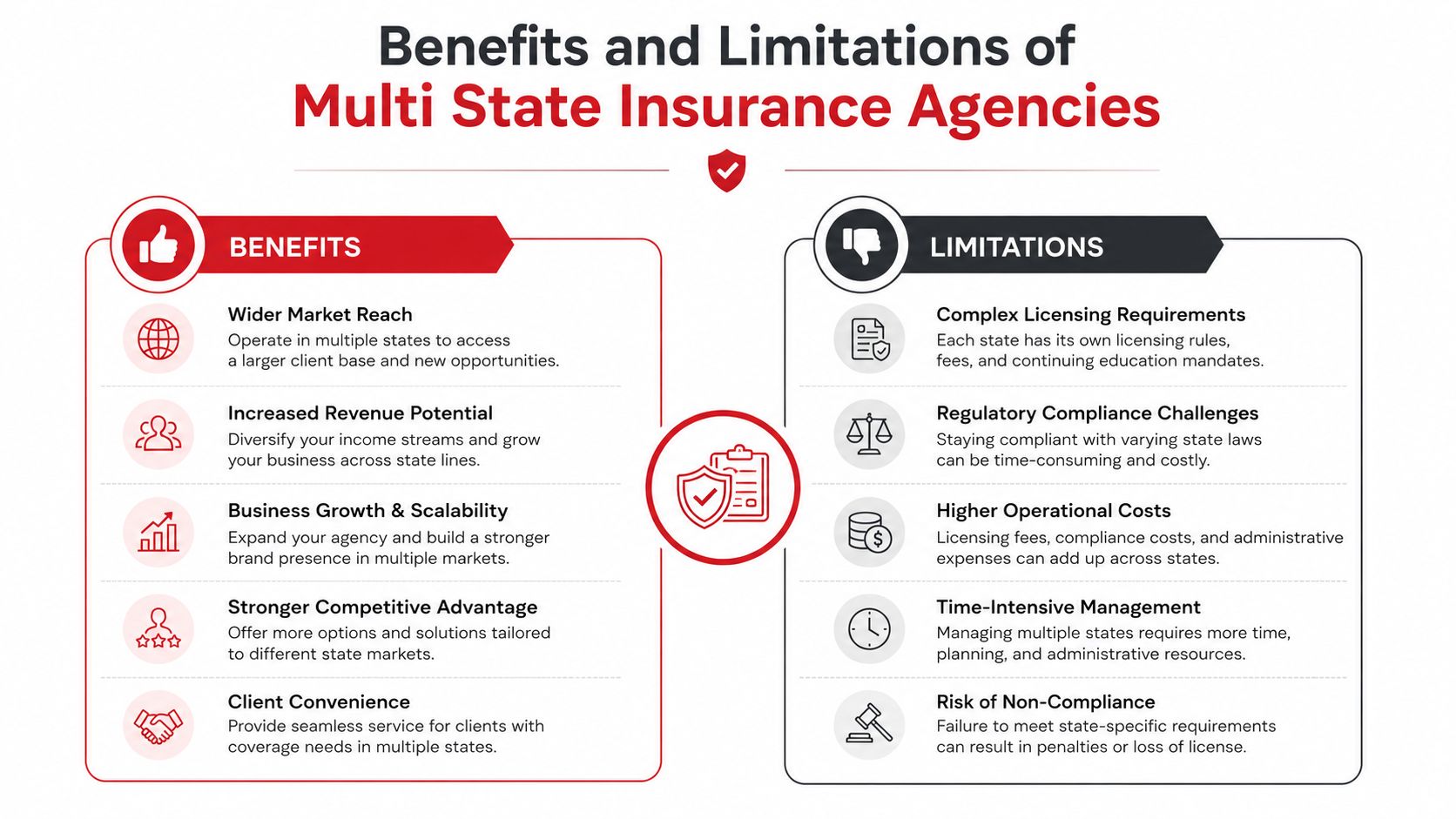
Bottom line: more states can mean more options, but only if the agency has the systems to service those options without creating confusion.
The best agencies don't oversell themselves. They tell you where they're strong, where the carrier market is thin, and when a placement will need a harder look because of state-specific rules or unusual exposure.
State by State Insurance Considerations Across the Southeast
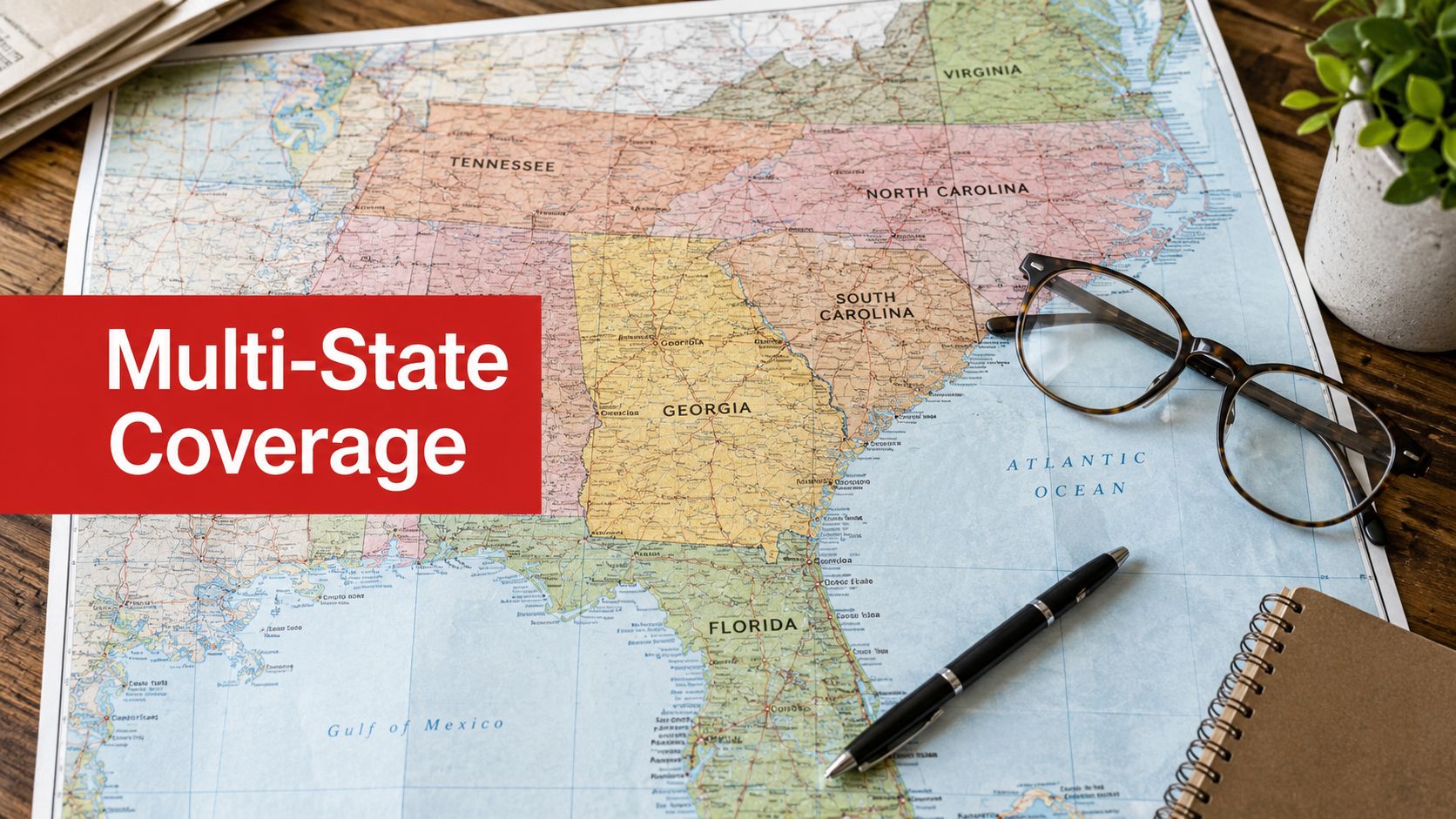
The Southeast is not one insurance market. Alabama, Florida, Georgia, North Carolina, South Carolina, Tennessee, and Virginia each come with their own pricing pressures, underwriting habits, and service realities. A multi state insurance agency has to treat each state as its own operating environment, not as one big regional bucket.
The Southeast state snapshot
| State | Key Consideration | Coverage Priority |
|---|---|---|
| Alabama | Keep liability and property limits aligned with local risk and carrier appetite | Auto, homeowners, and small business liability |
| Florida | Wind, hurricane, and flood exposure can change the whole conversation | Homeowners, flood, and commercial property |
| Georgia | Coverage needs often shift when drivers and vehicles move frequently across state lines | Auto, commercial auto, and uninsured motorist protection |
| North Carolina | State-specific pricing and underwriting review matter more than most buyers expect | Auto and homeowners |
| South Carolina | Coastal and inland risks can differ sharply | Homeowners, commercial property, and auto |
| Tennessee | Multi-state routing and fleet operations need tight policy coordination | Commercial auto, trucking, and liability |
| Virginia | Multi-location households and businesses need clean recordkeeping and renewal control | Personal lines, commercial auto, and business packages |
Florida deserves special attention because wind and water can reshape both underwriting and claims handling. A homeowner who has lived inland for years may need a very different conversation after moving closer to the coast. Georgia and the Carolinas bring their own carrier appetites and pricing dynamics, so the agency has to shop smart instead of assuming one quote set fits everywhere.
Commercial drivers and fleets need tighter control
For business clients, interstate travel changes more than the route sheet. Commercial auto, trucking, and workers' compensation all need to match where people work and drive. That's why fleet managers should care about fleet efficiency strategies, because the cleaner the fleet operation, the easier it is to align insurance with real-world vehicle use.
A good Southeast agency also knows when a client's needs are better handled by a state-specific commercial desk. The internal page on commercial insurance in the Southeast reflects the kind of localized approach buyers should expect from a serious operation.
If the agency can't explain the state difference in plain English, it probably doesn't understand the market well enough to place it correctly.
Don't accept generic “we cover the Southeast” language. Ask how the agency handles Florida water exposure, North Carolina pricing review, Georgia driver changes, and business accounts that run across several jurisdictions.
How to Vet a Multi State Insurance Agency Before You Commit
Before you sign anything, verify the basics yourself. Ask for proof of active licensing in your state, then ask how the agency handles producer appointments and renewals. If they cannot answer quickly and clearly, keep looking.
The questions that actually matter
Use this checklist on the quote call:
- State License Check: Confirm the agency is licensed where you live or operate, not just where its headquarters sits.
- Carrier Access: Ask how many carriers they can quote in your state and whether they can compare options across personal and commercial lines.
- Unified Workflow: Find out whether your account lives in one system or gets handed off between offices with separate processes.
- Claims Handling: Ask how they support claims when your vehicle, property, or business operation crosses state lines.
- Renewal Control: Ask what happens if you move, add drivers, open a new location, or change vehicles.
- Commercial Experience: If you need business coverage, ask for examples of how they handle fleets, contractors, or trucking accounts.
- Language Access: If you need bilingual service, confirm that you can speak with someone who can help, not just translate a sales pitch.
That is also where skepticism pays off. If an agency makes big claims about discounts or “special access,” read up on how to spot insurance fraud before you hand over personal information or payment details. Good agencies welcome hard questions because they know a real policy stands up better than a flashy promise.
One local test for real competence
Ask how the agency handled a recent interstate move or a business expansion across state lines. You are not looking for a sales story, you are looking for process. If they can describe the workflow clearly, they probably have one.
The internal guide on what is an independent insurance agency helps here, because independence is what usually gives an agency the carrier access and flexibility to work across several states without locking you into one company's narrow rules.
Practical rule: if the agency sounds vague on licensing, carrier access, or claims support, it is not ready for multi-state work.
Serving Spanish Speaking Customers and Commercial Clients Across State Lines
Spanish-speaking families in the Southeast shouldn't have to guess what their policy says. If the agency can't explain deductible language, claim steps, or renewal changes in a way the client fully understands, the service isn't good enough. Bilingual support is not a nice extra, it's part of doing the job correctly.
That's why neighborhood-level service matters so much in places like Central Florida and the Carolinas. A local office can answer questions face to face, by phone, or by text, and that often beats a national call center when the customer needs a decision now. For readers who want a practical example of that kind of access, a bilingual insurance agent in Florida is exactly the sort of resource that can keep the conversation clear when the policy language gets technical.
Commercial accounts need more than a quote
Fleets, contractors, and trucking operations have a different problem. Their vehicles, crews, and jobs don't stay in one zip code, and the insurance has to follow them without falling apart at the seams. That means commercial auto, general liability, property, workers' compensation, and trucking coverage all need to be handled with the same discipline, especially when operations cross state lines every week.
A captive agent or an online-only setup can miss the operational detail that matters most. If the carrier panel is thin or the service team can't coordinate state-by-state issues, the account turns into a patchwork. That's a bad way to run a business and an even worse way to protect one.
**Good multi-state service is part language access, part carrier access, and part operational discipline. Miss any one of those and the customer feels it fast.
Select Insurance Group, Inc. fits that model in a practical way because it serves Alabama, Florida, Georgia, North Carolina, South Carolina, Tennessee, and Virginia, compares quotes from multiple carriers, and offers bilingual specialists for customers who need clearer communication. That's the kind of structure Spanish-speaking households and interstate businesses should demand.
Your Next Steps for Getting Multi State Insurance Coverage
Begin by gathering your current policy documents before shopping for anything new. Pull together your declarations pages, driver list, property addresses, business locations, and any recent changes in where you live or operate. Then ask a qualified agency to compare the account against the states you need covered, not just the state shown on the old paperwork.
A serious multi state insurance agency should show you carrier options, spell out the state-by-state differences, and tell you where the risk is straightforward and where it needs more attention. If you are dealing with a Florida property issue, this resource on water damage claims in Florida is a useful reminder that home coverage details matter a lot more once weather and water enter the picture.
Your move is straightforward.
- Collect your policy documents.
- Ask for a no-obligation quote comparison.
- Use the vetting questions before you commit.
The questions that matter
Ask how the agency handles licensing, carrier appointments, and service in the states where you need protection. In the Southeast, that means knowing whether they can handle Alabama, Florida, Georgia, North Carolina, South Carolina, Tennessee, and Virginia without sending you in circles when a claim, endorsement, or renewal crosses state lines.
You also need to know how they serve bilingual households and commercial clients. If the team cannot explain coverage clearly in plain language, or if they only look good on the website but fall apart once the file gets complicated, keep moving. A true agency works the account, not just the quote.
If you want insurance handled by people who work across state lines every day, Select Insurance Group, Inc. offers independent quote comparison, bilingual support, and service across the Southeast for drivers, homeowners, and business owners. Visit Select Insurance Group, Inc. and ask for a review of your current coverage before the next renewal catches you off guard.