
You're sitting at the kitchen table in Charlotte, staring at a renewal notice that jumped again. The number feels too high, especially if you're comparing it to what somebody pays in a smaller town, but this market doesn't run on small-town math. Charlotte NC auto insurance has become a coverage decision, not just a price-shopping exercise, and the July 2025 rule change made that even more true.
If you drive in Charlotte, the right question isn't “How do I buy the cheapest policy?” It's “How do I buy enough protection in one of North Carolina's priciest urban auto markets without paying for fluff I don't need?” That's the lens that matters now, because the city's base rates, crash exposure, and minimum-coverage habits all push in the same expensive direction.
Table of Contents
- Why Charlotte Drivers Need a Different Approach to Auto Insurance
- North Carolina's Auto Insurance Requirements and What Just Changed
- Average Auto Insurance Costs for Charlotte Drivers
- The Local Factors That Push Charlotte Premiums Higher
- Discounts Charlotte Drivers Can Stack to Lower Costs
- How to Compare Charlotte Auto Insurance Quotes the Right Way
- Common Mistakes That Cost Charlotte Drivers Real Money
- Get a Charlotte NC Auto Insurance Quote That Actually Fits
Why Charlotte Drivers Need a Different Approach to Auto Insurance
A lot of Charlotte drivers get the same rude awakening at renewal. The policy looked fine last year, then the new number arrives and it's up a few hundred dollars, while a friend in a smaller North Carolina city swears they pay far less for similar cars. That isn't your imagination, and it isn't just bad luck.
Charlotte is consistently treated as a high-cost urban insurance market. Independent data puts the city above the North Carolina average and above the national norm, with Experian showing $2,017 per year for Charlotte versus $1,935 statewide, and NerdWallet showing $1,964 per year for Charlotte versus $1,793 statewide. Other market snapshots run higher still, which tells you the issue isn't a single quote, it's the way the city is priced overall. Experian's North Carolina auto insurance data and NerdWallet's Charlotte analysis both point in the same direction.
This market punishes lazy shopping
The usual “cheap car insurance” article misses the point. In Charlotte, the difference between a decent policy and a weak one is often hidden in the limits, deductibles, and uninsured motorist protection, not just the premium line. That matters more now because a large share of local drivers still carry only minimum coverage, and the state's minimums changed in 2025.
Practical rule: In Charlotte, don't shop for the lowest payment first. Shop for the right coverage, then cut waste with discounts and carrier comparison.
The practical takeaway is simple. If you treat auto insurance like a commodity, Charlotte will punish you. If you treat it like risk management, you can still control cost, but you do it by making smarter coverage choices, not by blindly chasing the cheapest number.
North Carolina's Auto Insurance Requirements and What Just Changed
Charlotte drivers who are still thinking in old minimums are already behind. North Carolina used to allow a lower legal floor, and a lot of policies were built around that older setup. Before July 1, 2025, the state minimum liability limits were $30,000/$60,000 bodily injury, $25,000 property damage, and $30,000/$60,000 uninsured motorist coverage. After that date, the minimums rise to $50,000/$100,000 bodily injury and $50,000 property damage. The Select Insurance Group's North Carolina auto insurance requirements guide lays out the change plainly.
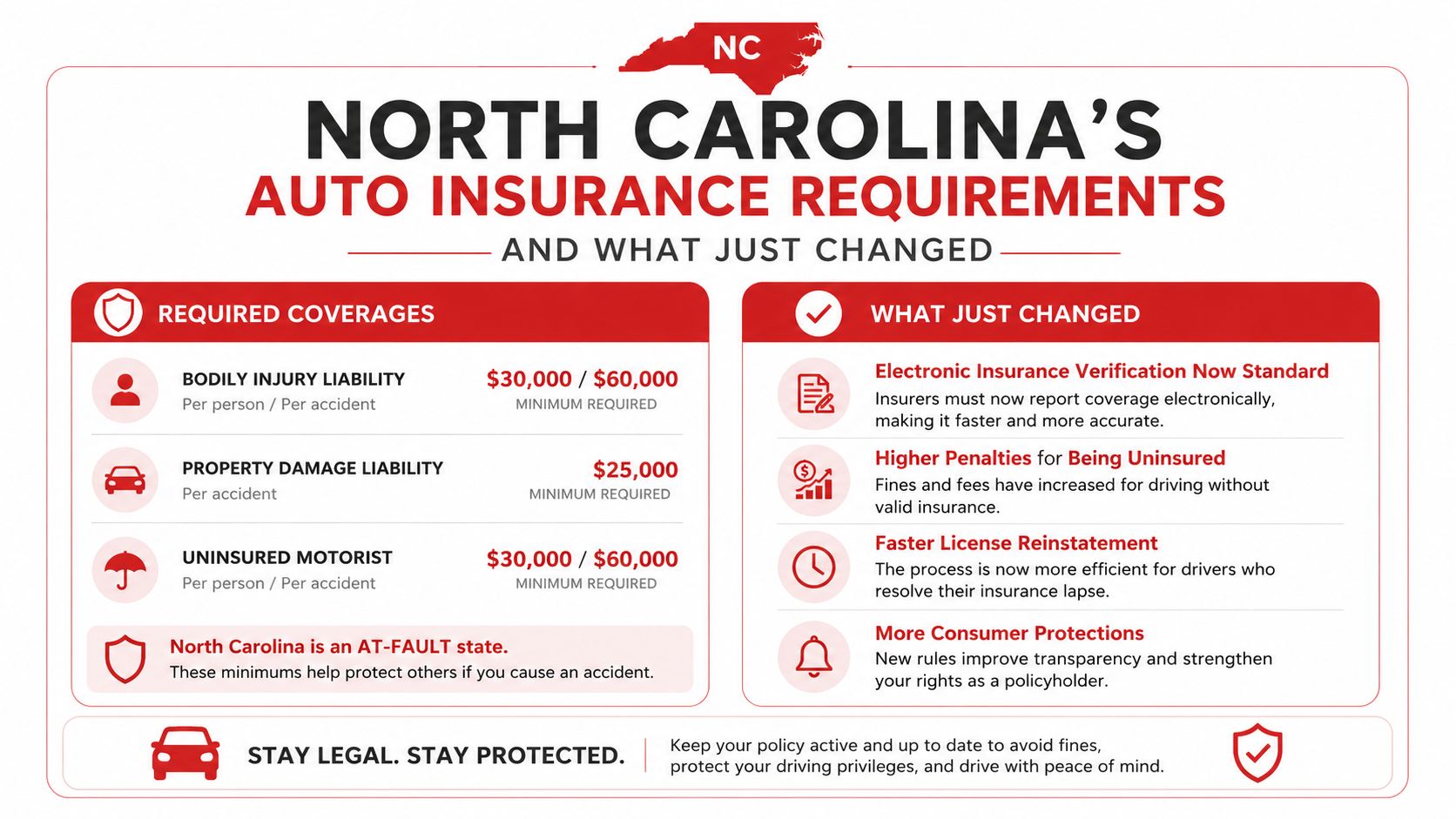
The new floor changes the meaning of “cheap.” A bare-bones policy only works if the crash is small, clean, and uncomplicated. That is a weak bet in Charlotte, where traffic is dense and crash exposure is part of daily driving.
What uninsured motorist coverage is doing for you
Uninsured motorist coverage matters because a wreck is not always an even exchange of insurance information. The Insurance Information Institute, as cited in the brief, says about 1 in 10 drivers in North Carolina are uninsured. If one of them hits you, your own protection matters a lot more than the other driver's promise to pay. Select Insurance Group's Charlotte guidance on state minimums and uninsured motorist coverage explains why this issue hits Charlotte drivers so hard.
Newer drivers face another cost driver as well. The inexperienced-operator surcharge can now last up to eight years for drivers first licensed on or after July 1, 2025, according to NC DOI's July 1, 2025 rating changes. That matters for younger households and for parents who are trying to keep a new driver insured without getting squeezed every renewal cycle.
A crash on I-77 makes the point fast. If you are dealing with a multi-car wreck and a hospital bill, minimum coverage can disappear quickly. The new limits are better than the old ones, but they still do not make a thin policy a smart choice for an urban driver with real exposure.
Average Auto Insurance Costs for Charlotte Drivers
Charlotte pricing makes more sense when you stop hunting for a single “true” number. Different datasets use different coverage assumptions, so the city shows a range instead of one neat figure. The pattern is clear, though, Charlotte sits above the state average in the sources that matter here.
| Source | Charlotte Average | NC State Average |
|---|---|---|
| Experian | $2,017 per year | $1,935 per year |
| Insurance.com | $2,647 per year | Not provided in the brief |
| Insure.com | $2,647 per year | Charlotte is $60 above the state average |
| Insurify | $122 per month for full coverage, $82 per month for liability coverage | Not provided in the brief |
| NerdWallet's Charlotte pricing analysis | $1,964 per year | $1,793 per year |
That spread tells you two things. Charlotte is not a bargain market, and the price you see depends heavily on how much protection you ask for. The city's structural cost shows up in every serious pricing review.
Read the range, not the headline
Charlotte's numbers vary because the market reacts to coverage assumptions, driver profile, and where the car is garaged. That is the point to focus on. The market is expensive enough that small rating differences matter.
Bottom line: If two quotes look close on price, take the policy with stronger limits and the right deductibles. In this city, cutting coverage to shave a few dollars usually costs more later.
Insurify's liability and full-coverage figures show the tradeoff plainly. Leaner coverage and fuller protection are priced differently for a reason, and in Charlotte that difference often buys real risk reduction. For a broader look at where prices run lower in the state, Select Insurance Group's page on where North Carolina insurance is least expensive is a useful reference, because Charlotte sits on the expensive end of the market.
The Local Factors That Push Charlotte Premiums Higher
Charlotte prices aren't high by accident. They're high because the city has the exact ingredients insurers price conservatively, dense traffic, more claims, more severe losses, and more drivers who aren't carrying enough coverage of their own. When those factors stack up, your quote reflects the whole environment, not just your driving record.
A big piece of that picture is crash frequency. Insurify reports that Charlotte sees about 82 car accidents per day, and that kind of daily exposure drives loss costs up across the city. Add in the state-level uninsured driver problem, about 1 in 10 drivers in North Carolina are uninsured per the Compare.com citation to the Insurance Information Institute, and you've got a market where your own coverage matters more than in a low-risk rural area.
Your driving record can multiply the pain
North Carolina's Safe Driver Incentive Plan makes violations expensive fast. The state schedule shows that 8 points can raise a $300 base premium to $885, 10 points to $1,080, and 12 points to $1,320. That's a huge jump off a small base, and it's the clearest proof that violations don't just add annoyance, they reshape long-run insurance cost. NC DOI's Safe Driver Incentive Plan lays out those surcharge levels.
Charlotte drivers also face a weather-risk stack that gets underplayed too often. Storms, hail, flooding, and parked-car damage all raise the appeal of collision and full coverage, especially if you commute in dense ZIP codes or leave your car outside. The point isn't to scare you into buying everything. It's to recognize that urban property damage risk is part of the price here.
A clean record helps, but in Charlotte it doesn't erase the local loss environment. It just keeps you from compounding it with points, surcharges, and avoidable claims.
The fix is part discipline, part strategy. Avoid chargeable violations, review whether your current limits fit a city with heavy traffic, and use discount stacking to offset the cost. That's how you push back against Charlotte pricing without underinsuring yourself.
Discounts Charlotte Drivers Can Stack to Lower Costs
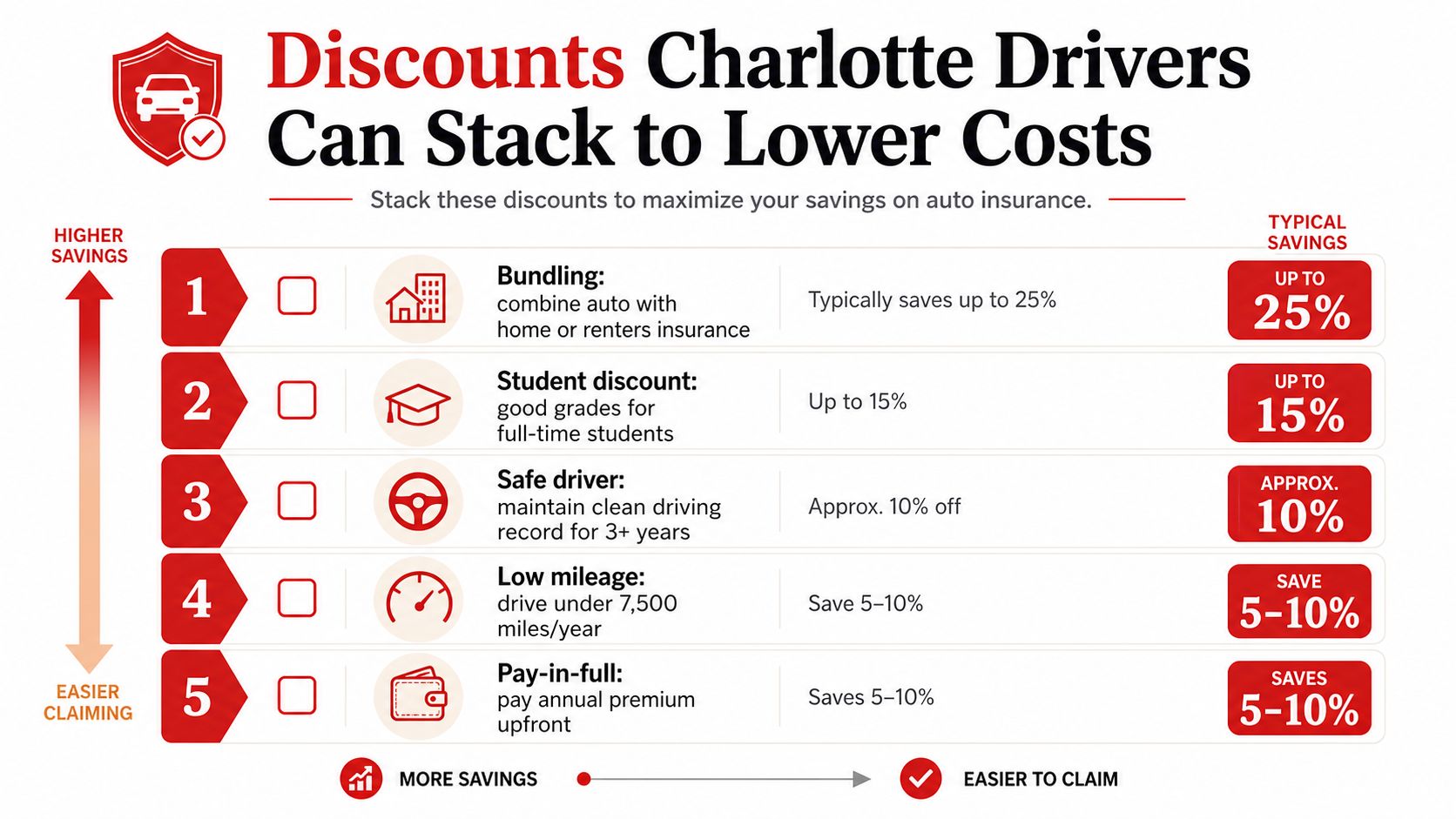
Discounts matter in Charlotte, but only if you treat them like a stack instead of a wish list. One small discount won't rescue a bad policy, and a big discount on a weak coverage form still leaves you exposed. The money is in combining multiple savings opportunities across one quote or across several carriers.
Start with the discounts that usually create the most room. Bundling auto with home or renters insurance is often the biggest lever, and lower-mileage discounts can help remote workers or commuters who don't rack up much annual driving. Good students, defensive driving course completions, paperless billing, pay-in-full arrangements, and clean-record discounts can all chip away at the premium too.
Ask for the combinations, not just the list
The mistake most drivers make is asking whether a discount exists instead of asking how it interacts with the rest of the policy. A carrier might be generous on bundling and weak on telematics, while another does the opposite. In Charlotte, that difference can matter more than a single advertised discount.
Here's the checklist I'd use on every call:
- Bundling: Ask how much the premium drops if you combine auto with home or renters coverage.
- Multi-vehicle: Check whether every car in the household qualifies for a shared discount.
- Safe driver or telematics: Ask how the carrier rewards a clean record or measured driving.
- Pay-in-full and paperless billing: Small savings can add up when they're both available.
- Driving courses and student discounts: Make sure any qualifying household member is counted correctly.
- Low-mileage use: Remote work, school commutes, and second-car status can matter.
An independent agency earns its keep here because it can compare several carriers in one conversation and model the combinations instead of guessing. Select Insurance Group is one option in that space, and the useful part is the comparison process, not the sales pitch. The goal is to make sure the discount stack matches the way you drive, not the way a generic quote form assumes you drive.
How to Compare Charlotte Auto Insurance Quotes the Right Way
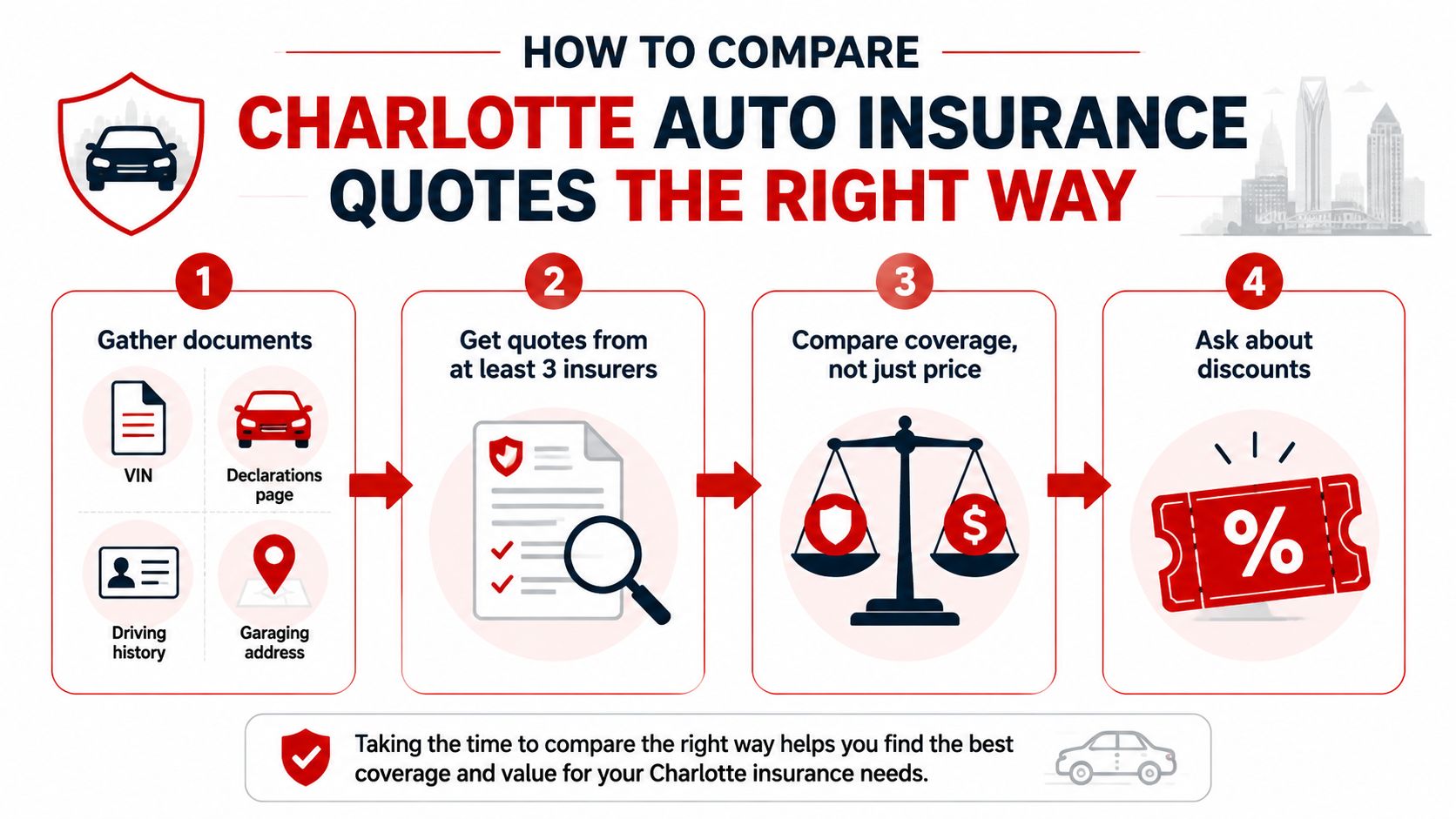
Gather the right paperwork before you start, or you'll end up comparing sloppy quotes that don't mean much. You need the VINs, your current declarations page, a basic summary of your driving history, and the garaging address for each vehicle. If you skip that prep, you'll waste time and create quote gaps that look like price differences but really aren't.
Compare the parts that actually change the outcome
An independent agency can pull from a broad carrier panel, and the point is to compare more than the number at the bottom. If the liability limits, deductibles, or uninsured motorist coverage don't line up, you're not looking at the same product. Select Insurance Group's carrier comparison page is relevant here because the value of an agency is range, not a single quote.
| What to Compare | Why It Matters |
|---|---|
| Liability limits | Higher limits can protect you from a claim that goes beyond a bare-minimum policy. |
| Deductibles | Lower deductibles usually mean less out-of-pocket pain after a loss, but higher premiums. |
| Uninsured and underinsured motorist limits | Important in a state where uninsured drivers are still part of the risk picture. |
| Collision and comprehensive coverage | These cover damage to your vehicle from different types of loss, including many urban hazards. |
| Discount stacking | The same driver can get very different pricing depending on how credits are applied. |
If you only compare the monthly payment, you're inviting a mistake. The cheapest quote is often thin on the exact protections Charlotte drivers need most. Compare coverage first, then price, and you'll make a better decision every time.
Common Mistakes That Cost Charlotte Drivers Real Money
The most expensive mistake in Charlotte is thinking the state minimum is automatically “smart” because it's cheap. It isn't smart if one crash, one hit-and-run, or one uninsured driver blows past the limits. A city with roughly 82 accidents per day is no place to treat auto insurance like a checkbox.
The second mistake is skipping uninsured or underinsured motorist protection because the policy already feels expensive. That's backward in a state where about 1 in 10 drivers are uninsured. If the other driver can't pay, your policy has to do the job, and bare-bones coverage usually doesn't do enough. This North Carolina DWI overview from the Law Office of Bryan Fagan is a useful reminder that risky driving behavior carries consequences well beyond a traffic ticket.
The third mistake is comparing quotes without matching the limits and deductibles. People do this all the time, then wonder why the cheapest option looks good on paper and feels terrible after a claim. That's not a savings strategy, it's a coverage trap.
If your policy can't survive a bad day, it's not really saving you money. It's postponing the bill.
The new minimums that took effect in 2025 are better than the old ones, but they still don't make a minimal policy a wise choice for every Charlotte household. In an urban market like this, I'd rather see a driver carry the right limits and spend a little less elsewhere than carry a bargain policy that fails when the bill gets real.
Get a Charlotte NC Auto Insurance Quote That Actually Fits
The right move now is simple. Decide what liability limits make sense for a dense urban market, stack every discount you can claim, and compare the same coverage across multiple carriers before you renew. That's how you stop paying for confusion and start paying for protection.
If you want a straight answer instead of a rushed renewal decision, get a no-obligation comparison from an independent agency that shops the market. Select Insurance Group, Inc. brings 30-plus years of experience, bilingual service, and access to multiple carriers, which makes it easier to see whether your current Charlotte policy is competitive or just convenient.
If you're ready to stop guessing, visit Select Insurance Group, Inc. and ask for a Charlotte auto insurance quote built around your driving profile, your limits, and the discounts you can use. Compare the options side by side, then choose the policy that protects your household instead of just shrinking the bill.