
By December 2024, home insurance accounted for 14.9% of the typical mortgage payment in Tampa Bay. That's not a side expense anymore, it's part of the core housing bill, and it helps explain why Tampa homeowners are looking at insurance differently than they did a decade ago. The right move isn't chasing the lowest monthly quote. It's understanding your total out-of-pocket exposure after wind, flood, and hurricane deductibles stack on top of each other.
Table of Contents
- Why Tampa Home Insurance Costs What It Does in 2026
- What a Tampa Homeowners Policy Actually Covers
- Tampa-Specific Risks Every Homeowner Should Plan Around
- What Really Moves Your Tampa Premium Up or Down
- Wind Mitigation, Four-Point, and Other Tampa Discounts
- How to Compare Tampa Home Insurance Quotes the Right Way
- Building a Tampa Wind, Flood, and Hurricane Deductible Budget
- Claims, Documents, and Tampa Home Insurance FAQs
Why Tampa Home Insurance Costs What It Does in 2026
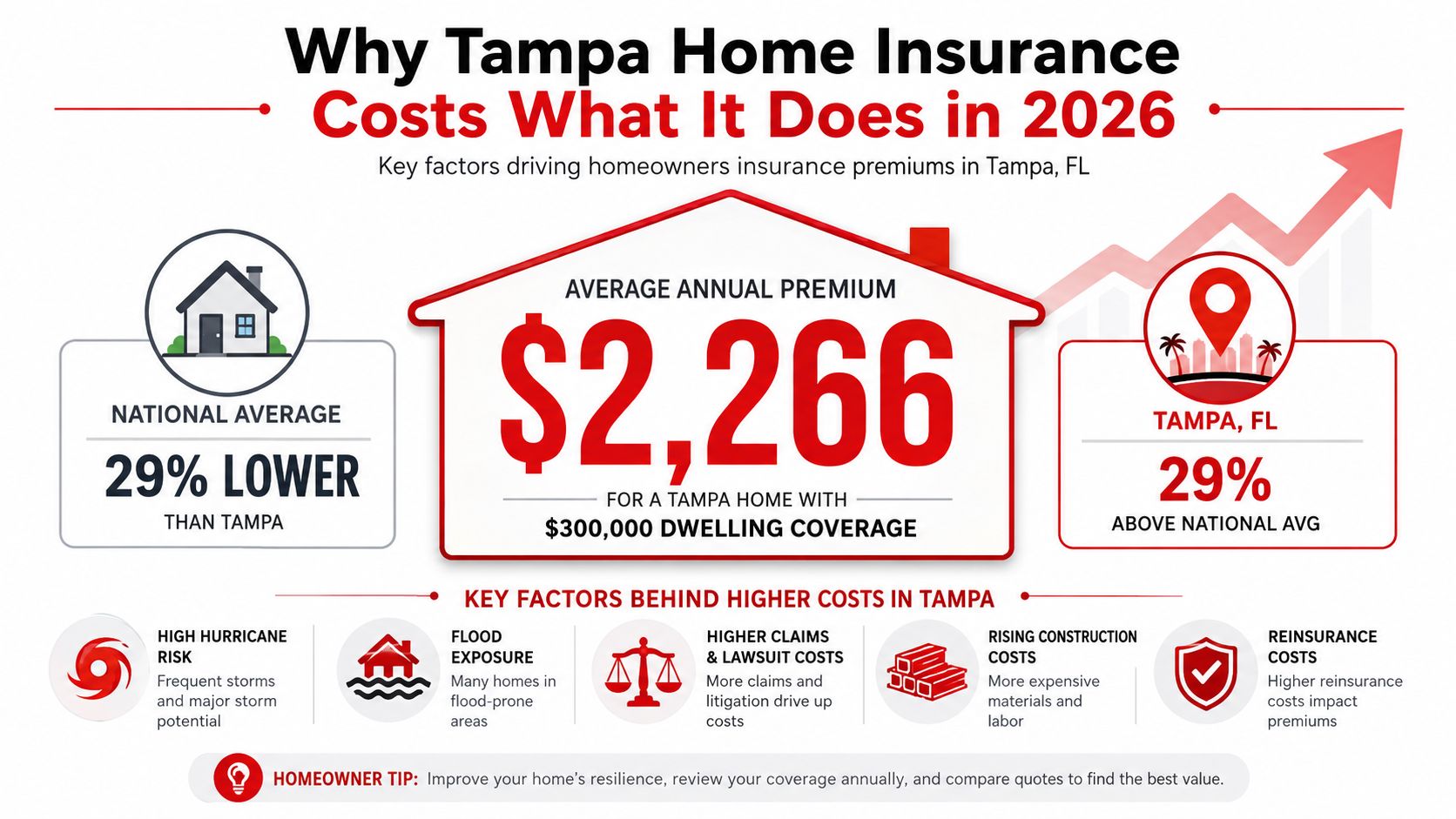
A Tampa homeowner with $300,000 in dwelling coverage is paying about $2,266 per year on average, which is roughly 29% above the national average and basically in line with the Florida average of $2,288 (An infographic showing the 2026 average annual homeowners insurance premium in Tampa, Florida compared to national averages.). That is the number to anchor on. If your quote is far above or below that, ask what is different in the house, the deductible, or the underwriting.
Why the market prices Tampa above the national norm
Insurers do not price Tampa like an inland, low-loss market. The Insurance Information Institute says about 1 in 18 insured homes has a claim each year, and about 1 in 36 has a wind- or hail-related property damage claim. In a storm-prone coastal metro, those losses force carriers to load more cost into the premium. If you want the right Tampa strategy, start with home insurance in Florida and build from there.
That is why people get wildly different quotes for what looks like the same home. The roof, the opening protection, the age of the property, the claims history, and the deductible structure can push a policy much higher or lower even before you get into flood. A cheap quote on day one can turn into a bad deal once you examine the deductibles.
Practical rule: do not shop Tampa home insurance by premium alone. Shop by what happens when the storm hits.
The monthly side of the story matters too. Tampa Bay home insurance rose from $192 to $300 a month over the last ten years, while the national average moved from $106 to $191 (Axios Tampa Bay home insurance cost story). That is why owners feel squeezed. The policy is not a background utility bill anymore, it is a major ownership cost.
A smart Tampa buyer should focus on the full out-of-pocket exposure, not just the monthly premium. That means wind, flood, and hurricane deductibles have to be priced together, because a roof claim, a flood claim, and a storm deductible can all hit the same household at once. A policy that looks affordable on paper can be the wrong choice if the deductible stack is too high.
A roof example makes this obvious. If a $350,000 Tampa bungalow takes roof damage in a Category 2 storm, the dwelling claim may be only one part of the bill. The deductible, the flood gap, and any coverage limits decide what the owner pays before repairs start. That is why roof damage coverage for Utah homes at roof damage coverage for Utah homes is not the right way to judge Tampa risk, the Tampa buyer has to look at the whole storm bill.
If you want the right Tampa strategy, the goal is straightforward. Keep the premium down, but never at the expense of letting your deductible exposure get out of control. A strong mitigation plan and disciplined shopping process protect both sides of the equation, and that is where smart owners should focus.
What a Tampa Homeowners Policy Actually Covers
A standard homeowners policy is built around a handful of core protections, and Tampa buyers need to understand them before they ever compare price. Dwelling coverage pays to repair the house itself. Other structures covers detached items like a shed or fence. Personal property protects your belongings. Loss of use helps with extra living costs if the home is uninhabitable. Personal liability responds if someone is injured and makes a claim against you.
The parts Tampa homeowners usually misunderstand
The big mistake is assuming the policy covers everything a hurricane can do. It doesn't. Flood damage is generally separate, and storm surge is a flood issue, not a roof issue. Earth movement and many ground-related losses sit outside the standard homeowners form as well. Sewer backup and ordinance-and-law shortfalls are also common gaps unless you buy extra protection.
Tampa homeowners also need to watch the deductible structure. Florida carriers often attach a separate hurricane or wind deductible to named-storm losses. That means the policy can look normal until a storm is declared and your out-of-pocket amount jumps. A roof claim and a flood claim can hit different parts of the coverage at the same time, which is exactly why the combined-exposure approach matters.
A roof example makes this obvious. If a $350,000 Tampa bungalow takes roof damage in a Category 2 storm, the dwelling limit may pay for repair or replacement. But if the policy has a 5% wind deductible, the homeowner could be looking at $17,500 out of pocket before coverage meaningfully helps. That's not a small detail. It's the number that should drive your planning.
For a plain-English breakdown of how roof claims work in another market, this guide on roof damage coverage for Utah homes is a useful general reference. The principles are similar, even though the Florida deductible structure is much harsher.
The right way to read a Tampa policy is to treat it as the starting point, not the finish line. Coverage on paper is only useful if you can afford the deductible and the separate flood exposure after the storm.
Tampa-Specific Risks Every Homeowner Should Plan Around
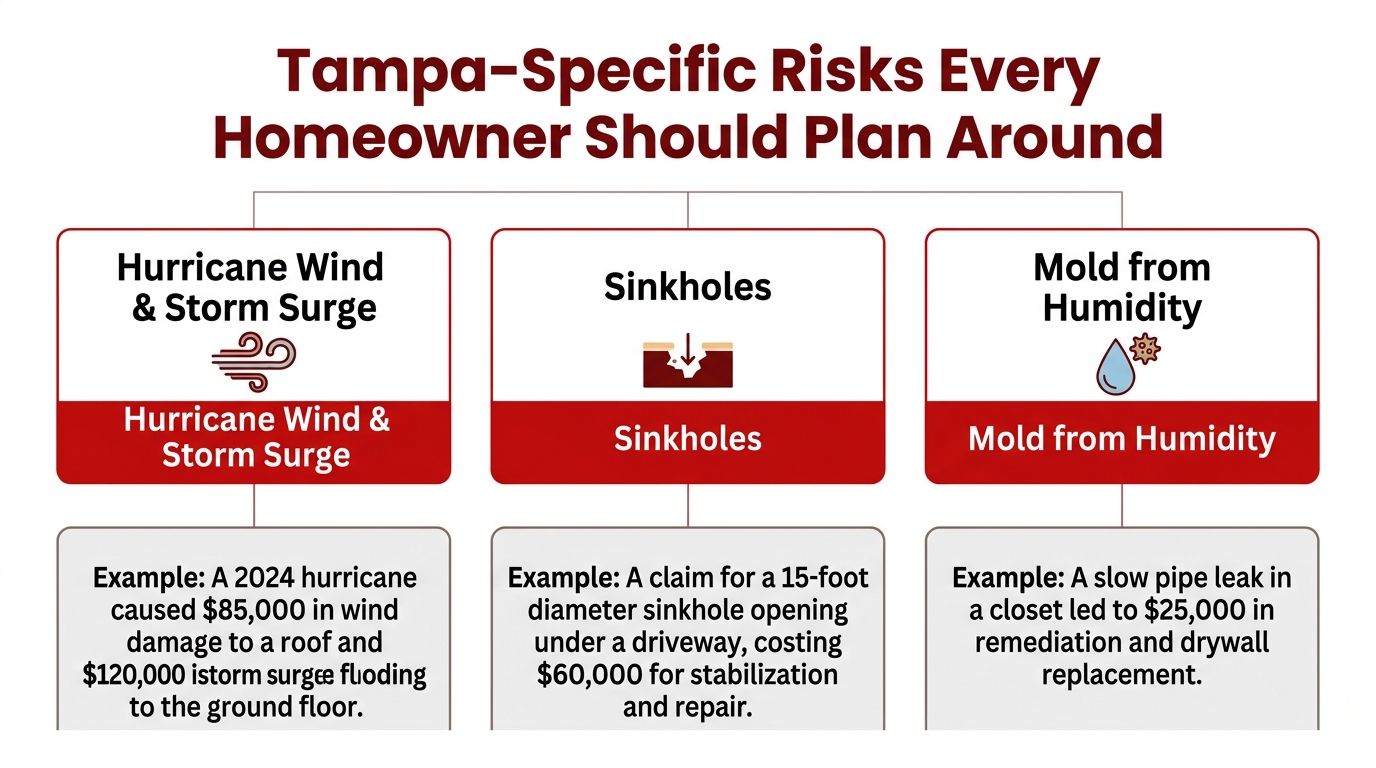
Tampa homeowners should budget for one combined out-of-pocket exposure, not three separate problems. Wind can damage the roof and openings, floodwater can hit the first floor, and soil movement can create a fourth layer of loss that standard coverage may treat very differently. The policy question is simple. Which losses are covered, which losses need separate insurance, and how much cash will you owe after a storm hits?
Hurricane wind, storm surge, sinkholes, and fire
Start with wind and surge. Hurricane wind rips shingles, breaks windows, and drives rain into the structure. Storm surge is flood loss, and standard homeowners insurance usually does not pay for it. Tampa owners also need to plan for the separate deductible hit on wind or hurricane losses. For more on wind-specific risks, see our guide on windstorm insurance for Tampa Bay properties.
Storm surge deserves its own line in the budget because it is a separate claim problem, not a variation of roof damage. The same storm can leave you with wind damage on one side of the house and flood damage on the other, each handled under different parts of the insurance setup. That is why chasing the lowest monthly premium misses the core issue.
Sinkholes are another Florida-specific exposure. Coverage for sudden collapse can be narrower than homeowners expect, and some policies limit or exclude related losses. Settlement cracks, driveway movement, and structural shifting do not always trigger the response a homeowner assumes, so the policy wording matters more than the sales pitch.
Fire still matters in a coastal market. Distance to a hydrant and fire station can move a quote, and a house with better exterior protection can price differently from a similar home farther from services. Tampa pricing is never just about the coastline.
If you want a plain explanation of how roof claims can work in a different market, this roof damage coverage for Utah homes reference is useful as a general guide. The mechanics differ, but the lesson is the same, read the policy before the storm, not after.
Tampa owners should also watch hidden water issues after a storm. Slow leaks, trapped moisture, and mold can turn a wind claim into a much bigger repair if the problem is not caught fast. Practical DIY leak detection tips for Las Vegas help homeowners spot water intrusion early, even though the climate and roof details differ.
The practical takeaway is blunt. Wind points to your homeowners policy and deductible structure. Flood points to separate flood coverage. Ground movement points to exclusions and limits that need a careful read. If one layer is missing, your combined exposure is higher than your premium suggests, and that is the number Tampa homeowners should plan around.
What Really Moves Your Tampa Premium Up or Down
Two homes in the same Tampa ZIP code can get very different quotes because the carrier is pricing the house, not just the neighborhood. That is the part generic insurance advice misses. Roof age and material, roof-to-wall connections, opening protection, prior claims, distance to fire services, heating and plumbing type, security features, pets, and unusual structures all feed the rate.
The property details insurers care about
Roof age is one of the biggest levers. If the roof is older or looks tired, the underwriter sees higher expected loss. If it has strong connections and wind-resistant features, the carrier sees less risk. The same logic applies to windows and doors. Basic openings leave more room for wind-driven damage, while impact-rated protection changes the pricing story.
Claims history matters too. A clean record helps. A pattern of small losses can make the house look expensive to insure. Fire-service proximity is another real rating factor. If the property sits farther from a hydrant or station, the insurer may price that in even if the house itself looks well kept.
The deductible choice can shift the quote even before any of those details change. Tampa rate pages show annual prices of roughly $2,602 to $2,863 for a $300,000 home depending on deductible (Brier Grieves Tampa homeowners questions). That spread tells you something simple. The policy form, not just the house, drives price.
A useful way to read a quote
- Roof and opening protection: The carrier wants to know how the home holds up in wind.
- Fire response profile: Distance to fire services still matters.
- Loss history: Prior claims can hurt even if the repair was minor.
- Odd structures: Detached studios, docks, and similar features can change the underwriting outcome.
One homeowner can improve the quote, another cannot. That is the contrarian truth. Tampa is expensive because Tampa is risky is only half the story. The other half is property-specific and often fixable.
If you are gathering options, DIY leak detection tips for Las Vegas is not a Florida guide, but the core lesson still applies. Catching and fixing small water issues before they become claims is one of the few things homeowners can control.
Wind Mitigation, Four-Point, and Other Tampa Discounts
The fastest savings in Tampa usually come from proving the house is less likely to lose money in a storm. That's what insurers reward. A wind-mitigation inspection is the best-known example, and on a post-2002 Florida Building Code home, a qualifying inspection can commonly save $800 to $2,500 per year.
What the inspection is really measuring
The inspection form, OIR-B1-1802, looks at the features that matter to underwriters. Roof age and covering. Roof-to-wall attachment. Opening protection. Secondary water resistance. Those are the details that tell the carrier whether the house is built to take wind without turning into a major claim.
Older homes often need a four-point inspection instead. That one checks the roof, electrical, plumbing, and HVAC systems. If you wait until the last minute, underwriting can stall because the carrier wants proof that the systems are sound. Get the inspection done early, not after you already found a replacement policy.
Practical rule: if your home is eligible for wind mitigation, ask for the form before binding the policy. Don't wait until renewal pressure forces your hand.
Other credits that actually matter
Bundling can help, though the value depends on the full quote, not the headline discount. Paying in full can shave friction off the pricing. Homes with newer construction tend to be easier to place than older properties that need more review. Those are key levers.
I'd ignore vanity discounts and focus on the ones that change the carrier's risk view. Roof protection, opening protection, and system health are the credits that move Tampa pricing in a meaningful way. If an agent can't explain how the house is being credited, you're not getting the full picture.
The best time to ask for these documents is before you bind coverage. Once the policy is in motion, you're negotiating from a weaker position. Bring the inspection work to the front of the process and you'll usually get a cleaner result.
How to Compare Tampa Home Insurance Quotes the Right Way
Most bad shopping happens because people compare quotes that aren't really comparable. One quote has a higher hurricane deductible. Another assumes a different roof age. A third excludes something you thought was included. If you don't normalize the inputs, you're just comparing noise.
A clean shopping process
Start with the dwelling limit and make every carrier use the same number. Then match the deductible structure, including the hurricane deductible percentage if there is one. Use the same roof age and the same mitigation features across every quote. If one agent prices the house with shutters and another doesn't, the comparison is worthless.
Next, get quotes from multiple carriers through an independent agency that can shop the market. A local agency can compare a broad carrier mix instead of forcing you into a single company's rules. For a Tampa quote review, this home insurance quote resource is a straightforward starting point if you want a local quote process that lines up the inputs correctly.
Here's the policy check many homeowners skip. Confirm whether the roof is replacement cost or actual cash value. Confirm the form used for broad perils. Confirm whether ordinance-and-law coverage is included or weak. Those details can matter as much as the premium itself.
What to put side by side
| Input | Why It Matters | Tampa-Specific Tip |
|---|---|---|
| Dwelling limit | It anchors the entire quote | Keep the same rebuild assumption across carriers |
| Hurricane deductible | It changes your real out-of-pocket cost | Convert the percentage to dollars before comparing |
| Roof age and condition | It affects underwriting and price | Use the same inspection data on every quote |
| Flood coverage | It sits outside the standard homeowners policy | Price it next to the home policy, not separately in your head |
| Ordinance-and-law | It affects older homes after a loss | Check it before you assume the policy is complete |
The cheapest premium is often not the cheapest package. Once you layer in deductibles and exclusions, some “cheap” policies become expensive the moment a storm hits. Good shopping means seeing the whole structure, not just the first number on the page.
Building a Tampa Wind, Flood, and Hurricane Deductible Budget
Tampa homeowners should stop treating wind, flood, and hurricane deductibles as separate questions. They hit the same wallet after the same storm. If a hurricane brings roof damage and surge flooding, you may be dealing with a homeowners deductible, a hurricane deductible, and a separate flood policy all at once. That's the exposure.
By December 2024, home insurance made up 14.9% of the typical Tampa Bay mortgage payment, and the average monthly payment rose from $192 to $300 over ten years, versus a national move from $106 to $191 (Axios Tampa Bay home insurance cost story). That's proof homeowners already feel the budget strain. You need to budget the storm loss the same way.
A real budgeting framework
Take a $400,000 Tampa home. If the policy has a 5% hurricane deductible, the out-of-pocket amount tied to wind damage can be substantial before coverage kicks in. Add the standard homeowners deductible for non-hurricane losses, then add the flood policy deductible structure for the separate flood claim. On a major storm, the homeowner is not facing one bill, they're facing a stack of them.
That's why I tell owners to budget by event, not by policy line. Ask yourself what happens if the roof is damaged, the interior gets wet, and the first floor floods. If you can't comfortably absorb that combined hit, the coverage structure is too thin for your house.
You should also layer endorsements with intent. Sewer and backup coverage helps with drainage-related messes. Equipment breakdown can protect expensive systems. Loss assessment matters if you live under an HOA. Increased ordinance-and-law coverage helps when code upgrades become part of the repair. None of those endorsements replace flood, but they make the rest of the package less fragile.
The market is also moving around you. Citizens Property Insurance announced an average 8.7% statewide rate reduction for Spring 2026 renewals, its first personal-lines decrease since 2015, with more than 330,000 policyholders seeing decreases and over 150,000 getting cuts of 10% or more (Axios Tampa Bay home insurance cost story). That doesn't mean every private quote gets cheaper. It means you should still re-shop and compare, because the market is not static.
If you budget the combined exposure before you bind the policy, you're far less likely to walk away from a claim because the deductible shocked you.
Claims, Documents, and Tampa Home Insurance FAQs
The first 72 hours after a Tampa storm are about damage control, not paperwork perfection. Stop further damage if it's safe. Take photos and video before cleanup. Call the carrier before you start major contractor work. Don't let a pushy public adjuster or contractor run the claim before you've documented the loss.
Store the policy, wind-mitigation form, four-point inspection, and photos of major contents in a cloud folder and a paper backup. If you keep those documents easy to reach, you'll save yourself hours when the house is already stressed.
If you're trying to understand roof-loss timing and claim handling, this roofing insurance claim guide is a practical reference for the documentation side of the process. The claim itself will still come down to your policy language and the adjuster's inspection.
Tampa home insurance FAQs
What does flood coverage cost for a Tampa home? Price depends on the home, the flood zone, and whether you're using a standard flood policy or a private alternative. The key point is simpler, flood is separate from the homeowners policy, so it has to be budgeted as its own line.
Is sinkhole damage automatically covered? No. Read the policy language closely. Sinkhole-related losses can be narrower than homeowners expect, and not every crack or settlement issue triggers the outcome people assume.
Can I get Spanish-language service? Yes, many local agencies in Tampa serve bilingual customers. That matters when you're comparing exclusions, deductibles, and inspection requirements, because the policy details need to be understood clearly.
When does Citizens make sense? Usually when the private market won't offer acceptable terms or pricing. If private carriers are still quoting, compare them first and make Citizens the fallback, not the starting point.
If you want a straight answer on what tampa home insurance should cost for your house, what your deductible exposure really looks like, and which mitigation steps are worth doing first, talk to Select Insurance Group, Inc.. They compare quotes across multiple carriers, help Tampa homeowners line up the deductible structure correctly, and can walk you through flood, wind, and homeowners options without the usual confusion.