
You're standing at the counter or scrolling on your phone, and the same problem keeps coming up. The quote looks fine, but the key question is who picks up when you need a certificate this morning, a policy change this afternoon, or a claim callback that doesn't disappear into voicemail. In Kissimmee, that's the difference between buying a policy and being covered.
A good Kissimmee insurance agency earns its keep after the binder, not just before it. That matters in a city with a dense agency cluster, a statewide market that's big and tightly regulated, and customers who often need help in more than one language. Florida had 2,052 total licensed domestic and foreign insurers in 2024, ranked 4th nationally in total premium, 3rd in property/casualty premium, 1st in private flood premium with 22.8% of the U.S. market, and 2nd in homeowners premium with 10.67% of the U.S. market, all with a regulatory cost of $0.31 per $1,000 in written premium (NAIC Florida market facts). That's not a simple shopping environment.
Kissimmee reflects that complexity locally. Public licensing records summarized by Find Independent Insurance report 308 active independent property and casualty agencies in the city, with 23 that have records going back 20 or more years, and 8 that hold full property and casualty authority. Another directory lists 129 insurance agency business entities in the city, which tells you one thing fast, competition is real and service matters.
Table of Contents
- Why Kissimmee Drivers and Business Owners Shop Local for Coverage
- What an Independent Insurance Agency Does
- Coverage Lines a Full-Service Kissimmee Agency Handles
- Independent Agency vs Captive Carrier vs Online Quote Site
- How the Instant Quote and Onboarding Process Works
- Why Post-Sale Service and Bilingual Support Are Real Differentiators
- Florida-Specific Questions Every Kissimmee Buyer Should Ask
- Getting Covered and Frequently Asked Questions
Why Kissimmee Drivers and Business Owners Shop Local for Coverage
A rideshare driver in Kissimmee doesn't care about insurance theory. He wants a rate that makes sense, and he wants to know whether the policy still works when the app is on, when it's off, and when an adjuster asks questions he's not prepared to answer. A small contractor is even more blunt. If a client needs a certificate of insurance at 8 a.m., the lowest quote in the world is useless if nobody answers the phone.
That's why local service keeps winning in this market. Kissimmee agencies work inside a state where property, flood, and homeowners risk are tied to hurricane exposure and carrier appetite, not just to a zip code and a birthday. Local listings also show that agencies here serve homeowners, auto, business, and Medicare-related needs across both independent and major-brand channels, which is a clue that buyers need more than one-line quoting to get the right fit.
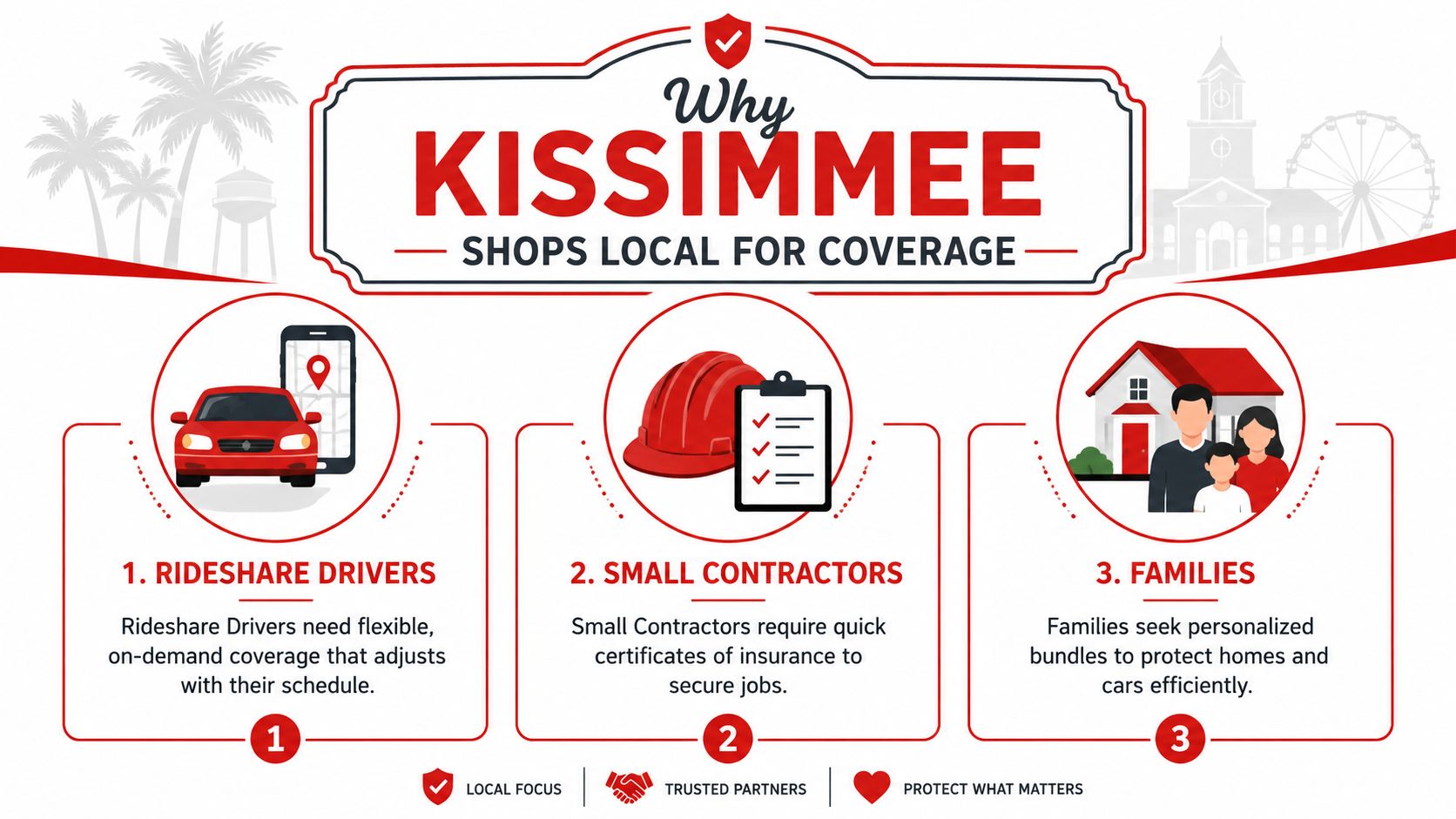
For a family renting near the attractions, the issue is different but just as practical. They want renters and auto bundled without wasting an afternoon on separate applications, and they want help from someone who can explain the policy in plain English or Spanish. That's the local advantage, not a glossy office sign.
If you're comparing service models for nearby property work too, it helps to look at how other local buyers vet providers. A useful example is to compare vacation rental managers in Kissimmee the same way you'd compare an agency, with an eye on responsiveness, coverage, and post-sale support instead of just the headline price.
The rest of this guide is built around that reality. Kissimmee buyers don't just need a quote. They need a shop that can handle the handoff after the policy is bound, when the work starts.
What an Independent Insurance Agency Does
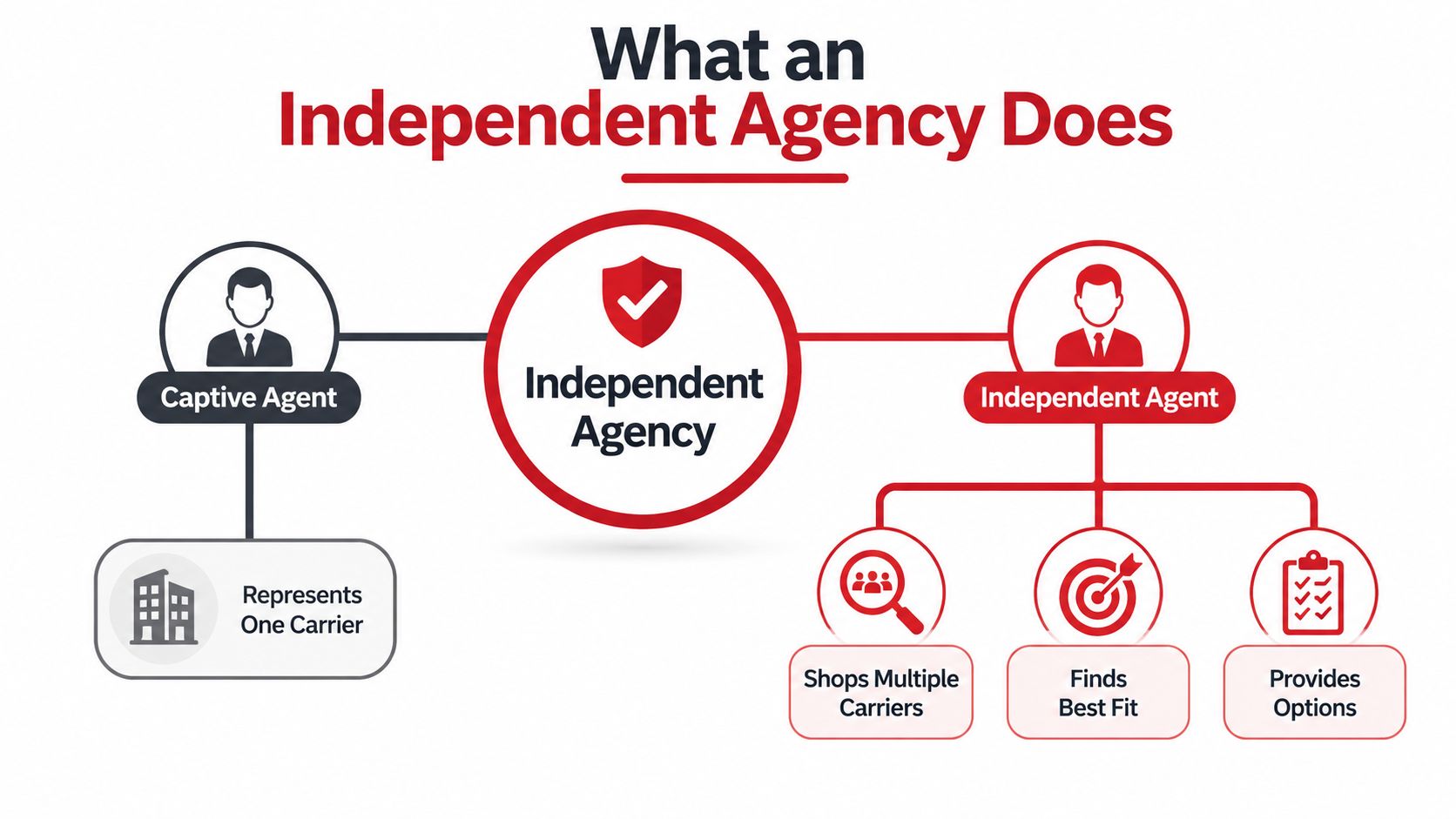
An independent insurance agency works like a storefront with access to multiple carrier appointments behind it. A captive agent usually represents one carrier and can only sell that carrier's products. An independent agency can shop several carriers, compare options, and point you toward a policy that fits the risk instead of forcing your risk to fit the company.
That difference matters most in Florida. Carrier appetite changes fast in storm-exposed markets, and a carrier that likes one home, one driver, or one small business may reject the next one for a detail the customer did not even know mattered. The independent model gives the agent room to move when the first quote is too expensive, too narrow, or not available.
Practical rule: If your situation is simple, one carrier may be enough. If you need options, endorsements, or help sorting through tradeoffs, independent wins.
A good independent shop also saves you from re-entering the same information across multiple carriers. Select Insurance Group says it compares instant quotes from 20 to 40 leading carriers, which is the right kind of scale for a market like Kissimmee because it improves the odds of finding a fit without turning the customer into the data-entry department. If you want the plain-language version of how that model works, their explainer on what an independent insurance agency is is worth reading before you start shopping.
The right questions to ask any agency are simple. How many carriers can you quote? Which lines do you place every day? What happens if the first carrier turns you down? If the answer sounds vague, keep looking. A real independent agency should be able to explain the process without hiding behind jargon.
Coverage Lines a Full-Service Kissimmee Agency Handles
A full-service agency in Kissimmee should be able to cover the person, the vehicle, and the business without making you start over from scratch every time you change lines. That's the point of broad carrier access. One conversation can move from a commuter's auto policy to a house, then to a storefront or job-site risk, without sending you to three separate offices.
Personal coverage for everyday life
Auto insurance is the starting point for most drivers. A Kissimmee commuter needs liability limits, physical damage protection, and a policy that won't become a headache when a fender-bender turns into a claim. Homeowners insurance is for owners who need structure and liability protection, while renters insurance is the cleaner fit for apartment dwellers and families renting near the city's busier corridors. Motorcycle and RV coverage make sense for people who split time between local driving and weekend travel.
Commercial coverage for businesses that cannot miss a workday
For business owners, the mix is different. General liability is the baseline for many service businesses, while commercial property protects equipment, inventory, and the space itself. Workers' compensation matters when you have employees, and commercial auto matters the minute a vehicle is used for work. Trucking coverage serves operators whose routes stretch beyond the city, and that's where an agency with broader carrier relationships can be useful because not every insurer wants the same kind of commercial risk.
A practical agency should match coverage to the job, not the label on the building. A restaurant needs different protection than a drywall contractor. A small hauler needs a different conversation than a family in a townhouse.
Bottom line: The right coverage line is the one that follows how you actually live or work, not the one that sounds cheapest in a quote box.
Select Insurance Group says it brings over 30 years of experience and serves multiple states, which gives it the kind of carrier familiarity that matters when a policy has to be built around a mixed personal and commercial profile. In a market like Kissimmee, that breadth matters more than a shiny sales pitch.
Independent Agency vs Captive Carrier vs Online Quote Site
Kissimmee buyers usually have three paths. Each one works, but they do not work equally well for every situation. If you know what each channel does best, you'll waste less time and avoid the usual trap of buying the cheapest-looking option and then discovering the service side is thin.
| Channel | Carrier Access | Post-Sale Service | Best Fit For |
|---|---|---|---|
| Captive Carrier | One company's products | Usually tied to that company's process | Simple buyers who want one brand and one account |
| Online Quote Site | Varies by site, often limited and impersonal | Mostly self-service | Shoppers who only need a quick first look |
| Local Independent Agency | Multiple carriers | Human help after binding, endorsements, claims support | Drivers, families, and businesses with changing needs |
A captive setup can be fine if you know exactly what you need and you do not plan to move much. An online quote site can be useful for speed, but it usually stops at the quote screen and leaves you to interpret the details alone. That's where problems start, especially with deductibles, exclusions, and policy changes that only become obvious after the purchase.
An independent agency has the better mix for most Kissimmee households and small businesses because it keeps the quote side and the service side under one roof. That matters when a certificate has to be issued, a lender needs proof of coverage, or a claim question pops up after hours. It also matters for bilingual service, because a fast quote is not much help if the customer still needs to translate the explanation themselves.
If you're comparing options from the consumer side, the hard question is not “who can quote me fastest.” It's “who will still answer when the policy needs work later.” In this market, that question is the one that saves money and headaches.
How the Instant Quote and Onboarding Process Works
The first step should be simple. You call, text, or submit an online form, and the agency asks for the basics that let them shop intelligently instead of guessing. For auto, that usually means driver and vehicle details. For home, it's the property basics and your current declarations page. For commercial lines, the agency needs enough business information to avoid quoting the wrong exposure.
Once the information is in, the shop can run the quote across multiple carriers and surface options side by side. That is where the independent model pays off. One carrier may be cheaper on auto, another may be stronger on homeowners, and a third may be the better answer for a small commercial account that needs a different appetite.
If you want to prep before you call, a good checklist is not complicated.
- Have your documents ready: Driver's license, VIN, current policy page, and any business basics you already use for billing or licensing.
- Know your priorities: Lower premium, lower deductible, broader coverage, or faster service.
- Flag special needs early: Bilingual communication, endorsements, certificates, or mid-term policy changes.
If you want a practical reminder about saving money without cutting corners, the insurance savings tips from A-1 are a decent companion read because they reinforce the basics, keep your record clean, compare carefully, and don't buy blindly. For anyone who wants the quote flow in one place, the agency's free insurance quotes in Florida page shows the kind of no-pressure start most buyers want.
After you bind, the work should still stay easy. Secure document upload, payment tools, and policy-update workflows matter because insurance is not a one-time transaction. Select Insurance Group also notes complimentary notary service at many locations, which is useful when a client needs signatures handled in person without making another stop.
Why Post-Sale Service and Bilingual Support Are Real Differentiators
A cheap quote that turns into a service problem is not cheap. In Florida, policyholders are already dealing with a market where affordability, catastrophe exposure, and coverage changes can complicate the first renewal or claim. If the agency doesn't handle communication well, the customer is left chasing answers through state consumer channels instead of getting help where they bought the policy in the first place. Florida's consumer-help structure routes policy and complaint issues through state services, including DFS Consumer Services and the Florida CFO complaint portal, which is a clear sign that post-sale service is not optional.
That is why I tell buyers to ask hard questions before they sign. Who handles certificates? Who returns claim calls? How do policy changes get processed? What happens if the customer speaks Spanish and wants the conversation handled directly, not through a family member or a third-party translator?
If bilingual service matters to you, read the agency's page on bilingual insurance agent service in Florida before you assume every office can communicate the same way. A real bilingual workflow is more than a greeting. It means policy explanations, claim follow-up, and endorsement requests can move without confusion.
You're not paying for a quote only. You're paying for someone to stay useful after the payment goes through.
In a market like Kissimmee, that is the differentiator. The lowest premium is nice. The agency that answers, documents, and follows through is what protects your time.
Florida-Specific Questions Every Kissimmee Buyer Should Ask
Start with the roof and wind risk. Ask whether the quote changes if the home has an older roof, and whether mitigation details can improve the result. That matters in Central Florida because hurricane and wind exposure can change what a carrier will accept, and what it will charge.
Then ask about flood separately. Homeowners insurance does not solve that problem. In Florida, flood needs its own conversation, especially if you live or work near water, in a low-lying area, or in a spot where drainage becomes a problem after heavy rain.
Use these questions at the kitchen table or on the call:
- What happens if the carrier tightens after inspection? You want to know whether the agency can still pivot.
- Which deductibles are you choosing? A lower premium can hide a bigger out-of-pocket cost.
- Does this policy cover what I'm building or running now? Renovations, rentals, and business changes can all shift the fit.
- If I need a different policy mid-term, how fast can you handle it? That matters more than people admit.
Ask one more question if you want the true test of an agency. Who is still useful after the binder is issued, when you need a certificate of insurance at 8 a.m., a claim follow-up, or a policy change that cannot wait until next week?
The point is simple. In Florida, a quote is only the first draft.
Getting Covered and Frequently Asked Questions
If you want to move forward, call, text, visit in person, or fill out an online quote form and start with the basics. A solid Kissimmee agency should tell you what to bring, explain the options clearly, and keep the next steps simple. That is the standard I'd expect from any independent shop serving local drivers, families, and business owners.
Can you help with SR-22 or non-standard auto? If an agency handles a wide auto market, it should be able to tell you quickly whether it can place that risk or point you to the right next step.
Do you work with truckers running out of state? A commercial-focused agency should ask about routes, vehicle use, and operating footprint before it quotes.
What should I bring to a notary appointment? Bring a valid ID and the paperwork you need signed, then confirm whether the signature has to happen in person.
How are policy changes handled mid-term? Ask who makes the update, how it is documented, and when the revised paperwork is sent.
If you want a local agency that handles personal and commercial coverage with bilingual support, document help, and quote shopping across multiple carriers, Select Insurance Group, Inc. is built around that workflow. Visit Select Insurance Group, Inc. to start the conversation and get a quote that fits how you live and work.