
A Florida business owner usually notices the problem at the worst possible time, after a storm when the roof is torn up, the tenant has stopped answering calls, and everyone wants to know which policy is paying for what. On paper, the building was insured. In the claim, the wind carrier, the flood carrier, the adjuster, the contractor, and the lender may all be asking for different documents, and that's where a lot of owners discover the coverage they bought doesn't match the loss they suffered.
That gap is why commercial property insurance in Florida needs to be read as a claims plan, not just a price quote. The market itself shows how much pressure Florida property owners are under. Admitted-market premium rose from $8.7 billion in 2022 to $12.52 billion in 2023, then to $14.34 billion in 2024, while surplus lines also climbed sharply, according to the Florida Surplus Lines Service Office market report (Florida market insights PDF). That growth says carriers are still willing to write Florida, but they're doing it with more scrutiny, tighter terms, and less tolerance for sloppy data.
If you own, lease, or manage a building here, the question isn't whether you can buy a policy. It's whether the policy survives the hurricane, the rebuild, and the accounting after the loss.
Table of Contents
- The Hurricane Scenario Most Florida Policies Are Not Ready For
- What Commercial Property Insurance Actually Covers
- Florida-Specific Risks That Reshape Your Policy
- Valuation Methods and Deductible Choices That Move Real Dollars
- Endorsements Florida Owners Most Often Wish They Had Bought
- Premium Drivers in Florida and What Underwriters Score
- How to Get Competitive Florida Quotes Without Leaving Coverage on the Table
- Filing a Florida Claim and Lowering Next Year's Premium
The Hurricane Scenario Most Florida Policies Are Not Ready For
A Central Florida strip plaza takes a direct hit from a hurricane. The roof membrane is gone in sections, rain pushed into the units, and the parking lot has standing water. The tenant closes for weeks, then sends a notice saying the inventory is ruined and the business cannot reopen until the space is dried out, repaired, and inspected. That is the moment the policy stops feeling abstract.
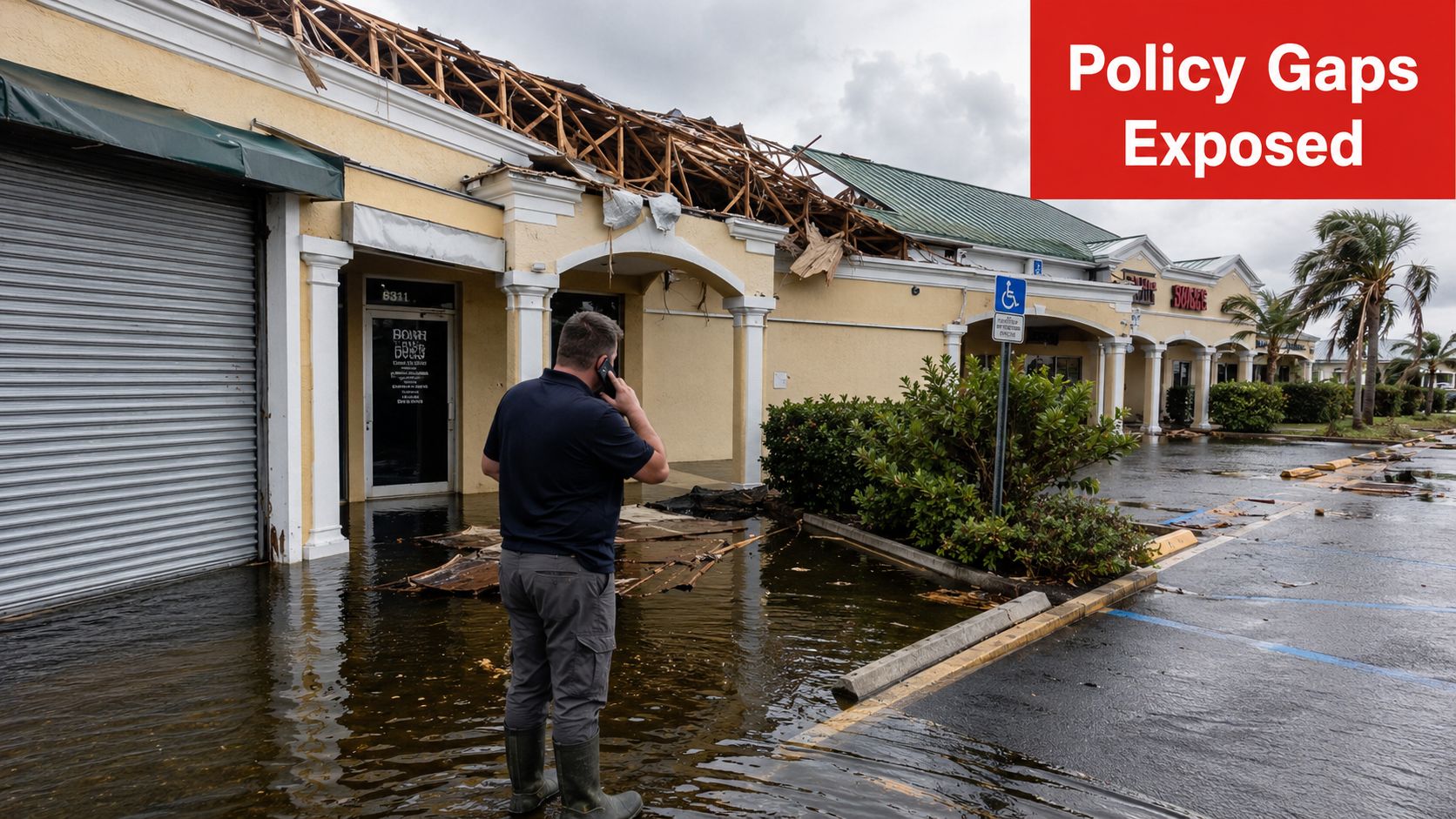
The owner often thinks there is one claim. In practice, there may be at least two. Wind damage can fall under one policy or one part of the policy, while flood or storm surge can sit under a separate policy, sometimes with a different carrier and a different adjuster. That split matters because the same hurricane can create both losses on the same property, and the business owner has to document them separately from the start.
Practical rule: if the damage source changes, the claim file changes too. Wind, flood, code upgrades, and lost income usually do not move through the same channel.
Code upgrades and business interruption gaps show up next. If the roof section must be rebuilt to current code, the policy may not automatically pay every ordinance-driven cost unless the owner bought the right endorsement. If the tenant cannot reopen for months, the business income limit may run out before the actual recovery does. A local commercial roofing contractor can document roof damage and repair scope early, which helps the owner avoid losing time while the claim is still being sorted out.
Florida owners also tend to miss how admitted-market pricing has moved. Recent market reporting from the Florida Office of Insurance Regulation shows admitted-market premium climbing from $8.7 billion in 2022 to $12.52 billion in 2023, then to $14.34 billion in 2024. That kind of increase does not just reflect more exposure. It also reflects tighter underwriting, higher replacement costs, and carriers being far more selective about which roofs, buildings, and locations they will still write. For a business owner, the practical result is simple, higher pressure on terms, and less room for sloppy limits or weak documentation. If you are comparing options, commercial property insurance in Orlando should be built around the loss scenario, not just the renewal price.
The point is simple. A generic commercial property form can look fine at binding, then fall short when the building has wind, water, and shutdown losses at once. That is the gap most Florida owners do not see until after the storm.
What Commercial Property Insurance Actually Covers
A commercial property policy is built to protect the physical stuff tied to the business. That usually means the building itself, business personal property inside it, and the financial cost of repairing or replacing covered damage after a named peril hits. In plain English, it's there for the structure, the contents, and some of the fallout when a covered event shuts the place down.
The standard building and contents grant
For an owner-occupied building, the policy often starts with building coverage. That pays to repair or rebuild the structure after covered damage such as fire, certain wind loss, vandalism, or sprinkler leakage, depending on the form and endorsements. For a tenant or owner with equipment and inventory on-site, business personal property coverage matters just as much, because desks, shelving, tools, stock, and machinery can be just as costly to replace as walls and roofs.
Think of a business policy like a custom build-to-suit lease, not a starter apartment. You're not just insuring a shell. You're insuring the way the space functions, the fixtures, the contents, and sometimes the income stream tied to that space.
| Standard Coverages | Common Florida Exclusions |
|---|---|
| Building structure | Flood |
| Business personal property | Storm surge water |
| Fire damage | Earth movement, unless a separate form applies |
| Theft and vandalism | Wear and tear |
| Certain wind damage, depending on form | Maintenance issues |
| Sprinkler leakage | Gradual deterioration |
The Florida CFO's consumer guidance says commercial property insurance covers buildings and contents against fire, windstorm, and other perils, while flood sits outside standard coverage and must be bought separately through NFIP or the private market (Florida CFO commercial property guidance). That distinction is the one owners most often misunderstand because the policy declaration page can make coverage look broader than it really is.
The exclusions that matter most in Florida
The biggest operational mistake is assuming the property policy handles everything a hurricane does. It doesn't. Flood is typically excluded, and in Florida that can be the difference between a payable claim and a major uninsured loss. The same storm can leave you with two different damage types, two different adjusters, and two different claim timelines.
A policy that only looks complete at binding is not enough. It has to still make sense after the storm has split the loss into pieces.
That's why quote review matters so much. If you see a cheap premium but the limits are thin, the exclusions are broad, or the endorsements are missing, the apparent savings can disappear in a single event. If you're reviewing a local market option, this business property insurance in Orlando page is a useful example of how property coverage is often presented to Florida owners who need to compare structure, contents, and add-ons side by side.
Florida-Specific Risks That Reshape Your Policy
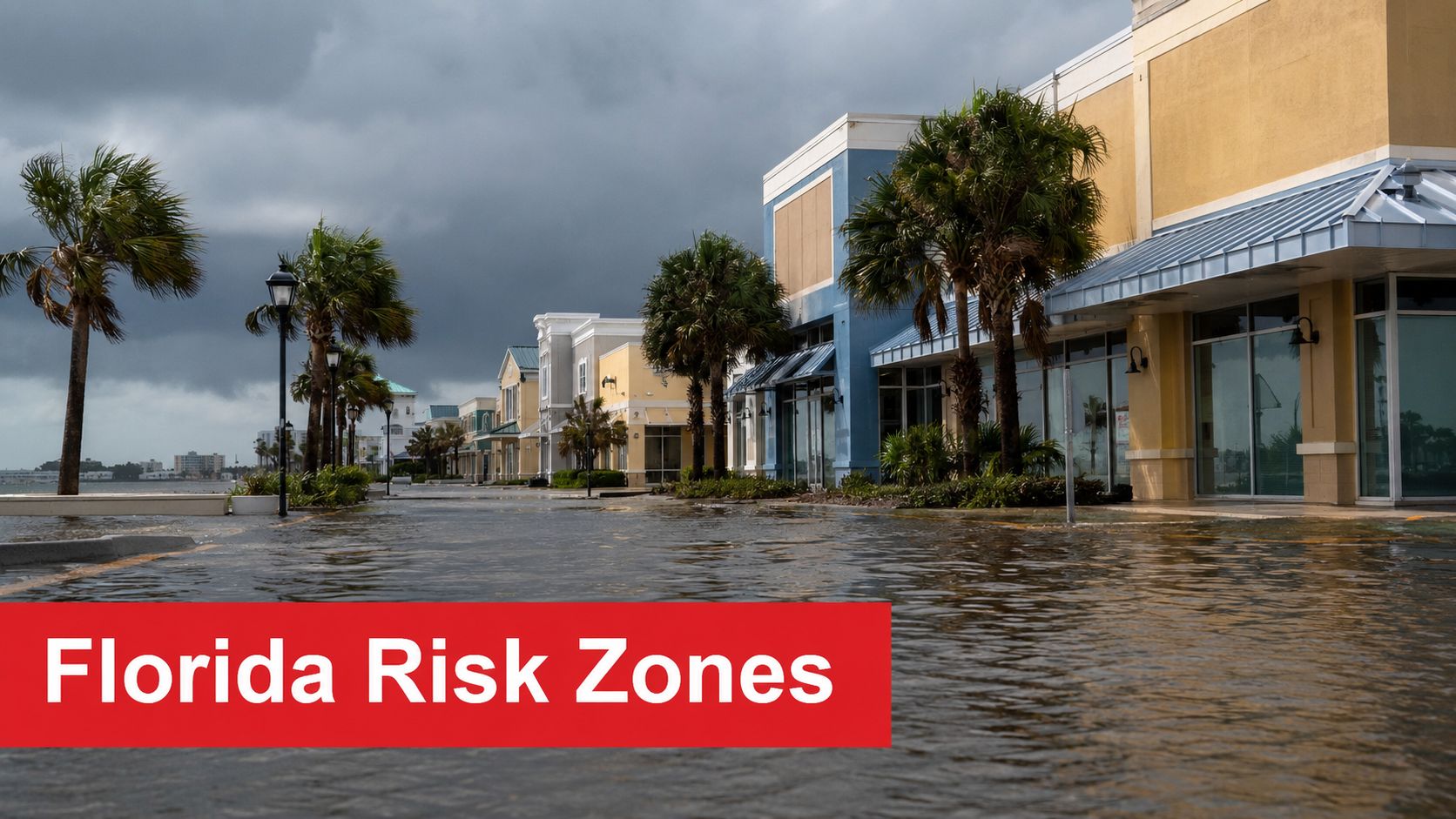
A Florida owner can have two buildings with nearly the same footprint, the same tenant mix, and the same revenue, then receive very different pricing because the carrier is really pricing the storm path, roof condition, and claim severity, not just the address. That is the reality of commercial property insurance here. Coastal water intrusion, building-code sensitivity, and repeated catastrophe exposure shape the form long before a loss ever happens.
Wind, water, and claim separation
After a hurricane, the first argument is usually about cause. The roof may be stripped by wind, the interior may take water, and the lot may flood at the same time, but the claim does not get handled as one simple loss. Wind damage may fall under one policy or one carrier, while flood or storm surge is handled separately. The owner has to document which damage came from wind and which damage came from rising water, even when both happened during the same hour and under the same roof.
That split matters because the claim can turn into multiple files, multiple adjusters, and multiple deadlines. A business owner who does not understand that separation often expects one deductible and one settlement process, then gets a much harder claims experience than expected.
Florida market reporting shows why carriers stay tight on terms. In 2023, Florida property insurers paid almost $3.5 billion in defense costs and containment expenses, including attorney fees, which shows how claims can become expensive long before the building is fully repaired (Insurance Journal summary of Florida market reporting). The same report says Florida commercial property insurers wrote about $2.5 billion in premiums in 2023, with a 30.9% loss ratio, and Florida ranked as the 3rd-largest state market in the NAIC's commercial property line. That is why underwriters here ask more questions and tolerate less sloppiness in the file.
Coverage choices that change the outcome
The decisions that change the claim outcome are practical. A building in a flood-prone area needs a separate flood policy, because the property form usually will not pay for that water damage. A business owner comparing property coverage can see how that layer is often treated in a Florida flood insurance overview before the storm ever hits. If the roof and walls are exposed to hurricane wind, the owner needs to know where the wind deductible applies and what the carrier means by hurricane-related damage. If the structure is older or only partly occupied, the underwriting file often needs more detail than owners expect.
Practical rule: Florida owners should treat flood, wind, and ordinance issues as separate buying decisions, not as one bundled promise.
The market has also leaned more heavily on non-admitted capacity. The Florida Surplus Lines Service Office's market reporting shows surplus lines' share of Florida's broader property market moving from 30% in 2018 to 36% in 2023. That is a clear sign that carriers are using alternative capacity when admitted insurers want narrower terms or less exposure.
Older buildings bring another set of trade-offs. Even when a policy looks acceptable on paper, the rebuild may run into code upgrade gaps, ordinance and law limits, or coverage terms that leave part of the post-loss cost outside the settlement. Owners often focus on the premium and miss the repair path. In Florida, the critical test is whether the policy still works after the storm has broken the loss into pieces.
Valuation Methods and Deductible Choices That Move Real Dollars
The fastest way to overpay is to insure a building as if every dollar of value were fully exposed to a total loss. The fastest way to underinsure is to use an old valuation and hope inflation doesn't catch up before renewal. Florida owners tend to get squeezed from both sides because rebuild costs are volatile and carrier scrutiny is high.
How to think about limit selection
There are four common valuation approaches. Replacement cost aims to cover what it would take to rebuild with current labor and material costs. Actual cash value subtracts depreciation, which lowers premium but can cut hard into a claim check. Agreed value sets a value upfront, which can work when the property is well documented. Functional replacement focuses on restoring usefulness, not necessarily duplicating every original feature.
For a 5,000-square-foot warehouse, replacement cost usually makes the most sense if the owner expects to rebuild after a loss and wants the policy to follow current construction costs. For an older masonry building in Orlando, actual cash value may look cheaper on paper but can leave the owner short if the property is older and the depreciation hit is heavy. For a coastal retail center, agreed value can be useful only if the valuation is current and the building data is clean enough for the insurer to trust it.
Florida-oriented guidance warns that older valuation numbers can leave owners materially short on coverage, especially in inflationary rebuild environments and for older buildings with roof age, tenant mix, or vacancy issues. That's the underwriting reality owners feel when a limit looked comfortable two years ago and suddenly doesn't.
How deductibles change the claim check
Deductibles can be flat dollar amounts, percentage-based, or a hurricane percentage deductible tied to building value. In Florida, the hurricane version is common enough that owners should read it as part of the total risk, not as fine print. A low premium with a high percentage deductible can leave the insured paying a much larger share of the first loss than expected.
A good deductible is one the business can actually absorb without skipping payroll or delaying repairs.
The right pairing depends on the property. Coastal properties often need more conservative valuation and a deductible the owner can realistically fund after a storm. Inland properties with newer roofs can sometimes tolerate a different structure. Older or partially vacant buildings need even closer attention because insurers are watching how the structure will behave under stress, not just what it cost to buy.
Endorsements Florida Owners Most Often Wish They Had Bought
The policies that disappoint owners after a hurricane usually weren't “bad policies.” They were incomplete for the way the business operates. The missing pieces tend to be the same ones, and they show up when a tenant can't reopen, the code office gets involved, or a mechanical failure shuts down the building's function instead of the roofline itself.
The coverage gaps that show up after the loss
Business interruption and extra expense are usually the first endorsements owners regret skipping. They matter when the property is physically repairable, but the business can't reopen fast enough to keep revenue flowing. In a hurricane claim, the roof may be fixed before the business can function again, and that lag is where the income gap opens.
Ordinance and law coverage is just as important for older structures. If part of the building is damaged and the repair has to meet current Florida Building Code requirements, the owner may need more than basic repair money. Loss of rents matters for landlords whose tenants stop paying during the shutdown. Equipment breakdown protects the HVAC, refrigeration, and electrical systems that keep a property usable. Utility interruption can cover losses when outside service disruptions stop operations even if the building itself is still standing. Mold and fungus coverage is often contentious because sublimits can be narrow, and Florida humidity makes that restriction more visible after a storm.
How to prioritize add-ons without wasting premium
The order matters. Start with the endorsements that protect cash flow, then add the ones that protect legal and rebuilding exposure. A 12-month business interruption period may feel adequate at binding, but in post-hurricane work the recovery can run longer than the policy owner expects, so the time limit deserves careful review. Likewise, ordinance and law isn't a luxury on older buildings, it's often the difference between partial repair and a proper rebuild.
If you want a plain-English reminder of how commercial coverage layers together, the commercial insurance in Florida guide is a useful reference point for policy structure and business coverage decisions.
Practical rule: buy the endorsements that help the property function again, not just the ones that make the quote look complete.
For a service business with sensitive equipment, the right endorsement package can matter more than a small premium difference. That's especially true if the building's value is moderate but the downtime cost is severe.
Premium Drivers in Florida and What Underwriters Score
Florida premiums make more sense once you know what the underwriter is grading. The address matters, but it rarely tells the full story. Roof condition, construction type, tenant mix, vacancy, loss history, and whether the file gives a clean picture of how the building performs in a storm all shape the quote.
The data points carriers care about
Roof age and roof material usually sit near the top of the review because they signal how likely a loss is to turn into a large claim. Wind zone and coastal exposure also matter, since the same building can fall into a very different risk bucket depending on where it sits. Construction type counts too, because frame, masonry, and concrete behave differently under wind and water.
Occupancy and tenant mix change the risk profile quickly. A quiet professional office is not priced the same way as a mixed-use building with food service, refrigeration, or heavier electrical load. Vacancy matters because empty space often gets viewed as less monitored and more exposed. Prior claims history shows the carrier how often the property has already been hit. Protection class, including fire hydrant and fire station access, still matters because fire response can turn a minor event into a major one if access is poor. Carrier appetite changes the rest, because a company that wants Florida wind exposure one quarter may tighten up the next.
Florida's market scale also explains why underwriting gets so selective. Admitted-market premium climbed from $12.52 billion in 2023 to $14.34 billion in 2024, after the 42.75% jump into 2023, according to state market reporting and premium filings. A market that large and that volatile does not reward sloppy submissions.
What to clean up before you quote
Start with COPE data, construction, occupancy, protection, and exposure. Then verify roof age on paper, not by memory. Document sprinkler testing if the building has it. Confirm vacancy and tenant use. If the file says one thing and the building does another, the quote may come back with a correction later, and that is how surprise endorsements show up mid-term.
Good underwriting files reduce friction at renewal because they leave less room for carrier assumptions.
I have seen clean files get better responses because the owner or property manager could answer the questions quickly and consistently. That does not guarantee a low premium, but it does reduce the odds that the policy is priced against bad data.
For a plain-English reminder of how commercial coverage layers together, the commercial insurance in Florida guide is a useful reference point for policy structure and business coverage decisions. For a smaller business, it also helps to compare the submission process with the questions a contractor-facing operation might ask. If you need a separate operational insurance checklist, this piece on what insurance should a pest company have shows the kind of detail underwriters expect when the work itself drives the risk.
How to Get Competitive Florida Quotes Without Leaving Coverage on the Table
The easiest way to lose money in this market is to ask for price first and details later. Florida quoting works better when the property file is built before the market sees it. That gives you a shot at real comparison instead of a stack of nearly useless numbers with different deductibles, exclusions, and assumptions.
A better shopping sequence
Start with the building facts. Gather construction details, occupancy, protection, exposure, roof documentation, and prior loss runs. Decide which endorsements are essential before the first quote request goes out. Then choose whether the risk belongs in the admitted market, the surplus lines market, or both.
That matters because non-admitted capacity is often the answer for coastal wind, older buildings, or properties that need more flexible underwriting. A “declination” from an admitted carrier isn't the same thing as a “declination-to-offer” in surplus lines. The first usually means the admitted market won't write it. The second means the surplus lines carrier reviewed it and chose not to offer terms. Those are not identical outcomes, and owners shouldn't treat them as such.
For a smaller business, it helps to compare the commercial property submission process with the questions a contractor-facing operation might ask. If you need a separate operational insurance checklist, this piece on what insurance should a pest company have shows how coverage needs can change once equipment, vehicles, and job-site exposure enter the picture. The same principle applies to buildings with unusual tenant mixes or specialized use.
How to read admitted and surplus lines responses
When quotes come back, compare more than premium. Look at deductible structure, wind treatment, flood handling, ordinance and law, business income, and any exclusions tied to roof age or maintenance. If one quote looks cheaper because it assumes less risk, it may not be a better offer.
That's where an independent agency earns its keep. Select Insurance Group, Inc. offers commercial property coverage as part of its Florida commercial insurance options and can compare placements across multiple carriers when the risk profile calls for it. The point isn't a logo, it's getting enough market access to see which structure fits the property.
Ask for the quote that would still make sense after a storm, not the one that only looks good before bind.
The owner who shops this way usually ends up with fewer surprises and a cleaner claims process, which is what matters when the building is the source of revenue.
Filing a Florida Claim and Lowering Next Year's Premium
The best time to manage a claim is before the storm, when the camera is in your hand and the records are current. The second-best time is the first 72 hours after the loss, when small mistakes can still be avoided. After that, the claim file starts hardening into whatever story the documents support.
The first 72 hours after a loss
Photograph the building, the roof, the interiors, the equipment, and the water line before anything is moved if it's safe to do so. Call the broker right away. Ask for a certified copy of the policy, not just a summary, so you can check the deductible, the endorsements, and the claim reporting rules. Separate wind and flood documentation from the start if both are in play.
Do not sign an assignment of benefits just because a contractor suggests it. Read the claim paperwork carefully before you hand over control of the file. If the carrier starts with a low actual cash value offer, push back with better photos, repair estimates, and documentation of the building's condition before the storm. The claim is much easier to argue when the property file was maintained well in the first place.
The maintenance habits that help at renewal
Premium control in Florida is usually tied to mitigation and documentation. Roof age and maintenance records matter. Hurricane shutters or other rated openings can help the file tell a better story. A monitored alarm system is useful on buildings where theft or vacancy risk is part of the underwriting picture. Sprinkler retesting and fire protection records also matter when the building has that equipment. Older properties often benefit from a wind mitigation inspection and updated valuation support, especially when the building has been improved over time.
A practical 12-month rhythm works better than a scramble before renewal.
- Quarter 1: update roof records, photos, tenant use, and vacancy status.
- Quarter 2: confirm valuation, loss runs, and any ownership or occupancy changes.
- Quarter 3: inspect openings, shutters, alarms, and sprinkler service records.
- Quarter 4: review deductibles, business income limits, and ordinance and law before renewal.
That approach doesn't eliminate Florida risk. It makes the policy more likely to respond the way the owner expects when the building takes a hit.
If you want a Florida commercial property review that looks beyond the quote and into the claim outcome, Select Insurance Group, Inc. can help you compare coverage options, deductibles, and carrier appetite for your building. Visit Select Insurance Group, Inc. to request a commercial property review and make sure your policy is built to survive the storm, not just bind before it.