
A $1 million umbrella policy can sit on top of your auto and home liability coverage and step in after those limits are used up. In the kind of Florida accident that starts with one bad lane change and ends with a serious injury claim, that second layer can turn a financial disaster into a handled insurance problem.
A lot of Florida households only think about this after they've gotten a renewal notice, bought a boat, added a teen driver, or started renting a place out part time. At that point, the question isn't whether umbrella coverage sounds useful, it's whether your current policies even let you qualify for it.
Table of Contents
- Why Florida Households Are Turning to Umbrella Coverage
- How Umbrella Insurance Actually Works
- Florida Rules That Shape Your Umbrella Quote
- Umbrella Insurance Compared to Other Liability Options
- What Umbrella Insurance Costs in Florida
- How to Qualify and Buy an Umbrella in Florida
- Real Florida Households and Their Umbrella Outcomes
- Key Takeaways and How Select Insurance Group Can Help
Why Florida Households Are Turning to Umbrella Coverage
A driver on I-4 taps the brakes too late, the cars behind can't stop, and what looked like a routine commute becomes a serious liability claim. If the injured person's lawyer pushes past the limits on your auto policy, your home, savings, and future income can start looking like the next source of recovery. That's the moment umbrella coverage matters, because it sits above the first policy layer and helps cover the part your base insurance can't reach.
Florida households feel that pressure faster than many people expect. Dense traffic, heavy tourist driving, a strong boating culture, and homes with pools or rental activity all raise the odds that one claim could grow into a large one. If you want a plain-English look at the minimum liability side of the equation, the Florida insurance guide for drivers is a useful place to see how base auto coverage is usually discussed before umbrella coverage even enters the picture.
A good umbrella policy doesn't replace your auto or home insurance. It catches the overflow after those policies are already spent.
That overflow is why many homeowners start thinking differently once they understand the layered structure. Your auto policy protects the car accident claim first. Your homeowners or renters liability protects the slip-and-fall or property damage claim next. The umbrella only matters after those limits are used up, which is why it works best for households that already have meaningful assets or income to protect.
If you're reviewing home coverage at the same time, the liability side of a homeowners insurance Florida policy is the part to pay attention to first. Umbrella coverage builds on that foundation, not around it. The harder part in Florida is often not deciding whether extra protection is smart. It's figuring out whether your current policies are structured in a way that lets an umbrella attach cleanly.
How Umbrella Insurance Actually Works
Think of umbrella coverage as a second shield. Your auto, homeowners, renters, or watercraft liability policy is the first shield. When that first shield is fully used, the umbrella starts catching what gets through. That's why umbrella insurance is called excess liability coverage, it pays after the underlying policy has already done its job.
The layer concept in plain language
The first policy handles the early part of a covered claim. The umbrella doesn't kick in right away, and it doesn't sit beside your base policy like a duplicate. It only responds after the underlying liability limits are exhausted. In practice, that means the claim has to be large enough to run past the primary coverage before the umbrella pays anything.
That distinction matters because many people assume umbrella insurance is a broader replacement for everything else. It isn't. It's a higher layer designed to protect against the part that would otherwise land on you personally. In Florida, that can be especially important for auto claims, pool injuries, dog incidents, and some landlord exposures.
Practical rule: if the base policy hasn't paid out to its limit, the umbrella usually hasn't started yet.
Umbrella policies are typically written to follow an occurrence-based structure, so they protect against events that happen during the policy period, even if the claim is reported later. They also commonly help with legal defense when a claim is being disputed, which is one reason people buy them even when they think they're unlikely to be sued. A groundless claim still costs money to defend, and that can drain a household quickly.
| Coverage Area | What the Umbrella Does | What the Umbrella Does Not Do |
|---|---|---|
| Liability overflow | Pays after the underlying liability policy is exhausted | Replaces the base policy limits |
| Legal defense | Can help with defense costs tied to covered liability claims | Cover your own injuries |
| Personal liability | Extends protection beyond the first layer in some situations | Fix your own car, home, or belongings |
| Claim trigger | Responds when a covered liability event exceeds the base policy | Activate before the primary policy pays |
If you're comparing how umbrella coverage fits with homeowner liability, the broader umbrella policy insights for homeowners can help frame why the second layer exists in the first place. The key idea is simple. You buy umbrella coverage for the claim that does not stay neatly inside the first policy.
Florida Rules That Shape Your Umbrella Quote
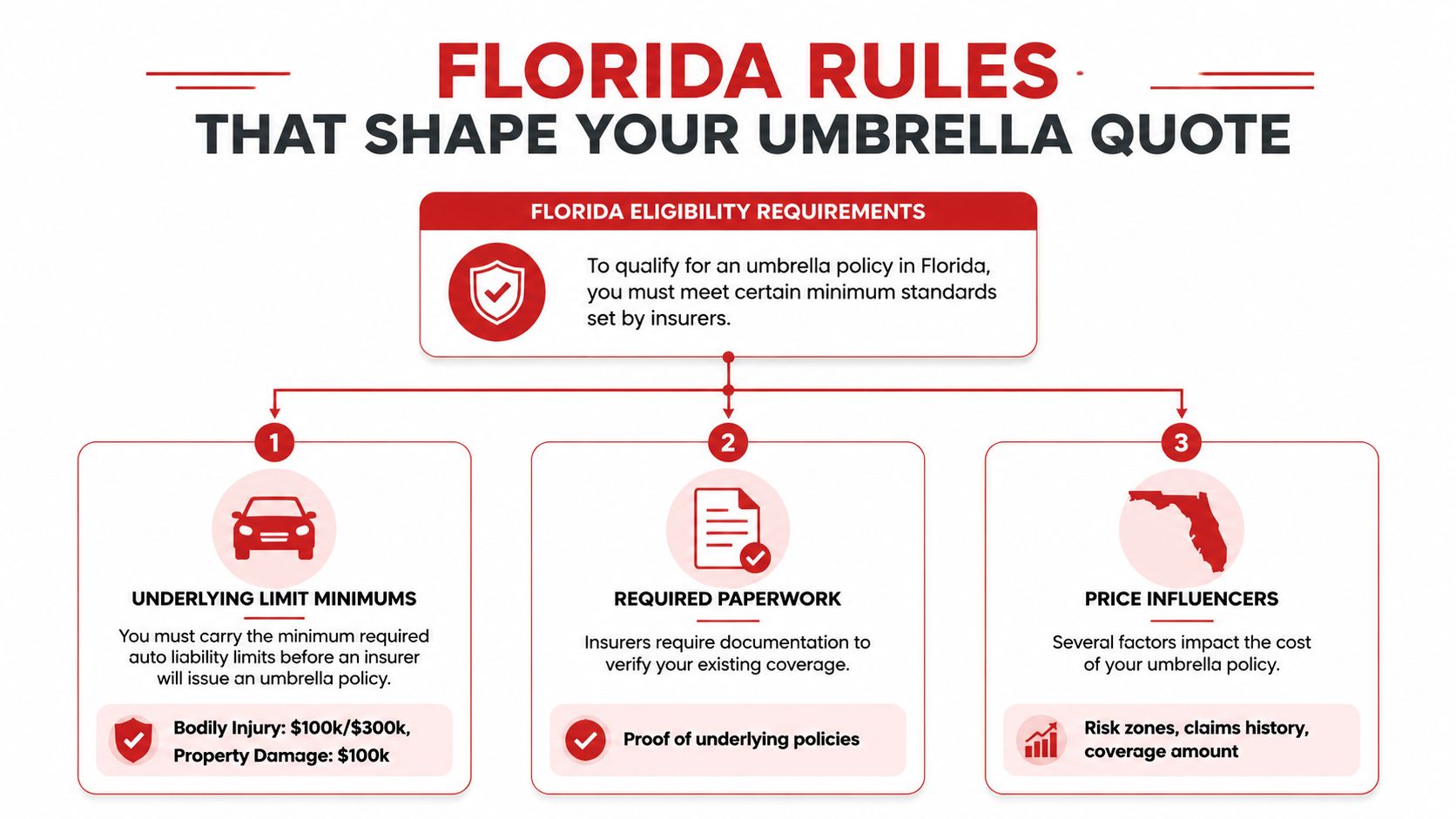
A Florida umbrella quote often starts with a question the homeowner did not expect, does your current liability coverage already carry enough weight to hold the umbrella up? That is the first underwriting gate, and many households run into it before price is even discussed. Auto policies usually need higher bodily injury limits, and homeowners or renters policies often need a much stronger personal liability layer before the umbrella will attach. The same idea appears in Florida underwriting guidance from insurance minimums for auto coverage, because the umbrella sits on top of the base policy, much like a second floor needs a solid foundation.
Why the base policy often has to move first
Florida drivers can register a vehicle without bodily injury liability, but that creates a practical problem for umbrella shoppers. Many carriers still want to see higher auto limits before they will issue the umbrella, so the base policy has to be adjusted first. The same can apply to the home policy. If the personal liability limit is too low, the quote may stop there, even if the household only wanted the extra layer.
That is the part that confuses many buyers. They ask for a high-limit umbrella, receive a quote, and then learn the carrier wants the auto and home policies changed before the umbrella can bind. The carrier is checking that the first layer can do its job before the second layer is added. A personal umbrella works like a safety net, but it needs the trampoline underneath it to be set up correctly.
If you want a plain-language overview of how the layers fit together, the broader umbrella policy insights for homeowners help explain why the structure matters before a claim ever happens.
Why certain Florida homes get pushed higher
Households with teen drivers, pools, boats, or rental properties often face more underwriting friction because the risk picture changes. Florida-focused guidance from GreatFlorida notes that umbrella limits are usually sold in $1 million increments, and higher-exposure families are often placed into larger layers. That does not mean every household needs the same amount. It means the carrier looks closely at what sits behind the umbrella before deciding what it is willing to offer.
| Rule Type | What It Usually Means in Florida | Why It Matters |
|---|---|---|
| Auto underlying limits | A higher auto liability limit is commonly required | The umbrella often will not attach until the base policy meets the carrier's standard |
| Home liability limit | A stronger personal liability limit is commonly required | The home policy has to support the excess layer |
| Coverage increments | Usually sold in $1 million increments | The buyer chooses the layer size, not a random amount |
| Higher-risk households | Pools, boats, teen drivers, rental homes | These households often need more umbrella capacity |
For families comparing options, the carrier's decision often comes down to stacking. If the auto policy, the home policy, and any watercraft or rental exposure do not line up cleanly, the quote can shift into a different market or require a different structure. That is why an umbrella quote in Florida is rarely just a price exercise. It is an underwriting check on the whole household.
Umbrella Insurance Compared to Other Liability Options
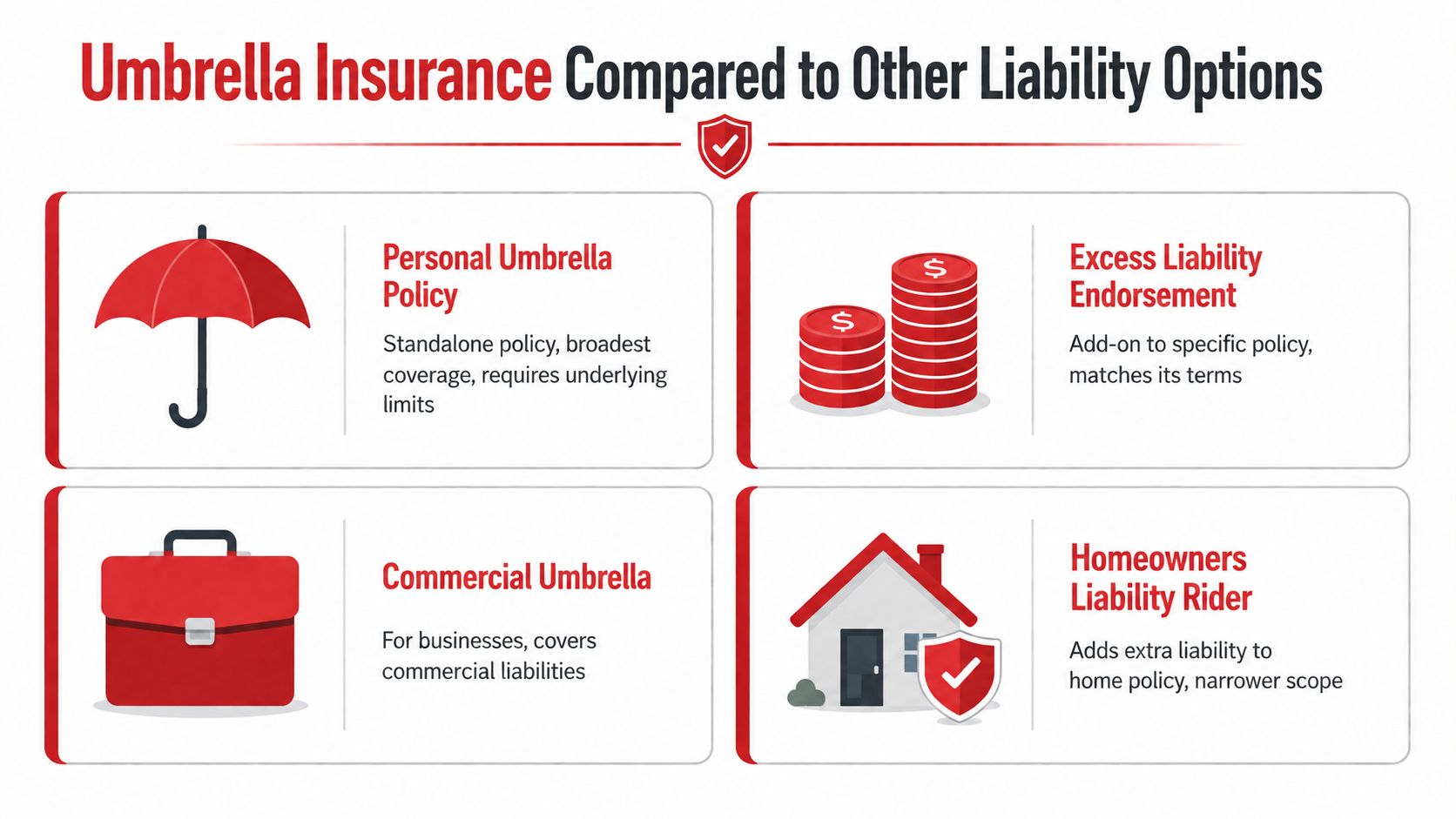
People use the word “umbrella” loosely, but the products are not interchangeable. A personal umbrella policy is a standalone liability layer that sits on top of your auto and home policies. An excess liability endorsement is usually tied to one specific policy and follows that policy's terms more closely. A commercial umbrella is built for business exposure, not personal errands or family driving. And a homeowners liability rider usually adds capacity to the home policy itself, which can be narrower than a true umbrella.
Which structure fits which household
A standard homeowner with only personal exposure usually wants the cleanest, broadest personal liability structure available. A family with a side business may need a commercial umbrella for the business piece and a personal umbrella for everything else. A landlord with a separate rental property may need a different combination depending on how the property is held and who is exposed.
The key is not to assume one liability product replaces all the others. A rider can be useful when you only need more room on the home policy, but it does not act like a full umbrella. An excess endorsement can be efficient if you're extending one specific policy. A personal umbrella is often the more flexible personal solution, but only when the underlying policies already meet the carrier's rules.
If you want a refresher on the policy your umbrella is going to sit above, home insurance basics for homeowners is a helpful way to think about the first layer before you add more liability protection.
A homeowner shouldn't shop umbrella coverage in isolation. The right answer depends on what the base policy already does well, and what it leaves exposed.
Florida households need to be careful with short-term rentals and boats. The coverage structure has to match the way the risk is used. A personal umbrella can be a strong fit for personal liability, but once business activity or specialized watercraft exposure enters the picture, the policy design deserves a closer look. The wrong structure can leave a gap even when the premium looked attractive.
What Umbrella Insurance Costs in Florida
Florida umbrella pricing is usually more approachable than people expect. A set of Florida market guides places a $1 million personal umbrella policy in a lower annual range, with each additional $1 million adding a smaller amount on top of that. The exact figure still changes from one household to the next, because the carrier is looking at city, driving history, home exposure, and how much underlying insurance is already in place. One Florida umbrella guide shows how widely the numbers can move once underwriting starts asking questions.
Why the number can look different from one city to another
Florida pricing is not one flat number. Market samples show that Orlando, Tampa, and Fort Lauderdale can all land in different bands for the same $1 million limit, and a statewide guide also notes that some low-risk households can see entry-level quotes near the lower end of the range. That spread makes sense once you remember how umbrella underwriting works. The carrier is not only selling extra liability, it is judging how likely the policy is to be used, and local exposure patterns can change that judgment.
A longer-term Florida analysis points in the same direction. It shows that the cost per $1,000 of insured value increased over time. That does not explain every quote by itself, but it helps explain why many homeowners remember older liability pricing as lower than the quotes they are seeing now. Underwriting standards have tightened in some places, and the quote reflects that pressure even before a carrier asks about boats, pools, or rental use.
What pushes a quote up or down
A clean driving record, fewer household drivers, and lower exposure can help keep the price closer to the lower end. A pool, a boat, rental activity, or a higher-risk household profile can push it upward. The quote is built the same way a lender looks at a loan application. The carrier checks the base risk first, then decides whether it is comfortable adding another liability layer on top.
Good rule of thumb: the least expensive umbrella quote usually sits on top of strong base policies and a simple risk profile.
Capacity matters too. A $1 million policy is the most common entry point, but households with more exposure often ask for more. The premium rises as the limit rises, although the underlying underwriting requirements often matter just as much as the limit itself. A carrier may like the premium level and still decline the application if the home, auto, or watercraft pieces do not fit its required structure.
How to Qualify and Buy an Umbrella in Florida
The easiest way to buy umbrella coverage is to start with the policies you already have. Pull out the auto declarations page and the homeowners or renters declarations page first. If the liability limits are too low, raise them before you apply for the umbrella. That order matters because many carriers will not issue the umbrella until the base policies meet the required thresholds.
The usual buying sequence
Most Florida households move through the process in the same general order. First, they confirm that the auto and home liability limits are high enough. Next, they decide whether $1 million is enough or whether the household exposure points toward a higher tier. After that, they submit the umbrella application, along with the proof the carrier asks for, such as driver license numbers for household members, vehicle VINs, property details, and any watercraft or recreational vehicle information.
If the household can't fit the standard admitted market, a specialty placement may be needed, and Florida surplus-lines disclosure paperwork can come into play. That disclosure matters because the buyer needs to know when the carrier is outside the standard market and what that means for service and placement. It's not a step commonly considered, but it can change the way the policy is issued.
What to gather before you ask for quotes
- Policy Declarations: Bring the auto and home declarations pages so the underwriter can see the liability limits.
- Driver and Vehicle Details: Have driver license information and VINs ready for every household vehicle.
- Property and Exposure Facts: Be prepared to describe pools, boats, rental activity, or other liability exposure.
- Rental and Watercraft Records: If you own a watercraft or a second property, have that information available up front.
Select Insurance Group, Inc. can also shop umbrellas alongside the base policies, which helps when a carrier wants the limits raised in a specific way before it will quote the excess layer. The practical benefit is fewer gaps between policies and less back-and-forth with underwriting. Select Insurance Group, Inc. is one place Florida households can use when they want the base policies and the umbrella lined up together.
Real Florida Households and Their Umbrella Outcomes
A standard Orlando homeowner with two adult drivers usually has the cleanest path. If the auto policy already carries the higher bodily injury limits and the home policy has enough personal liability, the household often qualifies for a straightforward personal umbrella quote. This is the kind of file that tends to stay in the admitted market because the exposure profile is simple and the paperwork is easy to verify.
A Tampa Bay family with a teen driver and a center-console boat looks different. The teen driver raises the auto exposure, and the watercraft adds another layer the carrier wants to understand before it will price the umbrella. That household may still qualify for a personal umbrella, but the quote can be more conditional because the carrier is checking whether the base policies and the boat liability structure are both strong enough to support the excess layer.
A Gulf Coast host with a second property used for short-term rentals is the most likely to encounter friction. Rental activity changes the risk conversation fast, especially if guests come and go frequently. That household may still get personal umbrella protection for personal exposure, but the rental piece can push the placement toward specialty underwriting or require separate handling of the property-side liability.
The same umbrella limit can sit on very different households, but the path to getting it approved is rarely the same.
Those differences are why Florida shoppers should look at underwriting as part of the cost, not separate from it. A quote that looks fine on paper can become more expensive or harder to place once the carrier sees boats, pools, teen drivers, or rental income. In Florida, the question is often not “Do I want umbrella coverage?” It's “What does my household have to look like before a carrier will write it?”
Key Takeaways and How Select Insurance Group Can Help
The decision checklist is simple. Confirm your base liability limits first. Decide whether $1 million is enough or whether your household exposure points toward $2 million to $5 million. Check for boats, pools, rentals, or a teen driver. Then ask whether the quote needs surplus-lines placement if your risk profile is outside the standard market. That order saves time and keeps you from shopping for an umbrella you can't yet qualify for.
Umbrella policies also raise a few recurring questions. A teen driver in your household can be covered if the auto structure is set up correctly. Short-term rental guests can change the underwriting picture fast, so the property has to be disclosed accurately. Legal defense is one of the main reasons people buy the coverage, because defense costs can pile up even when the claim is weak.
Select Insurance Group, Inc. can compare personal and commercial options across a broad carrier panel, which matters when Florida underwriting rules make one quote look cheap and another one impossible to place. The right fit isn't just about the premium, it's about whether the policy attaches when it should.
If you're ready to see what an umbrella would look like on top of your current Florida policies, visit Select Insurance Group, Inc. and ask for a quote review that checks your auto, home, and umbrella fit together. They can help you compare options, spot underwriting gaps, and line up the liability layers before a claim ever happens.