
You're standing in your condo after a leak, a storm, or a failed appliance, and the first call you make is to the association. That's where a lot of Orlando owners get a rude surprise. The HOA handles the building side, but your HO-6 policy is what decides whether your cabinets, flooring, furniture, and temporary living costs come out of your pocket.
That gap is the whole game in condo insurance Orlando. A cheap annual premium means nothing if the master policy stops at the bare walls and your own coverage is thin on interior damage, assessments, or loss of use. In Florida, that mistake gets expensive fast, because association costs, storm risk, and policy wording all hit the same wallet.
Table of Contents
- Why Orlando Condo Owners Face a Coverage Surprise
- What an HO-6 Policy Actually Covers
- Where the HOA Master Policy Ends and Yours Begins
- Hurricane Costs Beyond Premiums in Orlando
- What Condo Insurance Costs in Orlando Compared to Florida
- How to Get Accurate Quotes from Local Orlando Agents
- Your Condo Insurance Action Plan
Why Orlando Condo Owners Face a Coverage Surprise
A pipe bursts in a downtown unit, or a storm drives water into the building envelope, and the owner assumes the condo association will make things right. Then the adjuster points to the master policy, and the owner discovers the core issue: the building is covered, but the interior gap is theirs. That's the part many Orlando buyers never read closely enough.
Florida law makes the split even more important. Under Florida Statute 718.111(11), the association must insure the building to replacement cost based on an independent appraisal updated at least every 36 months, while the owner covers many of the items left outside that master policy, including personal property and interior finishes, as described in Florida condo coverage guidance from Florida condo insurance 101. That legal structure is why a unit can look fully protected on paper and still leave the owner exposed after a loss.
The mistake I see over and over
Owners shop condo insurance like it's a commodity. It isn't. The quote only matters after you know what the association insures, whether the policy is walls-in or bare-walls, and how much of the unit's interior you've personally upgraded.
Practical rule: if you haven't read the master policy declarations page, you don't know what you're buying.
That matters in Orlando because the city sits inside a broader Florida market where condo coverage costs and availability have shifted sharply. The statewide average condo premium has been estimated at $995 per year, compared with a $490 U.S. average, which is more than 2x higher, and Orlando's estimated average sits around $985 in the same analysis, with another Orlando-focused estimate at $764 per year for an HO-6 policy, according to NerdWallet's Florida condo insurance analysis. Those sticker prices look manageable until you see how much still isn't covered.
What actually surprises owners after a claim
The surprise is rarely the premium. It's the bill after the claim, the deductible, the interior rebuild, the hotel, and the HOA special assessment. If the association policy stops at the structure and your own policy only covers a basic interior, you're the one bridging the gap.
Orlando condo insurance works best when you treat it like a balance sheet, not a form. You need to know what the association owns, what you own, and where the claim turns from “building issue” into “your expense.”
What an HO-6 Policy Actually Covers
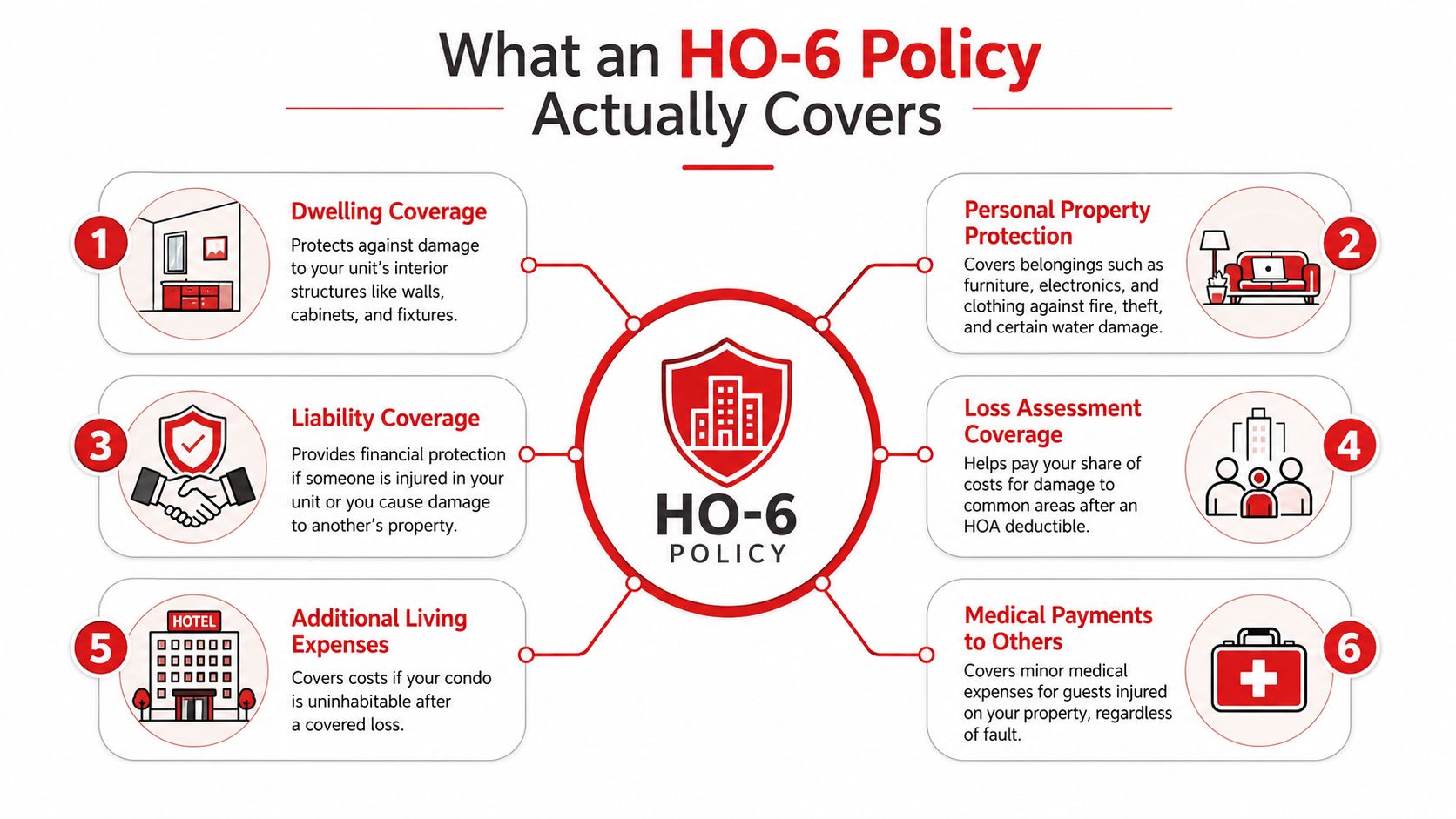
An HO-6 policy is a set of separate protections, and each one handles a different type of loss. If you know what each part pays for, you can stop wasting money on one area and leaving a bigger hole somewhere else.
The six parts that matter
- Dwelling coverage protects the parts inside the unit that belong to you, such as interior walls, cabinets, fixtures, flooring, and built-ins when the master policy does not cover them.
- Personal property protection covers your belongings, including furniture, electronics, clothing, and the items you would need to replace after fire, theft, or certain water losses inside the unit.
- Liability coverage protects you if someone gets hurt inside your unit or if you accidentally damage another unit.
- Loss-assessment coverage helps pay your share when the association bills owners after a covered common-area loss or a large deductible event. If you want a fuller explanation of how that bill gets triggered, this condo loss assessment guide is a useful reference.
- Additional living expenses help with hotel or temporary housing costs if a covered loss makes your unit uninhabitable.
- Medical payments to others can handle smaller guest injury bills without turning the claim into a fault fight.
Dwelling coverage pays for fixed items. Personal property coverage pays for the things you can pack up and move. Liability coverage protects you from claims that can turn into a lawsuit.
That split matters in Orlando after a storm. A unit with custom cabinets, upgraded counters, or higher-end flooring can need much more dwelling coverage than a basic builder-grade condo, and the replacement value of your belongings can run far higher than the default limit many owners carry. If the master policy leaves more of the interior on your side, your HO-6 has to pick up the difference or you pay it out of pocket.
For owners who rent or host guests, the line gets sharper. Guest injury, tenant damage, and loss of use can change fast once a unit is used as a rental, so it helps to understand the structure of rental-focused insurance too, including read about Global's rental insurance, even though your own condo policy still has to match the HOA rules.
The policy should match the actual rebuild, not the finish level that came with the unit.
That is the standard I use with owners. If your interior value is higher than the policy assumes, you are underinsured even if the contract is technically in force.
Where the HOA Master Policy Ends and Yours Begins
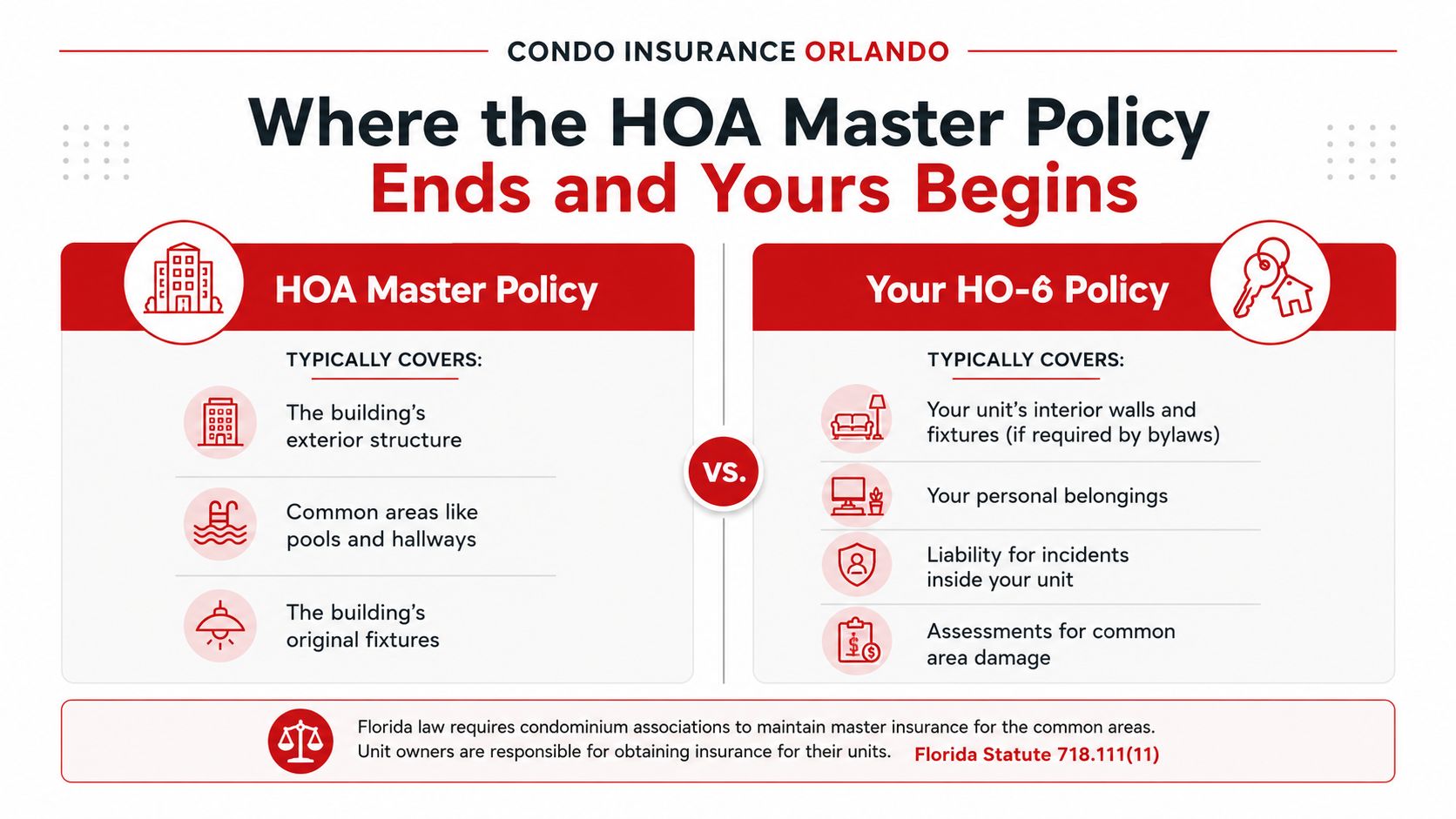
The cleanest way to see your exposure is to draw a hard line between the association's master policy and your HO-6 policy. In an Orlando condo, that line decides who pays for the interior after a loss, and it is where a lot of owners get surprised. The association insures what its declaration and policy say it insures, and you cover the parts left to the unit owner, including items many buyers assume sit under the HOA umbrella.
Read the master policy like a buyer, not a hopeful owner
Start with the declarations page. Look for the coverage wording, the deductible, and whether the building uses walls-in or bare-walls treatment. That single detail changes who pays for cabinets, countertops, appliances, fixtures, and interior finishes.
A declaration excerpt can make the difference plain. If it says the association insures the “building structure and common elements” but excludes “unit improvements and betterments,” you are on the hook for the upgraded interior unless your HO-6 fills that gap. If it says walls-in, the association may cover more of the interior shell. If it says bare-walls, expect the unit owner to carry more of the interior rebuild cost.
Florida condo guidance lays out that split clearly in Florida condo insurance 101. The point is not just what the master policy names, it is what it leaves out.
A lot of owners hear “the HOA covers the building” and stop there. That shortcut gets expensive. If your unit is damaged and the master policy restores only the original build-out, every upgrade above that level sits with you unless your HO-6 covers the difference.
Use the declaration sheet to test your risk
Ask a few specific questions. What part of the inside of the unit does the master policy cover. Which interior items are carved out. What deductible or assessment can come back to unit owners after a loss. In Orlando, those answers matter more than the marketing summary in the sales packet.
Practical rule: if the master policy is unclear, assume the gap is yours until the declaration page proves otherwise.
That is why I tell owners to request the master policy declarations page before they compare condo quotes. If the association handles common-area upkeep or exterior work, that tells you nothing about who pays when the loss hits the unit interior. A building can look well maintained and still leave you exposed for drywall, flooring, cabinets, and built-ins. If you are also trying to understand how assessments can shift part of a claim back to owners, review condo loss assessment coverage in Florida. HOA window cleaning services are part of maintenance, not insurance, and they do not answer who pays after a covered loss.
The clean takeaway is simple. Your HOA insures the building shell and shared space. You insure your unit's interior risk, your belongings, your liability, and the bills that can come back through assessments.
Hurricane Costs Beyond Premiums in Orlando
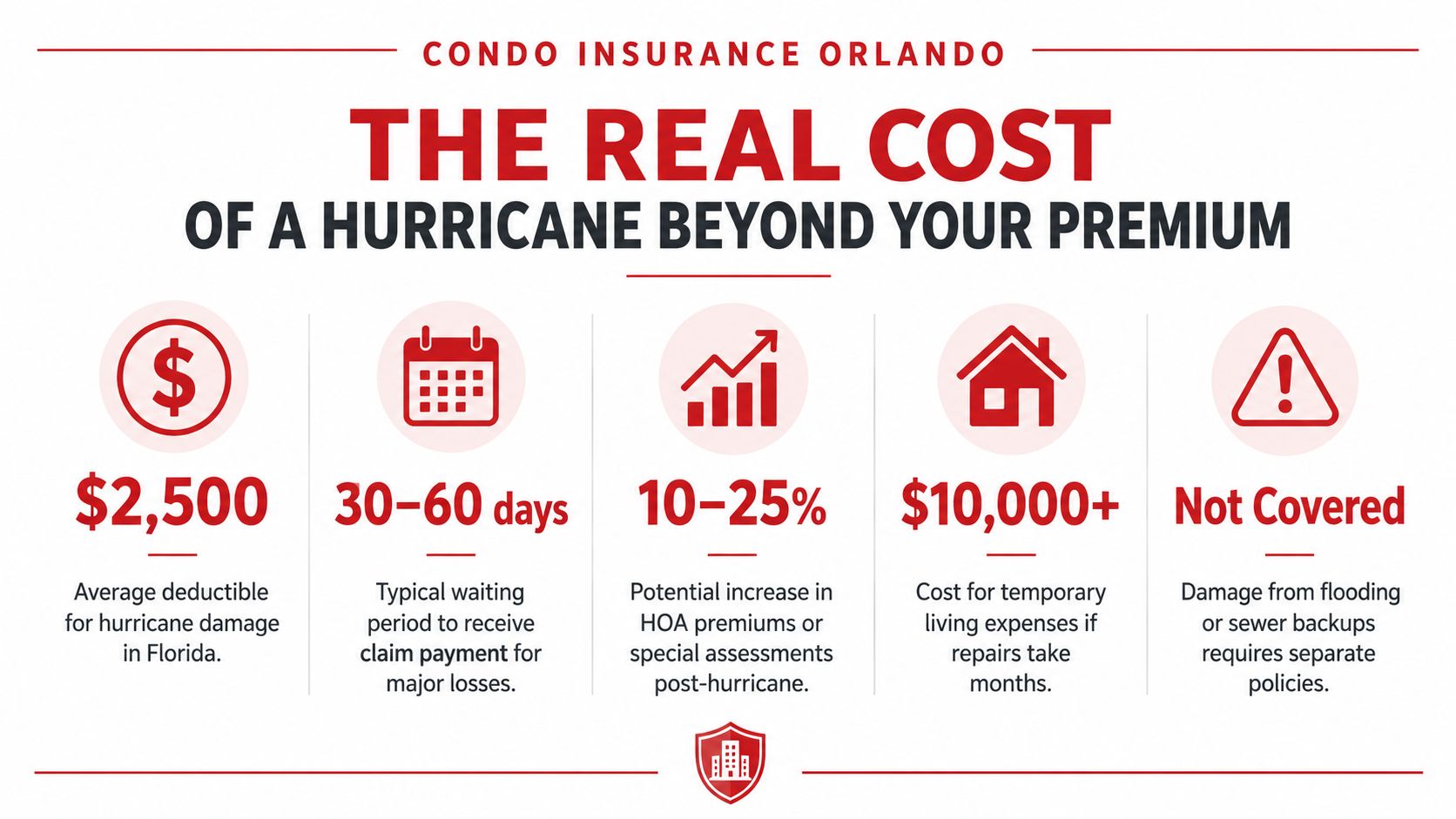
A storm rolls through Orlando, the roof holds, and the premium you paid all year still does not tell you what the claim will cost you. The bill shows up in layers. Your deductible hits first, then the unit interior, then any temporary housing costs, then the HOA's own chargebacks or assessments if the association pushes part of the loss back to owners.
The out-of-pocket layers most owners underestimate
Start with the deductible. If your HO-6 uses a percentage-based hurricane deductible, the cash you need before the insurer pays can be painful. Then look at water loss. Flood damage is not covered by a standard HO-6 policy, so storm surge and some water intrusion losses sit outside the policy unless you buy separate flood coverage. If you need a clean check on that point, read whether flood insurance is required in Florida.
The next layer is the association. Many Orlando owners learn too late that the HOA master policy has its own deductible, and the association can spread part of that cost back to unit owners as a loss assessment. After a major storm, that same association may also levy a special assessment for repairs, inspections, or reserve shortfalls. Florida's own insurance stability reporting has shown how fast condo association property insurance costs have climbed, and owners feel that pressure through dues and assessments long before they see a formal claim notice. For the underlying market context, see Florida OIR's January 2024 report.
An Orlando unit owner can also get hit by the interior finish problem. Drywall, flooring, cabinets, built-ins, and upgraded fixtures may fall on the owner if the master policy stops at the shell or at original construction standards. That is where the gap gets expensive. A condo can look fully covered on paper and still leave you paying for the exact parts of the unit you touch every day.
Why the premium can fool you
A low annual premium can hide weak coverage. That is the problem. If the HO-6 limit is thin, the loss assessment limit is too small, or you have no flood policy at all, the quote looks fine right up until the storm claim lands.
I have seen owners focus on the monthly or annual price and ignore the policy language that decides who pays after a loss. One unit had a manageable-looking premium and still faced a brutal repair bill because the interior upgrades were not fully covered and the association's deductible was pushed back through the owner invoice. Another owner kept the condo premium low, then found out that the basement-level water issue was a flood problem, not a standard HO-6 claim, and the repair money had to come from somewhere else. That is why the cleanest pricing benchmark is not the premium. It is the amount you could owe after a hurricane in your building, with your deductible, your finishes, and your HOA's billing rules.
If you also want to understand how unrelated underwriting choices can affect what you pay, read this insurance surcharge from a Florida speeding citation. It is a useful reminder that one line on a policy bill rarely tells the whole story.
Practical rule: if you cannot state your worst-case out-of-pocket number in plain dollars, you have not finished shopping.
That is the standard I use in real renewals. If the answer is fuzzy, the policy is too thin.
What Condo Insurance Costs in Orlando Compared to Florida
A condo owner in Orlando can get a quote that looks reasonable and still be underinsured when a storm hits. That is the trap. The premium may be close to the state average, but the key question is how much you would have to pay out of pocket after the HOA master policy, your deductible, and your interior coverage limits all do their part.
| Market | Average Annual Premium | Key Cost Drivers |
|---|---|---|
| Florida statewide | $995 per year, according to NerdWallet's Florida condo insurance analysis | hurricane exposure, market availability, building risk, policy structure |
| Orlando estimate 1 | $985 per year, according to the same analysis | coverage scope, building type, location, deductible choices |
| Orlando estimate 2 | $764 per year for an HO-6 policy with $40,000 personal property coverage, $100,000 liability coverage, and a $1,000 deductible, according to the Orlando-focused source cited in the same NerdWallet analysis | coverage limits, deductible, insurer appetite, interior upgrades |
| Orlando spread | $236 to $1,831 average, according to the Orlando-focused source in the same analysis | insurer, coverage level, and unit-specific underwriting |
Those numbers matter, but they do not tell the whole story. A cheaper quote can leave you exposed if the unit finishes are underpriced, the deductible is too high for your savings, or the loss assessment limit is too low for a big association claim. That is where Orlando owners get hurt, because the bill after a storm is usually larger than the premium difference they were chasing.
Why two similar condos can price very differently
The building matters, but the unit details matter just as much. Square footage, year built, construction type, renovation history, and whether the association uses walls-in or bare-walls coverage all affect pricing, which is why carriers ask for those details up front, consistent with the underwriting factors described by GEICO's condo insurance guidance. A newer high-rise with upgraded interiors can cost more to insure than a plain unit of the same size because the replacement-cost gap is bigger.
The market setup matters too. The Florida Office of Insurance Regulation reported that as of September 30, 2023, 87.34% of condominium unit owner policies were written by voluntary insurers and 12.66% by Citizens, the state-backed insurer of last resort, in the January 2024 stability report at Florida OIR's January 2024 report. That means most owners are still in the private market, but a meaningful share has already shifted into the residual market.
Keep the premium down without buying a hole
Trim the premium by changing the right parts of the policy, not by gutting the coverage that pays the claim. Increase the deductible from $500 to $1,000 only if you can comfortably cover that extra amount after a loss. Keep loss assessment coverage in line with what your association could charge back to unit owners, and do not let that limit sit at a token amount if your building carries a large master-policy deductible. If your unit has basic finishes, match the dwelling coverage to that reality. If you have upgraded cabinets, flooring, counters, and built-ins, price the interior replacement correctly instead of hoping a low limit will hold up.
One more thing. A broader insurance bill can move for reasons that have nothing to do with the condo itself. For a separate example, see the explanation of insurance surcharge from a Florida speeding citation. The point is simple. The cheapest condo quote is useless if it leaves you paying the association bill, the interior rebuild, and a deductible you cannot absorb.
How to Get Accurate Quotes from Local Orlando Agents
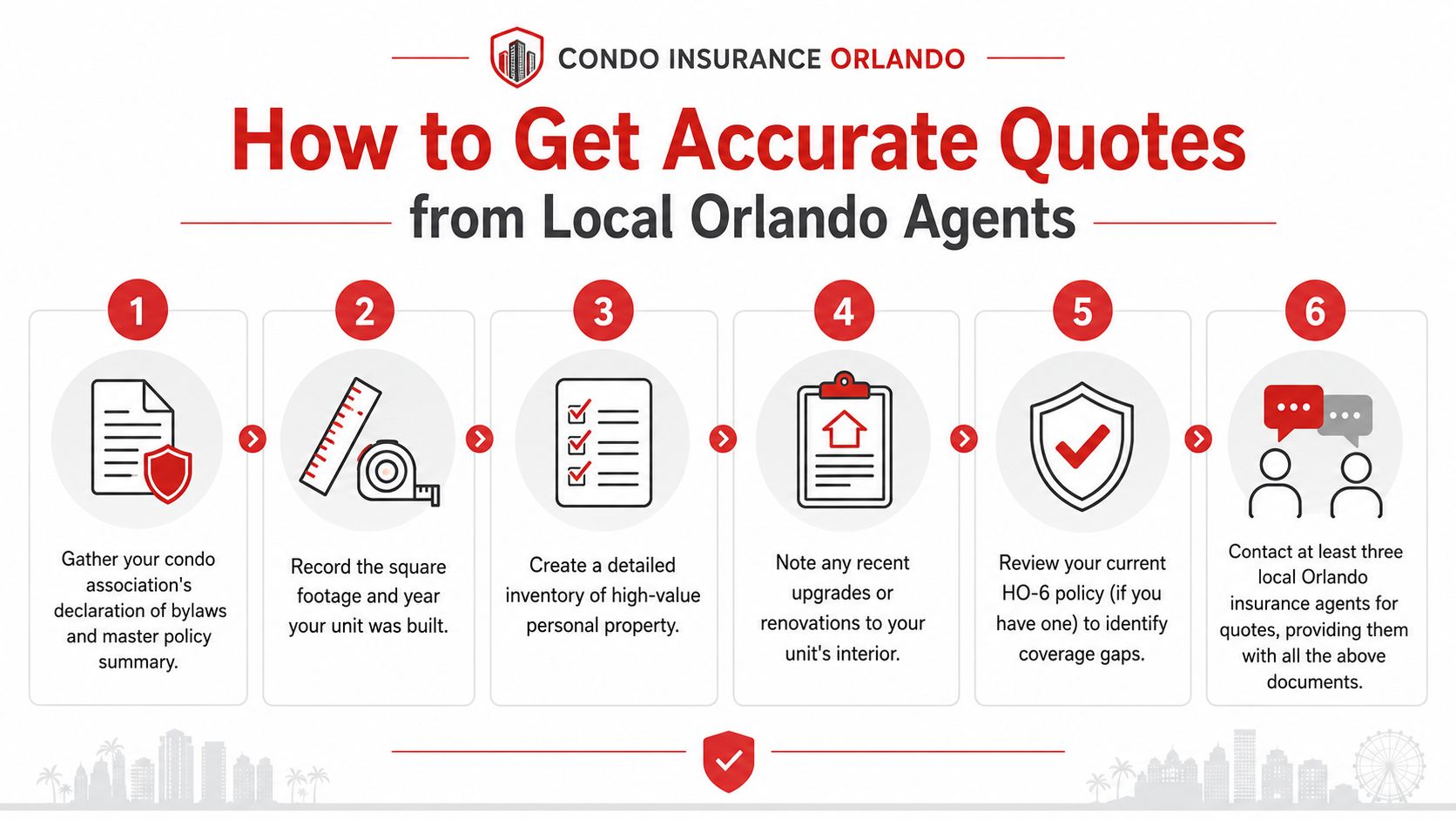
A condo quote in Orlando can look cheap on paper and still leave you exposed after a storm. The gap usually shows up in the master policy, the HOA deductible, the interior rebuild, or a weak loss assessment limit. Give an agent vague details, and you get a generic number. Give the right building documents, and you get a quote that reflects the actual risk.
The documents you need before you call
- Master policy declarations page: Ask for the declarations page and the association bylaws, then confirm whether the building uses walls-in or bare-walls coverage under Florida Statute 718.111(11). That detail tells the agent what the HOA insures and what rolls into your HO-6.
- Flood policy declarations page, if the building requires it: Many Orlando owners discover too late that flood sits outside standard condo coverage. Keep the flood declarations page with the condo file if your lender or association requires it.
- Unit facts that match the building, not a generic condo: Give the square footage, year built, construction type, floor level, and whether the association's policy stops at the drywall or covers more interior components. Those details change the quote more than a rough address ever will.
- Upgrade list for the interior: Write down cabinets, counters, flooring, built-ins, appliances, and any custom work. The rebuild number should reflect the finishes inside your unit, not the basic shell the building came with.
- Belongings inventory with real replacement values: If you own higher-value property, say so. A guess on contents coverage leaves you underinsured after a claim.
- A quote from more than one local independent agent: If you want a cleaner read on price and policy language, compare options through Select Insurance Group's Orlando condo insurance agency page and ask for a side-by-side review of the coverage assumptions.
Orlando condo insurance gets misquoted when the agent has to fill in the blanks. A local agency can read the building paperwork, spot the master-policy boundary, and match the quote to the unit you own. Select Insurance Group, Inc. does that work directly, which matters when the difference between a thin quote and a proper one is the part of the loss you would otherwise pay yourself.
What to ask before you bind coverage
Practical rule: ask for the deductible, the loss assessment limit, and the interior coverage assumption in writing.
Then ask one more thing, what the quote assumes about the HOA master policy. If the agent cannot tell you whether the building is walls-in or bare-walls, the quote is too loose to trust. If the deductible or loss-assessment number is buried, assume you will be surprised later.
Bring the master policy page, the unit details, and the upgrade list to the call. Compare the quotes side by side and check the policy language, not just the premium. That is how Orlando condo owners avoid paying for a cheap quote that collapses when the claim hits.
Your Condo Insurance Action Plan
Review the master policy first, because that tells you where the HOA stops and your policy starts. Then measure your real exposure after a storm, including interior rebuild costs, deductible risk, assessments, and the fact that flood is outside standard condo coverage.
Next, pull together the right documents and ask for quotes that reflect your actual unit, not a generic condo file. Then schedule a yearly review, because building rules, association costs, and your own interior value don't stay still.
If you want a straight comparison of Orlando condo coverage options, use an independent agency that can read the master policy with you and quote multiple carriers. That's the cleanest way to close the gap before the next claim forces the issue.
Select Insurance Group, Inc. helps Orlando condo owners compare coverage options, understand the master-policy boundary, and get free, no-obligation quotes from multiple carriers. If you want a clear read on what your HOA covers and what your HO-6 needs to pick up, visit Select Insurance Group, Inc. and ask for a condo insurance comparison built around your building, not a generic estimate.