
A customer slips near the entrance of your Knoxville shop after rain, or a contractor's crew damages a client's flooring while completing a renovation. The owner may believe the incident is minor, but medical bills, repair costs, legal defense, and contract obligations can turn a simple complaint into a serious business expense.
That's where Knoxville general liability insurance fits. It can help protect a business when someone outside the company alleges bodily injury, property damage, or certain personal and advertising injuries connected with the business. Tennessee's fault-based legal system makes that protection especially relevant because the party found responsible for a loss can be financially liable for damages.
This guide explains what general liability covers, why Tennessee contractors and Knoxville landlords often request proof of insurance, how local pricing ranges can vary, and which risks require separate policies. It also gives you a practical way to compare coverage without treating a standard limit as a universal answer.
Table of Contents
- What Knoxville Business Owners Need to Know About General Liability
- Understanding What General Liability Actually Covers
- Tennessee Rules and Local Contract Requirements That Drive Coverage Decisions
- Knoxville General Liability Cost Ranges and What Drives Pricing
- Common Coverage Gaps and When General Liability Is Not Enough
- How to Get General Liability Insurance in Knoxville and Compare Quotes
- Frequently Asked Questions About Knoxville General Liability
What Knoxville Business Owners Need to Know About General Liability
A flooring contractor in West Knoxville finishes a job and leaves a tool beside a walkway. The customer trips, reports an injury, and requests payment for treatment. Even when the contractor disputes responsibility, the allegation can require investigation, legal advice, and settlement discussions.
Knoxville general liability insurance is built for covered third-party claims involving people outside the business, such as customers, visitors, clients, vendors, or other members of the public. It may help with qualifying bodily injury, property damage, and certain related legal costs, subject to the policy's exclusions, limits, and conditions.
The coverage is not a promise that every complaint will be paid. It is a financial framework for claims connected with the business's operations.
Tennessee uses an at-fault system. A person or business found responsible for a loss may owe damages, which makes liability planning part of operating in Knoxville. For example, a Market Square retailer with steady pedestrian traffic faces different premises concerns from a Halls-based contractor working at customers' properties. Their limits, deductibles, and endorsements should not be selected from the same template.
A certificate of insurance can satisfy a customer's or general contractor's paperwork requirement. It does not replace the policy. The policy wording determines whether a covered claim receives a defense or payment.
Tennessee's minimum auto liability limits are $25,000 per person and $50,000 per accident for bodily injury, plus $25,000 per accident for property damage, as described in Knoxville auto insurance information. Those limits apply to auto liability, not general liability. The distinction matters for businesses using vans, trailers, deliveries, or mobile crews because a vehicle accident may fall under a different policy.
Contractors may also face insurance requests tied to licensing, subcontractor agreements, or commercial project requirements. A home-based consultant, landscaping crew, retailer, and commercial contractor can therefore need different coverage structures even when each carries general liability.
Understanding What General Liability Actually Covers
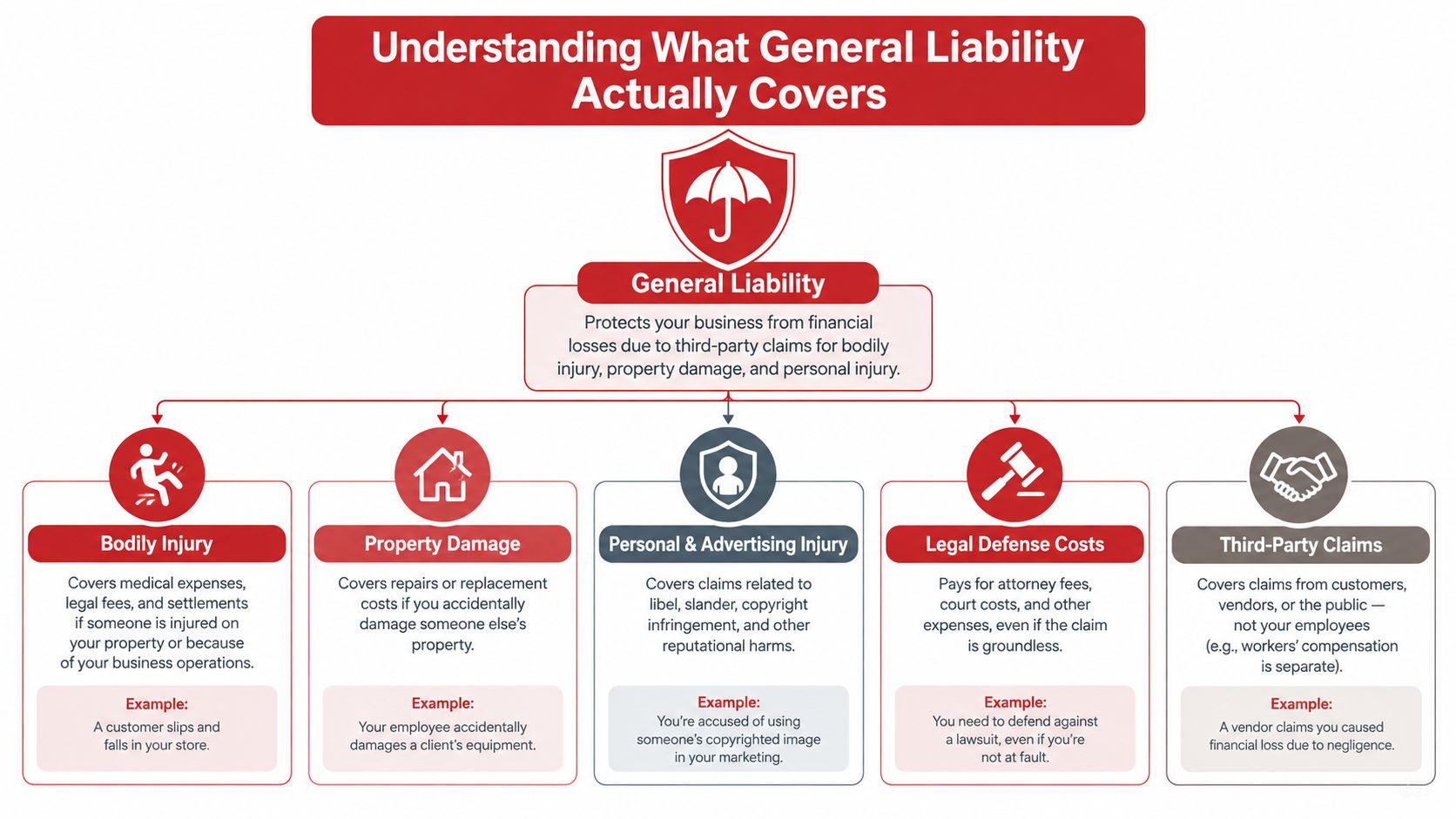
General liability works like financial armor for certain claims made by people outside your company. The protection usually centers on four practical areas, though exact coverage depends on the policy language, exclusions, limits, and endorsements.
Bodily injury applies to allegations that your business caused physical harm to another person. A customer could slip inside a Knoxville retail shop, or a visitor could trip over equipment at a service location. The policy may help with covered medical costs, defense, and settlements or judgments within the policy terms.
Property damage concerns damage to someone else's property. A contractor might break a client's window while moving materials, or a cleaning company might damage flooring with an unsuitable product. General liability isn't a guarantee for defective workmanship itself, but it may respond to covered damage caused during operations.
Personal and advertising injury addresses certain nonphysical injuries, such as specific allegations involving libel, slander, or advertising-related offenses. The wording is technical, so a business shouldn't assume that every dispute involving a social media post, advertisement, or business name automatically qualifies.
Medical payments coverage can address certain minor medical expenses for a third party without requiring the business owner to establish fault, subject to policy conditions. It can sometimes resolve a small incident efficiently, but it doesn't replace the broader liability investigation process.
The boundary matters
General liability typically isn't property insurance for your building, tools, inventory, or contents. It also isn't workers' compensation, commercial auto, cyber coverage, professional liability, or business interruption protection. A business that confuses these categories can buy a valid policy and still have no coverage for the loss it encounters.
For another plain-language discussion of liability planning, the Overton Security liability guide can provide useful background.
A simple hierarchy looks like this:
- Business protection strategy
- General liability, third-party injury and property-damage claims
- Commercial property or a BOP, business property and, when included, business interruption
- Workers' compensation, employee work injuries
- Commercial auto, business vehicle exposure
- Specialty coverage, cyber, employment practices, professional, or other targeted risks
The key question isn't only, “Do I have liability insurance?” Ask, “Which person, property, vehicle, employee, or income stream could create a loss, and which policy is meant to address it?”
Tennessee Rules and Local Contract Requirements That Drive Coverage Decisions
Many Knoxville businesses buy general liability because someone requires proof, not because a single Tennessee statute requires every small business to carry it. Most small businesses don't need general liability by law, but contractor licensing, landlords, municipalities, and private clients often make coverage a condition of doing business.
That distinction affects how you shop. A contractor may need a certificate before bidding or starting work. A tenant may need to name a landlord as an additional insured. A vendor working at a public facility or private event may need evidence that its policy meets the contract's requirements.
Contract terms often set the practical limit
A contract may specify liability limits, additional-insured wording, completed-operations coverage, or a certificate deadline. Many commercial relationships use $1 million/$2 million limits as a starting point, but that isn't a universal legal rule or a recommendation for every business. The appropriate limit depends on the work, the contract, the public exposure, the assets at risk, and the consequences of a serious claim.
Before requesting a quote, read the contract instead of guessing. A policy with a low premium may fail the client's requirements, while a policy with broad limits may include features your operation doesn't need.
Tennessee fault rules add context
Tennessee is an at-fault state, so the party found responsible for a loss can be financially liable for damages. That principle applies beyond auto accidents. It helps explain why a business owner may want liability protection even when no license, lease, or client has demanded a certificate.
A contractor reviewing commercial work can also use the Tennessee general liability insurance resource to organize questions about limits, certificates, and business activities. The goal is to match the policy to the actual obligation, not to purchase a generic document and hope it satisfies the next contract.
Knoxville General Liability Cost Ranges and What Drives Pricing
A Knoxville consultant working from a home office may receive a very different liability quote than a roofing contractor, restaurant, or mobile repair business. Pricing reflects the work, the people exposed to it, and the size of a possible claim.
Market references place monthly general liability estimates at about $32 to $94, while another estimate lists $33 to $125 per month for $1 million/$2 million limits, according to Tennessee small-business insurance pricing context. These figures are guideposts, not guaranteed Knoxville quotes. One estimate places Tennessee pricing roughly 6% below the national average, while broader 2026 market context puts the small-business general liability average at about $45 per month.
| Coverage Scenario | Typical Monthly Range |
|---|---|
| Knoxville general liability market reference | $32 to $94 |
| Knoxville small-business estimate for $1M/$2M limits | $33 to $125 |
| Broader 2026 small-business general liability average | About $45 |
The gap between two quotes often starts with classification. An office-based consultant presents a different physical risk from a contractor entering customer homes or a restaurant serving the public. Underwriters may review:
- Business classification, including whether the work is office-based, hands-on, or public-facing.
- Revenue and customer volume, which indicate the scale of operations and potential exposure.
- Claims history, including the type and frequency of previous losses.
- Coverage limits, deductibles, endorsements, and additional-insured requirements.
- Work locations and subcontractors, especially when crews visit Knoxville homes, commercial sites, or construction projects.
A business with more customers, more job sites, or more physical work generally gives an insurer more situations to evaluate. A clean claims record can help, although it does not erase the risks tied to the trade itself.
Renewal pricing can also change even when a business has had no claim. Insurers continue to examine litigation severity and large verdicts, particularly for operations with frequent public contact. That broader market pressure does not set one owner's premium, but it can lead to closer review of contracts, safety practices, subcontractors, and prior losses.
Practical rule: Compare quotes only after confirming that each carrier is rating the same operations, limits, endorsements, and payroll or revenue information.
The lowest proposal may leave out an endorsement or describe the business incorrectly. Ask what changed between quotes, then compare the protection line by line.
Common Coverage Gaps and When General Liability Is Not Enough
General liability is important, but it isn't a complete business-protection plan. Knoxville owners often discover the difference after assuming one policy covers every loss involving the company.
A mobile contractor may believe general liability covers a crash involving a work vehicle. Usually, vehicle-related exposure belongs under commercial auto or hired and non-owned auto coverage, depending on who owns the vehicle and how it's used. A delivery business, repair company, or contractor should disclose vehicle use instead of assuming a personal auto policy or general liability policy will respond.
Employee-related risks also sit elsewhere. Employee injuries generally belong under workers' compensation, not general liability. Employers should review what workers' compensation insurance covers when evaluating workplace protection, particularly as staffing, job duties, and Tennessee requirements change.
Four gaps deserve a direct conversation
Cyber liability may be relevant when a business stores customer information, accepts digital payments, or depends on connected systems. A general liability policy isn't a substitute for coverage designed around data incidents and cyber response.
Employment practices liability addresses certain allegations involving employees, such as harassment, discrimination, or wrongful termination. General liability doesn't generally fill that role.
Business interruption concerns lost income and continuing expenses after a covered property event forces a closure. Standalone general liability doesn't cover buildings, contents, or lost income. A BOP can bundle general liability with property and business interruption coverage, but the exact terms still need review.
Professional liability may matter for advice-based work. A consultant, designer, engineer, or other service provider can face allegations that the advice or professional service caused financial harm, which isn't the same as third-party bodily injury or property damage.
A coverage review should map the business from end to end: people, premises, vehicles, data, advice, equipment, inventory, and income. That approach is more reliable than adding policies based only on what a client happens to request.
How to Get General Liability Insurance in Knoxville and Compare Quotes
Start with an accurate description of the business. List every service, work location, employee role, subcontractor relationship, vehicle use, annual revenue, and property exposure. A vague description can lead to an inaccurate classification, which may affect both the quote and the claims process.
Next, collect the contract requirements. Identify requested limits, additional-insured language, waiver wording, completed-operations requirements, and certificate deadlines. If a landlord, general contractor, municipality, or client provided insurance instructions, give those documents to the agent before the quote is prepared.
Use a consistent comparison process
- Request multiple carrier options. Comparing more than one insurer can reveal differences in price, eligibility, exclusions, and endorsement availability.
- Match the limits. Don't compare a lower-limit quote against a higher-limit quote and call the cheaper one a savings.
- Review exclusions. Ask about vehicles, subcontracted work, professional services, employee claims, cyber events, and property damage.
- Confirm certificates. Make sure the agency can issue the proof your contract requires and that the certificate reflects the policy accurately.
- Revisit the policy after growth. New employees, vehicles, services, locations, or larger contracts can change the appropriate coverage.
An independent agency can compare available carriers while keeping the discussion focused on your actual operations. Select Insurance Group, Inc. offers commercial insurance options, bilingual assistance, access to multiple carriers across Tennessee, and free quote support. You can also review its Knoxville commercial insurance options when organizing a broader business-insurance review.
Frequently Asked Questions About Knoxville General Liability
Is general liability legally required in Tennessee?
Not for most small businesses as a blanket rule. In practice, contractor licensing, leases, municipal work, and customer contracts often require proof of coverage before work begins.
Is a BOP better than standalone general liability?
It depends on the business. A BOP can combine general liability with commercial property and business interruption coverage, while standalone general liability doesn't protect buildings, contents, or lost income. A business with little property exposure may need a different structure than a storefront or workshop.
Should limits change as the business grows?
They may need to. Review limits when revenue, customer volume, contract size, public exposure, locations, or services increase. Treat $1 million/$2 million as a contract-driven starting point in some situations, not as a universal answer.
Which Knoxville businesses face the most contract pressure?
Contractors, subcontractors, vendors, commercial tenants, event businesses, and companies serving municipalities or larger clients commonly encounter certificate and limit requirements. The exact wording varies by contract.
What should I do before requesting a quote?
Prepare your business description, revenue, payroll information, claims history, services, locations, vehicle use, and current contracts. Accurate details help an agent compare policies that fit the work.
Select Insurance Group, Inc. can help Knoxville business owners review general liability, commercial property, workers' compensation, commercial auto, and related coverage through multiple carrier options. Visit Select Insurance Group, Inc. to request a free, no-obligation quote review and discuss the limits and endorsements your Tennessee contracts require.