
Tennessee's commercial auto minimum is 25/50/15, and commercial auto premiums average about $229 per month, or $2,744 annually statewide (Tennessee coverage guidance, premium benchmark). That legal floor is only a starting point for most Knoxville contractors, service companies, and fleets.
The question usually arrives after a close call. A technician backs a van into another vehicle, an employee uses a personal SUV for deliveries, or a contractor rents a box truck for a busy week. The owner assumes the existing personal policy or general liability policy will respond, then discovers that the vehicle use, driver, cargo, or liability limit falls outside the contract.
That gap is avoidable. Knoxville businesses need to match the policy to who drives, what the vehicle carries, where it travels, and how often it operates for work. Tennessee law establishes the minimum, but local crash exposure, uninsured drivers, vehicle type, driver history, and the broader commercial auto market determine whether that minimum is sensible.
Table of Contents
- What Business Auto Insurance Actually Does for Knoxville Businesses
- Core Coverages and Endorsements Contractors and Fleets Rely On
- How Tennessee Rules and Knoxville Driving Conditions Set the Price
- When Personal Auto Stops Being Enough for Work Driving
- Evaluating Your Needs and Getting Competitive Quotes
- Why Two Similar Knoxville Fleets Get Very Different Quotes
- Smart Ways to Lower Premiums and Handle Claims With Confidence
What Business Auto Insurance Actually Does for Knoxville Businesses
Tennessee's commercial auto liability floor is 25/50/15. That means $25,000 for bodily injury to one person, $50,000 for bodily injury in one accident, and $15,000 for property damage in one accident. A commercially registered vehicle used for business must satisfy the state's liability rules, but compliance and adequate protection are different decisions.
A commercial auto policy is a contract between your Knoxville business and an insurer. Your business pays the premium, follows the policy conditions, and reports material changes. The insurer pays covered losses involving vehicles titled to the business or used in the business, subject to the selected limits, deductibles, exclusions, and endorsements.
That distinction matters because personal auto insurance generally excludes business use. A personal policy may cover commuting or errands, yet respond differently when the driver is delivering products, visiting job sites, transporting tools, or performing a paid service. Tennessee commercial auto guidance explains that commercial policies can address multiple drivers, multiple vehicles, hired and non-owned exposure, and higher liability limits.
Knoxville exposure changes the decision
Knoxville vehicles operate around freight traffic, busy interchanges, construction zones, dense commercial corridors, and changing weather. A service van making repeated stops faces a different exposure from an employee's sedan used occasionally for a meeting.
Local data makes the risk concrete. A Knoxville-focused insurance source reports 4,163 annual crashes, a crash rate of 2,019 per 100,000 people, and an uninsured-driver rate of 17.8% in the Knoxville area. Those conditions affect the coverage conversation, especially for businesses whose vehicles spend most of the day on local roads.
Practical rule: Treat 25/50/15 as the legal starting line, not as a recommendation for a business that carries employees, equipment, inventory, or contractual obligations.
The policy's core promise has three parts. Liability coverage protects the business when an insured driver causes injury or property damage. Physical damage coverage can address covered collision, theft, weather, and other damage to scheduled vehicles. Hired and non-owned auto coverage can address qualifying rented vehicles and employee-owned vehicles used on company business.
Many Knoxville businesses ultimately choose limits far above the state minimum, sometimes into the hundreds of thousands or $1 million in liability protection, depending on contracts and operating risk. The right limit depends on the business, but the wrong limit can leave the owner personally responsible for the difference.
Core Coverages and Endorsements Contractors and Fleets Rely On
Liability is the foundation. If a company driver causes a collision, liability coverage addresses covered bodily injury and property damage claims up to the policy limit. For a Knoxville contractor driving between job sites, a single accident can involve several injured people, vehicle repairs, lost income claims, and legal defense costs.
The 25/50/15 minimum may satisfy the state requirement, but it can be inadequate when a business operates several vehicles or places employees on busy roads. Higher limits provide more room before the business's assets and cash flow become the next source of payment.
Build the policy around actual vehicle use
Uninsured and underinsured motorist coverage deserves serious attention in Knoxville. With the area's reported 17.8% uninsured-driver rate, a business vehicle can be damaged by someone who can't fully pay for the loss. This coverage can help protect the business and occupants when the other driver has no insurance or insufficient limits, subject to the policy terms.
Collision and coverage address different physical damage events. Collision generally applies to covered impacts. This coverage generally addresses non-collision events such as theft, hail, falling objects, animal strikes, or weather-related damage. A contractor with tools in a van should also ask whether tools and equipment are covered under the auto policy, a property policy, or another form. The vehicle can be insured while its contents remain subject to a separate limitation or exclusion.
Other endorsements become important at the edges of normal operations:
- Hired and non-owned auto: Helps address qualifying rentals and employee-owned vehicles used for company business.
- Medical payments or elected personal injury protection: Can provide limited benefits for eligible medical expenses, subject to the selected coverage and Tennessee rules.
- Drive-other-car coverage: May matter for an owner or executive who regularly drives a company vehicle but also needs personal-use protection.
- Motor carrier cargo: Fits businesses transporting customers' property, materials, or goods.
- Hired physical damage: Can address physical damage exposure for qualifying rented vehicles.
- Trailer interchange: Matters when a business has contractual responsibility for another party's trailer.
- Umbrella or excess liability: Adds protection above underlying limits when contracts or severe-loss exposure justify another layer.
| Coverage | What It Pays For | Knoxville Use Case |
|---|---|---|
| Liability | Covered injury and property damage claims caused by an insured driver | Contractor vans, delivery vehicles, and company pickups |
| Uninsured or underinsured motorist | Eligible losses involving a driver without enough insurance | Local service routes and collision exposure |
| Collision | Covered damage from an impact | A fleet vehicle damaged in traffic or at a work site |
| Comprehensive | Covered non-collision damage | Theft, hail, animal strikes, and weather losses |
| Hired and non-owned auto | Qualifying rented or employee-owned vehicle exposure | Employee deliveries or a temporary rental |
| Cargo | Covered customer property being transported | HVAC materials, roofing supplies, or delivered goods |
| Trailer interchange | Covered responsibility for another party's trailer | Contracted hauling arrangements |
| Umbrella or excess | Additional liability limits above underlying policies | Larger projects and higher contract requirements |
Select the endorsements based on the operation, not on a generic package. A small electrical contractor may need a different structure from a trucking operation, even if both have only a few vehicles.
How Tennessee Rules and Knoxville Driving Conditions Set the Price
Insurers don't price Knoxville business auto from the vehicle count alone. They examine the required liability structure, territory, vehicle class, driver records, mileage, use, claims history, limits, and deductibles.
The state minimum remains 25/50/15, with $25,000 per person, $50,000 per accident, and $15,000 for property damage. Serious driving violations can create additional filing and underwriting complications. Commercial filings also operate differently from personal insurance filings, so a business should disclose the actual operation rather than assume a personal-policy process applies.
Knoxville's driving environment adds another layer. The local source reports 4,163 annual crashes and a 2,019-per-100,000 crash rate, while also reporting 17.8% uninsured drivers. Those figures don't determine an individual quote, but they help explain why insurers examine frequent urban driving, delivery schedules, and loss history closely.
A reported average Tennessee auto claim cost of $16,979 also shows why a business shouldn't evaluate coverage only by the monthly premium. One serious loss can cost far more than routine premium savings.
The inputs underwriters actually weigh
| Pricing Factor | Knoxville-Specific Detail | Effect On Premium |
|---|---|---|
| Liability limits | State minimum is 25/50/15, while business exposure may require much higher limits | Higher limits generally increase premium |
| Territory | Frequent local trips, commercial corridors, and dense traffic create regular exposure | More road exposure can increase cost |
| Vehicle class | Cargo vans, pickups, flatbeds, and heavier trucks don't carry the same risk | Larger or specialized vehicles may cost more |
| Driver history | MVRs, violations, experience, and assigned vehicles affect eligibility and price | Poor records can raise premium or restrict options |
| Mileage and use | Delivery, service, hauling, and passenger use create different patterns | More frequent or intensive use can increase cost |
| Loss history | Prior frequency and severity influence underwriting | Repeated losses can raise renewal pricing |
| Deductible | The business chooses how much physical damage loss it retains | A higher deductible can reduce premium, but increases out-of-pocket cost |
The statewide benchmark is about $229 monthly, or $2,744 annually, but it isn't a promise for a Knoxville business. Towing, trucking, heavier vehicles, multiple drivers, and adverse loss history can move the quote substantially higher. Price the policy against the operation you run.
When Personal Auto Stops Being Enough for Work Driving
The boundary is simple: occasional commuting is personal use, while transporting people, tools, materials, or products for a business can create commercial exposure. The problem is that owners often cross that boundary gradually.
A West Knoxville contractor may use a personal pickup to carry tools to a job. A florist in Bearden may use a personal SUV for deliveries. An independent plumber may carry equipment every day while assuming the vehicle remains personal because the title is in the driver's name. A contractor may also rent a box truck during a busy period without arranging hired physical damage or liability protection.
Four common boundary cases
- Personal pickup with occasional job travel: Personal coverage may not respond fully when the vehicle regularly carries business equipment or serves business customers. Ask for a commercial classification or appropriate endorsement before the pattern becomes routine.
- Personal SUV making deliveries: Delivery use is a direct business trigger. A personal policy may exclude or restrict the claim, leaving the owner and business exposed.
- Independent contractor using a personal vehicle: The business should determine whether the driver is independent, whether the business controls the work, and whether hired and non-owned auto coverage is needed.
- Short-term box-truck rental: Confirm liability, physical damage, rental contracts, and cargo responsibility before taking possession. Don't assume the business's existing policy automatically follows the rental.
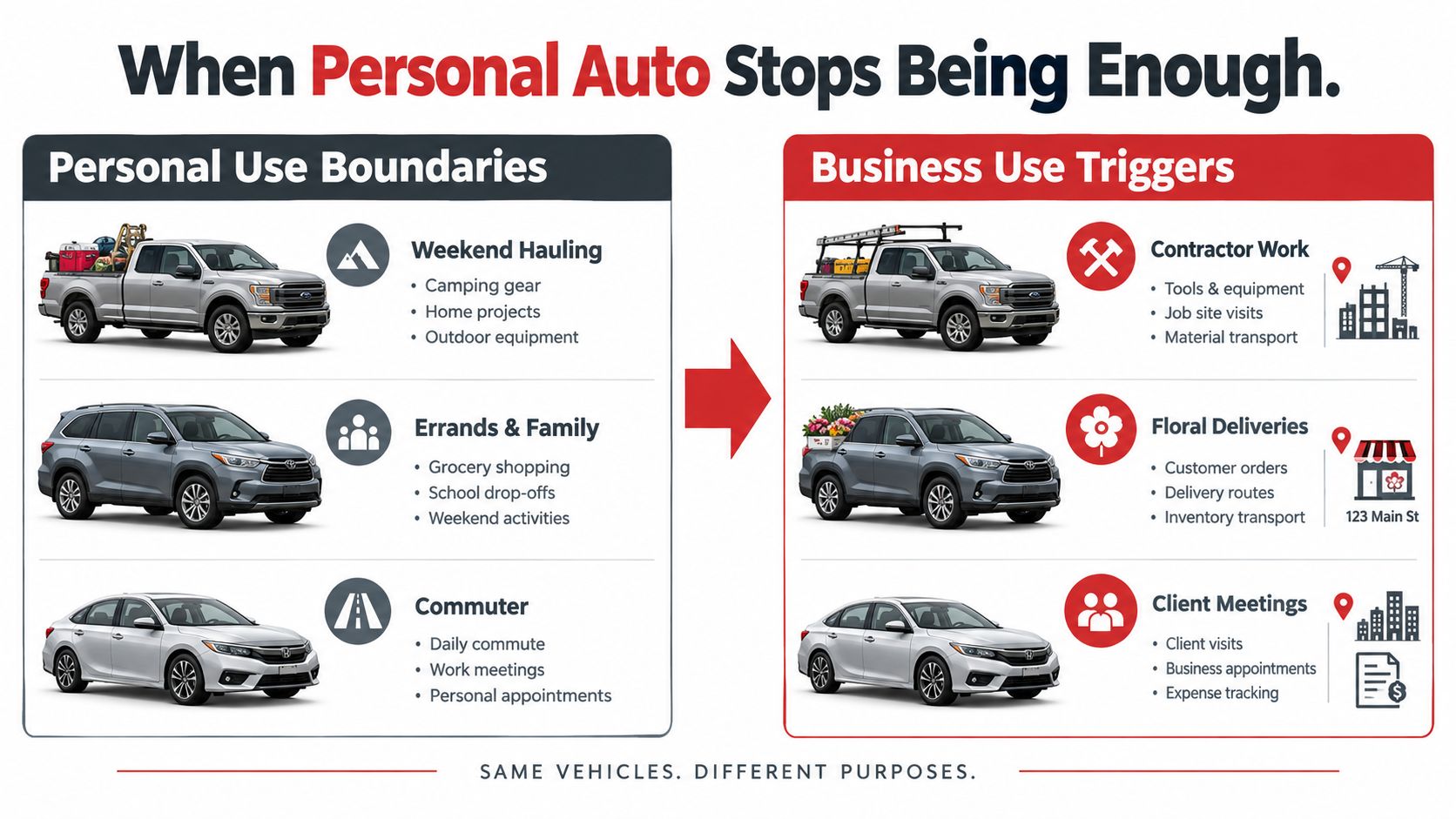
Hired and non-owned auto is often the cleanest solution when employees use personal vehicles for errands or deliveries, or when the business rents vehicles occasionally. It doesn't automatically insure every vehicle or solve every cargo and physical damage issue, so the policy wording still matters.
Trailers deserve their own review. A small utility trailer may be treated differently from a heavier commercial trailer, and the answer depends on ownership, use, weight, vehicle policy, and insurer rules. Schedule the trailer commercially when the business owns it, uses it regularly, hauls customer property, or has contractual responsibility for it.
Workers' compensation creates a related trap. Calling someone a 1099 subcontractor doesn't by itself settle the worker's legal or insurance status. After a crash, the business must be able to show who employed or controlled the driver and which policy was intended to respond.
Evaluating Your Needs and Getting Competitive Quotes
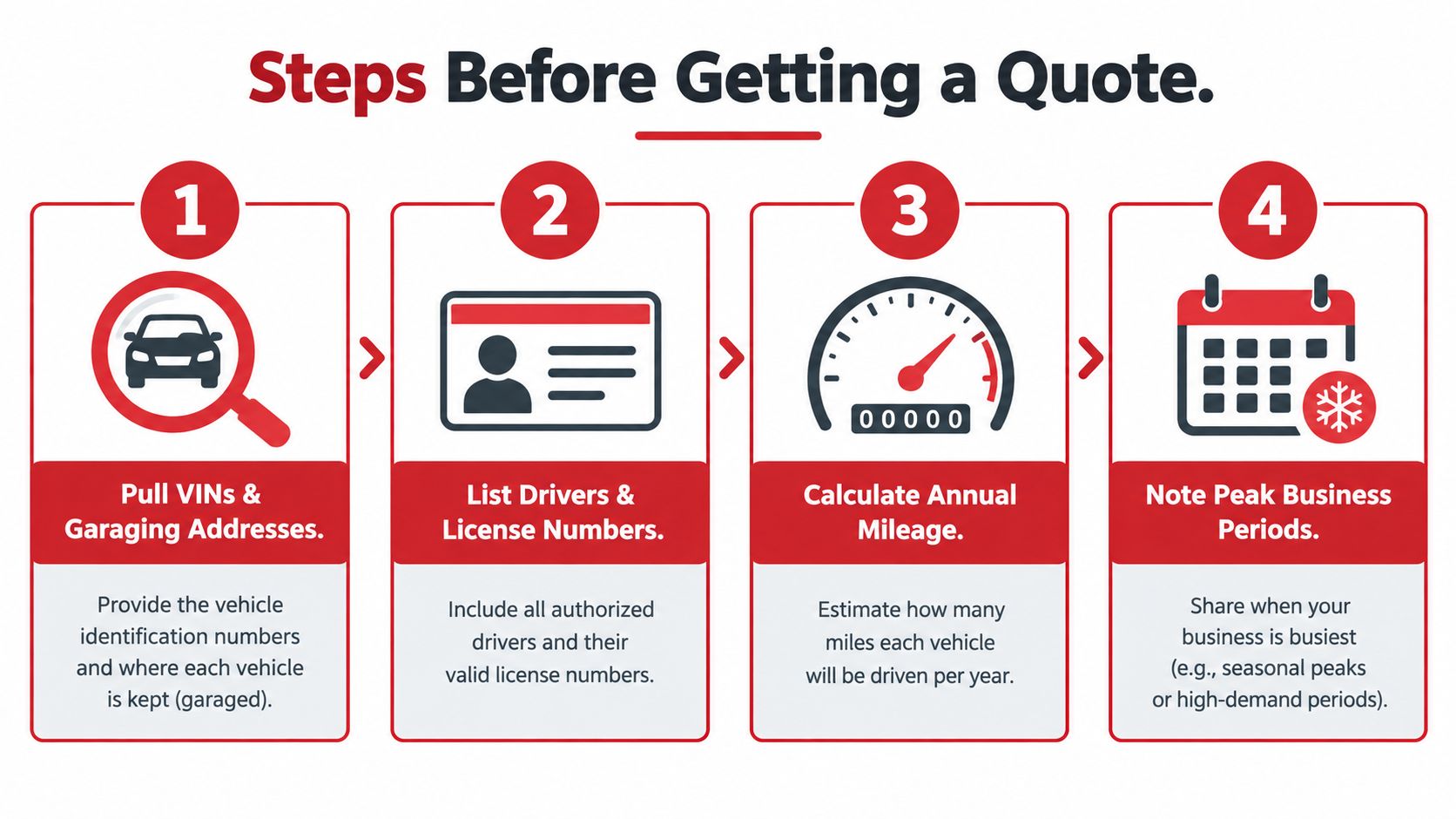
Good quotes begin with accurate information. Before contacting an agent, assemble the facts an underwriter will verify. Incomplete applications produce bad comparisons, delayed binding, and unpleasant changes after inspection.
Prepare the vehicle and driver file
Start with every vehicle, not just the ones titled in the company name. Gather:
- VINs and garaging addresses: Confirm where each vehicle is normally kept overnight.
- Driver details: List every regular driver, license information, assignments, and available motor vehicle records.
- Use descriptions: Separate service, delivery, hauling, sales, commuting, and passenger use.
- Mileage patterns: Estimate annual mileage and identify seasonal peaks rather than providing a guess that hides busy periods.
- Vehicle details: Record ownership, financing, cargo, trailers, modifications, and whether a vehicle crosses state lines.
The application should describe what happens on the road. "General business use" is too vague for a company that sends technicians to homes, delivers materials, transports customers' property, or dispatches drivers across multiple territories.
Compare the contract, not just the price
Choose liability limits above the 25/50/15 legal floor when the business has employees, valuable assets, recurring customer visits, or contract requirements. Many contractors consider 100/300 or higher, but the appropriate choice depends on the operation and the advice of the agent.
Request loss runs for the prior policy period and make sure the information is consistent across quotes. Insurers examine claim frequency, severity, driver changes, vehicle changes, and open reserves. A low quote that omits a vehicle, understates mileage, or uses the wrong vehicle class isn't competitive. It's incomplete.
Review these items side by side:
- Liability limits: Confirm that every quote uses the same limits.
- Physical damage deductibles: Compare the retained cost for collision and damage claims.
- Coverage form: Verify whether the policy is written for business auto, dealer exposure, motor carrier operations, or another classification.
- Hired and non-owned wording: Check who qualifies as an insured and which uses are excluded.
- Cargo and equipment: Identify whether transported property and tools require separate coverage.
- Driver restrictions: Read assigned-driver, age, experience, and permissive-use conditions.
The goal is not the lowest first-year premium. The goal is a policy that accurately describes the business and leaves no unexplained gap between the vehicle, the driver, and the work being performed.
Why Two Similar Knoxville Fleets Get Very Different Quotes
Two fleets can share a garaging address and vehicle count yet receive very different quotes. Location matters, but it doesn't tell the underwriter how the vehicles are driven, who operates them, or what the business has done to control losses.
A fleet with clean motor vehicle records, documented hiring standards, regular maintenance, dashcam use, and consistent routes presents a different risk from a fleet with frequent driver turnover, poor inspection records, and repeated low-severity claims. The vehicles may look similar in the parking lot, but the risk profile isn't similar.
Commercial auto underwriting is also responding to a difficult national market. Industry reporting says commercial auto premiums rose 5.8% in the first quarter of 2026, marking the 59th consecutive quarter of increases, while claim severity, repair inflation, and litigation costs continue to pressure rates. The same market discussion identifies telematics and usage-based underwriting as increasingly central to pricing decisions.
| Lever | Lower Quote | Higher Quote |
|---|---|---|
| Driver records | Clean MVRs and documented screening | Violations, inexperienced drivers, or unclear assignments |
| Loss history | Few claims with strong corrective action | Repeated claims, even when individual losses are modest |
| Telematics | Consistent speed, braking, routing, and mileage data | No usable data or persistent risky driving patterns |
| Vehicle class | Smaller service vehicles with limited exposure | Heavier trucks, flatbeds, or specialized equipment |
| Operating radius | Controlled local routes | Frequent longer-distance or congested-corridor travel |
| Safety program | Training, inspections, maintenance, and incident review | Informal practices with little documentation |
| Coverage design | Accurate limits and classifications | Misclassified vehicles or missing endorsements |
The business can change several of these levers before renewal. Tighten driver screening, assign vehicles deliberately, review telematics reports, coach harsh braking, document maintenance, and investigate every incident. Those steps won't guarantee a lower quote, but they give an underwriter evidence beyond the ZIP code.
Smart Ways to Lower Premiums and Handle Claims With Confidence
Premium control starts with retained risk. A business may lower the premium by increasing physical damage deductibles to $1,000 or $2,500, but it must keep enough cash available to pay that amount after a loss. Don't choose a deductible that forces a vehicle off the road because the company can't fund the repair.
Other practical moves include:
- Bundle related coverage: Ask whether placing business auto with general liability or commercial property creates a package credit.
- Train drivers: Use a documented defensive-driving program and keep completion records.
- Use telematics thoughtfully: Ask whether driving data can support usage-based underwriting or coaching.
- Remove stale exposure: Delete sold vehicles, former employees, and drivers who no longer operate company units.
- Pay annually when practical: Compare the total cost of annual payment with installment billing.
- Control permissive use: Put written rules around personal errands, passengers, phone use, and after-hours driving.
Claims handling should follow a written process. First, protect people and call emergency services when needed. Then photograph the scene, exchange information, collect the police report number, seek medical attention for injuries, and preserve dashcam or surveillance footage.
Don't admit fault at the scene. Give accurate facts, but let the adjuster and investigators determine responsibility. Notify the carrier promptly, keep receipts and repair records, and maintain a vehicle repair log that shows when the unit was inspected, repaired, and returned to service.
Select Insurance Group, Inc. offers commercial auto options for company cars, delivery vehicles, service trucks, and fleets, including liability, physical damage, hired and non-owned auto, cargo, and tools and equipment coverage. To compare the actual needs of your Knoxville operation with available policy options, visit Select Insurance Group, Inc. for a commercial quote.