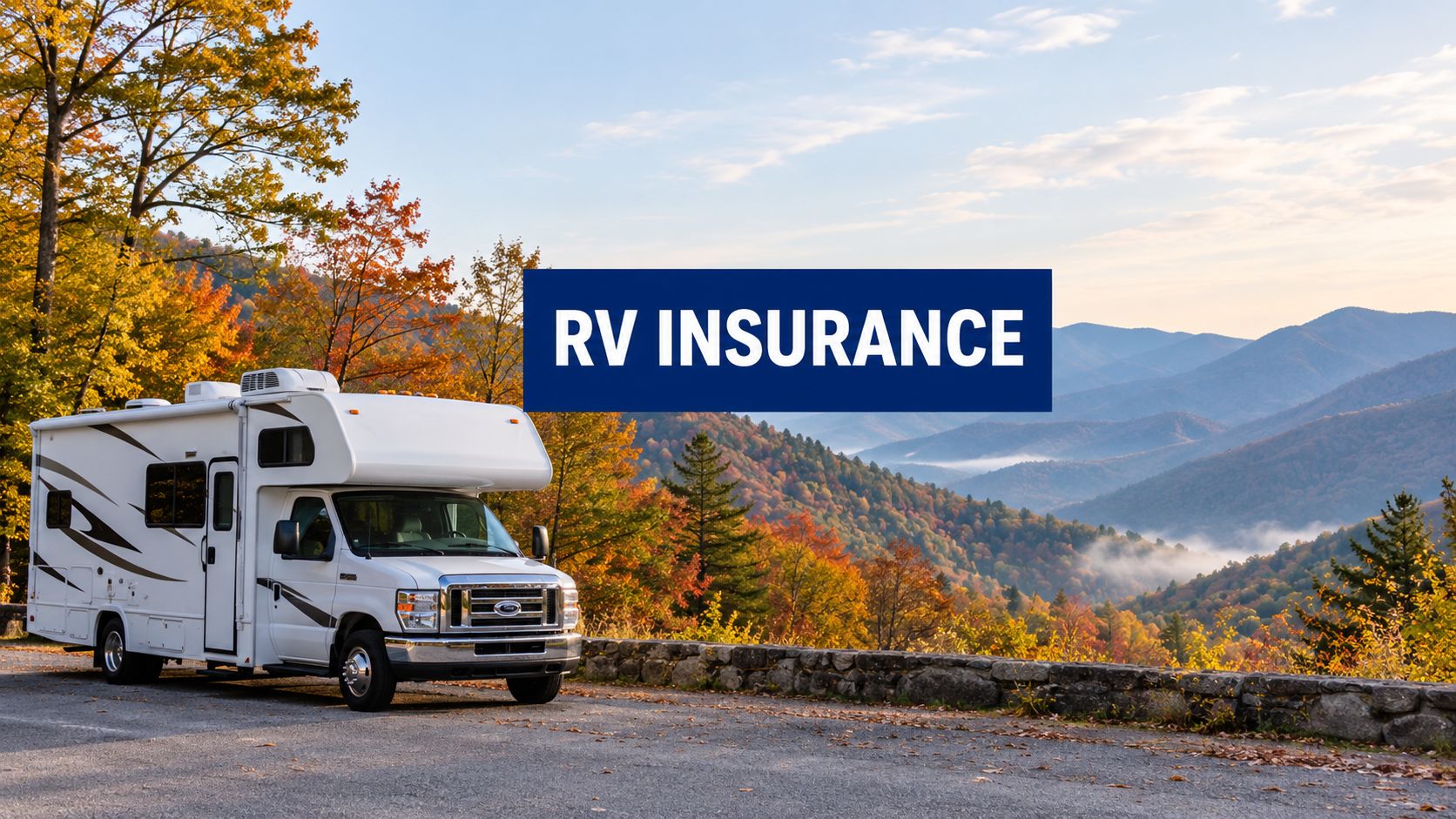

Motorized RVs in Tennessee must carry at least 25/50/25 liability coverage, while towable units typically don't require separate liability insurance. Knoxville owners should use Tennessee's 2024 averages as a starting benchmark, about $1,110 annually for motorhomes and roughly $743 for travel trailers.
You may be standing in a Knoxville driveway right now, checking tire pressure, loading camping gear, and wondering whether your auto policy is enough for the weekend. Maybe you're taking a motorhome to a Vols tailgate, or pulling a travel trailer toward the Smokies with the family. The answer depends on what you own, how you use it, where you store it, and what you can afford to lose.
The legal minimum is only the starting line. Knoxville adds its own practical complications, from hail and flash flooding to long-term storage, crowded campgrounds, attached equipment, and personal belongings inside the RV. A sound policy connects Tennessee's liability rules with the physical risks your RV faces in East Tennessee.
Table of Contents
- Why Knoxville RV Owners Need a Specialty Policy
- What Knoxville Recreational Vehicle Insurance Actually Covers
- Tennessee Legal Requirements for Knoxville RV Drivers
- How Much RV Insurance Costs in Knoxville and Tennessee
- Coverages and Add-Ons Knoxville RV Owners Should Consider
- East Tennessee Weather and Why Parked-RV Protection Matters
- Discounts, Bundles, and Smart Ways to Lower Your Knoxville RV Premium
- Comparing Quotes, Filing Claims, and How Select Insurance Group Helps
Why Knoxville RV Owners Need a Specialty Policy
A Class A owner leaving West Knoxville for a football weekend may think of the RV as a large vehicle. In practice, it behaves more like three things at once: a motor vehicle, a small residence, and sometimes the base camp for another vehicle. A family towing a travel trailer toward the Smokies faces a similar issue. The trailer carries appliances, furniture, electronics, clothing, food, and outdoor equipment that a regular auto policy wasn't designed to insure.
That distinction matters after a loss. A standard auto policy may address the vehicle's liability and collision damage, but it may not adequately address an awning, interior appliance, attached satellite system, roof-mounted equipment, or the belongings stored inside. Homeowners coverage can have its own limitations when the RV is away from the home, used for travel, or occupied by guests at a campsite.
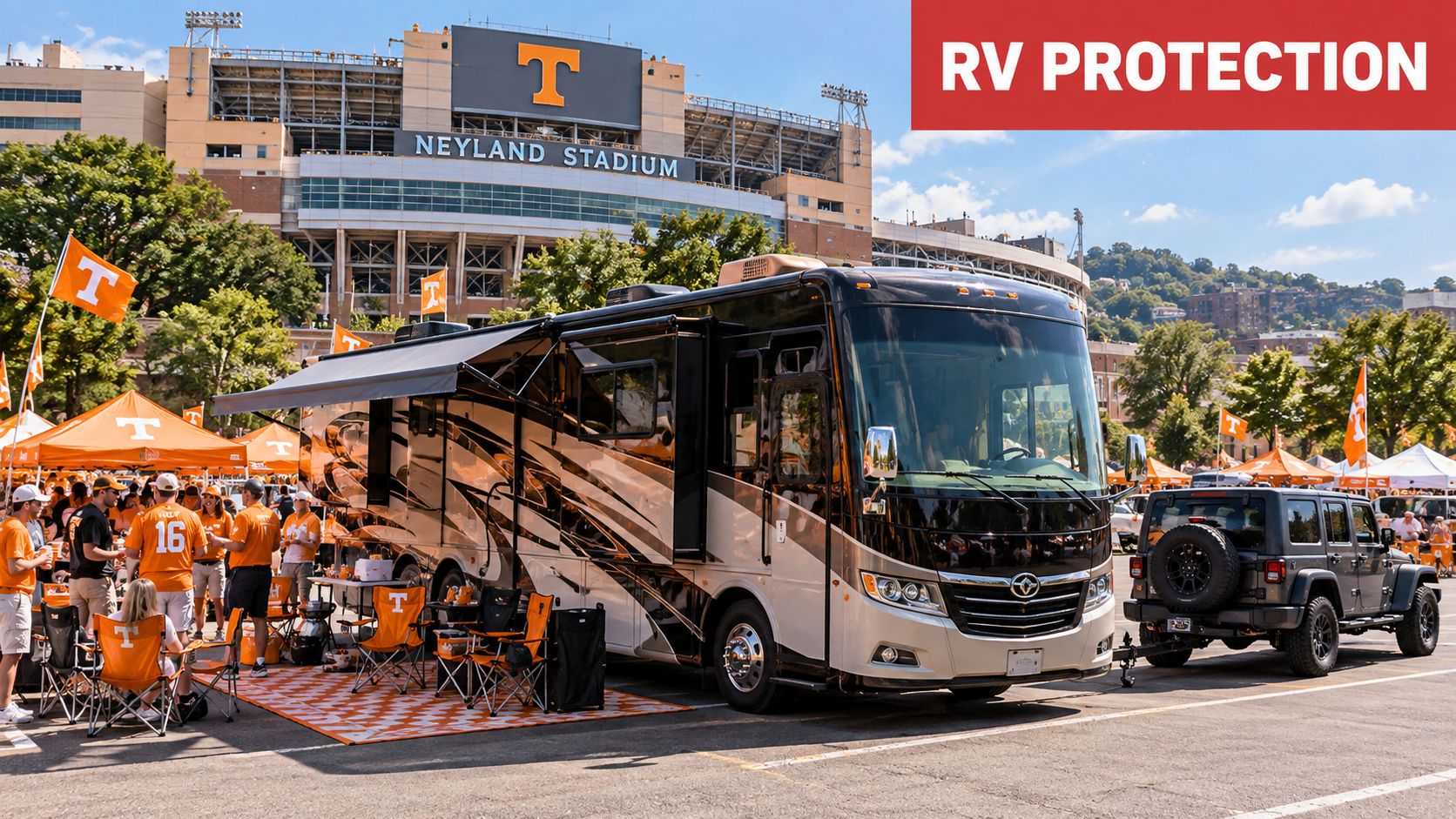
The exposure is bigger than a car
An RV can cause a backing accident at a campground, damage another vehicle, injure a guest, or suffer a loss while parked. A motorhome can easily exceed $150,000, and a fully equipped fifth wheel can fall between $40,000 and $80,000, as outlined in the Tennessee market guidance supplied for this article. Those figures aren't being used as universal market prices. They illustrate why a claim can overwhelm ordinary auto limits and why replacement-cost assumptions deserve careful review.
The RV also creates living-space liability. Someone visiting your campsite may trip over equipment, suffer an injury inside the vehicle, or claim that you caused damage while hosting them. Weekend use, seasonal travel, and full-time occupancy create different underwriting questions.
Practical rule: If the vehicle has beds, plumbing, appliances, built-in systems, or substantial personal property, insure it as an RV rather than treating it like an oversized car.
Specialty Knoxville recreational vehicle insurance isn't a luxury upgrade. It closes the gaps created when auto, homeowners, and lender requirements address only one piece of the risk.
What Knoxville Recreational Vehicle Insurance Actually Covers
Start with liability. This portion pays when you or someone operating the insured RV causes bodily injury or property damage to another party. Think of backing into another vehicle at a Pigeon Forge campground or damaging a site fixture while maneuvering into a tight space. Tennessee's minimum limits are a legal floor, not a recommendation for every owner.
Collision coverage addresses damage from an accident, whether you caused it or another driver did, subject to the policy terms and deductible. Coverage for non-collision losses handles events such as fire, theft, flood, hail, vandalism, and animal strikes, according to the coverage guidance supplied for Knoxville risks and the National Weather Service hazardous-weather information for Knoxville.
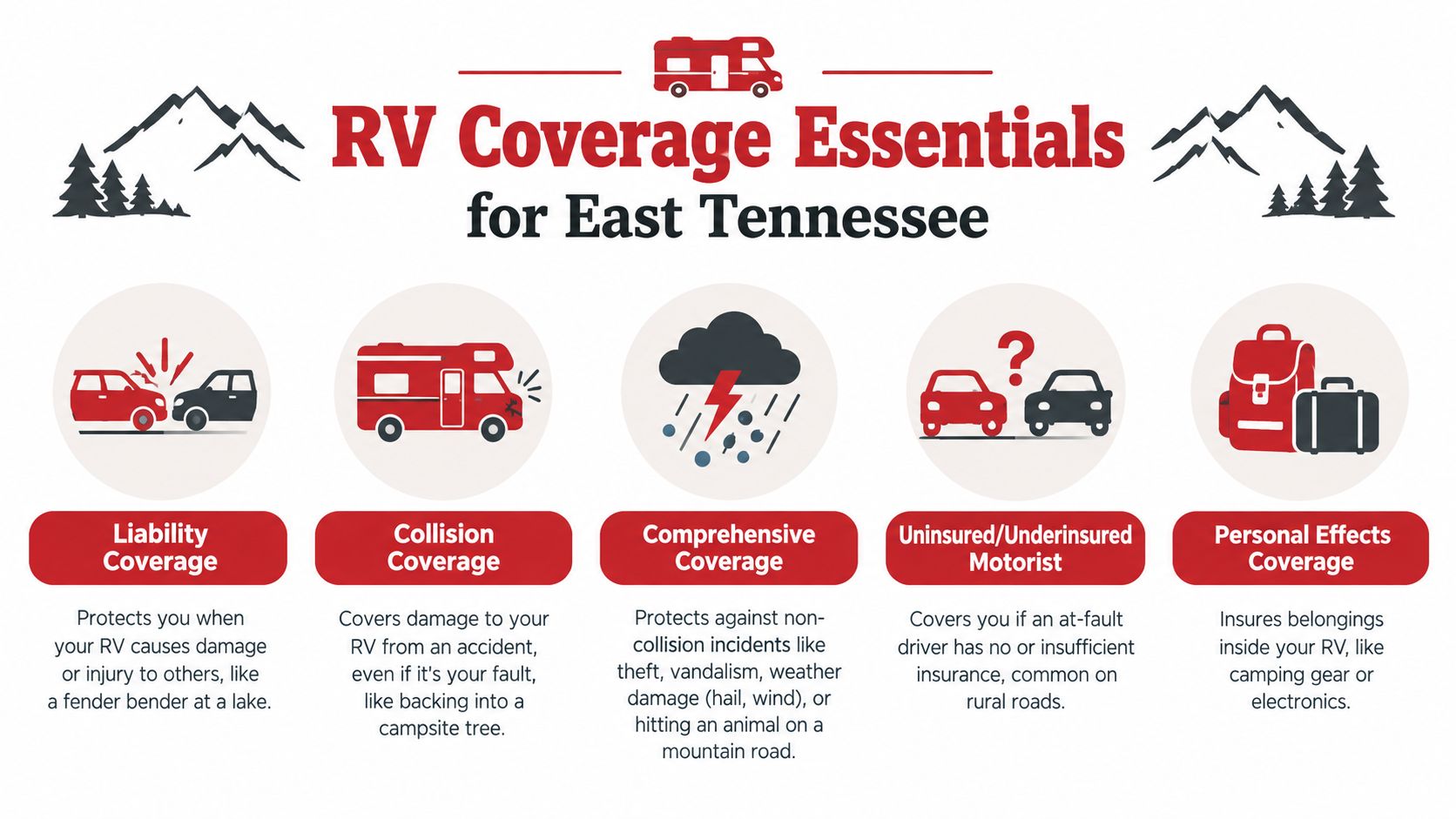
The core protection layers
- Uninsured and underinsured motorist coverage: This helps protect you when another driver causes the crash but has no insurance or insufficient limits.
- Medical payments coverage: This can address eligible injuries to occupants without requiring you to establish fault.
- Emergency expenses: If a covered loss leaves you without usable transportation or lodging, this coverage may help with necessary travel and temporary accommodations.
- Personal effects coverage: Clothing, camping equipment, electronics, and other belongings need an RV-specific limit rather than an assumption that auto insurance will cover them.
- Accessory coverage: Awnings, satellite equipment, roof-mounted air-conditioning units, and other attached items may need scheduled or specifically defined protection.
The important question isn't whether a policy contains these labels. Ask what each limit covers, whether depreciation applies, and whether the protection works while the RV is parked, stored, occupied, or traveling. A travel trailer policy also needs to coordinate with the tow vehicle, because the trailer and the vehicle pulling it don't have identical exposures.
Tennessee Legal Requirements for Knoxville RV Drivers
If your Knoxville motorhome carries only the state minimum, you may be legal to drive while leaving much of the rig and your finances exposed. Tennessee requires motorized vehicles to carry $25,000 for bodily injury to one person, $50,000 for bodily injury in one accident, and $25,000 for property damage, according to the Tennessee RV insurance requirements reference. Those limits establish compliance, not adequate protection for an expensive motorhome.
The motorized-versus-towable distinction matters. A motorhome has its own engine and generally needs its own liability policy. A travel trailer or fifth wheel usually does not need a separate liability policy under Tennessee law because liability generally follows the tow vehicle. The trailer still needs protection for its own damage. Lenders commonly require coverage for collision and non-collision losses on a financed towable.
Separate law from lender expectations
Registration can require extra attention for heavier motorhomes. Confirm title, registration, and driver-licensing questions with the Knox County Clerk and the appropriate Tennessee authorities, especially when the vehicle's weight or use changes its classification. A policy written for a lighter recreational vehicle may not fit a heavier or commercially registered unit.
| Requirement | Tennessee Minimum (Law) | Typical Lender Requirement | Notes for Knoxville RV Owners |
|---|---|---|---|
| Motorhome liability | $25,000/$50,000/$25,000 | Higher liability may be requested | Applies to the self-propelled RV's third-party risk |
| Travel trailer liability | Generally no separate liability policy | Usually not the primary lender concern | Confirm how the tow vehicle extends liability |
| Physical damage | Not the central legal requirement for towables | Commonly required when financed | Protects the lender's collateral and your investment |
| Other-than-collision and collision | Policy choice for many owners | Frequently required on financed units | Addresses weather, theft, vandalism, and crash damage |
Use the law as your starting point, then match coverage to the RV's value, storage, travel pattern, and East Tennessee weather exposure. Select Insurance Group can compare carriers and explain which option fits a Knoxville motorhome or towable, rather than treating the legal minimum as a complete recommendation.
How Much RV Insurance Costs in Knoxville and Tennessee
A Knoxville owner can receive two very different quotes for similar-looking RVs. A motorhome carries its own liability, collision, and physical-damage exposure. A towable usually depends on the tow vehicle for primary third-party liability, while its separate policy focuses more on the trailer and its contents. That difference sets the starting point for the price.
Tennessee averages provide a useful reference point: $1,110.53 per year for a motorhome and $742.80 per year for a travel trailer. Use those figures to question a quote that seems far outside the normal range, not to set a guaranteed budget. Your coverage choices and Knoxville risk profile decide the final premium.
| RV Class | TN Average Annual Premium | Key Cost Driver | Knoxville Adjustment |
|---|---|---|---|
| Motorhome | $1,110.53 | Powered vehicle, value, liability, and systems | Storage, mileage, occupancy, and weather exposure can move the quote |
| Travel trailer | $742.80 | Trailer value and physical damage | Tow vehicle, storage, deductible, and lender terms matter |
What changes the quote
Insurers review the RV class, replacement value, garaging ZIP code, annual mileage, driver history, deductible, use pattern, and lienholder requirements. A motorhome used for frequent travel presents a different risk from a trailer parked most of the year, even within the same Knoxville neighborhood.
Storage deserves a direct conversation. A unit kept outdoors near a lake or in an exposed lot faces different theft and storm conditions from one stored under a secure roof. Seasonal mileage can affect collision exposure. Full-time use changes the policy discussion because the RV functions as a residence, not occasional recreation.
The broader market also affects pricing decisions. Tennessee-focused analysis estimates more than 11 million U.S. RV-owning households and an American RV insurance market of about $9.72 billion in 2023. It also reports Tennessee auto-insurance premiums increasing from $36,337 million in 2014 to $61,993 million in 2024, or about 70.6%. That context helps explain why Knoxville quotes reflect more than the RV's purchase price. Review the Tennessee recreational-vehicle market overview for the cited market discussion.
Ask for a coverage-by-coverage explanation. An independent bilingual agency such as Select Insurance Group can compare available carriers, apply Tennessee's legal baseline, and recommend limits based on your Knoxville storage, travel, occupancy, and severe-weather exposure. Treat the averages as your opening question, then buy the protection your actual RV requires.
Coverages and Add-Ons Knoxville RV Owners Should Consider
Build the policy in layers. Begin with liability, collision, and coverage. Choose a deductible you can comfortably pay after a storm or accident, not one that looks attractive only because it lowers the premium.
Then decide how the insurer will settle a total loss. An actual-cash-value policy pays the depreciated value at the time of loss, less the deductible. The RV policy guidance from the supplied insurance reference explains why that can create a gap between what the unit is worth to replace and what the policy pays. Agreed value or total-loss replacement may make more sense for a newer, financed, or high-value RV.
Match the extras to how you live
Personal effects coverage deserves attention if your RV carries cameras, outdoor gear, laptops, tools, or clothing. Don't assume a homeowners policy will follow every item everywhere or provide the limit you need.
Emergency-expense coverage can be worthwhile when a covered loss strands you away from home. Ask whether it addresses lodging, transportation, meals, or other defined expenses, and whether the limit fits the kind of trips you take.
For people who live in an RV year-round, standard recreational use isn't enough. Full-timer coverage may address residence-related liability and personal-property concerns that weekend policies don't fully contemplate. Independent guidance identifies premises liability and contents protection as common gaps for RV users whose vehicles function as homes. The Tennessee recreational-vehicle coverage discussion provides relevant background.
Where I would spend and where I wouldn't
- Spend on settlement protection when depreciation or a loan balance could leave you financially exposed.
- Spend on roadside assistance if your motorhome is long, heavy, or difficult to tow.
- Consider vacation liability when you regularly host guests at rented campsites.
- Skip redundant personal-property limits after confirming that another policy already provides adequate coverage without restrictive exclusions.
- Don't buy an add-on just because the name sounds specialized. Ask for the covered event, limit, deductible, and settlement basis.
The right stack isn't the one with the most endorsements. It's the one that responds to your actual RV, trips, storage, and household exposure.
East Tennessee Weather and Why Parked-RV Protection Matters
Knoxville RV owners should treat parked-vehicle losses as a primary insurance concern. East Tennessee exposure includes hail, flash flooding, wind, fallen trees, vandalism, theft, and animal strikes, and the National Weather Service's Knoxville outlook documents the region's severe-weather exposure. For an RV sitting at a campground, storage lot, or driveway, these events may matter more than a roadway collision.
A storm can tear a roof, break windows, flood lower compartments, or scatter debris across an awning and exterior systems. Other-than-collision protection generally addresses these losses, but exclusions, limits, and deductibles determine what the policy pays. Flood damage requires close review because insurers may treat water intrusion, rising water, maintenance problems, and storm damage differently.
Storage is part of the insurance decision
Covered or indoor storage can reduce exposure. It does not automatically qualify for a discount or protect against every peril. Tell the carrier where the RV is kept, whether it sits on a home driveway, in an open storage lot, under a covered structure, or inside a secured facility. Those details can affect underwriting and the available protection.
Set the deductible at an amount you can pay without disrupting your household budget. A lower deductible costs more but reduces the immediate repair burden after a covered loss. A higher deductible can work when accessible savings cover it, especially if you prefer to retain smaller losses. Choose it deliberately, not to make the quote look cheaper.
Weather protection starts before the claim. Store the RV properly, photograph its condition, maintain the roof and seals, and ask the insurer what other-than-collision coverage excludes.
The right policy combines sufficient protection with sensible storage and documented maintenance. Cutting coverage to save money is often a poor trade for an RV parked through East Tennessee storms. An independent bilingual agency can compare carriers quickly, then match the policy to Knoxville weather exposure, storage conditions, and the owner's actual tolerance for repair costs.
Discounts, Bundles, and Smart Ways to Lower Your Knoxville RV Premium
Lower the premium by improving the risk, not by stripping away the coverage that makes the policy useful. Start with the quote structure, then look for credits that reflect how you own and operate the RV.
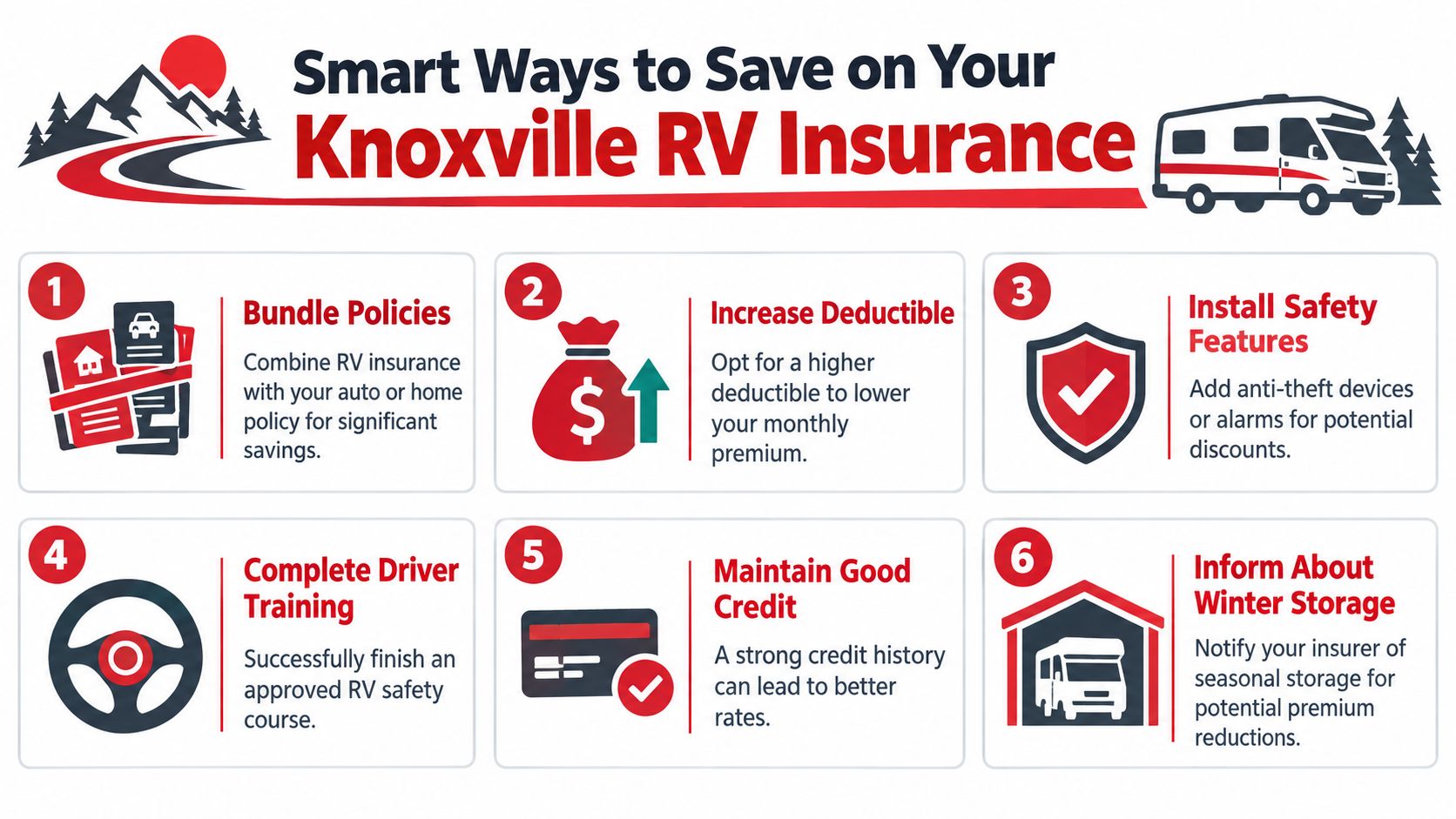
Bundling your RV with auto or homeowners insurance may simplify billing and produce a multi-policy discount. Paying the annual premium in full can also change the total cost. Raising the deductible may reduce the premium, but only choose that route if your emergency fund can cover the selected amount immediately after a loss.
Ask about discounts that fit your situation
- Bundle policies: Ask whether one carrier can insure the RV alongside your existing household policies.
- Report seasonal storage: Give the insurer the correct storage address and explain when the RV is inactive.
- Document low use: If the RV travels only for occasional regional trips, provide an honest mileage estimate.
- Protect the vehicle: Anti-theft devices, alarms, and other approved safety features may qualify for credits.
- Review driver history: Safe-driving and mature-driver programs may be available based on eligibility.
- Complete recognized training: Ask whether an approved RV safety course can affect the rate.
- Insure multiple recreational units: A household with more than one eligible unit may qualify for a multi-unit discount.
Don't exaggerate low mileage or describe outside storage as covered storage. Incorrect information can create underwriting problems and complicate a claim.
Prepare before requesting quotes
Have the VIN, current odometer reading, garaging address, lienholder details, purchase documents, storage information, and a list of major accessories ready. Decide whether the RV is recreational, seasonal, or full-time use before the conversation begins.
Be skeptical of vanishing deductibles and similar extras. Ask what they cost, how the benefit accumulates, when it applies, and whether a straightforward deductible choice would serve you better. The cheapest premium isn't a win if the policy removes the protection you bought it for.
Comparing Quotes, Filing Claims, and How Select Insurance Group Helps
Compare quotes only after making them equivalent. A lower premium may reflect actual-cash-value settlement instead of agreed value, weaker liability limits, a higher deductible, or missing personal-effects and emergency-expense coverage.
Request quotes from carriers that understand motorhomes, travel trailers, fifth wheels, and the equipment attached to them. Put the comparison in writing so you can see the coverage form, settlement basis, deductibles, exclusions, and endorsements beside the price.
Use a disciplined claim process
- Protect people first. Move away from traffic or other hazards when it's safe, and contact emergency services when needed.
- Document the scene. Photograph the RV, surrounding property, weather damage, debris, campsite, storage area, and any other vehicles.
- Report the loss promptly. Follow the policy's reporting instructions and ask what deadlines apply.
- Save every receipt. Keep records for towing, lodging, transportation, emergency repairs, and related expenses.
- Use an RV-qualified repair facility. A motorhome contains systems and structures that a conventional auto shop may not understand.
- Request an itemized estimate. Confirm that the estimate addresses appliances, accessories, interior damage, structural work, and hidden water intrusion where relevant.
An independent agency can collect multiple carrier options through one conversation, then help you select a policy based on Knoxville storage, travel, occupancy, and settlement needs. Select Insurance Group, Inc. offers bilingual service, Tennessee RV insurance, and instant comparisons across multiple carriers, giving owners a practical way to compare equivalent protection instead of chasing the lowest displayed price.
Your agent should also remain available after the policy is issued. Ask who will help with documentation, endorsements, payment questions, and claim communication when the RV is damaged. Fast quoting is useful, but correct coverage and clear support matter more once a storm or accident has occurred.
Select Insurance Group, Inc. can compare Knoxville RV insurance options for motorhomes, travel trailers, fifth wheels, and related recreational vehicles while helping you match liability, physical damage, personal-property, and roadside needs. Visit Select Insurance Group, Inc. for a free, no-obligation quote and bilingual guidance based on how you store and use your RV.