
In Tennessee, businesses with five or more employees must carry workers' compensation insurance, whether those employees are full-time, part-time, or seasonal. Knoxville employers also operate in a busy claims market, with Knox County accounting for 7.0% of Tennessee workers' compensation claims in one recent reporting period.
A workplace injury rarely arrives at a convenient time. You may be opening a shop near downtown Knoxville, sending a crew to a construction site, or managing a warehouse shift when an employee reports a back injury, fall, or repetitive-motion problem. Suddenly, you're balancing medical care, payroll, reporting duties, and questions about whether the injury is truly work-related.
The confusing part is that Tennessee coverage costs have been moving down while insurers and claims administrators continue to examine documentation, causation, and medical treatment closely. For Knoxville employers, that combination creates an important lesson: lower rates don't make claims management optional. They make accurate classification, prompt reporting, and sound workplace records even more valuable.
Table of Contents
- Is Workers Compensation Mandatory for Knoxville Businesses?
- How Tennessee Employers Can Meet Coverage Requirements
- What Drives Your Workers Compensation Premium Costs
- Step-by-Step – Navigating the Workers Comp Claims Process
- The Hidden Reality Behind Declining Workers Comp Rates
- How Select Insurance Group Simplifies Your Coverage
Is Workers Compensation Mandatory for Knoxville Businesses?
A Knoxville retail owner may think a small staff means workers' compensation is a concern for later. Then a part-time employee slips while restocking inventory, and the owner discovers that employee count, industry, and worker classification can determine whether coverage is required.
Tennessee's basic rule is straightforward. Most employers with five or more employees must carry workers' compensation insurance, and the count generally includes full-time, part-time, and seasonal workers. Construction employers can face a stricter requirement, with coverage generally required when they have even one employee unless a specific exemption applies. Coal mining employers also operate under special rules.
The safest approach is to count everyone who works for the business, not just the people who receive the largest paychecks or work a standard schedule. A seasonal employee hired for a busy period still deserves careful classification. So does a part-time cashier, delivery worker, or office assistant.
Know where exceptions stop
A sole proprietor with no employees may not be required to buy a workers' compensation policy. Independent contractors may also fall outside the employee count, but calling someone a contractor doesn't make it legally true. The actual working relationship, control over the work, and business arrangement matter.
Tennessee's original workers' compensation law, signed in 1919, excluded several categories, including farm workers, independent contractors, coal mines, and interstate common carriers. The law applied to employers with 10 or more workers at that time and was elective for workers. Knoxville was specifically connected to the labor conflicts surrounding that law, including strikes involving the Knoxville Railway and Light Company. The system later developed into a structure that relied heavily on trial courts before Tennessee created a dedicated workers' compensation dispute process. The Tennessee Bar Association's historical account explains why the state's system has such deep legal roots.
Practical rule: If your business is close to the employee threshold, don't wait for an injury to confirm your obligation. Review your workforce and classifications with an insurance professional.
Coverage protects more than the employee. It can help provide an organized path for medical treatment and wage-related benefits while reducing the risk that an employer faces an uncovered claim directly. Employers can review Tennessee-focused options through workers' compensation coverage guidance for Tennessee businesses.
How Tennessee Employers Can Meet Coverage Requirements
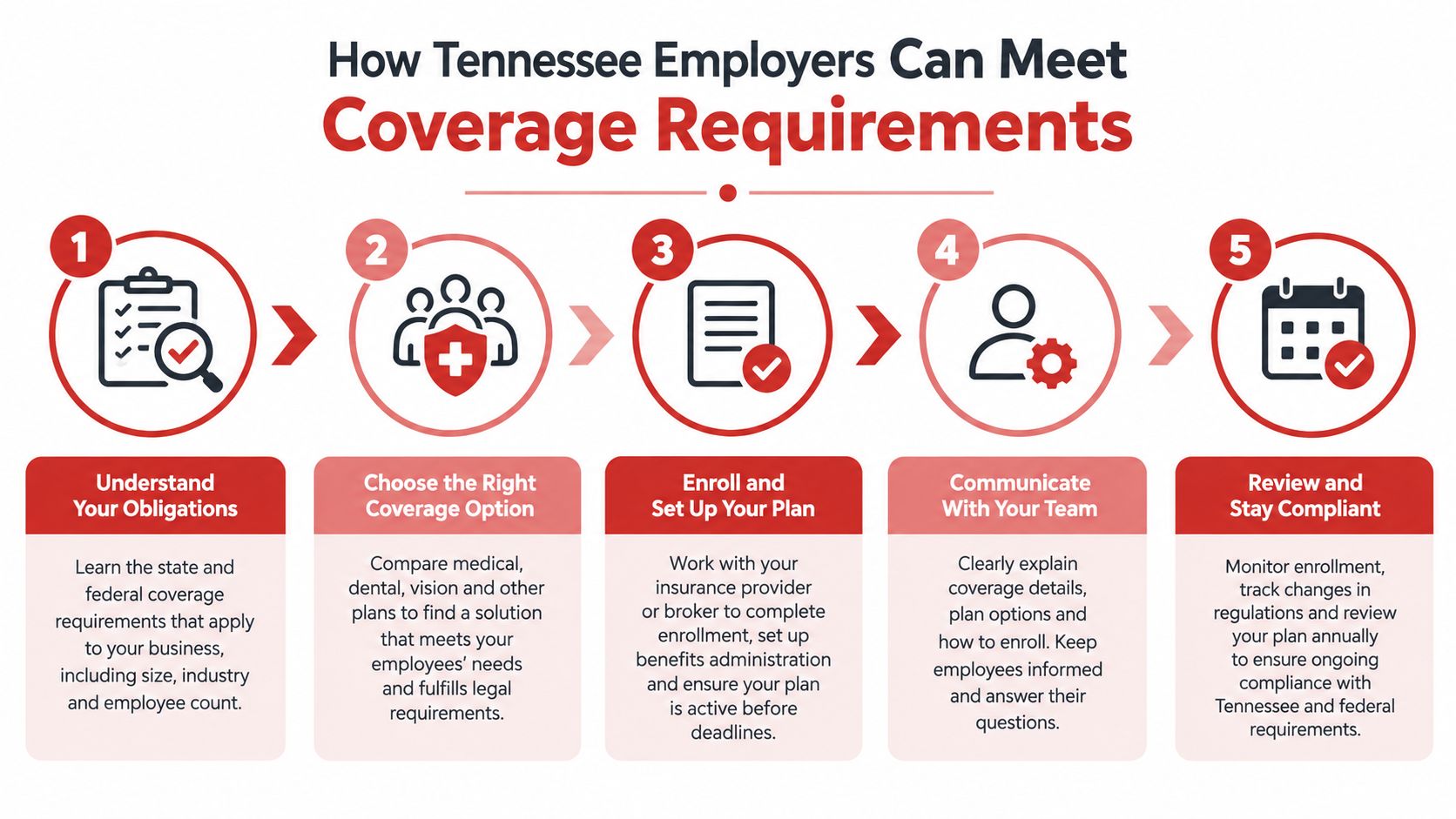
Meeting Tennessee's requirement doesn't mean every employer uses the same financial arrangement. The right path depends on business size, financial strength, claims history, administrative capacity, and the ability to absorb unexpected losses.
The private insurance route
Most Knoxville businesses purchase a policy from a licensed private carrier. The carrier generally handles covered claim payments under the policy, while the employer pays the premium and follows reporting and safety obligations. This arrangement is familiar, scalable, and practical for many small and midsize businesses.
The application must accurately describe the business. Insurers look at the work employees perform, payroll, locations, subcontracting arrangements, and prior loss information. A remodeling company that describes itself as an office-based business could create problems later if the classification doesn't reflect actual field work.
Self-insurance
Self-insurance can be available to financially strong employers that meet Tennessee's requirements. Instead of transferring the ordinary claim-payment responsibility to a standard policy, the employer retains more of that responsibility and must demonstrate the resources and controls to support it.
This option usually requires more than confidence in the company's cash flow. Employers need reliable reserves, claims administration, reporting procedures, and a plan for severe losses. A business should treat self-insurance as a regulated risk-financing decision, not just a way to avoid premium payments.
Group and other approved arrangements
Some employers may qualify for an approved group, fund, or alternative arrangement. Availability depends on the structure, eligibility rules, and current Tennessee requirements. The employer still needs to confirm that the arrangement satisfies the legal obligation and provides appropriate protection for its workforce.
A useful starting point is to compare the actual responsibilities under each option:
- Private policy: The carrier takes on covered claim obligations, subject to the policy terms.
- Self-insurance: The employer retains substantial financial and administrative responsibility.
- Approved group or fund: The employer participates under the arrangement's eligibility and operating rules.
For a plain-language explanation of what a policy generally addresses, review this guide to workers' compensation coverage. Then ask an advisor to match the structure to your workforce, industry, and financial tolerance rather than choosing based on price alone.
What Drives Your Workers Compensation Premium Costs
Premium pricing starts with the business itself. An office, restaurant, roofing contractor, and delivery operation expose employees to different hazards, so the insurer needs accurate information about job duties, payroll, and classifications before it can evaluate the risk.
The experience modification factor, often called the EM factor, compares an employer's actual losses with expected losses for its classification and industry. Tennessee materials note that a new business may begin with an EM of 1.00, while an employer with higher-than-expected losses may pay additional premium. Carriers may also review up to five years of loss history when evaluating experience rating. Tennessee insurance materials explain experience modification and loss history.
Why claims history matters
One serious injury can matter, but repeated preventable losses often send a clearer message to an insurer. Frequent claims may indicate gaps in training, supervision, equipment maintenance, reporting, or return-to-work practices. The employer's response after an injury also matters because delayed reporting can complicate medical and factual review.
A disciplined process includes:
- Accurate classification: Describe the work employees perform, including field, driving, lifting, and equipment duties.
- Reliable payroll records: Keep payroll organized by role and classification so the policy reflects real exposure.
- Prompt reporting: Notify the carrier quickly and preserve the first report, witness details, photographs, and relevant workplace records.
- Return-to-work coordination: Follow medical restrictions and identify suitable duties when appropriate.
- Loss prevention: Correct hazards and document the corrective action, rather than treating each claim as an isolated event.
A low premium today can become expensive if inaccurate classifications or unmanaged losses produce an unfavorable experience factor later.
Medical coding can change claim costs
Tennessee uses a state medical fee schedule based on Medicare methodology with Tennessee-specific conversion percentages. The April 2026 handbook lists different percentages by specialty and service category, including 275% for orthopedics and neurosurgery with the ON modifier, 200% for surgery and radiology, 180% for therapy, and 150% for home health. The Tennessee medical fee schedule handbook shows why code selection and specialty classification affect reimbursement.
That doesn't mean an employer chooses a medical code. It does mean the employer should provide accurate injury information and avoid casual descriptions that blur the body part, mechanism, or work activity. Clear records help the claims team apply the correct treatment and coverage rules.
For a broader discussion of how business owners think about workers' compensation pricing, see this workers' compensation cost guide, while remembering that Tennessee rules and fee schedules control a Knoxville policy.
Step-by-Step – Navigating the Workers Comp Claims Process
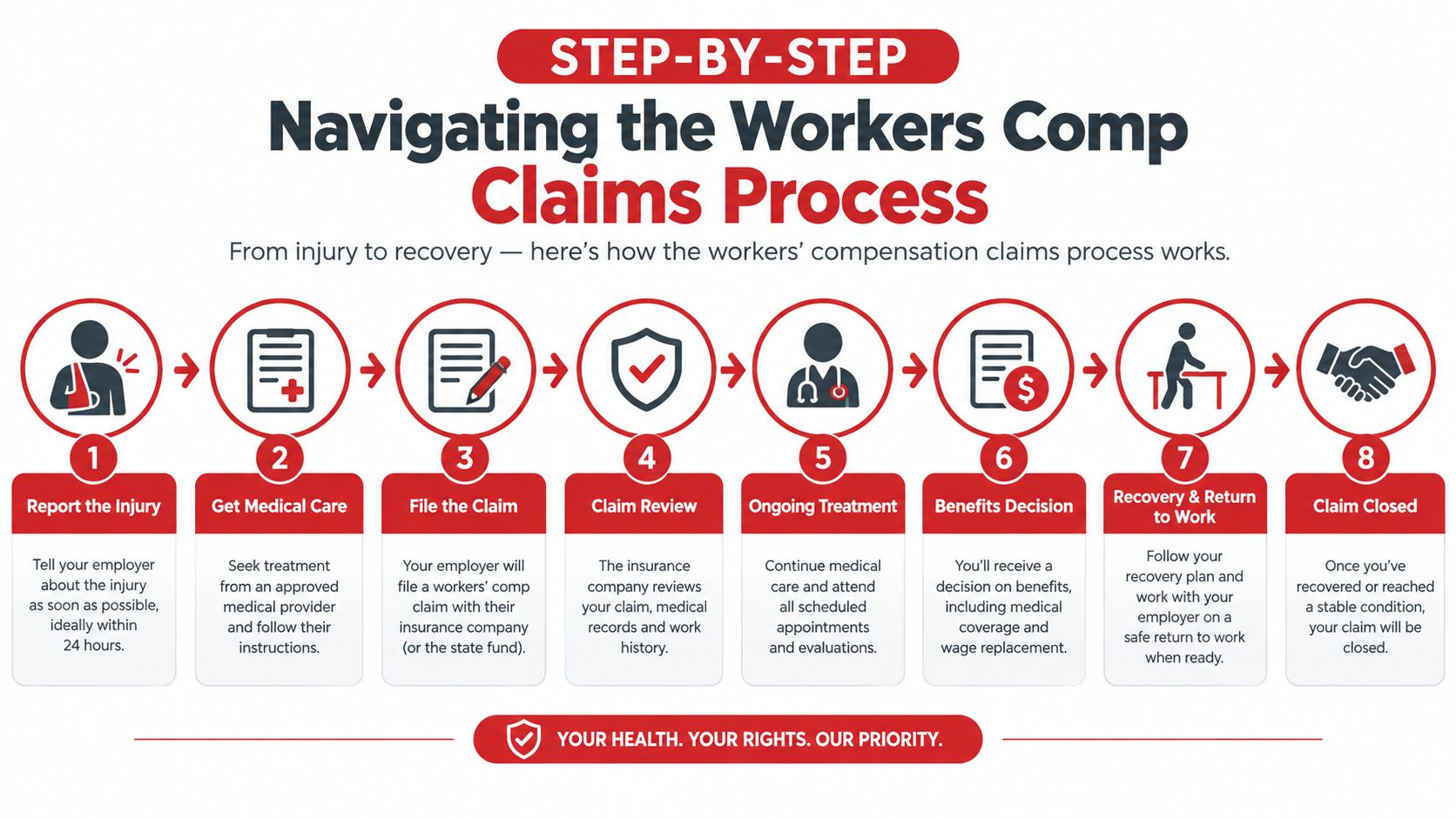
At 9:00 a.m., an employee tells a supervisor that a shoulder began hurting after lifting materials. The supervisor shouldn't guess whether the injury qualifies. The supervisor should start the process, document what was reported, and make sure the employee receives appropriate instructions for medical care.
1. Stabilize the situation
Emergency treatment comes first when the injury requires it. For less urgent injuries, separate the employee from the hazard, provide basic assistance within your training, and record the time, location, activity, and people who witnessed the event.
2. Receive the report carefully
The employee should report the injury to the employer as soon as possible. The supervisor should record the employee's own description without adding conclusions such as “not serious” or “definitely unrelated to work.” Those judgments can create confusion later.
3. Notify the insurer
Send the report through the employer's established claims channel and preserve confirmation that it was submitted. Include the employee's job, the work being performed, known witnesses, treatment information, and any available photographs or video.
4. Address medical care
Tennessee workers' compensation treatment generally follows an employer-provided physician panel, from which the employee selects an authorized treating physician. The employer should give clear instructions and avoid sending the employee to an unauthorized provider without guidance.
5. Track restrictions and benefits
If the treating physician limits work, the employer should compare those restrictions with available duties. Keep the restrictions current and communicate changes to the claims handler. Disability payments depend on the claim and medical circumstances, so employers shouldn't promise an amount or start date without confirmation.
6. Stay organized through treatment
Save appointment information, work status notes, wage records, and communications in one controlled file. Ask the employee to follow treatment instructions and attend appointments, while keeping communication respectful and focused on recovery.
Tennessee's reform-era data provides useful context for this organized approach. Average time from injury to maximum medical improvement fell from 52.25 weeks before reform to 39.9 weeks after reform, while time from MMI to claim conclusion declined from 43.8 weeks to 26.7 weeks. Return to work with the same employer rose from 58.6% to 72%. The Tennessee Bureau of Workers' Compensation annual report presents those statewide figures, not a guarantee for any individual Knoxville claim.
Employees and managers may also benefit from a plain-language pain clinic guide to workplace injuries that explains the difference between workers' compensation and other injury claims.
The Hidden Reality Behind Declining Workers Comp Rates
A declining rate environment can make a Knoxville business owner feel that workers' compensation is becoming easier to obtain and manage. That conclusion misses the difference between pricing and claim acceptance.
Tennessee approved a 3.6% voluntary-market loss-cost decrease for 2025 and a further 2% overall loss-cost decrease for 2026. The state described this as 13 straight years of declining rates for most businesses, while NCCI reported that Tennessee lost-time claim frequency continued its long-term decline and fell faster in the latest policy year than the historical average. Tennessee's announcement on workers' compensation rate changes provides the market context.
Those figures describe loss costs and claim-frequency trends. They don't promise that every Knoxville employer will receive the same premium change, and they don't eliminate underwriting review. The insurer still evaluates the business's class, payroll, loss record, workplace practices, and individual claims.

Why scrutiny can increase while prices fall
Carriers can compete aggressively for sound risks while becoming more selective about disputed claims. A claim involving a clear accident, prompt notice, consistent medical records, and a documented work connection is easier to evaluate than a claim involving delayed reporting, several medical conditions, prior injuries, or unclear job duties.
Tennessee decisions and appeals content show that contested claims can involve disputes over additional medical treatment and temporary disability. That means “cheap coverage” doesn't mean “easy claims.” A favorable rate environment can coexist with close examination of:
- Compensability: Did the injury arise from the work or occur in the course of employment?
- Causation: Do the medical records connect the condition to the reported work activity?
- Documentation: Do the first report, witness accounts, job description, and treatment notes agree?
- Ongoing treatment: Is additional care supported under the applicable rules and medical evidence?
The local lesson: A competitive premium rewards careful risk selection. It doesn't replace the employer's duty to document what happened.
Knox County's 7.0% share of claims in the cited reporting period places it among Tennessee's highest-volume counties, behind Davidson County at 15.7% and Shelby County at 12.0%. That volume makes consistency especially important for Knoxville businesses. Employers should treat every incident report as a record that may later help establish, or challenge, the facts of a claim.
How Select Insurance Group Simplifies Your Coverage
Knoxville employers don't need another generic quote that treats every business alike. They need an advisor who can translate job duties into accurate classifications, explain why a premium changed, and help prepare the information an insurer needs to evaluate the risk.
An independent agency can approach that work differently from an employer who contacts a single carrier directly. Select Insurance Group, Inc. compares instant quotes from 20 to 40 leading national carriers, according to the publisher information provided for this guide. The practical value isn't the size of the list by itself. It's the ability to compare appetite, underwriting questions, coverage terms, service expectations, and pricing across more than one market.
What a useful review should uncover
A responsible workers' compensation review begins with the business's actual operations. An advisor should ask who performs physical work, whether employees drive or travel, how subcontractors are handled, where employees work, and whether payroll is separated by role.
That conversation can identify problems before renewal:
- Classification mismatch: An office classification may not fit employees who regularly visit job sites or handle materials.
- Incomplete payroll detail: Combining different roles can make the policy harder to audit accurately.
- Unclear contractor treatment: A 1099 label alone doesn't settle the underlying classification question.
- Weak loss explanation: Underwriters need context for past claims, including corrective actions and current controls.
- Missing renewal preparation: Waiting until the last minute can leave no time to correct records or compare alternatives.
A Knoxville contractor with field crews needs a different review from a professional office, restaurant, manufacturer, or retail shop. The policy should reflect the work people really perform, not the business owner's shortest description of the company.
Support matters after the policy starts
A quote is only one part of the relationship. Employers also need help understanding certificates, payroll audits, renewal requests, claim-reporting contacts, and policy changes. When an injury occurs, clear access to the right reporting channel can prevent avoidable delays.
The agency's published overview describes coverage support for Tennessee employers and service for Knoxville among its Tennessee locations. It also describes bilingual specialists and assistance across commercial insurance lines. For Spanish-speaking owners or employees, the ability to discuss a technical issue in a preferred language can make instructions easier to understand and follow.
The same discipline used for workers' compensation belongs in the broader financial plan. Founders and owners who want a wider framework can review these risk management tips for founders and then apply the relevant ideas to workplace safety, cash reserves, contracts, and insurance limits.
Questions to bring to your advisor
Before requesting a quote, gather:
- A current employee count, including part-time and seasonal workers.
- A plain-language description of each job, including physical and driving duties.
- Payroll by role or classification, where available.
- Prior loss information, including claim status and corrective actions.
- Subcontractor details, certificates, and written agreements.
- A preferred claims process, including who reports injuries and who maintains records.
This preparation doesn't guarantee a lower premium or a favorable claim decision. It does give the insurer a clearer picture of the business and gives the employer a stronger basis for comparing proposals.
For Knoxville owners, the central decision is not just whether a policy is inexpensive. It's whether the coverage, classification, service, and claims support fit the way the business operates. Declining statewide rates create an opportunity to review the market, while increased scrutiny makes accuracy essential.
Select Insurance Group, Inc. can help Knoxville employers compare workers' compensation options, review classifications, and prepare the information carriers need for a sound quote. Visit Select Insurance Group, Inc. to request a personalized, no-obligation review of your Tennessee business coverage.