
A storm has just moved through Chattanooga. You're checking the roof for missing shingles, wondering whether the water near the crawl space came from runoff or a plumbing problem, and trying to remember what your policy says about wind damage. The declarations page may show a reasonable premium, but the definitive answer lies in the exclusions, deductibles, and limits that only become obvious after a loss.
That's why Chattanooga home insurance requires more than a national checklist. Tennessee River exposure, flash flooding, severe thunderstorms, roof condition, and percentage-based wind and hail deductibles can all change how a policy responds. The right coverage isn't the cheapest quote. It's coverage that matches the way your home can be damaged.
Table of Contents
- Why Chattanooga Homeowners Face Unique Insurance Needs
- What Standard Home Insurance Covers in Tennessee
- Understanding Flood Risk and Flood Insurance Options
- Navigating Wind, Hail, and Tornado Deductibles
- How Home Insurance Costs Have Changed in Tennessee
- How to Choose the Right Policy and Agent in Chattanooga
- Getting Started With Better Protection
Why Chattanooga Homeowners Face Unique Insurance Needs
A Chattanooga homeowner may have a well-maintained house, a current policy, and still face an unpleasant surprise after a storm. A roof can sustain hail damage while the interior remains dry. Heavy rain can overwhelm drainage near the foundation. A nearby river or creek can raise flood concerns even when the home doesn't look especially vulnerable from the street.
Local pricing reflects that combination of property details and regional weather exposure. One current market snapshot estimates Chattanooga's median annual homeowners premium at $1,247, with one version of the estimate showing $96 per month for some carriers. The same source puts the local affordability ratio at about 1.93% of median household income of $64,523, while Tennessee's average HO-3 premium is estimated at $1,368 per year. Chattanooga's estimate is close to the national median of $1,348, at about 7% lower, according to this Chattanooga homeowners insurance market snapshot.
Those figures are useful benchmarks, not promises. Your actual premium can move sharply based on replacement cost, roof age, construction, claims history, deductible selection, proximity to water, and the carrier's underwriting rules.
Why national advice falls short
Generic insurance guides often say to bundle policies, raise your deductible, and review your limits. Those suggestions can help, but they don't answer the Chattanooga questions that matter most:
- Is flood excluded? Standard homeowners coverage doesn't pay for flood damage, even when flooding follows heavy rainfall or river overflow.
- Which deductible applies? Wind and hail may use a separate percentage-based deductible rather than the flat deductible shown elsewhere on the policy.
- Can the roof be insured as expected? Older materials, prior repairs, and visible wear can affect eligibility, settlement, or available coverage.
- Does the dwelling limit reflect rebuilding cost? Market value and replacement cost aren't interchangeable.
Tennessee's storm history adds pressure to these decisions. Underwriters are responding to a claims environment shaped by wind, hail, tornadoes, and water. Homeowners who understand those local mechanics can make better coverage choices before the next storm arrives.
Practical rule: Treat the declarations page as a starting point, not a complete explanation of your protection.
What Standard Home Insurance Covers in Tennessee
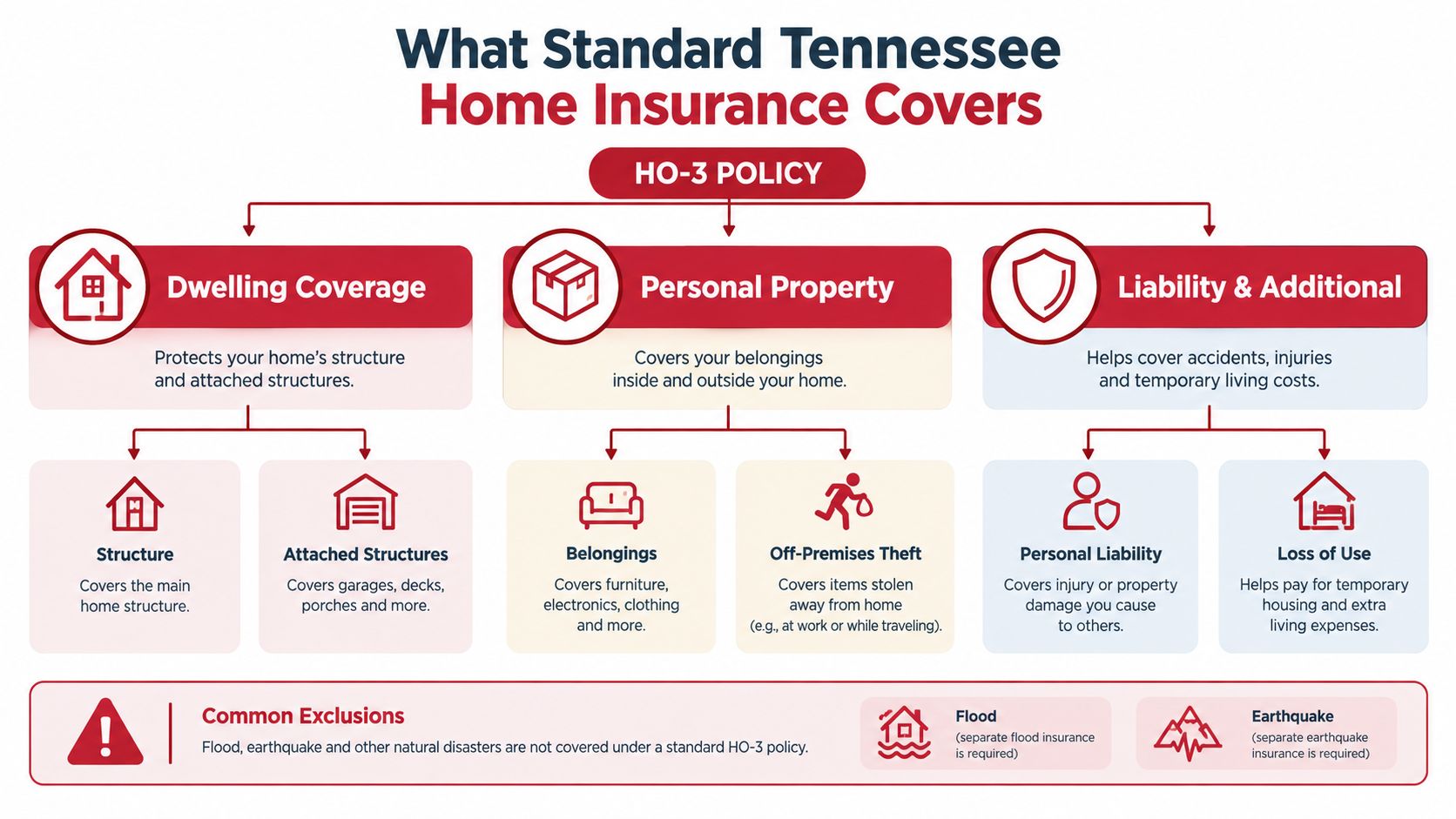
A typical HO-3 policy is designed to protect the home, the contents inside it, and the household's financial responsibility to others. The details vary by policy and carrier, but the basic structure is familiar.
The four coverage areas to inspect
Dwelling coverage applies to the house itself and usually attached structures. The limit should represent the estimated cost to rebuild with comparable materials, not the home's sale price or taxable value.
Other structures coverage may apply to detached garages, sheds, fences, and similar property. Check whether the limit is sufficient for the structures you have. A basic fence and a detached workshop create very different insurance needs.
Personal property coverage protects belongings such as furniture, clothing, appliances, and electronics against covered causes of loss. Some high-value items may need separate scheduling or additional limits, particularly jewelry, collectibles, cameras, or specialized equipment.
Liability and loss of use coverage address two different problems. Personal liability can respond when someone claims your negligence caused injury or property damage. Additional living expense coverage can help with eligible temporary living costs when a covered loss makes the home uninhabitable.
Covered weather does not mean unlimited protection
Windstorm, hail, and tornado damage are typically covered under standard homeowners policies, but the policy may apply a separate wind and hail deductible. That distinction matters because the deductible can be calculated as a percentage of Coverage A rather than a fixed dollar amount.
Tennessee's weather experience helps explain why carriers scrutinize these terms. An industry analysis reports 60 confirmed tornadoes in 2025, tied for the highest count in a four-year window, and describes a rise of 900% between 2022 and 2025, from 6 tornadoes to 60. A separate Tennessee claims review reports that claim frequency increased 17% over the past decade, while average claim severity rose 43%. It also reports 8,565 claims totaling $490 million from six significant weather events between 2022 and 2024, according to this Tennessee storm and claims analysis.
Those figures don't determine your individual claim, but they explain why policy language matters. For a Tennessee-focused overview of common homeowners coverage, review this Tennessee home insurance guide.
The exclusions deserve equal attention
A policy can cover sudden water damage from a burst pipe while excluding floodwater entering from outside. It can cover wind damage while imposing a separate deductible. It can cover a stolen television while limiting recovery for certain categories of valuables.
Before storm season, look for:
- Flood exclusion: Confirm whether rising or surface water requires separate coverage.
- Wind and hail deductible: Identify the percentage, the Coverage A amount used, and the perils to which it applies.
- Roof settlement terms: Ask whether the roof is covered for replacement cost or actual cash value.
- Ordinance or law coverage: Determine whether the policy helps with updated building requirements after a covered loss.
- Liability limits: Review whether the limit fits your assets, household activities, and property risks.
Understanding Flood Risk and Flood Insurance Options
Flood is the coverage gap most likely to be misunderstood by Chattanooga homeowners. A standard homeowners policy excludes flood damage entirely. It may cover certain types of accidental or sudden water damage, but that doesn't turn the policy into flood insurance.
Flood exposure can come from Tennessee River overflow, flash flooding, or heavy rainfall. A property can also face water movement outside the areas homeowners commonly think of as high-risk zones. Local flood guidance explains that homes in FEMA Special Flood Hazard Areas may need separate coverage through the National Flood Insurance Program or a private carrier, and federally regulated mortgage lenders generally require it in mapped high-risk areas. See this Chattanooga flood risk and insurance explanation.
Mandatory coverage and sensible coverage aren't identical
If a lender requires flood insurance, the decision is straightforward. You must maintain the required coverage to satisfy the loan terms. Outside a mandatory zone, the choice becomes a risk and budget decision.
A flood map can help you identify the mapped status of an address, but it shouldn't be treated as a complete prediction of future water damage. Drainage, grading, nearby waterways, foundation design, and rainfall patterns all affect the practical exposure. A homeowner outside a mandatory zone may still decide that separate flood coverage is worth pricing.
Compare the available approaches
Separate flood insurance is designed specifically for flood-related building and contents losses. It keeps the flood exclusion from the standard policy from becoming a complete financial gap.
Private flood coverage may offer terms that differ from federal program coverage, including different limits, deductibles, exclusions, and treatment of additional living expenses. The policy form matters as much as the premium.
An endorsement or add-on, when available, can place extra protection alongside the existing homeowners policy. Availability and scope vary, so don't assume an add-on matches a standalone flood policy.
FEMA's Risk Rating 2.0 framework makes flood premiums property-specific. Distance to water, elevation, foundation type, and replacement cost can all affect pricing, which means two nearby homes may receive materially different flood premiums.
Ask these questions before buying
- What counts as flood under this policy? Ask for the operative definition and examples.
- What building elements are covered? Confirm treatment of foundations, utilities, HVAC equipment, finished areas, and attached structures.
- How are contents settled? Replacement cost and actual cash value produce different claim outcomes.
- What is excluded? Review basements, landscaping, detached structures, temporary housing, and property stored below applicable elevations.
- When does coverage begin? Flood coverage may not respond immediately after purchase, so arranging it before threatening weather is essential.
The practical comparison isn't “required versus unnecessary.” It's the cost of separate protection versus the financial consequence of accepting an uncovered flood loss.
Navigating Wind, Hail, and Tornado Deductibles
Wind and hail coverage can appear prominently in a policy while the deductible remains easy to overlook. Many Tennessee policies use a separate wind and hail deductible calculated as a percentage of Coverage A, the dwelling limit.
Suppose a policy uses a 1% or 2% deductible, as described in this Chattanooga wind and hail coverage overview. The percentage applies to the dwelling coverage amount, not necessarily to the repair estimate. That creates a different result from a flat deductible. As the dwelling limit increases, the homeowner's share of a wind or hail claim increases with it.
Read the deductible before judging the premium
A low annual premium may look attractive until you compare the deductible structure. Ask the agent to identify:
- The Coverage A limit used to calculate the deductible.
- The exact percentage that applies to wind and hail.
- The events included, such as tornado, hail, straight-line wind, or named storm.
- Whether other deductibles can apply to the same loss.
- How the carrier handles roof damage, including depreciation and matching materials.
The deductible can exceed the cost of routine repairs on a higher-valued dwelling. That doesn't make the coverage useless. It changes the point at which filing a claim makes financial sense.
Use a severity-first claim strategy
After a storm, don't file based only on what you can see from the ground. Photograph the roof, siding, gutters, windows, interior ceilings, and any fallen trees. Keep records of the storm date, temporary repairs, contractor observations, and damaged property.
Minor cosmetic damage may not cross the applicable deductible. Structural damage, active leaks, electrical problems, or damage that worsens over time deserves faster attention. Ask a qualified professional to inspect questionable areas, but avoid signing repair contracts before you understand the claim process and policy terms.
After a storm: Protect the property from further damage, document conditions, and notify the carrier promptly when you suspect a covered loss.
A deductible decision also belongs in your broader emergency budget. If you choose a percentage-based structure, keep enough accessible funds to handle the out-of-pocket amount without delaying essential repairs.
How Home Insurance Costs Have Changed in Tennessee
Premium pressure has changed the way Chattanooga homeowners evaluate insurance. The question is no longer just whether a quote looks competitive today. It's whether the coverage remains financially workable after regional claim costs, repair prices, and underwriting changes affect the next renewal.
Tennessee home insurance costs rose 8.3% in 2025, after increases of about 11% in 2023 and 10% in 2024, according to this Tennessee homeowners insurance cost analysis. Those increases make it tempting to reduce limits or remove optional coverage. That may lower the bill, but it can also transfer a much larger risk to the homeowner.
Reduce avoidable underwriting problems
Some actions won't eliminate market-wide increases, but they can improve the quality of your risk profile.
- Maintain the roof: Keep inspection records, repair loose materials, and replace failing components before a storm turns a maintenance issue into a claim dispute.
- Document upgrades: Save invoices for electrical, plumbing, roofing, HVAC, security, and storm-resistance improvements.
- Review reconstruction limits: Construction costs and home improvements can make an old dwelling limit inadequate.
- Ask about mitigation credits: Carriers may consider protective features, but discounts depend on the policy and underwriting rules.
- Compare the deductible trade-off: A higher deductible can reduce premium, but only choose one you can fund after a loss.
Flood coverage deserves its own affordability review. Because a standard homeowners policy excludes flood, removing or overlooking separate flood protection doesn't make that exposure disappear. Price it alongside the base policy and compare the added premium with the cost of accepting the loss yourself.
Compare quotes on equal terms
A quote comparison only works when the limits and deductibles match. One carrier may appear cheaper because it uses a lower dwelling limit, a different roof settlement method, or a higher wind and hail deductible.
Request quotes using the same information:
- Replacement-cost dwelling limit
- Personal property and liability limits
- Flat all-peril deductible
- Wind and hail deductible
- Roof age and construction
- Flood coverage status
- Recent claims and property improvements
For a quote review that keeps those variables visible, you can request Tennessee insurance quotes. The goal isn't to chase the lowest number. It's to identify the least expensive option that still responds to the losses your home is most likely to face.
How to Choose the Right Policy and Agent in Chattanooga
Start with the house, not the advertisement. An accurate quote requires the property address, approximate square footage, construction details, roof age, heating and electrical information, detached structures, mortgage details, and recent claim history. If you've renovated the kitchen, finished a lower level, added a deck, or replaced the roof, provide those details before the agent calculates the dwelling limit.
Ask for a coverage comparison
A useful proposal should show more than the premium. Ask the agent to place competing options side by side and identify:
- Dwelling limit: What rebuilding assumptions support the amount?
- Roof settlement: Is the roof settled at replacement cost or actual cash value?
- Wind and hail deductible: Is it flat or percentage-based?
- Flood solution: Is separate coverage available and necessary for the property?
- Liability protection: Does the limit fit your household and assets?
- Loss of use: What happens if a covered event makes the home unlivable?
An independent agency can compare policies from multiple carriers rather than presenting only one company's product. To understand how that arrangement works, review this explanation of independent insurance agencies.
Choose communication over assumptions
The right agent should explain exclusions and deductibles in plain language, answer questions before binding coverage, and help you understand what to do after a loss. Bilingual support can also make policy conversations more precise for Spanish-speaking households, particularly when technical terms affect claim expectations.
Select Insurance Group, Inc. is one agency option for Tennessee homeowners. Its process connects customers with multiple carriers, offers home insurance quote support, and includes bilingual specialists across its service area.
A good agent won't promise that every claim will be covered or that every renewal will remain unchanged. They'll show you where the policy is strong, where it has limitations, and what decisions belong to you.
Getting Started With Better Protection
Pull out your declarations page and mark four items first: the dwelling limit, the standard deductible, the wind and hail deductible, and any flood exclusion or separate flood policy. Those details tell you more about your storm readiness than the premium alone.
Then check your property's mapped flood status and ask for a separate flood quote if water exposure is possible. Compare policy options using identical limits and deductibles, and ask whether bundling, protective features, or other available discounts apply to your situation.
Keep a simple home file with roof records, renovation invoices, photos of major rooms, appliance details, and prior claim documents. After severe weather, photograph damage before repairs whenever it's safe, take reasonable steps to prevent further damage, and contact the carrier promptly.
Chattanooga homeowners don't need to eliminate every risk. They need to understand which risks the standard policy handles, which ones require separate protection, and how deductibles affect the money they'll need after a storm.
Select Insurance Group, Inc. helps Chattanooga homeowners compare home insurance options, review flood and wind-hail gaps, and request quotes from multiple carriers. Visit Select Insurance Group, Inc. to start a Tennessee home insurance quote and discuss coverage that fits your property.