
The truck is ready, the first customer has booked a job, and the insurance question is suddenly urgent. A personal auto policy may not cover business use, while a commercial quote can be hard to judge if you don't know what's included. The search for “box truck insurance near me” is really a search for coverage that fits the truck, the cargo, the route, and the work.
The right way to shop is to work through the details in order: identify the coverage your business needs, check which rules apply to your operation, gather underwriting information, then compare quotes on matching terms. That helps you spot the costly gaps, such as cargo exclusions or limits that don't satisfy a contract, before you pay for a policy.
Table of Contents
- The Moment You Realize You Need a Policy
- What a Box Truck Policy Actually Covers
- Federal Rules and State Minimums in the Southeast
- Documents to Prepare Before You Request a Quote
- Comparing Quotes From Local Agents and Direct Carriers
- What Actually Moves Your Premium
- Lowering the Premium and Binding Your Policy
The Moment You Realize You Need a Policy
A box truck parked at home can feel like a business asset right up until you picture it backing into a customer's car, damaging a storefront, or getting hit while carrying a load. Commercial insurance isn't just a formality before the first job. It's a way to keep one accident from turning into a dispute about whether the vehicle, cargo, driver, or business activity was covered.
The phrase “near me” matters because insurers need to understand where the truck is garaged and where it operates. A local moving truck, a delivery vehicle crossing state lines, and a contractor hauling tools may look similar in the driveway, but they don't present the same risk. Your state, operating territory, cargo, driver history, and customer contracts can all shape the coverage and quote.
Shop for a defensible structure, not just a price
Start with commercial auto liability and physical damage. Then decide whether your work calls for cargo coverage, hired and non-owned auto, general liability, or workers' compensation. Don't assume one package automatically includes every exposure. Ask for the policy documents and confirm exclusions, limits, and deductibles before you bind.
Practical rule: If the truck is being used to earn revenue, describe that work plainly to the agent. A vague description can lead to a quote that doesn't match the operation.
The process is straightforward once you have the right information: classify the truck and its use, check applicable rules, prepare the documents, and compare equivalent quotes from carriers willing to insure the risk. Then make any sensible changes to reduce the premium without removing protection the business depends on.
What a Box Truck Policy Actually Covers
A box truck policy is a set of coverages, not a single promise that “the truck is insured.” The main question is what caused the loss, who suffered it, and what property was involved. Federal crash data underscores why a personal auto policy isn't a substitute: FMCSA's 2020 table recorded 40,475 towaway crashes involving van and enclosed-box trucks, 46.7% of all large-truck towaway crashes, along with 19,651 injury crashes, 42.8% of the total (FMCSA large-truck crash table).
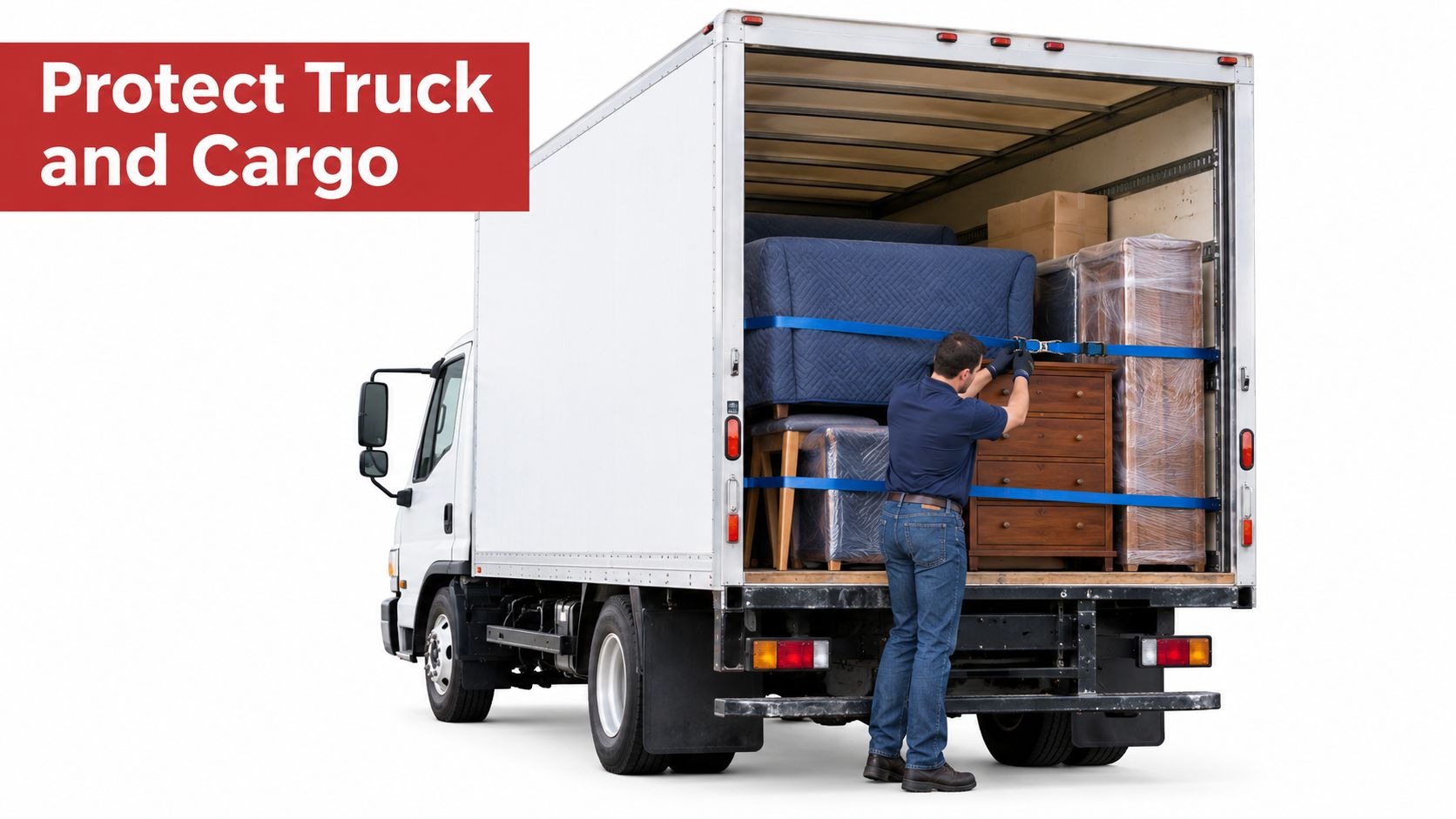
Match each coverage to a loss
- Commercial auto liability pays for covered bodily injury and property damage you cause to other people while operating the truck. It's the foundation, but the limit should reflect your contracts and exposure, not just the minimum you hope to meet.
- Physical damage covers the insured vehicle for covered collision and non-collision losses, subject to the policy terms and deductible. Check the value shown for the truck and how the policy handles a total loss.
- Motor truck cargo applies to covered damage or loss to goods in transit. A mover with furniture, an appliance delivery business, and a contractor hauling customer property should each describe the maximum load value and cargo type accurately. Read exclusions, conditions, and valuation terms closely. For a focused overview of this coverage, see cargo insurance for truckers.
- Hired and non-owned auto can address certain business use of rented or borrowed vehicles, as well as employee-owned vehicles used for work. It may matter when a helper uses a personal pickup to bring supplies to a job.
- General liability addresses certain third-party injury or property damage connected to business operations away from the truck, such as a customer's property being damaged during a move. It doesn't replace auto liability.
A solo owner-operator may focus on the truck, liability, and cargo. A small fleet needs to account for every vehicle and driver. Contractors should consider tools, equipment, and off-truck job-site exposures. Businesses arranging moves can also compare removalist cover options as a way to identify coverage questions to raise with their own agent. Ask for a written explanation of what each selected coverage does and what it leaves out.
Federal Rules and State Minimums in the Southeast
The label “box truck” doesn't by itself determine which insurance filing applies. Federal requirements depend on the carrier's operating authority, cargo, and vehicle type; state requirements depend on the operation and the state. FMCSA guidance says minimum financial responsibility can start at $750,000 and rise as high as $5 million depending on those factors (FMCSA insurance filing requirements).
That figure isn't a universal limit for every box-truck owner. A private business using a truck for its own work, an intrastate delivery company, and an interstate for-hire carrier can fall under different rules. A lender or shipper may also require limits beyond a legal minimum. Get the agent to confirm which filings and limits apply to your actual operation before relying on a general rule.
Check the relevant state and federal framework
For operators in Alabama, Florida, Georgia, North Carolina, South Carolina, Tennessee, and Virginia, ask about the rules in the state where the business is based and the states where the truck operates. Don't assume that an intrastate truck has the same filing obligations as an interstate carrier, or that one state's answer carries over across a state line. Because requirements can turn on business details and change over time, have the applicable state agency or a commercial insurance professional verify current rules for your operation.
Questions to resolve include:
- Operating authority: Are you hauling for others for compensation, or carrying your own business property?
- Route: Does the truck remain within one state, or cross state lines?
- Vehicle and cargo: What's the GVWR, and what commodities are being transported?
- Contract and financing terms: Does a shipper, customer, or lender specify liability limits, filings, or physical-damage coverage?
A legal minimum answers what you must carry. It doesn't automatically answer what your business can afford to lose.
A sensible limit decision weighs route, GVWR, commodity, contracts, and the business's ability to withstand an uninsured loss. If vehicle regulations are part of your compliance checklist, a resource on chrome bumper rules for trucks can help flag a separate equipment question to discuss with the appropriate authority. For a Georgia-based operation, review truck insurance in Georgia alongside the requirements that apply to your specific work.
Documents to Prepare Before You Request a Quote
Underwriters can't price a truck accurately from its body style alone. A complete submission gives them the facts they need to assess the vehicle, drivers, cargo, and operating territory. It also makes it easier to compare quotes without repeatedly correcting missing or inconsistent information.

Assemble one underwriting file
Prepare the following before calling an agent:
- Vehicle details: VIN, GVWR, year, make, model, and the value you want insured for physical damage.
- Where and how it runs: Garaging address, operating radius, states served, and annual mileage estimate.
- Work and cargo: A plain description of the business, the types of goods carried, and the maximum load value.
- Drivers: Names of everyone who may drive, their motor-vehicle records, and any relevant driving or commercial experience.
- Loss history: Loss runs from prior insurers, if available, plus a clear explanation of any listed claims.
- Coverage needs: Desired liability and physical-damage limits, deductibles, cargo terms, and any rental-reimbursement request.
- Outside requirements: Customer contracts, shipper terms, or lender documents that specify limits, certificates, or coverage conditions.
Include details that change the picture
Tell the agent where the truck stays overnight and whether it's parked in a secured area. Disclose whether employees drive it, whether you cross state lines, and whether the business uses GPS or other tracking. These details help the insurer understand how the truck is used instead of guessing from the business name.
Review the application before it goes to market. A mismatched address, incomplete driver list, or overly broad cargo description can slow underwriting or produce a quote that isn't usable. If you're approaching more than one agent, provide the same information to each and ask them to quote the same limits and deductibles. That gives you a meaningful comparison rather than several prices for different policies.
Comparing Quotes From Local Agents and Direct Carriers
A lower premium isn't a fair win if it comes with a lower liability limit, a larger deductible, or a cargo exclusion you didn't notice. Compare the quote documents line by line, and check that each insurer has accepted the same description of your business. An independent agency, a captive agent, and a direct carrier can each be a reasonable starting point, but they don't offer the same shopping process.
| Source | Best For | Speed | Key Trade-Off |
|---|---|---|---|
| Independent agency | Operators who want help shopping multiple insurers and sorting coverage | Can be quick when the submission is complete | Market access and trucking expertise vary by agency |
| Captive agent | Applicants who prefer working with one insurer's representative | Often straightforward for risks the insurer accepts | The agent can't compare the risk across unaffiliated carriers |
| Direct carrier | Applicants comfortable handling details and documents themselves | May be efficient for a simple, eligible operation | You may need to resolve coverage questions and filings without an intermediary |
Make the terms match
Put each quote next to the others and confirm the same items:
- Liability limits and any required filings
- Physical-damage deductibles and vehicle valuation
- Cargo limits, covered property, and exclusions
- Whether hired and non-owned auto is included
- Listed vehicles and drivers
- Fees, payment terms, and certificate handling
Don't treat similar labels as proof that two policies are equivalent. Ask the agent to point to the relevant wording in the proposal or policy, especially for cargo conditions and valuation. If you haul for a customer, compare its contract requirements against each quote before choosing.
An independent agency that handles commercial trucking can be useful when the operation needs careful classification or several coverage pieces. A captive or direct option may suit a more straightforward risk, provided you verify the terms yourself. For help thinking through a structured quote comparison, use this guide to finding commercial truck insurance rates. Ask each provider who will handle certificates, filings, and policy changes after binding, not just who can deliver a price.
What Actually Moves Your Premium
Your premium reflects the risk the insurer believes it's taking on, not just the truck's purchase price. The inputs that usually matter most are vehicle type and value, operating territory, cargo, driver records, and claim history. A clean driving record helps, but it won't erase the effect of a high-value truck, broad radius, or demanding cargo exposure.
Commercial auto pricing has faced substantial pressure. In Texas, a 2024 Department of Insurance report found average liability premiums across all vehicle types rose 70% from 2017 through 2023, about 8.6% per year, while rates rose 73% over the same period (Texas commercial-auto report). Texas isn't a substitute for a quote in a Southeast state, but the report helps explain why commercial coverage can't be priced like personal auto.
Focus first on the factors you can document
Vehicle size, weight, and value shape both liability and physical-damage exposure. Then consider radius and state crossings: an insurer needs to know whether the truck stays local or operates farther afield. Annual mileage adds another measure of time on the road, while cargo type and maximum load value affect the potential severity of a cargo loss.
The garaging address matters because the truck's storage and operating environment form part of the risk. Driver motor-vehicle records and claims history matter too. Keep driver information current, disclose losses accurately, and avoid adding people to the policy who won't operate the truck. Guessing low on mileage or radius may produce a quote that has to be corrected later.
Theft protection is another practical area to address. Industry reporting citing CargoNet said reported cargo-theft incidents increased from 2,852 in 2023 to 3,625 in 2024, a 27% increase, with average theft value reaching $202,364 (cargo-theft reporting). Tell the agent how the truck is parked, whether cargo is left onboard, and what tracking or securement practices you use. Those steps don't replace cargo coverage, but they give the underwriter a clearer picture of your controls.
Lowering the Premium and Binding Your Policy
The best premium reductions come from choices that don't leave the business unable to absorb a loss. Start by asking the agent to price a higher deductible, then make sure the business has enough cash to pay it after a claim. Ask whether telematics or a documented safety program could affect the offer, and whether combining appropriate policies changes the total cost. Don't assume a discount applies until it appears in the written quote.
Review the truck's garaging arrangement and driver list. Secure parking, such as a gated or monitored yard, can be worth discussing with the insurer. List only drivers who need access, but don't omit a regular driver to improve the price. Keep mileage and operating radius accurate; a declared local operation that regularly crosses state lines can create a coverage problem, not just a billing correction.
Bind only after checking the details
Before authorizing coverage, confirm the effective date and time, covered vehicles, listed drivers, limits, deductibles, and any cargo conditions. Ask for certificates for customers or lenders, and confirm whether the insurer or agent will submit any required filings. Interstate operations may have additional FMCSA filing needs, so verify that the right filing is handled before dispatch. Save the agent's direct contact details for certificate requests and policy questions while the truck is working.
The cheapest quote isn't a bargain if it leaves a cargo gap, an inadequate limit, or an unexpected deductible the business can't pay.
If a loss happens, prioritize safety and contact emergency services when needed. Photograph the vehicles, damage, scene, and cargo before anything is moved if it's safe to do so. Notify the insurer or agent promptly, keep receipts and claim documents together, and follow instructions about repairs and damaged goods. A responsive local agent can help direct the claim to the right contact and clarify what information the adjuster needs.
Select Insurance Group, Inc. offers commercial auto and trucking coverage options for delivery vehicles, service trucks, and fleets across the Southeast. Gather your vehicle, driver, route, cargo, and contract details, then contact Select Insurance Group, Inc. to discuss a box-truck policy that fits the way your business operates.