
Tennessee requires at least 25/50/25 liability coverage for any registered motorcycle in Memphis, while local full-coverage averages around $67 per month and minimum-only coverage averages roughly $12 per month statewide. Compliance is cheap, but meaningful protection costs more because the minimum policy won't pay for your motorcycle, your injuries, theft, or every serious liability claim.
You might be five minutes from home on Poplar, carrying groceries in one saddlebag and thinking about dinner. Then a driver drifts across the lane without signaling. You grab the brake, the bike goes down, and the cheap policy you bought online suddenly becomes the most important document in your possession.
That rider could be on a used Sportster, a commuter bike, or a touring motorcycle financed through a lender. The common mistake is the same: treating a motorcycle as a weekend toy and choosing the smallest liability limits on the screen. In Memphis, that decision deserves closer attention because the city has documented motorcycle-crash activity, dense traffic corridors, and exposure to uninsured drivers.
This guide focuses on the practical side of Memphis motorcycle insurance. You'll see what Tennessee requires, what the minimum limits pay, how local crash severity changes coverage priorities, which policy components work together, what premiums look like, and how to compare quotes without spending a Saturday on hold. You'll also get a final checklist that tells you what to do next.
Table of Contents
- A Memphis Rider at the Intersection
- Tennessee Motorcycle Insurance Requirements
- Why Memphis Riding Looks Different on Paper
- The Coverage Types You Can Stack on a Memphis Policy
- What Memphis Motorcycle Insurance Really Costs
- Discounts Memphis Riders Leave on the Table
- Comparing Quotes the Smart Way in Memphis
- Your Next Steps and How Select Insurance Group Helps
A Memphis Rider at the Intersection
It's a Tuesday afternoon at Poplar and Highland. A Memphis rider on a used Sportster is waiting for the light, five minutes from home, when a sedan rolls past without signaling. The rider has Tennessee's minimum liability coverage because it was the cheapest option on the website. The motorcycle was supposed to be “just for weekends,” so higher limits felt unnecessary.
Nothing happens this time. The sedan clears the intersection, the light changes, and the rider gets home. But the near miss exposes the weakness in the policy. Minimum liability doesn't repair the Sportster after a collision, replace a stolen motorcycle, pay the rider's hospital bills, or provide enough protection when another driver causes a serious injury and carries little or no insurance.
That gap matters before a crash, not after one. Once the loss occurs, you can't add collision coverage, increase liability limits, or retroactively insure damaged equipment.
Practical rule: Buy coverage based on the loss you couldn't comfortably absorb, not on the price of the motorcycle policy alone.
The right policy depends on how and where you ride. A short commute through Midtown creates different exposure from occasional rural rides. A financed touring bike has different requirements from an older paid-off cruiser. A rider who carries a passenger, stores custom parts, or rides after dark needs to ask different questions than someone who rides only in dry daylight.
The sections ahead separate legal compliance from actual protection. You'll see why liability is only one layer, how uninsured motorist coverage fits into the Memphis risk picture, and where quote comparisons commonly go wrong. You'll also get a practical way to ask carriers for matching coverage so the cheapest quote isn't the thinnest policy.
Compliance is cheap. Protection isn't free. The difference becomes clear when you translate each limit into an actual Memphis crash.
Tennessee Motorcycle Insurance Requirements
Before choosing limits, separate Tennessee's legal floor from the protection you may need after a Memphis crash. The state commonly expresses its motorcycle insurance requirement as 25/50/25. That means at least $25,000 for bodily injury to one person, $50,000 for bodily injury per accident, and $25,000 for property damage. Memphis follows Tennessee's statewide insurance and helmet rules. The Tennessee motorcycle insurance overview explains those state-specific requirements.
The first bodily-injury figure is the most the liability policy pays for one injured person, subject to its terms. The second is the total bodily-injury limit available for everyone injured in one accident. The property-damage limit applies to damage you cause to another person's vehicle or other property.
| Requirement | What the number or rule means | Memphis example |
|---|---|---|
| Bodily injury per person | At least $25,000 available for one injured person | A rear-end collision on Poplar injures the other driver |
| Bodily injury per accident | At least $50,000 available for all injured people in one crash | A passenger and driver are both hurt near Shelby Farms |
| Property damage | At least $25,000 for damage to another person's property | A sideswipe in a Cooper-Young parking area damages a vehicle |
| Helmet rule | Every rider and passenger must wear a DOT-compliant helmet | The rule applies regardless of age or experience |
Those limits are ceilings, not recommended targets. A 25/50/25 policy can satisfy the liability requirement, but it may leave little room when injuries, lost income, or damage to a newer vehicle push a claim above the available limits. The rider responsible for the crash can face the remaining financial exposure personally.
Tennessee's minimum is liability coverage, not a complete motorcycle-protection package. It generally pays claims made by other people when you are legally responsible. It does not repair your own motorcycle after a crash. Collision coverage addresses crash damage to the insured bike, while other first-party coverage may address separate losses under the policy.
Tennessee also has a universal helmet law. Every motorcycle rider and passenger must wear a DOT-compliant helmet, regardless of age or experience. Riders without a windscreen need appropriate eye protection. Proof of insurance can also matter during a traffic stop or when officers document an accident.
Liability limits need a practical review
Liability coverage follows the insured motorcycle and the policy terms, not just the person wearing the helmet. Lending the bike can raise coverage questions if the borrower was not disclosed, lacked permission, or falls outside the policy's definitions. Confirm how the policy treats permitted riders before handing over the keys.
A coverage lapse creates a separate problem. An insurer will not backdate protection for an accident that already happened. Registration, renewal, traffic-stop, and post-crash consequences can follow, so keep proof of active coverage with the motorcycle and confirm the effective date before riding. When reviewing Tennessee motorcycle insurance coverage options, verify both the required limits and the protections that apply to your own bike.
Why Memphis Riding Looks Different on Paper
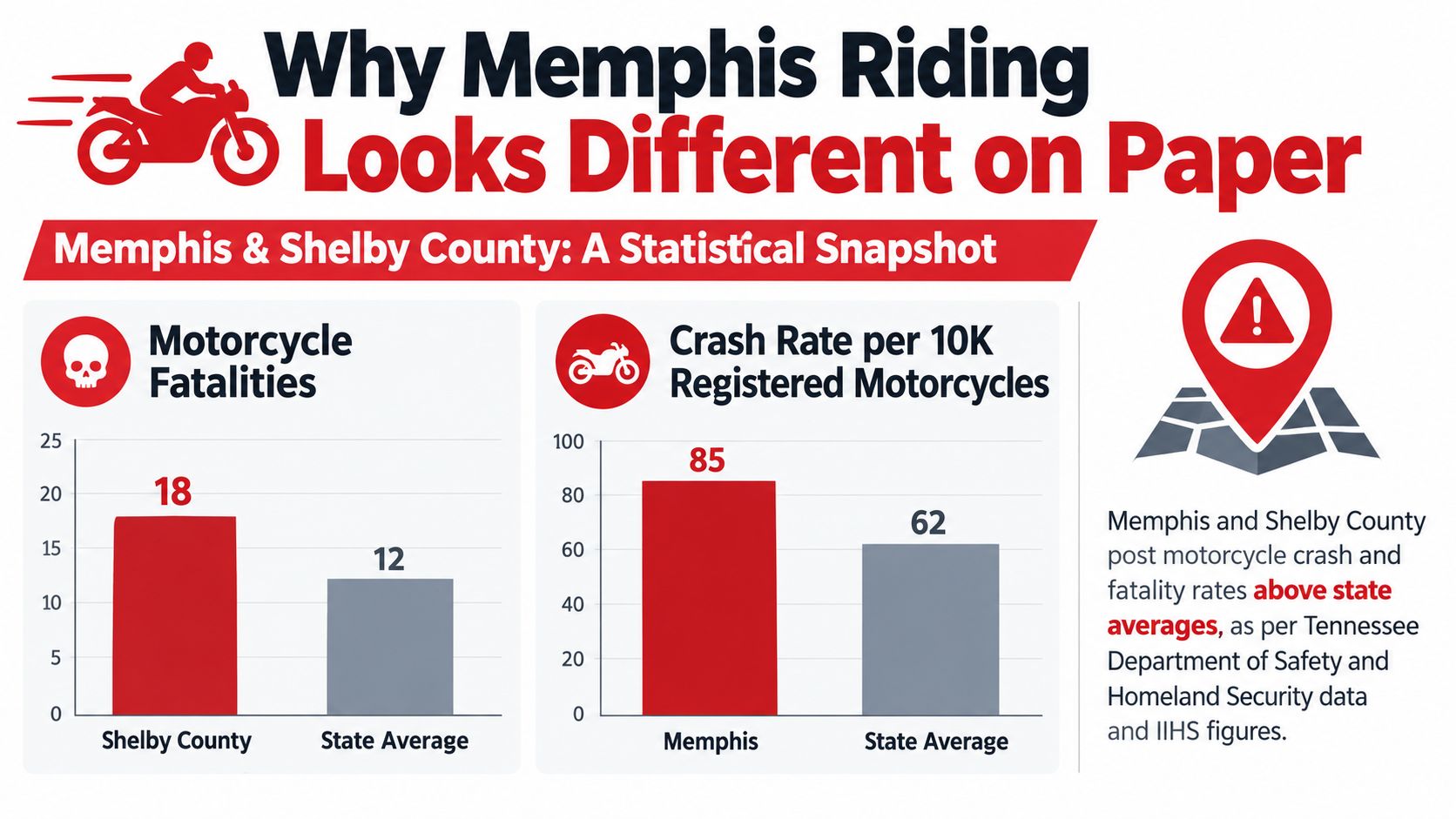
Memphis isn't a smaller version of rural Tennessee riding. A University of North Carolina-backed safety analysis identified Memphis as one of Tennessee's six motorcycle crash hotspot areas. The same analysis recorded 14,677 motorcycle crashes statewide from 2016 through 2020, with 73.4% producing rider injuries, 5.1% producing fatal outcomes, and 21.7% causing incapacitating injuries. Those figures are reported in the Tennessee motorcycle safety analysis.
A separate local legal summary reported over 75 motorcycle crashes in Memphis during 2023, while statewide motorcycle-crash information shows recurring activity across the years covered by the available data. The practical point isn't that every ride ends badly. It's that injury exposure is a recurring underwriting concern, and urban riding puts the motorcycle in more conflict points with larger vehicles.
Urban exposure changes the buying decision
A Memphis rider deals with multilane traffic, abrupt lane changes, busy intersections, and recurring congestion. I-40, I-55, and the I-240 loop can turn a small mistake into a high-energy incident. Wet leaves, uneven pavement, poor visibility, and night riding add different hazards from an open rural route.
Tennessee also has a notable uninsured-driver problem. Recent state-focused estimates place the uninsured share around 20% to 20.9%, which makes protection against an uninsured or underinsured driver especially important for a motorcyclist. That coverage can help move the claim away from an empty promise by the other driver and toward the rider's own policy, subject to the selected limits and terms.
For a Memphis policy, I generally examine higher bodily-injury limits, uninsured and underinsured motorist coverage, medical payments, collision, and full coverage before discussing optional extras. The bike's value matters, but the rider's injury exposure often deserves the first serious conversation. A motorcyclist has less physical protection than someone inside a passenger vehicle, so a policy built around property damage alone can miss the largest financial risk.
If a collision has already happened, a practical resource on recovering after a motorcycle crash can help explain the broader claim process. Insurance questions and legal questions overlap after a serious injury, but they aren't identical, so document the scene, preserve medical records, and avoid guessing about fault.
The Coverage Types You Can Stack on a Memphis Policy
A motorcycle policy works best as a deliberate stack of protections. Liability addresses damage you cause to other people or their property. First-party coverage addresses your motorcycle, your injuries, and the equipment that keeps the bike usable. The right combination depends on the bike's value, how you ride, and how much financial risk you can absorb.
| Coverage | What it pays for | When Memphis riders skip it |
|---|---|---|
| Bodily-injury and property-damage liability | Claims from people or property you damage | They choose only the legal minimum before riding I-240, I-40, or I-55, where a severe crash can create injury and property claims quickly |
| Collision | Damage to your motorcycle from a crash, subject to the deductible | They expect the other driver to pay after a disputed crash in Memphis traffic |
| Other-than-collision coverage | Non-collision losses such as theft, vandalism, fire, flood, or animal strikes, subject to the policy | They leave the bike outside near busy Memphis corridors or apartment parking and have no protection after theft or vandalism |
| Uninsured and underinsured motorist | Injury-related protection when the responsible driver has no insurance or insufficient limits | They assume a driver who causes a hit-and-run on a Memphis street will have usable liability coverage |
| Medical payments | Covered medical expenses after a motorcycle accident, subject to the selected amount and terms | They rely entirely on health insurance after a crash on a congested Memphis route and overlook deductibles or coverage gaps |
| Accessories and custom equipment | Eligible aftermarket parts, gear, and custom equipment within policy limits | They add exhaust, luggage, electronics, or upgraded parts without reporting them before riding around Memphis |
Liability protects the other side
Bodily-injury liability handles claims from people injured in a crash you caused. Property-damage liability addresses the other vehicle, fence, structure, or belongings you damage. Tennessee's 25/50/25 floor can satisfy the legal requirement, but a serious motorcycle collision can involve medical treatment, lost income, rehabilitation, and legal expenses that move beyond minimum limits quickly.
The limit choice is an asset-protection decision. A rider with savings, a home, or income that could be targeted should treat liability as protection against more than the immediate repair bill. Minimum limits may leave personal assets exposed after a high-severity Memphis collision.
Collision and other-than-collision coverage protect the motorcycle
Collision responds to crash damage to your bike, whether you slide on your own or collide with another vehicle, subject to the deductible and policy terms. It matters on busy Memphis corridors because proving another driver's fault can take time, while the motorcycle may need repairs before the liability investigation finishes.
Other-than-collision coverage addresses losses that do not involve a crash. Theft, vandalism, fire, flood, and animal strikes are common examples, but read the policy language rather than assuming every event is included. If you own a financed motorcycle, the lender will commonly require physical-damage coverage.
UM, medical payments, and accessories fill the gaps
Uninsured and underinsured motorist coverage deserves close attention for Memphis riders. A hit-and-run driver or someone carrying inadequate limits can leave the motorcyclist with both the injury and the bill. Matching or higher UM and UIM limits give the policy a stronger response when the responsible driver's coverage cannot handle the loss.
Medical payments can help with eligible expenses after a covered accident. Accessory coverage addresses equipment that a standard motorcycle valuation may not fully recognize. Tell the agent about custom paint, upgraded suspension, luggage, communications equipment, riding gear, and other additions.
For a household with more than one bike, this multi-bike insurance coverage guide can help organize the policy conversation and identify equipment or coverage details that need to be listed separately.
What Memphis Motorcycle Insurance Really Costs
The available rate comparisons show a clear split between legal compliance and broader protection. One Tennessee rate study cited average monthly costs of about $12 for minimum liability statewide and $51 for full coverage statewide, while a Memphis-specific comparison reported an average of about $67 per month for full coverage. These figures come from published rate comparisons summarized through Tennessee motorcycle insurance pricing information.
| Coverage level | Average monthly premium | Annual estimate | What moves the price |
|---|---|---|---|
| Minimum liability, statewide reference | About $12 | About $144 | Rider profile, motorcycle, driving record, and location |
| Full coverage, statewide reference | About $51 | About $612 | Physical damage, liability selection, deductible, and rider risk |
| Full coverage, Memphis comparison | About $67 | About $804 | Urban rating factors, motorcycle value, coverage limits, and claims exposure |
The annual estimates are simple conversions of the monthly figures, not guarantees for an individual Memphis rider. Your quote can differ because insurers evaluate the motorcycle, rider, use, storage, coverage limits, deductibles, and prior losses together.
What changes an individual quote
A sport-oriented motorcycle may receive a different rate from a cruiser because the carrier evaluates performance, repair cost, theft exposure, and rider use. Engine size can matter, but it isn't the only variable. The same motorcycle can price differently for a new rider, an experienced rider, a rider with recent violations, and a rider with prior claims.
Garaging location also matters. A motorcycle stored in a secured garage may present a different theft exposure from one parked outdoors. Annual mileage, commuting use, passenger use, financing, selected deductible, and the value of custom equipment all affect the final policy structure.
I wouldn't use a hypothetical comparison between two specific motorcycle models as a promised price illustration. A clean-record rider on a touring bike and the same rider on a sport motorcycle can receive materially different quotes, but the actual difference depends on the carrier's filed rating rules and the rider's complete profile.
The extra premium isn't buying a vague feeling of safety. It's buying specific payments for specific losses, including damage to your bike, injury protection, theft, and claims involving drivers who can't pay.
The useful question isn't whether full coverage costs more than minimum liability. It obviously does. Ask whether the added protection addresses the loss you would struggle to fund yourself, then compare deductibles and limits rather than choosing solely by monthly price.
Discounts Memphis Riders Leave on the Table
Discounts can lower the cost of a sound policy, but they shouldn't be used to disguise incomplete information. Ask each carrier or agency to review the same facts and identify every eligible credit before you reduce limits or remove physical-damage coverage.
Common opportunities include:
- Bundling: Combining motorcycle coverage with eligible home or auto policies may reduce the overall insurance cost, depending on the carrier and account structure.
- Approved safety training: Completing an approved motorcycle safety course can qualify for a policy credit, subject to carrier rules and course eligibility.
- Payment choices: Paying the premium in full may avoid installment charges and can sometimes receive a billing credit.
- Multiple motorcycles: A household with a cruiser and a second motorcycle should ask whether placing both on one policy changes the rate.
- Secure garaging: A locked garage, gated location, or qualifying anti-theft device may receive consideration when the carrier accepts documented protective measures.
- Renewal and paperless options: Some carriers offer credits for eligible renewal, electronic-document, or advance-payment arrangements.
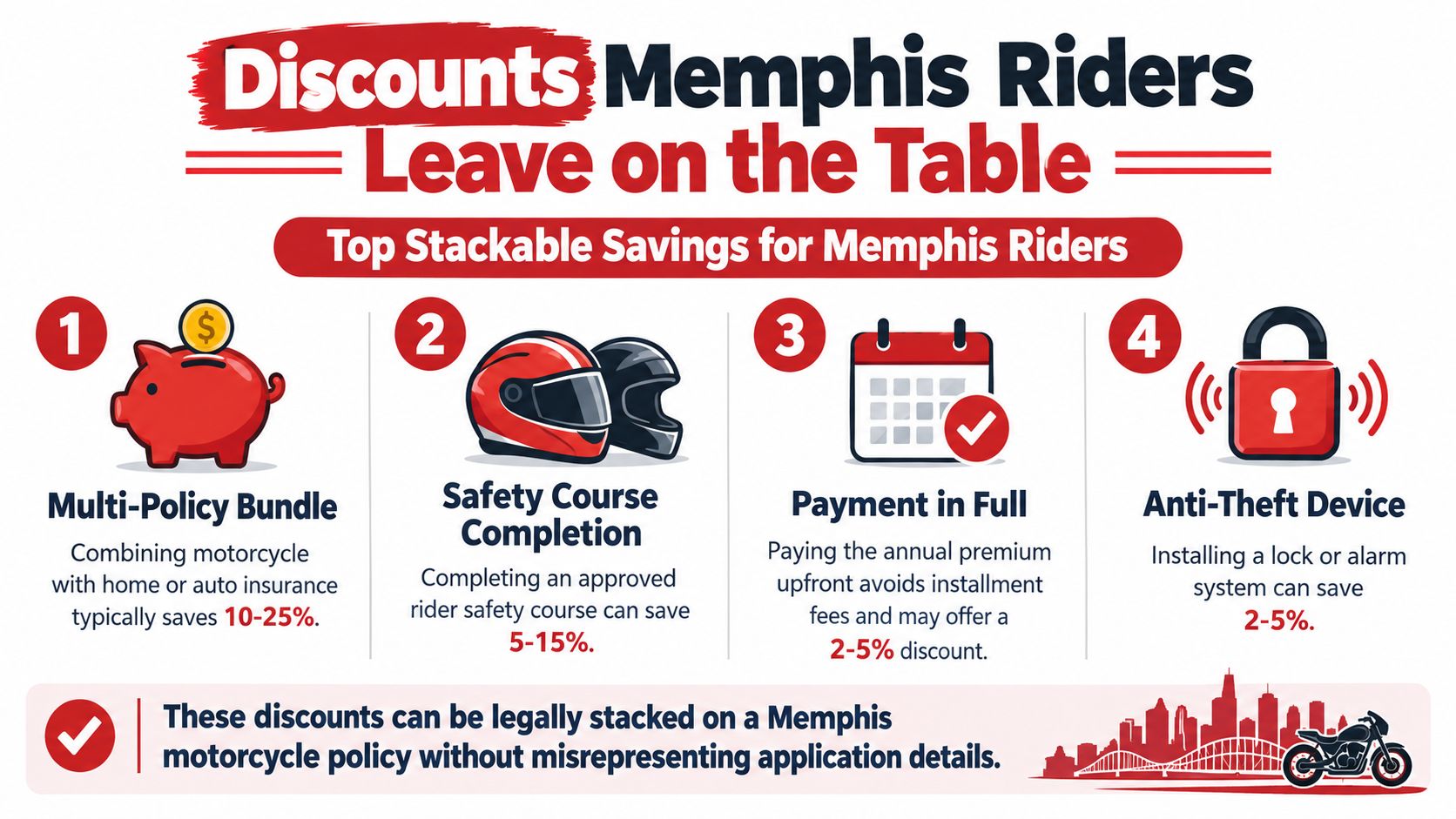
Discounts require accurate applications
Don't understate mileage to obtain a lower rate. Don't claim riding experience you don't have, and don't say the motorcycle is stored in a locked garage if it sits outside. Misrepresentation can create claim disputes and can affect renewal or policy eligibility.
The same caution applies to motorcycle use. If you commute daily, carry passengers, participate in organized events, or use the bike for business, describe that use accurately. A discount that depends on incorrect information isn't a real saving.
Use the same five questions with every quote:
- Which discounts apply to my rider profile?
- Does an approved safety course qualify?
- Is there a billing credit for paying in full?
- Does secure garaging or an anti-theft device qualify?
- Can I combine a multi-policy or multi-bike discount with the other credits?
Ask for the premium before and after each eligible discount. That makes it easier to distinguish a genuine discount from a lower quote that just removes coverage.
Comparing Quotes the Smart Way in Memphis
A quote comparison only works when each carrier receives the same information and coverage choices. Prepare the declarations page, motorcycle VIN, year, make, model, engine details, annual mileage, garaging ZIP code, riding history, completed courses, and prior claims. If the bike is financed, include the lender's information so required physical-damage coverage is clear.
Request matching liability limits, UM and UIM limits, deductibles, medical-payments coverage, collision and non-collision protection, and accessory coverage. A lower premium can mean a carrier left out protection included elsewhere.
Use the worksheet below as a fill-in comparison when gathering quotes. Empty cells are intentional, so you can record each proposal in the same format.
| Field to compare | Carrier A | Carrier B | Carrier C |
|---|---|---|---|
| Liability limits | |||
| UM and UIM limits | |||
| Collision deductible | |||
| Other-than-collision deductible | |||
| Medical payments | |||
| Accessory or custom-equipment limit | |||
| Total monthly or paid-in-full premium | |||
| Valuation method at total loss |
Ask questions the quote screen may hide
Ask whether repairs use original-equipment parts, approved alternatives, or another stated process. Confirm how the carrier values a total loss, whether the deductible changes after a not-at-fault collision, and how UM and UIM limits apply to a motorcycle claim.
Clarify whether medical payments coordinate with health insurance, whether guest-passenger liability is included, and whether roadside assistance applies to the motorcycle rather than only to a passenger vehicle. Record the answers in your notes. A verbal assurance is difficult to evaluate later if it does not appear in the proposal or policy documents.
An independent agency that can approach multiple carriers may save time compared with calling companies one at a time. It does not guarantee the lowest premium. The useful test is whether the proposals use matching limits, deductibles, exclusions, and coverage details. This motorcycle insurance quote guide can help organize those details before you request proposals.
Watch for three warning signs:
- A teaser premium: The initial number changes after discounts expire or underwriting reviews the application.
- Thin liability limits: The quote stays near the statutory floor, leaving less protection when an injury claim exceeds those limits.
- Missing UIM protection: The online process makes it easy to skip or reduce coverage against an uninsured driver.
Read the declarations page before binding. Confirm the effective date, motorcycle VIN, named riders, deductibles, limits, exclusions, and lender information.
Your Next Steps and How Select Insurance Group Helps
Start with a short afternoon checklist:
- Choose a liability target: Consider limits above Tennessee's minimum, such as 50/100/50 or higher, based on your assets and risk tolerance.
- Gather the basics: Have the VIN, garaging ZIP, current declarations page, annual mileage, and motorcycle details ready.
- Review rider qualifications: Document completed safety training and disclose tickets, claims, and prior riding experience accurately.
- Compare several proposals: Request three to five quotes with identical limits and deductibles.
- Confirm the overlooked layers: Check UM and UIM, medical payments, collision, and accessory coverage in every proposal.
- Prevent a lapse: Bind the replacement policy before the existing coverage ends and keep proof of insurance with the motorcycle.
A 25/50/25 policy may be appropriate for a rider with limited assets and a low-value motorcycle who knowingly accepts the exposure. It isn't automatically enough for a Memphis rider who depends on the bike, carries passengers, owns custom equipment, or would struggle with an injury claim after an uninsured-driver collision.
Select Insurance Group, Inc. can gather Memphis motorcycle quotes across multiple carriers in one conversation, review coverage gaps, and assist with policy changes after binding. Its bilingual team supports English- and Spanish-speaking customers through phone, text, or in-person service, making a second opinion practical for riders who aren't sure whether minimum-only coverage still fits.
Select Insurance Group, Inc. offers motorcycle insurance quote comparisons and guidance on liability, UM/UIM, physical damage, medical payments, and accessories for Memphis riders. Visit Select Insurance Group, Inc. to request a no-obligation review and compare your current 25/50/25 policy with broader protection.