
Florida recorded 9,548 motorcycle crashes and 621 fatalities in 2023, according to the Florida motorcycle accident statistics summary. That single fact should change how you think about motorcycle insurance in Florida.
A lot of new riders hear one thing and stop there: Florida doesn't require motorcycle insurance to register or ride. Legally, that's true in a narrow sense. Practically, it's one of the most misunderstood rules in the state. Riders assume “not required” means “safe to skip.” It doesn't.
Florida gives motorcyclists more freedom up front and more financial exposure after a crash. That's the trade-off. If you're shopping for motorcycle insurance Florida riders need, the goal isn't just checking a legal box. The goal is avoiding a coverage gap that can follow you long after the bike is repaired or replaced.
If you're still deciding whether a motorcycle is the right fit for your commute or weekend riding, this electric bike vs motorcycle guide gives a useful side-by-side look at how ownership and riding needs differ.
Table of Contents
- Riding in the Sunshine State The Truth About Florida Motorcycle Insurance
- Florida's Unique Motorcycle Insurance Laws Explained
- The High Cost of Riding Uninsured in Florida
- Decoding Your Coverage Options for Florida Roads
- Factors That Determine Your Florida Motorcycle Premium
- Finding Every Available Discount on Your Policy
- Your Step-by-Step Guide to Getting Insured
- Conclusion Ride with Confidence and Protection
Riding in the Sunshine State The Truth About Florida Motorcycle Insurance
Florida is one of those states where the law sounds simple until you apply it to a real crash. You can legally ride without a standard motorcycle policy in many situations, but you're still exposed if you injure someone, damage property, or get hit by a driver who has weak coverage. That gap is where riders get into trouble.
The biggest mistake I see in motorcycle insurance Florida decisions is treating the legal minimum as the smart minimum. Those are not the same thing. A legal rule tells you what the state will allow. A sound insurance plan should protect your income, your bike, and your ability to recover after a bad wreck.
Practical rule: If a coverage choice only helps you stay technically legal, but doesn't help you pay real-world costs after a crash, it's probably not enough.
That matters even more in Florida because motorcycle claims don't work like standard auto assumptions. Riders often expect the state's broader car-insurance logic to carry over. It doesn't. That misunderstanding leads people to skip the exact coverages that matter most.
When riders ask me where to start, I tell them to separate three questions:
- What does Florida allow? You may be able to ride without a traditional policy.
- What can suspend your driving privileges later? Failing to meet financial responsibility after a crash can create serious problems.
- What protects your own body and finances? That answer usually goes far beyond the bare legal threshold.
If you keep those three questions separate, the rest of the choices get much easier.
Florida's Unique Motorcycle Insurance Laws Explained
Many Florida riders make the same bad assumption. They hear Florida is a no-fault state for cars and assume that rule protects them on a motorcycle too. It does not.
Financial responsibility is not the same as mandatory insurance
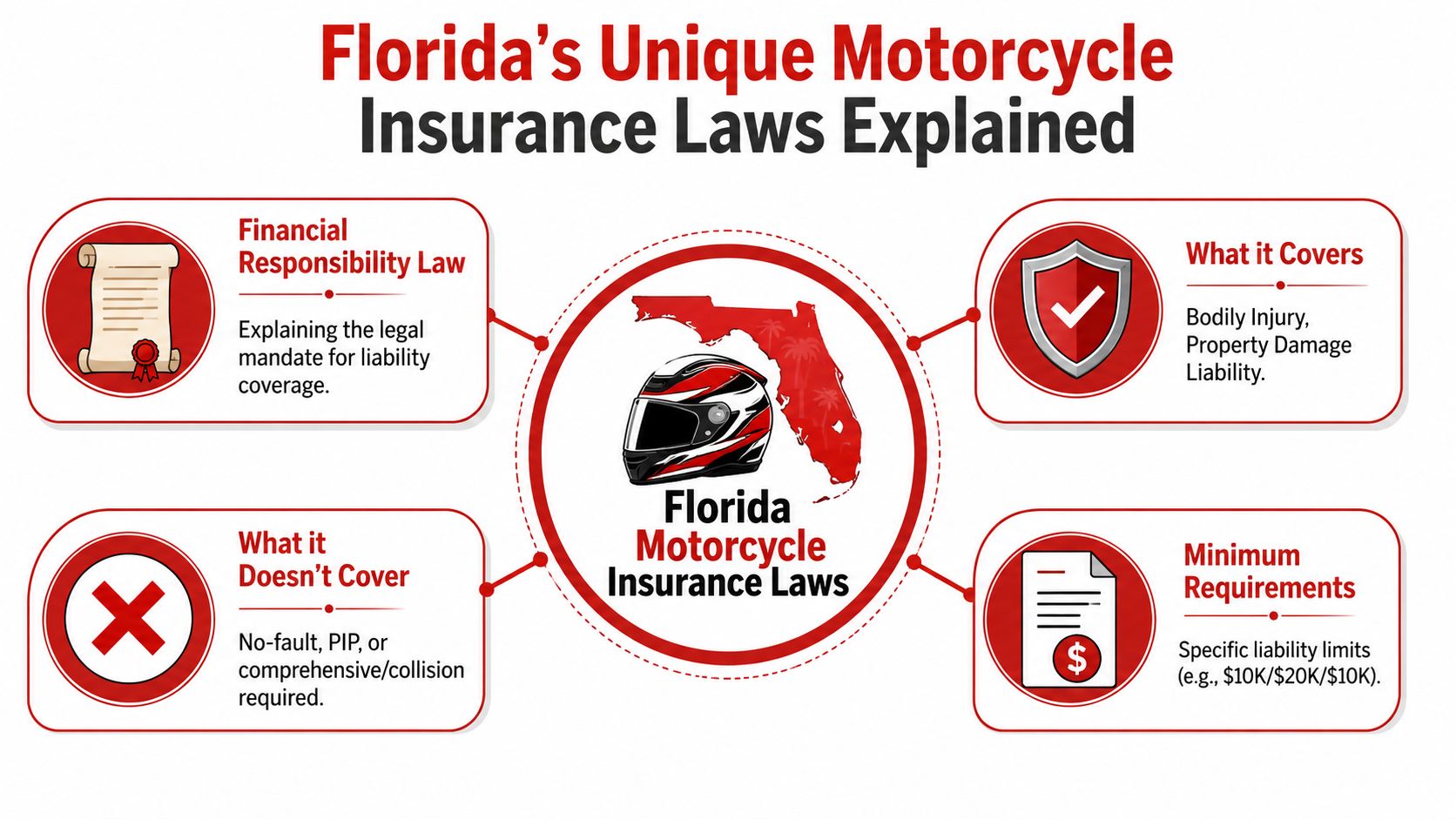
Florida excludes motorcycles from the no-fault system. That means riders are generally not covered by the PIP structure car owners know, and the state usually does not require the same proof of insurance upfront for motorcycle registration or operation.
That legal setup confuses new riders because it sounds permissive. In practice, it shifts more risk onto you.
Financial responsibility means Florida may let you ride without a standard motorcycle policy, but it still expects you to pay if you cause injuries or property damage. If you cannot, the problem is no longer theoretical. It becomes a license, registration, and personal-assets issue.
The no-fault misunderstanding also causes riders to skip the coverage that matters most in Florida: uninsured and underinsured motorist protection. If a driver hits you and carries little insurance, or none at all, your own bike policy may be the only thing standing between you and a stack of medical bills. Even ambulance transport can create a serious bill, which is why riders should understand the Med Jets guide to transport coverage along with their policy choices.
For riders sorting out endorsement, licensing, and insurance at the same time, this guide on motorcycle insurance and your license requirements explains how those pieces connect.
How Florida lets riders satisfy the law
Florida gives riders a few ways to meet financial responsibility requirements after a qualifying loss. A liability policy is the route almost everyone uses. Some riders can also post a surety bond or qualify through self-insurance, as summarized in this explanation of Florida motorcycle insurance requirements and laws.
For everyday riders, the practical options break down like this:
- Liability insurance: The simplest and most common choice. It pays for injuries or property damage you cause to other people, up to your policy limits.
- Surety bond: A financial guarantee filed to satisfy the state. It exists as an option, but it is rarely convenient for individual riders.
- Self-insurance certificate: A narrow fit for riders who can document enough assets and are willing to retain the risk themselves.
Legal does not always mean smart. A rider can satisfy a rule and still be badly underinsured for a real crash.
The helmet rule that catches riders off guard
Florida also ties insurance to helmet use in a way many riders miss. Riders 21 and older can go without a helmet only if they can show at least $10,000 in medical benefits coverage, as described in this summary of Florida's helmet-related medical coverage rule.
That requirement is narrower than many people expect. It does not mean your overall protection is strong. It only means you have met the medical coverage condition tied to riding without a helmet.
The bigger takeaway is simple. Florida's motorcycle law is not a no-fault safety net for riders. It is a looser front-end system that leaves you exposed unless you choose the right coverage yourself, especially UM/UIM.
The High Cost of Riding Uninsured in Florida
A motorcycle crash in Florida can turn into a personal financial problem fast. Riders often assume the state's no-fault system gives them a backstop. It does not apply the way many people think it does for motorcycles, and that misunderstanding is expensive.
What happens after an at-fault crash
If you cause a serious wreck and cannot meet Florida's financial responsibility rules, the state can suspend your driving privileges, motorcycle endorsement, and registration for years, as noted earlier.
That is only part of the problem.
The bigger exposure is the claim itself. If someone else is hurt, misses work, or suffers major vehicle damage, you can be pursued personally for those losses. A rider who skipped coverage to save a few hundred dollars can end up facing medical bills, repair costs, legal expenses, and collection pressure that lasts much longer than the accident claim.
Florida may let some riders go without a policy up front. It does not protect them from the bill after a bad crash.
Why the no-fault myth costs riders money
I see one mistake more than any other. Riders hear “Florida is a no-fault state” and assume their own injuries will be handled automatically after a crash.
That assumption breaks down on a motorcycle claim. If a driver hits you and carries little or no bodily injury coverage, there may be no easy pool of insurance money waiting for your hospital bill, follow-up care, lost income, or long recovery. Without Uninsured Motorist or Underinsured Motorist coverage, many riders are left using health insurance, paying deductibles and copays out of pocket, or trying to collect from a driver who has no real assets.
That is why UM/UIM matters so much in Florida. It protects your side of the loss when the other driver cannot.
Where uninsured riding gets expensive fast
The cost pattern is usually straightforward:
- The crash creates immediate bills. Ambulance charges, ER treatment, imaging, surgery, rehab, and bike damage start piling up right away.
- Your personal finances are exposed. Savings, future wages, and other assets can become part of the discussion if you caused the crash or cannot recover enough from the other driver.
- Your license and registration can be interrupted. That creates practical problems for work, commuting, and daily life.
- A weak policy leaves you stranded even when the other driver is at fault. If they carried too little coverage, your recovery may depend on whether you bought UM/UIM before the crash.
Bare-legal riding often looks cheap only before something goes wrong.
A smart Florida motorcycle policy is built around what creates large losses. Liability coverage protects you from the damage you cause. UM/UIM protects you from drivers who cannot pay for the damage they cause. Riders who miss that distinction are usually the ones most shocked after a claim.
Decoding Your Coverage Options for Florida Roads
Shopping for motorcycle insurance in Florida gets easier when you stop thinking in terms of “full coverage” and start thinking in terms of specific risks. Each coverage solves a different problem. Some protect other people from your mistakes. Others protect you from your own bike damage, your own medical bills, or another driver's lack of insurance.
The no-fault myth that hurts riders
The most dangerous misunderstanding in this market is the idea that Florida's no-fault system automatically protects motorcycle riders. It doesn't.
A critical misconception is that Florida's no-fault system covers motorcycles, and it does not. That exclusion makes Uninsured/Underinsured Motorist coverage vital because it protects the rider when a driver who caused the crash lacks enough bodily injury insurance, as explained in this Florida motorcycle insurance laws overview.
That single point changes how you should build a policy.
If you ride assuming PIP will step in the way it often does for four-wheel vehicles, you may discover after a crash that your motorcycle claim works very differently. Riders then fall back on health insurance, MedPay if they bought it, or their own resources. If the at-fault driver has weak or no bodily injury coverage, UM/UIM can be the piece that keeps the loss from becoming your problem.
The same source notes Florida has the sixth-highest rate of underinsured drivers nationally. For a rider, that means the primary danger isn't only what you might do to someone else. It's what happens when someone else hits you and can't pay enough.
If you only buy liability, you may be protecting the stranger you hit more than you're protecting yourself from the stranger who hits you.
What each major coverage actually does
Here's the practical breakdown riders need.
- Liability coverage pays for injury or property damage you cause to others. This is the foundation for meeting financial responsibility in the most usable way.
- Collision coverage pays to repair your motorcycle after an impact, regardless of who caused it, subject to your deductible.
- Other than collision coverage handles non-collision losses such as theft, vandalism, weather events, and similar damage.
- UM/UIM coverage helps when another driver causes your injuries but doesn't carry enough bodily injury coverage.
- Medical Payments coverage helps with medical expenses tied to a crash. In Florida, riders often look at MedPay because motorcycles aren't part of no-fault PIP in the same way as cars.
- Custom parts and equipment coverage matters if your bike includes upgrades that a standard base policy may not value correctly.
For riders who've invested in accessories, paint, wheels, or performance parts, this custom bike coverage guide is a useful reminder that stock-bike assumptions can leave modified motorcycles underinsured.
Medical logistics matter too. After a serious crash, transportation and emergency billing questions can become part of the claim experience. This Med Jets guide to transport coverage is a practical resource for understanding how medical transport costs may or may not fit within broader insurance arrangements.
Florida Motorcycle Insurance Coverage Comparison
| Coverage Type | What It Protects | Is It Required? |
|---|---|---|
| Liability | Other people's injuries and property damage if you cause a crash | Required as a practical way to satisfy financial responsibility, though not universally required for registration |
| Collision | Your motorcycle after a collision | No |
| Comprehensive | Your motorcycle for theft and other non-collision losses | No |
| UM/UIM | You and, depending on policy terms, covered losses caused by an inadequately insured driver | No, but highly important in Florida |
| Medical Payments | Medical bills after a crash | No |
| Custom Parts and Equipment | Upgrades and accessories beyond standard factory value | No |
A smart Florida policy usually starts with liability, then adds UM/UIM and the property protections that fit the value of the bike. What doesn't work is buying on price alone and discovering too late that your policy was built around the wrong risk.
Factors That Determine Your Florida Motorcycle Premium
Premiums don't come out of nowhere. Carriers price motorcycle insurance Florida policies by looking at the rider, the bike, where it's kept, and how it's used. You can't control every factor, but you can understand them well enough to avoid surprises.
What insurers look at first
Your riding profile matters. Insurers typically look at age, riding experience, prior violations, accident history, and whether you've maintained continuous coverage. A clean record usually gives you more options. A rough record can limit carrier choices and push you toward less favorable pricing.
They also consider how you use the motorcycle. A bike used for occasional weekend riding is viewed differently from one used for frequent commuting in dense traffic. Garaging habits matter too. A secured overnight location usually looks better than a bike left exposed in a high-risk setting.
Better pricing often starts before the quote. Clean records, consistent coverage, and accurate application details usually produce stronger results than last-minute shopping after a lapse.
How the bike itself changes the price
Not all motorcycles present the same claim profile. A lightweight commuter, a cruiser, and a high-performance sport model won't be treated the same way. Engine size, performance characteristics, repair cost, theft appeal, and replacement value all affect the premium.
Modified bikes create another layer. Custom parts can increase both the value of the motorcycle and the cost to insure it correctly. If a rider upgrades the bike but doesn't tell the insurer, the quote may look cheaper at first and become a claims problem later.
Financed bikes also tend to narrow your choices. Even when Florida law is flexible, a lender often isn't. Lenders commonly require physical damage protection because they have a financial interest in the motorcycle.
Location and usage matter more than riders expect
Your ZIP code influences pricing because insurers look at local loss patterns, traffic density, weather exposure, theft concerns, and claim severity trends. A rider in a dense metro area may see very different pricing than a rider in a quieter part of the state, even with the same motorcycle and similar driving history.
Mileage estimates also matter. Riders often guess low, thinking it helps. It's better to be accurate. If the policy is based on unrealistic usage, that mismatch can complicate underwriting and claims.
When you request quotes, provide details that are complete and consistent. The goal isn't just getting a fast number. It's getting a usable offer that still makes sense when the policy is issued.
Finding Every Available Discount on Your Policy
Most riders focus on coverages and forget the savings side. That's a mistake. Discounts can make a meaningful difference, but only if you ask the right questions and present the right information up front.
Discounts worth asking about
Use this as a checklist when you shop:
- Multi-policy savings: If you also insure a home, condo, renters policy, or auto, ask whether bundling changes the motorcycle rate.
- Safety course credits: Approved rider training can help because it shows commitment to safer riding habits.
- Clean driving history discounts: Fewer violations and accidents usually improve your options.
- Anti-theft features: Garaging, alarms, and recovery devices may help depending on the carrier.
- Paid-in-full or automatic payment options: Some carriers price these differently than monthly billing.
- Association or affinity programs: Some memberships can open up discounts.
- Renewal and loyalty considerations: Staying with a policy can help in some situations, though it's still wise to review the coverage regularly.
How riders miss savings
The most common misses are simple. Riders forget to mention a completed course. They don't disclose anti-theft features. They insure the bike but leave obvious bundle opportunities on the table.
Another issue is shopping one company at a time and assuming the answer is fixed. Discount structure varies by carrier. An independent agency model can help sort through those differences because one application can be matched against multiple markets. Select Insurance Group, Inc. works that way, comparing quotes across multiple carriers for riders who want to review options without repeating the same process over and over.
What works is treating discounts like documentation, not wishful thinking. Have your course records, vehicle details, and related policies ready. The easier you make it to verify eligibility, the easier it is to capture the savings you qualify for.
Your Step-by-Step Guide to Getting Insured
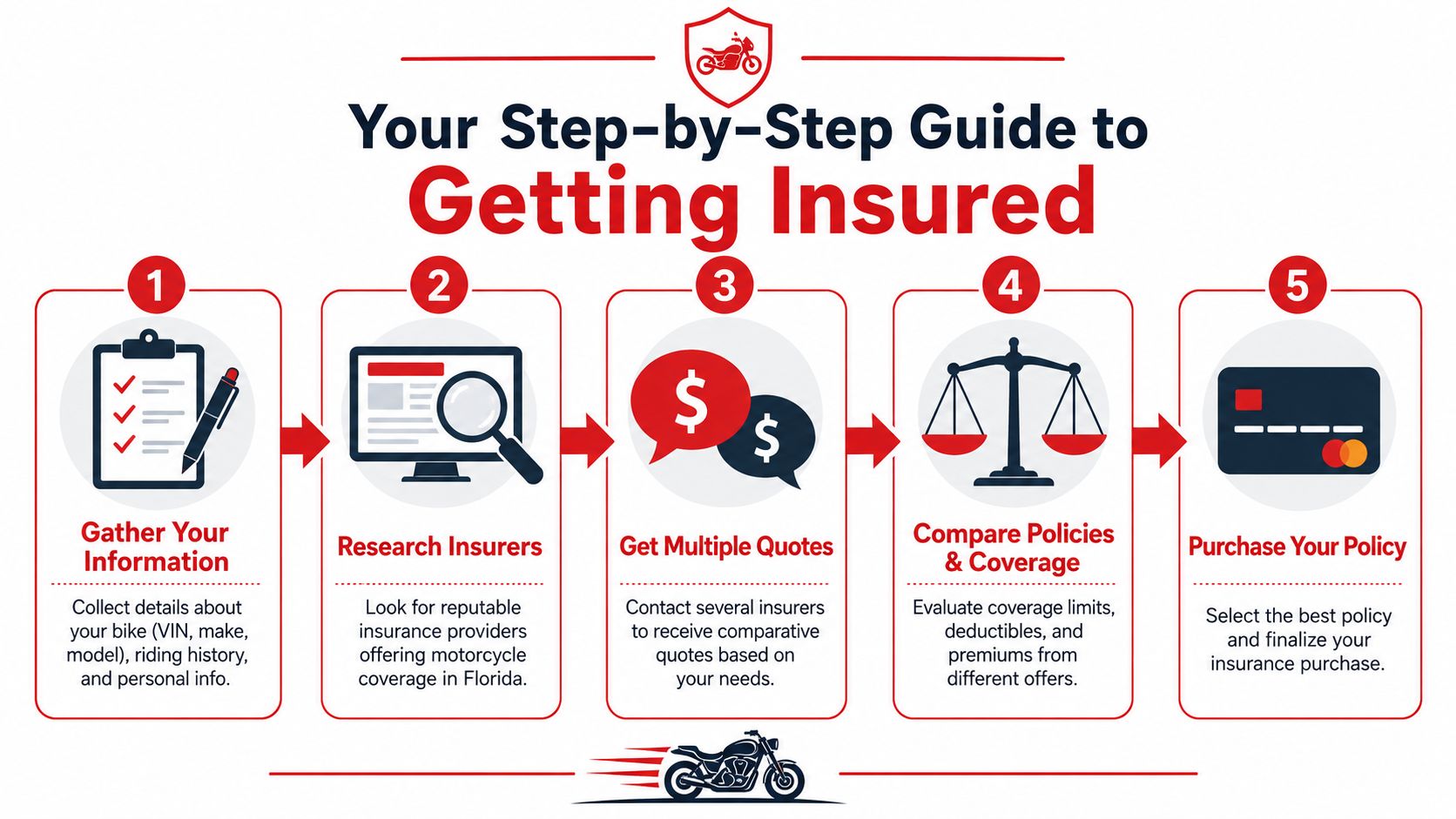
Many riders delay buying coverage because they assume the process will be messy. It usually isn't. Most delays come from missing information, unclear goals, or comparing quotes that don't match.
What to gather before you request quotes
Start with the basics:
- Your rider information: Driver's license details, address, riding history, and prior insurance information.
- Your motorcycle details: VIN, year, make, model, and whether the bike has custom parts or anti-theft equipment.
- Usage details: How often you ride, where the bike is stored, and whether it's financed.
- Helpful supporting records: Safety course completion documents and any information tied to other policies you may want to bundle.
Getting these details right matters more than getting them fast. A sloppy quote often turns into a revised premium later.
How to compare policies without getting distracted by price alone
Once quotes come in, compare them line by line. Don't just look at premium.
Check these points carefully:
Liability limits
Make sure you're comparing the same limits across quotes.UM/UIM availability
In Florida, this deserves close attention because of the no-fault gap for motorcycles.Deductibles for physical damage
Lower premiums sometimes come from deductibles you wouldn't want to pay after a loss.Accessory coverage
If the bike is customized, confirm whether the quote accounts for that.Medical-related options
Review whether MedPay or related medical protection is included or available.
For riders who want a cleaner checklist before they buy, this motorcycle insurance quote guide is a practical reference for comparing policy details without missing the fine print.
How to finish the process cleanly
After you choose a policy, read the declarations page before you move on. Confirm names, VIN, garaging address, and coverages. If the bike is financed, make sure the lender information is handled correctly. If you ride without a helmet and qualify to do so, make sure your medical coverage documentation is in order.
Then save proof of insurance in more than one place. Keep a digital copy you can access quickly and a backup method that doesn't depend on your phone battery cooperating after a roadside stop.
A good purchase process feels boring. That's a compliment. Boring means the details are right.
Conclusion Ride with Confidence and Protection
Florida gives motorcycle riders unusual freedom, but freedom without a plan can get expensive quickly. The legal minimum for motorcycle insurance Florida riders can operate under is not the same thing as meaningful protection. That gap is where many riders get blindsided.
The key takeaway is simple. Don't build your policy around what the state lets you skip. Build it around what could hurt you most. For many riders, that means looking hard at liability, UM/UIM, medical-related protection, and physical damage coverage for the bike itself.
The no-fault myth is the most expensive misunderstanding in this market. If you remember only one thing, remember that motorcycles don't get the same no-fault protection many Florida drivers assume exists across the board.
A well-built policy gives you options after a crash. A bare-bones approach often leaves you with obligations instead.
If you want help reviewing motorcycle insurance options in Florida, Select Insurance Group, Inc. can help you compare coverage choices, review policy gaps, and request a free, no-obligation quote through its independent agency platform.