
You can do everything right on paper, pay the premium, hang the certificate on the wall, and still find out after a loss that the policy doesn't answer the core issue. A burst pipe wrecks the office buildout. A customer falls on a wet floor. A storm tears up part of the roof. Then the adjuster starts asking about exclusions, deductibles, flood, wind, employees, subcontractors, and whether the contract required something you never bought.
That's the part most owners don't get told up front. Business insurance in Florida is not just a shopping exercise. It's a market-access problem, a coverage-fit problem, and sometimes a survival problem, because the state sits near the top of the national insurance map while still staying tough on affordability. Florida ranked 1st in private flood premium with 22.8% of the U.S. market, 3rd in property/casualty premium, and 4th in total premium in 2024, according to the Florida Office of Insurance Regulation Florida insurance market facts. That's why this guide focuses on what you're uninsured for, and whether a carrier will even write the risk in the first place.
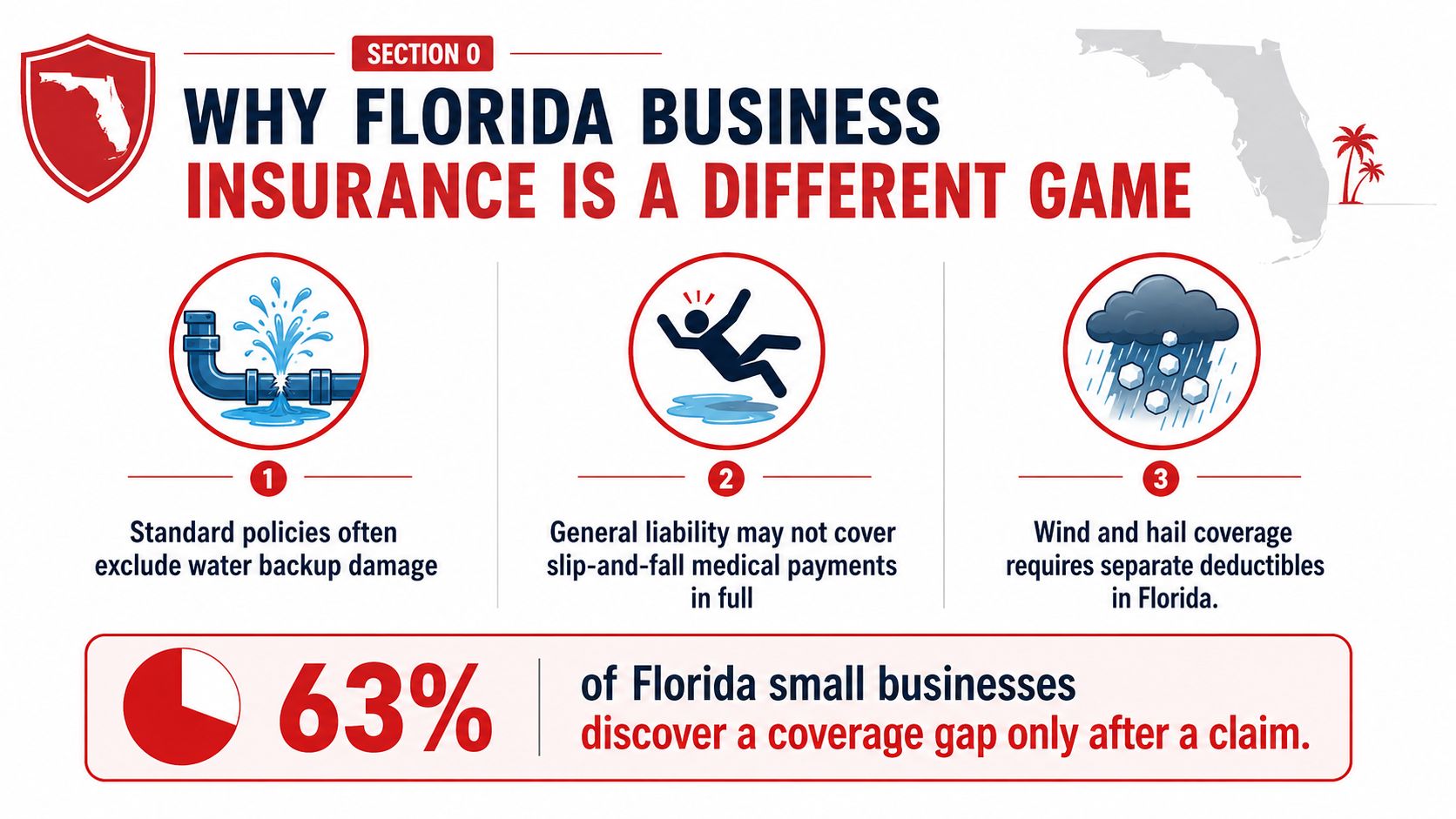
Table of Contents
- Why Florida Business Insurance Is a Different Game
- The Core Coverage Categories Every Florida Business Should Know
- What Florida Law Actually Requires You to Carry
- Hurricane, Flood, and Lawsuit Risk in the Sunshine State
- Coverage Recommendations by Industry
- What Florida Business Insurance Actually Costs
- How to Evaluate Policies and Get Competitive Quotes
- Cutting Premiums and Surviving a Claim in Florida
Why Florida Business Insurance Is a Different Game
A restaurant owner calls after a kitchen leak damages the ceiling and part of the dining room. The landlord says the building policy handles the structure. The owner assumes the business policy handles the rest. Then the adjuster points to a flood exclusion, a water-backup issue, and a business interruption trigger that doesn't work the way the owner expected. The loss is real, but the payout is smaller than the repair bill.
That's Florida in a nutshell. The state's insurance market is huge, highly regulated, and still expensive for small firms, especially when employees, vehicles, or higher liability exposure enter the picture. Florida also ranked 1st in private flood premium in 2024, which is a giant clue that water is not an afterthought here, it's part of the baseline risk Florida insurance market facts.
The real question is not the policy name
A lot of owners ask for general liability, property, workers' compensation, or a BOP and think they've covered the bases. Sometimes they have. Sometimes they've bought a package that looks complete but still leaves the business exposed to wind, flood, business interruption, cyber, or employment-related loss. Florida-focused legal guidance makes the same point plainly, the problem is often not having no insurance, it's being insured for the wrong risks Florida coverage gaps guidance.
That gap matters because Florida is a national bellwether. When carriers tighten terms here after a storm season, after litigation shifts, or after reinsurance pricing moves, the effect often shows up in other coastal and Sun Belt markets too. So the practical playbook is simple, even if the market isn't. First, identify the exposure. Second, ask whether the policy form responds. Third, confirm a carrier is willing to write the class of business at all.
Practical rule: In Florida, the cheapest policy is usually the one you understand the least. If you can't explain what it excludes, you don't really know what you bought.
A working Florida insurance strategy has to answer two questions at once. What do I need to protect? And can I still find a carrier that wants the risk?
The Core Coverage Categories Every Florida Business Should Know
Think of a business like a building. Some coverages protect the sidewalk, some protect the walls, some protect the parking lot, and some only make sense once the business starts moving vehicles, hiring people, or giving advice for a living. A BOP can tie a few of those pieces together, but it doesn't replace judgment.
Start with the coverages that do the heavy lifting
General liability is the sidewalk. It's meant for third-party injury, property damage, and certain advertising claims. It is not the same thing as property coverage, and it won't fix your roof, replace your inventory, or automatically cover every slip-and-fall scenario the way owners assume.
Commercial property is the walls. It protects building, contents, equipment, and sometimes tenant improvements. It is not flood coverage, and in Florida that distinction matters more than almost anywhere else.
Workers' compensation is the elevator inspection. It exists because employees get hurt, and Florida's thresholds can turn on headcount fast. It is not a catch-all for every dispute, and it won't solve a contract problem with a subcontractor.
Commercial auto is the parking lot. If the business owns or leases vehicles, this is the layer that sits between your operation and a bad loss on the road. It is not personal auto coverage with a business label slapped on it.
The coverages that get missed most often
Professional liability protects advice, design, or service mistakes that cause client financial harm. It is not a substitute for general liability, because the trigger is different.
Cyber coverage responds to data breach, ransomware, and related response costs. It is not just for tech firms, because any business that stores customer data can be affected.
Business Owner's Policy, or BOP, is the broom that sweeps a few of these pieces together for qualifying small businesses. It can be efficient, but it's not a magic fit for every operation, especially if the business has vehicles, specialized equipment, or flood exposure.
| Coverage Type | What It Protects | What It Usually Does Not |
|---|---|---|
| General Liability | Third-party injury, property damage, advertising injury | Your building, your tools, your employees' injuries, flood |
| Commercial Property | Building, contents, equipment, tenant improvements | Flood, every kind of storm loss, liability claims |
| Workers' Compensation | Employee work injuries and wage-related benefits | Client disputes, vehicle crashes, property damage |
| Commercial Auto | Business vehicles and related liability | Personal use gaps, cargo, tools, every off-road loss |
| Professional Liability | Advice, design, service errors, omissions | Bodily injury, property damage, flood, vehicle claims |
| Cyber | Breach response, data loss, cyber extortion-related costs | Physical property damage, employee injury, auto loss |
| BOP | A packaged mix of property and liability for many small businesses | Specialty exposures, flood, unusual equipment, vehicle needs |
A good policy stack isn't about collecting lines. It's about matching the way the business earns money.
Practical rule: If the loss came from a thing you own, a person you employ, a vehicle you drive, or advice you gave, the answer is usually in a different coverage bucket.
If you're trying to sort the employee side first, a focused workers' compensation insurance Florida review can help you separate payroll exposure from property and liability decisions.
What Florida Law Actually Requires You to Carry
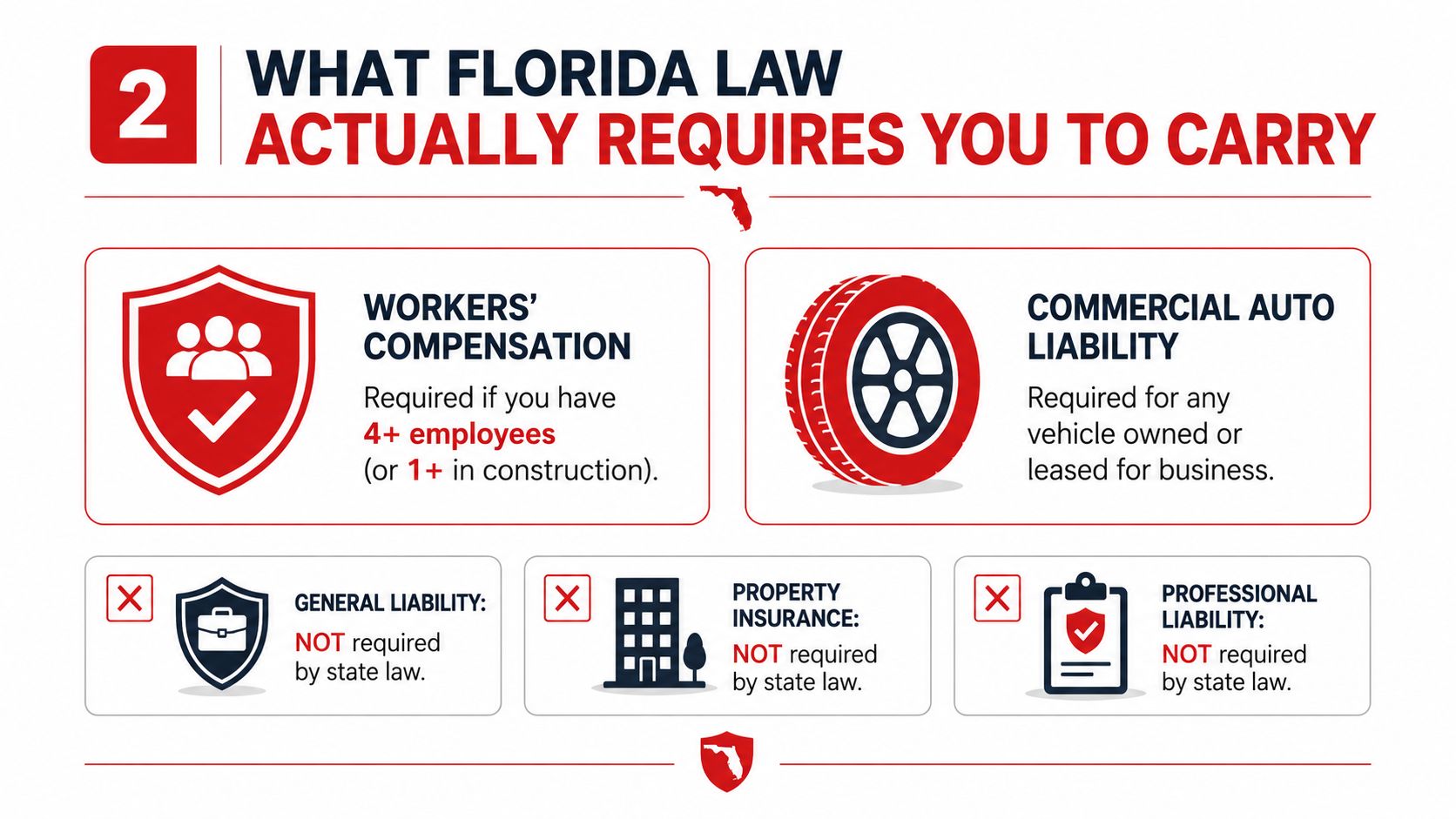
Florida doesn't require a universal business insurance package. That's the first myth to kill. The law generally mandates workers' compensation and commercial auto for the right businesses, and everything else usually comes from leases, contracts, licensing, or client requirements. Florida-focused legal guidance makes the same point, state law mainly requires those two lines, while the rest becomes effectively required by the way you operate Florida coverage gaps guidance.
Workers' compensation is triggered by headcount and industry
For non-construction employers, the trigger is four or more employees. For construction employers, it starts at one or more employees. The Florida Department of Financial Services also says seasonal-agriculture employers can trigger coverage at six regular employees or twelve seasonal workers meeting the statutory day-count rules Florida workers' comp requirements.
That headcount rule is where a lot of owners get burned. A shop that was fine last month can cross the line with a hire, a seasonal crew, or a role that was counted wrong. If the coverage isn't in force before the threshold is hit, the exposure is immediate.
Commercial auto is a separate legal layer
Florida requires continuous coverage for registered vehicles with four or more wheels, including $10,000 Personal Injury Protection, or PIP, and $10,000 Property Damage Liability, or PDL Florida insurance requirements. If the coverage lapses, registration and licensure can be jeopardized, which is a problem for any business that relies on trucks, vans, or delivery units.
That minimum is only the floor. For a business vehicle, especially one tied to contracts, cargo, or interstate work, the state minimum often isn't enough to protect the operation. The policy has to match the risk, not the bare legal requirement.
If you want a more granular look at how coverage fits contractor operations, the commercial side of Select Insurance Group's Florida insurance guidance is a useful place to compare what's mandatory with what's operationally smart.
The legal floor is rarely the business floor
Landlords, lenders, municipalities, and clients usually ask for more than Florida law does. A lease may require general liability. A client may require higher auto or umbrella limits. A professional board may ask for proof tied to licensure. So the right question isn't, “What does Florida require?” The right question is, “What does my lease, my contract stack, and my actual operation require?”
A lot of owners discover that distinction only after a certificate gets rejected or a claim gets denied for a missing endorsement.
Practical rule: If your insurance discussion ends with state law, you haven't finished the job. The contract, not the statute, often sets the real floor.
For licensed professionals who also have continuing education and compliance obligations, a practical outside reference like Florida RN CEU requirements can be a good reminder that credentialing and coverage often move together in regulated work.
Hurricane, Flood, and Lawsuit Risk in the Sunshine State
Florida owners often think in terms of a storm, but the loss usually arrives in separate pieces. Wind damages part of the roof. Water gets into the interior. The business closes for days or weeks. Customers cancel. Then the claim file turns into a fight over what caused what, which policy responds, and whether the business was properly insured for the actual source of the damage.
Wind and flood are not the same problem
Wind is usually handled under property coverage, but flood almost always sits outside the standard commercial property form. Many owners assume the landlord's policy will catch the loss. It won't, not for tenant contents, tenant improvements, or the business income loss that follows if the operation can't reopen quickly. A separate flood policy, private or through the national program, often needs to be on the table if the location sits in a risk corridor Florida flood guidance.
Rebuilding cost is another trap. A policy can look adequate on paper and still fall short after a storm because construction pricing has moved, the limits are stale, or a co-insurance condition cuts the payout. That's why Florida owners need to think in terms of rebuild math, not just premium math. The policy has to keep up with what it costs to put the business back together, not what it cost to buy the building five years ago.
Liability in Florida needs more than a small limit
The litigation environment changes how useful a liability limit really is. A limit that feels fine in a lower-claims state can be thin in Florida when the business has customers on site, alcohol service, employees, or operations that invite allegations after a loss. Standard policies also frequently narrow or sub-limit claims tied to assault and battery, liquor liability, and employment practices, which is where many owners find the surprise after they need the policy most Florida placement guidance.
The practical takeaway is blunt. In Florida, the policy form matters almost as much as the price. A cheap quote with the wrong exclusions isn't cheap if it leaves the business paying out of pocket after a storm or a lawsuit.
If the carrier won't explain how wind, flood, and business interruption interact on your form, keep asking until someone does.
That's especially true for business interruption, which many owners barely read until a shutdown hits. If the trigger is wrong, the waiting period is too long, or the covered cause of loss doesn't line up with the damage, the business can be open to loss on the exact days it needs cash the most.
Coverage Recommendations by Industry
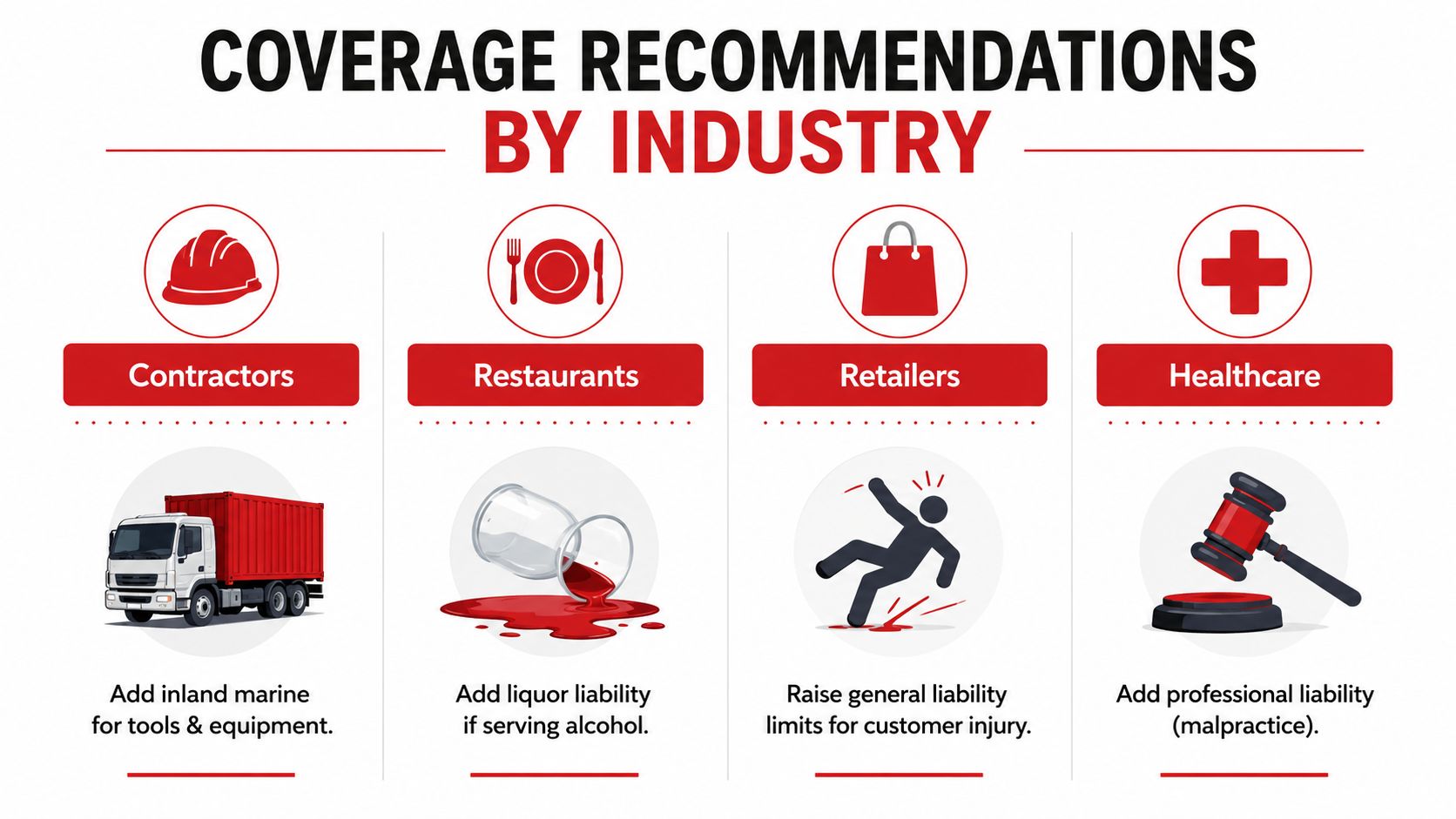
Florida does not hit every industry the same way. A roofing contractor, a restaurant, a small retailer, and a remote-service firm do not buy the same policy stack, even if the declarations pages all look tidy. Standard markets in Florida often narrow terms or decline them for coastal construction, marine contractors, roofing, restaurants, and data centers because wind, pollution, liquor liability, and cyber exposure change the loss picture fast. industry placement guidance
Contractors need more than a liability certificate
For contractors, general liability by itself can be a paper shield. If the business handles tools, materials, crews, vehicles, and jobsite exposures, the right program usually needs inland marine for tools and equipment, plus the right auto, workers' comp, and sometimes pollution-related protection. The issue is not just getting a certificate for the job. It is keeping the operation insured while crews move from site to site.
The market access problem shows up fast in this class. A contractor can be fully honest and still get narrowed terms because the class is hard to place. The question is whether the agency knows which carriers still want the risk, not whether the owner can fill out another application.
Restaurants and retail need liability that matches foot traffic
Restaurants have different pain points. Liquor liability matters if alcohol is served. Assault and battery issues can appear when security or late-night traffic is part of the operation. Food-related claims can pull in property, liability, and interruption concerns at the same time. Retailers lean harder on customer injury, display risk, theft, and point-of-sale cyber exposure.
A retail owner often gets sold a tidy package because the business looks simple. It usually is not. If customers come and go all day, if the store uses card payments, or if employees work around inventory and delivery areas, the coverage stack has to reflect those realities.
Tech-adjacent and remote-service firms need professional and cyber protection
Remote-service businesses, MSPs, consultants, and other tech-adjacent firms tend to underestimate their exposure because they do not have much physical inventory. They have advice, data, systems access, and client dependence. That points straight to professional liability and cyber.
A business can outsource operations and still keep the exposure in-house. A remote team, a shared drive, and client logins can be enough to create a serious claim if the policy form does not match the work.
Practical rule: If the business's value lives in tools, vehicles, liquor service, customer access, or client data, a standard BOP usually is not the whole answer.
For licensed professionals who also have continuing education and compliance obligations, a practical outside reference like Florida RN CEU requirements can be a reminder that credentialing and coverage often move together in regulated work. For a Florida agency with a broad carrier appetite, a quote review like the one offered by Select Insurance Group, Inc. can help match the policy form to the class of business instead of forcing every operation into the same package.
What Florida Business Insurance Actually Costs
Florida business insurance pricing starts with the business itself, not the policy label. A 2026 market estimate put Florida businesses at about $128 per month, or $1,538 per year, which is about $17 above the $111 national average and ranks the state 43rd out of 51 for affordability Florida business insurance cost data. The same source found a Florida business with no employees pays about $55 per month, while one with 20 to 49 employees pays around $736 per month, roughly 13 times as much.
Payroll, class code, and claims history drive the bill
The biggest price movers are usually payroll, class code, prior claims, and location. Construction and other more volatile operations cost more than low-touch office or retail work because the loss patterns are different. One claim can change the renewal conversation quickly, especially when the underwriter sees a class that already looks tight.
Location matters too. Coastal and storm-exposed areas often create more demanding underwriting than inland areas, and Florida's market history has made carriers careful about that distinction. The result is simple, even if the pricing isn't. Two businesses with the same revenue can get very different quotes if one has trucks, field work, and prior losses.
Different coverages price in different ways
Workers' comp usually tracks payroll and job classification. If the payroll is coded wrong, the premium can be wrong too, and the audit at the end of the year can be painful.
Commercial property pricing often hinges on construction type, protection features, replacement cost, and location. A cheap limit can be misleading if it doesn't reflect what rebuilds cost.
Commercial auto gets hit by vehicle type, driver history, radius of operation, and whether the business uses owned, hired, or non-owned vehicles. One distracted-driver claim can change the next renewal fast.
BOP pricing can look attractive because it bundles a few lines together. The trap is assuming that convenience equals completeness. A BOP can be efficient for the right small business, but the package isn't automatically right for flood, specialty equipment, or higher exposure operations.
Another important sign of the market is profitability. A 2026 Florida market report said direct premiums written were about $33 billion, up 1.3% year over year, while the weighted average combined ratio improved from 104 in 2024 to just under 82 in 2025. It also said policyholder surplus climbed to $16.4 billion, up almost 25% from the prior year Florida market report. That doesn't mean Florida is cheap. It does mean the market has been stabilizing after recent stress.
How to Evaluate Policies and Get Competitive Quotes
A good quote process starts with risk, not product names. List what can hurt the business, then match the exposures to the forms. If a business owns vehicles, stores customer data, keeps equipment off-site, signs contracts with indemnity language, or has seasonal headcount swings, those details belong in the quote file before anyone talks price.
Use a simple quote discipline
- Inventory the operation first. Write down employees, vehicles, equipment, locations, contracts, and the most likely loss scenarios.
- Ask for multiple quotes. Compare at least three, and compare carriers with different appetites, not just different premiums.
- Line up the forms. Look at deductibles, exclusions, wind treatment, flood treatment, business interruption triggers, cyber response, and equipment schedules.
- Check the class fit. A hard-to-place operation often gets the first quote because it's the easiest to write, not because it's the best fit.
- Review certificates before binding. If clients or landlords need special wording, that has to be built into the policy, not guessed at later.
What to watch for in a thin quote
A quote can look complete and still be missing the essential work. If there's no deductible schedule, no equipment list, no employee count tied to workers' comp, or no process for certificates, the file probably isn't ready. And if the agent never asked what the business does on a daily basis, the pricing is probably too generic to trust.
An independent agency that compares a wide spread of carriers usually has a better shot at finding a workable placement than a single-source quote. That matters in Florida because carrier appetite changes often, and a business that was easy to insure last year can be hard to place today. A careful market sweep can mean the difference between a clean renewal and a scramble.
Practical rule: A quote that ignores exclusions is not a quote, it's a guess with a price attached.
If you want to compare options without starting from scratch, use a free review like Florida insurance quotes and bring the operating details, not just a renewal page.
Cutting Premiums and Surviving a Claim in Florida
The fastest way to overpay is to buy the wrong structure and then try to save money by shrinking the limit. The better levers are more boring and more useful. Bundle where it makes sense. Raise deductibles only to the level the business can absorb. Harden the property. Keep records clean. Shop the renewal before the carrier shops you.
What actually helps the premium
A BOP can lower cost when the business fits the form. Higher deductibles can trim premium if cash flow can support the hit after a loss. Hurricane shutters, impact protection, and documented safety procedures can make the submission look more disciplined to underwriters. A carrier will usually price a clean file more seriously than a messy one.
Shopping matters too. Florida pricing swings enough that renewing with the same carrier on autopilot can get expensive. A fresh look every couple of years forces the market to reprice the risk instead of letting last year's assumptions roll forward.
What helps when the claim comes
Claims go better when the business is already organized. Keep photos and serial numbers for equipment. Store policy numbers and agent contacts off-site. File the claim promptly. Use the adjuster relationship instead of waiting in a phone queue. Keep contracts, leases, and certificates where you can reach them fast.
A smart owner also knows what the policy is supposed to do before the loss happens. That's the part that keeps a claim from turning into a document hunt. If the company knows who owns the building, who covers the contents, what the wind deductible is, and where flood sits, the conversation after a storm gets a lot easier.
One-page checklist worth saving: policy declarations, carrier contacts, vehicle list, equipment photos, employee roster, subcontractor certificates, lease requirements, contract requirements, and off-site claim documents.
That checklist won't prevent the storm, the lawsuit, or the broken pipe. It will make the claim survivable, and sometimes that's the difference between reopening and closing the doors for good.
Select Insurance Group, Inc. helps Florida business owners sort out what's required, what's missing, and what's gettable in today's market. If you want a practical review of your current coverage, renewals, or contract requirements, visit Select Insurance Group, Inc. and ask for a Florida commercial insurance quote built around the way your business really operates.