
A Georgia owner-operator can leave Savannah with a load headed for Jacksonville believing the day's route is routine. Then a tire failure sends the tractor into the median, damages another vehicle, and creates a serious liability claim. The policy may be active, the premium may be paid, and the truck may be properly registered, yet an intrastate-only policy can still fail to respond if the trip was interstate.
That's the central problem with truck insurance in Georgia. The right policy depends on where the truck operates, what it hauls, how it's used, and which authority governs the movement. A local policy that satisfies Georgia's minimum may not satisfy federal requirements once the truck crosses a state line or carries regulated cargo. Treat insurance as part of dispatch planning, not as paperwork handled after the load is booked.
Table of Contents
- Why Georgia Truck Insurance Is More Complex Than You Think
- Georgia Liability Limits and FMCSA Compliance Rules
- Core Coverage Types Every Georgia Trucker Needs
- What Drives Truck Insurance Costs in Georgia
- How to Get Accurate Quotes and Avoid Coverage Gaps
- The Hidden Risks of Bare-Minimum Compliance
- Your Action Plan for Securing the Right Coverage
Why Georgia Truck Insurance Is More Complex Than You Think
Georgia operators work in a state where local and interstate freight routes sit close together. A carrier may perform regular Georgia deliveries but accept a single load connected to another state, changing the insurance and compliance analysis immediately. The route on the GPS isn't the only issue. The shipment's origin, destination, authority, and cargo classification all matter.
The route can change the policy requirement
Suppose a carrier's declarations page describes Georgia-only operations. The owner then accepts a load picked up in Savannah and delivered across the Florida line. If the policy excludes interstate activity, the carrier may face a coverage dispute after a crash because the actual operation no longer matches the underwriting information.
That example isn't a reason to reject interstate freight. It's a reason to make sure the policy reflects the business before dispatch. Review the route, the authority, and the insurance filing together. A broker's load requirement doesn't override a policy exclusion, and a paid premium doesn't automatically expand the territory or use covered by the contract.
Broker's rule: Never let a dispatcher change the operating pattern without telling the insurance agent first.
Georgia's framework is unusually detailed because intrastate and interstate carriers can face different liability floors. For-hire trucks operating only within Georgia may fall under state requirements, while federally regulated interstate carriers must meet FMCSA standards. The state also applies different treatment to certain passenger configurations, vehicle sizes, and cargo risks. A useful starting point for reviewing Georgia-specific operations is this Georgia trucking insurance guidance.
Why local compliance isn't the same as adequate protection
Minimum insurance is a legal threshold, not a business-protection strategy. It may permit a carrier to operate under a particular authority while leaving the company with little room for medical expenses, vehicle damage, legal defense, cargo disputes, and settlement demands after a severe crash.
Georgia's crash history reinforces the severity issue. A federal Georgia summary reports large-truck fatal crash counts of 234 in 2020, 257 in 2021, 198 in 2022, 171 in 2023, and 168 in 2024 (FMCSA Georgia large-truck crash summary). The counts vary by year, but the exposure remains substantial.
The practical conclusion is simple. A Georgia truck policy must match the actual movement of freight, including occasional cross-border loads. If your operation is changing, update the policy before the truck rolls.
Georgia Liability Limits and FMCSA Compliance Rules
The first question isn't, “What's the cheapest premium?” It's, “Which liability rule applies to this operation?” Georgia intrastate requirements and federal interstate requirements can produce very different limits, filings, and underwriting results.
For intrastate for-hire trucks over 10,000 pounds, Georgia's commonly cited bodily injury floor is $100,000 per person and $300,000 per accident, plus property damage requirements. Federally regulated interstate freight carriers operating at 10,001 pounds and up generally face an FMCSA minimum of $750,000 in liability coverage. Hazmat requirements can rise to $1,000,000 or $5,000,000, depending on the commodity and risk class. These thresholds are summarized in Georgia trucking insurance minimum liability limits.
Compare the governing standards
| Operation Type | Cargo Class | Minimum Liability Limit | Governing Authority |
|---|---|---|---|
| Georgia intrastate for-hire, over 10,000 pounds | General freight | $100,000 per person and $300,000 per accident for bodily injury, plus property damage | Georgia requirements |
| Interstate freight, 10,001 pounds and up | General freight | $750,000 | FMCSA |
| Interstate regulated freight | Hazmat, depending on commodity and risk class | $1,000,000 to $5,000,000 | FMCSA |
| Certain passenger configurations | Vehicles carrying 12 or more passengers | $500,000 | Georgia requirements |
A carrier can't choose the lower limit just because most trips stay within Georgia. If the business accepts interstate freight, its insurance program must address the federal operation. The same applies when the cargo profile changes. A policy written for ordinary freight may not satisfy the financial-responsibility standard for hazardous materials.
Filings and records matter as much as limits
Georgia motor vehicle owners and operators must keep proof of minimum liability coverage in the vehicle during operation, as emphasized in the Georgia Department of Revenue insurance requirements publication. Certain motor-carrier filings may also require insurer-filed certificates, including Form E for liability and Form H for cargo in applicable situations.
That creates two separate checks. First, confirm the policy limits are correct. Second, confirm the filing was made under the correct legal entity, authority, and effective dates. A carrier can pay for insurance and still face an authority problem if the insurer hasn't filed the required certificate or if a cancellation creates a gap.
For fleets with multiple drivers, trucks, renewals, and authority records, structured documentation reduces preventable mistakes. A system designed to automate DOT recordkeeping with Logivo can help organize compliance tasks, but it doesn't replace an agent's review of the policy and filings. For the coverage itself, review your trucking liability insurance options against the route and cargo handled.
Core Coverage Types Every Georgia Trucker Needs
Liability is only one part of a workable trucking insurance program. A truck can be legally insured and still lack protection for its own equipment, the freight in the trailer, or an owner-operator's off-dispatch activity.
Start with primary liability
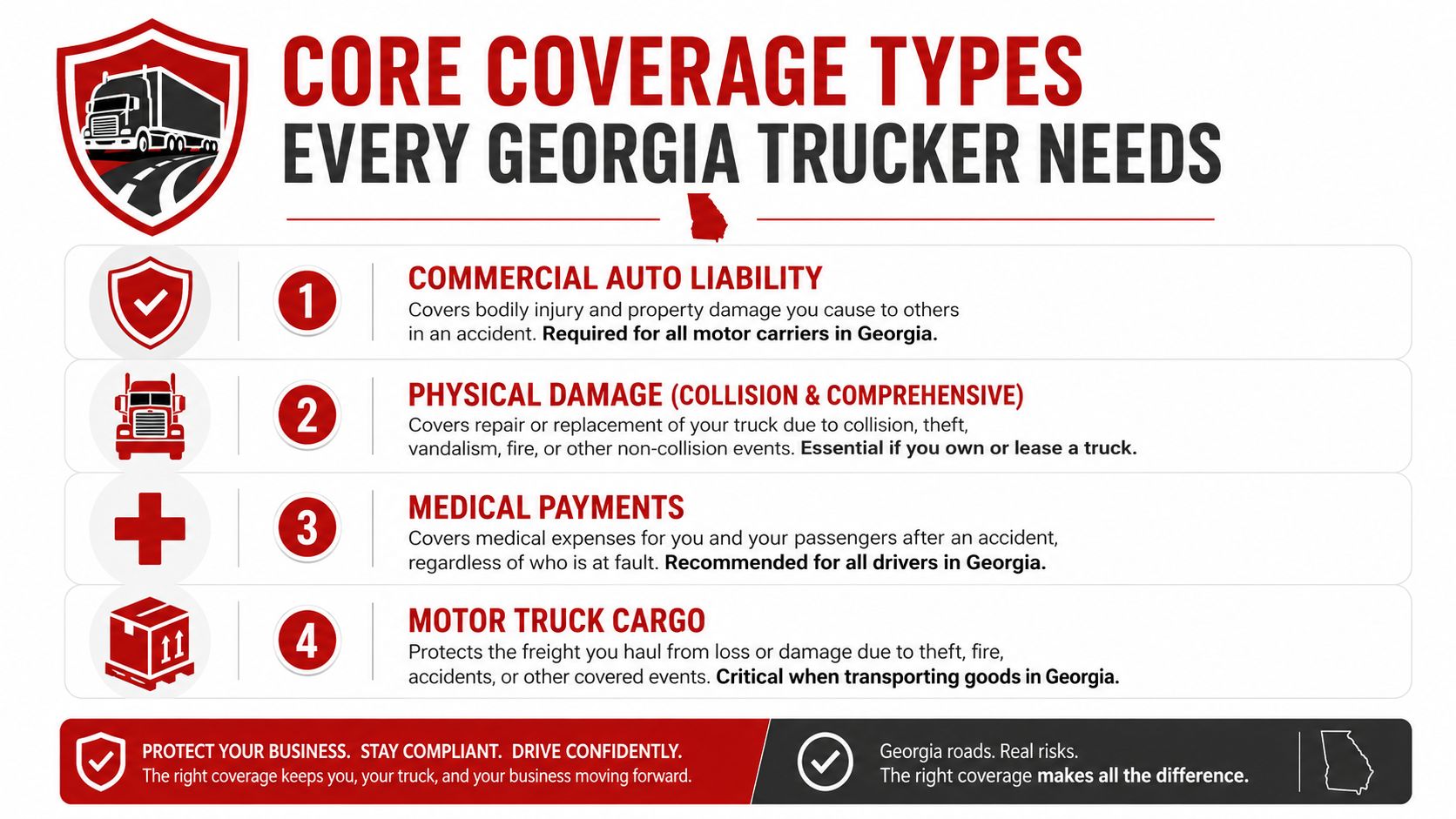
Commercial auto liability pays for bodily injury and property damage you cause to other people while operating the insured truck. It's the coverage regulators, brokers, and shippers inspect first. The correct limit depends on the operation described earlier, but contract demands may exceed the legal floor.
A collision on a busy freight corridor can involve several vehicles, emergency response, medical treatment, vehicle repairs, and litigation. Liability also pays for the legal defense covered by the policy, subject to its terms and exclusions. Don't reduce this line to make a monthly payment fit unless you've reviewed the authority and contractual consequences.
Protect the truck itself
Physical damage coverage combines collision and non-collision protection for the truck. Collision addresses impact-related damage, including a crash or rollover. Non-collision generally addresses losses such as theft, fire, vandalism, weather damage, or an animal strike, depending on the policy wording.
A lender commonly requires physical damage coverage on financed equipment. Even without financing, the decision is financial: could the business replace the truck or fund a major repair immediately? Choose a deductible the company can pay after a loss. A lower premium is useless if the deductible creates a shutdown.
Cover freight and specialized exposure
Motor truck cargo insurance protects covered freight while it's in the carrier's care, custody, or control. Contracts often specify the required limit and may impose conditions involving theft prevention, refrigeration, loading, or unattended vehicles. Review cargo insurance for truckers before accepting a commodity that falls outside the current description.
Refrigerated operations may need reefer breakdown coverage for losses caused by equipment failure, rather than a simple collision. Perishable freight moving through agricultural corridors can create a large claim quickly when temperature controls fail. Cargo coverage won't automatically cover every type of spoilage, so read the trigger and exclusions.
Close the off-dispatch gaps
Bobtail liability applies in situations where a tractor is operated without a trailer, often after a delivery or while traveling between assignments. Non-trucking liability generally addresses certain personal-use situations when the driver isn't operating under dispatch. The distinction depends on the lease, dispatch status, and policy language.
Fleet owners should also consider hired and non-owned auto coverage when they lease equipment or use vehicles they don't own for business activity. These coverages aren't interchangeable. Ask the agent to map each driver's actual use to a specific policy provision before assuming the gap is covered.
What Drives Truck Insurance Costs in Georgia
Georgia doesn't have one meaningful truck-insurance price. A broad commercial auto average can be far below the cost of regulated for-hire trucking because the two categories carry different limits, cargo exposures, filings, and loss severity. One market summary places broad Georgia commercial auto around $1,866 per year, while truck-specific pricing is often quoted around $10,000 to $19,000 per power unit annually, with higher-risk for-hire operations reaching $30,000 or more.
The main rating variables
Metro Atlanta garaging often produces tougher underwriting than a rural South Georgia location because traffic density, theft exposure, and claim conditions differ. The address must be the garaging location, not a more favorable address selected for a quote.
New authority also matters. Underwriters have less operating history to evaluate, so they may price the account more cautiously. Driver experience, motor vehicle records, loss history, operating radius, equipment value, and deductible selection all influence the result.
Cargo can shift the quote sharply. General freight, refrigerated goods, and hazardous materials don't present the same severity or compliance requirements. Port and intermodal work can introduce concentrated traffic, terminal procedures, and equipment-use questions that the application needs to describe accurately.
Recent Georgia-focused summaries cite monthly ranges from roughly $600 to $2,300 or more for workable truck policies, with many owner-operators falling around $800 to $1,600 per month, depending on the risk profile. These figures are budgeting references, not promises.
Compare the variables, not just the premium
| Cost Driver | Low-End Estimate | High-End Estimate | Impact Notes |
|---|---|---|---|
| Broad commercial auto | About $1,866 annually | Varies by operation | Not a reliable proxy for for-hire trucking |
| Truck-specific coverage | About $10,000 annually per power unit | $30,000 or more for higher-risk operations | Limits, cargo, authority, drivers, and losses drive the difference |
| Monthly truck budgeting | About $600 monthly | $2,300 or more monthly | Payment plan and underwriting profile affect the amount |
Better documentation can support underwriting and claim defense. If you're evaluating location visibility, driver behavior, or asset monitoring, learn how a GPS tracker for truck may fit into your risk-control process. Technology won't erase a poor loss history, but organized evidence can help explain how the fleet manages exposure.
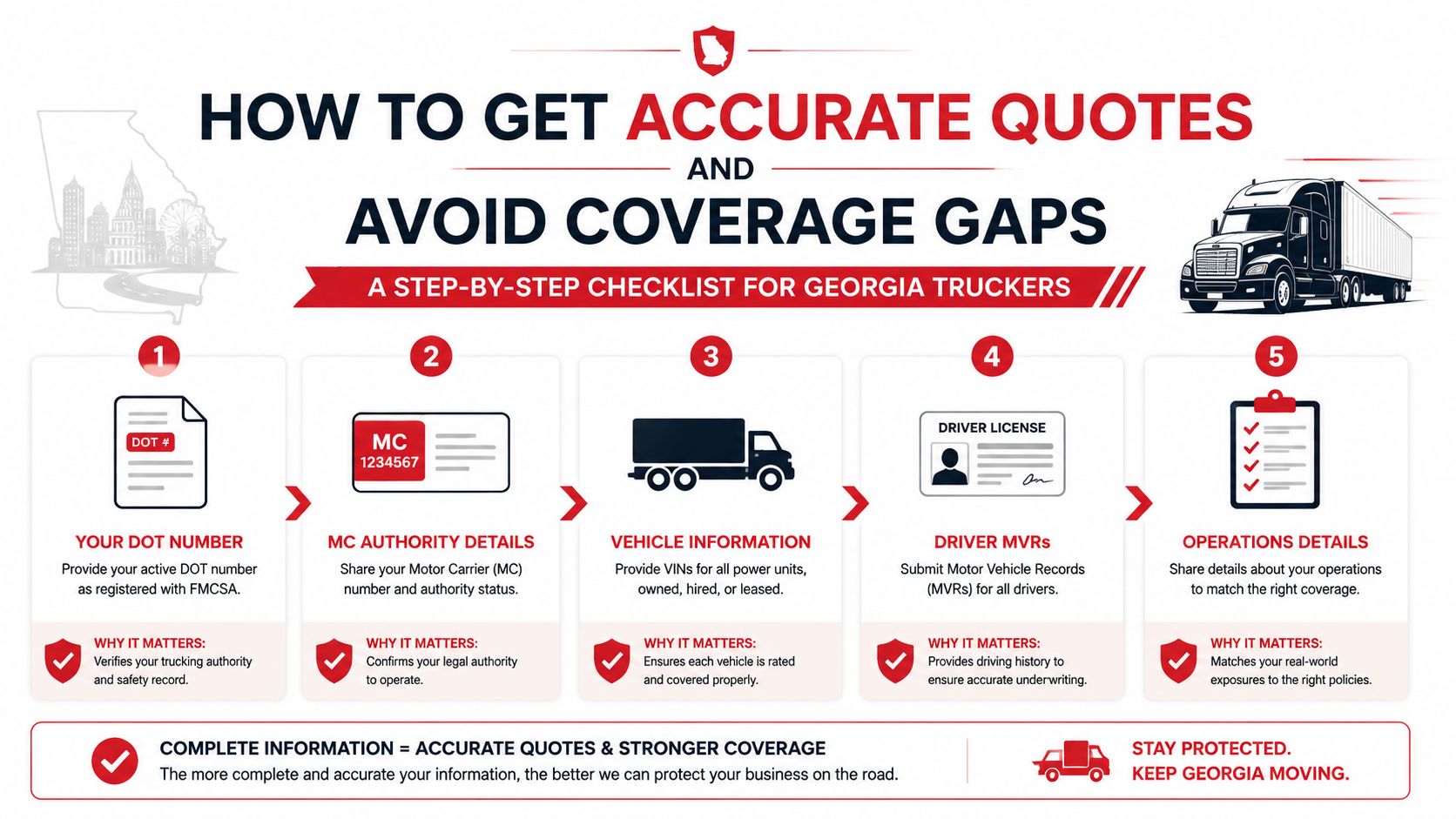
How to Get Accurate Quotes and Avoid Coverage Gaps
A fast quote isn't necessarily an accurate quote. If the application says Georgia-only general freight but the truck regularly crosses state lines, the price may be attractive because the risk was described incorrectly. That creates trouble at binding, filing, renewal, or claim time.
Prepare the underwriting file
Gather these items before requesting proposals:
- DOT and authority details: Provide the legal business name, DOT information, and applicable MC authority details.
- Vehicle records: List every VIN, truck type, model information, stated value, lender interest, and actual garaging location.
- Driver information: Supply current MVRs, license details, experience, and any relevant safety history.
- Operations description: Explain the operating radius, states visited, commodities hauled, trailer types, ports used, and whether loads are brokered or contracted.
- Loss documentation: Provide prior claims and loss runs, including open claims and circumstances under review.
The more accurately you describe the business, the less likely the quote will change after an underwriter asks follow-up questions. Don't hide occasional interstate work because the majority of trips are local. State the actual pattern and price the correct exposure.
Demand an apples-to-apples proposal
Ask for each line item separately: primary liability, physical damage, cargo, bobtail, non-trucking liability, and any required endorsements. Compare limits, deductibles, exclusions, territory, covered use, filing responsibility, and cancellation terms. A lower total may reflect a higher deductible or missing coverage.
An independent agency can compare options across multiple carriers instead of presenting one company's terms. Select Insurance Group, Inc. is one agency that provides commercial trucking quote services for Georgia businesses. Whether you use that agency or another qualified broker, insist that the agent explain what changes if you cross state lines, add a driver, change cargo, or lease on with a carrier.
The Hidden Risks of Bare-Minimum Compliance
Georgia's intrastate minimum can satisfy a regulatory requirement while leaving a carrier financially exposed. The commonly cited intrastate bodily injury floor for qualifying for-hire trucks is $100,000 per person and $300,000 per accident, but a serious crash can involve several injured parties, extensive treatment, lost income, vehicle damage, and legal costs.
Georgia's safety record explains why insurers and carriers treat truck claims as high-severity events. A statewide dataset covering 2013 through 2023 recorded 310,746 total truck crashes, 2,374 fatalities, and 106,409 injuries (Georgia truck crash safety data). The same data represents an average of roughly 31,000 truck crashes per year and more than 200 truck-crash deaths annually, calculated from those reported totals.
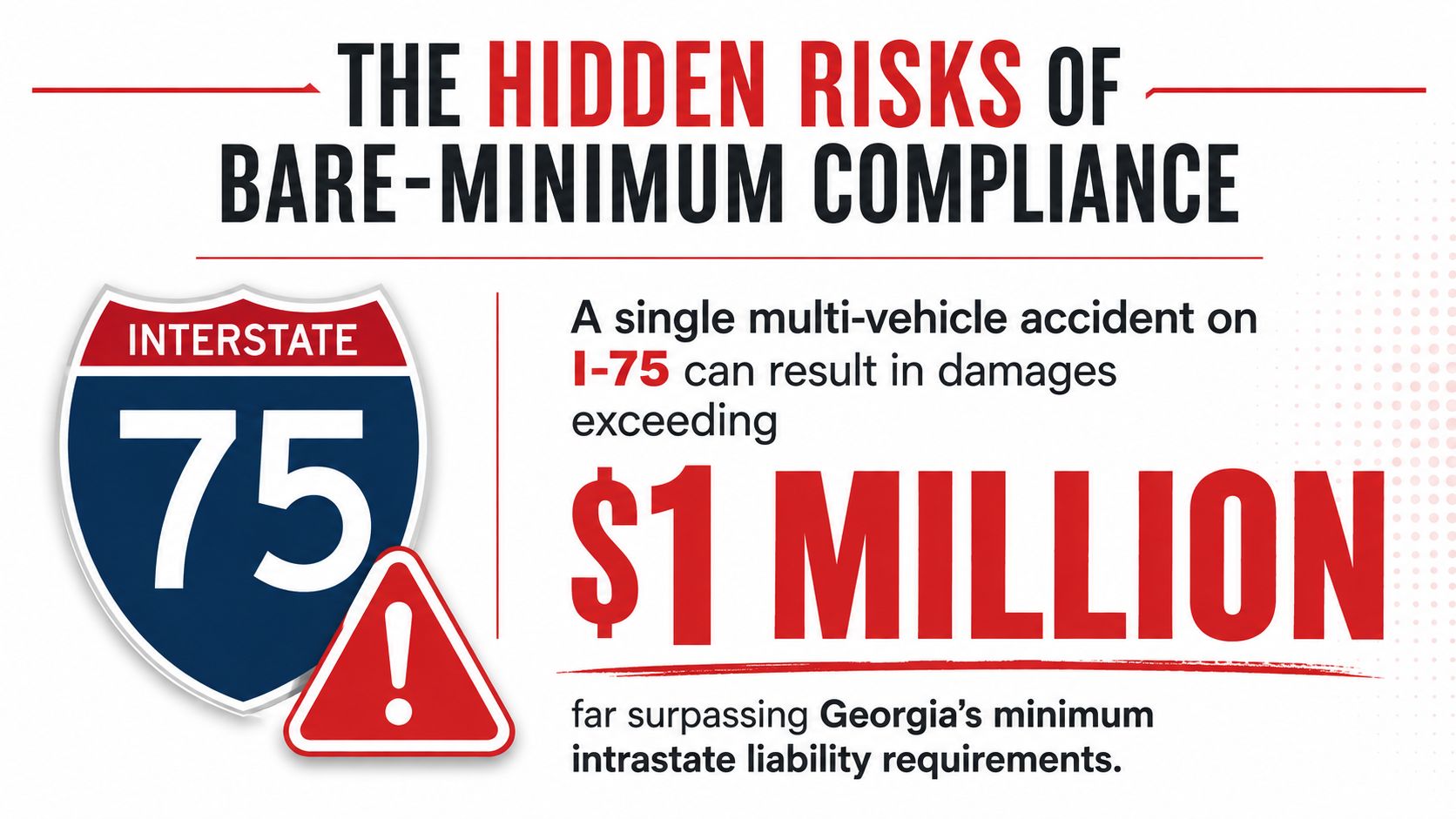
Coverage decision: Buy limits for the loss you need to survive, not merely the limit that lets the truck start moving.
If damages exceed the policy limit, the business may need to fund the remainder. Depending on the company structure and available protections, creditors and claimants may also pursue business assets and create personal financial pressure for the owner. Contracts can create another problem. Brokers and shippers may require limits higher than the state minimum, so a bare-minimum policy can restrict freight access even before a claim occurs.
Coverage protects more than a single vehicle. It protects the company's authority, working relationships, equipment financing, and ability to keep paying drivers after a severe loss.
Your Action Plan for Securing the Right Coverage
Start with the declarations page, not the renewal invoice. Confirm whether the policy allows intrastate operations only or includes interstate authority, then compare the listed cargo, operating radius, vehicles, drivers, and garaging address with what the company does.
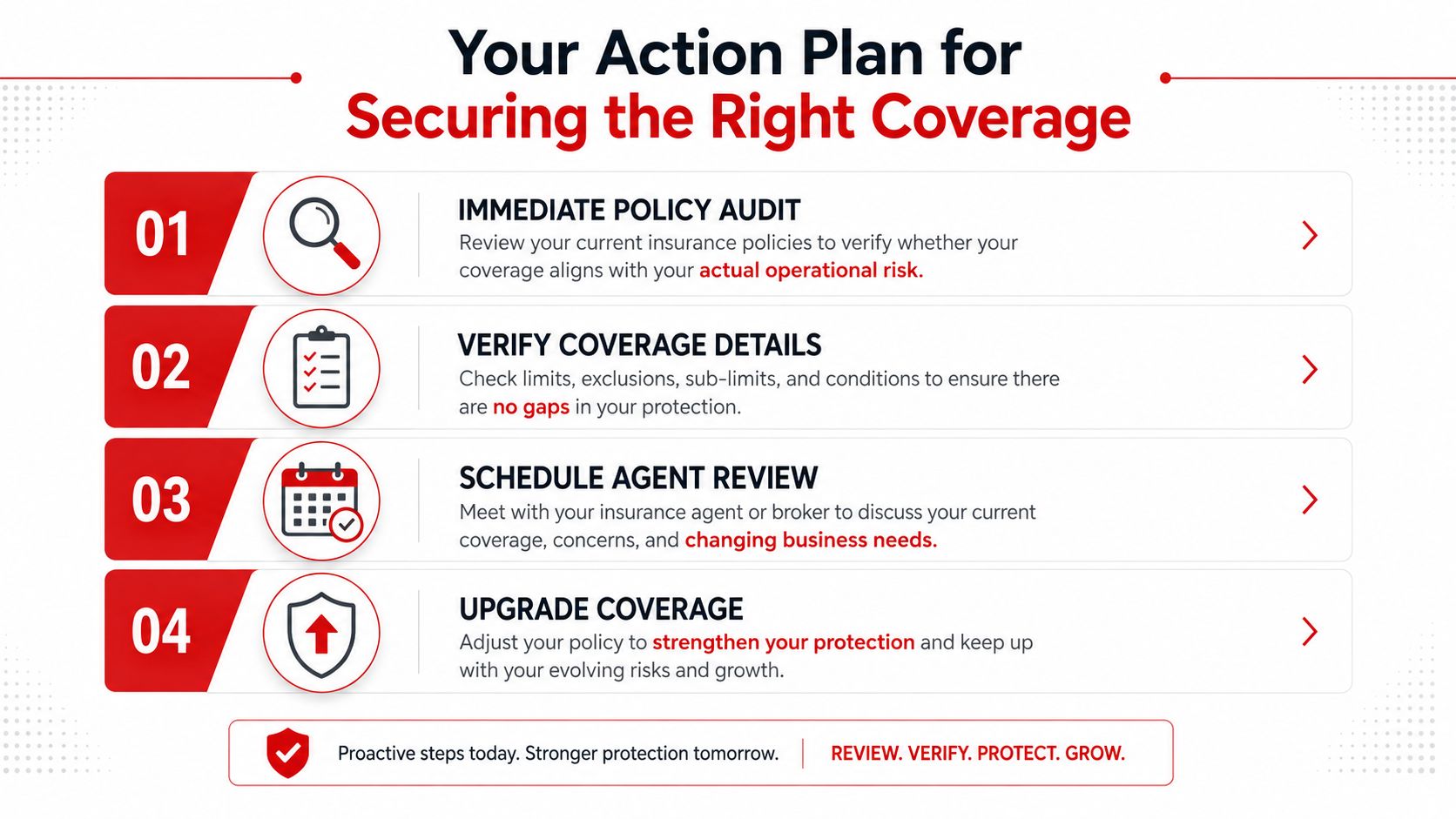
Complete the review in four moves
- Audit the policy now: Check liability limits, physical damage deductibles, cargo terms, exclusions, and covered territories.
- Verify the filings: Confirm that required state or federal insurance filings match the correct legal entity, authority, limits, and effective dates.
- Review the operation with an agent: Bring current declarations, loss runs, vehicle information, driver records, contracts, and cargo details to a broker who understands trucking.
- Upgrade deliberately: Increase protection where the exposure demands it, rather than adding limits or endorsements without understanding the reason.
Review the FMCSA record and the insurance information on file against the declarations page. Any mismatch deserves immediate attention, especially before dispatching interstate freight or renewing authority. Start the renewal conversation early enough to correct filings, obtain loss runs, and compare coverage without accepting a rushed solution.
The right policy balances compliance, claims protection, cargo obligations, and cash flow. A low premium that excludes the work you perform isn't a saving. It's an unfunded liability waiting for a claim.
Select Insurance Group, Inc. offers Georgia trucking businesses commercial auto and trucking coverage, with quote comparisons designed around the vehicles, routes, drivers, cargo, and authority they use. Visit Select Insurance Group, Inc. to request a coverage review, provide your current declarations and loss information, and get a practical comparison focused on closing gaps without wasting premium.