
You just got the renewal notice, the premium jumped, and the first instinct is to blame the market. That's usually the wrong diagnosis. In Orlando, the issue is that business insurance has become a line-by-line decision, and owners who treat it like one lump purchase end up paying for the wrong protection in the wrong places.
A better approach is blunt and practical. Separate liability, property, workers' compensation, commercial auto, professional liability, cyber, and umbrella into distinct decisions, then price each one against how your business operates in Central Florida. That matters here because Orlando isn't a generic inland city, it's a dense metro with tourism traffic, contractor activity, and a huge small-business base, including more than 415,000 small businesses in the metro area and 96% of Orange County businesses classified as small businesses, according to an Orange County government release (Orange County business resource office release).
Table of Contents
- Why Orlando Small Businesses Need Coverage That Actually Fits
- The Core Coverage Toolkit Every Orlando Owner Should Know
- Florida Cost Drivers and the Split Market Orlando Faces in 2026
- How Workers' Comp Pricing Really Works by Trade
- Bundled Versus Unbundled Coverage in Practice
- Your Step-by-Step Plan to Compare Orlando Quotes
- Coverage Mistakes Orlando Owners Keep Making
- Next Steps With an Independent Orlando Agent
Why Orlando Small Businesses Need Coverage That Actually Fits
A café near Lake Eola gets clipped by a delivery van that jumps the curb and takes out part of the patio. A contractor on the way to a job near the attractions corridor loses tools overnight because the truck sat in a bad lot. Those are not exotic losses. They're the kind of everyday business interruption and property problems that hit Orlando owners because traffic, weather, and job-site exposure are part of the operating environment.
That's why a generic out-of-state policy template is a bad fit. A Florida policy has to work for contractors, restaurants, retailers, service firms, and fleets that need quick certificates, contract wording, and clean coordination across several lines of coverage. If you run a business here, you're not buying a logo or a package name, you're buying a defense plan that needs to match the way your crews move, where your customers show up, and how your lease or contract is written.
Start with the exposure, not the form
Owners usually ask for a “cheap quote” first. That's backward. The better question is which losses would put you in a cash crunch, because that tells you whether the first dollars should go to property, auto, workers' comp, cyber, or umbrella.
Practical rule: If a policy doesn't reflect your leases, vehicle use, payroll mix, and customer traffic, it's not really tailored, it's just priced.
For Orlando businesses, the core categories are straightforward. General liability protects against customer injury and third-party claims. Property covers the building and contents. Workers' comp protects employees and keeps you aligned with Florida rules. Commercial auto matters the moment business use moves onto titled vehicles. Professional liability covers service and advice mistakes. Cyber helps with breach and ransomware costs. Umbrella extends the liability ceiling when a normal claim runs past the base policy.
The Core Coverage Toolkit Every Orlando Owner Should Know
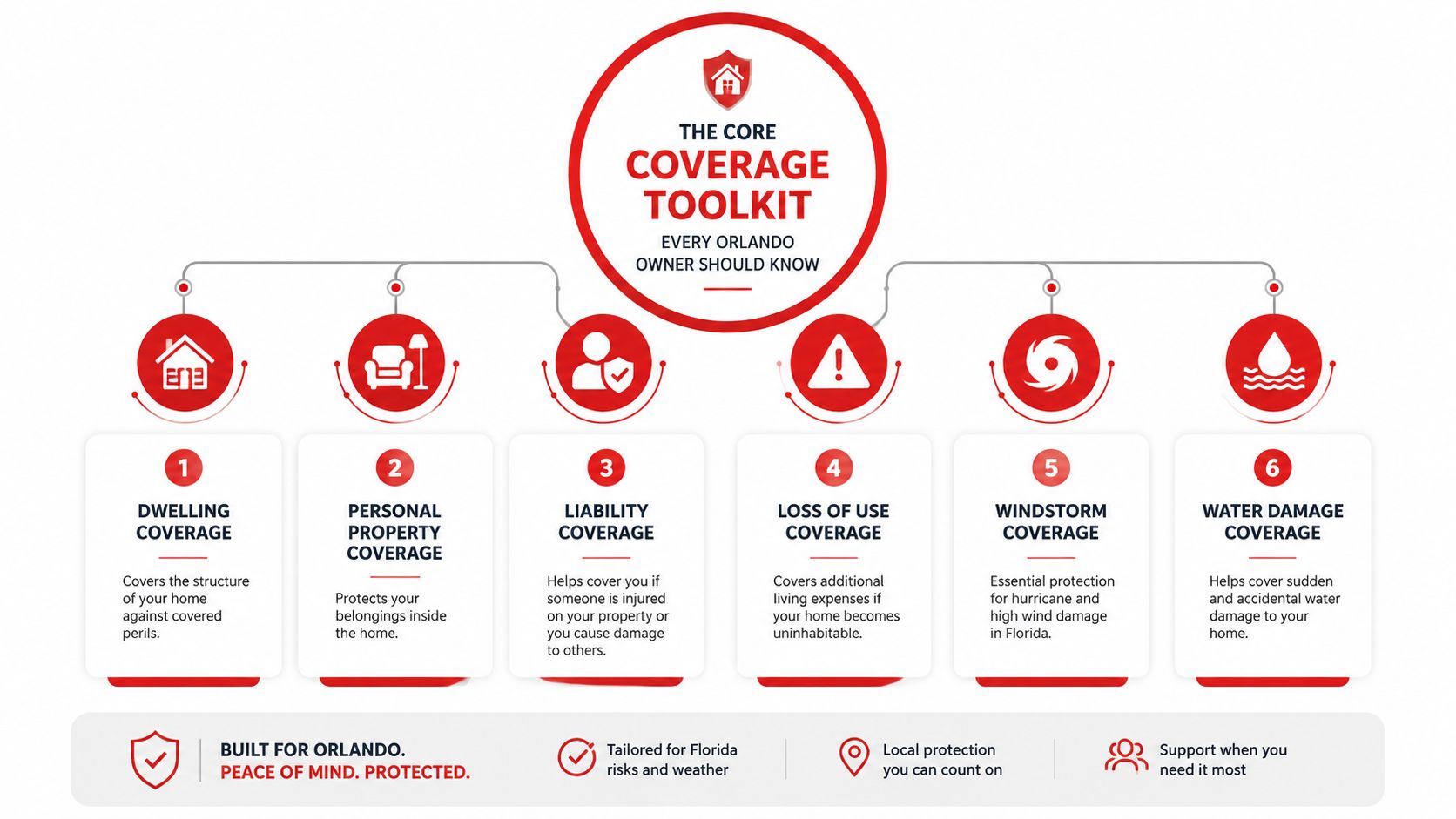
Each layer solves a different problem, and a weak layer can leave the whole program exposed. Orlando owners get better results when they build coverage line by line, starting with the risks that can hit cash flow first. A BOP, or business owner's policy, often serves as the base because it can combine property and general liability in one package, which keeps things simpler for smaller firms that want fewer moving parts.
The rest of the toolkit fills the gaps a BOP leaves behind. Workers' compensation handles employee injury and the compliance side of payroll. Commercial auto addresses business vehicles and driving done for work. Professional liability protects against advice, design, or service mistakes. Cyber handles breach response and payment-related trouble. Umbrella adds higher liability limits when a claim runs past the base policy.
The mix changes by business type. An Orlando restaurant needs more than property and general liability, because foodborne illness defense, liquor exposure, and equipment breakdown can hit hard. A retailer near the tourist corridors should care about cyber risk if card processing and customer data flow through the business every day. A contractor needs to sort out whether tools, trailers, and field operations are covered the way the owner expects.
Straight answer, the core categories are simple. GL covers customer-facing injury and damage claims. Property covers the location and its contents. Workers' comp covers the workforce. The other lines cover how modern businesses operate. For owners who want a local starting point, this local commercial insurance resource lays out Orlando commercial coverage options in plain terms.
| Coverage | What it does | Orlando use case |
|---|---|---|
| General liability | Covers third-party injury and damage claims | A customer slips at the front counter |
| Property | Covers building and contents | Wind damage or theft at the storefront |
| BOP | Bundles core protections | A small office or shop wants simpler administration |
| Workers' comp | Covers employee injury costs and wage replacement rules | A restaurant or job crew with payroll |
| Commercial auto | Covers business vehicles and driving exposures | A service van making daily stops |
| Professional liability | Covers errors in services or advice | A consultant or designer misses a key detail |
| Cyber | Covers breach response and related costs | A retailer handling card data and email invoices |
| Umbrella | Raises liability limits above the base policy | A claim runs higher than the standard limit |
Florida Cost Drivers and the Split Market Orlando Faces in 2026
Florida is not one insurance market. It's several markets living under the same state rules. That's the part many Orlando owners miss. Workers' compensation has been moving in a friendlier direction, while property, auto, umbrella, and cyber can price very differently depending on the line and the risk profile. A one-size quote hides that split and usually leads to bad decisions.
Why the same business can get very different pricing
For workers' comp, Florida's system is state-based and updated annually. The Florida Office of Insurance Regulation approved a 6.9% average statewide workers' compensation rate decrease effective January 1, 2026, the ninth consecutive annual decrease in the state. That's the kind of relief Orlando owners should chase, especially if they've been assuming every line is getting worse at the same pace.
Property is a different story. In Orlando, the underwriting focus is less about simple replacement cost and more about hurricane wind mitigation, roof shape, opening protection, and debris resistance. Inland doesn't mean safe. A storm can still damage the envelope, trigger business interruption, and create a long repair queue. Flood is also a blind spot for a lot of owners who assume being away from the coast solves the problem. It doesn't.
| Coverage Line | 2026 Market Direction | Key Orlando Driver |
|---|---|---|
| Workers' comp | Softer | Statewide rate relief and class-code discipline |
| Property | Tighter | Hurricane wind, deductible structure, and business interruption |
| Commercial auto | Tighter | Liability pressure and vehicle exposure |
| Umbrella | Tighter | Claims severity and high-limit demand |
| Cyber | More negotiable | Expanding capacity and more carrier appetite |
The strategic move is simple. Shop by line, not by slogan. A contractor, restaurateur, or fleet owner may be able to improve one line while another stays stubborn. That's why a clean comparison and the right market guidance matter, especially if you're also sorting out staffing decisions with a broader Florida labor solution such as PEO Metrics provider selection advice.
For flood-specific planning, this is the point where Orlando owners should stop guessing and ask whether their property coverage includes the exposure they think it does. A direct check against a Florida flood rule explainer like this flood insurance guide is worth the time.
Orlando owners don't need a cheaper blanket quote. They need the right line to get the right repricing, because the market is moving in different directions at once.
How Workers' Comp Pricing Really Works by Trade
Orlando owners hear one workers' comp number and assume it applies across the board. It doesn't. Florida pricing turns on NCCI class code selection and the payroll attached to each code, so a desk-heavy office can stay cheap while a trade crew or kitchen operation pays far more on the same payroll base.
Trade codes drive the bill
The spread is wide. Clerical office work sits at $0.11 per $100 of payroll, restaurant NOC at $1.16, retail store NOC at $1.18, janitorial services at $2.45, and residential carpentry at $7.69 per $100 of payroll. Contractor classes separate just as sharply, with roofing at $6.752, carpentry NOC at $4.364, concrete construction NOC at $5.184, electrical wiring at $2.969, plumbing NOC at $2.737, HVAC at $2.995, and clerical office work at $0.105 per $100 of payroll (Florida workers' comp class codes).
| Industry | NCCI Class Code | Approx. FL Rate per $100 Payroll | What Drives the Cost |
|---|---|---|---|
| Clerical office | 8810 | $0.105 to $0.11 | Low physical exposure |
| Roofing | 5552 | $6.752 | Height, fall risk, field labor |
| Carpentry | 5403 / carpentry NOC | $4.364 | Tools, framing, job-site hazards |
| Concrete construction | NOC | $5.184 | Heavy labor and site risk |
| Electrical wiring | Trade code | $2.969 | Field exposure and safety risk |
| Plumbing | NOC | $2.737 | Service calls and job-site work |
| HVAC | Trade code | $2.995 | Equipment handling and field exposure |
Documentation and proper classification drive the premium. Separate office payroll from field payroll. Recheck owner and executive treatment. Audit whether a foreman is being coded as labor or supervision. If your records are clean, a reclassification review is worth the time, and the Florida-specific workers comp cost guide is the right place to pressure-test the numbers.
Practical rule: If payroll is blended, premium is probably inflated. Split the job duties before you ask for a renewal quote.
For contractors, the operational side of those codes is easier to read in a workers comp guide for trades.
Bundled Versus Unbundled Coverage in Practice
A contractor in Orlando with a small crew usually likes the BOP path. It's tidy. General liability and property sit together, the paperwork is lighter, and the package pricing often feels easier to digest. If the business also adds workers' comp, commercial auto, and an umbrella, the owner gets a workable structure without forcing every line into one oversized policy.
A restaurateur often takes a different route. Tenant lease terms may require specific property limits, equipment breakdown detail, or endorsements the standard bundle handles only through sublimits. In that case, unbundling makes sense because the owner gets more control over the deductible, the property valuation, and the extra protections that matter in a food-service operation.
Choose the structure that matches your contracts
The trade-off is control versus simplicity. A BOP can be efficient, but efficiency is useless if the limits are too low or the policy language is too narrow for the lease. Standalone policies take more time to assemble, but they can fit a harder contract standard better.
If you're comparing both approaches, read the declarations page first, then check what each policy caps. A packaged quote that feels cheaper on day one can turn expensive if the business outgrows the sublimits or the landlord demands a specific endorsement later.
The right answer depends on your lease, your general contractor requirements, and how much room you want to customize the coverage stack. If you want less guesswork, compare the bundle against the standalone lines side by side before you sign anything.
Your Step-by-Step Plan to Compare Orlando Quotes
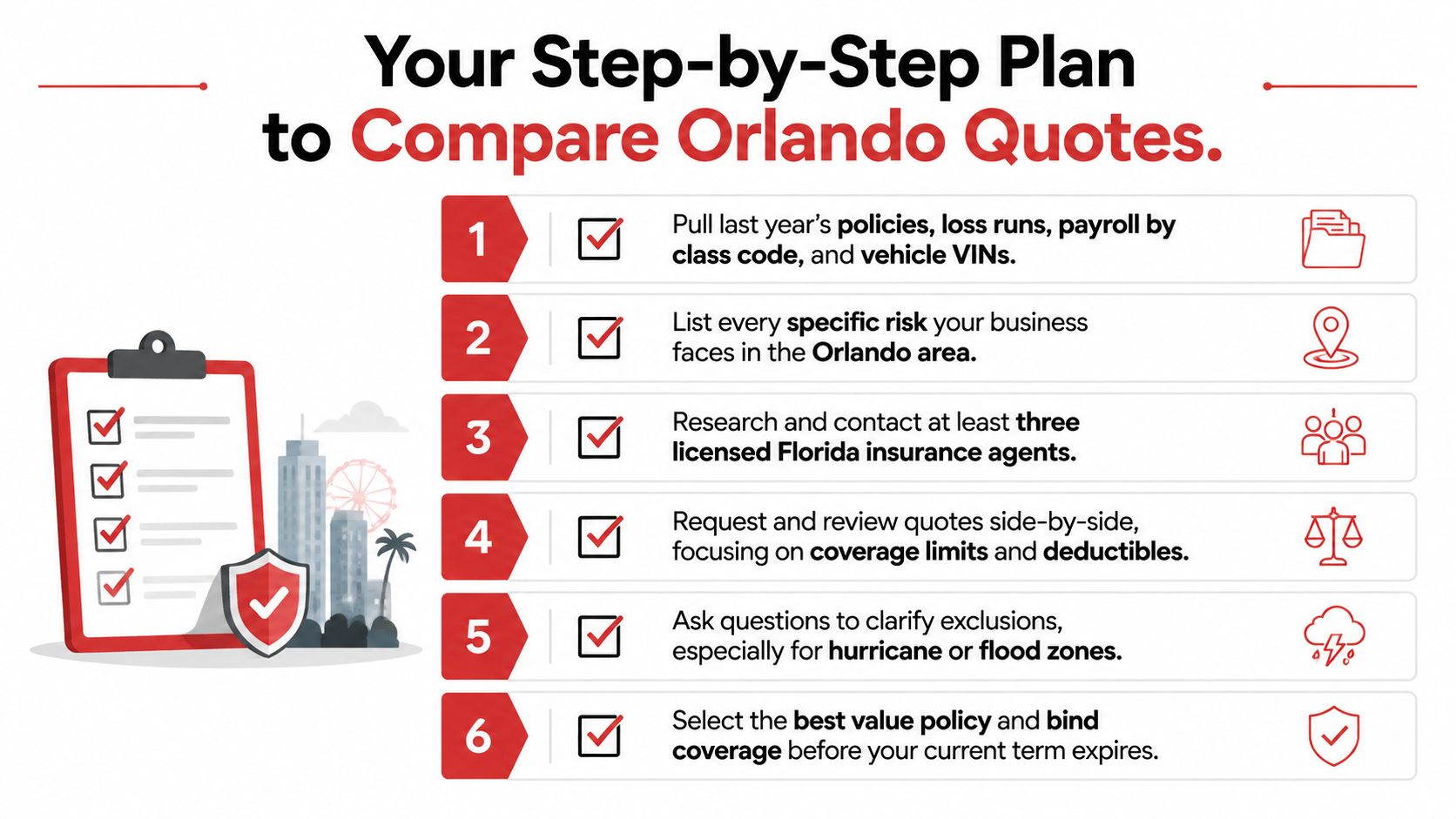
Start with your paperwork, not your memory. Pull last year's declarations page, loss runs, payroll by class code, and vehicle VINs. If you run multiple locations or job sites, include the lease language and any contract insurance requirements too, because that's where the hidden minimums usually live.
Build the quote request correctly
Next, list every real exposure in Orlando terms. That means customer traffic, employee driving, tools in transit, cyber exposure, and flood or wind interruptions if your property sits in a vulnerable parcel. Don't let the request focus only on the obvious building and slip-and-fall items.
Then narrow the field to a few independent agencies that can access multiple carriers and explain the differences without steering you into a single default package. You want someone who can quote by line, not just one who can push a bundled teaser.
Ask for like-for-like quotes. Same limits, same deductibles, same endorsements, same class codes. Anything less is noise.
After that, review the proposals against a checklist. Confirm the BOP limits, workers' comp class assignments, commercial auto liability, professional liability if you sell advice or services, cyber if you store data or invoice by email, and umbrella if your contract language expects a higher cap. If the insurer leaves a gap, ask for the exclusion in writing before you bind.
A useful working habit is to negotiate, bind, and then schedule a 90-day check-in. Growth changes the answer fast, especially in a city where more staff, more vehicles, or one new commercial lease can shift the risk profile. And when you need a certificate of insurance for a landlord or job, online portals can shave that request down to minutes instead of a day of back-and-forth.
Coverage Mistakes Orlando Owners Keep Making
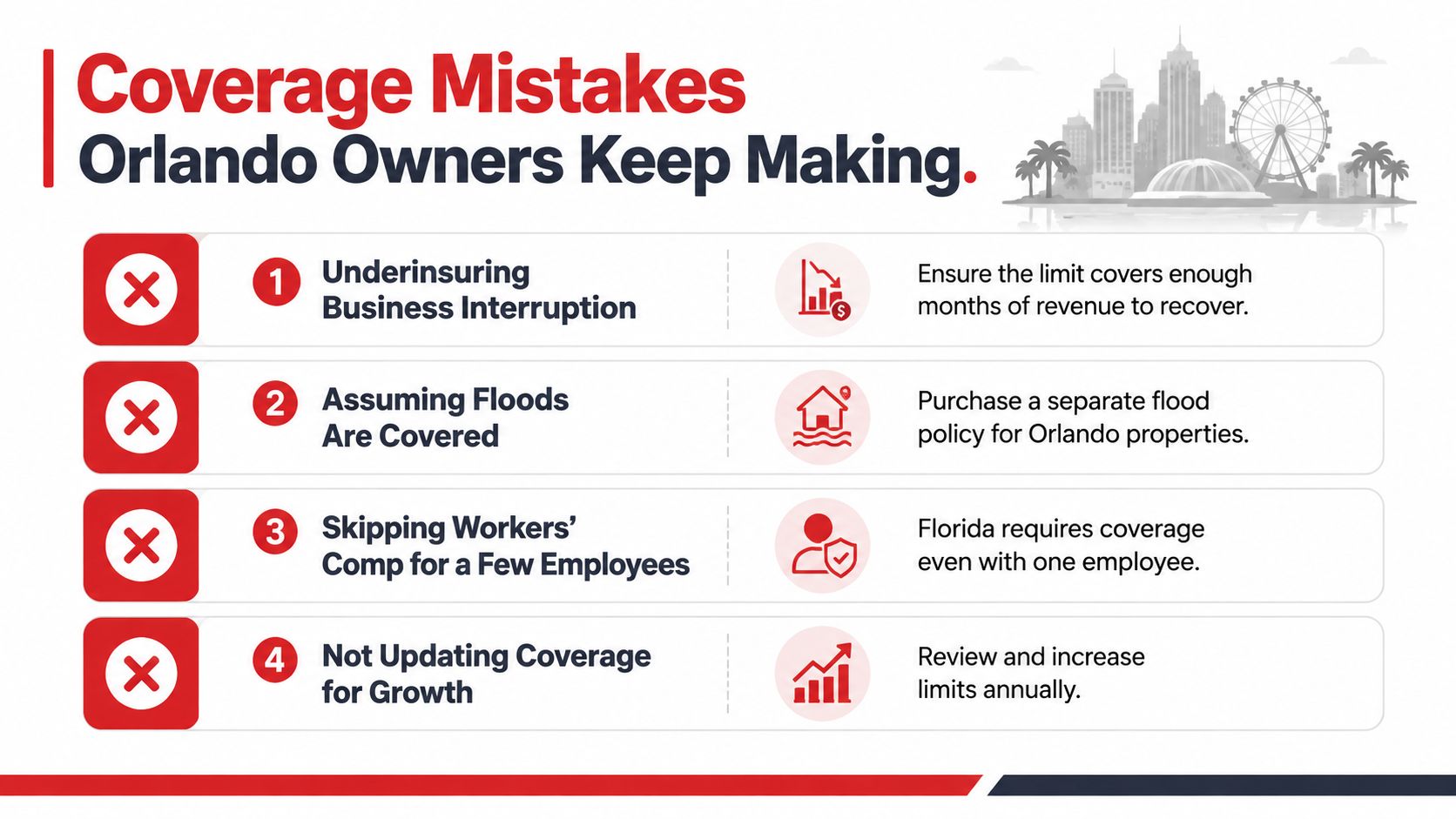
The first mistake is underinsuring business interruption. Owners look at current revenue, then forget that recovery costs rise when a storm or fire delays reopening. If the cash-flow math is weak, the policy may pay less than the business needs when rent, payroll, and temporary fixes keep coming due.
The second mistake is assuming flood is folded into a normal property policy. In Florida, that's a dangerous assumption. Even inland Orlando parcels can face water loss problems, and many owners learn too late that the standard property form doesn't do what they expected.
The shortcuts that create expensive surprises
Another common error is mixing personal and commercial vehicles. The moment a truck is used for tools, signage, or regular business routes, personal auto logic stops fitting the exposure. That mismatch gets even uglier when there's a claim and the insurer looks at how the vehicle was used.
Cyber is the other blind spot. A lot of owners say they don't process enough card data to care. That misses the email compromise, invoice fraud, and vendor-side breach exposures that hit modern offices, restaurants, and contractors every week. In a split market, skipping cyber because it feels optional is the kind of shortcut that punishes you later.
Use this self-audit before renewal. Ask whether the business could reopen after a wind loss, whether the property form covers the exposure you think it covers, whether every vehicle is correctly titled and rated, and whether someone in the office is one phishing click away from creating a claim. If any answer is fuzzy, fix that before you shop price.
Next Steps With an Independent Orlando Agent
A good independent agent should make this easier, not more confusing. The value is in line-by-line shopping, re-shopping when the market changes, and helping you avoid the trap of one bundled answer for every risk. That matters if you want English or Spanish support, quick turnaround, and a team that understands how Orlando contractors, retailers, and hospitality operators work day to day.
Start with three concrete moves. Gather last year's declarations page, payroll schedule, and vehicle list. Book a short coverage review. Then ask for a side-by-side proposal that separates workers' comp, property, auto, and cyber instead of hiding everything inside a teaser quote.
If you run a business in Central Florida, don't treat this as a one-time purchase. Treat it like an ongoing operating decision, because your staffing, vehicles, leases, and contracts keep changing. The right agent relationship should keep pace with that, and it should make certificates, billing, and policy updates easy enough that your team doesn't waste time chasing paperwork.
Select Insurance Group, Inc. helps Orlando-area business owners compare commercial insurance options across key lines like general liability, commercial property, workers' compensation, commercial auto, and BOP coverage. If you want a clearer quote process and a local conversation about what fits your operation, visit Select Insurance Group, Inc. to request a review and see how your coverage stacks up.