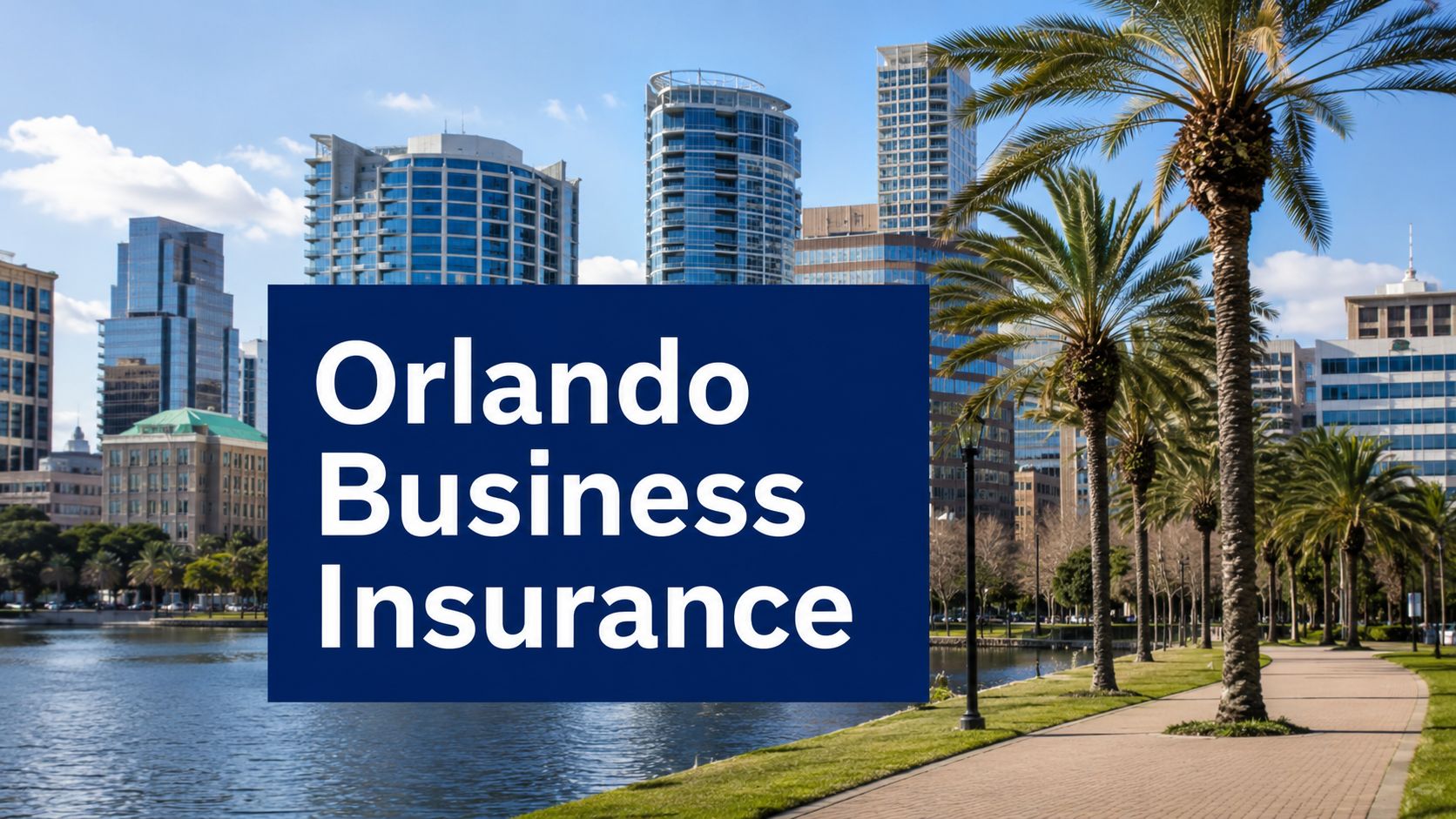

You can run a busy Orlando business and still feel like you're one storm, one slip-and-fall, or one fender-bender away from a serious loss. A café in Lake Nona has customer injuries to think about, a contractor has tools and truck risk on the road, and a retailer has property, payroll, and hurricane exposure all sitting in the same policy conversation. Orlando commercial insurance only works when it matches those realities, not when it's built from a generic quote checklist.
The problem is that Central Florida doesn't reward a one-size-fits-all approach. Wind exposure, flood exclusions, vehicle use, payroll class codes, and industry-specific liability all change what the right coverage should look like. If you're comparing policies now, the real question isn't just what it costs. It's what happens after a claim.
Table of Contents
- Protecting Your Orlando Business From Day One
- The Core Four Commercial Insurance Policies Explained
- Specialty Coverage for Orlando's Key Industries
- The Florida Factor Navigating Hurricanes and Regulations
- Understanding the Cost of Orlando Commercial Insurance
- Your Step-by-Step Guide to Getting Coverage Fast
- Partner With a Local Expert Select Insurance Group
- Frequently Asked Questions About Orlando Business Insurance
Protecting Your Orlando Business From Day One
A restaurant owner in Orlando can have a normal morning, then deal with a customer injury, a delivery vehicle scrape, and a storm watch by afternoon. That's not unusual here. Tourism traffic, dense commercial corridors, and hurricane season all sit on top of each other, so the insurance conversation has to start with real operating risk, not a standard form.
Orlando business insurance guidance works best when the policy matches the way the business functions. A storefront has different exposures than a service contractor. A fleet-based company has a different problem set than a professional office. A building-heavy operation needs to think about wind, roof type, and coverage structure, while a mobile business has to worry about vehicles, drivers, and cargo.
Practical rule: if a policy only feels affordable because it leaves out the most likely claim, it isn't really affordable.
The market data backs up why comparison matters. Florida's commercial property market grew from $13.65 billion in 2023 to $14.34 billion in 2024, a 5.05% increase in the admitted market, and year-to-date premium through May 2025 had already reached $7.8 billion (Florida market insights, June 2025). That kind of activity tells you carriers are still writing business, but they're also paying close attention to building quality, wind exposure, and claims history.
For Orlando owners, the takeaway is simple. Coverage should be built around the business's actual loss drivers, not around the easiest application to fill out. That's how a policy becomes protection instead of paperwork.
The Core Four Commercial Insurance Policies Explained
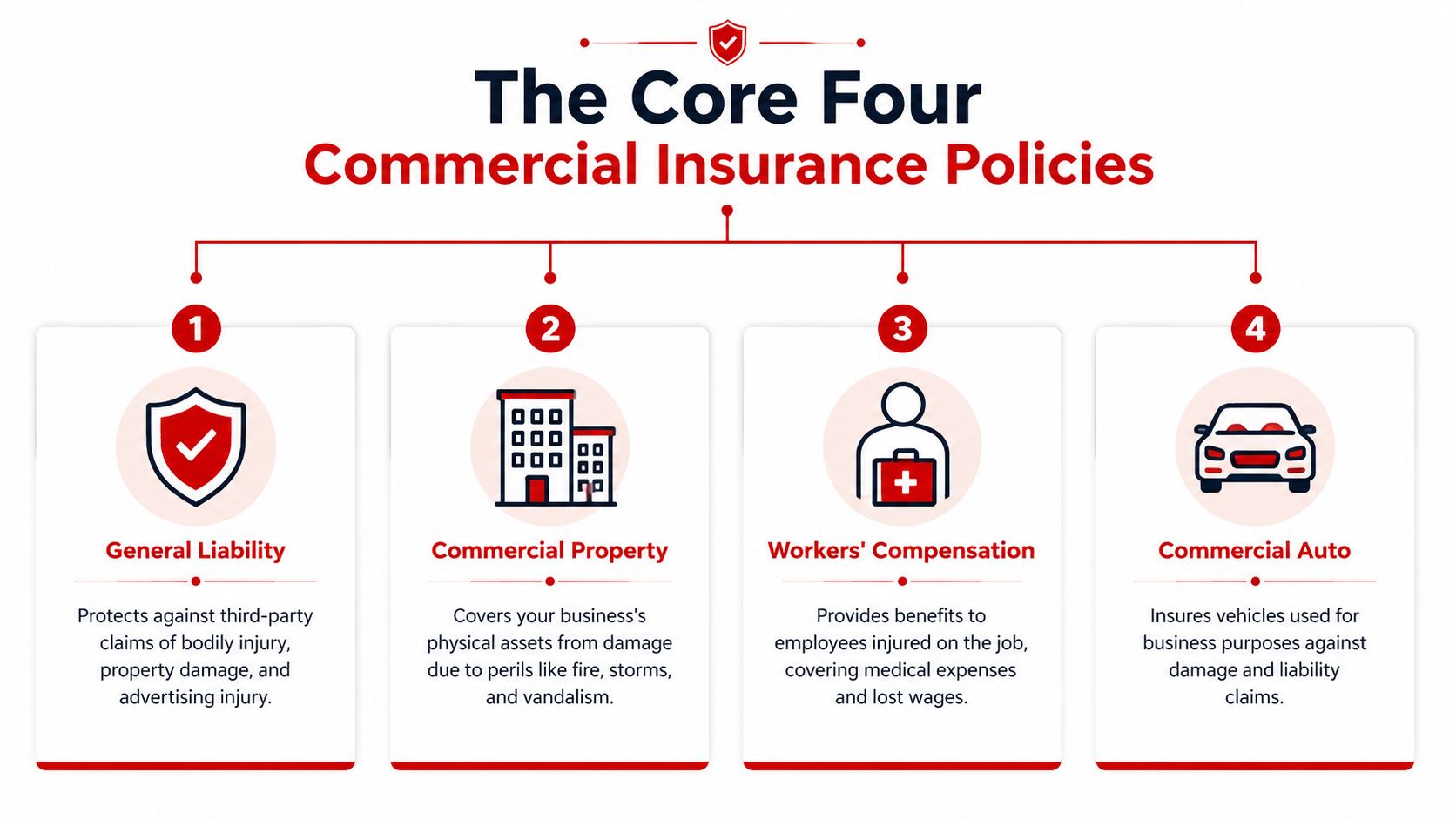
Every Orlando business needs a core structure, even if the details change by industry. Think of the main policies as four separate jobs. One handles outside claims, one protects the location and contents, one protects employees, and one covers business driving.
General Liability and Commercial Property
General Liability is the shield. If a customer slips in a Winter Park boutique or says your business damaged their property, this is the policy that responds to that third-party claim. Commercial Property is the fortress. It protects the building, contents, and physical assets from covered losses like fire, storm damage, or vandalism.
The hard truth is that many owners only notice the difference after a loss. General liability doesn't rebuild a roof. Property coverage doesn't pay a guest's injury claim. The structure matters more than the premium line item because each policy solves a different problem.
Workers' Compensation and Commercial Auto
Workers' Compensation handles employee injuries on the job, including medical costs and lost wages where required. A kitchen worker with a burn, a warehouse employee with a back injury, or a technician injured on a ladder all fall into this category. Commercial Auto covers vehicles used for business, including liability and physical damage tied to that use. If a delivery van is in service every day, personal auto coverage usually isn't built for that risk. Commercial auto coverage guidance is part of a serious Orlando insurance review, especially for fleets and service companies.
Many small Orlando businesses pay roughly $500 to $1,800 per year for general liability and about $900 to $3,000 per year for a Business Owner's Policy, according to a local market guide. That doesn't mean every business will land in that range, but it does show why class code, payroll, property value, and vehicle use matter.
| Industry | General Liability | Commercial Property | Workers' Comp | Commercial Auto |
|---|---|---|---|---|
| Retail storefront | High priority | High priority | If employees are on payroll | If deliveries or service driving are involved |
| Contractor | High priority | Equipment-focused | High priority | High priority |
| Office-based firm | High priority | Moderate to high | If employees are on payroll | Usually limited |
| Restaurant | High priority | High priority | High priority | If catering or delivery is used |
Specialty Coverage for Orlando's Key Industries
Some Orlando businesses can't be protected well with a standard package alone. Contractors need to think about tools, materials in transit, and project obligations. Restaurants and retail stores need to think about customer-facing liability, payment systems, and fast-moving property exposure. Transportation-heavy firms have to address vehicle severity, driver risk, and higher liability limits.
Contractors and construction operations
Construction work is a classic example of a business that becomes harder to place as operations get more complex. Independent market sources note that construction and contractors are increasingly among Florida's hard-to-place risks, often moving into E&S / surplus-lines markets rather than standard carriers (hard-to-place commercial risks in Florida). That matters because a contractor's real exposure isn't just the office or truck. It's tools, jobsite delays, subcontractor issues, and equipment that may move every day.
A good contractor package often needs more than the basics. It should be reviewed for tools and equipment, jobsite liability, and any obligations tied to client contracts. If a business is growing fast, the question isn't whether the policy is cheap. It's whether the policy can support the work being done.
Hospitality, retail, and transportation
Restaurants and retail stores need careful attention to customer injury exposure, interior buildout, and payment-system risk. Independent market sources also flag restaurants as a harder-to-place category in Florida, which is another reason placement strategy matters more than quote shopping alone (hard-to-place commercial risks in Florida). Transportation and fleet operations need to think about vehicle liability, cargo, and the fact that one bad accident can affect both revenue and reputation.
Standard coverage is often enough only if the business is simple. Orlando businesses rarely stay simple for long.
Some businesses also cross into specialty territory because of cyber exposure, especially when point-of-sale systems and customer data are part of daily operations. That doesn't mean every shop needs the same endorsement stack. It means the coverage review has to follow the operation, not the other way around.
The Florida Factor Navigating Hurricanes and Regulations
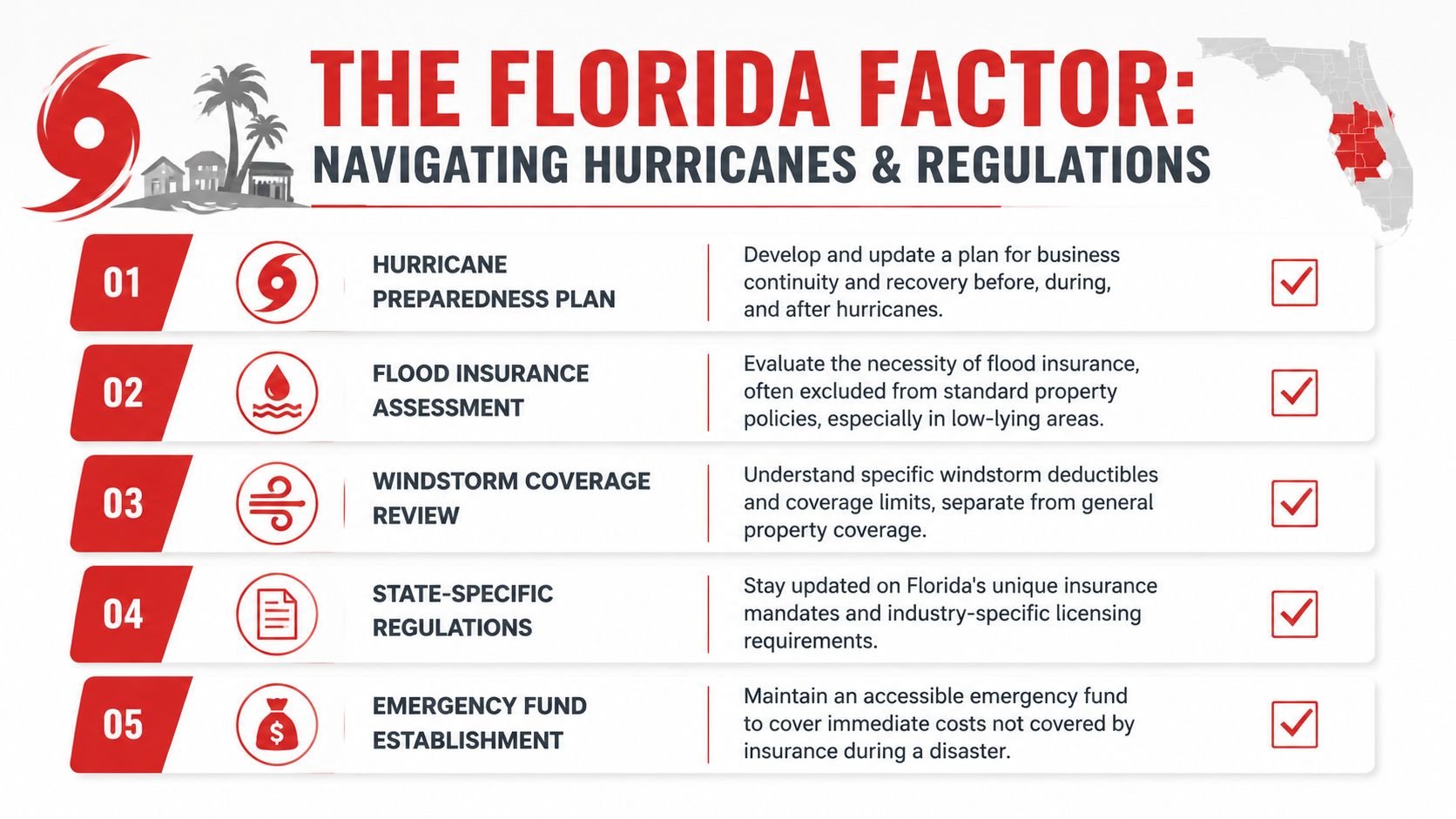
Orlando owners don't just buy insurance, they buy a response plan for wind, water, and downtime. That's the part many policies don't explain clearly enough. A hurricane deductible can look manageable on paper and still create a major cash problem after a storm. Flood can be excluded entirely. Those two facts alone can leave a business with a false sense of security.
Deductibles and coverage gaps
For Orlando businesses, hurricane deductibles are often set at 2%–5% of the insured property value, and flood damage is typically excluded entirely, creating a major claims gap. That means the deductible is not a small fixed amount. It scales with the value of the property, which can make a post-storm recovery expensive before repairs even begin.
The better question is not “What's the monthly premium?” It's “What do I owe after a storm, and what losses are covered?” Businesses with business-interruption exposure should also review how quickly that coverage starts, what it excludes, and whether it lasts long enough to cover a real shutdown.
A cheap policy with the wrong deductible can cost far more than a stronger policy with the right structure.
Wind mitigation and building resilience
Florida pricing still rewards better mitigation. A building with strong wind mitigation may price at $0.50 to $1.50 per $100 of value, while a less-protected building could cost over $2.00 per $100. That gap reflects the insurer's view of tail risk. Hip roofs, opening protection, and other resilience features can reduce modeled wind loss and make a risk more attractive to carriers.
That's why Orlando owners should keep an eye on the physical building, not just the policy forms. Roof condition, storm shutters, and documented improvements all matter during underwriting. Flood coverage review for Orlando businesses belongs in the same conversation, because flood and wind are not the same risk and they're often handled very differently on the policy.
Understanding the Cost of Orlando Commercial Insurance
Pricing in Orlando usually follows the business's exposure, not a flat menu. Underwriters look at industry, payroll, revenue, property value, vehicle type, and claims history. If a business has more employees, more driving, more customer interaction, or more physical assets, the premium usually has more to account for.
What moves the quote
A small office with limited foot traffic is evaluated differently from a contractor with multiple trucks and tools. Payroll influences workers' compensation. Vehicles influence commercial auto. Property features and wind exposure influence commercial property. Claims history can push all of those numbers in the wrong direction because the carrier is pricing both the operation and the record.
A useful way to think about it is control versus non-control. You can improve safety procedures, document maintenance, and keep cleaner records. You can't control broader repair inflation or the fact that some classes are more expensive to insure in Florida.
Where the market is heading
Many small Orlando businesses pay roughly $500 to $1,800 per year for general liability and about $900 to $3,000 per year for a Business Owner's Policy, according to a local market guide. The same source notes that 2026 commercial auto rates may see 5% to 10% increases because of repair-cost inflation. That means fleets and service businesses should expect auto to stay under pressure even if other lines feel steadier.
If you're trying to reduce premium pressure, focus on loss control first. A practical primer like Proven ways to reduce premiums is useful because it keeps the discussion centered on what business owners can influence. The bigger point is that a lower price only helps if the policy still responds when it matters.
Your Step-by-Step Guide to Getting Coverage Fast
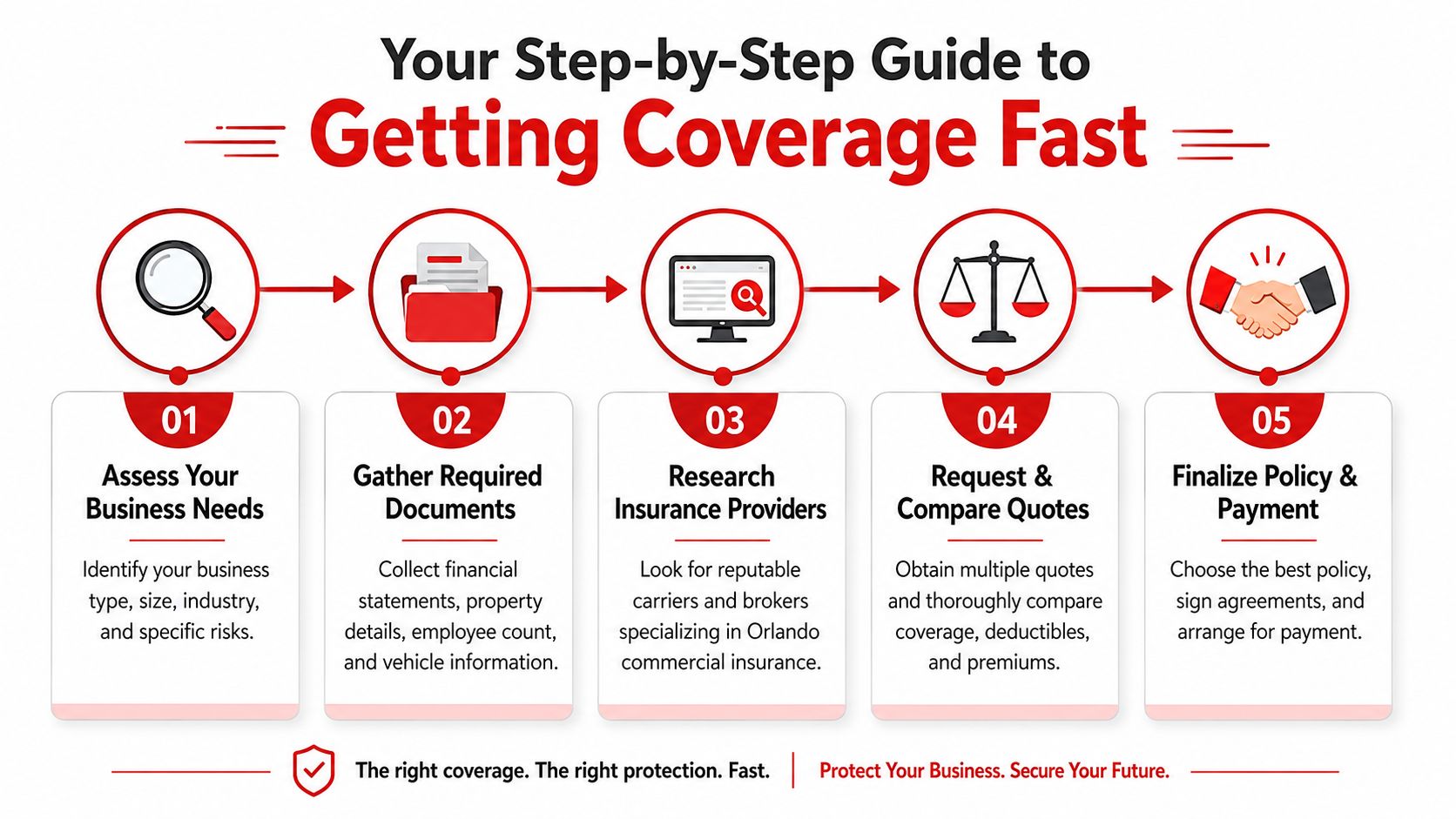
The fastest quote file is the one that's complete before the first carrier review starts. Have your EIN, revenue estimate, payroll summary, vehicle list, property details, and any prior policy information ready. If the business has leases, contracts, or certificates required by customers, keep those handy too.
Gather the facts first
A good submission saves time and prevents back-and-forth. Underwriters want to know what you do, where you operate, what you own, who drives, and how often things change. A clean file usually gets a cleaner response.
If the application is vague, the quote is usually vague too.
Compare the right way
The old way is to repeat the same story carrier by carrier and then try to compare partial quotes. The better way is to let an independent agent shop the risk across multiple markets at once, then compare coverage, deductibles, exclusions, and service terms side by side. Select Insurance Group, Inc. is one local option that does that kind of carrier comparison for commercial accounts in Central Florida.
That process is especially helpful when a business might need standard-market quotes for one part of the package and specialty placement for another. It keeps the focus on fit instead of just speed. Secure document upload, quick follow-up, and one organized submission can cut a lot of wasted time out of the process.
Partner With a Local Expert Select Insurance Group
Orlando insurance gets complicated fast because the city combines tourism, density, vehicles, storms, and specialty industry exposure in one market. That's why a local conversation matters. A broker who understands Central Florida can spot the coverage gap before it becomes a claim problem, especially when flood, wind, and liability all need to be reviewed together.
Independent agencies are useful here because they can compare multiple carriers instead of steering a business toward one answer. In a market where Florida commercial property remains active and underwriting stays sensitive, that flexibility matters. It's even more important for businesses that are drifting into hard-to-place territory and need a smarter placement strategy, not just another quote.
Select Insurance Group has the kind of local, bilingual, multi-carrier support that helps business owners sort through those choices without starting from scratch every time. The point isn't to make insurance feel simple. The point is to make the decision clear enough that you can move forward with confidence.
Frequently Asked Questions About Orlando Business Insurance
Can I bundle commercial policies? Often, yes. Many businesses combine property and liability in a single package, but the right structure still depends on the operation, the building, and any vehicle use.
What if my business changes during the policy term? Tell your agent right away. A new vehicle, new location, added employees, or expanded services can change the coverage you need before renewal ever arrives.
Do home-based businesses in Orlando need insurance? Usually, yes. A home office doesn't remove business liability, and personal home policies often don't fully cover commercial activity or business property.
Should I review my policy after a slow season or a growth spurt? Absolutely. Revenue changes, payroll changes, and service changes can all affect how the policy should be written.
A CTA for Select Insurance Group, Inc..