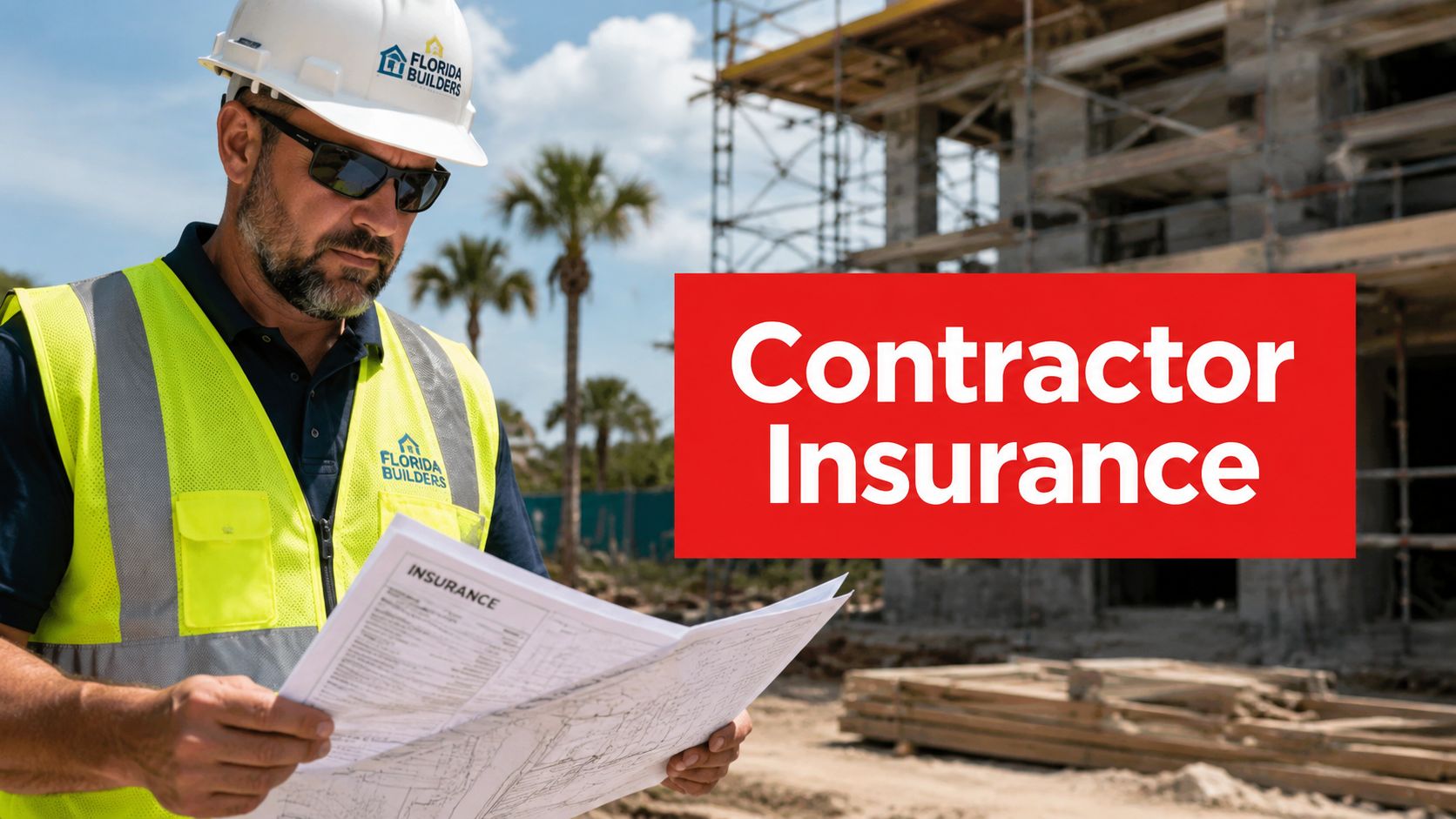

You win the bid, the client wants the job started Monday, and the first thing they ask for is a certificate of insurance. If you don't already have the right policies in force, the schedule slips, the crew sits idle, and a simple paperwork request turns into a real business problem. In Florida, that gap gets dangerous fast because one employee can flip a contractor from optional coverage to mandatory workers' comp under the state's construction rules.
That's the part most owners miss. They think insurance is a renewal task, but for Florida contractors it's a job-readiness requirement, a licensing issue, and a liability control all at once. Get the coverage wrong, and the fallout can run from delayed starts to stop-work orders.
Table of Contents
- Why Florida Contractors Need the Right Insurance Before Starting Work
- Florida Legal Requirements for Contractor Insurance
- Required and Recommended Coverages for Florida Contractors
- What Drives Contractor Insurance Costs in Florida
- How to Get Quotes and Certificates of Insurance
- Risk Management Tips and a Contractor-Ready Checklist
- How Select Insurance Group Helps Florida Contractors Get Covered
Why Florida Contractors Need the Right Insurance Before Starting Work
A contractor closes a deal on a bathroom remodel in Orlando, calls the client back, and gets a simple response, send over the insurance certificate before anyone steps on site. If the policy isn't active, or the certificate doesn't match the contract, the job pauses. That's not theory, that's how Florida construction work gets stuck in the world.
The better move is to treat insurance as part of bid prep, not an afterthought. Contractor insurance Florida buyers need isn't just one policy, it's the package that gets you licensed, allowed on site, and protected when a claim lands. For construction businesses in Florida, workers' compensation is the legal line you can't ignore, and general liability is the coverage clients usually expect to see before they let you start.
The job starts with proof, not promises
If you're a contractor, the customer's question is rarely “Are you insured?” It's “Send the COI.” That certificate request is where missing coverage gets exposed, especially when a general contractor or property manager won't issue a notice to proceed until their file is complete.
Florida also has a long construction-insurance legacy. FCCI traces back to Sarasota in 1959 as the Florida Contractors and Construction Industries Self-Insurance Fund, formed by construction owners who wanted to lower workers' comp costs. That history matters because Florida still treats construction insurance as a core operating requirement, not a side issue. Florida contractor insurance history and FCCI origins
If the certificate is wrong, the job is wrong. Fix the policy first, then bid the work.
That's why I tell contractors to line up coverage before they chase the next job. You don't want your first call after winning a project to be an apology to the client.
Florida Legal Requirements for Contractor Insurance
Florida is stricter on construction than on most other businesses, and the rules are built that way on purpose. Under Florida Statutes § 440.10, any contractor or subcontractor doing public or private construction in the state must secure and maintain workers' compensation for employees, and contractors must verify subcontractor coverage before work begins. The state's coverage threshold for construction is 1 or more employees, while non-construction employers generally trigger mandatory coverage at 4 or more employees, with agricultural employers following separate thresholds of 6 regular employees or 12 seasonal workers. Florida workers' compensation coverage requirements
That one-employee threshold is the hidden trap. A helper on payroll can change your legal status immediately, and that changes how you should quote, staff, and document every job. If you're still operating like coverage is optional after hiring that first field employee, you're already exposed.
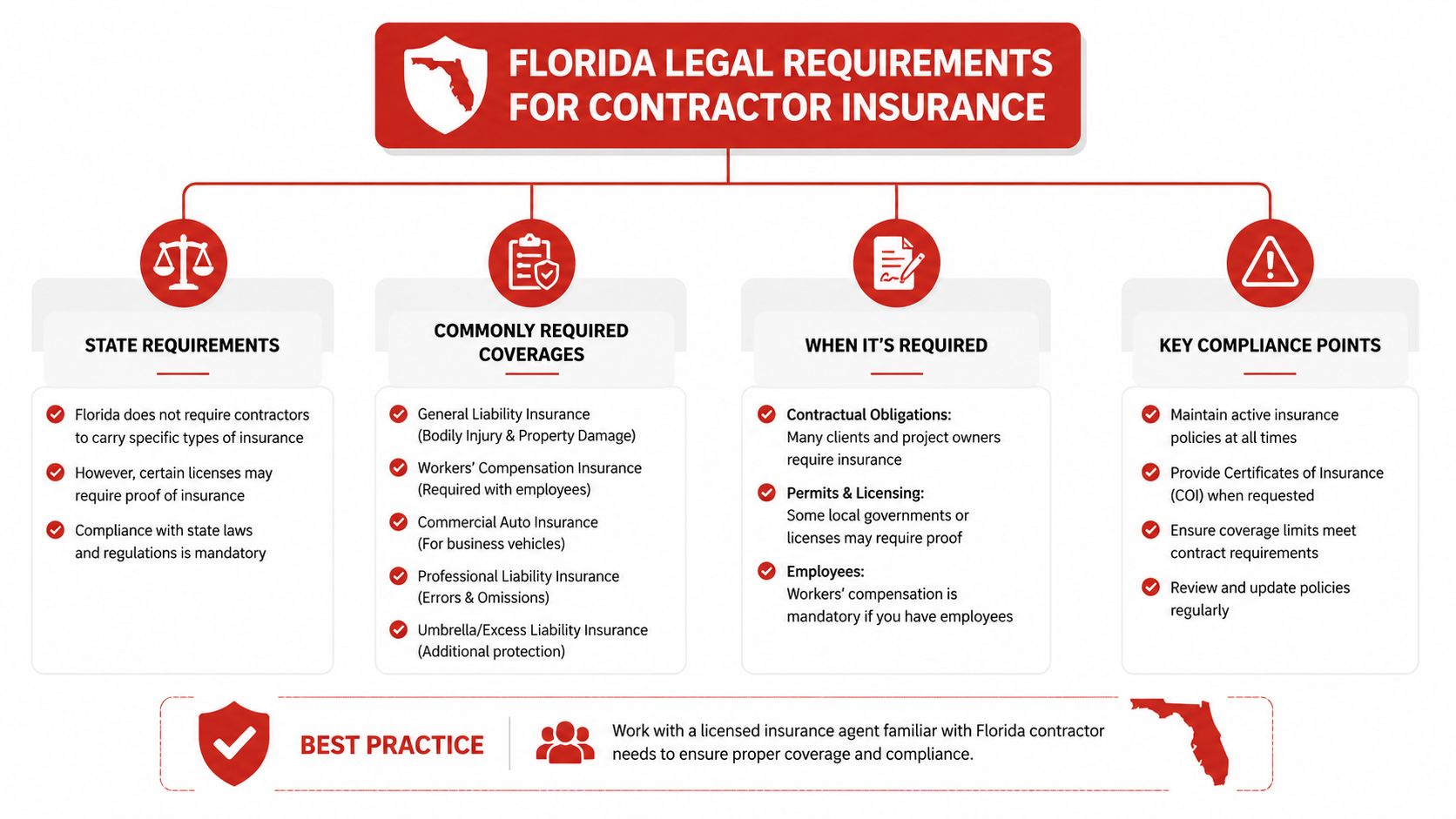
What Florida expects from contractors
Florida's administrative rules push responsibility upward. The contractor has to obtain evidence that subcontractors are insured, which means coverage gaps can travel up the job chain and become your problem. That's not a small detail, it's the difference between a clean file and a liability mess when the audit or claim arrives.
Use this as your baseline:
- Carry workers' comp before field labor starts. If you have employees in construction, you don't get to wait until payroll grows.
- Collect subcontractor proof before they hit the site. Don't rely on verbal assurances or old emails.
- Keep the certificate file organized. Missing records can turn into enforcement trouble fast.
- Expect penalties if you ignore the rule. Florida can issue a stop-work order and financial penalties for noncompliance. Florida workers' compensation coverage requirements
For a contractor trying to get compliant quickly, a practical starting point is workers' compensation insurance in Florida. That's the policy that usually determines whether you can legally keep the crew moving.
Required and Recommended Coverages for Florida Contractors
The right policy stack depends on what you build, how you move equipment, and who you hire. Still, the same core coverages show up again and again for Florida contractors because they solve the same problems, bodily injury, property damage, vehicle loss, stolen tools, and bond requirements that stall licensing or permits.
What each coverage actually does
General liability is the first line of defense for third-party bodily injury and property damage. A dropped tool cracks a tile floor, a customer trips over a cord, or a subcontractor's work causes damage after your crew leaves, that's the kind of claim GL is meant to address. Florida doesn't impose a universal statewide general liability requirement for every contractor, but many contracts and licensing situations still require proof, so in practice it's close to mandatory for getting hired. General liability requirements for Florida contractors
Workers' compensation is different. For construction employers in Florida, it's not optional once you have employees, and the threshold is the one discussed above. If you're paying field labor, this policy needs to be active.
Commercial auto matters any time your business owns, leases, or routinely uses vehicles for work. That includes service trucks, trailers, supply runs, and employee driving that supports the job. A personal auto policy is not built for that exposure.
Tools and equipment coverage, often structured as inland marine, protects portable gear that moves from van to site to shop. Ladders, saws, diagnostic tools, and specialty equipment are easy to lose and expensive to replace.
Surety bonds are not insurance in the same way, but they often sit in the same conversation because licensing and permitting may require them. A bond helps satisfy a contractual or regulatory condition, which is why contractors should check it early, not after the permit is blocked.
Practical rule: buy the policy that matches the job you actually do, not the lowest premium that fits a vague trade label.
| Florida Contractor Insurance Coverage Overview | What It Protects | Required or Recommended | Typical Claim Scenario |
|---|---|---|---|
| General Liability | Third-party injury, property damage, defense costs | Recommended, often required by contract | A client's property is damaged during work |
| Workers' Compensation | Employee injury and wage-related benefits | Required for construction employers with employees | A crew member is hurt on the job |
| Commercial Auto | Business vehicles and work travel exposure | Recommended, often contract-driven | A truck is damaged in a collision during work travel |
| Tools and Equipment | Portable tools, gear, and jobsite equipment | Recommended | Tools are stolen from a van or jobsite |
| Surety Bond | Contract or licensing obligations | Often required for permits or licensing | A permit or contract requires bonding proof |
If you want a broader shopping framework, this contractor insurance guide helps you compare what matters before you bind coverage.
What Drives Contractor Insurance Costs in Florida
Florida contractor pricing starts with payroll and classification, not a generic company profile. For workers' compensation, premium is tied to classification codes per $100 of payroll, so the trade mix matters as much as the total payroll number. A crew with mostly plumbing work is priced differently than a crew doing carpentry or framing, because the carrier is rating the work being performed, not just the headcount. Florida contractor workers' compensation rate examples
The 2026 Florida examples are clear. Rates are roughly $2.74 for plumbing, $2.97 for electrical wiring, $3.00 for HVAC, $4.48 for painting, $5.22 for masonry, and $7.69 for carpentry/framing. That spread tells you everything you need to know about why a quote can jump when labor shifts from one trade bucket to another. Florida contractor workers' compensation rate examples
Why the quote changes when your crews change
If you move a worker from low-risk service plumbing into framing work, the carrier sees a different injury profile and a different premium base. The same is true when your payroll mix changes across residential repair, new construction, or heavier trade work. That's why sloppy job coding can cost you more than an accurate quote ever would.
Other cost drivers still matter, even when the workers' comp side is the biggest swing factor:
- Claims history. Prior losses usually make underwriters pay attention.
- Total payroll. More payroll generally means more exposure.
- Employee count. More hands on site means more ways for a loss to happen.
- Experience modification rate. Carriers use this where it applies to judge loss performance.
The cheapest quote is usually the one that misclassifies your labor. The expensive quote is often the one that finally prices the business correctly.
For a contractor trying to reduce cost without cutting protection, accuracy is the lever. Clean payroll reporting, honest class codes, and a real description of the work do more than any gimmick ever will.
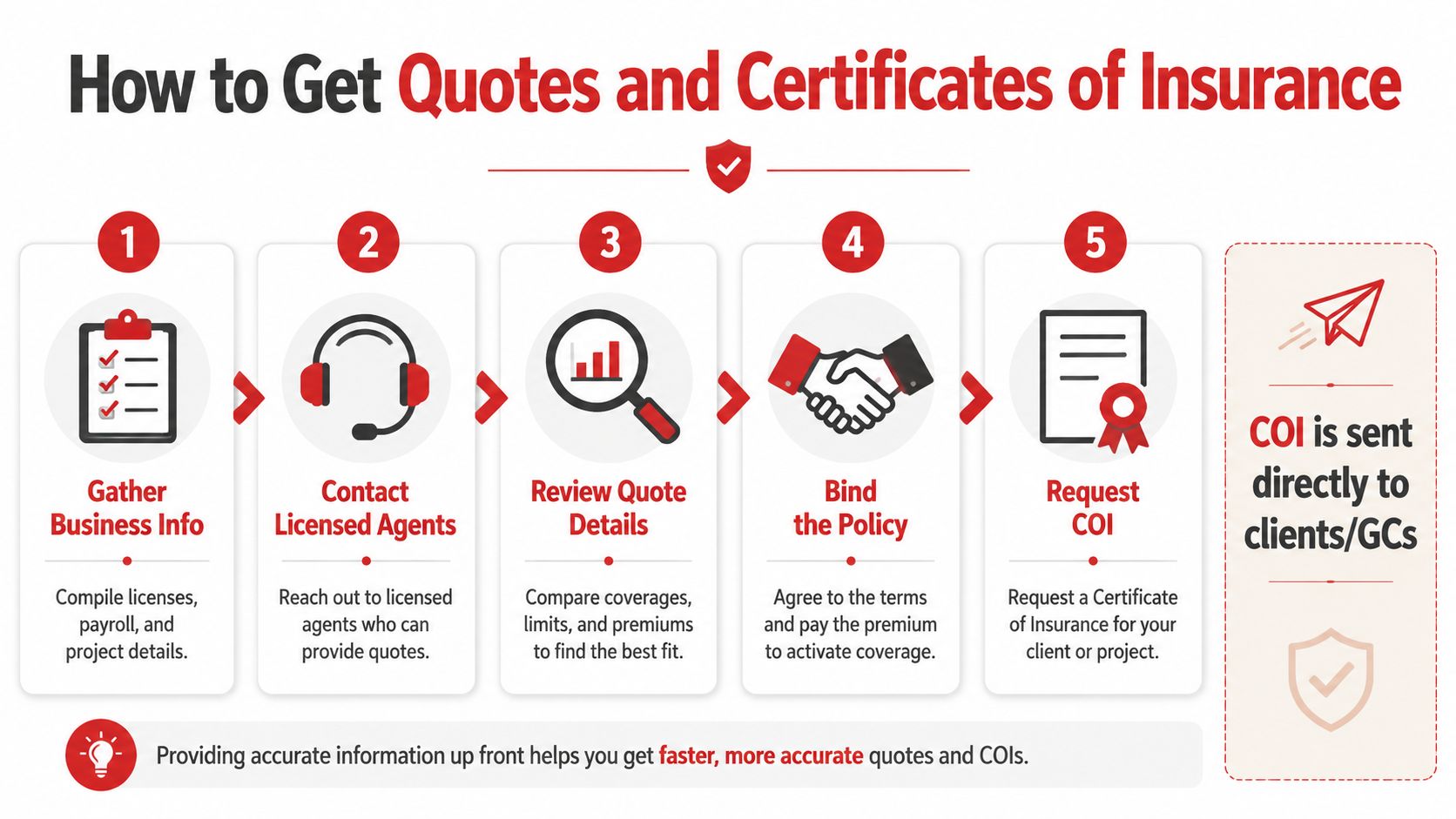
How to Get Quotes and Certificates of Insurance
The fastest way to slow a job down is to ask for a quote without the right paperwork. If you want a serious Florida contractor quote, gather the business facts first, then let the policy be built around reality instead of guesswork.
Quote prep that saves time
Start with the details carriers use to price the risk. That means payroll by trade, a clear description of the work, vehicle information, equipment values, claims history, and any subcontractor files you already keep. The more precise the intake, the less back-and-forth you'll get when the job is waiting on proof.
A good process looks like this:
- Gather business info. Compile licenses, payroll, vehicles, equipment, and project details.
- Contact licensed agents. Ask for a real comparison, not a single rushed quote.
- Review quote details. Check class codes, exclusions, and certificate wording.
- Bind the policy. Make sure the coverage is active before work starts.
- Request the COI. The certificate should go directly to the client or general contractor.
A contractor who wants speed and clean paperwork can use free insurance quotes in Florida as a starting point, but the quote is only as good as the information that goes in.
What a COI does, and what it doesn't
A certificate of insurance proves the policy exists on a specific date. It doesn't rewrite exclusions, add endorsements by itself, or fix a contract that asked for coverage you never bought. That's where contractors get burned, because a client may think the certificate means everything is in place when the actual policy says otherwise.
Keep the certificate file current. If your policy renews, your subcontractors change, or the client asks for a different named additional insured, update the paperwork right away. A responsive agent matters here because a delayed COI can hold up mobilization, payment, or access to the jobsite.
Risk Management Tips and a Contractor-Ready Checklist
Insurance gets cheaper to manage when the business gets harder to hurt. That means fewer unsafe habits, tighter subcontractor controls, and better documentation when something goes wrong. Florida contractors don't need more theory, they need a system.
Build the file before the job starts
The biggest avoidable mistake is letting subs onto a project without proof. Every subcontractor should have current insurance evidence before they step on site, and that record should stay with the job file. If you want a deeper process for repeatable controls, contractor safety management system 2026 is a useful reference point for structuring safety oversight alongside insurance paperwork.
Use this checklist every time:
- Verify subcontractor coverage first. No COI, no site access.
- Document site conditions. Photos and notes help when a dispute starts.
- Keep equipment logs current. Missing tools are easier to track when inventory is real.
- Run short safety talks. Daily reminders beat a long apology after an injury.
- Review policies before renewal. Catch scope changes before the carrier does.
Keep the business ready all year
The owners who stay out of trouble usually do the boring things well. They keep employee training records, maintain a written safety program, and store insurance certificates where someone can find them quickly. They also check whether new work, new vehicles, or new labor patterns have changed the policy needs.
Contractor-ready rule: if you can't prove it on paper, don't assume it's covered.
That discipline matters because compliance failures don't stay local. A missing subcontractor file can become your problem at audit time, and a weak safety habit can turn a small incident into a claim that affects future pricing.
How Select Insurance Group Helps Florida Contractors Get Covered
Florida contractors need fast quoting, clear certificate handling, and someone who understands construction paperwork without making it a guessing game. Select Insurance Group, Inc. compares instant quotes from 20 to 40 leading carriers, which saves time when you need to line up general liability, workers' compensation, commercial auto, or another policy tied to a job requirement. The agency also supports contractors through phone, text, document upload, payments, policy updates, and claim support, which matters when a project moves faster than your inbox.
That local access is practical, not flashy. The agency's bilingual specialists and long operating history fit contractors who want straight answers and a quick turnaround instead of a call-center script. If you're also working on outreach, vendor lists, or tenant mix for Florida properties, local homeowner mailings for insurance can be one piece of a broader lead strategy, but the first priority is still getting the policy right.
For contractors, the right insurance partner should do one thing well, remove friction between the job request and the proof of coverage. Select Insurance Group does that by comparing options, handling the paperwork, and keeping the file moving so you can stay on site and keep billing.
If you need contractor insurance in Florida, get the coverage lined up before the next job starts. Select Insurance Group, Inc. can compare quotes, issue the certificates your clients ask for, and help you make sure one employee, one subcontractor, or one new project doesn't create a coverage gap you didn't plan for.