
You've just received a notice saying your Florida driver's license is suspended until you provide proof of financial responsibility. Your car is parked, your commute is suddenly uncertain, and you're trying to understand why an insurance form could determine whether you can work, take your children where they need to go, or handle basic errands. The first surprise is that SR-22 insurance isn't an insurance policy. It's a filing connected to a policy, and the filing fee is usually the least expensive part of the problem.
Florida drivers often search for “sr22 insurance florida” after a lapse in coverage, an uninsured crash, or another serious financial responsibility issue. The practical priorities are simple: identify whether you need an SR-22 or FR-44, obtain the correct policy, file the certificate, and keep coverage active without interruption.
Table of Contents
- Why Florida Drivers Need an SR-22 Filing
- What SR-22 Insurance Actually Means in Florida
- Violations and Situations That Trigger an SR-22 Requirement
- How to Obtain and File Your SR-22 in Florida
- The Cost of SR-22 Compliance in Florida
- Finding Affordable SR-22 Coverage Through Independent Agents
- Maintaining Compliance and Planning Your Next Steps
Why Florida Drivers Need an SR-22 Filing
A Florida driver may discover the requirement through a suspension notice, a court document, or a reinstatement instruction from the Florida Department of Highway Safety and Motor Vehicles. The notice can feel confusing because it may not explain the difference between a filing and a policy. It may state that driving privileges won't return until proof of financial responsibility reaches the state.
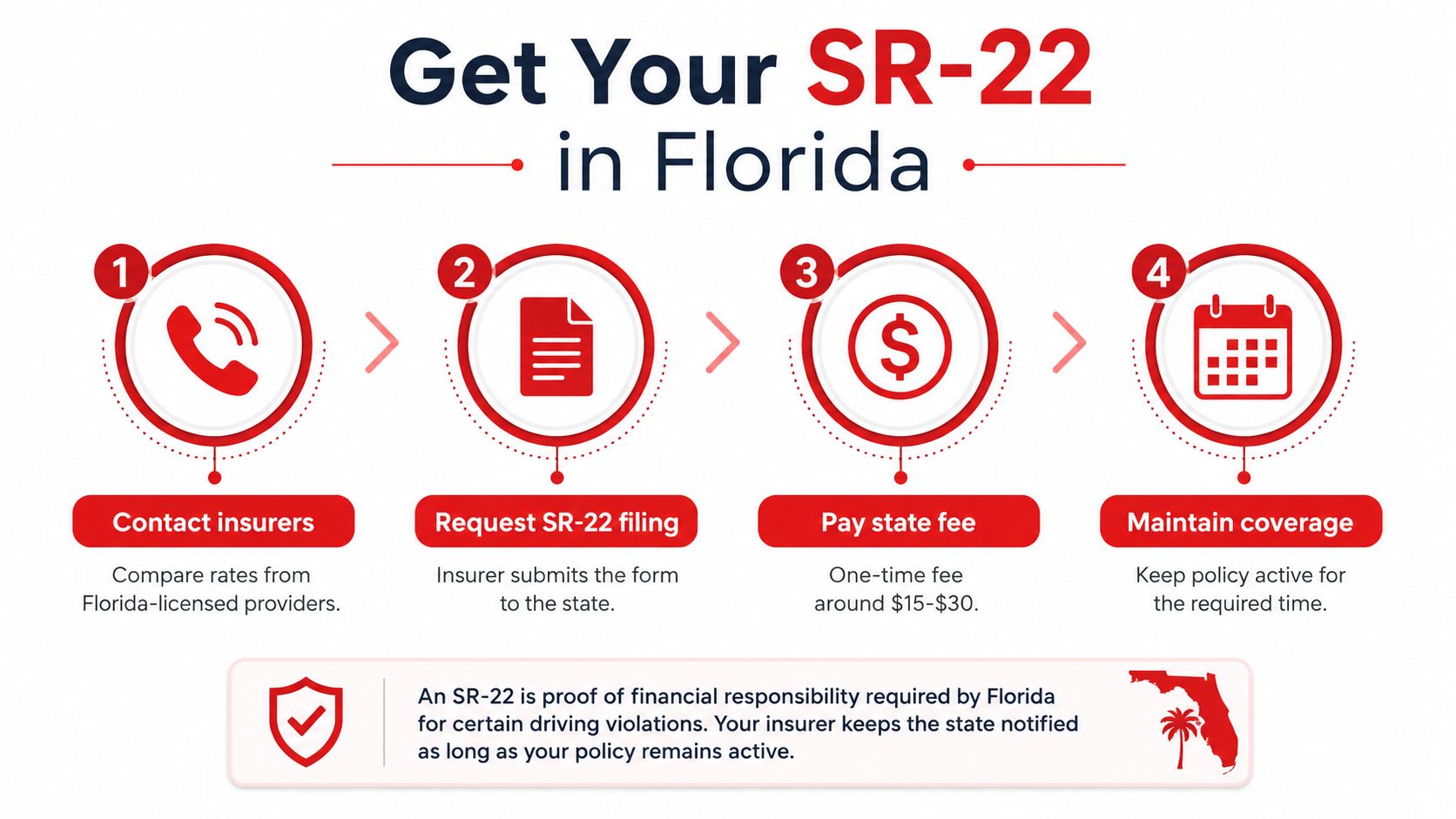
Florida uses an SR-22 as an ongoing compliance mechanism. The insurer files the certificate, and the state can monitor whether the required coverage stays active. If the insurer cancels the policy, the carrier can send an SR-26 notice to the state, which is why an SR-22 isn't a document you obtain once and forget.
The immediate stakes
For many people, driving is tied directly to earning income and managing family responsibilities. A suspended license can affect a job that requires a commute, a parent's ability to get children to school or appointments, and access to everyday necessities. Driving during a suspension can create additional legal and insurance complications, so the safest response is to stop driving until the state confirms that your privileges are restored.
The SR-22 itself isn't an extra punishment. It's Florida's proof-of-coverage requirement for certain high-risk, non-DUI situations. The underlying violation, suspension, judgment, or lapse is what affects your underwriting profile and may raise the premium.
Get the paperwork moving
Start by reading the state notice carefully. Look for the reason for suspension, the required filing type, the reinstatement instructions, and any other obligations listed. If the notice is unclear, contact the state or an insurance professional before buying coverage. Ordering the wrong filing can delay reinstatement.
A traffic course may also be useful after a qualifying violation, although it won't replace the filing when the state requires one. Drivers looking for broader strategies can review how traffic school lowers premiums while they work through the reinstatement process.
Practical rule: Don't buy a policy based only on the phrase “SR-22 insurance.” Confirm the exact filing Florida requires and the date your compliance period begins.
What SR-22 Insurance Actually Means in Florida
An SR-22 is a certificate of financial responsibility, not a standalone insurance product. You purchase an auto policy that meets the required liability limits, then ask the insurer to file the SR-22 with Florida on your behalf. The certificate tells the state that the policy is in force and satisfies the applicable financial responsibility requirement.
The filing is connected to your policy, so the insurer has an ongoing role. If coverage ends, the carrier's notice to the state can put your license at risk. That relationship makes the choice of insurer important. A low initial quote isn't useful if the carrier can't file correctly or won't maintain the required reporting.
The SR-22 coverage limits
Florida's SR-22-related minimum liability limits are $10,000 for bodily injury to one person, $20,000 for bodily injury in one crash, and $10,000 for property damage. These are commonly expressed as 10/20/10, and the Florida Highway Safety and Motor Vehicles insurance guidance describes the SR-22 as part of the state's financial responsibility framework. You can review the state's explanation of insurance filings through the Florida insurance requirements guidance.
These limits represent the minimum structure tied to the filing. They don't automatically cover damage to your own vehicle, and they may not provide enough protection for every driver's assets or exposure. Your agent should explain liability, collision, and any other coverage separately instead of treating the SR-22 as complete insurance protection.
SR-22 and FR-44 aren't interchangeable
Florida changed its treatment of DUI-related filings on October 1, 2007. DUI convictions under Florida Statute 316.193 began requiring an FR-44 instead of an SR-22, and the state standardized FR-44 implementation for reinstatement effective February 15, 2008. Florida's administrative guidance identifies SR-22 as the reinstatement filing for bodily injury and property damage liability in financial responsibility cases, while DUI-related reinstatement follows the FR-44 track.
The FR-44 limits are substantially higher: $100,000 bodily injury per person, $300,000 bodily injury per crash, and $50,000 property damage, maintained for three years. The state's implementation distinction is outlined in this Florida FR-44 statutory guidance.
| Filing | Bodily injury per person | Bodily injury per crash | Property damage | Typical trigger | Duration |
|---|---|---|---|---|---|
| SR-22 | $10,000 | $20,000 | $10,000 | Non-DUI financial responsibility event | Generally three years |
| FR-44 | $100,000 | $300,000 | $50,000 | Florida DUI-related reinstatement | Three years |
If your suspension followed a DUI, don't assume an SR-22 will satisfy the state. Ask the insurer or agent to verify the filing requirement before the policy is issued.
Violations and Situations That Trigger an SR-22 Requirement
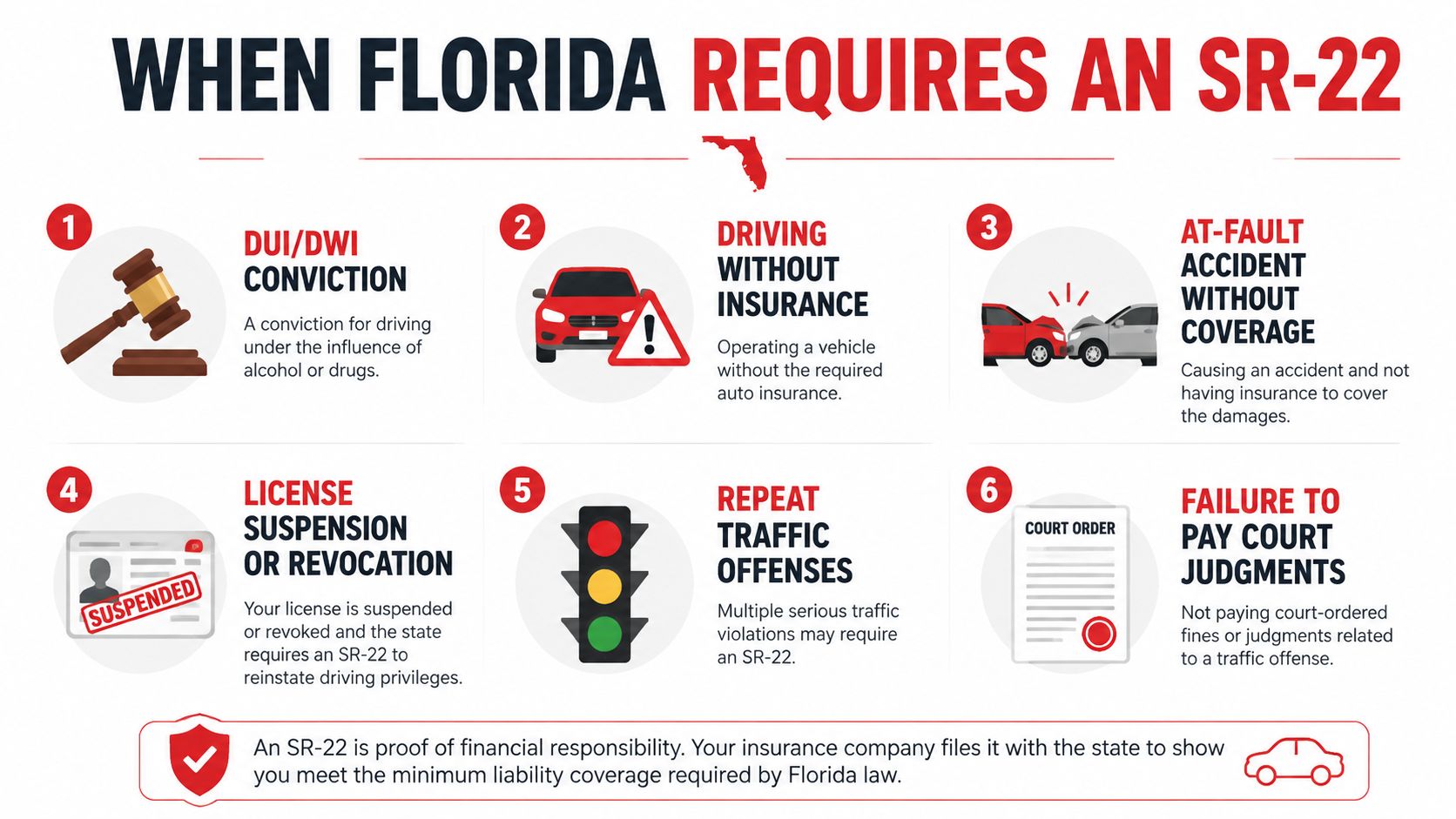
Florida generally associates SR-22 filings with non-DUI financial responsibility events. The state's insurance materials identify the filing as a tool for certifying required liability coverage when a driver needs reinstatement after a qualifying problem.
Common situations include:
- Coverage lapse: You were required to carry insurance, but the policy ended or wasn't active when the state or another authority required proof.
- Uninsured crash: You were involved in a crash without the required coverage, creating a financial responsibility problem.
- Unsatisfied judgment: A court judgment connected to an accident remains unpaid, and the state requires proof of future financial responsibility.
- Habitual traffic offender revocation: A revocation tied to repeated serious driving violations may require an SR-22 before reinstatement.
- Other non-DUI suspension events: The state or court may require the filing as a condition of restoring driving privileges after a qualifying violation.
The exact trigger matters because it tells the agent what to file and helps determine what documents the state may need. Gather the suspension notice, court paperwork, current license information, vehicle details, and any reinstatement instructions before requesting a quote.
The DUI distinction is decisive
A DUI case after the Florida filing change generally calls for an FR-44, not an SR-22. That distinction isn't cosmetic. FR-44 carries the higher 100/300/50 liability structure described above, and an insurer must file proof of that larger coverage obligation before the state restores driving privileges.
Alcohol-related facts can also appear alongside other violations, which makes assumptions dangerous. If your notice references DUI, ask specifically whether Florida requires FR-44. If it references an uninsured crash, lapse, judgment, or habitual traffic offender matter without a DUI requirement, ask whether SR-22 is the applicable filing.
Don't diagnose the requirement from a search result
Online explanations often use “SR-22 insurance” as a broad phrase for high-risk coverage. That phrase can mislead Florida drivers, especially after a DUI. Use the state notice as the starting point, then have the insurer match the filing to the reinstatement requirement.
How to Obtain and File Your SR-22 in Florida
The process is manageable when you handle it in the right order. Start with the state requirement, not with a random insurance quote. Tell every agent immediately that you need a Florida SR-22 filing, because not every insurer writes these risks or submits this certificate.
Follow the filing sequence
Confirm the filing type. Read the notice and determine whether it calls for SR-22 or FR-44. If the reason is unclear, verify it with the state or an experienced agent.
Contact a Florida-licensed insurer or independent agent. Provide your full name, date of birth, driver's license information, vehicle details, address, violation information, and reinstatement notice. Accurate disclosure prevents a quote from changing after underwriting.
Choose the policy. The policy must meet the required liability limits. If you own a vehicle, discuss the vehicles that need coverage. If you don't own one, ask whether a non-owner policy can satisfy your situation.
Request the SR-22 filing. The insurer attaches the certificate to the policy and submits it to the state. Ask how the carrier files, what confirmation you'll receive, and whether any state or processing fee applies.
Verify acceptance. Keep the policy declarations, filing confirmation, payment receipt, and reinstatement instructions. Don't assume your license is valid until the state reflects the filing and confirms reinstatement.
Protect the effective date. If you're replacing an existing policy, start the new policy and filing before cancelling the old one. That timing prevents a gap that could produce a cancellation notice and another suspension.
Switching carriers? Have the new carrier file first, then coordinate cancellation of the old policy. Never cancel first because the replacement quote looks cheaper.
Drivers who need more context around the broader process of getting back on the road after a suspension can consult a legal resource, especially when court obligations and insurance filings overlap.
For drivers without a vehicle, review the practical considerations in getting SR-22 insurance without a car. A non-owner arrangement can be different from a policy covering an owned vehicle, so the agent must match the policy to your actual driving situation.
Keep a paper trail
Save every document in one folder, including the state notice, declarations page, filing confirmation, payment records, and correspondence with the insurer. If the state record doesn't update as expected, those documents give the agent and the state something concrete to review.
The Cost of SR-22 Compliance in Florida
A driver may pay only a modest filing fee and still face a much larger insurance bill. The filing charge is often roughly $15 to $25, according to this Florida SR-22 cost explanation. That one-time administrative cost is rarely the main financial burden.
The recurring premium drives the expense. Insurers consider the violation, suspension history, claims history, vehicle, location, coverage choices, and their own underwriting rules. An SR-22 does not create the risk classification. It documents the financial responsibility requirement that follows a serious event.
Where the money goes
The cost breaks into three components:
- Filing charge: An administrative fee for submitting the certificate.
- Policy premium: The recurring insurance price, which may rise because of the underlying violation or financial responsibility issue.
- Lapse exposure: The cost of another suspension, reinstatement work, and a longer compliance period if coverage ends.
Florida guidance indicates that drivers generally need continuous SR-22 coverage for three years from the designated suspension or reinstatement date. A lapse can trigger another reinstatement cycle or reset the compliance period. The Florida crash and insurance guidance explains why active coverage must remain in place after a financial responsibility event.
Budget for the policy, not just the certificate. Compare the total premium, payment schedule, coverage limits, cancellation rules, and the insurer's ability to keep the filing active. A cheap initial quote can become expensive if missed payments cause cancellation and another suspension.
SR-22 versus FR-44 economics
FR-44 coverage usually costs more because it requires the higher 100/300/50 liability structure and is associated with DUI-related underwriting. SR-22-related coverage uses the 10/20/10 benchmark, although the underlying violation can still make the policy expensive.
Ask the agent to separate the filing charge from the premium before accepting a quote. Also ask how long the violation may affect pricing. This guide on how long traffic tickets affect insurance provides additional context for that ongoing premium impact.
Finding Affordable SR-22 Coverage Through Independent Agents
The most effective cost strategy is to compare insurers, not just policies. A captive representative may have access to one company's pricing, while an independent agency can request quotes from multiple Florida-licensed carriers. That matters because high-risk underwriting varies sharply between insurers.
Select Insurance Group, Inc. is one agency that compares quotes from 20 to 40 carriers, according to the publisher information provided for this guide. Its Florida auto insurance service includes support for drivers who need SR-22 filings, and its bilingual specialists can explain the process in English or Spanish.
Build a better quote request
Give every agent the same information so the comparison is meaningful. Include the filing type, reason for the requirement, effective date, vehicle, garaging address, desired liability limits, and whether you need owner or non-owner coverage.
Ask these questions directly:
- Can you file the required certificate? Confirm SR-22 or FR-44 capability before discussing price.
- What is the total recurring premium? Separate the administrative filing charge from the policy cost.
- What happens if I pay late? Understand cancellation timing and reinstatement procedures.
- Can you quote higher limits? The minimum may satisfy the state but may not fit your financial exposure.
- Do you offer payment options? Compare the total cost of paying in full with installment arrangements.
- Can you help replace a policy without a gap? This is essential during a carrier switch.
Use every legitimate cost lever
Bundling auto insurance with renters or homeowners coverage may create a multi-policy discount when the insurer offers one. A clean driving record during the compliance period can also improve future underwriting, although the underlying violation may continue affecting pricing until it ages.
Paying in full may be less expensive than installments with some carriers, but don't choose that option if it would make the policy harder to keep active. The cheapest quote is the one you can maintain continuously, not the one with the lowest first payment.
For help evaluating the role of a comparison-based agency, see this guide to an independent insurance agent in Florida. Ask for written coverage details and filing confirmation rather than relying on a verbal estimate.
Maintaining Compliance and Planning Your Next Steps
Once the SR-22 is filed, your main job is continuity. Set up automatic payments if they're reliable for your account, keep the payment method current, and monitor renewal notices. A policy can cancel when a payment fails, even if the driver believes the coverage is still active.
Florida's filing system allows the carrier to report cancellation through an SR-26 notice. That can lead to another license suspension and may restart or extend the required compliance period. Don't wait for a state notice if you know a payment, vehicle change, or move could affect the policy.
Use a simple maintenance checklist
- Confirm the effective date: Keep proof that the policy and filing began.
- Track renewal dates: Put reminders on your calendar before each payment or renewal.
- Report changes promptly: Tell the insurer about a new address, vehicle, or licence status.
- Coordinate cancellations: Replacement coverage must be active before the old policy ends.
- Ask before removing the filing: Don't assume the requirement has ended because the policy has renewed.
When the required period is complete, ask the state or your agent whether the SR-22 can be removed. The filing may not disappear because you believe the period has ended. After removal, request a fresh quote based on your current record and coverage needs.
If the requirement appears incorrect, gather the suspension notice, court records, filing confirmation, and driving record. Contact the Florida Highway Safety and Motor Vehicles administrative office identified in your notice, and ask the agency or an attorney about the appropriate review or appeal channel.
Your next step should be concrete: verify the filing type today, request comparable quotes from multiple Florida-licensed insurers, and refuse to cancel any existing policy until replacement coverage and filing confirmation are secured.
Select Insurance Group, Inc. helps Florida drivers compare auto coverage and arrange SR-22 filings through multiple carriers, with bilingual guidance available for customers who prefer Spanish. Visit Select Insurance Group, Inc. to request a free, no-obligation quote and get practical help keeping your coverage active throughout the compliance period.