
South Carolina's average homeowners premium reached about 4,172 in 2025, up from about 4,017 in 2024, so the right question isn't just how to find a cheaper policy. You need to decide how much it would cost to rebuild, how much you can absorb through a hurricane deductible, and whether flood coverage is carried separately.
That average is a statewide reference point, not a quote for your address. A coastal home, an older roof, a historic structure, and a property with limited wind coverage can all produce a very different result. The practical decisions are straightforward: set the dwelling limit from reconstruction needs, choose the deductible in actual dollars, then check whether rising water and storm surge are excluded from the policy you're buying.
South Carolina's market has been repricing for years. Statewide homeowners premiums increased 43.6% from 2010 to 2021, compared with a 55.2% national increase, and the state's premiums moved from being 10% to 12% above the U.S. average in 2010 to 2015 to about 1.5% above it in the more recent period. Those figures point to a market that's expensive for real reasons, not a temporary billing error. The South Carolina Department of Insurance presentation connects the pressure to catastrophe exposure, repair costs, and claims severity.
Table of Contents
- What Home Insurance in South Carolina Covers
- How South Carolina Premiums Are Set and What Drives Your Quote
- Coverages, Deductibles, and Endorsements Worth Choosing on Purpose
- Common Misconceptions That Leave SC Homeowners Underinsured
- Filing a Home Insurance Claim in South Carolina
- Discounts and Savings You Can Stack on One Policy
- Your Next Steps and How to Get Fast Local Quotes
What Home Insurance in South Carolina Covers
A standard homeowners policy protects three financial areas: the house, the belongings inside it, and your responsibility for covered injuries or property damage to others. It is not a maintenance contract, and it does not cover every type of water or weather loss.
The statewide average is only a market reference. Policy adequacy depends on your dwelling limit, deductible, roof terms, and flood protection. A lower premium may reflect less coverage, a higher out-of-pocket cost, restricted roof payment, or no protection for rising water.
The basic HO-3 structure
Most homeowners begin with an HO-3 policy, which divides protection into several coverage parts:
- Dwelling coverage pays to repair or rebuild the insured home after a covered cause of loss. Set the limit from reconstruction cost, not the sale price, tax assessment, or land value.
- Other structures coverage applies to detached garages, sheds, fences, and similar property, subject to policy limits and exclusions.
- Personal property coverage protects furniture, clothing, appliances, and other belongings after covered damage. Jewelry and other valuables may require scheduled coverage.
- Loss of use coverage can help pay additional living expenses when a covered loss makes the home uninhabitable.
- Personal liability coverage addresses covered claims alleging that you caused bodily injury or property damage to someone else.
- Medical payments to others can cover limited medical expenses for a guest injured on the property, even when you are not legally liable, subject to the policy terms.
A falling tree shows why claim details matter. Photograph the scene, prevent further damage, and keep repair receipts before removing damaged limbs or starting work. Use this guide to organize your claim steps after tree damage.
What the standard policy leaves out
Flood creates the most damaging coverage misunderstanding. The South Carolina Department of Insurance says most homeowner and fire policies with extended coverage don't cover flood damage or losses from rising water. Water entering from outside the structure can remain excluded even when hurricane conditions caused it. The department's flood and homeowners FAQ explains the boundary between a covered plumbing or weather loss and excluded rising water.
| Coverage part | What it pays for | South Carolina-specific note |
|---|---|---|
| Dwelling | Covered damage to the house | Use reconstruction cost, not market value |
| Other structures | Covered damage to detached structures | Check fences, docks, and outbuildings carefully |
| Personal property | Covered losses to belongings | Flood damage generally isn't included |
| Loss of use | Additional living expenses after a covered loss | Applies only when the underlying loss is covered |
| Liability | Covered claims involving injury or property damage | It doesn't replace an umbrella or business policy |
| Medical payments | Limited medical expenses for injured guests | Policy limits and conditions apply |
| Flood | Usually excluded from standard homeowners coverage | Rising water requires separate flood insurance |
| Wear and earth movement | Maintenance issues and excluded earth movement events | Aging roofs and settling aren't automatically insured |
Roof material, square footage, framing, elevation, construction class, and updates affect the replacement-cost calculation. Roof coverage also deserves a close reading, especially for coastal properties and older homes. A declaration page showing a large dollar limit does not prove the limit is adequate.
Have the dwelling estimate reviewed before shopping for price. A low premium paired with an insufficient limit can leave you paying the difference after a total loss. Check the deductible in dollars, confirm the roof settlement terms, and determine whether flood protection is separate before you bind the policy.
How South Carolina Premiums Are Set and What Drives Your Quote
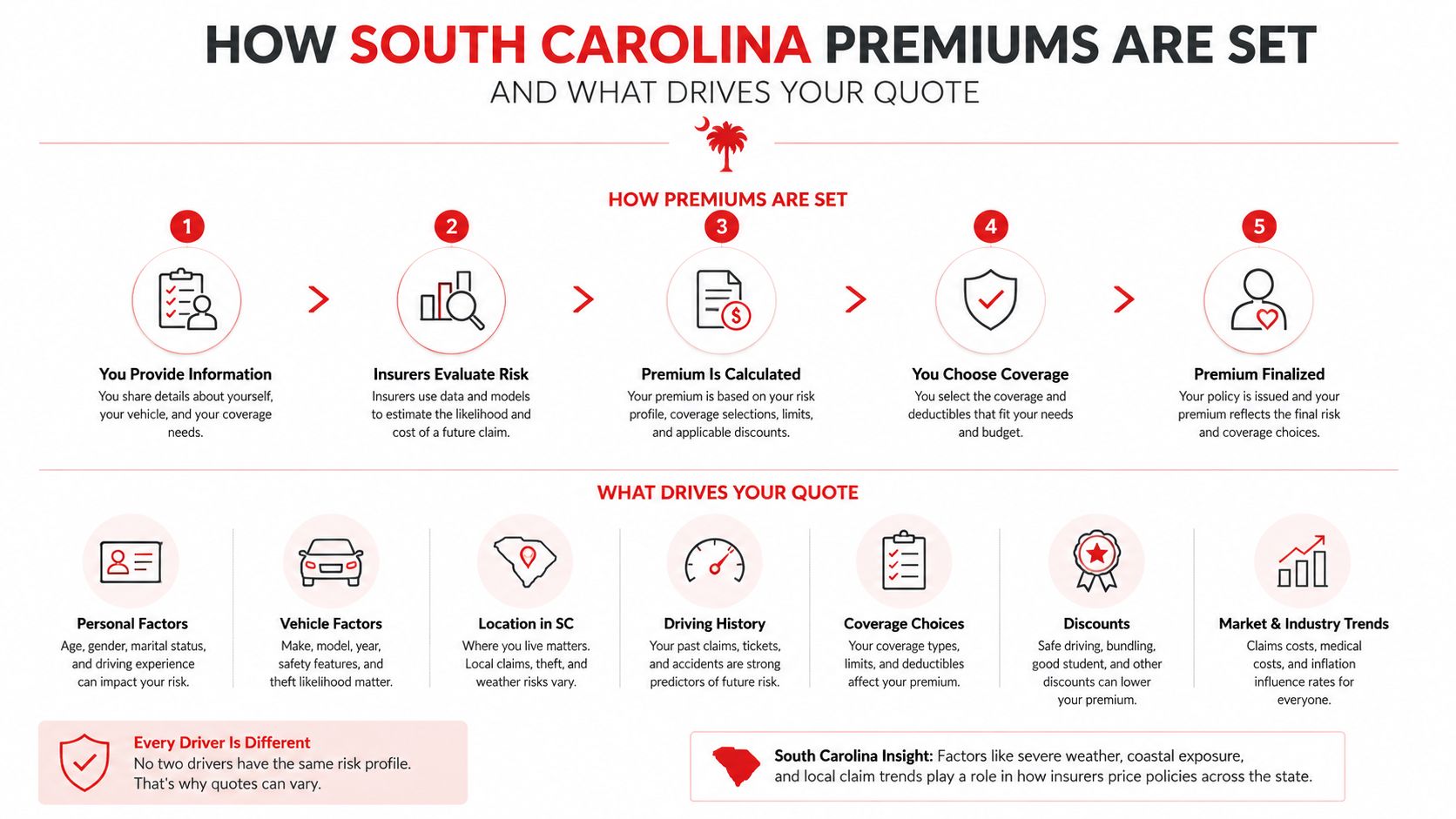
The state's recent underwriting results explain why carriers are tightening terms. The homeowners combined ratio reached 143.9% in 2024, after readings of 78.5% in 2021, 94.8% in 2022, and 88.2% in 2023. In plain language, insurers paid about 1.44 in claims and expenses for every 1.00 collected in premium during 2024. Industry comments presented to South Carolina lawmakers.%20Matt%20Overturf%20and%20Gina%20Rotunno.pdf) show how sharply the market moved from relatively favorable underwriting to major losses.
The same environment accompanied the rise from about 4,017 in 2024 to 4,172 in 2025, with a reported 4% year-over-year increase. Your quote reflects the carrier's view of future risk, not just your personal claims history.
Four quote levers that matter
Coastal exposure comes first. A property near the coast faces a different wind and hurricane profile from a similar home farther inland. Wind-pool eligibility, distance from exposed water, storm vulnerability, and local construction characteristics can change both price and availability.
The roof has an outsized effect. Insurers look at age, material, installation quality, and condition. A newer metal roof and an aging shingle roof don't present the same expected loss, even when the homes have similar square footage. Older roofs may also receive less favorable settlement terms.
The wind-and-hail market affects availability. The state's coastal wind-and-hail pool reported a 6% year-over-year decline in policy count and a 346 million drop in exposure in 2025, while also filing for higher dwelling and mobile-home rates. The 2025 coastal property report shows why homeowners may face fewer standard-market options.
Reinsurance and catastrophe filings push coastal pricing. The Department of Insurance reported that a 20% dwelling rate increase and a 25% mobile-home increase took effect on June 1, 2024, and both remained below actuarial indication. The department's coastal property market report provides the relevant state-market context.
My recommendation: Don't use the cheapest online quote as your baseline. Compare the same dwelling limit, roof settlement method, wind treatment, flood treatment, and deductible before you call one policy cheaper.
Homeowners who move between states or maintain property in several regions can also review multi-state insurance agency support when coordinating policies. The important point is that a quote is built from property-specific underwriting, not a statewide average.
Coverages, Deductibles, and Endorsements Worth Choosing on Purpose
Coverage form comes before price. Named-peril policies such as HO-1 and HO-2 respond only to causes of loss listed in the contract. An open-peril dwelling form such as HO-3 generally starts from broader protection for the structure, while exclusions still apply and personal property may be handled differently.
The deductible deserves more attention than most homeowners give it. South Carolina policies commonly use percentage-based hurricane, named-storm, or wind-and-hail deductibles, and state rules require the trigger and an example calculation to be clearly disclosed. South Carolina Regulation R. 69-56 sets out that disclosure structure.
Turn the percentage into a household decision
On a 400,000 dwelling limit, a 2% deductible equals 8,000, while a 5% deductible equals 20,000. Those are not abstract percentages. They're the checks or available cash you need after a qualifying storm before the insurer begins paying.
Choose the deductible you could fund without using retirement money, high-cost credit, or selling property. A lower premium isn't a savings if the deductible makes a realistic claim unaffordable. Ask whether the trigger is a named storm, hurricane, wind, hail, or another defined event, because the wording controls when the percentage applies.
Roof settlement can change the claim
Replacement cost generally aims to pay the cost to repair or replace with comparable materials, subject to conditions and policy limits. Actual cash value, by contrast, subtracts depreciation for age and condition. On an older roof, that deduction can leave a homeowner with a large gap between the contractor's invoice and the claim payment.
Read the roof endorsement, roof schedule, cosmetic-damage language, matching provisions, and wind exclusions. A useful companion resource on how to read your policy can help you identify the declarations, exclusions, conditions, and endorsements that control a claim.
Add endorsements for known weak spots
Older homes in Charleston, Beaufort, and Myrtle Beach may need a code-upgrade endorsement. If rebuilding requires current wind straps, electrical work, plumbing changes, or other code compliance, the base limit may not be enough without the right extension.
Water-backup and equipment-breakdown endorsements also deserve a deliberate review. They address risks that a basic policy may restrict or exclude, including backup through drains or failures of covered household systems. For coastal properties, homeowners can also review coastal home insurance in Charleston before accepting a standard quote.
Write your deductible choices on paper before requesting quotes. That prevents an agent or online form from making the most important out-of-pocket decision for you.
Common Misconceptions That Leave SC Homeowners Underinsured
Three assumptions create the worst surprises in South Carolina. A standard homeowners policy doesn't automatically cover flood, a hurricane deductible isn't necessarily a small flat amount, and a home's market value doesn't equal its reconstruction cost.
Flood isn't the same as interior water
The Department of Insurance says most homeowner and fire policies with extended coverage don't cover flood damage or losses from rising water. Storm surge and water that enters from outside the building are treated differently from a burst interior pipe. If rising water damages the kitchen, cabinets, flooring, and electrical systems, the homeowners policy can still deny the loss because of the source.
Buy separate flood coverage before you need it. South Carolina regulators note that many flood policies carry a 30-day waiting period, and they advise purchasing coverage before hurricane season begins. That timing matters because a policy bought after a storm warning may not protect the property for the event you're already watching.
Percentage deductibles are real cash
On a 400,000 dwelling limit, a 2% hurricane deductible is 8,000, while 5% is 20,000. The insurer doesn't pay the first dollar until the applicable deductible is satisfied, so compare deductibles by the amount you could produce.
Don't assume the highest percentage is acceptable because it lowers the premium. Ask for the dollar amount beside every percentage and confirm the trigger in writing.
Market value doesn't rebuild a coastal home
Market value includes land, location, demand, and neighborhood conditions. Reconstruction cost reflects labor, debris removal, materials, contractor availability, permits, and required upgrades. Coastal rebuilding may also involve wind-related code requirements and roofing specifications that don't appear in the county assessment.
Sinkhole coverage creates another area of confusion. Earth movement exclusions and sinkhole treatment aren't interchangeable, so owners in parts of the Midlands should ask specifically what the policy does and doesn't cover. Finally, a landlord's policy protects the building and the owner's liability, not a tenant's belongings. Renters need their own coverage for furniture, clothing, electronics, and personal liability.
Filing a Home Insurance Claim in South Carolina
A good claim starts before the adjuster arrives. Your first job is to make the property safe and stop preventable damage, not to wait for permission while water spreads or exposed areas deteriorate.
Follow the sequence
Protect the property. Arrange reasonable emergency work such as tarping, board-up, water extraction, or temporary repairs. Keep every invoice, receipt, photograph, and service note. Don't authorize permanent repairs before documenting the condition unless safety requires immediate action.
Record the damage immediately. Photograph and video every affected room, exterior elevation, roof area, contents, openings, and visible water path. Capture wide views first, then close-ups. Preserve damaged materials when practical.
Report the loss twice. Call your agent and the carrier's claims line. Get the claim number, adjuster contact information, and reporting date in writing. Your agent may help identify missing documents or follow up when communication slows.
Separate wind from flood. After a coastal storm, insurers may distinguish wind-driven rain, wind-created openings, and rising water. Don't accept a general denial without asking which cause of loss the carrier applied to each damaged item.
Review the estimate line by line. Compare labor, materials, debris removal, temporary repairs, code upgrades, drying, and replacement-cost holdback. Ask the adjuster to explain every omitted item and submit contractor documentation that supports your position.
Escalate a short payment. Keep communication factual and organized. If the carrier still underpays or fails to explain its decision, submit a formal complaint through the South Carolina Department of Insurance at doi.sc.gov and retain the confirmation.
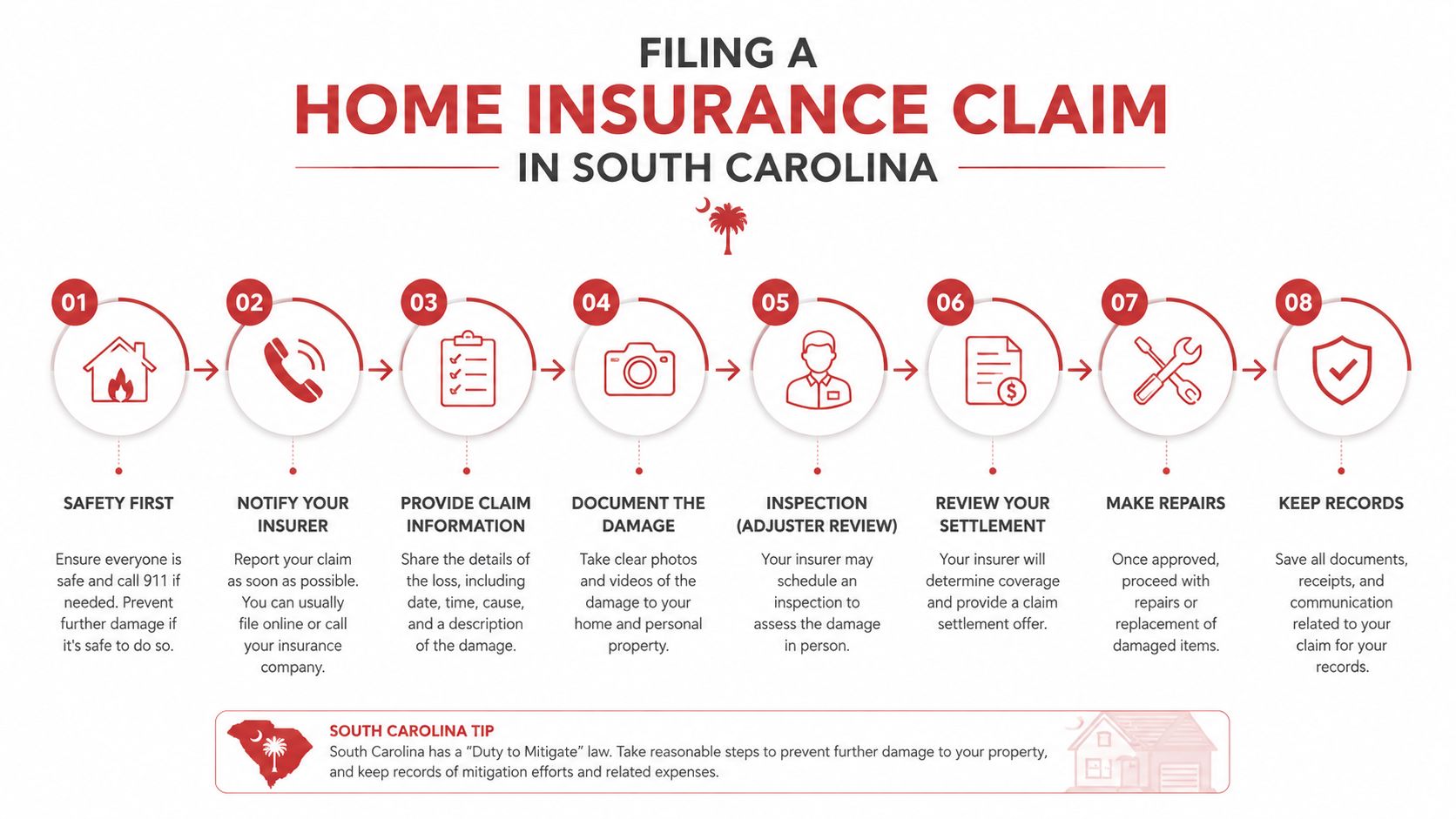
Document first, repair second. Emergency mitigation protects the building, but undocumented repairs can make the claim harder to prove.
Use a qualified mitigation or repair provider when immediate storm damage threatens the structure. SuperiorPRO storm damage help can be a useful starting point for urgent response, while your insurer remains responsible for evaluating coverage.
Don't sign a broad assignment or final release before you understand the estimate, deductible, exclusions, and any recoverable depreciation. The claim file should tell the story in dates, photographs, invoices, and written decisions.
Discounts and Savings You Can Stack on One Policy
The best discounts lower your premium while improving the home or giving the insurer better documentation. Ask for every available credit, but do not spend heavily on a feature solely to qualify for a discount. The protection benefit must justify the project.
Eligibility depends on the carrier, property, records, and filing rules. The figures below are guide ranges, not a promise that one policy will receive every credit.
| Discount | Typical savings | What you need to qualify |
|---|---|---|
| Auto and home bundle | 8% to 20% | Policies placed with the same licensed carrier |
| Impact-resistant roof | 5% to 12% | Qualifying UL 2218 Class 3 or Class 4 materials |
| Wind mitigation | Can compound with roof credits | A completed wind-mitigation inspection or certificate |
| Monitored alarm or sprinklers | 2% to 5% | Installed, active, and documented protective systems |
| Loyalty or tenure | Varies by carrier | Continuous policy history, often tied to renewal tenure |
| Paperless billing | Small administrative credit | Electronic documents and communications |
| Paid in full | Small administrative savings | Annual payment instead of escrow-spread payments |
A realistic stack can reach roughly 15% to 35% off the base quote when the carrier permits the credits to combine and the home satisfies each requirement. As noted earlier, The South Carolina Department of Insurance's 2025 coastal property report explains that newer-roof credits are tightening in 2025 filings. If your roof is under ten years old, ask about its eligibility before renewal.
Start with the largest savings. Compare bundling first. Then document roof and wind features, followed by protective systems and billing choices. On a coastal home, a wind-mitigation inspection can be more useful than chasing a small administrative credit because it documents features the underwriter can evaluate.
Keep the math practical. Do not replace a sound roof only for a discount. Compare the project cost, expected service life, storm protection, and effect on coverage before approving the work.
Ask for every credit in writing. The quote should state whether each discount applies to the entire policy or only one coverage component. It should also explain whether the carrier can remove the credit after an inspection or documentation review. Check the declarations page at renewal to confirm the savings remain in place.
Your Next Steps and How to Get Fast Local Quotes
Gather the facts before you ask for prices. A complete submission produces cleaner comparisons and reduces the chance that an insurer later changes the terms after inspection.
Prepare these seven items
- Property address: Include the exact location, unit details, and mailing address if different.
- Year built: Older construction often requires more underwriting detail.
- Square footage: Provide the finished living area and any attached structures separately.
- Roof age and material: Include installation records, permits, inspection reports, and photos.
- Major updates: List HVAC, electrical, plumbing, foundation, and other meaningful renovations.
- Current declarations page: This lets the agent match limits, endorsements, exclusions, and deductibles.
- Claim and flood history: Report prior losses accurately, including wind, water, and flood-related events.
Ask an independent South Carolina-licensed agency to compare multiple carriers rather than accepting a single renewal offer. Select Insurance Group, Inc. compares quotes from 20 to 40 carriers and serves homeowners across the Southeast, including South Carolina. You can also review its South Carolina home insurance options before starting the quote conversation.
Compare equivalent protection
For coastal property, request a separate wind and hail option through the state wind pool when the standard market won't provide acceptable terms. Request a separate flood quote as well, through the federal program or a private flood market, because homeowners coverage doesn't fill that gap automatically.
Place the quotes side by side and verify:
- Dwelling limits match. A lower limit isn't a cheaper equivalent.
- Deductible structures match. Compare flat-dollar and percentage deductibles by converting each to actual dollars.
- Wind treatment matches. Check whether wind is included, excluded, separately insured, or subject to a named-storm trigger.
- Roof settlement matches. Confirm replacement cost or actual cash value and read any roof schedule.
- Flood treatment is clear. Confirm whether flood is separate and what waiting-period rules apply.
- Endorsements match. Include code upgrades, water backup, equipment breakdown, and valuables when needed.
Get three quotes before renewing, and don't wait until the current policy is about to expire. A ten-minute call with your address, roof details, declarations page, and deductible target can expose gaps that a headline premium hides.
Select Insurance Group, Inc. can compare South Carolina home insurance options across multiple carriers, review wind, roof, deductible, and flood issues, and provide a no-obligation quote through licensed agents. Visit Select Insurance Group, Inc. this week with your declarations page and property details, then ask for three matched quotes before you renew.