
A restaurant owner in the Gulch can have the dining room ready for a busy weekend and still be unable to open because the landlord wants a certificate of insurance. A contractor in Germantown can submit a strong build-out bid and never reach the shortlist because the general contractor requires liability coverage first. A Broadway venue can lose a booking when the promoter asks to be named as an additional insured and the policy can't support the contract.
That's the Nashville insurance reality. Tennessee generally doesn't require most businesses to carry general liability insurance statewide, but leases, client agreements, venue riders, and construction contracts often make proof of coverage a condition of doing business. The policy isn't merely a compliance document. It's the financial boundary between an ordinary operating mistake and a claim that threatens the company.
Table of Contents
- Why Nashville Businesses Reach for General Liability First
- What General Liability Actually Covers
- Reading Policy Limits the Right Way
- What Drives the Price in Nashville
- Exclusions Most Nashville Buyers Miss
- Real Nashville Claims Scenarios
- How to Compare Quotes Without Getting Burned
- A Practical Close for Nashville Owners
Why Nashville Businesses Reach for General Liability First
Nashville has a dense small-business economy. Tennessee's 2023 small-business profile counted 664,681 small businesses, representing 99.5% of all businesses, employing 1.2 million people and 41.9% of the state's workers. Those figures come from the state profile summarized by Tennessee commercial insurance guidance for Nashville businesses. Nashville businesses operate inside that broader commercial base, from restaurants and retailers to contractors, venues, and professional firms.
The first step is to separate legal requirements from commercial requirements. Tennessee generally doesn't impose a statewide general liability mandate on most businesses. Your landlord, client, venue operator, or general contractor may still require a certificate before handing over keys, approving a vendor, or allowing work to begin.
The contract usually decides
A lease may specify liability limits, an additional-insured endorsement, and a certificate deadline. A construction agreement may require coverage for ongoing and completed operations. A venue contract can demand that several parties receive protection under your policy, not just a certificate showing that the policy exists.
That's why a business owner should review the insurance paragraph before signing the agreement. If the policy is purchased first and the contract is read later, the business may discover that the required limit, location, operation, or additional-insured wording doesn't match.
Practical rule: If another party can stop your lease, project, event, or vendor relationship by asking for proof of insurance, treat general liability as operationally necessary.
For contractors who want a plain-language explanation of the underlying coverage, this contractor liability insurance explained guide is a useful reference. Nashville owners can also review broader commercial options through Nashville commercial insurance resources, especially when general liability needs to be coordinated with property, workers' compensation, or commercial auto coverage.
The practical sequence is simple:
- Read the contract first. Identify limits, additional-insured wording, waiver requirements, and certificate instructions.
- Describe the actual operation. Tell the agent where the work occurs, who visits, what equipment is used, and whether subcontractors are involved.
- Bind matching coverage. A certificate cannot repair a policy that excludes the work or carries insufficient limits.
- Confirm acceptance. Send the certificate and endorsements to the landlord, client, promoter, or general contractor before the deadline.
What General Liability Actually Covers
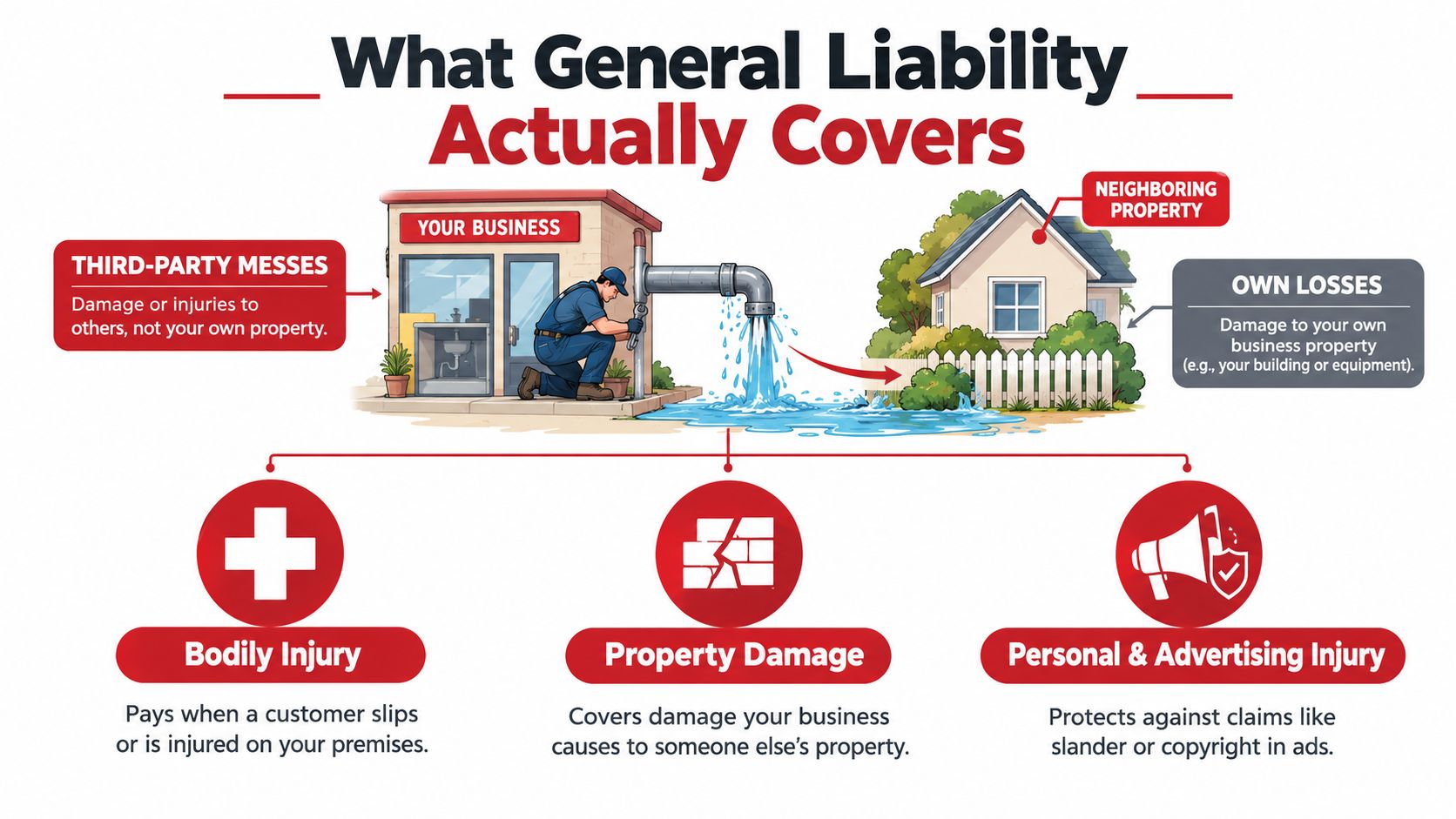
Think of general liability as the plumbing behind your business's third-party messes. If your operation causes bodily injury, property damage, or certain personal and advertising injuries to someone else, the policy may respond with defense and indemnity, subject to the form, limits, deductible, and exclusions. It generally doesn't pay for your own damaged inventory, your own professional mistake, or an employee's workplace injury.
Three coverage triggers
Bodily injury involves physical harm to another person connected to your premises or operations. A customer trips over a loose floorboard at a Midtown cafe, suffers an injury, and files a lawsuit. The policy can address covered defense costs and damages, up to the applicable limit.
Property damage involves damage to someone else's tangible property. A contractor's crew breaks a custom glass storefront while working on 12th Avenue. The key questions become whether the damage arose from covered operations, whether the damaged work falls under an exclusion, and what the contract requires.
Personal and advertising injury covers a different kind of allegation. A retailer is sued after a competitor claims a social media post defamed the company. No one needs to suffer physical harm for this coverage section to matter, but the wording and exclusions control the response.
Coverage beyond the headline
Buyers often focus on bodily injury and property damage while overlooking several supporting features:
- Medical payments may address certain minor third-party injuries without requiring the claimant to establish negligence.
- Products and completed operations can apply after a product is sold or work is finished, subject to the policy terms.
- Damage to premises rented may help with qualifying damage to a space the business rents, but it isn't a substitute for commercial property insurance.
- Defense costs can be significant even when the claim eventually fails, so confirm how the policy treats those costs in relation to the limit.
General liability is broad, but it isn't universal. A restaurant's spoiled stock, a contractor's defective professional advice, an employee's injury, and a company vehicle accident may require other coverage. The right question isn't “Does this policy cover my business?” It's “Which third-party risks does this policy cover, and which exposures remain outside it?”
Reading Policy Limits the Right Way
Most Nashville small businesses start by reviewing a $1 million per-occurrence limit and a $2 million aggregate limit, a structure commonly marketed for general liability in Nashville and Tennessee. The local benchmark and the distinction between those limits are outlined in Nashville commercial insurance market guidance.
The per-occurrence limit is the most the insurer may pay for one covered occurrence, subject to the policy's terms. The aggregate limit is the most the insurer may pay for covered claims during the policy period across the applicable coverage sections. Several separate claims can consume the aggregate, and a severe claim can use a large portion of it at once.
Contract limits change the decision
The starting structure isn't automatically enough. A venue contract may ask for higher limits. A landlord may require a larger umbrella or excess layer. A public-sector project may impose its own insurance specifications, including additional insured status, completed-operations protection, and specific certificate language.
| Common Nashville general liability limit requirements | Typical limit asked | Why it matters |
|---|---|---|
| Small lease, local vendor agreement, or ordinary service contract | $1 million per occurrence, $2 million aggregate | Establishes a common baseline for third-party claims and contract compliance |
| Venue, promoter, or event agreement | Higher limits may be requested | Large crowds, contractual indemnity, and multiple additional insureds can increase the required protection |
| High-rise commercial lease | Higher limits may be requested | Property owners often want more financial protection for shared buildings and public access |
| Municipal or institutional work | Contract-specific limits | The bid documents, insurance specifications, and indemnity terms control the requirement |
Don't choose a limit because the number looks familiar. Ask the agent to compare the contract with the declarations page and endorsements. For a broader explanation of how policy limits work in another jurisdiction, the Colorado injury insurance limits guide offers useful general context, although your Nashville contract and Tennessee policy form remain controlling.
Higher limits are often less expensive than business owners expect when added to a properly structured base policy. The bigger mistake is buying the lowest limit that gets a certificate accepted without considering the business's foot traffic, work locations, products, completed operations, and contract obligations.
What Drives the Price in Nashville
Nashville general liability pricing starts with classification, not with a generic citywide rate. Carriers look at the industry class code, annual revenue, employee headcount, payroll, locations, operations, subcontracting, claims history, and requested limits. A retail shop with limited customer interaction presents a different underwriting problem from a bar, restaurant, contractor, or live-event venue.
Published Tennessee benchmarks show why business size matters. One dataset reports an average of $112 per month, approximately $1,346 annually, for businesses with 1 to 4 employees at $1 million/$2 million limits, while monthly premiums rise to $2,030 for firms with 20 to 49 employees. The figures are reported in Tennessee general liability cost data. A separate Nashville pricing dataset places a typical small-business cost around $42 per month, while broader Tennessee estimates cluster near the higher small-business benchmark. The spread is a reminder that class, size, and exposure matter more than a single advertised average.
The rating factors that deserve attention
Headcount affects exposure. More employees can mean more customer contact, more work locations, and greater operational volume. Underwriters price that added opportunity for third-party injury or property damage into the rate and eligibility requirements.
Classification can outweigh revenue. A low-revenue contractor performing hazardous work may pay more than a larger low-hazard retailer. Misclassifying the operation to obtain a lower quote creates a coverage problem, not a savings strategy.
Claims history changes the conversation. Carriers examine prior losses, open claims, corrective action, and whether the business has changed its procedures. Explain the facts accurately and document what changed.
Contract requirements affect the structure. Additional insureds, completed operations, higher limits, and special endorsements can move the quote beyond a basic policy.
| Industry or class | Risk tier | Estimated annual premium range |
|---|---|---|
| Low-hazard retail or office operation | Lower | Qualitative pricing depends on class, size, limits, and history |
| Restaurant or bar | Moderate to higher | Often priced above low-hazard retail because of public traffic and premises exposure |
| Contractor or trade business | Moderate to higher | Depends heavily on work type, subcontractors, locations, and completed operations |
| Venue or event-facing operation | Higher complexity | Contract requirements, crowd exposure, and exclusions can drive the structure |
Don't rely on an unsupported "cheap Nashville rate." Ask for the same limits, deductible, classification, endorsements, and exclusions from every carrier. A lower premium is useful only when it protects the operation you run.
Exclusions Most Nashville Buyers Miss
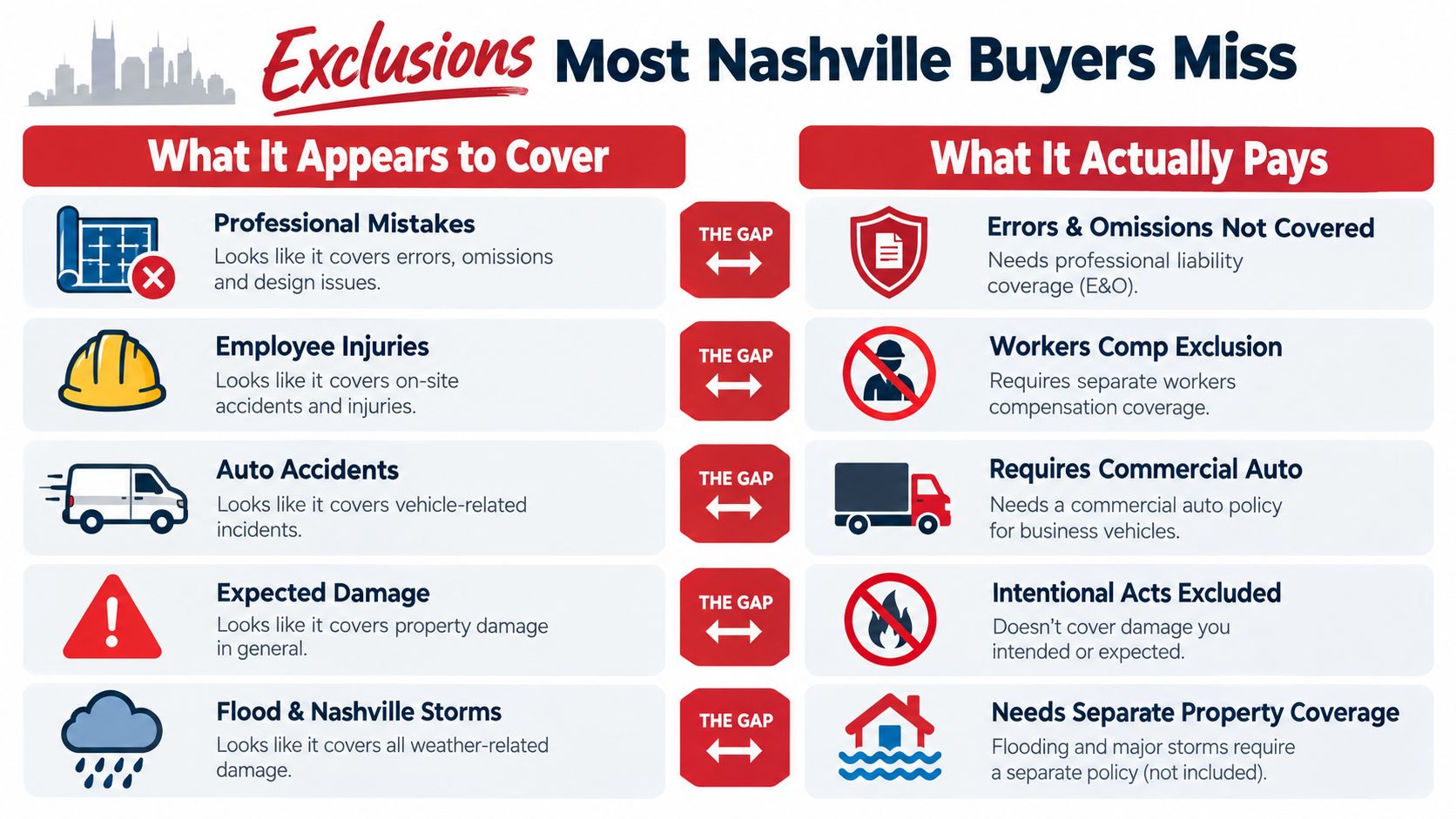
The coverage page tells you what the policy can cover. The exclusions page tells you where the insurer draws the line. Nashville buyers who read only the certificate and declarations page often miss the most consequential gaps.
Professional liability is the classic example. General liability may respond to bodily injury or property damage arising from operations, but it generally isn't designed to cover financial loss caused by professional advice, design, consulting, or an error in specialized services. Workers' compensation addresses employee injuries, and commercial auto addresses vehicle-related exposures. Neither belongs inside a basic general liability assumption.
Emerging exclusions require direct questions
Market reporting for the projected 2026 liability environment describes more stable pricing for many lower-hazard accounts, while underwriters remain cautious about litigation severity, nuclear verdicts, excess liability capacity, and exclusions involving PFAS, biometric data, assault and battery, and human trafficking. The 2026 business insurance trends report explains why buyers need to ask about wording, not just premium.
- PFAS and chemical exposure: Contractors, manufacturers, maintenance firms, and businesses handling treated materials should ask whether pollution or chemical exclusions remove the relevant exposure.
- Biometric data: A business using fingerprint or facial scanning may face privacy-related allegations that a standard liability form doesn't address.
- Assault and battery: This exclusion deserves special attention for Broadway honky-tonks, bars, security-heavy venues, and crowded events.
- Human trafficking: Hospitality contracts and venue relationships may include specific risk-transfer requirements that a standard policy doesn't satisfy.
- Pollution: East Nashville contractors and auto-adjacent operations should distinguish ordinary property damage from pollution claims and ask whether a separate policy or endorsement is needed.
A lawn-care company should also examine whether its work creates chemical, completed-operations, or auto-related gaps. The lawn care liability insurance resource provides context for that kind of operation.
Read the exclusions endorsement before you read the marketing summary. The endorsement can change the answer.
Don't assume an exclusion applies identically across carriers. Ask whether the carrier offers an endorsement, whether the endorsement restores coverage narrowly or broadly, and whether the contract requires wording the carrier won't provide.
Real Nashville Claims Scenarios
A Broadway venue closes after a tourist trips over an unmarked threshold on a wet evening. The visitor alleges bodily injury and files a lawsuit. The venue's general liability policy may provide defense and respond to covered damages, subject to the per-occurrence limit, applicable conditions, and the policy's treatment of medical payments.
The venue's operational lesson is basic but often ignored: document inspections, correct floor hazards quickly, preserve incident records, and report the claim promptly. Medical payments coverage may help with certain minor injuries, but it doesn't replace sound premises controls or a serious liability limit review.
A renovation damages the neighboring shop
A Germantown contractor is renovating a commercial space. During the work, a subcontractor's crew breaks a water main, and water damages a neighboring retail area. The contractor's policy must be examined for property damage coverage, subcontractor conditions, ongoing operations, contractual obligations, and any deductible that applies.
The contract can determine whether the contractor must indemnify the property owner, name additional insureds, or carry completed-operations protection. A certificate alone doesn't answer those questions. The owner needs the policy and endorsements reviewed against the agreement before work starts.
A slogan creates an advertising dispute
A local retailer launches a social media campaign. A competitor alleges that the slogan defames its business or violates a protected advertising interest. No physical property is damaged, and no customer is injured, but the retailer may still face defense costs and a demand for damages under the personal and advertising injury section, if the allegation fits the policy wording.
The lesson is to preserve the campaign materials, approval records, and communications. Don't delete posts after receiving a demand, and don't admit liability before the insurer reviews the claim. General liability can address nonphysical allegations, but the exact offense, exclusion, and timing matter.
These scenarios are representative, not promises of coverage. The policy form, endorsements, facts, and notice determine the outcome.
How to Compare Quotes Without Getting Burned
Start with an independent agency licensed in Tennessee. A single-carrier quote can be useful, but it gives you no reliable way to tell whether the classification, exclusions, limits, or endorsements are competitive. An independent process lets you compare the same risk description across multiple markets.
Gather the underwriting file before requesting proposals:
- Loss information: Provide prior loss runs and explain open or unusual claims.
- Current policy details: Include the declarations page, endorsements, limits, and renewal terms.
- Operating figures: Prepare gross receipts, payroll, employee count, and square footage.
- Contract documents: Include leases, sub-tenant agreements, subcontractor agreements, venue riders, and general-contractor requirements.
- Operational details: Explain where work occurs, what equipment is used, whether alcohol is involved, and how subcontractors are managed.
Questions that expose a placeholder quote
Ask which commercial general liability form is being quoted and whether the exclusions endorsement is the carrier's current version. Ask how equipment breakdown and liquor liability are handled, whether they are excluded, separately quoted, or addressed through endorsements.
Then ask about certificates. Can the agency issue certificates promptly? Can it provide additional-insured endorsements when required? Will the landlord, promoter, client, or general contractor accept the certificate and supporting forms?
Force every proposal into the same comparison fields:
- Each coverage limit and aggregate.
- Deductible or self-insured retention.
- Classification and operations description.
- Products and completed operations treatment.
- Additional-insured and waiver wording.
- Assault and battery, pollution, PFAS, biometric, and other relevant exclusions.
- Liquor, auto, professional, property, and workers' compensation gaps.
- Carrier status, claims process, and certificate handling.
Select Insurance Group, Inc. offers Tennessee business owners general liability and related commercial coverage options, with quote comparisons across multiple carriers. Its commercial quote comparison service can be one option for owners who want a broader market review.
A Practical Close for Nashville Owners
Nashville owners don't need a complicated insurance ritual. They need a repeatable review that matches the policy to the lease, contract, premises, employees, vehicles, products, and completed work.
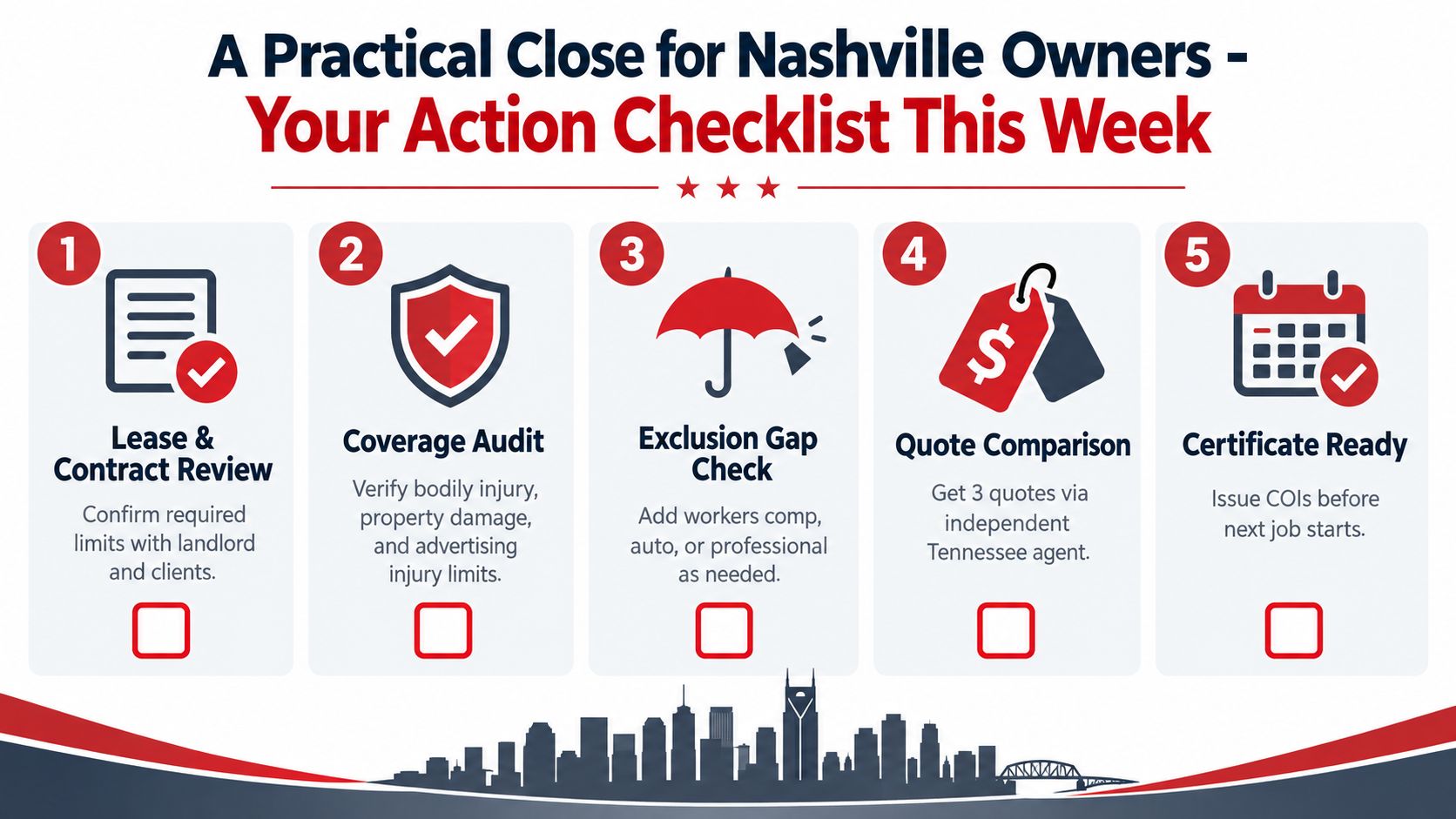
Use this checklist this week:
- Review every agreement: Mark the required limits, additional-insured language, waiver provisions, completed-operations requirements, and certificate instructions.
- Confirm the baseline: Review whether a $1 million per-occurrence and $2 million aggregate structure fits the business and the contract.
- Audit the exclusions: Ask about professional liability, workers' compensation, commercial auto, liquor liability, pollution, PFAS, biometric data, assault and battery, and human trafficking.
- Compare equivalent quotes: Require identical limits, deductibles, classifications, endorsements, and exclusion disclosures.
- Prepare certificates: Confirm who needs the certificate, what wording is required, and how quickly the agency can issue it before the next lease, job, or event.
The mistake I see most often is signing the cheapest quote that satisfies the landlord's certificate line, then discovering that the exclusions endorsement removes a critical exposure or that the carrier and contract requirements don't align. Price matters, but a cheap policy that cannot respond to the actual operation is an expensive document.
Tennessee may not require general liability for most businesses by statute, but Nashville contracts often require it in practice. Review the agreement, match the limits, close the exclusions, and have the certificate ready before someone else controls whether your business can open or start work.
Select Insurance Group, Inc. helps Nashville business owners compare general liability with related commercial coverage, including property, workers' compensation, and commercial auto options. Visit Select Insurance Group, Inc. to request a Tennessee-focused quote review and discuss the limits, certificates, and exclusions your next contract requires.