
For a motorized RV in Tennessee, the legal liability minimum is $25,000 for bodily injury per person, $50,000 per accident, and $25,000 for property damage. Progressive's 2024 Tennessee averages were $1,110.53 annually for a motorhome and $742.80 for a travel trailer, giving Memphis owners a useful starting point before coverage choices and storage conditions change the quote.
You're probably looking at an RV sitting in a driveway, a trailer waiting for its next trip, or a motorhome you plan to take through Memphis traffic this weekend. The policy may look simple until a collision, hailstorm, theft, or storage problem exposes the difference between legal compliance and useful protection.
Memphis Recreational Vehicle Insurance has two parts that national buying guides often separate. Tennessee's motor-vehicle-style rules determine the baseline for self-propelled RVs, while Memphis parking and storage rules can affect where the unit may legally sit. The cheapest premium can become an expensive choice if it leaves your RV, belongings, or storage arrangement exposed.
Table of Contents
- Why Memphis RV Owners Need Coverage That Goes Beyond the Minimum
- Coverage Types Every Memphis RV Policy Should Include
- Full-Time, Seasonal, and Lender-Required Coverage
- What RV Insurance Actually Costs in Memphis and Tennessee
- The Memphis Storage and Parking Rule Most Guides Skip
- Exclusions and Claim Pitfalls to Watch For
- Getting a Quote From Select Insurance Group
Why Memphis RV Owners Need Coverage That Goes Beyond the Minimum
It's Friday afternoon. You're leaving a Shelby Farms trailhead lot in a Class C motorhome, traffic is tightening on Poplar, and a sudden lane change puts a sedan beside your passenger-side mirror. The mirror clips the car. Nobody is seriously hurt, but the sedan needs substantial repairs and your motorhome has damage along the side.
That's where Tennessee's minimum liability framework matters. A motorized RV, including a Class A, B, or C motorhome, is treated as a motor vehicle and must satisfy the state's financial responsibility law before it's driven or registered. The minimums are $25,000 for bodily injury to one person, $50,000 for bodily injury in one accident, and $25,000 for property damage in one accident, as documented in this Tennessee RV insurance requirements guide.
Those limits establish legal compliance, not financial security. A single damaged vehicle, especially a newer SUV or a vehicle declared a total loss, can consume the property-damage limit quickly. Once the policy limit is exhausted, the remaining liability can become your responsibility.
The legal floor is not a claim strategy
Tennessee treats motorized and towable RVs differently. A travel trailer or fifth wheel generally isn't required to carry separate liability insurance under state law, while the tow vehicle's liability policy generally provides the primary road-use protection when the trailer is hitched. That doesn't automatically protect the trailer against theft, hail, fire, or collision damage.
Progressive reported 2024 average annual Tennessee premiums of $1,110.53 for a motorhome and $742.80 for a travel trailer, figures published in the same Tennessee RV insurance reference. Treat those as a statewide benchmark, not a Memphis quote. Your price will depend on the RV, its value, the driver, usage, garaging location, deductibles, and selected endorsements.
Practical rule: Buy liability limits for the damage you could realistically cause, not merely the limits that let you register the RV.
What should sit above the minimum
A sensible Memphis policy usually adds physical-damage coverage, uninsured motorist protection, roadside assistance, and coverage for belongings inside the unit. Owners who live in an RV need a different policy structure from weekend campers, and owners with loans must satisfy the lender's requirements even when state law doesn't require the same protection.
The right question isn't, “What's the cheapest RV policy?” Ask, “Which losses would I be unable to absorb?” That answer should guide the limits, deductibles, settlement method, and storage coverage you select.
Coverage Types Every Memphis RV Policy Should Include
A real RV policy is a stack of protections, not a single liability line. Start with the risks created by driving, then add the protections that apply while the RV is parked, occupied, stored, or carrying your property.
Liability and uninsured motorist protection
Liability coverage pays for covered injuries or property damage you cause to other people. For a motorhome, it follows the unit as a vehicle on public roads. For a towable RV, confirm how the tow vehicle and trailer interact, because the liability protection for driving the combination isn't the same as physical-damage coverage for the trailer.
Uninsured and underinsured motorist coverage helps when another driver causes an accident but lacks enough insurance to pay for your injuries or damage. Memphis traffic includes plenty of vehicles moving through busy corridors, so this protection deserves more attention than a bare state minimum.
Collision and comprehensive coverage
Collision coverage addresses damage from impact with another vehicle, a fixed object, or another covered collision event. It's the part you'll look to after a lane-change accident, backing mishap, or campground collision.
Full coverage handles non-collision losses such as theft, fire, hail, falling objects, vandalism, and certain animal strikes. It matters when the RV is parked during severe weather, stored for long periods, or traveling through rural Shelby County and nearby roads where animal encounters are possible.
Medical payments and personal effects
Medical payments coverage can help with covered medical expenses for occupants after an accident, subject to the policy terms. It can provide useful first-response protection while other insurance questions are sorted out.
Personal effects coverage protects property kept inside the RV. Think camping equipment, clothing, electronics, generators, golf clubs, and outdoor cooking gear. Don't assume a homeowners policy will automatically cover everything in a motorhome or trailer. Ask about the limit, deductible, valuation method, and exclusions.
Roadside assistance
A disabled motorhome creates a different towing problem from a disabled sedan. Roadside and tow coverage should match the RV's size, weight, and realistic travel routes. Confirm whether the benefit covers the motorhome itself, the tow vehicle, the trailer, labor, tire service, battery service, and the distance to a suitable repair facility.
Coverage check: A roadside benefit that looks adequate on paper may be impractical if it can't move your RV to a facility equipped to handle it.
Match each coverage to a Memphis scenario. A crash calls for liability and collision. A hailstorm calls for full coverage. A stolen generator calls for personal effects or accessory coverage. A breakdown between exits calls for roadside assistance. A collision with a driver who can't pay calls for uninsured or underinsured motorist protection.
Full-Time, Seasonal, and Lender-Required Coverage
Your use pattern determines the policy form. A motorhome used for occasional trips isn't exposed in the same way as an RV that functions as your residence, and a trailer sitting in seasonal storage has different needs from one used every week.
Part-time recreational use
A part-time policy treats the RV primarily as a vehicle used for recreation. It can be appropriate when you maintain another primary residence, use the RV for trips, and don't depend on it as your household's permanent home.
That policy still needs protection for the unit, its contents, and roadside events. Be accurate about usage. If the RV becomes your residence, keeping a recreational classification just to reduce the premium can create a serious coverage dispute after a claim.
Seasonal storage and full-time living
Seasonal owners should ask how storage affects the policy. Some carriers offer lay-up treatment or reduced exposure during periods when the RV isn't being used, but you shouldn't suspend protections that still matter while the unit is parked. Theft, fire, hail, vandalism, and other storage losses can happen without the RV moving.
Full-time residents need a policy designed for residential use. That generally means stronger personal liability, higher personal-effects protection, loss-of-use or emergency-expense features, and coverage that recognizes the RV as a primary home rather than a recreational vehicle used occasionally.
A Tennessee RV insurance overview can help you organize the questions around motorhomes, travel trailers, and full-time use before requesting quotes.
Financing changes the answer
A lender can require broader coverage than Tennessee law requires. If you finance a motorhome, travel trailer, or fifth wheel, expect the lender to require collision and other than collision coverage until the loan is satisfied. The lender may also require the lender's interest to appear correctly on the policy.
Ask about gap protection when the financed balance may exceed the RV's market value. Also confirm whether the policy settles a total loss using actual cash value or an agreed-value method. Those settlement choices can affect how much money is available after a serious loss.
What RV Insurance Actually Costs in Memphis and Tennessee
Tennessee pricing spans a wide band. One 2026 market guide places typical annual RV insurance costs in Tennessee between $600 and $2,500, while another Tennessee source cites starting coverage at about $125 per year for some RVs. Those figures aren't contradictory. They reflect different RV types, values, drivers, usage patterns, and coverage selections, as summarized in this Tennessee RV insurance cost guide.
A useful pricing reference
| RV Type | Low, TN Average | Typical Range | Memphis-Skewed High |
|---|---|---|---|
| Motorhome | $1,110.53 annual average | $600 to $2,500 typical Tennessee band | Varies by unit, value, storage, and use |
| Travel trailer | $742.80 annual average | $600 to $2,500 typical Tennessee band | Varies by unit, value, storage, and use |
| Class B campervan | Varies by carrier and unit | Quote-specific | Varies by unit, value, storage, and use |
| Fifth wheel | Varies by carrier and unit | Quote-specific | Varies by unit, value, storage, and use |
The motorhome and travel-trailer averages come from Progressive's reported 2024 Tennessee averages, while the broader band comes from the cited Tennessee market guide. Don't treat the “low” column as a guaranteed minimum. It's a reference point, not a promise.
What moves a Memphis quote
The RV class is an obvious driver. A self-propelled Class A, B, or C brings auto liability exposure, while a towable unit has a different liability arrangement. The unit's insured value, age, equipment, construction, and replacement cost also affect physical-damage pricing.
Your driving record, license requirements, annual mileage, and use pattern matter next. Weekend recreation, extended travel, seasonal storage, and full-time occupancy tell the carrier different risk stories.
Garaging is especially important. A secured storage facility, a private driveway, and an unapproved street location create different theft, weather, and compliance concerns. Memphis owners should disclose the actual garaging address rather than using a more favorable location.
Advisor's view: Compare policies at identical liability limits, deductibles, settlement terms, and endorsements. A cheaper quote with thinner coverage isn't a cheaper version of the same policy.
For a broader review of policy-selection considerations, see RV insurance company guidance. Ask about bundling, paid-in-full options, storage credits, and safety-related discounts, but never trade away a needed endorsement for a small premium reduction.
The Memphis Storage and Parking Rule Most Guides Skip
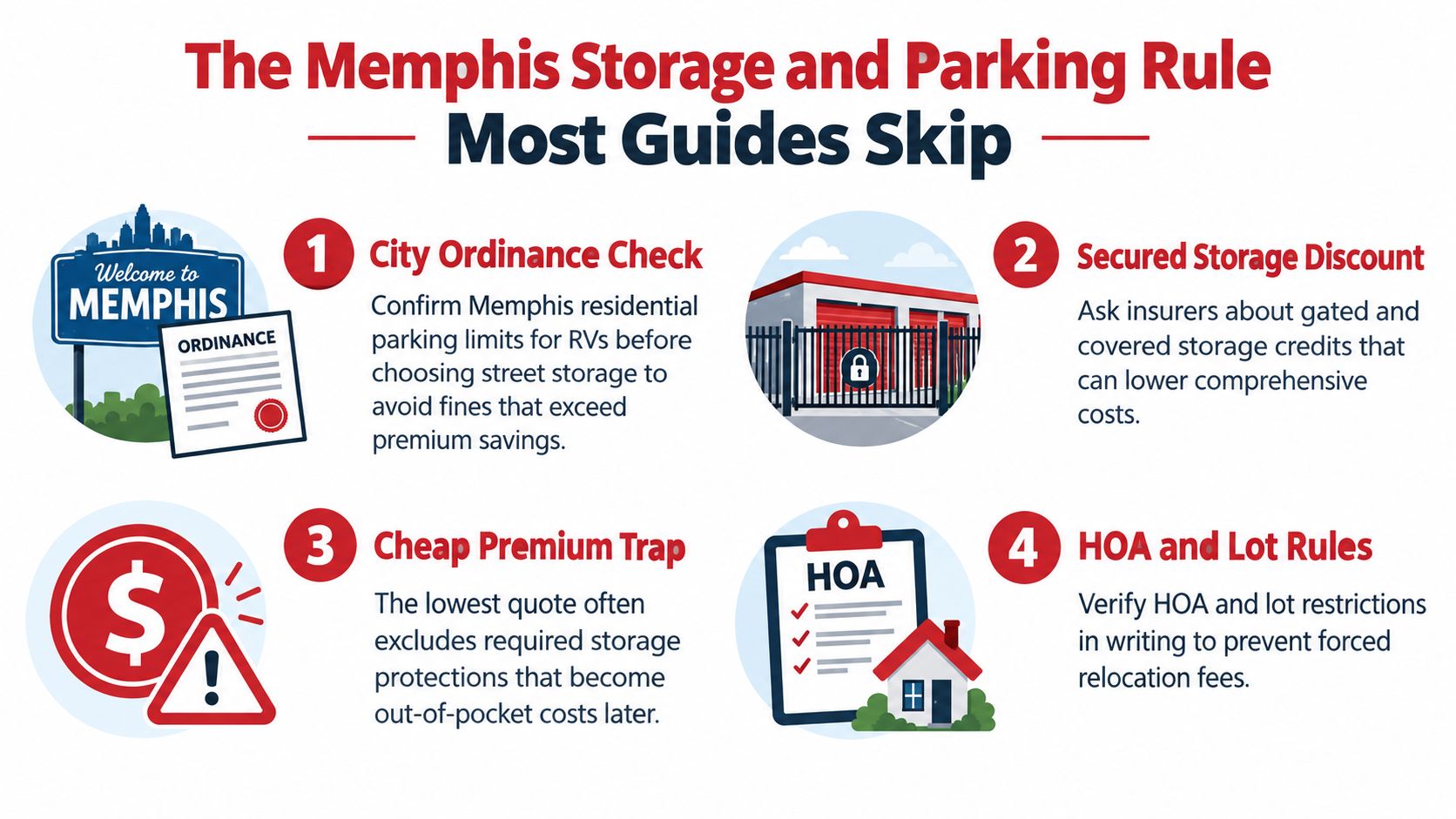
The cheapest premium may not be your biggest savings opportunity. Memphis RV owners also need to determine whether the RV can legally remain where they plan to park or store it.
Memphis ordinances prohibit parking or storing boats, campers, trailers, and other recreational equipment on public streets in residential districts. The city also limits residential-street parking to 24 consecutive hours, according to the Memphis ordinance material. Those rules make street storage a poor long-term plan, even if the policy itself is valid.
Storage affects both compliance and coverage
If you can't keep the RV on the street, you may need a private driveway, an approved storage lot, or another lawful location. HOA covenants can impose additional restrictions, and those rules may be stricter than city requirements. Check the governing documents for your exact property instead of relying on what a neighbor does.
Storage also changes the insurance conversation. Tell the carrier where the RV is kept, whether the facility is gated, whether access is controlled, and whether the unit is covered or exposed to weather. A secure storage arrangement may support better underwriting, while an open or uncertain location can leave theft and weather risks harder to manage.
The cheap-policy trap
A liability-only policy may look attractive for a paid-off trailer or older motorhome. But it won't solve a storage violation, repair a stolen unit, replace storm-damaged equipment, or protect belongings inside the RV. Municipal citations, relocation expenses, HOA enforcement, and uninsured physical damage can outweigh the premium savings.
Keep the storage agreement, parking approval, and HOA response in your records. Ask the agent to document that the proposed policy accepts the Memphis or Shelby County garaging arrangement. The strongest setup is lawful storage paired with coverage that reflects the actual exposure.
Exclusions and Claim Pitfalls to Watch For
Most RV claim disputes begin with a mismatch between what the owner thought was covered and what the policy says. Read the exclusions before binding, not after a storm or breakdown.
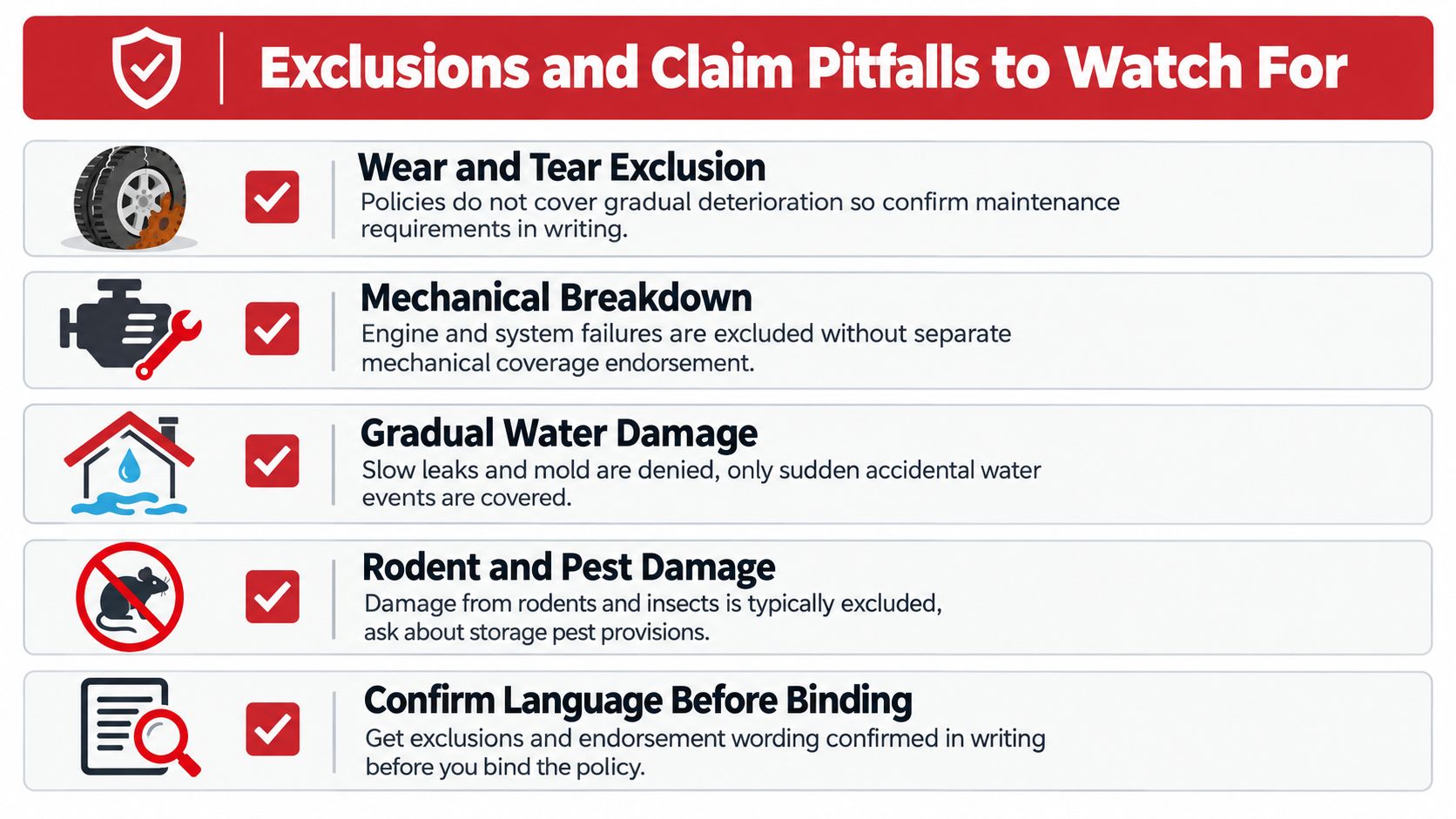
Wear and tear, mechanical breakdown, and gradual deterioration are common exclusions. Insurance is designed for covered, unexpected events, not routine maintenance, aging seals, failing appliances, rust, or systems that stop working because they reached the end of their useful life.
Risks created by how you use the RV
Long storage can invite rodent and pest damage, especially when the RV sits at a rural Shelby County property. Ask whether the policy excludes chewing, nesting, contamination, and infestation damage, and take reasonable maintenance steps such as inspections and sealing entry points.
Off-road use is another common problem. A policy written for public-road recreational use may not cover damage at a trail, river sandbar, undeveloped access road, or other location outside the permitted use. Confirm whether the carrier excludes off-road operation or provides a specific endorsement.
Peer-to-peer rental or paid transportation creates a separate issue. If you rent the RV through a platform or use it to transport people or property for payment, standard recreational coverage may not respond. Disclose the activity before accepting a booking.
Living in a vehicle written for recreation
An RV that functions as a residence needs the correct full-time endorsement. If you live in it while the policy describes occasional recreational use, a claim involving personal liability, belongings, or loss of use may become difficult. Your agent should confirm the classification in writing.
Also ask about water damage, sewer-line problems, appliance failures, and freezing conditions. A sudden covered event may be treated differently from a slow leak, neglected maintenance, or gradual deterioration. Winter travel requires a clear understanding of what happens to plumbing, tanks, pipes, and water heaters.
Before binding, request written answers to these questions:
- Full-time status: Does the policy include the required full-time endorsement if the RV is your residence?
- Valuables: Do laptops, firearms, camera equipment, and other high-value items need a scheduled personal-property rider?
- Towing: What mileage limit and destination rules apply to roadside assistance?
- Travel territory: Does the policy provide the coverage you need for international travel, including a trip to Mexico or the Yucatan?
Getting a Quote From Select Insurance Group
A useful quote starts with complete information. Gather the RV's year, make, model, VIN, current garaging ZIP, primary use, estimated mileage, and current declarations page. If the RV is financed, include the lienholder information so the policy can be issued correctly.
Submit those details through the RV insurance quote request or speak with an advisor. Select Insurance Group, Inc. can review recreational vehicle options for motorhomes, travel trailers, fifth wheels, and related recreational units, with attention to liability, collision, personal belongings, accessory coverage, and roadside assistance.
Questions to ask during the quote
Don't accept a single premium number without reviewing the policy design. Ask the advisor to show the liability limits, deductibles, total-loss settlement method, personal-effects limit, roadside terms, and any full-time or seasonal-use endorsement.
Also request confirmation that the policy accepts your Memphis-area garage ZIP and any self-storage facility you use in Shelby County. Ask about:
- Multi-policy discounts: Whether combining eligible household policies changes the premium.
- Paid-in-full options: Whether paying the premium in one payment changes the cost.
- RV club discounts: Whether membership qualifies for a carrier credit.
- Storage discounts: Whether gated, covered, or seasonal storage changes the rating.
- Lienholder wording: Whether the lender is listed exactly as required.
Plan for the application process to take about two business days, based on the provided agency process details. Binding generally requires a signed application, premium payment, and proof of lienholder information when the RV is financed.
Keep your declarations page, insurance ID cards, emergency roadside card, and storage agreement together. Add photos, receipts, maintenance records, and the HOA or parking approval that supports your declared garaging arrangement. Those documents make it easier to answer questions after a loss.
Select Insurance Group, Inc. offers Tennessee RV coverage guidance for Memphis motorhome, travel trailer, and fifth-wheel owners, including options for liability, physical damage, personal belongings, accessories, and roadside assistance. Visit Select Insurance Group, Inc. to request a quote and review coverage that fits your RV's use, financing, and storage location.